

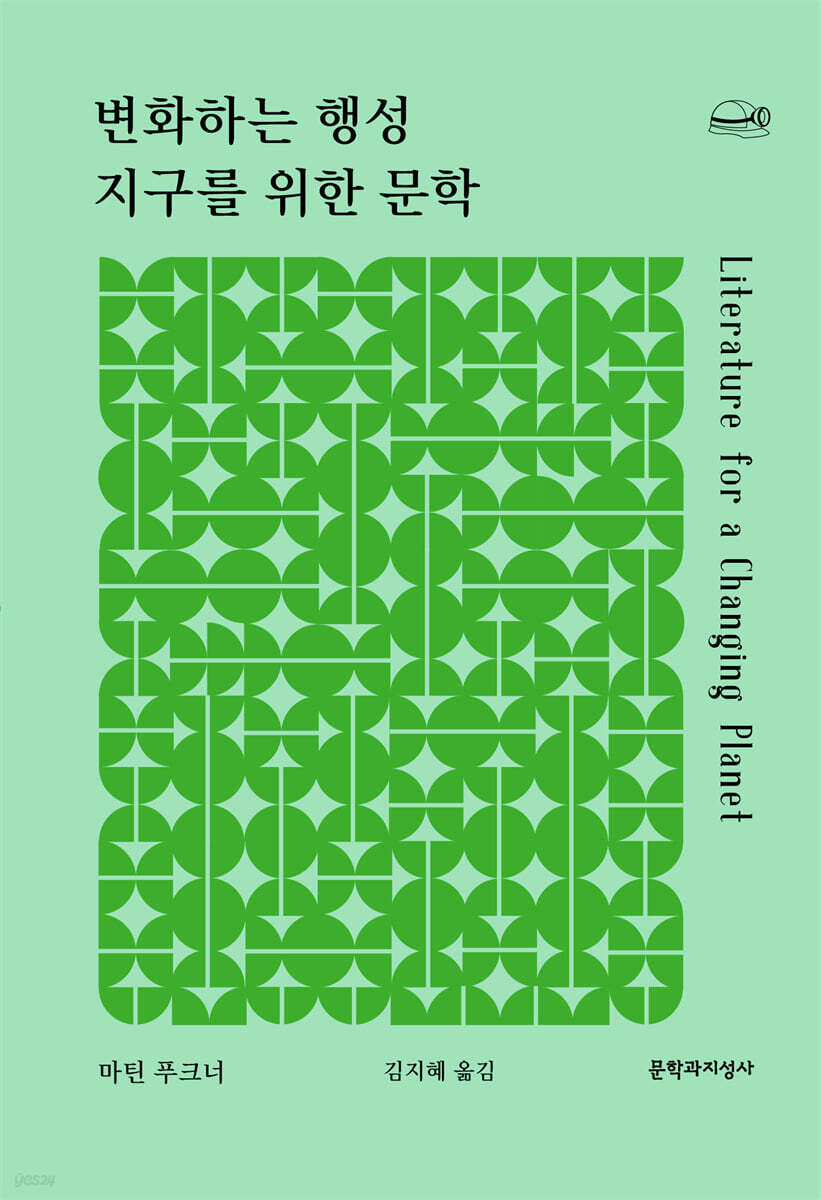
Literature for a Changing Planet Earth
 |
Description
Book Introduction
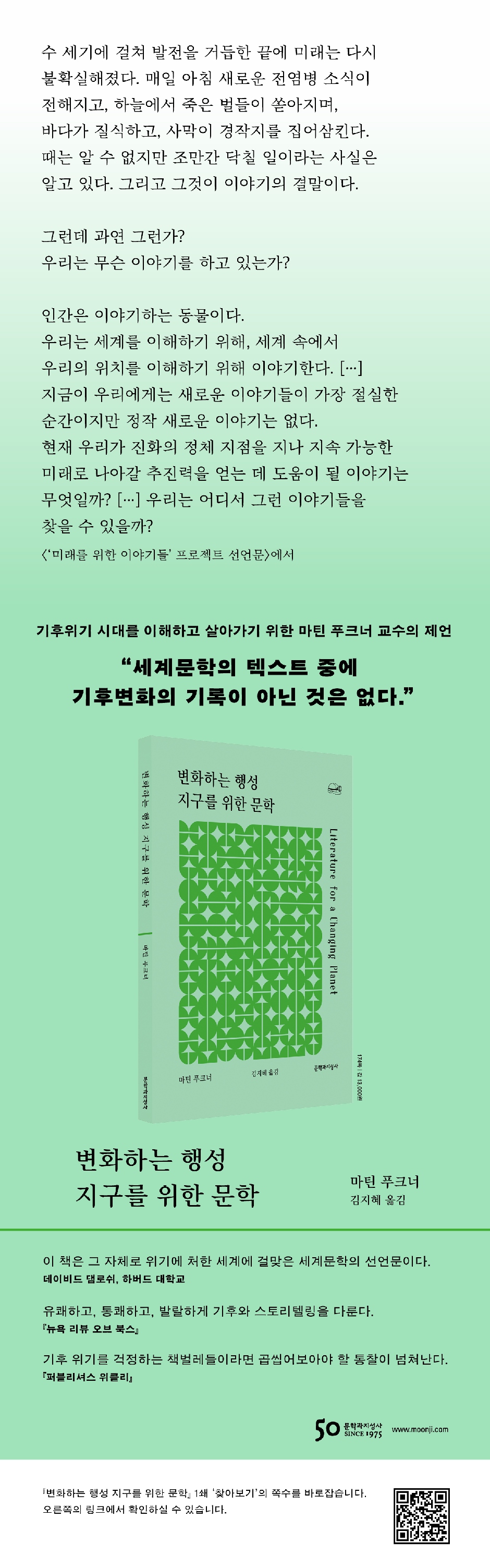
“Among the texts of world literature,
“There is no record of climate change that is not there.”
In this powerful, clear, and urgent study, Martin Puchner argues for the necessity of narrative, drawing on his masterful interpretations of the early epics.
It shows that we must share our stories to combat climate change.
World literature and the survival of planet Earth are closely intertwined.
This is a book we must read right now.
Laura Marcus, University of Oxford
Martin Puchner wrote an urgent and powerful appeal.
This book, which stands out for its outstanding insight and writing skills, is at once a declaration, a defense, and a history of world literature.
It boldly yet accessiblely weaves together vivid examples of ecocritical reading and practical methods for placing environmentalism at the center of literary studies.
Matthew Bell, King's College London
This book is the first to brilliantly unfold the history of world literature on the environment through the power of storytelling alone.
In the face of climate change, Martin Puchner argues that environmental reading can awaken and elevate humanity's collective sense of responsibility.
Whether you're an environmental scientist studying the Himalayas or a lover of world literature, this fascinating book is for you.
B. Venkat Mani, University of Wisconsin-Madison
This compelling and passionate essay argues that we must fundamentally reframe our relationship with the natural world to slow the accelerating climate crisis.
[…] We ask and think deeply about questions such as what it means to be human and what is our position in the natural world.
It is a bold and noteworthy work of literary criticism.
Forward Reviews
With extreme weather events like heat waves, heavy rain, and droughts becoming routine, climate disasters are no longer a distant future.
Planet Earth has entered its sixth mass extinction.
As the world gets hotter and the planet becomes more heated, what can and should we humans do in the face of this crisis? What if we were to recommend reading world literature as a response? Professor Martin Puchner (Harvard University, Department of English), a member of the editorial staff of the internationally bestselling "The Norton Collection of World Literature" and a former author who explored writing and human history in his works "Words of the World" and "Culture," explores the new possibilities of "story" as a means of combating climate change in his new book, "Literature for a Changing Planet."
As the title suggests, can ‘literature’ be ‘for’ the increasingly hot planet Earth?
“There is no record of climate change that is not there.”
In this powerful, clear, and urgent study, Martin Puchner argues for the necessity of narrative, drawing on his masterful interpretations of the early epics.
It shows that we must share our stories to combat climate change.
World literature and the survival of planet Earth are closely intertwined.
This is a book we must read right now.
Laura Marcus, University of Oxford
Martin Puchner wrote an urgent and powerful appeal.
This book, which stands out for its outstanding insight and writing skills, is at once a declaration, a defense, and a history of world literature.
It boldly yet accessiblely weaves together vivid examples of ecocritical reading and practical methods for placing environmentalism at the center of literary studies.
Matthew Bell, King's College London
This book is the first to brilliantly unfold the history of world literature on the environment through the power of storytelling alone.
In the face of climate change, Martin Puchner argues that environmental reading can awaken and elevate humanity's collective sense of responsibility.
Whether you're an environmental scientist studying the Himalayas or a lover of world literature, this fascinating book is for you.
B. Venkat Mani, University of Wisconsin-Madison
This compelling and passionate essay argues that we must fundamentally reframe our relationship with the natural world to slow the accelerating climate crisis.
[…] We ask and think deeply about questions such as what it means to be human and what is our position in the natural world.
It is a bold and noteworthy work of literary criticism.
Forward Reviews
With extreme weather events like heat waves, heavy rain, and droughts becoming routine, climate disasters are no longer a distant future.
Planet Earth has entered its sixth mass extinction.
As the world gets hotter and the planet becomes more heated, what can and should we humans do in the face of this crisis? What if we were to recommend reading world literature as a response? Professor Martin Puchner (Harvard University, Department of English), a member of the editorial staff of the internationally bestselling "The Norton Collection of World Literature" and a former author who explored writing and human history in his works "Words of the World" and "Culture," explores the new possibilities of "story" as a means of combating climate change in his new book, "Literature for a Changing Planet."
As the title suggests, can ‘literature’ be ‘for’ the increasingly hot planet Earth?
- You can preview some of the book's contents.
Preview
index
Introduction: Literature for a Changing Planet Earth
Chapter 1: Reading in a Heating World
Chapter 2: Revolutionary Changes in Accounting
Chapter 3: The Two Faces of World Literature
Chapter 4: How to Compile the World
Chapter 5: Stories for the Future
Acknowledgements
Source of the illustration
Translator's Note: A Transformation in Reading, Expanding Ecological Sensitivity
Search
Chapter 1: Reading in a Heating World
Chapter 2: Revolutionary Changes in Accounting
Chapter 3: The Two Faces of World Literature
Chapter 4: How to Compile the World
Chapter 5: Stories for the Future
Acknowledgements
Source of the illustration
Translator's Note: A Transformation in Reading, Expanding Ecological Sensitivity
Search
Detailed image
Into the book
It took 66 million years for the severely damaged ecosystem of planet Earth to return to balance.
All it took was time.
It took time for photosynthesis to restart, for random mutants to become better adapted to specific ecological niches, and for older species to migrate to other habitats.
Life re-emerged, but smaller than before, and the absence of large predators benefited bacteria and mammals.
The surviving dinosaurs took to the skies, occasionally hunting small mammals, a memory of their former superiority.
As time passed, the traces of the asteroid impact faded.
A crater 100 kilometers wide and 30 kilometers deep was also filled.
It was as if the impact of a wandering meteor had never happened before.
--- p.14~15
This story justifies the lines, or walls, drawn around humans.
The people who live in the forest are monsters and must be eliminated.
The forest is not a place for living.
It exists to cut down trees, bring them to the city, build houses, and fire bricks in the kiln to harden them.
Interestingly, the Epic of Gilgamesh describes this resource extraction and praises two heroes who performed it.
But the epic also shows that this comes at a great cost, and that price takes the form of the gods' decision to punish the two intruders.
Gilgamesh must survive, but Enkidu must die.
--- p.42~43
??
Foreign soldiers, plagues, and monks took over their world and reduced their books to ashes.
They had to watch as their knowledge of their precious writing system was suddenly destroyed.
Could their writing culture survive? The three surviving scribes made a delicate yet sad decision.
They wanted to preserve their stories, including the story of the creation of humans from corn, so that they could be read in the future.
However, they decided that it would be difficult for knowledge of the extremely difficult Mayan script to survive into the future, so they decided to record the stories in Latin, the script of the victors.
Thus, despite the destructive outrage directed at Maya writing and storytelling, the Popol Vu was able to be secretly recorded and preserved.
It is thanks to these three anonymous scribes that we can today utilize for our own purposes this great and unique epic, deeply intertwined with its unique agricultural foundations.
--- p.70
I've always found globalization and ecology to be interconnected, and I believe they represent two important but underexplored faces of world literature.
Both Goethe and Humboldt were keenly aware of the differences between different cultures and different ecosystems, and they knew that understanding them required tremendous humility.
While both men focused on their differences, they also recognized that human culture is part of an integrated whole, just as human life exists within a much larger environment.
--- p.93
Using the history of literature to assess climate change not only creates a new canon of environmental literature, but also allows us to read the canons of the past and present differently.
This means that we should not simply accept the power outage as a given.
In fact, power outages are always changing, and this will be no different in the era of climate change.
In particular, the rise of a canon of environmental literature has been observed, a phenomenon that has been concentrated mainly in the last two centuries.
World literature anthologies are a convenient way to examine the process by which canonical texts are formed.
--- p.107
There still exist a small number of nomadic peoples living outside settled societies.
Perhaps the term “outside” is not quite right.
Because the settler principle has encroached on most parts of the world.
Today, nomadic life takes place within and within the niches of the settled world.
People who are neither settlers nor nomads, but who are connected to them, are refugees.
Refugees are defined as people who have been forced out of their homes and are seeking refuge elsewhere.
Today, there are countless political refugees from North Africa to Latin America who are, in effect, climate refugees, either directly or indirectly, and their numbers are expected to increase sharply in the coming decades.
All it took was time.
It took time for photosynthesis to restart, for random mutants to become better adapted to specific ecological niches, and for older species to migrate to other habitats.
Life re-emerged, but smaller than before, and the absence of large predators benefited bacteria and mammals.
The surviving dinosaurs took to the skies, occasionally hunting small mammals, a memory of their former superiority.
As time passed, the traces of the asteroid impact faded.
A crater 100 kilometers wide and 30 kilometers deep was also filled.
It was as if the impact of a wandering meteor had never happened before.
--- p.14~15
This story justifies the lines, or walls, drawn around humans.
The people who live in the forest are monsters and must be eliminated.
The forest is not a place for living.
It exists to cut down trees, bring them to the city, build houses, and fire bricks in the kiln to harden them.
Interestingly, the Epic of Gilgamesh describes this resource extraction and praises two heroes who performed it.
But the epic also shows that this comes at a great cost, and that price takes the form of the gods' decision to punish the two intruders.
Gilgamesh must survive, but Enkidu must die.
--- p.42~43
??
Foreign soldiers, plagues, and monks took over their world and reduced their books to ashes.
They had to watch as their knowledge of their precious writing system was suddenly destroyed.
Could their writing culture survive? The three surviving scribes made a delicate yet sad decision.
They wanted to preserve their stories, including the story of the creation of humans from corn, so that they could be read in the future.
However, they decided that it would be difficult for knowledge of the extremely difficult Mayan script to survive into the future, so they decided to record the stories in Latin, the script of the victors.
Thus, despite the destructive outrage directed at Maya writing and storytelling, the Popol Vu was able to be secretly recorded and preserved.
It is thanks to these three anonymous scribes that we can today utilize for our own purposes this great and unique epic, deeply intertwined with its unique agricultural foundations.
--- p.70
I've always found globalization and ecology to be interconnected, and I believe they represent two important but underexplored faces of world literature.
Both Goethe and Humboldt were keenly aware of the differences between different cultures and different ecosystems, and they knew that understanding them required tremendous humility.
While both men focused on their differences, they also recognized that human culture is part of an integrated whole, just as human life exists within a much larger environment.
--- p.93
Using the history of literature to assess climate change not only creates a new canon of environmental literature, but also allows us to read the canons of the past and present differently.
This means that we should not simply accept the power outage as a given.
In fact, power outages are always changing, and this will be no different in the era of climate change.
In particular, the rise of a canon of environmental literature has been observed, a phenomenon that has been concentrated mainly in the last two centuries.
World literature anthologies are a convenient way to examine the process by which canonical texts are formed.
--- p.107
There still exist a small number of nomadic peoples living outside settled societies.
Perhaps the term “outside” is not quite right.
Because the settler principle has encroached on most parts of the world.
Today, nomadic life takes place within and within the niches of the settled world.
People who are neither settlers nor nomads, but who are connected to them, are refugees.
Refugees are defined as people who have been forced out of their homes and are seeking refuge elsewhere.
Today, there are countless political refugees from North Africa to Latin America who are, in effect, climate refugees, either directly or indirectly, and their numbers are expected to increase sharply in the coming decades.
--- p.135
Publisher's Review
The Complicity Between Settlement and Literature in Bringing About Climate Change
There is no doubt that humans are the main culprit behind climate change, with settled lifestyles, intensive agriculture, population explosion, and carbon emissions.
In Literature for a Changing Planet, Puchner examines key texts from four millennia of world literature to examine how we have set ourselves on the path to climate change and to find ways to achieve a transformation before it is too late.
While environmental destruction and rising carbon dioxide levels have accelerated dramatically over the past 200 years, the human decisions and habits that led to climate catastrophe began much earlier.
For example, the Epic of Gilgamesh, in which Gilgamesh and the wildling Enkidu embark on an adventure to slay the forest monster Humbaba, exemplifies a logging expedition to obtain timber, a vital resource for city-building, and is the first significant record of civilization's triumph over nature, showing how an ecologically destructive lifestyle of resource extraction began and was justified.
In this way, examining literary works can be useful material for understanding the process by which humans have changed the environment.
Moreover, literature is not a neutral observer but a deeply involved accomplice.
For thousands of years, literature has relied on intensive agriculture and urbanization, and its development has depended on resource extraction, from ancient clay tablets to today's e-books.
Through works such as The Epic of Gilgamesh, The Odyssey, The Tale of Genji, The Epic of Sunjata, and The Popol Bu, Puchner reveals how literature is deeply implicated in the way of life of resource extraction, and through environmental readings, he seeks to utilize the history of literature spanning thousands of years to respond to climate change.
The climate crisis we face today is not simply a matter of environmental destruction or carbon emissions, but rather an epistemological crisis and a crisis of narrative regarding how humans have perceived the world. Based on this awareness, Puchner seeks to find responsibility for and complicity in this crisis in literature, while also seeking solutions in various forms of storytelling, including literature.
The Role of World Literature and Environmental Reading in the Age of Climate Crisis
Puchner emphasizes the importance of not only a microscopic reading of individual works, but also a macroscopic view of literary history spanning thousands of years.
To this end, Puchner brings up the concept of ‘world literature’ created by Goethe in the 19th century.
World literature allows us to understand human storytelling on a global level, interconnected and unbound by national borders.
Puchner draws out the possibility of ecological thinking from this concept of 'world literature' and proposes a new reading method suited to a warming world.
Puchner shares his experience as an editor of an anthology of world literature, emphasizing that reading world literature canons from an environmental perspective can be a useful tool for learning how to think more broadly.
The recent COVID-19 experience has made us recognize that humanity across the globe is one species, interconnected, transcending borders.
Likewise, climate change is a problem for humans as a species and collective actor, and its solution is also a task that humans as collective actors must respond to together.
With this problem awareness, Puchner notes that Marx and Engels' "Communist Manifesto" conceived the genre of a manifesto to re-examine human history through the lens of class and to visualize the proletariat as a new collective actor.
He asks whether now is not the time to make a new declaration for environmental thinking, environmental reading, and environmental living.
According to him, we need new stories and new ways of understanding old stories.
Brimming with important insights into the fundamental relationship between literature and the environment, this book offers practical advice to readers concerned about the future of all life on planet Earth.
A Manifesto of World Literature for a World in Crisis
Literature has been intimately intertwined with power structures from its inception and has been implicated in the lifestyles that have led to climate change.
But it is precisely for this reason that literature becomes a valuable resource for understanding how we arrived at our current situation.
For Puchner, literature should no longer be a place of representation and responsiveness centered on human identity and emotions, but rather a stage of interaction where humans, nature, objects, animals, climate, and other non-human beings co-exist and intersect.
And this literary transformation does not simply mean a change in themes or characters, but rather a change in the way literature itself organizes the world and creates meaning.
He believes that through this transformation, literature can restore the imagination of collective agency, open up new imaginations that can simultaneously overcome the crises of literature and the planet, and reconceptualize the planet as a complex and dynamic field of coexistence rather than a single environment.
Ultimately, Puchner argues that this narrative shift enables ethical and practical reading and writing, and that this is precisely the most essential role literature can play in the age of climate crisis.
(Translator's note, p.
166)
What we need to do now is to restore the imagination of global solidarity.
We must also expand the two-way dialogue between ecocriticism and world literature to consider what stories we will tell in the future and how.
"What stories can help us gain momentum toward a sustainable future? What stories, either unwritten or marginalized, can help us today? Where can we find such stories?"
Puchner concludes the book with a manifesto for a project called "Stories for the Future," which aims to foster closer collaboration between literature and science.
“Humans produce literature not simply to satisfy themselves, but to participate in collective action and avoid difficult choices.
[…] Isn’t it time for storytellers around the world to unite?” This short but powerful book by Martin Puchner, one of today’s leading storytellers, will serve as an important guide not only for teachers of world literature, literary critics and climate scientists interested in ecocriticism, and a new generation of writers, but also for all of us who are personally experiencing climate disaster.
There is no doubt that humans are the main culprit behind climate change, with settled lifestyles, intensive agriculture, population explosion, and carbon emissions.
In Literature for a Changing Planet, Puchner examines key texts from four millennia of world literature to examine how we have set ourselves on the path to climate change and to find ways to achieve a transformation before it is too late.
While environmental destruction and rising carbon dioxide levels have accelerated dramatically over the past 200 years, the human decisions and habits that led to climate catastrophe began much earlier.
For example, the Epic of Gilgamesh, in which Gilgamesh and the wildling Enkidu embark on an adventure to slay the forest monster Humbaba, exemplifies a logging expedition to obtain timber, a vital resource for city-building, and is the first significant record of civilization's triumph over nature, showing how an ecologically destructive lifestyle of resource extraction began and was justified.
In this way, examining literary works can be useful material for understanding the process by which humans have changed the environment.
Moreover, literature is not a neutral observer but a deeply involved accomplice.
For thousands of years, literature has relied on intensive agriculture and urbanization, and its development has depended on resource extraction, from ancient clay tablets to today's e-books.
Through works such as The Epic of Gilgamesh, The Odyssey, The Tale of Genji, The Epic of Sunjata, and The Popol Bu, Puchner reveals how literature is deeply implicated in the way of life of resource extraction, and through environmental readings, he seeks to utilize the history of literature spanning thousands of years to respond to climate change.
The climate crisis we face today is not simply a matter of environmental destruction or carbon emissions, but rather an epistemological crisis and a crisis of narrative regarding how humans have perceived the world. Based on this awareness, Puchner seeks to find responsibility for and complicity in this crisis in literature, while also seeking solutions in various forms of storytelling, including literature.
The Role of World Literature and Environmental Reading in the Age of Climate Crisis
Puchner emphasizes the importance of not only a microscopic reading of individual works, but also a macroscopic view of literary history spanning thousands of years.
To this end, Puchner brings up the concept of ‘world literature’ created by Goethe in the 19th century.
World literature allows us to understand human storytelling on a global level, interconnected and unbound by national borders.
Puchner draws out the possibility of ecological thinking from this concept of 'world literature' and proposes a new reading method suited to a warming world.
Puchner shares his experience as an editor of an anthology of world literature, emphasizing that reading world literature canons from an environmental perspective can be a useful tool for learning how to think more broadly.
The recent COVID-19 experience has made us recognize that humanity across the globe is one species, interconnected, transcending borders.
Likewise, climate change is a problem for humans as a species and collective actor, and its solution is also a task that humans as collective actors must respond to together.
With this problem awareness, Puchner notes that Marx and Engels' "Communist Manifesto" conceived the genre of a manifesto to re-examine human history through the lens of class and to visualize the proletariat as a new collective actor.
He asks whether now is not the time to make a new declaration for environmental thinking, environmental reading, and environmental living.
According to him, we need new stories and new ways of understanding old stories.
Brimming with important insights into the fundamental relationship between literature and the environment, this book offers practical advice to readers concerned about the future of all life on planet Earth.
A Manifesto of World Literature for a World in Crisis
Literature has been intimately intertwined with power structures from its inception and has been implicated in the lifestyles that have led to climate change.
But it is precisely for this reason that literature becomes a valuable resource for understanding how we arrived at our current situation.
For Puchner, literature should no longer be a place of representation and responsiveness centered on human identity and emotions, but rather a stage of interaction where humans, nature, objects, animals, climate, and other non-human beings co-exist and intersect.
And this literary transformation does not simply mean a change in themes or characters, but rather a change in the way literature itself organizes the world and creates meaning.
He believes that through this transformation, literature can restore the imagination of collective agency, open up new imaginations that can simultaneously overcome the crises of literature and the planet, and reconceptualize the planet as a complex and dynamic field of coexistence rather than a single environment.
Ultimately, Puchner argues that this narrative shift enables ethical and practical reading and writing, and that this is precisely the most essential role literature can play in the age of climate crisis.
(Translator's note, p.
166)
What we need to do now is to restore the imagination of global solidarity.
We must also expand the two-way dialogue between ecocriticism and world literature to consider what stories we will tell in the future and how.
"What stories can help us gain momentum toward a sustainable future? What stories, either unwritten or marginalized, can help us today? Where can we find such stories?"
Puchner concludes the book with a manifesto for a project called "Stories for the Future," which aims to foster closer collaboration between literature and science.
“Humans produce literature not simply to satisfy themselves, but to participate in collective action and avoid difficult choices.
[…] Isn’t it time for storytellers around the world to unite?” This short but powerful book by Martin Puchner, one of today’s leading storytellers, will serve as an important guide not only for teachers of world literature, literary critics and climate scientists interested in ecocriticism, and a new generation of writers, but also for all of us who are personally experiencing climate disaster.
GOODS SPECIFICS
- Date of issue: July 29, 2025
- Page count, weight, size: 174 pages | 198g | 128*187*10mm
- ISBN13: 9788932044248
You may also like
카테고리
korean


korean

![GQ KOREA Mark (Monthly): December [2025]](http://librairie.coreenne.fr/cdn/shop/files/8ef265dbbfbf186523ed75ba7319009d.jpg?v=1765340328&width=3840)


