

From now on, Joseon's gender history
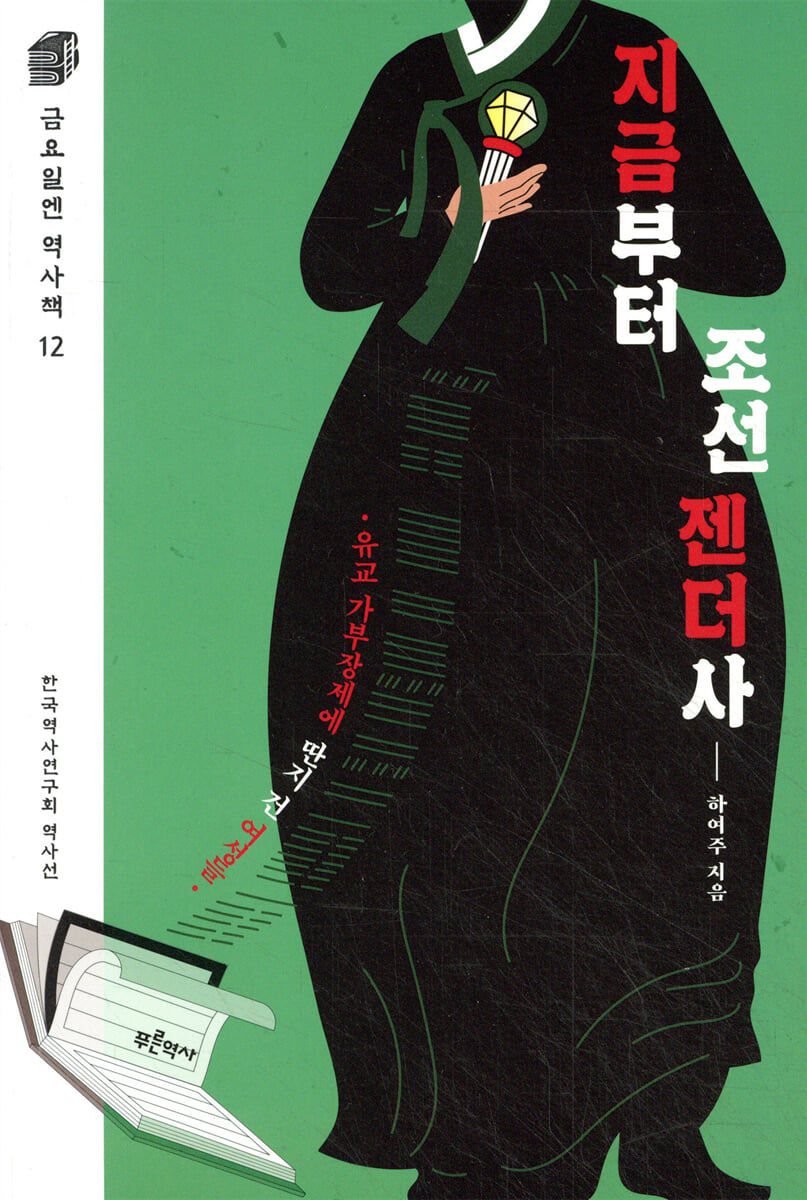 |
Description
Book Introduction
Forget the obedient, conservative 'Confucian girl'
The struggle of Joseon women against Confucian order
Joseon women-centered history omitted from textbooks
Until now, there has been no history book of the Joseon Dynasty like this.
This is because it is a book that could be called a history of Joseon gender rather than a history of Joseon women.
This book starts from the question, 'A textbook is just a textbook.'
In doing so, it raises the question, ‘Did Joseon women really live in compliance with Confucian gender norms?’
The fields are diverse, ranging from law and institutional history to life history.
Through this book, you can see the formation and changes of Joseon Confucian gender.
We examine how Joseon men, heavily armed with Confucianism, sought to secure and maintain political, socioeconomic, and sexual rights and power, and how women responded to this.
The struggle of Joseon women against Confucian order
Joseon women-centered history omitted from textbooks
Until now, there has been no history book of the Joseon Dynasty like this.
This is because it is a book that could be called a history of Joseon gender rather than a history of Joseon women.
This book starts from the question, 'A textbook is just a textbook.'
In doing so, it raises the question, ‘Did Joseon women really live in compliance with Confucian gender norms?’
The fields are diverse, ranging from law and institutional history to life history.
Through this book, you can see the formation and changes of Joseon Confucian gender.
We examine how Joseon men, heavily armed with Confucianism, sought to secure and maintain political, socioeconomic, and sexual rights and power, and how women responded to this.
- You can preview some of the book's contents.
Preview
index
ㆍEntering 005
01 Joseon, which erased Goryeo, established Confucian gender norms.
What are Confucian gender norms?
Women must remain chaste.
How women relate to men
For women, remarriage is a 'scarlet letter'
Establishing a Ritual System: The Prelude to Married Life
02 Creating Gender Norms Led by Yangban Men
The textbook of Confucian gender norms, the "Sohak"
The female body as defined by medicine
Beginning to write a Korean-style gender textbook
Will you be a hard-working daughter-in-law who acts carefully in everything?
03 Women's 'certain' strategies
People who walked out of the Korean letters in the grave
The Successful Separation of Oya-daek Jinju Ha
The period of adjusting to married life for Gwak Jeong-rye of Nongongdaek
A filial daughter-in-law? No, a filial daughter!
Daughter-in-law having a fling with her in-laws
04 Stories of Women Who Don't Follow Gender Norms
Divorce Request Free Pass, "Seven Deadly Sins" and "Crimes That Destroyed the Class"
Cursed murder accusations and five overturned verdicts
The reason why the simple-minded new lady was recorded as the cause of the family's troubles
Women who smoke despite gender norms telling them not to smoke
ㆍComing Out_The Diverse and Ingenious Appearances of Confucian Women
References
Search
01 Joseon, which erased Goryeo, established Confucian gender norms.
What are Confucian gender norms?
Women must remain chaste.
How women relate to men
For women, remarriage is a 'scarlet letter'
Establishing a Ritual System: The Prelude to Married Life
02 Creating Gender Norms Led by Yangban Men
The textbook of Confucian gender norms, the "Sohak"
The female body as defined by medicine
Beginning to write a Korean-style gender textbook
Will you be a hard-working daughter-in-law who acts carefully in everything?
03 Women's 'certain' strategies
People who walked out of the Korean letters in the grave
The Successful Separation of Oya-daek Jinju Ha
The period of adjusting to married life for Gwak Jeong-rye of Nongongdaek
A filial daughter-in-law? No, a filial daughter!
Daughter-in-law having a fling with her in-laws
04 Stories of Women Who Don't Follow Gender Norms
Divorce Request Free Pass, "Seven Deadly Sins" and "Crimes That Destroyed the Class"
Cursed murder accusations and five overturned verdicts
The reason why the simple-minded new lady was recorded as the cause of the family's troubles
Women who smoke despite gender norms telling them not to smoke
ㆍComing Out_The Diverse and Ingenious Appearances of Confucian Women
References
Search
Into the book
According to Confucian gender norms, the ideal woman was a wise wife who used her virtue and talents for her man, a virtuous lady who obeyed her man.
At this time, the male scholars who studied acquired the authority to lead and discipline women while learning academics and etiquette.
On the other hand, women are given the role of weaving cloth and preparing food to assist the male leaders.
--- p.17
『Gyeongje Yukjeon』 is a book of laws written by Jeong Do-jeon, a key figure in the founding of the nation… It states that the only people a woman of the noble class can meet are her parents, biological siblings, biological sisters, siblings of her parents, and in-laws. If she meets anyone else, it is considered ‘actual’ and she must be considered to have lost her chastity.
--- p.20
Maintaining a woman's chastity was a means of maintaining a single man (husband) and his family, and was a norm firmly tied to the institution of marriage.
In Confucianism, this was defined as the 'law of the universe'.
Since a couple is the foundation of human relationships, the belief was that although a wife had the duty of three obediences, she had no right to remarry.
--- p.21
Women and men avoiding each other or keeping their distance.
This behavior is also expressed as 'distinguishing between inside and outside' or 'distinguishing between inside and outside'.
This expression comes from Confucian gender norms that define women as inside and men as outside.
--- p.22
In the 13th year of King Sejong's reign (1431), the government defined it as a case of a noblewoman losing her chastity, that is, going on an outing to a famous mountain, visiting a Buddhist temple, committing an obscene act, or disrupting the moral code and customs.
--- p.22
〈Children’s Book〉 means a ledger that records the personal information of a promiscuous woman.
The 'Jajaan Ipnokje' was a system established in the third year of King Yejong's reign in Goryeo (1108). The names and deeds of married women who committed indecent acts were recorded in the 'Jajaan' and those people were made into seamstresses, thus reducing their status to lowly status.
It mainly recorded married women who committed adultery.
The founding powers of Joseon, having experienced failure in regulating women's remarriage at the end of the Goryeo Dynasty, used the "Jajaan" (Law on the Rights of Children) to restart control of women's sexuality.
--- p.25
During the reign of King Seongjong, there was even a discussion about banning the descendants of women who remarried after their husbands' deaths from holding public office. After much debate, the minority opinion that second marriages should be prohibited was adopted as law in 1477 (the 8th year of King Seongjong's reign).
Even the grandchildren of women who remarried or executed a noble family were not hired as officials, but great-grandchildren were allowed to be hired in positions other than those of the State Council, the Six Ministries, and Hanseongbu.
In other words, it was made impossible for them to advance to the current position.
--- p.27
Due to the widespread practice of ancestral rites based on patrilineal lineage, women, even daughters-in-law of the main family, were not allowed to perform ancestral rites except in cases where their husbands had died.
As the tradition of ancestral rites, where children take turns performing ancestral rites for their parents, gradually disappeared, the opportunity to take charge of ancestral rites for one's parents and participate in them gradually disappeared.
As a result, women were increasingly excluded from inheriting their parents' property.
--- p.32
Chinyeong, the Confucian wedding that gave birth to the term 'sijipsari', means 'a man welcomes a woman in person'.
Chinyeong (rite) is a form of marriage where a man brings a woman to his home and holds a wedding ceremony.… When a Chinyeong is performed, the woman naturally becomes an outsider and the family's residence becomes the area where the man's family is located.
--- p.33
Let's look at the book "Gyenyeoseo" that Song Si-yeol is said to have written to give to his daughter. Song Si-yeol emphasized the seriousness of jealousy among the seven evils that Confucius said could lead to a woman being driven out of her in-laws.
The prohibition of speculation takes up most of the second section of the 『Book of Women』, “The Duty of Serving a Husband,” which states, “No matter how much you love your concubine, do not show an angry expression and be even more respectful to her.
Your husband is a well-mannered gentleman, so he will not be tempted by women.
“You are not a speculator, but be careful,” he said.
--- p.38
The reason why women's illnesses are ten times more difficult to treat than men's is because they have more desires for pleasure and enjoyment than men, and they are twice as likely to get sick than men. They also have deep-seated jealousy, worry, anger, love for children, longing, and love and hate, and they cannot control their emotions, so the roots of their illnesses are deep. - 『Donguibogam』, 〈Miscellaneous Diseases〉, Women
--- p.43
A clear example of the bias against women's displayed emotions is detailed in the Joseon Dynasty's women's instruction book, Sasoseol (1775).
“Women cry a lot, and many cry when they shouldn’t, so it’s not a good virtue to cry often. … There are times when I cry out of anger, and even because of a pretty woman, and I can’t even say anything about it.” … So what’s the conclusion? “Women are flawed people who can’t control their emotions.”
--- p.44
“It is a great act of filial piety to go to your in-laws’ house and not let your parents have trouble with your mistakes, big or small. If you keep this in mind and do everything this way, even though you leave me, act as if you were under my care and listened to me.” - Biography of Song Si-yeol, 『Book of Women』… The logic is that living without conflict in your in-laws’ house is the ‘method of filial piety’ that does not harm your parents and your family.
--- p.51
In the late Joseon Dynasty, a woman's marriage was called 'Ugui'.
The word ‘Ugwi’ has the hidden meaning of ‘returning to one’s father-in-law’.… The original form of marriage in traditional Korea was for the man to enter the house of his father-in-law.
But gradually, the culture was changing to one where women returned to their father-in-law's house, or 'the in-laws'.
--- p.54
A 'daughter-in-law's guide to life' was needed.
For example, a daughter-in-law should not visit her parents' home often unless it is for important reasons.
A woman must not reveal to her in-laws what she has seen or heard.
Also, you could show the items or food sent from your parents' home to your in-laws first, and then only after receiving permission from them.
A daughter-in-law must 'absolutely obey' her parents-in-law's words.
Even if you are abused, you must obey.
--- p.55
Despite Gwak Ju's best efforts, the couple decided to live separately, following Jinju Ha's decision.
As a result, Jinju Ha lived in Nongong, while her husband, Gwak Ju, her in-laws, and Gwak I-chang lived in Sorye.… It is difficult to know the details of the situation, but it was not Jinju Ha who had entered her in-laws, but her husband, Gwak Ju, who struggled to resolve the conflict.… The in-laws had to tell their daughter-in-law to bring her children if they wanted to see the grandchildren they wanted to see.
--- p.79
It was analyzed that the interaction with the paternal family during the married life of a noble woman in the late Joseon Dynasty was limited to the level of close relatives who stayed at the paternal family for a certain period of time. However, the fact that the 'filial daughter' who was faithful enough to be recorded actually devoted all her efforts to living as a filial daughter... Park Yun-won's (1734-1799) younger sister changed her residence to live closer to her mother.... After discussing with her husband and in-laws, Park sold her house in the countryside and settled in Seoul.
His mother went to Seoul and they lived in the same village and visited each other.
--- p.93
Hong (1626-1682), whose father was Hong Ik-han, who was killed during the Byeongja Horan for advocating for the expulsion of foreigners, built a shrine for his family and established a successor after his family fell into ruin.
It is said that he once said to his sons, “There is still no tombstone on our father’s grave. How can we leave a permanent mark?”
--- p.98
Lady Seongsan, a person from the late 18th century, visited her parents' home throughout her life, regardless of the time period.
For example, when his younger sister-in-law was in critical condition and asked to go to her parents' house, her father-in-law could not stop her. According to the women's teachings, it is impossible for a married woman to visit her parents' house unless it is a serious matter such as the death of a parent.
But in reality, incest was a daily routine for women.
--- p.102
As a laywoman, Yun should have been buried in her in-laws' ancestral grave, but she was a very filial woman and, as she had wished, was buried in her parents' ancestral grave.
Not only Yun, but also in the 17th century, there were frequent cases of noble women building graves in their paternal ancestral graves during the same period and these were recorded.… They held an ambiguous and fluid position between their in-laws and their paternal families, and actively acted for their paternal families through various channels, utilizing the Confucian ideal of filial piety.
--- p.107
At the time, there was public opinion in the court that Lady Shin had been falsely accused.
The details were relatively detailed, including the fact that it was manipulated to eliminate Lady Shin, who knew about her sister-in-law's evil deeds.
However, the only minister who actually advised the king that Lady Shin had been falsely accused was the Right State Councillor Kim Sang-yong.
He requested his resignation, saying that he could no longer participate in the investigation in this situation where the law had collapsed due to the overturning of the verdict.
--- p.121
At the time of the incident, there was public opinion that Lady Shin had been falsely accused, but it was not made official, and as time passed, Lady Shin became a 'witch' as a woman who had been driven out of her home due to her 'wicked nature', and the cursed murder that never happened became 'fact'.
In the late Joseon Dynasty, noblemen found meaning in the false accusation case of Shin Suk-nyeo, as they punished women who had harmed the patriarchal order and thus rectified the ethics and gender hierarchy of the Confucian school.
--- p.125
A long pipe, called a jangjuk, always appears in Shin Yun-bok's paintings of gisaeng.
Why did they wear long robes, a garment reserved only for those of high social standing? It had to do with the special nature of the gisaeng's role: as sexual assistants to the yangban.
For example, the final formality when entering a gisaeng house was for the guest to light a cigarette for the gisaeng.
In this way, smoking was also one of the entertainments, like parasites, drinking, and dancing, in a space of sexual pleasure exclusive to men.
--- p.129
Yangban men did not want to share their smoking habits with 'ordinary' women, except for 'beauties' whom they regarded as sexual objects, as well as those of lower status.
They felt a sense of crisis that smoking would blur the distinction between men and women, and added a ban on smoking for women to the gender norms.
At this time, the male scholars who studied acquired the authority to lead and discipline women while learning academics and etiquette.
On the other hand, women are given the role of weaving cloth and preparing food to assist the male leaders.
--- p.17
『Gyeongje Yukjeon』 is a book of laws written by Jeong Do-jeon, a key figure in the founding of the nation… It states that the only people a woman of the noble class can meet are her parents, biological siblings, biological sisters, siblings of her parents, and in-laws. If she meets anyone else, it is considered ‘actual’ and she must be considered to have lost her chastity.
--- p.20
Maintaining a woman's chastity was a means of maintaining a single man (husband) and his family, and was a norm firmly tied to the institution of marriage.
In Confucianism, this was defined as the 'law of the universe'.
Since a couple is the foundation of human relationships, the belief was that although a wife had the duty of three obediences, she had no right to remarry.
--- p.21
Women and men avoiding each other or keeping their distance.
This behavior is also expressed as 'distinguishing between inside and outside' or 'distinguishing between inside and outside'.
This expression comes from Confucian gender norms that define women as inside and men as outside.
--- p.22
In the 13th year of King Sejong's reign (1431), the government defined it as a case of a noblewoman losing her chastity, that is, going on an outing to a famous mountain, visiting a Buddhist temple, committing an obscene act, or disrupting the moral code and customs.
--- p.22
〈Children’s Book〉 means a ledger that records the personal information of a promiscuous woman.
The 'Jajaan Ipnokje' was a system established in the third year of King Yejong's reign in Goryeo (1108). The names and deeds of married women who committed indecent acts were recorded in the 'Jajaan' and those people were made into seamstresses, thus reducing their status to lowly status.
It mainly recorded married women who committed adultery.
The founding powers of Joseon, having experienced failure in regulating women's remarriage at the end of the Goryeo Dynasty, used the "Jajaan" (Law on the Rights of Children) to restart control of women's sexuality.
--- p.25
During the reign of King Seongjong, there was even a discussion about banning the descendants of women who remarried after their husbands' deaths from holding public office. After much debate, the minority opinion that second marriages should be prohibited was adopted as law in 1477 (the 8th year of King Seongjong's reign).
Even the grandchildren of women who remarried or executed a noble family were not hired as officials, but great-grandchildren were allowed to be hired in positions other than those of the State Council, the Six Ministries, and Hanseongbu.
In other words, it was made impossible for them to advance to the current position.
--- p.27
Due to the widespread practice of ancestral rites based on patrilineal lineage, women, even daughters-in-law of the main family, were not allowed to perform ancestral rites except in cases where their husbands had died.
As the tradition of ancestral rites, where children take turns performing ancestral rites for their parents, gradually disappeared, the opportunity to take charge of ancestral rites for one's parents and participate in them gradually disappeared.
As a result, women were increasingly excluded from inheriting their parents' property.
--- p.32
Chinyeong, the Confucian wedding that gave birth to the term 'sijipsari', means 'a man welcomes a woman in person'.
Chinyeong (rite) is a form of marriage where a man brings a woman to his home and holds a wedding ceremony.… When a Chinyeong is performed, the woman naturally becomes an outsider and the family's residence becomes the area where the man's family is located.
--- p.33
Let's look at the book "Gyenyeoseo" that Song Si-yeol is said to have written to give to his daughter. Song Si-yeol emphasized the seriousness of jealousy among the seven evils that Confucius said could lead to a woman being driven out of her in-laws.
The prohibition of speculation takes up most of the second section of the 『Book of Women』, “The Duty of Serving a Husband,” which states, “No matter how much you love your concubine, do not show an angry expression and be even more respectful to her.
Your husband is a well-mannered gentleman, so he will not be tempted by women.
“You are not a speculator, but be careful,” he said.
--- p.38
The reason why women's illnesses are ten times more difficult to treat than men's is because they have more desires for pleasure and enjoyment than men, and they are twice as likely to get sick than men. They also have deep-seated jealousy, worry, anger, love for children, longing, and love and hate, and they cannot control their emotions, so the roots of their illnesses are deep. - 『Donguibogam』, 〈Miscellaneous Diseases〉, Women
--- p.43
A clear example of the bias against women's displayed emotions is detailed in the Joseon Dynasty's women's instruction book, Sasoseol (1775).
“Women cry a lot, and many cry when they shouldn’t, so it’s not a good virtue to cry often. … There are times when I cry out of anger, and even because of a pretty woman, and I can’t even say anything about it.” … So what’s the conclusion? “Women are flawed people who can’t control their emotions.”
--- p.44
“It is a great act of filial piety to go to your in-laws’ house and not let your parents have trouble with your mistakes, big or small. If you keep this in mind and do everything this way, even though you leave me, act as if you were under my care and listened to me.” - Biography of Song Si-yeol, 『Book of Women』… The logic is that living without conflict in your in-laws’ house is the ‘method of filial piety’ that does not harm your parents and your family.
--- p.51
In the late Joseon Dynasty, a woman's marriage was called 'Ugui'.
The word ‘Ugwi’ has the hidden meaning of ‘returning to one’s father-in-law’.… The original form of marriage in traditional Korea was for the man to enter the house of his father-in-law.
But gradually, the culture was changing to one where women returned to their father-in-law's house, or 'the in-laws'.
--- p.54
A 'daughter-in-law's guide to life' was needed.
For example, a daughter-in-law should not visit her parents' home often unless it is for important reasons.
A woman must not reveal to her in-laws what she has seen or heard.
Also, you could show the items or food sent from your parents' home to your in-laws first, and then only after receiving permission from them.
A daughter-in-law must 'absolutely obey' her parents-in-law's words.
Even if you are abused, you must obey.
--- p.55
Despite Gwak Ju's best efforts, the couple decided to live separately, following Jinju Ha's decision.
As a result, Jinju Ha lived in Nongong, while her husband, Gwak Ju, her in-laws, and Gwak I-chang lived in Sorye.… It is difficult to know the details of the situation, but it was not Jinju Ha who had entered her in-laws, but her husband, Gwak Ju, who struggled to resolve the conflict.… The in-laws had to tell their daughter-in-law to bring her children if they wanted to see the grandchildren they wanted to see.
--- p.79
It was analyzed that the interaction with the paternal family during the married life of a noble woman in the late Joseon Dynasty was limited to the level of close relatives who stayed at the paternal family for a certain period of time. However, the fact that the 'filial daughter' who was faithful enough to be recorded actually devoted all her efforts to living as a filial daughter... Park Yun-won's (1734-1799) younger sister changed her residence to live closer to her mother.... After discussing with her husband and in-laws, Park sold her house in the countryside and settled in Seoul.
His mother went to Seoul and they lived in the same village and visited each other.
--- p.93
Hong (1626-1682), whose father was Hong Ik-han, who was killed during the Byeongja Horan for advocating for the expulsion of foreigners, built a shrine for his family and established a successor after his family fell into ruin.
It is said that he once said to his sons, “There is still no tombstone on our father’s grave. How can we leave a permanent mark?”
--- p.98
Lady Seongsan, a person from the late 18th century, visited her parents' home throughout her life, regardless of the time period.
For example, when his younger sister-in-law was in critical condition and asked to go to her parents' house, her father-in-law could not stop her. According to the women's teachings, it is impossible for a married woman to visit her parents' house unless it is a serious matter such as the death of a parent.
But in reality, incest was a daily routine for women.
--- p.102
As a laywoman, Yun should have been buried in her in-laws' ancestral grave, but she was a very filial woman and, as she had wished, was buried in her parents' ancestral grave.
Not only Yun, but also in the 17th century, there were frequent cases of noble women building graves in their paternal ancestral graves during the same period and these were recorded.… They held an ambiguous and fluid position between their in-laws and their paternal families, and actively acted for their paternal families through various channels, utilizing the Confucian ideal of filial piety.
--- p.107
At the time, there was public opinion in the court that Lady Shin had been falsely accused.
The details were relatively detailed, including the fact that it was manipulated to eliminate Lady Shin, who knew about her sister-in-law's evil deeds.
However, the only minister who actually advised the king that Lady Shin had been falsely accused was the Right State Councillor Kim Sang-yong.
He requested his resignation, saying that he could no longer participate in the investigation in this situation where the law had collapsed due to the overturning of the verdict.
--- p.121
At the time of the incident, there was public opinion that Lady Shin had been falsely accused, but it was not made official, and as time passed, Lady Shin became a 'witch' as a woman who had been driven out of her home due to her 'wicked nature', and the cursed murder that never happened became 'fact'.
In the late Joseon Dynasty, noblemen found meaning in the false accusation case of Shin Suk-nyeo, as they punished women who had harmed the patriarchal order and thus rectified the ethics and gender hierarchy of the Confucian school.
--- p.125
A long pipe, called a jangjuk, always appears in Shin Yun-bok's paintings of gisaeng.
Why did they wear long robes, a garment reserved only for those of high social standing? It had to do with the special nature of the gisaeng's role: as sexual assistants to the yangban.
For example, the final formality when entering a gisaeng house was for the guest to light a cigarette for the gisaeng.
In this way, smoking was also one of the entertainments, like parasites, drinking, and dancing, in a space of sexual pleasure exclusive to men.
--- p.129
Yangban men did not want to share their smoking habits with 'ordinary' women, except for 'beauties' whom they regarded as sexual objects, as well as those of lower status.
They felt a sense of crisis that smoking would blur the distinction between men and women, and added a ban on smoking for women to the gender norms.
--- p.131
Publisher's Review
Searching through everything from women's books to medical books
The book delves into the work of men in establishing Confucian gender norms, as if dealing with the front and back sides of the moon.
We analyzed the laws and systems related to gender in Joseon, as well as the guidebook for married life that was engraved on folding screens and even delved into private life.
Confucian (Neo-Confucian) idealists focus on creating Confucian gender norms that began before the founding of the Joseon Dynasty.
It covers the process of transferring women's rights and activities from their parents' home to their in-laws' home by converting marriages, funerals, and ancestral rites to Confucian customs, as well as the prohibition of remarriage that had become a sexual shackle for Joseon women.
We will understand the definition of the female body through medical books such as Donguibogam.
So, it is mentioned that the body became weak, unable to actively create life and prone to disease.
We also examine the teachings of women written by yangban men, which began with the emergence of the culture of married life in the 17th century.
For example, they extracted the discourse outside the family that women should live as daughters-in-law, and the belief that the rise and fall of a family depends on the daughter-in-law.
The diverse and ingenious responses of Confucian women
Next, we introduce the appearance of women responding to the Confucian gender norms established by men.
As is generally the case with pre-modern historical records in Korea and other countries, Joseon women rarely left records of their own as marginalized people.
But the book finds women's voices even within men's records.
The devoted daughters-in-law actually followed and supported their exiled fathers, moved to live closer to their parents, and weaved to create an epitaph for their deceased fathers, and had their daughters-in-law do the same.
Some husbands even faithfully followed the will to build a grave in their parents' ancestral graveyard.
In this way, it is pointed out that Joseon women did not lose their sense of identity from their families while compromising to some extent with Confucian gender norms.
Punishment for Reckless Women, and the Reality
So how were women who did not conform to Confucian gender norms punished? This paper delves into the case of Lady Shin, who was expelled from her in-laws for one of the Seven Deadly Sins. It reveals how she was reviled as a daughter-in-law who ruined her family, transcending her time and continuing to be discussed as a Joseon-era witch.
The process of trampling on Shin Suk-nyeo, who became a Joseon version of a witch due to the political and social circumstances of the Injo era, is very similar to the witch hunts in the West from the Middle Ages to the modern era, as well as the witch hunts of celebrities carried out by the public in modern society.
Nevertheless, it captured the fact that women did not hesitate to create a crack in gender.
While cigarettes suddenly became a craze all over Joseon, men tried to create their own smoking culture, but the gender order was broken by women who enjoyed smoking without any regard.
The way Joseon women negotiated and compromised, or even created cracks in the rigid framework of Confucianism, seemed no different from meticulous strategists secretly waging war.
Overturning the 21st-Century "Confucian Girl" Myth
For several years now, a new word called 'Confucian Girl' has been trending, combining 'Confucianism' and the English word 'girl', meaning a girl or a common woman.
A 'Confucian girl' is a woman with a conservative mindset who follows the traditional Korean image of women, such as wearing clothes that do not reveal her body or avoiding men.
The author argues that the traditional Korean female image we have in our heads is merely a model of Joseon's "ideal" Confucian gender norms.
This book is the 12th book in the 'History Books on Fridays' series planned by the Korean History Research Association.
Like other books in the series, it is an easy read, but it is full of profound meaning and makes us reflect on our history.
The book delves into the work of men in establishing Confucian gender norms, as if dealing with the front and back sides of the moon.
We analyzed the laws and systems related to gender in Joseon, as well as the guidebook for married life that was engraved on folding screens and even delved into private life.
Confucian (Neo-Confucian) idealists focus on creating Confucian gender norms that began before the founding of the Joseon Dynasty.
It covers the process of transferring women's rights and activities from their parents' home to their in-laws' home by converting marriages, funerals, and ancestral rites to Confucian customs, as well as the prohibition of remarriage that had become a sexual shackle for Joseon women.
We will understand the definition of the female body through medical books such as Donguibogam.
So, it is mentioned that the body became weak, unable to actively create life and prone to disease.
We also examine the teachings of women written by yangban men, which began with the emergence of the culture of married life in the 17th century.
For example, they extracted the discourse outside the family that women should live as daughters-in-law, and the belief that the rise and fall of a family depends on the daughter-in-law.
The diverse and ingenious responses of Confucian women
Next, we introduce the appearance of women responding to the Confucian gender norms established by men.
As is generally the case with pre-modern historical records in Korea and other countries, Joseon women rarely left records of their own as marginalized people.
But the book finds women's voices even within men's records.
The devoted daughters-in-law actually followed and supported their exiled fathers, moved to live closer to their parents, and weaved to create an epitaph for their deceased fathers, and had their daughters-in-law do the same.
Some husbands even faithfully followed the will to build a grave in their parents' ancestral graveyard.
In this way, it is pointed out that Joseon women did not lose their sense of identity from their families while compromising to some extent with Confucian gender norms.
Punishment for Reckless Women, and the Reality
So how were women who did not conform to Confucian gender norms punished? This paper delves into the case of Lady Shin, who was expelled from her in-laws for one of the Seven Deadly Sins. It reveals how she was reviled as a daughter-in-law who ruined her family, transcending her time and continuing to be discussed as a Joseon-era witch.
The process of trampling on Shin Suk-nyeo, who became a Joseon version of a witch due to the political and social circumstances of the Injo era, is very similar to the witch hunts in the West from the Middle Ages to the modern era, as well as the witch hunts of celebrities carried out by the public in modern society.
Nevertheless, it captured the fact that women did not hesitate to create a crack in gender.
While cigarettes suddenly became a craze all over Joseon, men tried to create their own smoking culture, but the gender order was broken by women who enjoyed smoking without any regard.
The way Joseon women negotiated and compromised, or even created cracks in the rigid framework of Confucianism, seemed no different from meticulous strategists secretly waging war.
Overturning the 21st-Century "Confucian Girl" Myth
For several years now, a new word called 'Confucian Girl' has been trending, combining 'Confucianism' and the English word 'girl', meaning a girl or a common woman.
A 'Confucian girl' is a woman with a conservative mindset who follows the traditional Korean image of women, such as wearing clothes that do not reveal her body or avoiding men.
The author argues that the traditional Korean female image we have in our heads is merely a model of Joseon's "ideal" Confucian gender norms.
This book is the 12th book in the 'History Books on Fridays' series planned by the Korean History Research Association.
Like other books in the series, it is an easy read, but it is full of profound meaning and makes us reflect on our history.
GOODS SPECIFICS
- Date of issue: July 25, 2025
- Page count, weight, size: 160 pages | 276g | 140*207*11mm
- ISBN13: 9791156122982
- ISBN10: 1156122988
You may also like
카테고리
korean


korean

![GQ KOREA Mark (Monthly): December [2025]](http://librairie.coreenne.fr/cdn/shop/files/8ef265dbbfbf186523ed75ba7319009d.jpg?v=1765340328&width=3840)


