

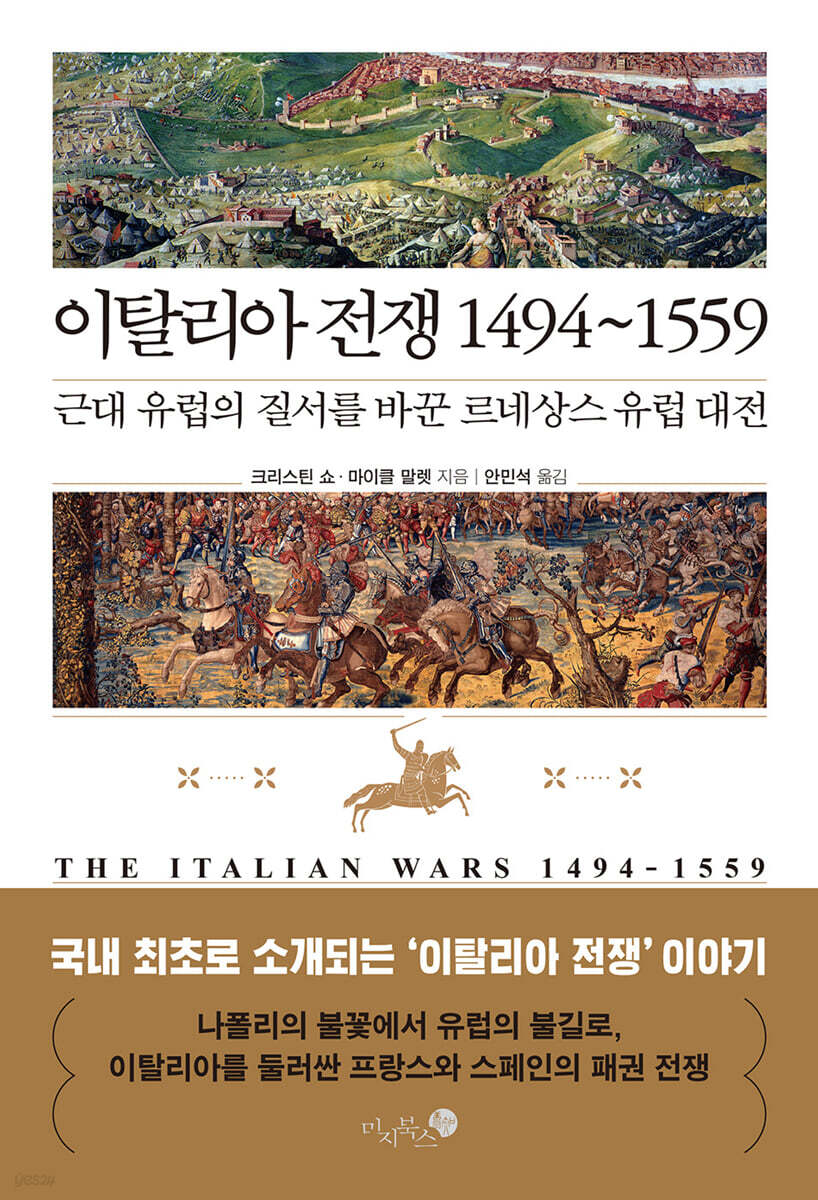
Italian Wars 1494–1559
 |
Description
Book Introduction
The epic of cataclysm that gave birth to modern Europe
The first domestic introduction of the 'Italian Wars'
From the flames of Naples to the flames of Europe,
The war between France and Spain for hegemony over Italy
The Italian Wars were a series of large-scale international conflicts that took place on the Italian Peninsula for 65 years from 1494 to 1559. They were a very important historical event that not only brought about groundbreaking innovations in military technology and strategy, but also brought about a major transformation in international politics, diplomacy, and culture.
The conflict, which began over the succession to the throne of the Kingdom of Naples, led to the intervention of European powers such as France, the Holy Roman Empire, Spain, and England, ultimately ending the Renaissance in Europe and beginning modern Europe. However, a book on the 'Italian Wars', which had such a historically important status, has not been introduced in Korea until now.
"The Italian Wars 1494-1559" examines the inner workings of the Great War, which began with the French invasion of Naples, from various levels: the ambitions of the Spanish-Habsburg and French royal families, the colorful personalities of the numerous warring parties, the alliances and alliances of interested parties, the use of firearms and the expansion of infantry that revolutionized the nature of war, and the war finances that were paramount to sustaining the war.
Christine Shaw and Michael Mallett, experts in Italian military history during the Renaissance, meticulously narrate based on extensive historical sources, while vividly depicting key events such as the Battle of Pavia and the Sack of Rome, making the book accessible to general readers and providing a sense of tension and excitement that makes you feel as if you were there.
Providing essential insights into the formation of modern European history through multifaceted and in-depth analysis, "The Italian Wars 1494-1559" will become a classic, not just a must-read, for history buffs thirsty for information on the "Italian Wars," but also for domestic readers interested in international relations and military strategy.
The first domestic introduction of the 'Italian Wars'
From the flames of Naples to the flames of Europe,
The war between France and Spain for hegemony over Italy
The Italian Wars were a series of large-scale international conflicts that took place on the Italian Peninsula for 65 years from 1494 to 1559. They were a very important historical event that not only brought about groundbreaking innovations in military technology and strategy, but also brought about a major transformation in international politics, diplomacy, and culture.
The conflict, which began over the succession to the throne of the Kingdom of Naples, led to the intervention of European powers such as France, the Holy Roman Empire, Spain, and England, ultimately ending the Renaissance in Europe and beginning modern Europe. However, a book on the 'Italian Wars', which had such a historically important status, has not been introduced in Korea until now.
"The Italian Wars 1494-1559" examines the inner workings of the Great War, which began with the French invasion of Naples, from various levels: the ambitions of the Spanish-Habsburg and French royal families, the colorful personalities of the numerous warring parties, the alliances and alliances of interested parties, the use of firearms and the expansion of infantry that revolutionized the nature of war, and the war finances that were paramount to sustaining the war.
Christine Shaw and Michael Mallett, experts in Italian military history during the Renaissance, meticulously narrate based on extensive historical sources, while vividly depicting key events such as the Battle of Pavia and the Sack of Rome, making the book accessible to general readers and providing a sense of tension and excitement that makes you feel as if you were there.
Providing essential insights into the formation of modern European history through multifaceted and in-depth analysis, "The Italian Wars 1494-1559" will become a classic, not just a must-read, for history buffs thirsty for information on the "Italian Wars," but also for domestic readers interested in international relations and military strategy.
- You can preview some of the book's contents.
Preview
index
introduction
Chapter 1: The Origins of War and the First French Expedition
Charles VIII and his legacy│French interests in Italy│King Ferrante of Naples and other Italian powers│Preparations for the Italian expedition│The last month│The reaction of the Italian powers│The march on Naples│The French in Naples│The French withdrawal and the Battle of Fornovo│The loss of Naples to France
Chapter 2: Milan and Naples Conquered, 1496–1503
Maximilian's Italian Expedition, 1496│War of Pisa, 1495–1499│Preparations for the French Invasion of Milan│French Invasion of Milan, 1499–1500│Return of Ludovico Sforza and his final defeat│France becomes an Italian power│Invasion of Naples│Spain expels the French from Naples
Chapter 3: The Escalation of the Conflict
Florence and Pisa│Ferdinand of Naples│Louis XII of Italy, 1507│Origins of the League of Cambrai│Beginning of the War of the League of Cambrai│Battle of Agnadello│Venetian Counterattack│Venetian Expedition, 1510│Julius II and France│Veneto Expedition, 1511│Holy League│Battle of Ravenna│Expulsion of French Forces
Chapter 4: The Birth of a New Order, 1512–1519
The return of the Medici family│The Milanese Compromise│Venice keeps its distance│French invasion of Milan, 1513│The Veneto War│Diplomatic disputes surrounding Lombardy│The ascension of Francis I and the invasion of Milan, 1515│Maximilian and the Swiss invasion of Milan, 1516│The final stage of the Venetian Wars, 1515-1516│The Medici's territorial expansion│The imperial election
Chapter 5: The Italian Struggle for Hegemony, 1520–1529
Expulsion of the French, 1521–1522 │ Imperial demands │ French re-invasion of Milan, 1523–1524 │ Francis I's second Italian expedition, 1524–1525 │ Battle of Pavia │ Aftermath of the Battle of Pavia │ Imperial takeover of Milan │ League of Cognac │ Sack of Rome │ Lombard Wars, 1527–1528 │ Invasion of Naples, 1528 │ Last Lombard expedition, 1528–1529 │ Treaties of Barcelona and Cambrai
Chapter 6: The Ongoing Territorial Dispute, 1529–1547
Charles V and Clement VII of Bologna, 1529-1530│Siege of Florence, 1529-1530│Second Congress of Bologna, 1532-1533│François I's Italian designs│Cession of Milan│French invasion of Savoy and Piedmont, 1536│Charles V's Italian campaign, 1535-1536│Resumption of the Italian Wars between Charles V and Francis I, 1536-1537│Truce and peace│Resumption of the Piedmont War, 1542-1544│Peace of Crepi, 1544│Spanish ambitions for Italy
Chapter 7: The French Challenge, 1547-1559
War of Parma and Mirandola, 1551-1552│War of North-West Italy, 1551-1552│Charles V in a corner│War of Siena, 1552-1555│From Charles V to Philip II│Navigate war│Corsica│War of North-West Italy, 1552-1556│Alliance of France and the Papacy│Duke of Alba's invasion of the Papal States, 1556│Duke of Guise's expedition, 1557│The final phase of the war│Peace of Cateau-Cambrésis
Chapter 8: The Transformation of War
Balance of Armaments and Armaments│The Impact of Gunpowder Weapons│Fortress Defense and Siege Art│Standing Armies and Professional Soldiers│Training and Technology│Tactics and Strategy│Command│Naval Warfare│War Experience
Chapter 9 War Resources
Recruitment and mobilization│Laws: mustering and control│Bed and quarters│Supplies│Pays│Naval resources│War costs
Chapter 10: Propaganda and Images of War
France's Italy│Italy the Empire│The Pope in Wartime│Italy's Sorrow
Chapter 11: The Legacy of War
Economic consequences | New state systems | Oppressed peoples | Changes in military groups | Italy within the Spanish Empire
Huzhou
References
Search
Chapter 1: The Origins of War and the First French Expedition
Charles VIII and his legacy│French interests in Italy│King Ferrante of Naples and other Italian powers│Preparations for the Italian expedition│The last month│The reaction of the Italian powers│The march on Naples│The French in Naples│The French withdrawal and the Battle of Fornovo│The loss of Naples to France
Chapter 2: Milan and Naples Conquered, 1496–1503
Maximilian's Italian Expedition, 1496│War of Pisa, 1495–1499│Preparations for the French Invasion of Milan│French Invasion of Milan, 1499–1500│Return of Ludovico Sforza and his final defeat│France becomes an Italian power│Invasion of Naples│Spain expels the French from Naples
Chapter 3: The Escalation of the Conflict
Florence and Pisa│Ferdinand of Naples│Louis XII of Italy, 1507│Origins of the League of Cambrai│Beginning of the War of the League of Cambrai│Battle of Agnadello│Venetian Counterattack│Venetian Expedition, 1510│Julius II and France│Veneto Expedition, 1511│Holy League│Battle of Ravenna│Expulsion of French Forces
Chapter 4: The Birth of a New Order, 1512–1519
The return of the Medici family│The Milanese Compromise│Venice keeps its distance│French invasion of Milan, 1513│The Veneto War│Diplomatic disputes surrounding Lombardy│The ascension of Francis I and the invasion of Milan, 1515│Maximilian and the Swiss invasion of Milan, 1516│The final stage of the Venetian Wars, 1515-1516│The Medici's territorial expansion│The imperial election
Chapter 5: The Italian Struggle for Hegemony, 1520–1529
Expulsion of the French, 1521–1522 │ Imperial demands │ French re-invasion of Milan, 1523–1524 │ Francis I's second Italian expedition, 1524–1525 │ Battle of Pavia │ Aftermath of the Battle of Pavia │ Imperial takeover of Milan │ League of Cognac │ Sack of Rome │ Lombard Wars, 1527–1528 │ Invasion of Naples, 1528 │ Last Lombard expedition, 1528–1529 │ Treaties of Barcelona and Cambrai
Chapter 6: The Ongoing Territorial Dispute, 1529–1547
Charles V and Clement VII of Bologna, 1529-1530│Siege of Florence, 1529-1530│Second Congress of Bologna, 1532-1533│François I's Italian designs│Cession of Milan│French invasion of Savoy and Piedmont, 1536│Charles V's Italian campaign, 1535-1536│Resumption of the Italian Wars between Charles V and Francis I, 1536-1537│Truce and peace│Resumption of the Piedmont War, 1542-1544│Peace of Crepi, 1544│Spanish ambitions for Italy
Chapter 7: The French Challenge, 1547-1559
War of Parma and Mirandola, 1551-1552│War of North-West Italy, 1551-1552│Charles V in a corner│War of Siena, 1552-1555│From Charles V to Philip II│Navigate war│Corsica│War of North-West Italy, 1552-1556│Alliance of France and the Papacy│Duke of Alba's invasion of the Papal States, 1556│Duke of Guise's expedition, 1557│The final phase of the war│Peace of Cateau-Cambrésis
Chapter 8: The Transformation of War
Balance of Armaments and Armaments│The Impact of Gunpowder Weapons│Fortress Defense and Siege Art│Standing Armies and Professional Soldiers│Training and Technology│Tactics and Strategy│Command│Naval Warfare│War Experience
Chapter 9 War Resources
Recruitment and mobilization│Laws: mustering and control│Bed and quarters│Supplies│Pays│Naval resources│War costs
Chapter 10: Propaganda and Images of War
France's Italy│Italy the Empire│The Pope in Wartime│Italy's Sorrow
Chapter 11: The Legacy of War
Economic consequences | New state systems | Oppressed peoples | Changes in military groups | Italy within the Spanish Empire
Huzhou
References
Search
Into the book
The Italian Wars were a watershed moment in the history of Italy and Europe, as well as in the history of war.
For over 60 years, Italy has been the epicenter of conflict between Western European powers.
(...) Why did Italy become the epicenter of conflict between the two most powerful dynasties in Western Europe? Essentially, because both sides claimed dynastic rights to the Italian states.
Both the King of France and the King of Spain claimed hereditary succession to the throne of Naples.
--- p.13~14
The fact that the French invasion of Naples was accomplished so quickly and easily caused considerable alarm among the other Italian states.
According to the somewhat exaggerated commentary of Marino Sanuto, not a single person gave allegiance to the House of Aragon (of Naples), and all submitted to the King of France without a fight.
--- p.71
The King of France was no longer the only king north of the Alps interested in Italy.
King Ferdinand of Aragon claimed to be the legitimate successor of his uncle, King Alfonso I of Naples (Alfonso V of Aragon), and some Neapolitan lords also preferred him to Federico.
--- p.93~94
Around this time, another famous duel took place.
It was a 13-on-13 duel between Italian and French heavy cavalry at Trani, then under Venetian control, on February 13th.
The decisive Italian victory in this duel, known as the "Duel of Barletta," brought pride and comfort to many Italians and became a legend of Italian patriotism that would endure for centuries.
--- p.143
Gonzalo de Córdoba had already had a reputation as a 'great commander', but this war established him as a figure who would be remembered in the history of European warriors.
(...) The outstanding commander Gonzalo was undoubtedly one of the most important assets of the Spanish army in Naples.
But if the French army had been better led, the outcome of the war could have been quite different.
--- p.156~159
The Battle of Agnadello was one of the most important battles of the Italian Wars.
Not because of the way the battle was fought, but because the defeat she suffered marked the arrival of the most decisive moment in the Republic's history, as Venice lost virtually all the territory it had acquired on the Italian mainland for over a century.
--- p.197
Charles, with his imperial authority, united the wealth and resources of his territories, which included Burgundy, the Habsburgs, the Spanish kingdoms, and the overseas territories of the New World and Italy.
(...) Italy would become the main stage of the struggle that would rage for the next forty years between Francis I, Charles, and their heirs, the House of Valois and the House of Habsburg.
--- p.287~288
The reliquary was smashed and tombs, including those of previous popes, were dug up.
A satirical meeting was held, and a Landsknecht even parodied the election of a 'pope'.
Even today, graffiti praising Luther can be seen carved into frescoes in the Vatican.
It was considered particularly shocking that such sacrilege should be committed in the city of the Apostle Peter, desecrating the relics and altars of churches visited by pilgrims from all over Europe.
--- p.336~337
On September 18, 1544, a peace treaty was signed at Crépy between Charles V and Francis I.
(...) All territories occupied by both sides after the Nice Armistice were returned.
Francis I withdrew his demands for Naples, Flanders, and Artois, and Charles V gave up Burgundy.
(...) Neither side was satisfied with these terms, but neither side wanted to continue the war.
--- p.417~420
On April 3, 1559, the Treaty of Cateau-Cambrésis was formally signed.
Henry II, who had defended Calais, ceded Luxembourg.
France agreed to withdraw from all occupied territories in Italy except the Duchy of Savoy on the French side of the Alps, the Marquisate of Saluzzo, Turin, Pinerolo, Chieri, Chivasso, and Villa Novadasti in Piedmont.
The Spanish army decided to station itself in Asti and Vercelli.
--- p.498
Many French commanders and officers, including Brissac, expressed disappointment at the sacrifices Henry II was willing to make.
There was widespread skepticism about whether this peace could last.
France would soon be engulfed in civil war, and Philip had a lot to do just to maintain his existing territories.
By contrast, at least in Italy, the Treaty of Cateau-Cambrésis finally brought an end to the long war that had begun with the expedition of Charles VIII in 1494.
--- p.503
All armies have moved in the direction of greater pay variance, particularly among infantry.
The increase in long-term service and the increase in the number of non-commissioned officers meant that a certain percentage of infantrymen began receiving double pay.
In 1537, this proportion of French troops stationed in Piedmont was about 10%.
Even within the same unit, matchlock musketeers received about a third more than ordinary pikemen.
In 1552, the pikemen of Piedmont received 6 livres per month, and the arquebusiers 7 livres.
This difference allowed some soldiers to offset the effects of inflation.
However, as of the 1530s, the purchasing power of soldiers was not even comparable to that of civilian artisans or manual laborers.
--- p.569~570
The impact of the Pope's warrior image was so strong that it even affected Leo X.
Lucas Cranach's engraving contrasting Christ and the Antichrist shows Christ rejecting the worldly crown in contrast to the worldly power of the Pope, depicted as a plump and stocky Pope Leo X, surrounded by soldiers and cannons.
(...) However, Leo X was not considered as powerful a monarch as Julius II.
--- p.617
The political map of Italy in 1559 looked quite different from that of 1494.
Of the five major states that had dominated the peninsula's political system through alliances and conflicts, Naples and Milan were no longer independent powers.
Florence was no longer a republic, but was ruled by the most powerful of the independent secular princes, the dukes.
Venice, which had previously been under intense pressure from rival powers seeking to dominate Italy and had been willing to expand its territory whenever the opportunity arose, now maintained a cautious attitude toward Italy's internal affairs.
--- p.645
Any assessment of this new order must bear in mind that the Spanish crown becoming the dominant power in Italy was not a foregone conclusion of the war.
(...) The final outcome of the war, embodied in the Treaty of Cateau-Cambrésis, was not, in the eyes of the Italians, the French, or even the Spaniards of the time, the inevitable result of the unwavering victory of the Spanish forces in Italy.
Rather, it was seen as a surprising change.
For over 60 years, Italy has been the epicenter of conflict between Western European powers.
(...) Why did Italy become the epicenter of conflict between the two most powerful dynasties in Western Europe? Essentially, because both sides claimed dynastic rights to the Italian states.
Both the King of France and the King of Spain claimed hereditary succession to the throne of Naples.
--- p.13~14
The fact that the French invasion of Naples was accomplished so quickly and easily caused considerable alarm among the other Italian states.
According to the somewhat exaggerated commentary of Marino Sanuto, not a single person gave allegiance to the House of Aragon (of Naples), and all submitted to the King of France without a fight.
--- p.71
The King of France was no longer the only king north of the Alps interested in Italy.
King Ferdinand of Aragon claimed to be the legitimate successor of his uncle, King Alfonso I of Naples (Alfonso V of Aragon), and some Neapolitan lords also preferred him to Federico.
--- p.93~94
Around this time, another famous duel took place.
It was a 13-on-13 duel between Italian and French heavy cavalry at Trani, then under Venetian control, on February 13th.
The decisive Italian victory in this duel, known as the "Duel of Barletta," brought pride and comfort to many Italians and became a legend of Italian patriotism that would endure for centuries.
--- p.143
Gonzalo de Córdoba had already had a reputation as a 'great commander', but this war established him as a figure who would be remembered in the history of European warriors.
(...) The outstanding commander Gonzalo was undoubtedly one of the most important assets of the Spanish army in Naples.
But if the French army had been better led, the outcome of the war could have been quite different.
--- p.156~159
The Battle of Agnadello was one of the most important battles of the Italian Wars.
Not because of the way the battle was fought, but because the defeat she suffered marked the arrival of the most decisive moment in the Republic's history, as Venice lost virtually all the territory it had acquired on the Italian mainland for over a century.
--- p.197
Charles, with his imperial authority, united the wealth and resources of his territories, which included Burgundy, the Habsburgs, the Spanish kingdoms, and the overseas territories of the New World and Italy.
(...) Italy would become the main stage of the struggle that would rage for the next forty years between Francis I, Charles, and their heirs, the House of Valois and the House of Habsburg.
--- p.287~288
The reliquary was smashed and tombs, including those of previous popes, were dug up.
A satirical meeting was held, and a Landsknecht even parodied the election of a 'pope'.
Even today, graffiti praising Luther can be seen carved into frescoes in the Vatican.
It was considered particularly shocking that such sacrilege should be committed in the city of the Apostle Peter, desecrating the relics and altars of churches visited by pilgrims from all over Europe.
--- p.336~337
On September 18, 1544, a peace treaty was signed at Crépy between Charles V and Francis I.
(...) All territories occupied by both sides after the Nice Armistice were returned.
Francis I withdrew his demands for Naples, Flanders, and Artois, and Charles V gave up Burgundy.
(...) Neither side was satisfied with these terms, but neither side wanted to continue the war.
--- p.417~420
On April 3, 1559, the Treaty of Cateau-Cambrésis was formally signed.
Henry II, who had defended Calais, ceded Luxembourg.
France agreed to withdraw from all occupied territories in Italy except the Duchy of Savoy on the French side of the Alps, the Marquisate of Saluzzo, Turin, Pinerolo, Chieri, Chivasso, and Villa Novadasti in Piedmont.
The Spanish army decided to station itself in Asti and Vercelli.
--- p.498
Many French commanders and officers, including Brissac, expressed disappointment at the sacrifices Henry II was willing to make.
There was widespread skepticism about whether this peace could last.
France would soon be engulfed in civil war, and Philip had a lot to do just to maintain his existing territories.
By contrast, at least in Italy, the Treaty of Cateau-Cambrésis finally brought an end to the long war that had begun with the expedition of Charles VIII in 1494.
--- p.503
All armies have moved in the direction of greater pay variance, particularly among infantry.
The increase in long-term service and the increase in the number of non-commissioned officers meant that a certain percentage of infantrymen began receiving double pay.
In 1537, this proportion of French troops stationed in Piedmont was about 10%.
Even within the same unit, matchlock musketeers received about a third more than ordinary pikemen.
In 1552, the pikemen of Piedmont received 6 livres per month, and the arquebusiers 7 livres.
This difference allowed some soldiers to offset the effects of inflation.
However, as of the 1530s, the purchasing power of soldiers was not even comparable to that of civilian artisans or manual laborers.
--- p.569~570
The impact of the Pope's warrior image was so strong that it even affected Leo X.
Lucas Cranach's engraving contrasting Christ and the Antichrist shows Christ rejecting the worldly crown in contrast to the worldly power of the Pope, depicted as a plump and stocky Pope Leo X, surrounded by soldiers and cannons.
(...) However, Leo X was not considered as powerful a monarch as Julius II.
--- p.617
The political map of Italy in 1559 looked quite different from that of 1494.
Of the five major states that had dominated the peninsula's political system through alliances and conflicts, Naples and Milan were no longer independent powers.
Florence was no longer a republic, but was ruled by the most powerful of the independent secular princes, the dukes.
Venice, which had previously been under intense pressure from rival powers seeking to dominate Italy and had been willing to expand its territory whenever the opportunity arose, now maintained a cautious attitude toward Italy's internal affairs.
--- p.645
Any assessment of this new order must bear in mind that the Spanish crown becoming the dominant power in Italy was not a foregone conclusion of the war.
(...) The final outcome of the war, embodied in the Treaty of Cateau-Cambrésis, was not, in the eyes of the Italians, the French, or even the Spaniards of the time, the inevitable result of the unwavering victory of the Spanish forces in Italy.
Rather, it was seen as a surprising change.
--- p.673
Publisher's Review
Almost all history about the 'Italian Wars' that you encounter for the first time
On August 29, 1494, with all preparations completed, King Charles VIII of France departed Grenoble for Naples.
This Italian expedition by Charles VIII, who believed that he had the right to succeed to the throne of the Kingdom of Naples, was the starting point of a great war that no one at the time (not even those who started the expedition) could have predicted.
The Italian Wars that began in this way escalated into a huge international war that shook Renaissance Europe.
『The Italian Wars 1494-1559』 is a work that comprehensively illuminates the history of this great war, examining the entire process from various perspectives, starting with Charles VIII's expedition to Naples and ending with the Treaty of Cateau-Cambrésis.
The Italian Wars, one of the most important international wars between the late Middle Ages and the early modern period in terms of scale and influence, are famous for ushering in the 'prelude to modern European international politics.'
This is because it was not simply a conflict within the Italian Peninsula, but a war involving all of Europe's major powers, including France, the Habsburgs (Spain and the Holy Roman Empire), England, and the Ottoman Empire.
Countries repeatedly formed alliances, betrayed each other, and waged wars for a long time to gain control of the wealthy Italian city-states and strategic locations.
During this process, the fate of major Italian city-states, including Florence, Venice, Milan, Naples, and the Papal States, also fluctuated greatly.
『Italian Wars 1494-1559』clearly organizes the Italian Wars from their beginnings to their development and conclusion, like a well-organized bookshelf.
Christine Shaw and Michael Mallett, experts in Italian military history during the Renaissance, cover major battles, diplomatic negotiations, national interests and strategies, and the political and social changes the war left behind, guiding readers through the events, characters, and backgrounds at a glance.
Through this process, readers will be able to feel the tension and excitement of the time as they encounter major historical events (Battle of Fornovo, Battle of Agnadello, Battle of Pavia, Sack of Rome, etc.) vividly depicted based on extensive historical materials and the exploits of key figures who shone with various lights (Ferdinand II, Charles V, Francis I, Philip II, Henry II, and all the popes).
In addition, 『Italian Wars 1494-1559』 provides a refreshing stimulus in that it introduces the full story of the Italian Wars to domestic readers for the first time.
The full picture of the Italian Wars was unknown in Korea until then, as it was only partially known through the works of Machiavelli and others.
However, through this book, readers will encounter the vast currents of the Italian War, the countless stories and colorful scenes hidden within it, and gain meaningful insights into the geopolitical and diplomatic issues we face today.
A new form of warfare and the dawn of modern military innovation
The Italian Wars were not simply regional conflicts; they marked the starting point of the order and balance of power in modern Europe. They demonstrated the complex intertwining of interests among European nations and the transition from the traditional medieval order to the order of modern international politics.
During the Italian Wars, the concept of balance of power emerged in earnest in Europe.
As France and the Habsburgs fiercely competed for Italy, each developed a diplomatic strategy of forming alliances and sometimes even joining hands with its enemies to advance its own interests.
In this process, the basic principle of international politics, the 'balance of power', began to operate.
Since then, the balance of power has become a core principle of European international politics.
The Italian Wars were also a stage for military innovation.
Innovations in military technology and tactics, such as the introduction of standing armies and the development of cannons and gunpowder weapons, were made amid the large-scale use of mercenary units hired from countries such as Switzerland and Germany.
This signified a shift from the traditional medieval warfare centered on heavily armed knights to modern armies and warfare methods, including the active use of infantry armed with pikes and arquebusiers.
In particular, the advent of large-scale artillery changed the way castles and cities were defended, and changed the very nature of warfare.
The Italian Wars also had a profound impact on European culture and society.
The Italian Peninsula, once the center of Renaissance culture, became an arena for foreign powers amidst the vortex of war, and in the process, the political independence and cultural leadership of the economically prosperous Italian city-states were greatly weakened.
On the other hand, territorial states such as France, Spain, and the United Kingdom showed great superiority and developed into leading players in the international order.
In particular, the Spanish Empire, which emerged victorious in the Italian Wars, emerged as a new hegemonic power in Europe.
What inspiration did the Italian Peninsula provide to the Korean Peninsula 500 years ago?
On the one hand, the Italian Wars were also a history of the competition for hegemony between France and Spain, the two great powers of early modern Western Europe.
The Holy Roman Empire (Germany) and England were also major rival powers.
On the other hand, the Italian city-states, where the wealth of the Mediterranean was concentrated and commercially vibrant, were divided into five major powers: Florence, Venice, Milan, Naples, and the Papal States.
They were absorbed in hostility and conflict with each other, forgetting their own security realities.
Even after the 'shock' of the French invasion, the Italian city-states were unable to maintain their independence on their own, and so they were reduced to a state of desperate need to secure survival only through alliances with foreign powers.
As a clear example, the Republic of Venice, which once dominated Mediterranean commerce and amassed enormous wealth, expanded its territory into mainland Italy for a long time and played a leading role in regional diplomacy, but faced a crisis of existence when all the major powers of Europe declared war on Venice.
Venice, left to face the Pope, the Emperor, and the alliance of France and Spain (the League of Cambrai) alone, suffered a crushing defeat at the Battle of Agnadello, losing almost all of the territories it had acquired on the Italian mainland over a century, and losing the very survival of the nation itself.
Although the alliance was fractured and destruction averted by the Pope's change of heart, fearing that French power might encroach upon all of Italy, Venice's fate 500 years ago speaks volumes about the harsh realities of international politics.
As the international situation becomes increasingly complex and intertwined, and the interests, alliances, and competition among nations intensify, the diplomatic skills, balance of power, and cycles of war and peace demonstrated in the Italian Wars offer important historical lessons for understanding the dynamics of modern international politics.
In that respect, a comprehensive analysis of the Italian Wars, essential to understanding the birth of modern Europe and the origins of international order, will also provide profound inspiration for the current political situation and diplomatic strategies surrounding the Korean Peninsula, which require the insight of "learning from the past and learning from the new."
Four Characteristics of the Italian Wars 1494–1559
First, 『Italian Wars 1494-1559』 is a comprehensive research book that helps us fully understand the entire picture of the Italian Wars, which has been only fragmentarily introduced in Korea so far.
As the book's notes and bibliography demonstrate, thanks to its systematic compilation of the Italian Wars that spanned two centuries, based on extensive historical sources, readers can grasp the flow of the war from its background to its development and conclusion at a glance.
Second, the book presents a nearly perfect synthesis of the diverse and complex issues of the Italian Wars, which stood at a crucial turning point in European and world history.
The book clearly and easily explains the relationship between the power struggle between the Spanish-Habsburg and French royal houses over Italy, the rise and fall of the Italian city-states, military innovations and alliances between nations, and the Reformation, making it accessible to everyone.
Third, this book goes beyond the history of war, encompassing the stories of countless individuals who played leading and supporting roles in this period, breathing life into its history, as well as the diplomatic, social, and cultural shifts that followed. It illuminates the war's impact on European countries and societies from various perspectives.
The drama unfolds the lives of countless figures, including Ferdinand II, who established the Spanish nation through his marriage to Queen Isabella and carried out energetic diplomacy; Charles V and Francis I, who were historical rivals; the infamous Pope Alexander VI and his son Cesare Borgia; the leaders of the Medici family in Florence; and the great generals Gaston de Foix (France), Gonzalo de Cordoba (Spain), Andrea Doria (Genoa), and Ferrante Gonzaga (Spain).
Through the fascinating stories of historical heroes, readers can comprehensively understand the three-dimensional changes that the Italian Wars brought to European history.
Finally, 『The Italian Wars 1494–1559』 goes beyond simply describing past history, offering insights into today's international politics and social changes.
The diplomatic skills, balance of power, and cycles of war and peace revealed in the Italian Wars offer important historical lessons for understanding the dynamics of modern international politics, and will serve as a valuable guide for history students, researchers, and general readers interested in international politics and world history.
On August 29, 1494, with all preparations completed, King Charles VIII of France departed Grenoble for Naples.
This Italian expedition by Charles VIII, who believed that he had the right to succeed to the throne of the Kingdom of Naples, was the starting point of a great war that no one at the time (not even those who started the expedition) could have predicted.
The Italian Wars that began in this way escalated into a huge international war that shook Renaissance Europe.
『The Italian Wars 1494-1559』 is a work that comprehensively illuminates the history of this great war, examining the entire process from various perspectives, starting with Charles VIII's expedition to Naples and ending with the Treaty of Cateau-Cambrésis.
The Italian Wars, one of the most important international wars between the late Middle Ages and the early modern period in terms of scale and influence, are famous for ushering in the 'prelude to modern European international politics.'
This is because it was not simply a conflict within the Italian Peninsula, but a war involving all of Europe's major powers, including France, the Habsburgs (Spain and the Holy Roman Empire), England, and the Ottoman Empire.
Countries repeatedly formed alliances, betrayed each other, and waged wars for a long time to gain control of the wealthy Italian city-states and strategic locations.
During this process, the fate of major Italian city-states, including Florence, Venice, Milan, Naples, and the Papal States, also fluctuated greatly.
『Italian Wars 1494-1559』clearly organizes the Italian Wars from their beginnings to their development and conclusion, like a well-organized bookshelf.
Christine Shaw and Michael Mallett, experts in Italian military history during the Renaissance, cover major battles, diplomatic negotiations, national interests and strategies, and the political and social changes the war left behind, guiding readers through the events, characters, and backgrounds at a glance.
Through this process, readers will be able to feel the tension and excitement of the time as they encounter major historical events (Battle of Fornovo, Battle of Agnadello, Battle of Pavia, Sack of Rome, etc.) vividly depicted based on extensive historical materials and the exploits of key figures who shone with various lights (Ferdinand II, Charles V, Francis I, Philip II, Henry II, and all the popes).
In addition, 『Italian Wars 1494-1559』 provides a refreshing stimulus in that it introduces the full story of the Italian Wars to domestic readers for the first time.
The full picture of the Italian Wars was unknown in Korea until then, as it was only partially known through the works of Machiavelli and others.
However, through this book, readers will encounter the vast currents of the Italian War, the countless stories and colorful scenes hidden within it, and gain meaningful insights into the geopolitical and diplomatic issues we face today.
A new form of warfare and the dawn of modern military innovation
The Italian Wars were not simply regional conflicts; they marked the starting point of the order and balance of power in modern Europe. They demonstrated the complex intertwining of interests among European nations and the transition from the traditional medieval order to the order of modern international politics.
During the Italian Wars, the concept of balance of power emerged in earnest in Europe.
As France and the Habsburgs fiercely competed for Italy, each developed a diplomatic strategy of forming alliances and sometimes even joining hands with its enemies to advance its own interests.
In this process, the basic principle of international politics, the 'balance of power', began to operate.
Since then, the balance of power has become a core principle of European international politics.
The Italian Wars were also a stage for military innovation.
Innovations in military technology and tactics, such as the introduction of standing armies and the development of cannons and gunpowder weapons, were made amid the large-scale use of mercenary units hired from countries such as Switzerland and Germany.
This signified a shift from the traditional medieval warfare centered on heavily armed knights to modern armies and warfare methods, including the active use of infantry armed with pikes and arquebusiers.
In particular, the advent of large-scale artillery changed the way castles and cities were defended, and changed the very nature of warfare.
The Italian Wars also had a profound impact on European culture and society.
The Italian Peninsula, once the center of Renaissance culture, became an arena for foreign powers amidst the vortex of war, and in the process, the political independence and cultural leadership of the economically prosperous Italian city-states were greatly weakened.
On the other hand, territorial states such as France, Spain, and the United Kingdom showed great superiority and developed into leading players in the international order.
In particular, the Spanish Empire, which emerged victorious in the Italian Wars, emerged as a new hegemonic power in Europe.
What inspiration did the Italian Peninsula provide to the Korean Peninsula 500 years ago?
On the one hand, the Italian Wars were also a history of the competition for hegemony between France and Spain, the two great powers of early modern Western Europe.
The Holy Roman Empire (Germany) and England were also major rival powers.
On the other hand, the Italian city-states, where the wealth of the Mediterranean was concentrated and commercially vibrant, were divided into five major powers: Florence, Venice, Milan, Naples, and the Papal States.
They were absorbed in hostility and conflict with each other, forgetting their own security realities.
Even after the 'shock' of the French invasion, the Italian city-states were unable to maintain their independence on their own, and so they were reduced to a state of desperate need to secure survival only through alliances with foreign powers.
As a clear example, the Republic of Venice, which once dominated Mediterranean commerce and amassed enormous wealth, expanded its territory into mainland Italy for a long time and played a leading role in regional diplomacy, but faced a crisis of existence when all the major powers of Europe declared war on Venice.
Venice, left to face the Pope, the Emperor, and the alliance of France and Spain (the League of Cambrai) alone, suffered a crushing defeat at the Battle of Agnadello, losing almost all of the territories it had acquired on the Italian mainland over a century, and losing the very survival of the nation itself.
Although the alliance was fractured and destruction averted by the Pope's change of heart, fearing that French power might encroach upon all of Italy, Venice's fate 500 years ago speaks volumes about the harsh realities of international politics.
As the international situation becomes increasingly complex and intertwined, and the interests, alliances, and competition among nations intensify, the diplomatic skills, balance of power, and cycles of war and peace demonstrated in the Italian Wars offer important historical lessons for understanding the dynamics of modern international politics.
In that respect, a comprehensive analysis of the Italian Wars, essential to understanding the birth of modern Europe and the origins of international order, will also provide profound inspiration for the current political situation and diplomatic strategies surrounding the Korean Peninsula, which require the insight of "learning from the past and learning from the new."
Four Characteristics of the Italian Wars 1494–1559
First, 『Italian Wars 1494-1559』 is a comprehensive research book that helps us fully understand the entire picture of the Italian Wars, which has been only fragmentarily introduced in Korea so far.
As the book's notes and bibliography demonstrate, thanks to its systematic compilation of the Italian Wars that spanned two centuries, based on extensive historical sources, readers can grasp the flow of the war from its background to its development and conclusion at a glance.
Second, the book presents a nearly perfect synthesis of the diverse and complex issues of the Italian Wars, which stood at a crucial turning point in European and world history.
The book clearly and easily explains the relationship between the power struggle between the Spanish-Habsburg and French royal houses over Italy, the rise and fall of the Italian city-states, military innovations and alliances between nations, and the Reformation, making it accessible to everyone.
Third, this book goes beyond the history of war, encompassing the stories of countless individuals who played leading and supporting roles in this period, breathing life into its history, as well as the diplomatic, social, and cultural shifts that followed. It illuminates the war's impact on European countries and societies from various perspectives.
The drama unfolds the lives of countless figures, including Ferdinand II, who established the Spanish nation through his marriage to Queen Isabella and carried out energetic diplomacy; Charles V and Francis I, who were historical rivals; the infamous Pope Alexander VI and his son Cesare Borgia; the leaders of the Medici family in Florence; and the great generals Gaston de Foix (France), Gonzalo de Cordoba (Spain), Andrea Doria (Genoa), and Ferrante Gonzaga (Spain).
Through the fascinating stories of historical heroes, readers can comprehensively understand the three-dimensional changes that the Italian Wars brought to European history.
Finally, 『The Italian Wars 1494–1559』 goes beyond simply describing past history, offering insights into today's international politics and social changes.
The diplomatic skills, balance of power, and cycles of war and peace revealed in the Italian Wars offer important historical lessons for understanding the dynamics of modern international politics, and will serve as a valuable guide for history students, researchers, and general readers interested in international politics and world history.
GOODS SPECIFICS
- Date of issue: May 15, 2025
- Format: Hardcover book binding method guide
- Page count, weight, size: 736 pages | 1,104g | 153*223*40mm
- ISBN13: 9791190498616
- ISBN10: 1190498618
You may also like
카테고리
korean


korean

![GQ KOREA Mark (Monthly): December [2025]](http://librairie.coreenne.fr/cdn/shop/files/8ef265dbbfbf186523ed75ba7319009d.jpg?v=1765340328&width=3840)


