

cold war
 |
Description
Book Introduction
The Cold War isn't over!
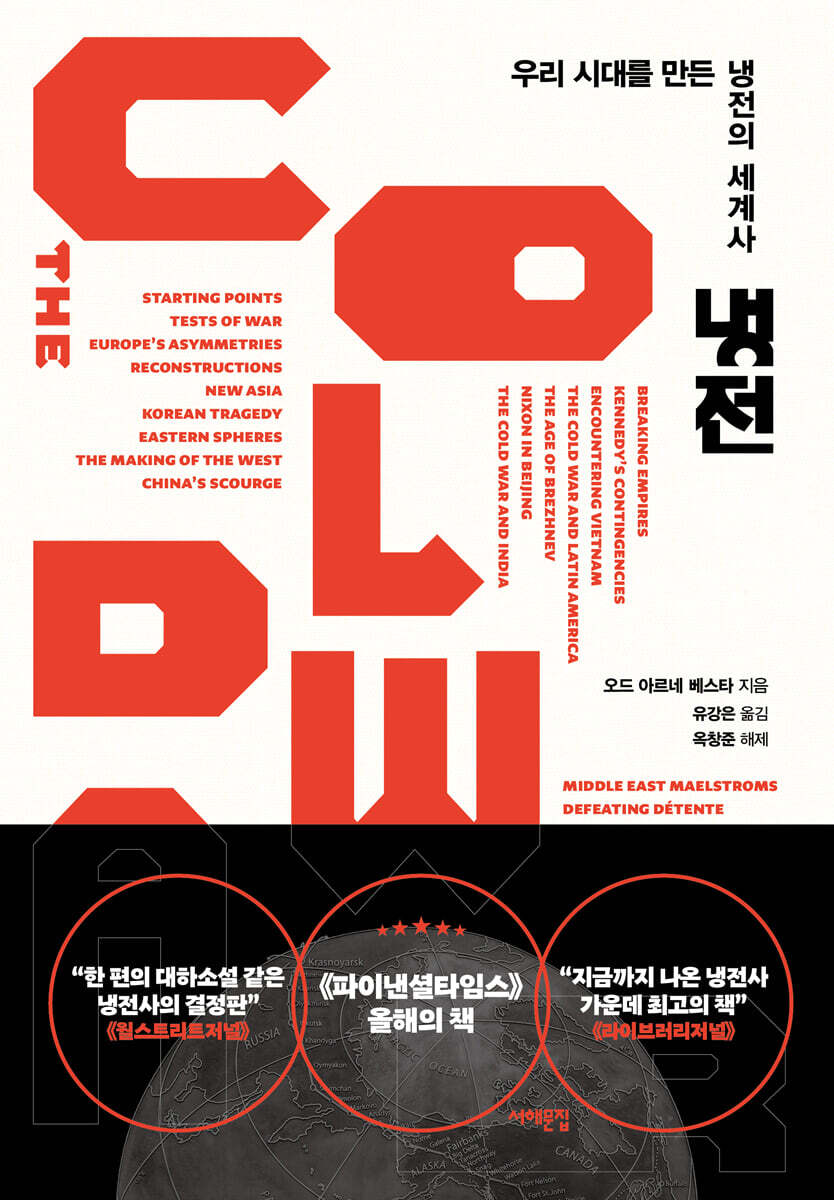
"The definitive Cold War history, like a saga."
The Wall Street Journal
“The best history of the Cold War ever written.”
Library Journal
*** Financial Times "Book of the Year" ***
We tend to think of the Cold War as a conflict with defined boundaries.
It is seen as a clash between the two superpowers, the United States and the Soviet Union, which were born from the ashes of World War II and dramatically ended with the collapse of the Soviet Union.
But in this weighty book, world-renowned Cold War scholar Odd Arne Vesta argues that the Cold War should be understood as a global ideological confrontation with roots in the Industrial Revolution that continues to reverberate around the world.
Vesta also offers a fresh perspective on a century in which great power rivalries and ideological battles have completely upended every corner of the planet.
The Cold War may have begun on the borders of Europe, but its repercussions were deepest in Asia, Africa, and the Middle East.
In these regions, nearly every community had to choose sides, a choice that still shapes economies and systems around the world.
Today, many regions suffer from environmental threats, social divisions, and ethnic conflicts that arose during the Cold War.
Cold War ideologies influence China, Russia, and the United States.
Iraq and Afghanistan are being destroyed by the belief in a purely military solution that emerged from the Cold War.
Armed with a remarkably broad and apocalyptic perspective, this book broadens our understanding of the Cold War geographically and chronologically, offering a fascinating new history of how the world we know today came into being.
"The definitive Cold War history, like a saga."
The Wall Street Journal
“The best history of the Cold War ever written.”
Library Journal
*** Financial Times "Book of the Year" ***
We tend to think of the Cold War as a conflict with defined boundaries.
It is seen as a clash between the two superpowers, the United States and the Soviet Union, which were born from the ashes of World War II and dramatically ended with the collapse of the Soviet Union.
But in this weighty book, world-renowned Cold War scholar Odd Arne Vesta argues that the Cold War should be understood as a global ideological confrontation with roots in the Industrial Revolution that continues to reverberate around the world.
Vesta also offers a fresh perspective on a century in which great power rivalries and ideological battles have completely upended every corner of the planet.
The Cold War may have begun on the borders of Europe, but its repercussions were deepest in Asia, Africa, and the Middle East.
In these regions, nearly every community had to choose sides, a choice that still shapes economies and systems around the world.
Today, many regions suffer from environmental threats, social divisions, and ethnic conflicts that arose during the Cold War.
Cold War ideologies influence China, Russia, and the United States.
Iraq and Afghanistan are being destroyed by the belief in a purely military solution that emerged from the Cold War.
Armed with a remarkably broad and apocalyptic perspective, this book broadens our understanding of the Cold War geographically and chronologically, offering a fascinating new history of how the world we know today came into being.
- You can preview some of the book's contents.
Preview
index
Preface to the Korean edition
Prologue_ The Formation of the World
1 Starting points
2 The Test of War
3. Imbalances in Europe
4 Reconstruction
5 New Asia
6 Tragedy on the Korean Peninsula
7 Eastern Bloc
8 The Formation of the West
9 Disasters in China
10 Broken Empires
11 Shocking Events of the Kennedy Era
12 Encounter with Vietnam
13 The Cold War and Latin America
14 The Brezhnev era
15 Nixon in Beijing
16 India's Cold War
17 The Swirling Middle East
18. Détente collapses
19 Ominous Signs for Europe
20 Gorbachev
21 Global Transition
22 European Reality
Epilogue: The World Created by the Cold War
Approach and Acknowledgements
Release_ Cold War History as Present History
main
Search
Prologue_ The Formation of the World
1 Starting points
2 The Test of War
3. Imbalances in Europe
4 Reconstruction
5 New Asia
6 Tragedy on the Korean Peninsula
7 Eastern Bloc
8 The Formation of the West
9 Disasters in China
10 Broken Empires
11 Shocking Events of the Kennedy Era
12 Encounter with Vietnam
13 The Cold War and Latin America
14 The Brezhnev era
15 Nixon in Beijing
16 India's Cold War
17 The Swirling Middle East
18. Détente collapses
19 Ominous Signs for Europe
20 Gorbachev
21 Global Transition
22 European Reality
Epilogue: The World Created by the Cold War
Approach and Acknowledgements
Release_ Cold War History as Present History
main
Search
Detailed image

Into the book
As I outline in this book, no region in the world suffered as much as the Korean Peninsula as a result of the Cold War.
The ideological divisions that developed since the late 19th century helped to divide the Korean Peninsula as it struggled to free itself from Japanese colonialism.
And the division of nations on a global scale, especially the conflict between the United States and the Soviet Union, made possible the long-term political division of the Korean Peninsula.
Even more surprising is that the Korean Peninsula remained divided even after the end of the Cold War international system in the early 1990s.
This has dire consequences for the long-term stability of both the Korean Peninsula and East Asia.
So it's no surprise that the Korean Peninsula is the only region in this book to which I devote an entire chapter.
There are two reasons why I decided to cover the Korean Peninsula in one chapter.
The first is the significance and consequences of the Korean War.
The Korean War devastated the Korean Peninsula, solidified the US-Japan alliance, solidified the Soviet-Chinese alliance and the rule of the Chinese Communist Party, and militarized the Cold War worldwide.
Second, it is necessary to understand how the global Cold War, on a much broader scale than the Korean Peninsula, interacted with local powers to produce new, often disastrous, outcomes around the world.
The second reason is just as important as the first.
For too long, the history of the Cold War has been written primarily as a history of the influence of the United States or the Soviet Union on the world.
This book attempts to approach the Cold War as a more critical and comprehensive world history, addressing not only the superpowers but also a variety of actors.
---From the "Korean Edition Preface"
Each chapter of "Cold War" is like a storybook, traveling through the East, West, North, South, and South of world history, comprehensively covering the various aspects of the Cold War.
(…)
If the study of Cold War history up to now has had the character of an academic discipline that debates who is responsible for starting the Cold War and gathers evidence to support this argument, Vesta's work in "Cold War" is decisively different in that it holds the political elites of the international system in the 1990s and 2000s responsible for failing to learn from the Cold War experience.
Vesta understands that the reason we must study world history is to properly live in the present that lies between the past and the future.
Perhaps this point is where Vesta's characteristics as a researcher of "present history" are well reflected, and readers of "Cold War" should keep this point in mind and read actively and critically, rather than simply observing a panorama of events in various parts of the world.
---From "Release"
The United States had emerged as the world's most powerful nation, but it was uncertain what role it should play in the world, beyond its economic significance.
The ideological Cold War between communism and capitalism has already intensified, but it has not yet created a polarized international system of opposing states.
--- p.68
The United States was as hesitant as the Soviet Union in approaching the new Asia, but its ties to Europe's past colonialism limited its room for maneuver.
Ironically, for a country that often flaunts its anti-colonial legacy, successive postwar US administrations have generally not prioritized anti-colonialism over Cold War concerns.
--- p.227
Massive destruction occurred on the Korean Peninsula.
At least twice the entire country was engulfed in war during military operations.
All the cities were in ruins.
About half of the population became refugees.
Most of the production facilities were destroyed, and starvation was widespread throughout the war.
Those who tried to survive in the city met a grim fate when war came again.
--- p.258
The antagonism between the Chinese Communist Party and the Soviet Union had the potential to transform international politics and shatter the Cold War's dualism.
This could not have happened as long as China was primarily preoccupied with dividing itself during the Cultural Revolution.
But as soon as China emerged from that swamp, the potential for a new global constellation to form also became apparent.
--- p.369
The real tragedy of Vietnam is, of course, Vietnam's own tragedy.
Like the Korean Peninsula, Vietnam was torn apart by the Cold War.
It was partly because of the brutality of the Vietnamese Communist Party and the failure of its development plans, but also because of the American occupation and bombing.
--- p.475
The Cold War in Latin America was fought internally rather than externally.
The focus was on increasingly violent clashes between the far more extreme political right and left.
--- p.509
On February 21, 1972, Nixon arrived in Beijing.
He was the first president in American history to visit China.
With arms control negotiations still underway with the Soviet Union and no end in sight to the Vietnam War, the president needed to make progress on foreign policy.
He was determined to make his visit to China a success.
--- p.574
Ultimately, it was American domestic politics that destroyed détente.
Nixon and Kissinger attempted to manage the Cold War with the Soviet Union beyond what most Americans were willing to accept.
--- p.698
The end of the Cold War was as multi-layered and complex as its origins.
As we've seen in South Africa and Southeast Asia, the end of global conflict has created enormous opportunities for good.
However, not all issues have been resolved, and some regional heritages, such as those of the Korean Peninsula, the Middle East, and the Balkans, still persist.
The ideological divisions that developed since the late 19th century helped to divide the Korean Peninsula as it struggled to free itself from Japanese colonialism.
And the division of nations on a global scale, especially the conflict between the United States and the Soviet Union, made possible the long-term political division of the Korean Peninsula.
Even more surprising is that the Korean Peninsula remained divided even after the end of the Cold War international system in the early 1990s.
This has dire consequences for the long-term stability of both the Korean Peninsula and East Asia.
So it's no surprise that the Korean Peninsula is the only region in this book to which I devote an entire chapter.
There are two reasons why I decided to cover the Korean Peninsula in one chapter.
The first is the significance and consequences of the Korean War.
The Korean War devastated the Korean Peninsula, solidified the US-Japan alliance, solidified the Soviet-Chinese alliance and the rule of the Chinese Communist Party, and militarized the Cold War worldwide.
Second, it is necessary to understand how the global Cold War, on a much broader scale than the Korean Peninsula, interacted with local powers to produce new, often disastrous, outcomes around the world.
The second reason is just as important as the first.
For too long, the history of the Cold War has been written primarily as a history of the influence of the United States or the Soviet Union on the world.
This book attempts to approach the Cold War as a more critical and comprehensive world history, addressing not only the superpowers but also a variety of actors.
---From the "Korean Edition Preface"
Each chapter of "Cold War" is like a storybook, traveling through the East, West, North, South, and South of world history, comprehensively covering the various aspects of the Cold War.
(…)
If the study of Cold War history up to now has had the character of an academic discipline that debates who is responsible for starting the Cold War and gathers evidence to support this argument, Vesta's work in "Cold War" is decisively different in that it holds the political elites of the international system in the 1990s and 2000s responsible for failing to learn from the Cold War experience.
Vesta understands that the reason we must study world history is to properly live in the present that lies between the past and the future.
Perhaps this point is where Vesta's characteristics as a researcher of "present history" are well reflected, and readers of "Cold War" should keep this point in mind and read actively and critically, rather than simply observing a panorama of events in various parts of the world.
---From "Release"
The United States had emerged as the world's most powerful nation, but it was uncertain what role it should play in the world, beyond its economic significance.
The ideological Cold War between communism and capitalism has already intensified, but it has not yet created a polarized international system of opposing states.
--- p.68
The United States was as hesitant as the Soviet Union in approaching the new Asia, but its ties to Europe's past colonialism limited its room for maneuver.
Ironically, for a country that often flaunts its anti-colonial legacy, successive postwar US administrations have generally not prioritized anti-colonialism over Cold War concerns.
--- p.227
Massive destruction occurred on the Korean Peninsula.
At least twice the entire country was engulfed in war during military operations.
All the cities were in ruins.
About half of the population became refugees.
Most of the production facilities were destroyed, and starvation was widespread throughout the war.
Those who tried to survive in the city met a grim fate when war came again.
--- p.258
The antagonism between the Chinese Communist Party and the Soviet Union had the potential to transform international politics and shatter the Cold War's dualism.
This could not have happened as long as China was primarily preoccupied with dividing itself during the Cultural Revolution.
But as soon as China emerged from that swamp, the potential for a new global constellation to form also became apparent.
--- p.369
The real tragedy of Vietnam is, of course, Vietnam's own tragedy.
Like the Korean Peninsula, Vietnam was torn apart by the Cold War.
It was partly because of the brutality of the Vietnamese Communist Party and the failure of its development plans, but also because of the American occupation and bombing.
--- p.475
The Cold War in Latin America was fought internally rather than externally.
The focus was on increasingly violent clashes between the far more extreme political right and left.
--- p.509
On February 21, 1972, Nixon arrived in Beijing.
He was the first president in American history to visit China.
With arms control negotiations still underway with the Soviet Union and no end in sight to the Vietnam War, the president needed to make progress on foreign policy.
He was determined to make his visit to China a success.
--- p.574
Ultimately, it was American domestic politics that destroyed détente.
Nixon and Kissinger attempted to manage the Cold War with the Soviet Union beyond what most Americans were willing to accept.
--- p.698
The end of the Cold War was as multi-layered and complex as its origins.
As we've seen in South Africa and Southeast Asia, the end of global conflict has created enormous opportunities for good.
However, not all issues have been resolved, and some regional heritages, such as those of the Korean Peninsula, the Middle East, and the Balkans, still persist.
--- p.805
Publisher's Review
A history of the impact of the Cold War on the world.
The definitive edition of Cold War history
In this book, the author evaluates the Cold War as a global phenomenon from a 100-year perspective.
The purpose of looking at the Cold War through a 100-year lens is to understand how the conflict between socialism and capitalism influenced and influenced the global situation on a grand scale.
To understand why conflicts of this kind recurred throughout the 20th century, and why all other contenders for material or ideological power had to be involved in them.
In particular, it is crucial to recognize the intensity of the economic, social, and technological changes that formed the backdrop to the Cold War.
Over the past century, from the 1890s to the 1990s, we have seen global markets emerge and be destroyed at a dizzying pace.
During this period, we witnessed the birth of many technologies that previous generations could only dream of.
Some technologies have been used to enhance humanity's ability to dominate and exploit others.
We have also experienced a period of remarkable rapid change in global lifestyles, with increased mobility and urbanization occurring almost everywhere.
Meanwhile, the Cold War was about the rise and consolidation of American power.
The Cold War also meant more than that.
It was soon a question of the defeat of Soviet-style communism and the triumph of a democratic consensus in Europe, institutionalized through the European Union.
In China, the Cold War meant a political and social revolution carried out by the Chinese Communist Party.
In Latin America, the Cold War meant that societies became increasingly polarized along the ideological divisions of the Cold War.
This book seeks to illustrate the significance of the Cold War between capitalism and socialism on a global scale, in all its diverse aspects and sometimes confusing contradictions.
Each chapter of "Cold War" is like a storybook, traveling through the East, West, North, South, and South of world history, comprehensively covering the various aspects of the Cold War.
(…) If the study of Cold War history up to now has had the character of an academic discipline that debates over who is responsible for starting the Cold War and gathers evidence to support this, Vesta’s work in “Cold War” is decisively different in that it holds the political elites of the international system in the 1990s and 2000s responsible for failing to learn from the experience of the Cold War.
Vesta understands that the reason we must study world history is to properly live in the present that lies between the past and the future.
Perhaps this point is where Vesta's characteristics as a researcher of "present history" are well reflected, and readers of "Cold War" should keep this point in mind and read actively and critically, rather than simply observing a panorama of events in various parts of the world.
- From 'Unrelease' (Ok Chang-jun, Professor, Academy of Korean Studies)
The definitive edition of Cold War history
In this book, the author evaluates the Cold War as a global phenomenon from a 100-year perspective.
The purpose of looking at the Cold War through a 100-year lens is to understand how the conflict between socialism and capitalism influenced and influenced the global situation on a grand scale.
To understand why conflicts of this kind recurred throughout the 20th century, and why all other contenders for material or ideological power had to be involved in them.
In particular, it is crucial to recognize the intensity of the economic, social, and technological changes that formed the backdrop to the Cold War.
Over the past century, from the 1890s to the 1990s, we have seen global markets emerge and be destroyed at a dizzying pace.
During this period, we witnessed the birth of many technologies that previous generations could only dream of.
Some technologies have been used to enhance humanity's ability to dominate and exploit others.
We have also experienced a period of remarkable rapid change in global lifestyles, with increased mobility and urbanization occurring almost everywhere.
Meanwhile, the Cold War was about the rise and consolidation of American power.
The Cold War also meant more than that.
It was soon a question of the defeat of Soviet-style communism and the triumph of a democratic consensus in Europe, institutionalized through the European Union.
In China, the Cold War meant a political and social revolution carried out by the Chinese Communist Party.
In Latin America, the Cold War meant that societies became increasingly polarized along the ideological divisions of the Cold War.
This book seeks to illustrate the significance of the Cold War between capitalism and socialism on a global scale, in all its diverse aspects and sometimes confusing contradictions.
Each chapter of "Cold War" is like a storybook, traveling through the East, West, North, South, and South of world history, comprehensively covering the various aspects of the Cold War.
(…) If the study of Cold War history up to now has had the character of an academic discipline that debates over who is responsible for starting the Cold War and gathers evidence to support this, Vesta’s work in “Cold War” is decisively different in that it holds the political elites of the international system in the 1990s and 2000s responsible for failing to learn from the experience of the Cold War.
Vesta understands that the reason we must study world history is to properly live in the present that lies between the past and the future.
Perhaps this point is where Vesta's characteristics as a researcher of "present history" are well reflected, and readers of "Cold War" should keep this point in mind and read actively and critically, rather than simply observing a panorama of events in various parts of the world.
- From 'Unrelease' (Ok Chang-jun, Professor, Academy of Korean Studies)
GOODS SPECIFICS
- Date of issue: March 10, 2025
- Page count, weight, size: 976 pages | 1,398g | 157*218*63mm
- ISBN13: 9791194413233
- ISBN10: 1194413234
You may also like
카테고리
korean


korean

![GQ KOREA Mark (Monthly): December [2025]](http://librairie.coreenne.fr/cdn/shop/files/8ef265dbbfbf186523ed75ba7319009d.jpg?v=1765340328&width=3840)


