

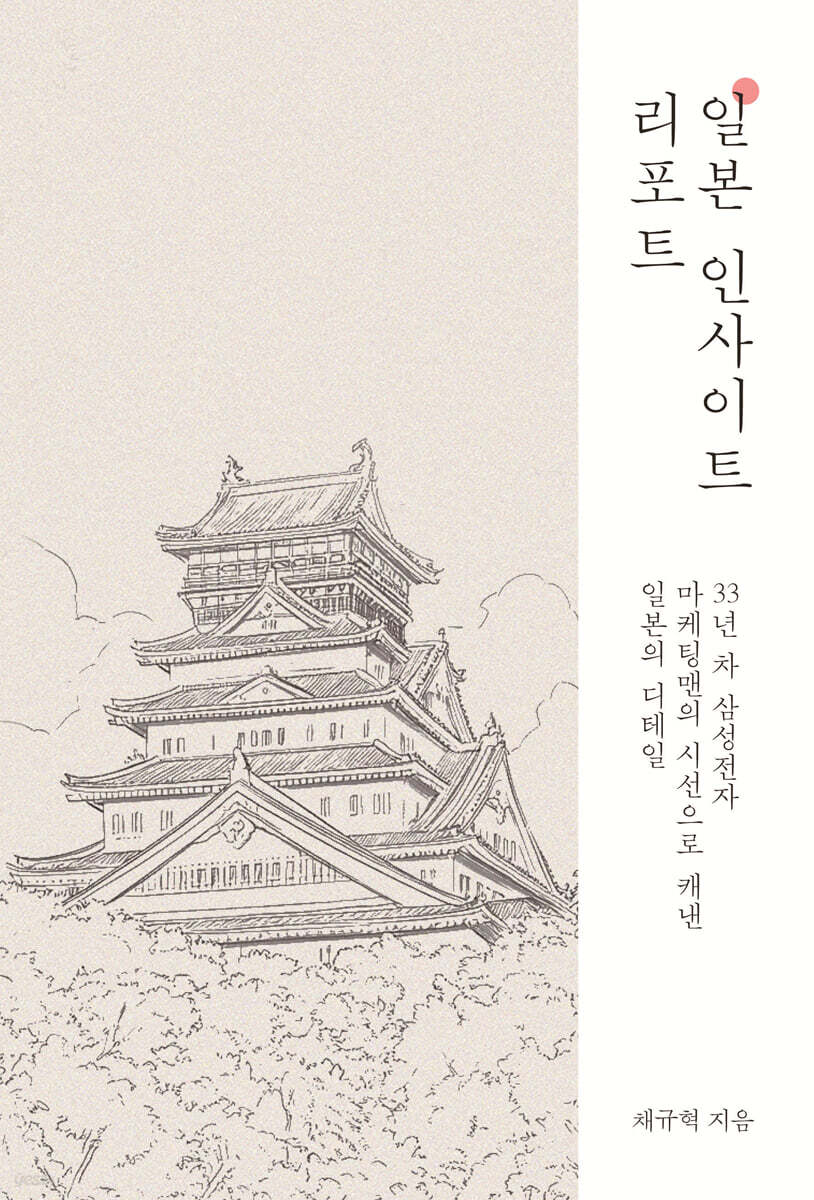
Japan Insight Report
 |
Description
Book Introduction
Overcome Japan by knowing Japan!
A living insightful report on Japanese business and society, crafted with passion by author Chae Gyu-hyeok, a former Samsung Electronics marketing executive with 33 years of experience!
What marketing strategy can accommodate the increasingly sophisticated market landscape and rapidly changing social landscape? The answer may seem surprisingly crude.
It is observation, recording, and insight.
Author Cha Gyu-hyeok, a self-proclaimed marketing expert who worked passionately at Samsung Electronics for 33 years, compiled the insights he gained while living in Osaka for three months after retirement into a book.
The author, who traveled all over Japan by bicycle from Osaka to Kyoto and Nara, covers a wide range of social topics, including Japan's aging society, distribution structure, and urban redevelopment sites, providing readers with a wealth of stories and data that help them understand the present of Japan.
In particular, it presents the direction our society should take and management lessons through the example of Japan, which was the first to experience a super-aged society.
Through this book, readers will gain an understanding of the social and business landscape of Japan, a country so close yet so distant, and gain practical wisdom that can be applied to their own daily lives and management practices.
I recommend this book to anyone seeking to understand Japan and prepare for its future, as well as to readers seeking new marketing insights.
A living insightful report on Japanese business and society, crafted with passion by author Chae Gyu-hyeok, a former Samsung Electronics marketing executive with 33 years of experience!
What marketing strategy can accommodate the increasingly sophisticated market landscape and rapidly changing social landscape? The answer may seem surprisingly crude.
It is observation, recording, and insight.
Author Cha Gyu-hyeok, a self-proclaimed marketing expert who worked passionately at Samsung Electronics for 33 years, compiled the insights he gained while living in Osaka for three months after retirement into a book.
The author, who traveled all over Japan by bicycle from Osaka to Kyoto and Nara, covers a wide range of social topics, including Japan's aging society, distribution structure, and urban redevelopment sites, providing readers with a wealth of stories and data that help them understand the present of Japan.
In particular, it presents the direction our society should take and management lessons through the example of Japan, which was the first to experience a super-aged society.
Through this book, readers will gain an understanding of the social and business landscape of Japan, a country so close yet so distant, and gain practical wisdom that can be applied to their own daily lives and management practices.
I recommend this book to anyone seeking to understand Japan and prepare for its future, as well as to readers seeking new marketing insights.
- You can preview some of the book's contents.
Preview
index
introduction
Part 1
Arriving at Kansai Airport, Japan
First Steps in Exploring Japan
Take the Osaka Loop Line
Japanese street scenes
First TGIF in Japan
Things I want to do in Japan
The two major mountain ranges of Japanese distribution
Japanese police and pachinko
Japanese religion and customs
From Osaka to Kyoto
Part 2
Japanese budget supermarkets
The Battle of Osaka and the 26-meter mountain
Japan's aging population and senior industries
Japan's job market and labor shortage
Go to Nara
Part 3
Freak? Serious? Don Quixote Distribution
Himeji Castle, a World Heritage Site
Japan's second-hand market (1)
Japan's second-hand market (2)
Japanese host culture
Part 4
Osaka, Tokyo, and Mt. Fuji
The Emperor and Yi Bong-chang's Uprising
Tokyo's downtown redevelopment and capsule hotels
Distribution centers near Tokyo and Akihabara
Experience the Korean Wave in Japan
Part 5
Uniqlo and SPA brands
Concluding my trip to Japan
Attachment
Attachment 1.
Current Status of Major Retail Distribution in Japan
Attachment 2.
Senior Market Trend Analysis
Author Interview
Part 1
Arriving at Kansai Airport, Japan
First Steps in Exploring Japan
Take the Osaka Loop Line
Japanese street scenes
First TGIF in Japan
Things I want to do in Japan
The two major mountain ranges of Japanese distribution
Japanese police and pachinko
Japanese religion and customs
From Osaka to Kyoto
Part 2
Japanese budget supermarkets
The Battle of Osaka and the 26-meter mountain
Japan's aging population and senior industries
Japan's job market and labor shortage
Go to Nara
Part 3
Freak? Serious? Don Quixote Distribution
Himeji Castle, a World Heritage Site
Japan's second-hand market (1)
Japan's second-hand market (2)
Japanese host culture
Part 4
Osaka, Tokyo, and Mt. Fuji
The Emperor and Yi Bong-chang's Uprising
Tokyo's downtown redevelopment and capsule hotels
Distribution centers near Tokyo and Akihabara
Experience the Korean Wave in Japan
Part 5
Uniqlo and SPA brands
Concluding my trip to Japan
Attachment
Attachment 1.
Current Status of Major Retail Distribution in Japan
Attachment 2.
Senior Market Trend Analysis
Author Interview
Detailed image

Into the book
“If you actually walk along the streets of Japan, you can see many temples and shrines.
However, I felt that these things were deeply rooted in the lives of Japanese people, as they were unconsciously mixed in with their homes.
In particular, on one road east of Osaka's central Namba area, about two or three blocks away, five or six temples lined up and occupied an entire block.
“I was surprised that temples could be so densely packed in the middle of a big city, breaking the stereotype that temples must be located in the mountains (between Tanimachi 6-chome? and Tanimachi 9-chome? on the Osaka Metro).”
--- p.46
“Actually, the cost of living in Japan is generally similar to that in our country. While the prices of daily necessities are similar, groceries are cheap, and transportation and rent are high.
Why are there so many freeters, even though the cost of living isn't that different from ours? I suspect it's because developed countries offer exceptionally good welfare programs for those classified as unemployed, including unemployment benefits, job placement services, and tax breaks, allowing them to make a living without having to secure full-time employment.
In this way, it seemed that I could work as a freelancer and enjoy my youth for a while if I wanted to.
However, this type of life has led to instability in the future, including old age, and has led to being eliminated from the marriage market, which has become the cause of the long-term increase in the low birth rate.
Moreover, due to young people like these turning away from regular employment, small and medium-sized businesses in Japan have suffered from chronic labor shortages.”
--- p.86
“At the Toyota dealership in Minami Namba that I pass by every day, there were six cars on display on the first and second floors, and two of them were used cars.
At the very front of the entrance on the first and second floors, there was a banner that said "Certified Used Cars" and there was a cover-like thing on the windshield indicating that it was a used car, so I looked back several times to see if this was really a store that sold new cars.
In conclusion, with manufacturers like Toyota, Honda, and Nissan entering the used car market and officially handling these 'certified used cars', the quality of the used car market has improved, and the level of trust has increased as false listings and fraudulent sales (such as selling accident vehicles) have decreased.
“It is also believed that there were positive aspects to the automaker’s ability to maintain the quality level of its used cars, lead the sales price, and even improve its overall brand value.”
--- p.129
“The vulnerability of SPA brands is that they require a certain amount of production routes to order production of products from factories, so it is a high-risk, high-return business model that requires sales routes and sales scale that can exhaust that amount.
However, it appears that the company is breaking through by selling out all of its released products through high-level product rotation, including rapid promotions and price adjustments through direct stores and rapid inventory depletion.
On June 19th, when I actually visited the Uniqlo Osaka Dome City store, there was a promotional flyer celebrating Japan's 'Father's Day' on June 16th posted at the store entrance.
To this end, many special products with a limited time special price of 990 to 1,990 yen were prepared, and intensive promotional efforts were shown, such as by displaying red POP tags that said “New Price” throughout the store.”
--- p.211
What was the most interesting discovery you made while living in Osaka?
While I was in Osaka, I took classes at a study abroad center for three hours every day.
I walked or biked to school, a distance of about 3-4 km.
Thanks to that, I was able to include a lot of what I saw and heard directly in the book.
I intentionally walked down a different street or alley every day to experience the unique Japanese culture that is embedded in every corner of the city.
I learned about issues from community-related organizations through street bulletin boards, and I also analyzed road signs, guidance messages, and roadside signs.
I could read the current trends from the small menu boards outside restaurants and the numerous product descriptions hanging inside shopping malls.
There are many issues in Japan, such as internet gambling, bicycle theft, child traffic accidents, an aging society, voice phishing, and protecting elderly people with dementia.
Based on these clues, I wrote this book by identifying Japan's unique characteristics and issues.
--- From "Author Interview"
What is the most important lesson Korea can learn from Japan's aging society?
As I mentioned in the book, legislation and institutional support for aging populations must be implemented quickly in our country as well.
Japan already mandated retirement at age 65 in 2013, and in 2020, it enacted the "Elderly Employment Stabilization Act," which mandates efforts to guarantee employment opportunities until age 70.
We also increased one axis of the labor supply by rehiring housewives on a part-time basis.
The fact that 52 percent of seniors aged 65 to 69 are participating in the labor market plays a significant role in maintaining their income and health.
On the other hand, in our country, there is currently a 4-5 year interval between retirement at age 60 and receiving a pension.
In the meantime, there are many cases where people lose their income due to not being able to find a suitable job.
It is also important to establish a business foundation that can directly care for the elderly.
In addition to developing nursing care products for the elderly, we must also prepare early for a nursing care insurance system that systematically subsidizes the government by renting these products at relatively low costs or operating clinics.
The same goes for real estate and finance industries that are trying to lower the threshold for Silvertown.
We too must fully prepare for a super-aging society that is changing at a much faster pace than Japan.
--- From "Author Interview"
Was there a place or experience that particularly impressed you during your stay in Japan?
The first was the experience of seeing a monument commemorating the late Lee Su-hyeon inside Shin-Okubo Station in Tokyo.
At approximately 7:15 PM on January 26, 2001, Lee Su-hyeon discovered a person who had fallen onto the tracks and risked his life to save the person.
I just learned that there is a monument related to this accident at Shin-Okubo Station with inscriptions in both Korean and Japanese.
It's been 23 years, but it still hurts my heart.
The second is the experience of learning the facts about Dr. Yun Bong-gil and Osaka Castle.
On April 29, 1932, Dr. Yun Bong-gil successfully assassinated major Japanese war criminals in Hongkou Park, Shanghai.
Afterwards, Dr. Yoon was sentenced to death in Lushun Prison and forcibly sent to Japan, where he stayed for one month in the military prison located within the current Osaka Castle.
Next to it stands a shrine and statue of Toyotomi Hideyoshi.
Korean tourists don't even know this fact and instead take commemorative photos in front of the statue with a V sign.
It was very unfortunate.
The third is visiting the graves of 126,000 Koreans in Kyoto.
It is said that Japanese soldiers cut off the ears and noses of those who died in the war and took them with them, pickling them in salt to use as evidence.
Even after 430 years, the anger still rages.
I was reminded once again that this is a history we must never forget.
The last time I saw Mt. Fuji was at a highway rest stop in the dim dawn of late May.
I witnessed the sight of Mt. Fuji 'flashing' in a bright red light, reflecting the rising sunlight.
I felt lucky that I didn't have to move to see Mt. Fuji.
However, I felt that these things were deeply rooted in the lives of Japanese people, as they were unconsciously mixed in with their homes.
In particular, on one road east of Osaka's central Namba area, about two or three blocks away, five or six temples lined up and occupied an entire block.
“I was surprised that temples could be so densely packed in the middle of a big city, breaking the stereotype that temples must be located in the mountains (between Tanimachi 6-chome? and Tanimachi 9-chome? on the Osaka Metro).”
--- p.46
“Actually, the cost of living in Japan is generally similar to that in our country. While the prices of daily necessities are similar, groceries are cheap, and transportation and rent are high.
Why are there so many freeters, even though the cost of living isn't that different from ours? I suspect it's because developed countries offer exceptionally good welfare programs for those classified as unemployed, including unemployment benefits, job placement services, and tax breaks, allowing them to make a living without having to secure full-time employment.
In this way, it seemed that I could work as a freelancer and enjoy my youth for a while if I wanted to.
However, this type of life has led to instability in the future, including old age, and has led to being eliminated from the marriage market, which has become the cause of the long-term increase in the low birth rate.
Moreover, due to young people like these turning away from regular employment, small and medium-sized businesses in Japan have suffered from chronic labor shortages.”
--- p.86
“At the Toyota dealership in Minami Namba that I pass by every day, there were six cars on display on the first and second floors, and two of them were used cars.
At the very front of the entrance on the first and second floors, there was a banner that said "Certified Used Cars" and there was a cover-like thing on the windshield indicating that it was a used car, so I looked back several times to see if this was really a store that sold new cars.
In conclusion, with manufacturers like Toyota, Honda, and Nissan entering the used car market and officially handling these 'certified used cars', the quality of the used car market has improved, and the level of trust has increased as false listings and fraudulent sales (such as selling accident vehicles) have decreased.
“It is also believed that there were positive aspects to the automaker’s ability to maintain the quality level of its used cars, lead the sales price, and even improve its overall brand value.”
--- p.129
“The vulnerability of SPA brands is that they require a certain amount of production routes to order production of products from factories, so it is a high-risk, high-return business model that requires sales routes and sales scale that can exhaust that amount.
However, it appears that the company is breaking through by selling out all of its released products through high-level product rotation, including rapid promotions and price adjustments through direct stores and rapid inventory depletion.
On June 19th, when I actually visited the Uniqlo Osaka Dome City store, there was a promotional flyer celebrating Japan's 'Father's Day' on June 16th posted at the store entrance.
To this end, many special products with a limited time special price of 990 to 1,990 yen were prepared, and intensive promotional efforts were shown, such as by displaying red POP tags that said “New Price” throughout the store.”
--- p.211
What was the most interesting discovery you made while living in Osaka?
While I was in Osaka, I took classes at a study abroad center for three hours every day.
I walked or biked to school, a distance of about 3-4 km.
Thanks to that, I was able to include a lot of what I saw and heard directly in the book.
I intentionally walked down a different street or alley every day to experience the unique Japanese culture that is embedded in every corner of the city.
I learned about issues from community-related organizations through street bulletin boards, and I also analyzed road signs, guidance messages, and roadside signs.
I could read the current trends from the small menu boards outside restaurants and the numerous product descriptions hanging inside shopping malls.
There are many issues in Japan, such as internet gambling, bicycle theft, child traffic accidents, an aging society, voice phishing, and protecting elderly people with dementia.
Based on these clues, I wrote this book by identifying Japan's unique characteristics and issues.
--- From "Author Interview"
What is the most important lesson Korea can learn from Japan's aging society?
As I mentioned in the book, legislation and institutional support for aging populations must be implemented quickly in our country as well.
Japan already mandated retirement at age 65 in 2013, and in 2020, it enacted the "Elderly Employment Stabilization Act," which mandates efforts to guarantee employment opportunities until age 70.
We also increased one axis of the labor supply by rehiring housewives on a part-time basis.
The fact that 52 percent of seniors aged 65 to 69 are participating in the labor market plays a significant role in maintaining their income and health.
On the other hand, in our country, there is currently a 4-5 year interval between retirement at age 60 and receiving a pension.
In the meantime, there are many cases where people lose their income due to not being able to find a suitable job.
It is also important to establish a business foundation that can directly care for the elderly.
In addition to developing nursing care products for the elderly, we must also prepare early for a nursing care insurance system that systematically subsidizes the government by renting these products at relatively low costs or operating clinics.
The same goes for real estate and finance industries that are trying to lower the threshold for Silvertown.
We too must fully prepare for a super-aging society that is changing at a much faster pace than Japan.
--- From "Author Interview"
Was there a place or experience that particularly impressed you during your stay in Japan?
The first was the experience of seeing a monument commemorating the late Lee Su-hyeon inside Shin-Okubo Station in Tokyo.
At approximately 7:15 PM on January 26, 2001, Lee Su-hyeon discovered a person who had fallen onto the tracks and risked his life to save the person.
I just learned that there is a monument related to this accident at Shin-Okubo Station with inscriptions in both Korean and Japanese.
It's been 23 years, but it still hurts my heart.
The second is the experience of learning the facts about Dr. Yun Bong-gil and Osaka Castle.
On April 29, 1932, Dr. Yun Bong-gil successfully assassinated major Japanese war criminals in Hongkou Park, Shanghai.
Afterwards, Dr. Yoon was sentenced to death in Lushun Prison and forcibly sent to Japan, where he stayed for one month in the military prison located within the current Osaka Castle.
Next to it stands a shrine and statue of Toyotomi Hideyoshi.
Korean tourists don't even know this fact and instead take commemorative photos in front of the statue with a V sign.
It was very unfortunate.
The third is visiting the graves of 126,000 Koreans in Kyoto.
It is said that Japanese soldiers cut off the ears and noses of those who died in the war and took them with them, pickling them in salt to use as evidence.
Even after 430 years, the anger still rages.
I was reminded once again that this is a history we must never forget.
The last time I saw Mt. Fuji was at a highway rest stop in the dim dawn of late May.
I witnessed the sight of Mt. Fuji 'flashing' in a bright red light, reflecting the rising sunlight.
I felt lucky that I didn't have to move to see Mt. Fuji.
--- From "Author Interview"
GOODS SPECIFICS
- Date of issue: January 7, 2024
- Page count, weight, size: 280 pages | 560g | 152*224*17mm
- ISBN13: 9791169296601
- ISBN10: 1169296602
You may also like
카테고리
korean


korean

![GQ KOREA Mark (Monthly): December [2025]](http://librairie.coreenne.fr/cdn/shop/files/8ef265dbbfbf186523ed75ba7319009d.jpg?v=1765340328&width=3840)


