

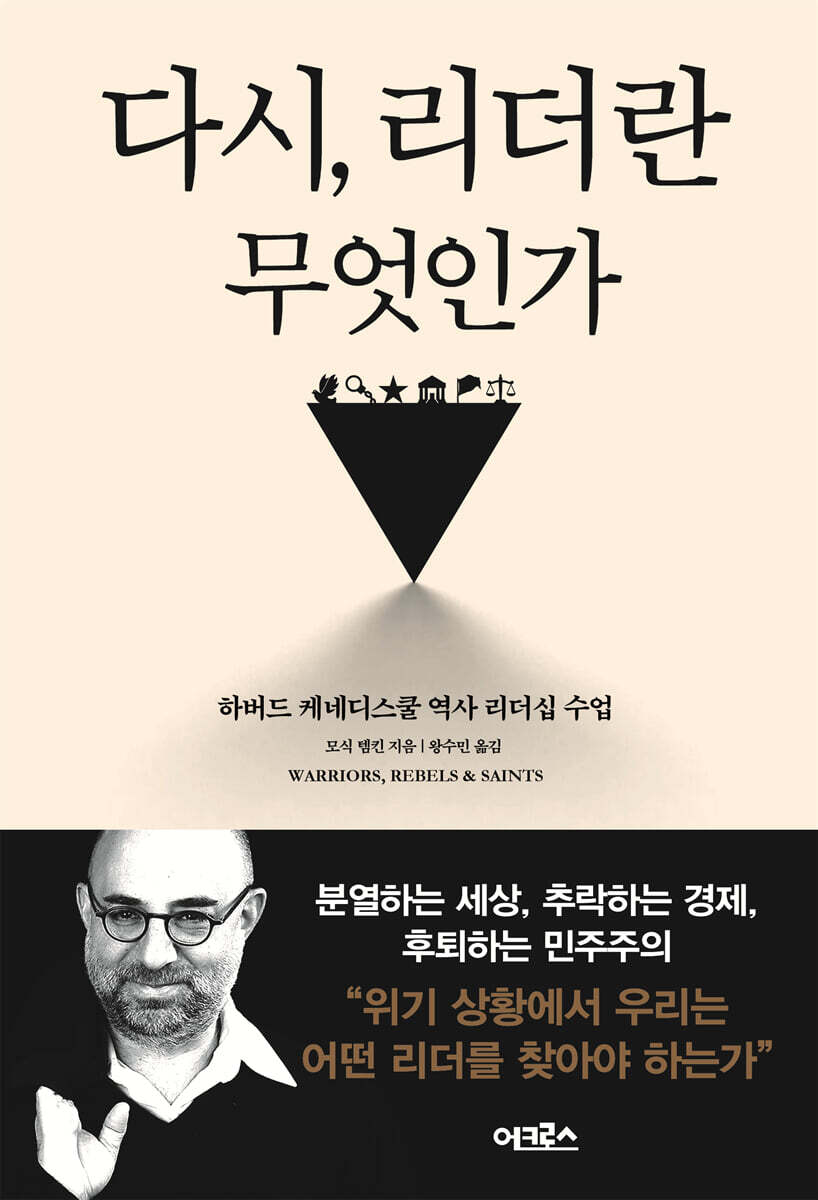
Again, what is a leader?
 |
Description
Book Introduction
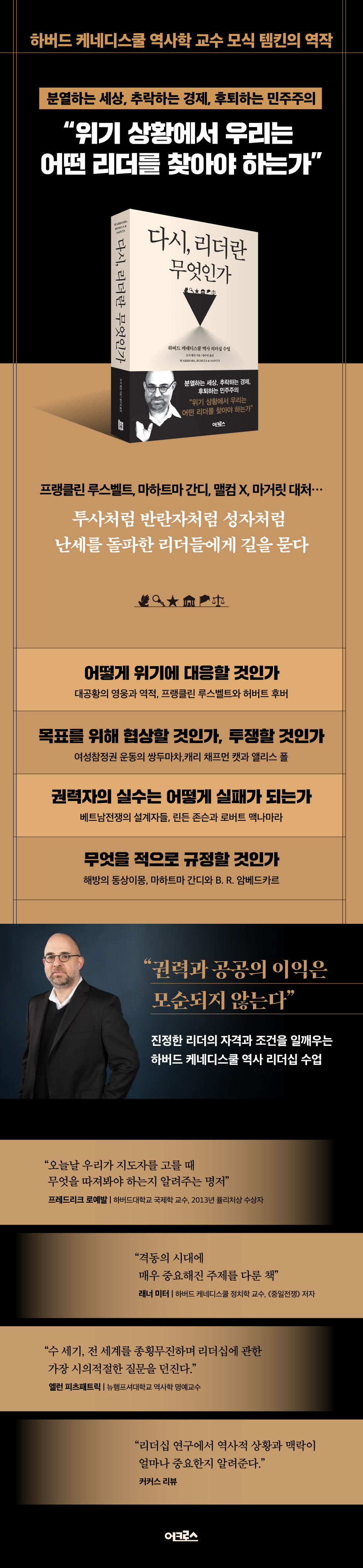
A divided world, a collapsing economy, and a retreating democracy
“What kind of leader should we look for in a crisis?”
Like a fighter, like a rebel, like a saint, he stands against the constraints of the times.
Asking leaders throughout history about their qualifications and requirements for leadership.
◆ A famous lecture that has captivated Harvard Kennedy School for 10 consecutive years
Do leaders make history, or does history make leaders? When a nation's economy is in turmoil, who is the leader we need? Should we negotiate with the established powers to reform society, or should we confront them? What does it mean to challenge the tyranny of a ruthless dictator? What context leads once-wise leaders to make foolish, reckless moves? What lessons does history teach us about this?
Historian Mosik Temkin teaches future leaders around the world at Harvard Kennedy School, exploring core, universal questions about leadership.
Franklin D.
From Roosevelt, 20th-century suffragettes, the French Resistance, Mahatma Gandhi, Martin Luther King and Malcolm X, Robert McNamara, and Margaret Thatcher.
By examining the ways in which various leaders have responded to the call of the times and the impact they have had, we are reminded that understanding a leader's specific context is essential to truly understanding his or her attitudes, actions, judgments, and decisions.
"What is a Leader Again?" is a book based on the Harvard Kennedy School lecture "Leaders and Leadership in History" by Mosik Temkin.
The stories of leaders who faced dark and desperate times head-on like fighters, overturned old systems like rebels, and dedicated themselves to the public good like saints teach us what a true leader is and what kind of leadership we need today.
“What kind of leader should we look for in a crisis?”
Like a fighter, like a rebel, like a saint, he stands against the constraints of the times.
Asking leaders throughout history about their qualifications and requirements for leadership.
◆ A famous lecture that has captivated Harvard Kennedy School for 10 consecutive years
Do leaders make history, or does history make leaders? When a nation's economy is in turmoil, who is the leader we need? Should we negotiate with the established powers to reform society, or should we confront them? What does it mean to challenge the tyranny of a ruthless dictator? What context leads once-wise leaders to make foolish, reckless moves? What lessons does history teach us about this?
Historian Mosik Temkin teaches future leaders around the world at Harvard Kennedy School, exploring core, universal questions about leadership.
Franklin D.
From Roosevelt, 20th-century suffragettes, the French Resistance, Mahatma Gandhi, Martin Luther King and Malcolm X, Robert McNamara, and Margaret Thatcher.
By examining the ways in which various leaders have responded to the call of the times and the impact they have had, we are reminded that understanding a leader's specific context is essential to truly understanding his or her attitudes, actions, judgments, and decisions.
"What is a Leader Again?" is a book based on the Harvard Kennedy School lecture "Leaders and Leadership in History" by Mosik Temkin.
The stories of leaders who faced dark and desperate times head-on like fighters, overturned old systems like rebels, and dedicated themselves to the public good like saints teach us what a true leader is and what kind of leadership we need today.
- You can preview some of the book's contents.
Preview
index
Prologue | A Future Leader Asks a Past Leader
Chapter 1 [Leadership] Do Leaders Make the Times, or Does the Times Make the Leader?
When Machiavelli's Prince Meets the River of Marxist History
Chapter 2 [Panic] Who Will Face the Crisis Head-on?
Heroes and Traitors of the Great Depression: Franklin Roosevelt and Herbert Hoover
Chapter 3 [Reform] Negotiate or Fight for Your Goals
Carrie Chapman Katt and Alice Paul, the two leading figures in the women's suffrage movement.
Chapter 4 [Tyranny] Can You Maintain Your Faith in the Face of Unjust Power?
Those Who Keep the Flame in the Dark: The Resistance and the Mirabal Sisters
Chapter 5 [System] Do we have the will to stop the death machine?
The invisible hand that caused World War II
Chapter 6 [Misjudgment] How Mistakes of Those in Power Become Failures
The Distorted Faces of the Vietnam War: Lyndon Johnson and Robert McNamara
Chapter 7 [Enemy] What should we define as our enemy and fight against?
The different dreams of liberation, Mahatma Gandhi and B.
R. Ambedkar
Chapter 8 [Legacy] How a Leader's Ideals Change the World
Leadership of Confidence and Principle: Margaret Thatcher, Martin Luther King, and Malcolm X
Epilogue | The Leader We Need Now
Acknowledgements
main
Search
Chapter 1 [Leadership] Do Leaders Make the Times, or Does the Times Make the Leader?
When Machiavelli's Prince Meets the River of Marxist History
Chapter 2 [Panic] Who Will Face the Crisis Head-on?
Heroes and Traitors of the Great Depression: Franklin Roosevelt and Herbert Hoover
Chapter 3 [Reform] Negotiate or Fight for Your Goals
Carrie Chapman Katt and Alice Paul, the two leading figures in the women's suffrage movement.
Chapter 4 [Tyranny] Can You Maintain Your Faith in the Face of Unjust Power?
Those Who Keep the Flame in the Dark: The Resistance and the Mirabal Sisters
Chapter 5 [System] Do we have the will to stop the death machine?
The invisible hand that caused World War II
Chapter 6 [Misjudgment] How Mistakes of Those in Power Become Failures
The Distorted Faces of the Vietnam War: Lyndon Johnson and Robert McNamara
Chapter 7 [Enemy] What should we define as our enemy and fight against?
The different dreams of liberation, Mahatma Gandhi and B.
R. Ambedkar
Chapter 8 [Legacy] How a Leader's Ideals Change the World
Leadership of Confidence and Principle: Margaret Thatcher, Martin Luther King, and Malcolm X
Epilogue | The Leader We Need Now
Acknowledgements
main
Search
Detailed image
Into the book
From King David to 20th-century suffragists, Franklin D.
Roosevelt, Malcolm X, Margaret Thatcher, Mahatma Gandhi, and Fela Kuti.
We have carefully examined how leaders operated within and against the constraints of their time.
We also witnessed how stereotypical decision-making can lead to irreversible and tragic consequences.
Among the students, there were quite a few who empathized with each incident as if it were their own.
(……) Through this class, they realized that they are a part of history, that the world is created through history, that the echoes of past events reverberate in present events, and that as a figure in history, they have the power to shape the future, for better or for worse.
--- From "Prologue | Future Leaders Ask Past Leaders"
Hoover was a polished and dignified politician, but there were clear warning signs during his presidency, which was in the midst of the Great Depression.
First of all, Hoover appeared to be a cold person in public.
He never liked superficial contact with the public or interactions with other politicians.
Even when giving a speech, he rarely smiled and had a blank expression on his face.
(……) The worst thing of all was that at a time when everyone was suffering immensely and society itself seemed to be collapsing and disappearing, Hoover seemed completely incapable of feeling the people’s suffering.
He was not capable of empathy to any great degree, nor could he pretend to be.
Roosevelt knew this dynamic all too well, having seen it in real time as fascism swept through Europe, with the Bolsheviks in Russia lurking behind the scenes.
In a roadside talk in April 1938, Roosevelt said:
“There are now several great countries where democracy has disappeared.
It's not that the people of that country hate democracy, but they're tired of unemployment, instability, children starving, a lack of leadership, and an ineffective government that forces them to just sit back and do nothing.
So in the end, in despair, I chose to sacrifice my freedom in the hope of getting my hands on something to eat.”
--- From "Chapter 2 Panic - Who Will Face the Crisis Head-on"
So which of the two is more effective? Which is more valuable? These questions were not the first faced by suffragists, and they have persisted ever since.
What the women's suffrage struggle teaches us about leadership is that there are not just one path to success (or failure), but many, and that the method of struggle we choose when leading people from a position of powerlessness often depends on how people want to fight for their cause.
(……) To win, suffragettes had to be dedicated fighters for their cause, resolute rebels against a social order that would deny them political power and representation, and unyielding saints when self-sacrifice was required.
History proves that when these three combine, there is nothing that can stop them.
--- From "Chapter 3 Reform - Negotiate or Fight for the Goal"
The sad and cruel irony that we learn through Balaguer is that although he was the main beneficiary of the end of the dictatorship, if everyone had behaved like him at the time, Trujillo's dictatorship would never have ended.
(……) Just like the French resistance movement under the Vichy regime, the Trujillo regime did not fall at the hands of Dominican resistance activists, including the Mirabal sisters.
But they knew that it had to start somewhere, and by someone.
If everyone just waits for someone to take on the job, then ultimately no one will step forward.
The core of resistance movements is sometimes quite simple.
Just resisting with action.
--- From "Chapter 4 Tyranny - Can You Keep Your Faith in the Face of Unjust Power"
McNamara, though exceptionally talented, had a fundamentally flawed (and very common) understanding of what public service meant.
Contrary to his beliefs about the world, a good public servant is not one who serves the powerful or is easily swayed by their whims.
A great public servant is one who always serves the people.
A good public servant does not try to exert influence on the world.
Public officials exercise their influence only when it serves the public interest; otherwise, their power is worthless.
This is how public officials become great leaders.
Truly serving in public office is leadership.
Great leadership means performing public duties properly.
--- From "Chapter 6 Misjudgment - How the Mistakes of Those in Power Become Failure"
Looking at the debate surrounding the caste system, beyond the way Gandhi and Ambedkar engaged in political struggles within the context of anti-colonialism, the question arises: how do leaders identify their enemies?
The reason we don't look at Gandhi so 'negatively' is because his image is so vivid and powerful that when we think of Gandhi, we think of non-violence, vegetarianism, and humility.
But what really made him a significant leader in history was his fight against extremely daunting odds.
Gandhi fought fiercely not only against the British Empire and colonialism, but also against divisions, conflicts, and hierarchies within India.
--- From “Chapter 7: The Enemy - What to Define as an Enemy and Fight Against”
King wrote about the classic, narrow-minded arguments that are often heard whenever there is a demand for change: "Now is not the time," or that young people, fearful of the future, should wait patiently while the older generation continues to hold the reins of power.
“History is a long and tragic story of how privileged people rarely give up what they have voluntarily.” These words were aimed at those at the very top of society.
While they demanded that those suffering under them "wait," "be polite" during protests, and "do not commit any illegal acts," they themselves were constantly (falsely) promising people that a brighter future awaited them by upholding various systems and regimes.
To King, it seemed like the true embodiment of the adage, “Justice too long delayed is justice denied.”
Roosevelt, Malcolm X, Margaret Thatcher, Mahatma Gandhi, and Fela Kuti.
We have carefully examined how leaders operated within and against the constraints of their time.
We also witnessed how stereotypical decision-making can lead to irreversible and tragic consequences.
Among the students, there were quite a few who empathized with each incident as if it were their own.
(……) Through this class, they realized that they are a part of history, that the world is created through history, that the echoes of past events reverberate in present events, and that as a figure in history, they have the power to shape the future, for better or for worse.
--- From "Prologue | Future Leaders Ask Past Leaders"
Hoover was a polished and dignified politician, but there were clear warning signs during his presidency, which was in the midst of the Great Depression.
First of all, Hoover appeared to be a cold person in public.
He never liked superficial contact with the public or interactions with other politicians.
Even when giving a speech, he rarely smiled and had a blank expression on his face.
(……) The worst thing of all was that at a time when everyone was suffering immensely and society itself seemed to be collapsing and disappearing, Hoover seemed completely incapable of feeling the people’s suffering.
He was not capable of empathy to any great degree, nor could he pretend to be.
Roosevelt knew this dynamic all too well, having seen it in real time as fascism swept through Europe, with the Bolsheviks in Russia lurking behind the scenes.
In a roadside talk in April 1938, Roosevelt said:
“There are now several great countries where democracy has disappeared.
It's not that the people of that country hate democracy, but they're tired of unemployment, instability, children starving, a lack of leadership, and an ineffective government that forces them to just sit back and do nothing.
So in the end, in despair, I chose to sacrifice my freedom in the hope of getting my hands on something to eat.”
--- From "Chapter 2 Panic - Who Will Face the Crisis Head-on"
So which of the two is more effective? Which is more valuable? These questions were not the first faced by suffragists, and they have persisted ever since.
What the women's suffrage struggle teaches us about leadership is that there are not just one path to success (or failure), but many, and that the method of struggle we choose when leading people from a position of powerlessness often depends on how people want to fight for their cause.
(……) To win, suffragettes had to be dedicated fighters for their cause, resolute rebels against a social order that would deny them political power and representation, and unyielding saints when self-sacrifice was required.
History proves that when these three combine, there is nothing that can stop them.
--- From "Chapter 3 Reform - Negotiate or Fight for the Goal"
The sad and cruel irony that we learn through Balaguer is that although he was the main beneficiary of the end of the dictatorship, if everyone had behaved like him at the time, Trujillo's dictatorship would never have ended.
(……) Just like the French resistance movement under the Vichy regime, the Trujillo regime did not fall at the hands of Dominican resistance activists, including the Mirabal sisters.
But they knew that it had to start somewhere, and by someone.
If everyone just waits for someone to take on the job, then ultimately no one will step forward.
The core of resistance movements is sometimes quite simple.
Just resisting with action.
--- From "Chapter 4 Tyranny - Can You Keep Your Faith in the Face of Unjust Power"
McNamara, though exceptionally talented, had a fundamentally flawed (and very common) understanding of what public service meant.
Contrary to his beliefs about the world, a good public servant is not one who serves the powerful or is easily swayed by their whims.
A great public servant is one who always serves the people.
A good public servant does not try to exert influence on the world.
Public officials exercise their influence only when it serves the public interest; otherwise, their power is worthless.
This is how public officials become great leaders.
Truly serving in public office is leadership.
Great leadership means performing public duties properly.
--- From "Chapter 6 Misjudgment - How the Mistakes of Those in Power Become Failure"
Looking at the debate surrounding the caste system, beyond the way Gandhi and Ambedkar engaged in political struggles within the context of anti-colonialism, the question arises: how do leaders identify their enemies?
The reason we don't look at Gandhi so 'negatively' is because his image is so vivid and powerful that when we think of Gandhi, we think of non-violence, vegetarianism, and humility.
But what really made him a significant leader in history was his fight against extremely daunting odds.
Gandhi fought fiercely not only against the British Empire and colonialism, but also against divisions, conflicts, and hierarchies within India.
--- From “Chapter 7: The Enemy - What to Define as an Enemy and Fight Against”
King wrote about the classic, narrow-minded arguments that are often heard whenever there is a demand for change: "Now is not the time," or that young people, fearful of the future, should wait patiently while the older generation continues to hold the reins of power.
“History is a long and tragic story of how privileged people rarely give up what they have voluntarily.” These words were aimed at those at the very top of society.
While they demanded that those suffering under them "wait," "be polite" during protests, and "do not commit any illegal acts," they themselves were constantly (falsely) promising people that a brighter future awaited them by upholding various systems and regimes.
To King, it seemed like the true embodiment of the adage, “Justice too long delayed is justice denied.”
--- From "Chapter 8 Legacy - How a Leader's Ideal Changes the World"
Publisher's Review
◆ A masterpiece by Harvard Kennedy School history professor Mosik Temkin
Praise from world-renowned scholars like Frederick Rojebal, Lanner Mitter, and Ellen Fitzpatrick
A divided world, a collapsing economy, and a retreating democracy
What kind of leader should we look for in a crisis?
Like a fighter, like a rebel, like a saint, he stands against the constraints of the times.
Asking leaders throughout history about their qualifications and requirements for leadership.
It is a difficult time that will be remembered in history.
The seemingly solid foundations of democracy are being shaken, and society is becoming increasingly filled with conflict, hatred, and division.
The prolonged recession and endless wars that have swept the world are further exacerbating anxiety and fear.
Now, faced with an unprecedented leadership vacuum, we cannot help but ask:
What should a leader for the people be like?
What kind of leadership do we want and need now?
How can we recognize such a leader?
Harvard Kennedy School history professor Mosik Temkin finds clues in the leaders and decisions made throughout history.
Franklin Roosevelt, who defended the New Deal policy despite its minimal economic impact, even resorting to expedients; the Mirabal sisters, who resolutely rebelled against Rafael Trujillo's chilling tyranny; and the architects of World War II and the Vietnam War, who foresaw the mass murder of civilians and yet carried out their attacks.
The leaders discussed in this book range from those in power within the institutional system, such as presidents, prime ministers, and government officials, to those in the field, such as leaders of social reform, resistance movements, and anti-colonial movements.
The implications of the stories of leaders who fought like warriors, challenged like rebels, and devoted themselves like saints in the face of the constraints imposed by history are clear.
The truth is that there is not just one path to success (or failure) for a leader, but many, and that the same choice can produce different results depending on the situation.
Above all, it reminds us that power and the public interest are not contradictory, and that fighting for the public interest is the most powerful authority a leader possesses.
Rather than providing superficial formulas or guidelines, this book delves into the essence of leadership and the decisions of leaders within a historical context, providing a valuable treasure trove of wisdom for both leaders and those tasked with selecting leaders.
Harvard Kennedy School's prestigious lecture for 10 consecutive years
Ultimately, both choice and responsibility lie with the leader.
Leadership Thought Experiments for Making the Best Decisions
With a tradition spanning over 90 years, the Harvard Kennedy School is considered one of the best public policy schools, having produced former U.S. President Barack Obama, former British Prime Minister David Cameron, and former UN Secretary-General Ban Ki-moon.
At this place, a cradle of future leaders around the world, Temkin has taught "Leaders and Leadership in History" for ten years, meeting thousands of students.
This course was, in a word, a 'thought experiment' for leaders.
Professor Temkin uses a vast array of audiovisual materials, including novels, speeches, films, music, and photographs, to vividly portray the desperate situations and moments of agony faced by leaders throughout history.
Watching Jean-Pierre Melville's film Army of Shadows, students were reminded of the stark choices faced by ordinary French citizens during the Nazi occupation, and reading the minutes of the Imperial meeting between Emperor Hirohito and high-ranking Japanese officials just before the attack on Pearl Harbor in late 1941, they understood how the Empire's distorted perceptions paralyzed rational discussion and process.
This book, an extension of Professor Temkin's lecture, "Leaders and Leadership in History," is enriched with thought experiments and case studies to help today's leaders make better choices and optimal decisions.
In addition, it categorizes various crisis situations that leaders may face into panic, reform, tyranny, system, misjudgment, opposition, and miscalculation, and provides more specific lessons.
When the economy collapses, "fixers" like Roosevelt emerge.
A new theory of monarchy that accurately captures the public sentiment of the troubled times
In times of severe economic hardship, people have no interest in their leaders' political ideology.
What matters is who faces the crisis head-on, explains the situation, and proposes solutions.
The author focuses on two presidents who led the United States during the Great Depression.
One is Franklin Roosevelt, the only president in American history to win four terms, and the other is Herbert Hoover, considered the most unpopular president in American history.
Herbert Hoover, a traditional conservative, was unable or unwilling to recognize or acknowledge the structural problems of the American economy when the Great Depression struck.
They simply advocated for principles, drastically reduced government spending to maintain fiscal soundness, and consistently suppressed protests by starving veterans with force.
Roosevelt, who succeeded Hoover as president, was the exact opposite.
Roosevelt exerted tremendous momentum, passing 76 bills, including the New Deal, within 100 days of taking office.
His focus was not on ideological beliefs but on improving people's lives in practical ways, and he took radical steps to achieve this, such as introducing a wealth tax that would impose taxes of up to 75% on the super-rich.
People thought Hoover's words, "Prosperity awaits us just around the corner," were cold and indifferent, but Roosevelt's words, "We have nothing to fear but fear itself," were met with tears of joy and cheers.
The author points out that the most crucial difference between Hoover and Roosevelt's success or failure as leaders lies in their crisis response methods and their ability to empathize.
What is most important is how sincerely we respond to the public suffering from economic hardship and despair, and how concrete solutions we propose and implement for their livelihoods.
How a Leader's Ideals Change the World
What kind of leader will we elect?
Beasts leave their skins behind, and people leave their names behind.
And leaders leave a legacy.
Becoming a leader is not simply a matter of occupying a high position.
This is because a leader's ideals, calling, and worldview determine the direction of a society, and sometimes an era.
Margaret Thatcher, former Prime Minister of the United Kingdom, is as famous for Thatcherism as she is for her nickname, the 'Iron Lady'.
Thatcherism is more of a worldview than a political line.
Thatcher believed that there was no such thing as 'society', only individuals and families.
While opinions on Thatcher and her actions are polarized, no one can deny that her legacy has had a profound impact on the discourse that dominates the world today.
In short, that era ushered in a new era of the individual, one in which competition was accepted as human nature and a means of motivation.
Meanwhile, there are people like Robert McNamara who rose to leadership positions without any particular sense of purpose or mission.
He was such a smart and rational person that he created the field of systems analysis in his youth.
When he was Secretary of Defense in the Johnson administration, a cabinet meeting was held regarding the escalation of the Vietnam War.
McNamara read the president's intentions and pushed for an expansion of the war, using his strength, data.
Although he soon realized that the data was wrong, he continued to lie throughout his term that the situation was going well in order to maintain his power and reputation.
The price paid for pursuing power for power's sake was dire.
The Vietnam War cost the lives of 58,000 American soldiers and more than 3 million Vietnamese.
This book closely explores the legacies of leaders throughout history who transformed the world and exerted powerful influence.
Among them, there were those who fought for public causes such as freedom or national liberation, while there were also those who made important decisions simply for their own glory, advancement, or power.
More important than judging whether their legacy is positive or negative is developing the discernment to discern what kind of leaders we need to create the world we each desire.
Praise from world-renowned scholars like Frederick Rojebal, Lanner Mitter, and Ellen Fitzpatrick
A divided world, a collapsing economy, and a retreating democracy
What kind of leader should we look for in a crisis?
Like a fighter, like a rebel, like a saint, he stands against the constraints of the times.
Asking leaders throughout history about their qualifications and requirements for leadership.
It is a difficult time that will be remembered in history.
The seemingly solid foundations of democracy are being shaken, and society is becoming increasingly filled with conflict, hatred, and division.
The prolonged recession and endless wars that have swept the world are further exacerbating anxiety and fear.
Now, faced with an unprecedented leadership vacuum, we cannot help but ask:
What should a leader for the people be like?
What kind of leadership do we want and need now?
How can we recognize such a leader?
Harvard Kennedy School history professor Mosik Temkin finds clues in the leaders and decisions made throughout history.
Franklin Roosevelt, who defended the New Deal policy despite its minimal economic impact, even resorting to expedients; the Mirabal sisters, who resolutely rebelled against Rafael Trujillo's chilling tyranny; and the architects of World War II and the Vietnam War, who foresaw the mass murder of civilians and yet carried out their attacks.
The leaders discussed in this book range from those in power within the institutional system, such as presidents, prime ministers, and government officials, to those in the field, such as leaders of social reform, resistance movements, and anti-colonial movements.
The implications of the stories of leaders who fought like warriors, challenged like rebels, and devoted themselves like saints in the face of the constraints imposed by history are clear.
The truth is that there is not just one path to success (or failure) for a leader, but many, and that the same choice can produce different results depending on the situation.
Above all, it reminds us that power and the public interest are not contradictory, and that fighting for the public interest is the most powerful authority a leader possesses.
Rather than providing superficial formulas or guidelines, this book delves into the essence of leadership and the decisions of leaders within a historical context, providing a valuable treasure trove of wisdom for both leaders and those tasked with selecting leaders.
Harvard Kennedy School's prestigious lecture for 10 consecutive years
Ultimately, both choice and responsibility lie with the leader.
Leadership Thought Experiments for Making the Best Decisions
With a tradition spanning over 90 years, the Harvard Kennedy School is considered one of the best public policy schools, having produced former U.S. President Barack Obama, former British Prime Minister David Cameron, and former UN Secretary-General Ban Ki-moon.
At this place, a cradle of future leaders around the world, Temkin has taught "Leaders and Leadership in History" for ten years, meeting thousands of students.
This course was, in a word, a 'thought experiment' for leaders.
Professor Temkin uses a vast array of audiovisual materials, including novels, speeches, films, music, and photographs, to vividly portray the desperate situations and moments of agony faced by leaders throughout history.
Watching Jean-Pierre Melville's film Army of Shadows, students were reminded of the stark choices faced by ordinary French citizens during the Nazi occupation, and reading the minutes of the Imperial meeting between Emperor Hirohito and high-ranking Japanese officials just before the attack on Pearl Harbor in late 1941, they understood how the Empire's distorted perceptions paralyzed rational discussion and process.
This book, an extension of Professor Temkin's lecture, "Leaders and Leadership in History," is enriched with thought experiments and case studies to help today's leaders make better choices and optimal decisions.
In addition, it categorizes various crisis situations that leaders may face into panic, reform, tyranny, system, misjudgment, opposition, and miscalculation, and provides more specific lessons.
When the economy collapses, "fixers" like Roosevelt emerge.
A new theory of monarchy that accurately captures the public sentiment of the troubled times
In times of severe economic hardship, people have no interest in their leaders' political ideology.
What matters is who faces the crisis head-on, explains the situation, and proposes solutions.
The author focuses on two presidents who led the United States during the Great Depression.
One is Franklin Roosevelt, the only president in American history to win four terms, and the other is Herbert Hoover, considered the most unpopular president in American history.
Herbert Hoover, a traditional conservative, was unable or unwilling to recognize or acknowledge the structural problems of the American economy when the Great Depression struck.
They simply advocated for principles, drastically reduced government spending to maintain fiscal soundness, and consistently suppressed protests by starving veterans with force.
Roosevelt, who succeeded Hoover as president, was the exact opposite.
Roosevelt exerted tremendous momentum, passing 76 bills, including the New Deal, within 100 days of taking office.
His focus was not on ideological beliefs but on improving people's lives in practical ways, and he took radical steps to achieve this, such as introducing a wealth tax that would impose taxes of up to 75% on the super-rich.
People thought Hoover's words, "Prosperity awaits us just around the corner," were cold and indifferent, but Roosevelt's words, "We have nothing to fear but fear itself," were met with tears of joy and cheers.
The author points out that the most crucial difference between Hoover and Roosevelt's success or failure as leaders lies in their crisis response methods and their ability to empathize.
What is most important is how sincerely we respond to the public suffering from economic hardship and despair, and how concrete solutions we propose and implement for their livelihoods.
How a Leader's Ideals Change the World
What kind of leader will we elect?
Beasts leave their skins behind, and people leave their names behind.
And leaders leave a legacy.
Becoming a leader is not simply a matter of occupying a high position.
This is because a leader's ideals, calling, and worldview determine the direction of a society, and sometimes an era.
Margaret Thatcher, former Prime Minister of the United Kingdom, is as famous for Thatcherism as she is for her nickname, the 'Iron Lady'.
Thatcherism is more of a worldview than a political line.
Thatcher believed that there was no such thing as 'society', only individuals and families.
While opinions on Thatcher and her actions are polarized, no one can deny that her legacy has had a profound impact on the discourse that dominates the world today.
In short, that era ushered in a new era of the individual, one in which competition was accepted as human nature and a means of motivation.
Meanwhile, there are people like Robert McNamara who rose to leadership positions without any particular sense of purpose or mission.
He was such a smart and rational person that he created the field of systems analysis in his youth.
When he was Secretary of Defense in the Johnson administration, a cabinet meeting was held regarding the escalation of the Vietnam War.
McNamara read the president's intentions and pushed for an expansion of the war, using his strength, data.
Although he soon realized that the data was wrong, he continued to lie throughout his term that the situation was going well in order to maintain his power and reputation.
The price paid for pursuing power for power's sake was dire.
The Vietnam War cost the lives of 58,000 American soldiers and more than 3 million Vietnamese.
This book closely explores the legacies of leaders throughout history who transformed the world and exerted powerful influence.
Among them, there were those who fought for public causes such as freedom or national liberation, while there were also those who made important decisions simply for their own glory, advancement, or power.
More important than judging whether their legacy is positive or negative is developing the discernment to discern what kind of leaders we need to create the world we each desire.
GOODS SPECIFICS
- Date of issue: December 13, 2024
- Page count, weight, size: 456 pages | 660g | 150*220*26mm
- ISBN13: 9791167741783
You may also like
카테고리
korean


korean

![GQ KOREA Mark (Monthly): December [2025]](http://librairie.coreenne.fr/cdn/shop/files/8ef265dbbfbf186523ed75ba7319009d.jpg?v=1765340328&width=3840)


