

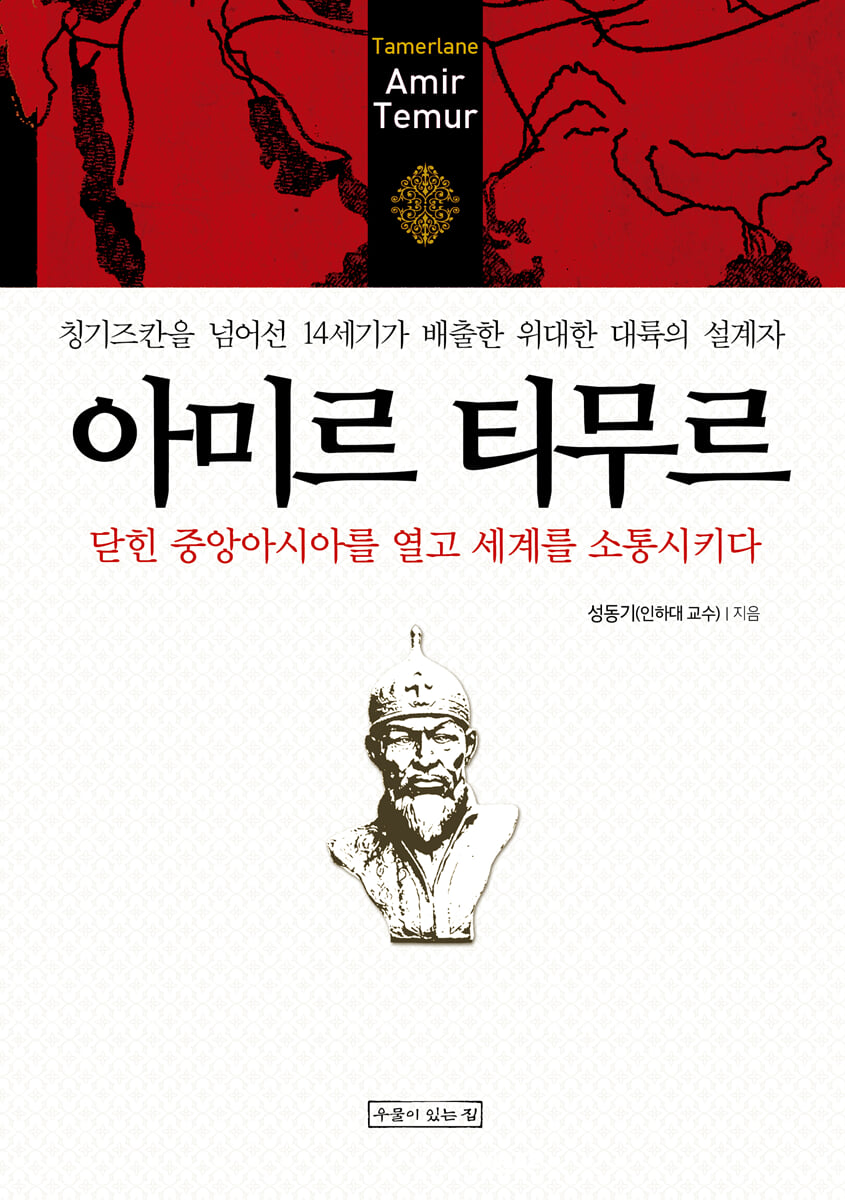
Amir Timur
 |
Description
Book Introduction
Amir Timur, who unified Central Asia
Amir Temur (1336-1405) was the man who made Central Asia the center of the world in the 14th century.
If there had been no Amir Timur, the Central Asia of today, with its multi-ethnic and diverse cultures, would not exist.
He served as a focal point, uniting the various ethnic groups scattered across what is now Central Asia.
If the people who previously ruled Central Asia were foreigners, he unified Central Asia as a member of the Central Asian people born in Central Asia.
His unification inspired other peoples living in Central Asia, and thus enabled the creation of a Central Asia with a culture different from that of Europe, the Middle East, and Asia.
Amir Temur (1336-1405) was the man who made Central Asia the center of the world in the 14th century.
If there had been no Amir Timur, the Central Asia of today, with its multi-ethnic and diverse cultures, would not exist.
He served as a focal point, uniting the various ethnic groups scattered across what is now Central Asia.
If the people who previously ruled Central Asia were foreigners, he unified Central Asia as a member of the Central Asian people born in Central Asia.
His unification inspired other peoples living in Central Asia, and thus enabled the creation of a Central Asia with a culture different from that of Europe, the Middle East, and Asia.
- You can preview some of the book's contents.
Preview
index
Introducing the Revised Edition | The Secret Key to Modern European History: Amir Timur, 8
Prologue│An Army That Only Goes on Expeditions·17
Chapter 1: The Invisible Strategy That Moves the World
1.
Europe's fate hinges on one Muslim. 25
2.
The Muslim Conqueror Loved by the Queen·29
Chapter 2: The Birth of Shahib Kiran
1.
The star that shines once every 800 years, 'Sahibkiran'·39
He Who Ruled the Earth and He Who Ruled Humanity·39
The child called 'Shahib Kiran'·45
2.
Born into a fallen traitor's family·50
The uncle who tried to kill his nephew, 50
A father who turned his back on the world and a mother who passed away early, 53
3.
Central Asian Mongol Civil War, 58
Mongols in the Chagatai Khanate: Jat and Qaraunas·58
Becoming the Next Generation Leader of Karaunas·60
The will of the people is stronger than the will of God. 67
4.
Central Asian Unification War·71
If a desert can support animals, people can too. 71
Amir Timur, 74, became crippled
Mud Battle 77
A Gift from the People·82
Taking over the heart of Eurasia · 87
The Curse of Amir Timur·92
Chapter 3: The Last Conqueror of Mankind
1.
A Nation Created by the Curse of the Forsaken·107
The Departing Rulers·107
Abandoned Compatriots·111
Compatriots, they are another enemy·114
2.
Cut off the head of Islam with the sword of Islam·117
Islam Created by Abandoned Muslims·117
Cut off the head of Islam with the sword of Islam · 124
3.
Descendants of the Mongols Abandon Genghis Khan·127
Nomads Building a Castle · 127
Amir Timur's Code: 'Ulozenia'·130
4.
Save the Heart of the Continent · 135
Destiny to Embark on an Expedition · 135
An army trained for one purpose only·140
5.
Humanity's Last Conqueror: The Great Silk Road Expedition: 170 Days of Winning Streak, 144
Napoleonic artillery in the 14th century·144
The greatest weapon ever created by humans is people. 151
Countries I Want to Tear Apart: Mogolistan and Khorezm·158
Moving the Road: The Russian Expedition · 162
Crossing the Indus: Expeditions to India·170
Cutting Off Religion with the Sword of Religion: The Holy War in Persia and the Middle East · 178
Attaching Europe to Asia: The Ottoman Expeditions, 188
In Search of the Last Remaining Dream, Heading for Mingling·200
6.
Great Figures Erased by World History·206
Evaluation and Standards of Strange History·206
The Bridge of Lost History·209
Chapter 4: Designing a Great Continent
1.
Amir Timur's Leadership·219
Carpet Leadership: The Fabrication of Power·219
Fusion Leadership: Harnessing Power·222
Chess Leadership: The Triumph of Strength · 226
2.
The Nation Created by Amir Timur·230
Multilingual Residents Who Can't Write: Internationalized Residents·230
People who add occupations to their names: All residents are professionals·232
The Largest Metropolitan of the Middle Ages: Oasis Crescent (235)
3.
Samarkand, a 14th-century landmark, 239
A City of Gardens in the Desert·239
There is no ruler on earth who would not want to own Samarkand. 244
Creating a New Urban Paradigm·248
4.
The World Created by Amir Timur·252
Compact World: Making the Earth Lighter · 252
Fusion World: Uniting Humanity's Legacy·260
Epilogue│There Is No Eternal Empire·269
Amir Timur Chronology 273
Major Events in 14th-Century World History·278
Amir Timur's Family Tree·280
Biographical Index·281
References·284
Prologue│An Army That Only Goes on Expeditions·17
Chapter 1: The Invisible Strategy That Moves the World
1.
Europe's fate hinges on one Muslim. 25
2.
The Muslim Conqueror Loved by the Queen·29
Chapter 2: The Birth of Shahib Kiran
1.
The star that shines once every 800 years, 'Sahibkiran'·39
He Who Ruled the Earth and He Who Ruled Humanity·39
The child called 'Shahib Kiran'·45
2.
Born into a fallen traitor's family·50
The uncle who tried to kill his nephew, 50
A father who turned his back on the world and a mother who passed away early, 53
3.
Central Asian Mongol Civil War, 58
Mongols in the Chagatai Khanate: Jat and Qaraunas·58
Becoming the Next Generation Leader of Karaunas·60
The will of the people is stronger than the will of God. 67
4.
Central Asian Unification War·71
If a desert can support animals, people can too. 71
Amir Timur, 74, became crippled
Mud Battle 77
A Gift from the People·82
Taking over the heart of Eurasia · 87
The Curse of Amir Timur·92
Chapter 3: The Last Conqueror of Mankind
1.
A Nation Created by the Curse of the Forsaken·107
The Departing Rulers·107
Abandoned Compatriots·111
Compatriots, they are another enemy·114
2.
Cut off the head of Islam with the sword of Islam·117
Islam Created by Abandoned Muslims·117
Cut off the head of Islam with the sword of Islam · 124
3.
Descendants of the Mongols Abandon Genghis Khan·127
Nomads Building a Castle · 127
Amir Timur's Code: 'Ulozenia'·130
4.
Save the Heart of the Continent · 135
Destiny to Embark on an Expedition · 135
An army trained for one purpose only·140
5.
Humanity's Last Conqueror: The Great Silk Road Expedition: 170 Days of Winning Streak, 144
Napoleonic artillery in the 14th century·144
The greatest weapon ever created by humans is people. 151
Countries I Want to Tear Apart: Mogolistan and Khorezm·158
Moving the Road: The Russian Expedition · 162
Crossing the Indus: Expeditions to India·170
Cutting Off Religion with the Sword of Religion: The Holy War in Persia and the Middle East · 178
Attaching Europe to Asia: The Ottoman Expeditions, 188
In Search of the Last Remaining Dream, Heading for Mingling·200
6.
Great Figures Erased by World History·206
Evaluation and Standards of Strange History·206
The Bridge of Lost History·209
Chapter 4: Designing a Great Continent
1.
Amir Timur's Leadership·219
Carpet Leadership: The Fabrication of Power·219
Fusion Leadership: Harnessing Power·222
Chess Leadership: The Triumph of Strength · 226
2.
The Nation Created by Amir Timur·230
Multilingual Residents Who Can't Write: Internationalized Residents·230
People who add occupations to their names: All residents are professionals·232
The Largest Metropolitan of the Middle Ages: Oasis Crescent (235)
3.
Samarkand, a 14th-century landmark, 239
A City of Gardens in the Desert·239
There is no ruler on earth who would not want to own Samarkand. 244
Creating a New Urban Paradigm·248
4.
The World Created by Amir Timur·252
Compact World: Making the Earth Lighter · 252
Fusion World: Uniting Humanity's Legacy·260
Epilogue│There Is No Eternal Empire·269
Amir Timur Chronology 273
Major Events in 14th-Century World History·278
Amir Timur's Family Tree·280
Biographical Index·281
References·284
Into the book
A child called 'Shahib Kiran'
In 1336, the Yuan Dynasty, the center of the Mongol Empire that ruled mainland China, had extended its power to the Korean Peninsula and was ruling Goryeo under the orders of Kublai Khan.
And in the spring of that year, Eurasian astrologers noticed the third Shahib-Khiran shining over the nameless steppes of Central Asia.
And I knew that soon one would be born who would rule all of humanity.
Eurasian astrologers say that the birth of the ruler of humanity can be known by the appearance of a bright star every 800 years.
That is 'Shahibkiran'.
They claim that when this star first shone, Alexander the Great was born, and when it shone a second time, the Prophet Muhammad was born.
As we know, Alexander the Great ruled half of humanity with the spiritual civilization of Hellenism, and Muhammad ruled half of humanity with Islam.
And in common, they expanded into physical territory.
However, Islam rejected Alexander the Great and Europe rejected Muhammad.
Amir Timur was born on April 9, 1336, in the small village of Kesh (now Shakhrisabz), near Samarkand, the second largest city in present-day Uzbekistan.
His mother, Tekine Hotun, later told her son about the dream she had.
“Once in a dream a very handsome young man who looked like an Arab gave me a knife.
I took it and started swinging it.
But suddenly, a flash of light came from the sword and illuminated the entire world.
As soon as I woke up in the morning, I ran to the wise man and asked him to interpret my dream.
He said that dreams tell destiny.
God said he would send me a son and that son would rule the world.
He said that all Muslims would respect him and that he would brighten up the difficult world.
The dream soon became reality.
God gave you to me.”
--- p.45~47
The army led by Amir Timur and Hussein attacked bravely and captured four fortresses.
Upon hearing this news, the remaining three fortresses surrendered.
However, Malik Mahmud began to fear the abilities of Amir Timur and Hussein, who had conquered the fortress more easily than expected, and heeded the advice of his subordinates that the two would swallow up Seistan whole.
He finally decided to attack Amir Timur and Hussein and launched a large-scale offensive.
For Amir Timur and Hussein, these attacks were not a terrifying threat.
However, a sudden situation made it difficult for him to maintain a stable defense, and he ended up suffering a fatal injury.
He was shot in the right elbow and leg by arrows.
However, despite Amir Timur's injury, the Allied forces repelled Malik Mahmud's attack.
In the Battle of Seistan, Amir Timur seized the opportunity to expand his power, but he suffered fatal injuries to his precious arms and legs, and was destined to live the rest of his life as a cripple.
But this marked the beginning of a legend.
--- p.74~75
Cut off the head of Islam with the sword of Islam
If we apply this phenomenon to modern times, Amir Timur created a third party between the ruling party and the main opposition party.
And by renewing the ruling paradigm of national administration, he presented a third way to the people.
It is a story of a challenge for power by uniting the abandoned people who wanted to overthrow the two great powers of the Mongol Empire and Sunni and Shia Islam.
Amir Timur's pledge to create a new world was to eradicate the evils of Islam.
As-Sid S., a leading scholar on Amir Timur.
AM
Adshead argued that as a Muslim, Amir Timur was a secularist and a modernist, not a fundamentalist.
He did not adhere to the fundamental principle of Islam, the unity of religion and state.
Muhammad, the founder of Islam, was both a religious leader and a political leader.
Therefore, all Islamic countries elected their leaders based on unity between the church and the state.
However, Amir Timur never acknowledged himself as a religious leader and maintained the following policy:
First, the administration of Islam was left entirely to Muslim leaders.
Second, it prohibited Islam from interfering in political affairs and, in fact, excluded the 'Ulema', who had served as traditional political and religious leaders, from government institutions.
Third, he prohibited the establishment of a seminary bearing his name.
He convinced Muslims that the names of Islamic scholars and leaders were appropriate for the names of seminaries, as he was clearly a political leader in the Islamic world and not a religious leader.
A great conqueror and ruler would have wanted to have a symbolic seminary named after him, but Amir Timur had different ideas.
He considered himself an equal Muslim, no different from ordinary people.
Fourth, he did not spare support for the reconstruction of mausoleums to honor the leaders of each sect in order to unite supporters of Sufism.
This was welcome news to Sufis, whose religious activities were centered around the tomb and opposed to the traditional ulema.
In 1336, the Yuan Dynasty, the center of the Mongol Empire that ruled mainland China, had extended its power to the Korean Peninsula and was ruling Goryeo under the orders of Kublai Khan.
And in the spring of that year, Eurasian astrologers noticed the third Shahib-Khiran shining over the nameless steppes of Central Asia.
And I knew that soon one would be born who would rule all of humanity.
Eurasian astrologers say that the birth of the ruler of humanity can be known by the appearance of a bright star every 800 years.
That is 'Shahibkiran'.
They claim that when this star first shone, Alexander the Great was born, and when it shone a second time, the Prophet Muhammad was born.
As we know, Alexander the Great ruled half of humanity with the spiritual civilization of Hellenism, and Muhammad ruled half of humanity with Islam.
And in common, they expanded into physical territory.
However, Islam rejected Alexander the Great and Europe rejected Muhammad.
Amir Timur was born on April 9, 1336, in the small village of Kesh (now Shakhrisabz), near Samarkand, the second largest city in present-day Uzbekistan.
His mother, Tekine Hotun, later told her son about the dream she had.
“Once in a dream a very handsome young man who looked like an Arab gave me a knife.
I took it and started swinging it.
But suddenly, a flash of light came from the sword and illuminated the entire world.
As soon as I woke up in the morning, I ran to the wise man and asked him to interpret my dream.
He said that dreams tell destiny.
God said he would send me a son and that son would rule the world.
He said that all Muslims would respect him and that he would brighten up the difficult world.
The dream soon became reality.
God gave you to me.”
--- p.45~47
The army led by Amir Timur and Hussein attacked bravely and captured four fortresses.
Upon hearing this news, the remaining three fortresses surrendered.
However, Malik Mahmud began to fear the abilities of Amir Timur and Hussein, who had conquered the fortress more easily than expected, and heeded the advice of his subordinates that the two would swallow up Seistan whole.
He finally decided to attack Amir Timur and Hussein and launched a large-scale offensive.
For Amir Timur and Hussein, these attacks were not a terrifying threat.
However, a sudden situation made it difficult for him to maintain a stable defense, and he ended up suffering a fatal injury.
He was shot in the right elbow and leg by arrows.
However, despite Amir Timur's injury, the Allied forces repelled Malik Mahmud's attack.
In the Battle of Seistan, Amir Timur seized the opportunity to expand his power, but he suffered fatal injuries to his precious arms and legs, and was destined to live the rest of his life as a cripple.
But this marked the beginning of a legend.
--- p.74~75
Cut off the head of Islam with the sword of Islam
If we apply this phenomenon to modern times, Amir Timur created a third party between the ruling party and the main opposition party.
And by renewing the ruling paradigm of national administration, he presented a third way to the people.
It is a story of a challenge for power by uniting the abandoned people who wanted to overthrow the two great powers of the Mongol Empire and Sunni and Shia Islam.
Amir Timur's pledge to create a new world was to eradicate the evils of Islam.
As-Sid S., a leading scholar on Amir Timur.
AM
Adshead argued that as a Muslim, Amir Timur was a secularist and a modernist, not a fundamentalist.
He did not adhere to the fundamental principle of Islam, the unity of religion and state.
Muhammad, the founder of Islam, was both a religious leader and a political leader.
Therefore, all Islamic countries elected their leaders based on unity between the church and the state.
However, Amir Timur never acknowledged himself as a religious leader and maintained the following policy:
First, the administration of Islam was left entirely to Muslim leaders.
Second, it prohibited Islam from interfering in political affairs and, in fact, excluded the 'Ulema', who had served as traditional political and religious leaders, from government institutions.
Third, he prohibited the establishment of a seminary bearing his name.
He convinced Muslims that the names of Islamic scholars and leaders were appropriate for the names of seminaries, as he was clearly a political leader in the Islamic world and not a religious leader.
A great conqueror and ruler would have wanted to have a symbolic seminary named after him, but Amir Timur had different ideas.
He considered himself an equal Muslim, no different from ordinary people.
Fourth, he did not spare support for the reconstruction of mausoleums to honor the leaders of each sect in order to unite supporters of Sufism.
This was welcome news to Sufis, whose religious activities were centered around the tomb and opposed to the traditional ulema.
--- p.125~126
Publisher's Review
Amir Timur, the savior of Europe in crisis
If there had been no Amir Timur, perhaps today's Europe would not exist.
At a time when the mighty Ottoman Turks were about to invade Europe, Amir Timur prepared for battle against the Ottoman Turks and won the battle.
And Timur stopped his expedition to the west there.
If Timur, who was always victorious, had continued to run towards Europe without stopping, a different world map would have been drawn.
Timur did not stop there, but rebuilt the Silk Road.
The reconstruction of the Silk Road by Amir Timur made it possible for Europe to once again accept advanced Asian civilization.
This became the spark for the European Renaissance.
Europe developed rapidly by accepting advanced civilizations.
However, communication was blocked again by the Ottoman Turks, who had grown their power, and the Europeans' desire for exchange with the East created the history of the exploration of the New World.
And this made Europe the center of the world.
Amir Timur, a descendant of the Mongol Barlas
Amir Timur's mother died early, and his father was so absorbed in religion that he neglected his family.
Although he grew up alone like a wild horse, he was given the energy of 'Sahibkiran', which the astrologers of the Central Asian steppes call the 'lucky star' that shines once every 800 years, and he was intelligent and brave from a young age, and was already recognized as the next generation leader of the Central Asian Mongols in his youth.
He suffered severe ordeals during the civil wars of his Central Asian compatriots, and was ultimately wounded in the right arm and leg by an arrow during the Battle of Seistan, leaving him with a limp for the rest of his life.
His Western name, Tamerlane, is derived from the name Timur the Lame.
Despite these hardships and adversities, he finally unified Central Asia and became the last conqueror of the continent since Genghis Khan.
He led the multi-ethnic and multi-cultural society of Central Asia, where over 120 ethnic groups coexist, toward communication and harmony, and promoted Islamic Sufism, which arose out of disillusionment with Sunni and Shia, and developed it into a national religion.
Based on his ingenious military strategy and exemplary leadership, he achieved an unprecedented record of not losing a single battle during the 1,000-day Eurasian expedition.
He designed the continent with a new paradigm to achieve the historical mission of reviving the Silk Road.
He made Samarkand, the capital of the empire, the greatest city of its time in the 14th century, and developed the economy, trade, and culture of Eurasia from there.
In particular, in the Battle of Ankara in 1402, the largest battle of the Middle Ages, he devastated the Ottoman Empire, which was looking down on Europe, and became the savior of Europe. Afterwards, European society was able to learn from his strategies and plans for the continent and lay the foundation for the modern era.
Amir Timur, who opened up the closed medieval Central Asia and opened up communication with the world, laying the foundation for the modern era, left to conquer the Ming Dynasty of China in 1404 and died of illness in Otrar.
He was 69 years old.
Although he has since been completely erased from history by someone, his great strategies and designs for the continent still survive and evolve.
A book about the life of Amir Timur, the greatest ruler of the 14th century.
This book is about the great emperor Amir Timur, who was born in the 14th century.
Despite having the largest empire in the world, he is undervalued and not mentioned, so let's take him out of the pages of history and unfold it.
In fact, it is impossible to discuss the beginning and development of the modern era without excluding him, who ruled over the largest area of land in the 14th century.
For example, Zheng He's great voyages after Amir Timur's death, the Italian Renaissance, the starting point of modern Europe, the development of maritime routes by European countries, and the Mughal Empire in India are all deeply related to him.
Western academia largely argues that the Renaissance and subsequent development into modernity in early modern Europe were born of their own capabilities.
However, looking at the literature, it feels like the Middle Ages in Europe are ending today and the modern era in Europe is just beginning tomorrow.
In other words, it feels like a Renaissance came suddenly one day, rather than something that was formed gradually around some foundation.
It is impossible.
How could European society, having experienced the Dark Ages of medieval Christianity for so long, create the vast world of the modern era overnight? The author emphasizes that Amir Timur was at the center of this process.
Readers who read this book on the life of Amir Timur will find the author's arguments to be those of a courageous scholar, and they will find them well-founded.
If there had been no Amir Timur, perhaps today's Europe would not exist.
At a time when the mighty Ottoman Turks were about to invade Europe, Amir Timur prepared for battle against the Ottoman Turks and won the battle.
And Timur stopped his expedition to the west there.
If Timur, who was always victorious, had continued to run towards Europe without stopping, a different world map would have been drawn.
Timur did not stop there, but rebuilt the Silk Road.
The reconstruction of the Silk Road by Amir Timur made it possible for Europe to once again accept advanced Asian civilization.
This became the spark for the European Renaissance.
Europe developed rapidly by accepting advanced civilizations.
However, communication was blocked again by the Ottoman Turks, who had grown their power, and the Europeans' desire for exchange with the East created the history of the exploration of the New World.
And this made Europe the center of the world.
Amir Timur, a descendant of the Mongol Barlas
Amir Timur's mother died early, and his father was so absorbed in religion that he neglected his family.
Although he grew up alone like a wild horse, he was given the energy of 'Sahibkiran', which the astrologers of the Central Asian steppes call the 'lucky star' that shines once every 800 years, and he was intelligent and brave from a young age, and was already recognized as the next generation leader of the Central Asian Mongols in his youth.
He suffered severe ordeals during the civil wars of his Central Asian compatriots, and was ultimately wounded in the right arm and leg by an arrow during the Battle of Seistan, leaving him with a limp for the rest of his life.
His Western name, Tamerlane, is derived from the name Timur the Lame.
Despite these hardships and adversities, he finally unified Central Asia and became the last conqueror of the continent since Genghis Khan.
He led the multi-ethnic and multi-cultural society of Central Asia, where over 120 ethnic groups coexist, toward communication and harmony, and promoted Islamic Sufism, which arose out of disillusionment with Sunni and Shia, and developed it into a national religion.
Based on his ingenious military strategy and exemplary leadership, he achieved an unprecedented record of not losing a single battle during the 1,000-day Eurasian expedition.
He designed the continent with a new paradigm to achieve the historical mission of reviving the Silk Road.
He made Samarkand, the capital of the empire, the greatest city of its time in the 14th century, and developed the economy, trade, and culture of Eurasia from there.
In particular, in the Battle of Ankara in 1402, the largest battle of the Middle Ages, he devastated the Ottoman Empire, which was looking down on Europe, and became the savior of Europe. Afterwards, European society was able to learn from his strategies and plans for the continent and lay the foundation for the modern era.
Amir Timur, who opened up the closed medieval Central Asia and opened up communication with the world, laying the foundation for the modern era, left to conquer the Ming Dynasty of China in 1404 and died of illness in Otrar.
He was 69 years old.
Although he has since been completely erased from history by someone, his great strategies and designs for the continent still survive and evolve.
A book about the life of Amir Timur, the greatest ruler of the 14th century.
This book is about the great emperor Amir Timur, who was born in the 14th century.
Despite having the largest empire in the world, he is undervalued and not mentioned, so let's take him out of the pages of history and unfold it.
In fact, it is impossible to discuss the beginning and development of the modern era without excluding him, who ruled over the largest area of land in the 14th century.
For example, Zheng He's great voyages after Amir Timur's death, the Italian Renaissance, the starting point of modern Europe, the development of maritime routes by European countries, and the Mughal Empire in India are all deeply related to him.
Western academia largely argues that the Renaissance and subsequent development into modernity in early modern Europe were born of their own capabilities.
However, looking at the literature, it feels like the Middle Ages in Europe are ending today and the modern era in Europe is just beginning tomorrow.
In other words, it feels like a Renaissance came suddenly one day, rather than something that was formed gradually around some foundation.
It is impossible.
How could European society, having experienced the Dark Ages of medieval Christianity for so long, create the vast world of the modern era overnight? The author emphasizes that Amir Timur was at the center of this process.
Readers who read this book on the life of Amir Timur will find the author's arguments to be those of a courageous scholar, and they will find them well-founded.
GOODS SPECIFICS
- Date of issue: March 25, 2024
- Page count, weight, size: 288 pages | 148*210*20mm
- ISBN13: 9791190631877
- ISBN10: 1190631873
You may also like
카테고리
korean


korean

![GQ KOREA Mark (Monthly): December [2025]](http://librairie.coreenne.fr/cdn/shop/files/8ef265dbbfbf186523ed75ba7319009d.jpg?v=1765340328&width=3840)


