

Field of lump stones
 |
Description
Book Introduction
Author Kim Dong-woo, captivated by the lives of independence activists, has been visiting independence movement historical sites scattered around the world since 2017, documenting them with photographs and writing. The reporting spanned ten countries: India, Mexico, Cuba, the United States, Russia, the Netherlands, Kazakhstan, Uzbekistan, and Japan, and this book tells the story of the Korean independence movement in Russia and the Netherlands. Primorsky Krai, the land where righteous armies established their base and independence activists continued their exile. There is a story there of people who did not give up hope even in the face of national ruin. The Ahn Jung-geun Danji Alliance Monument, the house and martyrdom site of Choi Jae-hyung, the godfather of the independence movement, the site of the Jayu City Massacre, the '150,000 Won Stealing Incident' which served as the actual motif for the movie 'The Good, the Bad, the Weird', the room where the Hague envoy spent the last days of his life, the first Korean Bolshevik revolutionary, Kim Alexandra, interviews with General Hong Beom-do's granddaughter, Ms. Kim Ala, and Ms. Lee In-seop's youngest daughter, Ms. Svetlana, etc., "The Field of Stones" listens to stories that are slowly disappearing while being excluded from history. The weighty photographs that attempt to capture the narrative and emotions contained within a historical site have value beyond mere records or archival materials. Perhaps we only know the ending of history called 'independence'. This book is an attempt to restore and connect the countless stories that have accumulated to reach that conclusion. Through the author's sincere writing and photographs, you will now feel the 'process' of independence deep within your heart. |
- You can preview some of the book's contents.
Preview
index
Preface | Dreaming of a Reunion of Memories That Will Shake Again
Chapter 1.
Primorsky Krai
Crossing the river risking one's life
Divided into three categories
To escape hardship and into adversity
Chapter 2.
Yeonchu
The scene from that distant day
Choi Jae-hyung, the man known as 'Pechka'
Lee Beom-yoon holding a maple leaf
An Jung-geun's last escape from home
Just, just isn't just
Code in the photo
Original Koreatown
Seo Taiji's "Dreaming of Balhae"
Chapter 3.
Sea cucumber
The sorrow of living with others
Shinhanchon, a mecca for the independence movement
Trampled land
Vladivostok's 'Namnambuknyeo'
Hairpins and rings that went to the Czech Republic
Theft of 150,000 won
The Spy and the Hangul Type Theft Case
The starting point of a great journey
Chapter 4.
The Hague, St. Petersburg
Breathless preparation
Who is Lee Beom-jin?
Unrecorded afterlife
Appeal of the Korean Empire
Lee Jun's Great Country
Erased name
A door that couldn't be opened
Some principles of work
Chapter 5.
Again, Vladivostok
Standing in the field
Jang Do-bin, Awakening Balhae
“Burn everything!”
A photo that asks a question
Struggling on a hill
Hong Beom-do's half-photo
The land of blessings, 'Samanri'
Chapter 6.
Free verse
KGB collaborator
Tragedy behind victory
Free poetry, the swamp of disaster
“I hope we never fight among ourselves again.”
Farewell Waltz
Chapter 7.
Khabarovsk
The Birth of a Female Revolutionary
Resist all discrimination and oppression
Elegant revenge
The person who is not remembered
Leaving the Book | Another Step Toward Practical Art
References
Chapter 1.
Primorsky Krai
Crossing the river risking one's life
Divided into three categories
To escape hardship and into adversity
Chapter 2.
Yeonchu
The scene from that distant day
Choi Jae-hyung, the man known as 'Pechka'
Lee Beom-yoon holding a maple leaf
An Jung-geun's last escape from home
Just, just isn't just
Code in the photo
Original Koreatown
Seo Taiji's "Dreaming of Balhae"
Chapter 3.
Sea cucumber
The sorrow of living with others
Shinhanchon, a mecca for the independence movement
Trampled land
Vladivostok's 'Namnambuknyeo'
Hairpins and rings that went to the Czech Republic
Theft of 150,000 won
The Spy and the Hangul Type Theft Case
The starting point of a great journey
Chapter 4.
The Hague, St. Petersburg
Breathless preparation
Who is Lee Beom-jin?
Unrecorded afterlife
Appeal of the Korean Empire
Lee Jun's Great Country
Erased name
A door that couldn't be opened
Some principles of work
Chapter 5.
Again, Vladivostok
Standing in the field
Jang Do-bin, Awakening Balhae
“Burn everything!”
A photo that asks a question
Struggling on a hill
Hong Beom-do's half-photo
The land of blessings, 'Samanri'
Chapter 6.
Free verse
KGB collaborator
Tragedy behind victory
Free poetry, the swamp of disaster
“I hope we never fight among ourselves again.”
Farewell Waltz
Chapter 7.
Khabarovsk
The Birth of a Female Revolutionary
Resist all discrimination and oppression
Elegant revenge
The person who is not remembered
Leaving the Book | Another Step Toward Practical Art
References
Detailed image
.jpg)
Into the book
History is the foundation of the humanities.
A building without a foundation stone cannot exist.
Shin Chae-ho (1880-1936) once emphasized the importance of history, saying, “If one abandons one’s people, there will be no history, and if one abandons history, a people’s concept of their own country will not be strong.”
This is why we cannot turn away from those who risked their lives to migrate across the river and those who dedicated their lives to the independence movement there.
A present without a past cannot exist, and a future without a present cannot come.
Past, present, and future are like one book.
All other time zones must be connected by a single line on the same line to complete a complete narrative.
The stories that are so heartbreaking must be shared to gain power.
That invisible energy makes you realize who you are, where you came from, and why we are great.
--- p.12, from “Dreaming of a Solidarity of Memories That Will Shake Again”
What does it mean to do something that is so specific that it involves damaging one's body?
The phrase “body, feet, and hands are like parents” appears at the beginning of the classic book on filial piety, “Classic of Filial Piety,” which is said to have been written by Confucius or his disciples.
It means that preserving the body you received from your parents is the first step to filial piety.
Could it be that the people who formed the alliance didn't know that?
It is a different level from 'bob cut' which is just cutting hair.
It is a job that requires seeing blood and enduring extreme pain.
And you have to live your whole life seeing the raw fish with your own eyes.
If so, doesn't that mean that the existence of the country should take priority over the practice of filial piety?
It is a matter of pushing away filial piety as a personal emotion and filling its place with the two letters of independence.
--- p.88, from “Just, Just is Not Just”
I stayed in Vladivostok and went to Shinhanchon as if I was going to work.
The first day, I was at a loss because I had nothing left, the second day, I felt hopeless in the face of disappearance, and the third day, I felt a surge of anger in the face of reality.
We set out to find the site of the house where Lee Dong-hwi spent his final years until his death in 1935.
The traces were replaced by a store building.
The Independence Gate, which was built by Koreans to commemorate the first anniversary of the March 1st Revolution in 1920, now exists only in records.
The only trace is a single sign that reads 'Seoul Sky', meaning 'Seoul Street'.
Where was the Hanmin School playground? Where did Shin Chae-ho write? Where were the spies spying on the independence activists? Did the village, with its campfires blazing, look peaceful despite its inner feelings? Is the only thing that hasn't changed from then to now the magpie's nest on the tree branch?
Still, the reason I couldn't put the camera away was because of the memories this space held.
The reason we can throw a tantrum and ask for some mercy is because there is a power here that connects memories.
--- p.131, from “Trampled Ground”
Even if the Czechoslovakian Legion handed over weapons cheaply, arming an army requires a huge budget.
But, even if an opportunity is right in front of you, you can't just sit there and wait because you don't have the funds.
Someone might have come out with a ring that felt like callused flesh, someone might have brought out a faded hairpin from their sideburns, someone might have brought out a treasure that had been hidden somewhere in their house.
For those who don't have that, wouldn't they have told them to at least take a clay pot?
Otherwise, there would be no reason for Korean rings, silver hairpins, and brass bowls to have flooded the Czech flea markets in the past.
I guess these were other independence funds like Altolan, donated by unknown independence activists.
--- p.152, from “The Hairpin and Ring that Went to the Czech Republic”
The number of people mobilized is known to be around 9,000.
Depending on the situation, horse-drawn carriages were used to transport weapons, and when they encountered frozen ground, sleds were used.
When transporting by march, one person carried four rifles on each shoulder and ran through the rough mountain path, avoiding the snow.
Most of the carriers were farmers.
If the purchase negotiations were delayed, the farmers in Bukgando who had set out to transport the goods would feel anxious about the farming work they had left behind.
If you're unlucky, you might end up having all the weapons you bought stolen by bandits.
Help from the nearby Korean community was essential.
The villagers showed them the way safely and provided them with shelter and food.
At times, he also helped transport weapons.
When the weapons carrier finally reached its destination, the independence fighters would have welcomed them with excited hearts and teary eyes.
The victory in Bongodong and Cheongsanri is the result of these invisible efforts.
--- p.152, from “The Hairpin and Ring that Went to the Czech Republic”
The completely unexpected truth that Eom In-seop is a master spy is revealed.
If we go through the harm he inflicted on our independence movement one by one, we will be so shocked that we will almost burst out in a scream.
One spy is more frightening than a hundred, or even a thousand Japanese soldiers.
How did he, who was praised as a leader of the volunteer army, end up becoming a spy who committed murder?
--- p.164, from “The Secret Agent and the Hangul Type Theft Incident”
The door opened, through which special envoys would have passed, beneath the Taegeukgi fluttering in the wind.
I climbed the stairs to the second floor and walked across the creaking wooden floor.
It was as if that sound was signaling the beginning of time travel.
'Lee Jun-yeol died in this room!' The words written above the door were visible.
The death of Lee Jun, who passed away on the evening of July 14, 1907, remains a mystery to this day.
--- p.196, from “Lee Jun’s Great Country”
That night I had to sleep in a corner chair at the airport.
What movie do you want to watch? Sometimes, when situations like this arise, I just want to quit my work.
Then review the photos you took.
Why does each and every scene look so lonely?
Then, I suddenly become curious about the next filming location.
How empty the space is there?
It's my own way of calming myself down when I want to let go.
--- p.222, from “Some Principles of Work”
Sovietskaya Hill, a little outside the city center.
This is the site where about 400 people were shot during the April Massacre.
It is also presumed that Choi Jae-hyung died here.
While staying in Ussuriysk, I climbed the hillside path every day.
One day I chose the morning breeze, another day when the sun was high in the sky, and another day I chose the twilight hour.
At first, I took pictures honestly, one by one.
There wasn't a single cut that was too much.
Then he shook the camera and fired the strobe like crazy.
If you don't like this either, take out your tripod, put on a filter, and let the time pass.
Later on, I even ran around with a camera.
Every time I climbed the hill, I was faced with a vague feeling and had a hard time finding my way because I didn't know where to go.
All I could do was hold my camera and struggle in front of the slaughterhouse on the hill.
Then, I saw the sun setting next to a cross that had nothing to do with anyone's death and trudged down the hill.
As the steps increased, the question, 'What kind of light did he see that caused his death?', which I couldn't shake off with each step, grew in size.
And the next day, I was forced to climb the hill again in search of the dreams of someone who had not been saved.
--- p.263, from “Struggle on a Hill”
Hong Beom-do, a man as tall as a tree.
His granddaughter, Mrs. Kim Ala, was not officially recognized as Hong Beom-do's blood relative.
Of course, biologically, Hong Beom-do's blood is not mixed in.
To be precise, you should consider them his family.
Because family can be formed without having to share blood.
What matters is not her direct lineage, but any memories she has.
That is why Mrs. Kim Ala's existence is important.
That memory can have power as its own proof.
The gun holster and worn-out photo of Hong Beom-do that she presented are evidence that she wants people to see her as herself.
However, some argue that it is necessary to verify whether they are truly Hong Beom-do's.
The standard by which we look at Mrs. Kim Ala, who was one of the people who had to prove herself and lived through a time when she could not prove herself, is the gaze of whether it is real or fake.
That cold, cruel gaze continues even now.
--- p.276, from “Hong Beom-do’s Half-Seat Photographs”
Leaving the city and heading south along the bumpy dirt road next to the railroad tracks, you will come across Chesnokov Station, the site of the Free City Massacre.
The steam locomotive water tower that remains here, where freight trains mainly stop, is a symbol of the Free City disaster.
Some of the independence fighters were stationed around this water tower in what was once the village of Suraseph.
The water tower must have looked down on the chaos of the bloody and gunpowder-smelling scene, where an unexpected civil war, not a civil war, had broken out.
The sole witness unwittingly became a symbol of the tragedy, bearing the brunt of it all.
--- p.303, from “I hope we never fight among ourselves again”
What I wanted to capture was a photograph that resists oblivion and concealment.
I wanted a single photograph to actively confront oblivion and bring it back to memory.
The past must be understood.
That knowledge must be based on a reflective attitude.
That is the quickest way to clear the haze from oblivion to memory.
I hope that Mrs. Svetlana's hazy face has helped us re-evaluate the past, bringing to mind those who have driven oblivion, and that this story and these photographs have fulfilled their purpose, helping to shape a true map of memory.
A building without a foundation stone cannot exist.
Shin Chae-ho (1880-1936) once emphasized the importance of history, saying, “If one abandons one’s people, there will be no history, and if one abandons history, a people’s concept of their own country will not be strong.”
This is why we cannot turn away from those who risked their lives to migrate across the river and those who dedicated their lives to the independence movement there.
A present without a past cannot exist, and a future without a present cannot come.
Past, present, and future are like one book.
All other time zones must be connected by a single line on the same line to complete a complete narrative.
The stories that are so heartbreaking must be shared to gain power.
That invisible energy makes you realize who you are, where you came from, and why we are great.
--- p.12, from “Dreaming of a Solidarity of Memories That Will Shake Again”
What does it mean to do something that is so specific that it involves damaging one's body?
The phrase “body, feet, and hands are like parents” appears at the beginning of the classic book on filial piety, “Classic of Filial Piety,” which is said to have been written by Confucius or his disciples.
It means that preserving the body you received from your parents is the first step to filial piety.
Could it be that the people who formed the alliance didn't know that?
It is a different level from 'bob cut' which is just cutting hair.
It is a job that requires seeing blood and enduring extreme pain.
And you have to live your whole life seeing the raw fish with your own eyes.
If so, doesn't that mean that the existence of the country should take priority over the practice of filial piety?
It is a matter of pushing away filial piety as a personal emotion and filling its place with the two letters of independence.
--- p.88, from “Just, Just is Not Just”
I stayed in Vladivostok and went to Shinhanchon as if I was going to work.
The first day, I was at a loss because I had nothing left, the second day, I felt hopeless in the face of disappearance, and the third day, I felt a surge of anger in the face of reality.
We set out to find the site of the house where Lee Dong-hwi spent his final years until his death in 1935.
The traces were replaced by a store building.
The Independence Gate, which was built by Koreans to commemorate the first anniversary of the March 1st Revolution in 1920, now exists only in records.
The only trace is a single sign that reads 'Seoul Sky', meaning 'Seoul Street'.
Where was the Hanmin School playground? Where did Shin Chae-ho write? Where were the spies spying on the independence activists? Did the village, with its campfires blazing, look peaceful despite its inner feelings? Is the only thing that hasn't changed from then to now the magpie's nest on the tree branch?
Still, the reason I couldn't put the camera away was because of the memories this space held.
The reason we can throw a tantrum and ask for some mercy is because there is a power here that connects memories.
--- p.131, from “Trampled Ground”
Even if the Czechoslovakian Legion handed over weapons cheaply, arming an army requires a huge budget.
But, even if an opportunity is right in front of you, you can't just sit there and wait because you don't have the funds.
Someone might have come out with a ring that felt like callused flesh, someone might have brought out a faded hairpin from their sideburns, someone might have brought out a treasure that had been hidden somewhere in their house.
For those who don't have that, wouldn't they have told them to at least take a clay pot?
Otherwise, there would be no reason for Korean rings, silver hairpins, and brass bowls to have flooded the Czech flea markets in the past.
I guess these were other independence funds like Altolan, donated by unknown independence activists.
--- p.152, from “The Hairpin and Ring that Went to the Czech Republic”
The number of people mobilized is known to be around 9,000.
Depending on the situation, horse-drawn carriages were used to transport weapons, and when they encountered frozen ground, sleds were used.
When transporting by march, one person carried four rifles on each shoulder and ran through the rough mountain path, avoiding the snow.
Most of the carriers were farmers.
If the purchase negotiations were delayed, the farmers in Bukgando who had set out to transport the goods would feel anxious about the farming work they had left behind.
If you're unlucky, you might end up having all the weapons you bought stolen by bandits.
Help from the nearby Korean community was essential.
The villagers showed them the way safely and provided them with shelter and food.
At times, he also helped transport weapons.
When the weapons carrier finally reached its destination, the independence fighters would have welcomed them with excited hearts and teary eyes.
The victory in Bongodong and Cheongsanri is the result of these invisible efforts.
--- p.152, from “The Hairpin and Ring that Went to the Czech Republic”
The completely unexpected truth that Eom In-seop is a master spy is revealed.
If we go through the harm he inflicted on our independence movement one by one, we will be so shocked that we will almost burst out in a scream.
One spy is more frightening than a hundred, or even a thousand Japanese soldiers.
How did he, who was praised as a leader of the volunteer army, end up becoming a spy who committed murder?
--- p.164, from “The Secret Agent and the Hangul Type Theft Incident”
The door opened, through which special envoys would have passed, beneath the Taegeukgi fluttering in the wind.
I climbed the stairs to the second floor and walked across the creaking wooden floor.
It was as if that sound was signaling the beginning of time travel.
'Lee Jun-yeol died in this room!' The words written above the door were visible.
The death of Lee Jun, who passed away on the evening of July 14, 1907, remains a mystery to this day.
--- p.196, from “Lee Jun’s Great Country”
That night I had to sleep in a corner chair at the airport.
What movie do you want to watch? Sometimes, when situations like this arise, I just want to quit my work.
Then review the photos you took.
Why does each and every scene look so lonely?
Then, I suddenly become curious about the next filming location.
How empty the space is there?
It's my own way of calming myself down when I want to let go.
--- p.222, from “Some Principles of Work”
Sovietskaya Hill, a little outside the city center.
This is the site where about 400 people were shot during the April Massacre.
It is also presumed that Choi Jae-hyung died here.
While staying in Ussuriysk, I climbed the hillside path every day.
One day I chose the morning breeze, another day when the sun was high in the sky, and another day I chose the twilight hour.
At first, I took pictures honestly, one by one.
There wasn't a single cut that was too much.
Then he shook the camera and fired the strobe like crazy.
If you don't like this either, take out your tripod, put on a filter, and let the time pass.
Later on, I even ran around with a camera.
Every time I climbed the hill, I was faced with a vague feeling and had a hard time finding my way because I didn't know where to go.
All I could do was hold my camera and struggle in front of the slaughterhouse on the hill.
Then, I saw the sun setting next to a cross that had nothing to do with anyone's death and trudged down the hill.
As the steps increased, the question, 'What kind of light did he see that caused his death?', which I couldn't shake off with each step, grew in size.
And the next day, I was forced to climb the hill again in search of the dreams of someone who had not been saved.
--- p.263, from “Struggle on a Hill”
Hong Beom-do, a man as tall as a tree.
His granddaughter, Mrs. Kim Ala, was not officially recognized as Hong Beom-do's blood relative.
Of course, biologically, Hong Beom-do's blood is not mixed in.
To be precise, you should consider them his family.
Because family can be formed without having to share blood.
What matters is not her direct lineage, but any memories she has.
That is why Mrs. Kim Ala's existence is important.
That memory can have power as its own proof.
The gun holster and worn-out photo of Hong Beom-do that she presented are evidence that she wants people to see her as herself.
However, some argue that it is necessary to verify whether they are truly Hong Beom-do's.
The standard by which we look at Mrs. Kim Ala, who was one of the people who had to prove herself and lived through a time when she could not prove herself, is the gaze of whether it is real or fake.
That cold, cruel gaze continues even now.
--- p.276, from “Hong Beom-do’s Half-Seat Photographs”
Leaving the city and heading south along the bumpy dirt road next to the railroad tracks, you will come across Chesnokov Station, the site of the Free City Massacre.
The steam locomotive water tower that remains here, where freight trains mainly stop, is a symbol of the Free City disaster.
Some of the independence fighters were stationed around this water tower in what was once the village of Suraseph.
The water tower must have looked down on the chaos of the bloody and gunpowder-smelling scene, where an unexpected civil war, not a civil war, had broken out.
The sole witness unwittingly became a symbol of the tragedy, bearing the brunt of it all.
--- p.303, from “I hope we never fight among ourselves again”
What I wanted to capture was a photograph that resists oblivion and concealment.
I wanted a single photograph to actively confront oblivion and bring it back to memory.
The past must be understood.
That knowledge must be based on a reflective attitude.
That is the quickest way to clear the haze from oblivion to memory.
I hope that Mrs. Svetlana's hazy face has helped us re-evaluate the past, bringing to mind those who have driven oblivion, and that this story and these photographs have fulfilled their purpose, helping to shape a true map of memory.
--- p.352, from “The Unremembered”
Publisher's Review
“Following the traces of the Korean Independence Movement!”
Finding and recording traces of our independence movement that remain around the world
Author Kim Dong-woo's second book, "The Field of Munguridol," has been published!
"The Field of Stones" is a documentary that unearths and records traces of our independence movement left behind in Russia and the Netherlands.
Since 2017, author Kim Dong-woo has been producing the project "In Search of Munguridol," which covers historical sites of the independence movement and descendants of independence activists scattered across various countries.
'Munguridol' is a Korean word meaning a large, round stone, and it originated from Kim Gu's 'Baekbeom Ilji'.
When Kim Gu was imprisoned in Seodaemun Prison, a Japanese policeman tortured him, saying, “Isn’t it natural for a landowner to pick out stones from his fields?”
To that, Kim Gu replied, “Yes, even if I die, I will die with the spirit of Munguridol, and even if I live, I will fulfill the duties of Munguridol.”
Inspired by Kim Gu's words, the author personally visits those who, like a stone, have dedicated their lives to the independence movement.
He has photographed over 300 locations in 10 countries, including India, Mexico, Cuba, the United States, Russia, the Netherlands, Kazakhstan, Uzbekistan, China, Japan, and Korea, and continues to work on them to this day.
In July 2021, he published "The Sea of Munguridol," a compilation of works from the Korean independence movement in India, Mexico, Cuba, and the United States. "The Field of Munguridol" is the second book in the series and tells the story of Russia and the Netherlands.
Primorsky Krai, the holy land of the independence movement, and the activities of socialist independence activists.
The Hague envoy's final journey, the scene of the Great Free City Massacre, the greatest tragedy in the history of the independence movement…
Great independence heroes who failed but never gave up
The story of Munguridol that every Korean must know
Far East Russia, the land bordering the Korean Peninsula.
In 1864, Koreans who crossed the Tumen River to escape famine settled in the Primorsky Krai, establishing a Korean village.
Since then, the Maritime Province has become a land for the survival of Koreans and a base and front line for the anti-Japanese struggle of independence activists who fled to escape Japanese oppression.
The land where hundreds of independence activists were born and died, the land where the provisional government was first established.
There is a story there of people who did not give up hope even in the face of national ruin.
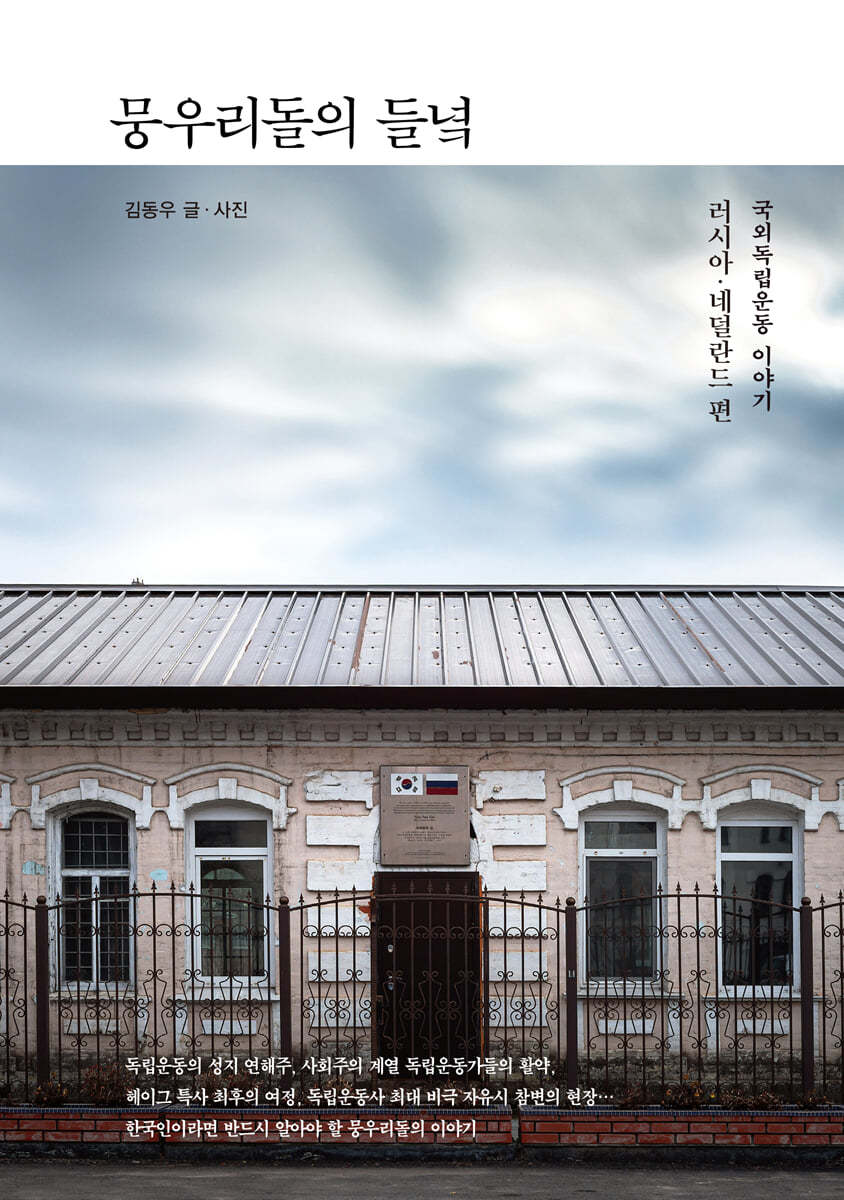
The photo on the cover of this book is of the house of independence activist Choi Jae-hyung.
Many people are familiar with Ahn Jung-geun, but few know of Choi Jae-hyeong, the wealthy man who supported the assassination of Ito Hirobumi in both material and spiritual ways and the godfather of the independence movement in the Maritime Province.
We learned about the Hague envoys in history textbooks, but we don't fully understand the desperation and determination of the envoys who rode the Trans-Siberian Railway all the way to the Netherlands, the end of the Eurasian continent, and what their fate was like as they were never able to return to their homeland.
We also do not properly know about the independence activists of the socialist lineage who were erased due to the ideological conflict that divided the country into the South and the North.
There are also people who have united without hesitation in the face of national crisis.
The common people willingly donated rings, hairpins, and brass bells to arm the independence activists, and this became the basis for the battles of Cheongsan-ri and Bongodong.
The '150,000 Won Theft', which served as the actual motif for the movie 'The Good, the Bad, the Weird', is also set in the Primorsky Krai region.
It also includes interviews with Ms. Kim Ala, the granddaughter of General Hong Beom-do, who was a socialist independence activist and thus was not widely recognized in Korea, and Ms. Svetlana, the youngest daughter of Lee In-seop.
"The Field of Cobblestones" listens to the stories of countless cobblestones, which are slowly disappearing, excluded from history.
A story from not so long ago, from my grandfather's grandfather's time, from my grandmother's grandmother's time...
"Undiscovered records, erased memories, and hidden truths will undoubtedly be found at this site."
Connecting with a fading history in a site that is now nothing but an empty lot
“On the first day, I was at a loss because I had nothing left, on the second day, I felt hopeless in the face of disappearance, and on the third day, I felt a surge of anger in the face of reality.
Still, the reason I couldn't put the camera away was because of the memories this space held.
“The reason I can throw a tantrum and ask for a little attention is because there is a power here that connects memories.” _From the text
"The Field of Stones" is a story about independence activists abroad, and a photographer's fierce struggle to keep their memories alive.
What writer Kim Dong-woo encounters most often when searching for historical sites is empty lots.
If you try to find a historical site with difficulty by relying on a single line of address, most of the time you will only find a shabby monument standing in a desolate state or a desolate empty lot.
Sometimes, unnecessary misunderstandings arise or filming plans get absurdly messed up.
The author says that "historical sites where nothing remains are places that allow photographers freedom," and that he seeks to reconnect with the solidarity of memories by "conveying certain emotions rather than recalling the past" through photography.
I hear a silent scream in the vast fields, and feel for something in the empty space.
So he intentionally takes blurry pictures of historical sites and descendants of independence activists.
It expresses the erased history, but also contains the meaning that it should not be erased and must be remembered.
“There comes a moment when you trudge through the fields, finally reaching your destination only to find a desolate empty lot, or when you realize once again how vain your imagination of someone welcoming you with open arms was.
But that doesn't mean you can just write it down carelessly.
There is a rule that when taking photos one after another, you must use tools that are beyond your capabilities.
If you choose the wrong camera for convenience or to save money, you will probably regret it for a long time.
It wasn't decided or ordered by anyone.
I just wanted to be proud and upright.
To whom? To those of the past who thought of their country before me and brought about the present.
“In Search of the Clump of Stones” is that kind of work for me.” _From the text
The author said in an interview:
“Someone felt that the traces of the people left around the world should be properly recorded.
Independence activists are people who never gave up, even if they failed.
To repay that debt, we must remember history fully.
If people's footsteps do not continue, history will be forgotten.
The fact that footsteps continue means that you remember and that you have the will to remember.
“I want to play a small role in helping people continue to follow in my footsteps.”
In the face of increasingly forgotten historical sites, these weighty photographs, designed to elicit the narrative and emotions they embody, hold value beyond mere records or archiving.
Perhaps we only know the ending of this history called 'independence'.
The photographs, which contain the sincerity of the author who wants to be a mediator of memory, make us feel the 'process' of independence deep in our hearts.
How was this country protected?
The shining status of our independence movement in the grand scale of world history
This book is based on information on overseas independence movement historical sites at the Independence Hall of Korea, and encompasses books, papers, domestic and foreign articles, and various materials to compile the history of our independence movement intertwined with the Korean Peninsula, the Russian Far East, and the Netherlands.
The story unfolds of a strong and poignant independence movement that was built without wavering amidst major world events, including the history of migration that began naturally across the Tumen River, the struggles between Japan, Russia, and China over land, and the interests of each country connected to World War I.
It also covers the bitter history of the Jayu City Massacre, where comrades pointed guns at each other.
Over 96 color photographs vividly depicting the present-day appearance of historical sites of overseas independence movements, along with historical context related to the sites and maps to aid understanding, provide a new, three-dimensional understanding of the history of our independence movement.
In 『Korea's Fight for Freedom』, British journalist Frederick Mackenzie wrote about naked independence activists.
“They looked pitiful.
They were destined to die, and they were fighting for a cause that was completely hopeless.
But I soon saw the commander on my right, and his sparkling eyes and smile seemed to mock my thoughts.
sympathy.
“Maybe they weren’t the ones I should have pitied.”
Our ancestors of the past sacrificed their lives to defend freedom and justice against the invasion of anti-human imperialism.
Reading repeatedly about the misery of the unmanaged field and the upright struggle of our ancestors against Japan causes a clash of conflicting emotions.
And soon, we look back on the history of the independence movement that made today possible and how this country was protected, and realize the importance of recording and remembering history.
“Now, remembering is the independence movement.”
Finding and recording traces of our independence movement that remain around the world
Author Kim Dong-woo's second book, "The Field of Munguridol," has been published!
"The Field of Stones" is a documentary that unearths and records traces of our independence movement left behind in Russia and the Netherlands.
Since 2017, author Kim Dong-woo has been producing the project "In Search of Munguridol," which covers historical sites of the independence movement and descendants of independence activists scattered across various countries.
'Munguridol' is a Korean word meaning a large, round stone, and it originated from Kim Gu's 'Baekbeom Ilji'.
When Kim Gu was imprisoned in Seodaemun Prison, a Japanese policeman tortured him, saying, “Isn’t it natural for a landowner to pick out stones from his fields?”
To that, Kim Gu replied, “Yes, even if I die, I will die with the spirit of Munguridol, and even if I live, I will fulfill the duties of Munguridol.”
Inspired by Kim Gu's words, the author personally visits those who, like a stone, have dedicated their lives to the independence movement.
He has photographed over 300 locations in 10 countries, including India, Mexico, Cuba, the United States, Russia, the Netherlands, Kazakhstan, Uzbekistan, China, Japan, and Korea, and continues to work on them to this day.
In July 2021, he published "The Sea of Munguridol," a compilation of works from the Korean independence movement in India, Mexico, Cuba, and the United States. "The Field of Munguridol" is the second book in the series and tells the story of Russia and the Netherlands.
Primorsky Krai, the holy land of the independence movement, and the activities of socialist independence activists.
The Hague envoy's final journey, the scene of the Great Free City Massacre, the greatest tragedy in the history of the independence movement…
Great independence heroes who failed but never gave up
The story of Munguridol that every Korean must know
Far East Russia, the land bordering the Korean Peninsula.
In 1864, Koreans who crossed the Tumen River to escape famine settled in the Primorsky Krai, establishing a Korean village.
Since then, the Maritime Province has become a land for the survival of Koreans and a base and front line for the anti-Japanese struggle of independence activists who fled to escape Japanese oppression.
The land where hundreds of independence activists were born and died, the land where the provisional government was first established.
There is a story there of people who did not give up hope even in the face of national ruin.
The photo on the cover of this book is of the house of independence activist Choi Jae-hyung.
Many people are familiar with Ahn Jung-geun, but few know of Choi Jae-hyeong, the wealthy man who supported the assassination of Ito Hirobumi in both material and spiritual ways and the godfather of the independence movement in the Maritime Province.
We learned about the Hague envoys in history textbooks, but we don't fully understand the desperation and determination of the envoys who rode the Trans-Siberian Railway all the way to the Netherlands, the end of the Eurasian continent, and what their fate was like as they were never able to return to their homeland.
We also do not properly know about the independence activists of the socialist lineage who were erased due to the ideological conflict that divided the country into the South and the North.
There are also people who have united without hesitation in the face of national crisis.
The common people willingly donated rings, hairpins, and brass bells to arm the independence activists, and this became the basis for the battles of Cheongsan-ri and Bongodong.
The '150,000 Won Theft', which served as the actual motif for the movie 'The Good, the Bad, the Weird', is also set in the Primorsky Krai region.
It also includes interviews with Ms. Kim Ala, the granddaughter of General Hong Beom-do, who was a socialist independence activist and thus was not widely recognized in Korea, and Ms. Svetlana, the youngest daughter of Lee In-seop.
"The Field of Cobblestones" listens to the stories of countless cobblestones, which are slowly disappearing, excluded from history.
A story from not so long ago, from my grandfather's grandfather's time, from my grandmother's grandmother's time...
"Undiscovered records, erased memories, and hidden truths will undoubtedly be found at this site."
Connecting with a fading history in a site that is now nothing but an empty lot
“On the first day, I was at a loss because I had nothing left, on the second day, I felt hopeless in the face of disappearance, and on the third day, I felt a surge of anger in the face of reality.
Still, the reason I couldn't put the camera away was because of the memories this space held.
“The reason I can throw a tantrum and ask for a little attention is because there is a power here that connects memories.” _From the text
"The Field of Stones" is a story about independence activists abroad, and a photographer's fierce struggle to keep their memories alive.
What writer Kim Dong-woo encounters most often when searching for historical sites is empty lots.
If you try to find a historical site with difficulty by relying on a single line of address, most of the time you will only find a shabby monument standing in a desolate state or a desolate empty lot.
Sometimes, unnecessary misunderstandings arise or filming plans get absurdly messed up.
The author says that "historical sites where nothing remains are places that allow photographers freedom," and that he seeks to reconnect with the solidarity of memories by "conveying certain emotions rather than recalling the past" through photography.
I hear a silent scream in the vast fields, and feel for something in the empty space.
So he intentionally takes blurry pictures of historical sites and descendants of independence activists.
It expresses the erased history, but also contains the meaning that it should not be erased and must be remembered.
“There comes a moment when you trudge through the fields, finally reaching your destination only to find a desolate empty lot, or when you realize once again how vain your imagination of someone welcoming you with open arms was.
But that doesn't mean you can just write it down carelessly.
There is a rule that when taking photos one after another, you must use tools that are beyond your capabilities.
If you choose the wrong camera for convenience or to save money, you will probably regret it for a long time.
It wasn't decided or ordered by anyone.
I just wanted to be proud and upright.
To whom? To those of the past who thought of their country before me and brought about the present.
“In Search of the Clump of Stones” is that kind of work for me.” _From the text
The author said in an interview:
“Someone felt that the traces of the people left around the world should be properly recorded.
Independence activists are people who never gave up, even if they failed.
To repay that debt, we must remember history fully.
If people's footsteps do not continue, history will be forgotten.
The fact that footsteps continue means that you remember and that you have the will to remember.
“I want to play a small role in helping people continue to follow in my footsteps.”
In the face of increasingly forgotten historical sites, these weighty photographs, designed to elicit the narrative and emotions they embody, hold value beyond mere records or archiving.
Perhaps we only know the ending of this history called 'independence'.
The photographs, which contain the sincerity of the author who wants to be a mediator of memory, make us feel the 'process' of independence deep in our hearts.
How was this country protected?
The shining status of our independence movement in the grand scale of world history
This book is based on information on overseas independence movement historical sites at the Independence Hall of Korea, and encompasses books, papers, domestic and foreign articles, and various materials to compile the history of our independence movement intertwined with the Korean Peninsula, the Russian Far East, and the Netherlands.
The story unfolds of a strong and poignant independence movement that was built without wavering amidst major world events, including the history of migration that began naturally across the Tumen River, the struggles between Japan, Russia, and China over land, and the interests of each country connected to World War I.
It also covers the bitter history of the Jayu City Massacre, where comrades pointed guns at each other.
Over 96 color photographs vividly depicting the present-day appearance of historical sites of overseas independence movements, along with historical context related to the sites and maps to aid understanding, provide a new, three-dimensional understanding of the history of our independence movement.
In 『Korea's Fight for Freedom』, British journalist Frederick Mackenzie wrote about naked independence activists.
“They looked pitiful.
They were destined to die, and they were fighting for a cause that was completely hopeless.
But I soon saw the commander on my right, and his sparkling eyes and smile seemed to mock my thoughts.
sympathy.
“Maybe they weren’t the ones I should have pitied.”
Our ancestors of the past sacrificed their lives to defend freedom and justice against the invasion of anti-human imperialism.
Reading repeatedly about the misery of the unmanaged field and the upright struggle of our ancestors against Japan causes a clash of conflicting emotions.
And soon, we look back on the history of the independence movement that made today possible and how this country was protected, and realize the importance of recording and remembering history.
“Now, remembering is the independence movement.”
GOODS SPECIFICS
- Date of issue: January 19, 2024
- Format: Hardcover book binding method guide
- Page count, weight, size: 380 pages | 718g | 151*216*25mm
- ISBN13: 9791193238196
- ISBN10: 1193238196
You may also like
카테고리
korean


korean

![GQ KOREA Mark (Monthly): December [2025]](http://librairie.coreenne.fr/cdn/shop/files/8ef265dbbfbf186523ed75ba7319009d.jpg?v=1765340328&width=3840)


