

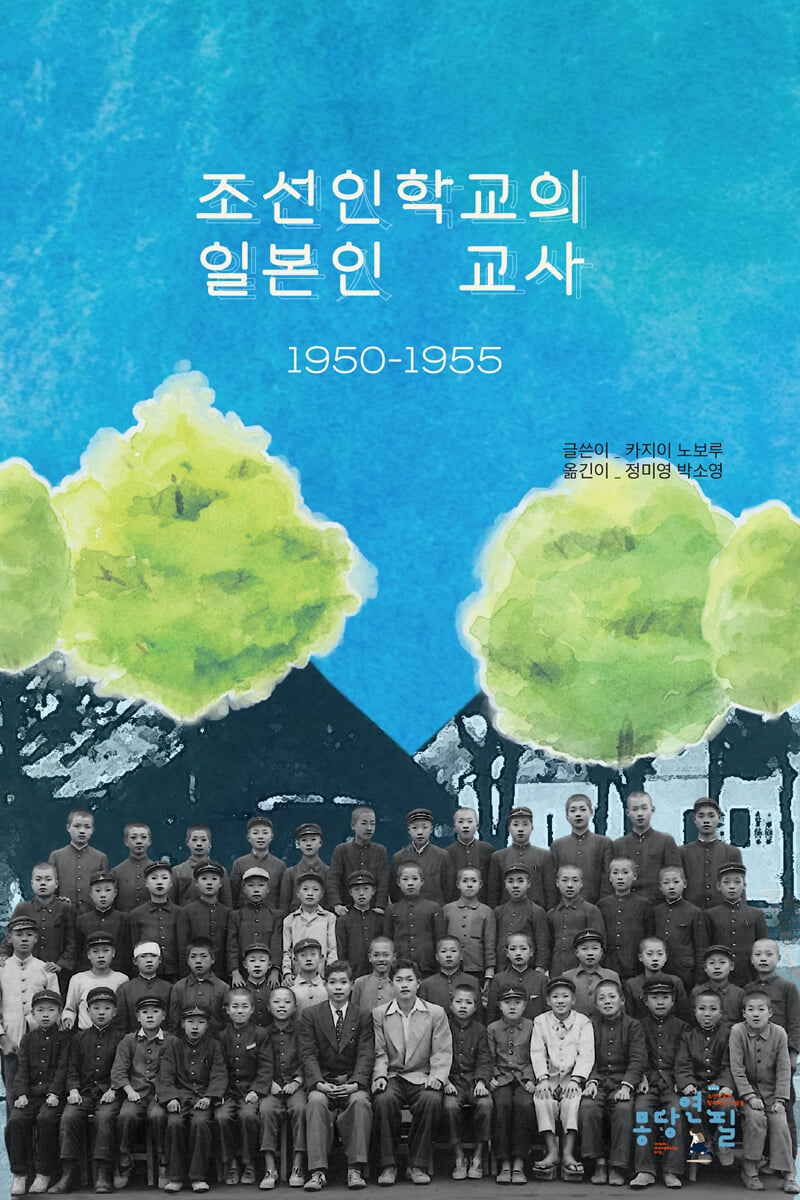
Japanese teachers at Korean schools 1950-1955
 |
Description
Book Introduction
Since the early 2000s, the issue of Korean schools in Japan has emerged as a hot topic among Korean civil society interested in unification, human rights, and education.
I received a lot of requests to give lectures thanks to the movie [Our School].
The focus was on the discrimination inflicted on Korean schools by Japanese society, and the 'April 24 Education Struggle' of 1948 was a regular topic in the history of Korean schools' national education.
The so-called "Struggle to Protect Korean Schools," which led to Japan declaring its first state of emergency since its defeat in the war, seemed at first to result in a victory for Koreans in Japan, but just one year later, in October 1949, the schools were forced to close down with military boots, putting them in danger of disappearing into history.
Then, in May 1955, the General Association of Korean Residents in Japan was formed, and in 1957, the North provided educational aid and a scholarship of 200 million yen, and in 1959, the "Return Movement" (called "North Korea Repatriation" in South Korea) became the catalyst for the revival of Korean schools.
So, what was the state of Korean schools during the six years from 1949 to 1955? Where did the 50,000 Korean children and teachers who attended Korean schools forcibly closed by the General Headquarters (GHQ) and the Japanese government, which occupied Japan at the time, go? Did they simply remain silent or cower during this so-called "dark age of national education"? My limited knowledge leaves me unable to explain the situation at that time.
Then one day, I found this book in a used bookstore in Japan and was shocked when I read it, as if I had found a scene that had been cut out from a movie.
Immediately after the defeat in the war (liberation for us), an ordinary rookie teacher, Noboru Kajii, is assigned to the 'Korean School' after being offered a high salary.
It was the so-called 'public Korean school' (in the case of Tokyo, it was a metropolitan Korean school).
Although it is a Korean school, it is a 'public school' financed and supervised by the Japanese government, but there was no Japanese school willing to accept the numerous Korean children from the forcibly closed Korean schools.
In the end, the school building and students were left as they were, and Japanese teachers were appointed to teach according to the educational policies of the Japanese Ministry of Education (now the Ministry of Education, Culture, Sports, Science and Technology).
So, on the first day that Mr. Kajii took office at the Korean school, he was shocked as if he had been hit in the head with a hammer.
This is because the children refused to attend classes, saying, “How can you teach Koreans when you don’t even know Korean?”
After that, Kajii lived a life as a teacher full of ups and downs, unlike any other Japanese person after the war.
As of 2023, the number of students at Chosun School, as well as the schools themselves, has decreased rapidly.
The Japanese government is still preoccupied with various discrimination and exclusionary policies aimed at eradicating Korean schools, and hate crimes occurring online and in everyday life are becoming increasingly serious.
However, even amidst all this, conscientious Japanese people are willing to stand as shields for Korean schools in each region and join them in calling for the abolition of discrimination against the Japanese government.
It is no exaggeration to say that the protagonist of this book, Mr. Noboru Kajii, was at the very beginning of this movement that continues to this day.
This book vividly and meticulously describes how an ordinary Japanese teacher, Noboru Kajii, survived for six years, often called the "dark ages" or the "public Korean school period," working with Koreans in Japan to protect their national education.
This story will be fascinating to readers interested in Koreans in Japan and Korean schools, and it will also provide a refreshing alternative to those grappling with the unsolvable historical tangles between Korea and Japan.
I received a lot of requests to give lectures thanks to the movie [Our School].
The focus was on the discrimination inflicted on Korean schools by Japanese society, and the 'April 24 Education Struggle' of 1948 was a regular topic in the history of Korean schools' national education.
The so-called "Struggle to Protect Korean Schools," which led to Japan declaring its first state of emergency since its defeat in the war, seemed at first to result in a victory for Koreans in Japan, but just one year later, in October 1949, the schools were forced to close down with military boots, putting them in danger of disappearing into history.
Then, in May 1955, the General Association of Korean Residents in Japan was formed, and in 1957, the North provided educational aid and a scholarship of 200 million yen, and in 1959, the "Return Movement" (called "North Korea Repatriation" in South Korea) became the catalyst for the revival of Korean schools.
So, what was the state of Korean schools during the six years from 1949 to 1955? Where did the 50,000 Korean children and teachers who attended Korean schools forcibly closed by the General Headquarters (GHQ) and the Japanese government, which occupied Japan at the time, go? Did they simply remain silent or cower during this so-called "dark age of national education"? My limited knowledge leaves me unable to explain the situation at that time.
Then one day, I found this book in a used bookstore in Japan and was shocked when I read it, as if I had found a scene that had been cut out from a movie.
Immediately after the defeat in the war (liberation for us), an ordinary rookie teacher, Noboru Kajii, is assigned to the 'Korean School' after being offered a high salary.
It was the so-called 'public Korean school' (in the case of Tokyo, it was a metropolitan Korean school).
Although it is a Korean school, it is a 'public school' financed and supervised by the Japanese government, but there was no Japanese school willing to accept the numerous Korean children from the forcibly closed Korean schools.
In the end, the school building and students were left as they were, and Japanese teachers were appointed to teach according to the educational policies of the Japanese Ministry of Education (now the Ministry of Education, Culture, Sports, Science and Technology).
So, on the first day that Mr. Kajii took office at the Korean school, he was shocked as if he had been hit in the head with a hammer.
This is because the children refused to attend classes, saying, “How can you teach Koreans when you don’t even know Korean?”
After that, Kajii lived a life as a teacher full of ups and downs, unlike any other Japanese person after the war.
As of 2023, the number of students at Chosun School, as well as the schools themselves, has decreased rapidly.
The Japanese government is still preoccupied with various discrimination and exclusionary policies aimed at eradicating Korean schools, and hate crimes occurring online and in everyday life are becoming increasingly serious.
However, even amidst all this, conscientious Japanese people are willing to stand as shields for Korean schools in each region and join them in calling for the abolition of discrimination against the Japanese government.
It is no exaggeration to say that the protagonist of this book, Mr. Noboru Kajii, was at the very beginning of this movement that continues to this day.
This book vividly and meticulously describes how an ordinary Japanese teacher, Noboru Kajii, survived for six years, often called the "dark ages" or the "public Korean school period," working with Koreans in Japan to protect their national education.
This story will be fascinating to readers interested in Koreans in Japan and Korean schools, and it will also provide a refreshing alternative to those grappling with the unsolvable historical tangles between Korea and Japan.
- You can preview some of the book's contents.
Preview
index
Entering - A Distant Little Memory Connecting Me and Joseon
Chapter 1: 'Provincial' Korean School
An Ordinary Middle School Teacher / Recruiting Japanese Teachers / Passing the Interview / Assigned to a Korean School / Surrounded by Cold Stares / Advice from Senior Japanese Teachers / Qualification Examination through 'Dal-A-Ma-Gi' Creating 'Introduction to the Korean Language' / The Contradictions of the Provincial Korean School / Appeal for the Establishment of a Korean School Teachers' Union / In the Amidst of Hostility and Hatred /
Chapter 2: Korean Schools During the Korean War
Tokyo Metropolitan Korean School Teachers' Union Formation Convention / Dare to Dissatisfy State Power? / The Power Group's Obsession with Closing Korean Schools / Japanese Teachers Who Abandoned Their Classes / The Hardships Surrounding National Education / The Forced Repatriation of Students / Movement Against Private School Transfer
Chapter 3 What Private Transfer Means
The Thick Wall of "Nationality" / The Red Korean School / The Meaning of "Go Back to Korea!" / The Illusion of Isolation / What Does "Korean" Mean in Education? / All-Night Report Writing / The Urgent Tokyo Representative Election Meeting
Chapter 4: The Road to the Closed School
The political underbelly of the privatization of Korean schools / The obsession with the report's presentation / The emotion on stage / Teachers striving for national education / From isolation to small solidarity / A plan for education for Koreans in Japan / Authorities denying the right to education / Teachers and students in chaos / The initial slight movement toward school closure / The course of the six-item problem / Accepting the six-item plan with tears in my eyes / The Tokyo Metropolitan Board of Education's re-attack / The image of Korean schools as depicted by those in power / Notice of the decision to close the school
Chapter 5: The Anguish of Korean Schools for Independence
Autonomic nervous system dysfunction / Friendship among colleagues who became a support / The last regular meeting of the Korean School Teachers' Union / Newly realized discrimination / The suffering of Korean teachers / The starting point as educators / Fundamental questions about education and the nation / Simple and clear basis for resistance / Optimism in adversity / Guaranteeing the status of all teachers facing difficulties / Expulsion of Japanese teachers who collaborated with Koreans / Petition by Korean teachers issued after much agony /
The last chapter: Studying Korean
Going out
[Chronology] Domestic and international situations surrounding the Joseon School
[Commentary] - Postwar Japanese Korean Education Policy and Provincial Korean Schools
[On the publication of the Korean edition]
[Korean Edition Appendix] Full Text of "Children of the Nation - The Korean School Issue"
Chapter 1: 'Provincial' Korean School
An Ordinary Middle School Teacher / Recruiting Japanese Teachers / Passing the Interview / Assigned to a Korean School / Surrounded by Cold Stares / Advice from Senior Japanese Teachers / Qualification Examination through 'Dal-A-Ma-Gi' Creating 'Introduction to the Korean Language' / The Contradictions of the Provincial Korean School / Appeal for the Establishment of a Korean School Teachers' Union / In the Amidst of Hostility and Hatred /
Chapter 2: Korean Schools During the Korean War
Tokyo Metropolitan Korean School Teachers' Union Formation Convention / Dare to Dissatisfy State Power? / The Power Group's Obsession with Closing Korean Schools / Japanese Teachers Who Abandoned Their Classes / The Hardships Surrounding National Education / The Forced Repatriation of Students / Movement Against Private School Transfer
Chapter 3 What Private Transfer Means
The Thick Wall of "Nationality" / The Red Korean School / The Meaning of "Go Back to Korea!" / The Illusion of Isolation / What Does "Korean" Mean in Education? / All-Night Report Writing / The Urgent Tokyo Representative Election Meeting
Chapter 4: The Road to the Closed School
The political underbelly of the privatization of Korean schools / The obsession with the report's presentation / The emotion on stage / Teachers striving for national education / From isolation to small solidarity / A plan for education for Koreans in Japan / Authorities denying the right to education / Teachers and students in chaos / The initial slight movement toward school closure / The course of the six-item problem / Accepting the six-item plan with tears in my eyes / The Tokyo Metropolitan Board of Education's re-attack / The image of Korean schools as depicted by those in power / Notice of the decision to close the school
Chapter 5: The Anguish of Korean Schools for Independence
Autonomic nervous system dysfunction / Friendship among colleagues who became a support / The last regular meeting of the Korean School Teachers' Union / Newly realized discrimination / The suffering of Korean teachers / The starting point as educators / Fundamental questions about education and the nation / Simple and clear basis for resistance / Optimism in adversity / Guaranteeing the status of all teachers facing difficulties / Expulsion of Japanese teachers who collaborated with Koreans / Petition by Korean teachers issued after much agony /
The last chapter: Studying Korean
Going out
[Chronology] Domestic and international situations surrounding the Joseon School
[Commentary] - Postwar Japanese Korean Education Policy and Provincial Korean Schools
[On the publication of the Korean edition]
[Korean Edition Appendix] Full Text of "Children of the Nation - The Korean School Issue"
GOODS SPECIFICS
- Date of issue: November 11, 2023
- Page count, weight, size: 336 pages | 150*225*30mm
- ISBN13: 9791198116819
- ISBN10: 1198116811
You may also like
카테고리
korean


korean

![GQ KOREA Mark (Monthly): December [2025]](http://librairie.coreenne.fr/cdn/shop/files/8ef265dbbfbf186523ed75ba7319009d.jpg?v=1765340328&width=3840)


