

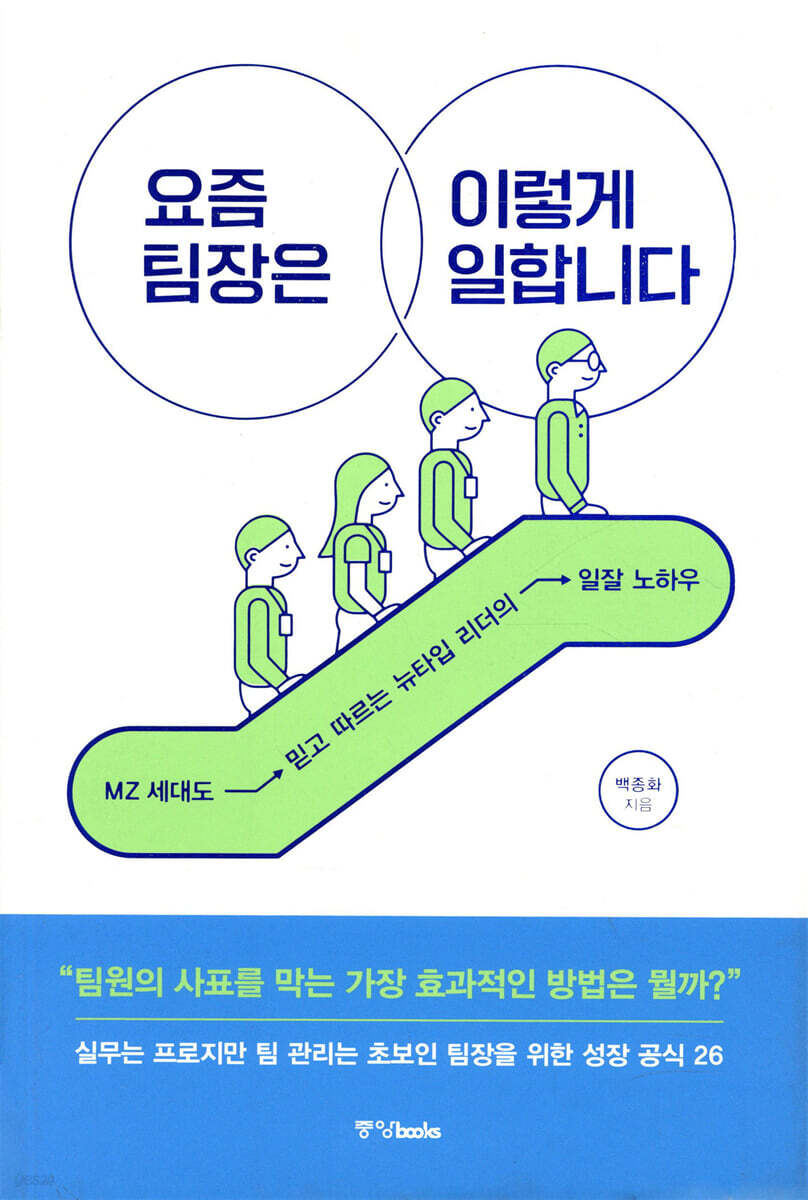
This is how team leaders work these days
 |
Description
Book Introduction
“How on earth do today’s team leaders, who are so good at their jobs, work?” A rookie team leader who is a professional in practice but an amateur in team management The secrets to becoming a new type of leader that even the MZ generation trusts and follows are revealed! Among the numerous team leaders in Korea, some are A-level team leaders who are respected by their team members and achieve results, while others are evaluated as B-level team leaders who constantly cause their team members to quit. Why does this difference arise? Coach Baek Jong-hwa, who has developed countless leaders in the field, from large corporations to startups, says the most common question new team leaders ask is, "What should I do? Will I be able to do well?" Unlike when you were a team member and could do well on your own, you have to do well together with the team, so it is inevitable that you will feel lost when you first become a team leader. In order to think about and share better leadership, I wrote a book titled “This is How Team Leaders Work These Days,” which easily explains the exemplary role of a “Team Leader These Days” that fits the changing working styles of today. Especially for team leaders who find it difficult to work with MZ generation team members, this book's leadership coaching will provide the best answers on how to communicate and work as a leader. If you're a professional in the field but an amateur when it comes to team management, this book will teach you everything you need to know about leadership, from your own growth to the success of your organization and the growth of your team members. |
- You can preview some of the book's contents.
Preview
index
What should a team leader say to a team member who has resigned?
Chapter 1: What does a team leader do?
An era without correct answers
Do we need a team leader?
Qualities of a team leader who delegates work well
The team leader needs a sub-character
Successful team leaders are different in 'this'
Chapter 2: There is no such thing as a perfect team leader.
5 Things Failing Team Leaders Have in Common
A-class team member, why is he suddenly quitting?
What Happens When a Team Leader Loses Complacency
Before becoming a team leader, let's protect 'myself'.
It means that the team leader is good at his job.
Chapter 3: There's Something Special About Team Leaders These Days
Successful team leaders have skills.
5 Leadership Skills Team Leaders Can Use
Is micromanaging bad?
Use the team leader's time differently depending on the team members.
The values and growth mindset that team leaders need to know
Chapter 4: A Team Leader's Sense of Wisdom That Leads Team Members to Growth
Team Leaders' Conversational Methods for Creating a Horizontal Organizational Culture
Listening to win the hearts of your team members
Questions that enhance team members' potential
Feedback that changes your team members
How to give good feedback
Praise that reinforces team member behavior
Chapter 5: All About Feedback for Team Leaders
The foundation of a good team is psychological safety.
How to provide work feedback like the world's strongest unit, the Navy SEALs?
Why did Microsoft ditch the word 'feedback'?
Various feedback methods used in practice
In this case, like this, feedback A to Z
In conclusion, if the team leader succeeds, the company succeeds, and team members grow.
Chapter 1: What does a team leader do?
An era without correct answers
Do we need a team leader?
Qualities of a team leader who delegates work well
The team leader needs a sub-character
Successful team leaders are different in 'this'
Chapter 2: There is no such thing as a perfect team leader.
5 Things Failing Team Leaders Have in Common
A-class team member, why is he suddenly quitting?
What Happens When a Team Leader Loses Complacency
Before becoming a team leader, let's protect 'myself'.
It means that the team leader is good at his job.
Chapter 3: There's Something Special About Team Leaders These Days
Successful team leaders have skills.
5 Leadership Skills Team Leaders Can Use
Is micromanaging bad?
Use the team leader's time differently depending on the team members.
The values and growth mindset that team leaders need to know
Chapter 4: A Team Leader's Sense of Wisdom That Leads Team Members to Growth
Team Leaders' Conversational Methods for Creating a Horizontal Organizational Culture
Listening to win the hearts of your team members
Questions that enhance team members' potential
Feedback that changes your team members
How to give good feedback
Praise that reinforces team member behavior
Chapter 5: All About Feedback for Team Leaders
The foundation of a good team is psychological safety.
How to provide work feedback like the world's strongest unit, the Navy SEALs?
Why did Microsoft ditch the word 'feedback'?
Various feedback methods used in practice
In this case, like this, feedback A to Z
In conclusion, if the team leader succeeds, the company succeeds, and team members grow.
Detailed image

Into the book
Everyone wants to be a successful team leader who is recognized by his team members.
But reality is not easy.
When you first become a team leader, you may be afraid because you don't know what to do, and some people even receive resignations from team members before they can even adapt.
I have also been working through such experiences.
Looking back, the reason why being a team leader is difficult lies elsewhere.
Problems usually start with the thought, 'I have to do it all by myself, I'll be right.'
A leader is not someone who achieves results through his own efforts, but someone who achieves results through others.
A good leader is one who delegates work well to others and makes them successful.
---From "What should a team leader say to a team member who has resigned?"
The word growth is really important to A-level talent.
I say that growth is about making tomorrow better than yesterday, and that to grow, you need motivation to change your behavior.
So what motivates A-level team members to change? While it varies slightly from person to person, the most common one is the "satisfaction felt after growth."
They feel they grow by taking on new tasks or projects that are larger than their previous experience.
Also, when I work with a role model in my organization, I look at him and find out what I need to learn and grow from in my future.
But the moment you feel like this isn't there, you start to think that your time at work is just stagnant time.
Moreover, this feeling becomes even stronger when you feel excluded from challenging tasks or when you feel that important positions will not come to you.
Then, you decide to quit your job and look for another organization where you can grow.
Because A-level employees have the confidence that they can do well wherever they go.
---From "Why is a Class A team member suddenly quitting?"
The team leader is also an ordinary office worker.
It can be stressful and, if not properly addressed, can lead to burnout.
It's not at all unusual to become a team leader and find your work difficult or feel depressed.
What is important at this time is to start by changing what I can control: my mind, my actions, and my use of time, rather than external circumstances that I cannot control.
Dealing with stress begins with discovering how to control your mind.
I, too, started doing things I had always wanted to do but had never been able to do in order to get through the tunnel of stress.
---From "Let's protect 'myself' before becoming a team leader"
Evaluation of NBT team members should be conducted from a team perspective, not an individual perspective.
Teams and companies have limited resources.
Especially in a small team, each and every hand and head will be precious.
What kind of performance would our team produce if we had an ace team member, not an NBT member? And how much more could our teammates grow working alongside this ace teammate? I think there's only one question to consider at this point.
Netflix's motto is 'The best benefit is working with the best colleagues.'
If you've given yourself ample opportunity and time to change, but still haven't seen any change, it may be a good idea to discuss next steps with your HR team.
But reality is not easy.
When you first become a team leader, you may be afraid because you don't know what to do, and some people even receive resignations from team members before they can even adapt.
I have also been working through such experiences.
Looking back, the reason why being a team leader is difficult lies elsewhere.
Problems usually start with the thought, 'I have to do it all by myself, I'll be right.'
A leader is not someone who achieves results through his own efforts, but someone who achieves results through others.
A good leader is one who delegates work well to others and makes them successful.
---From "What should a team leader say to a team member who has resigned?"
The word growth is really important to A-level talent.
I say that growth is about making tomorrow better than yesterday, and that to grow, you need motivation to change your behavior.
So what motivates A-level team members to change? While it varies slightly from person to person, the most common one is the "satisfaction felt after growth."
They feel they grow by taking on new tasks or projects that are larger than their previous experience.
Also, when I work with a role model in my organization, I look at him and find out what I need to learn and grow from in my future.
But the moment you feel like this isn't there, you start to think that your time at work is just stagnant time.
Moreover, this feeling becomes even stronger when you feel excluded from challenging tasks or when you feel that important positions will not come to you.
Then, you decide to quit your job and look for another organization where you can grow.
Because A-level employees have the confidence that they can do well wherever they go.
---From "Why is a Class A team member suddenly quitting?"
The team leader is also an ordinary office worker.
It can be stressful and, if not properly addressed, can lead to burnout.
It's not at all unusual to become a team leader and find your work difficult or feel depressed.
What is important at this time is to start by changing what I can control: my mind, my actions, and my use of time, rather than external circumstances that I cannot control.
Dealing with stress begins with discovering how to control your mind.
I, too, started doing things I had always wanted to do but had never been able to do in order to get through the tunnel of stress.
---From "Let's protect 'myself' before becoming a team leader"
Evaluation of NBT team members should be conducted from a team perspective, not an individual perspective.
Teams and companies have limited resources.
Especially in a small team, each and every hand and head will be precious.
What kind of performance would our team produce if we had an ace team member, not an NBT member? And how much more could our teammates grow working alongside this ace teammate? I think there's only one question to consider at this point.
Netflix's motto is 'The best benefit is working with the best colleagues.'
If you've given yourself ample opportunity and time to change, but still haven't seen any change, it may be a good idea to discuss next steps with your HR team.
---From "Use the team leader's time differently depending on the team members"
Publisher's Review
The difference between a good team leader and a tough team leader is a single stroke!
Being promoted to team leader is exciting, but at the same time, it feels daunting.
How do you go from being a competent team member to a truly effective team leader? With all the practical work involved in managing and managing teams, there's always a lot of work to do. While superiors constantly nudge you to achieve results, team members often wonder what exactly you're doing.
For team leaders who are properly 'stuck' in the middle, this book contains everything as a textbook on team leader leadership in Korea, from how to protect 'myself' before becoming a team leader to how to develop team members and achieve organizational performance.
As the work environment changes and the number of MZ generation members increases, the team leader leadership that was once sufficient as a manager and communicator is no longer effective in this era.
The author emphasizes that new leadership skills must now be learned, and that coaching leadership, in particular, is the leadership skill required for 'today's team leaders.'
"This is How Team Leaders Work These Days" vividly contains essential work know-how for leaders, including how to learn and utilize various leadership skills in addition to coaching, how to grow as a team leader, how to analyze the strengths of team members, and how to change the team leader's working style depending on the characteristics of the organization.
If you've just become a team leader and feel lost and frustrated because you have no one to ask questions, this book will be a great guide and role model for new team leaders.
To become a successful team leader in Korea
Revealing the team leader's principles!
Everyone starts out as a team leader.
However, some people become A-level team leaders who are recognized as natural leaders, while others become B-level team leaders who are avoided by their team members.
Where does this difference come from? The author argues that great leaders are made, not born.
There is a secret to learning and growing on your own that changes the pace.
This book covers everything from the fundamental mindset a team leader must have to making a difference to leadership skills that can be applied immediately in the field.
Chapter 1, "What Does a Team Leader Do?", raises fundamental questions about the role of a team leader in today's changing work environment and examines the necessary abilities.
Chapter 2, “There is no perfect team leader in the world,” discusses examples of team leader leadership that can easily fail, along with how to do well as a team leader.
Chapter 3, “There’s Something Special About Team Leaders These Days,” provides a detailed explanation of the leadership skills, team management methods, and team member management methods that successful team leaders possess.
Chapter 4, "A Team Leader's Sense of Speaking That Leads Team Members to Growth," discusses the four essential communication processes you must know when communicating with team members: listening, asking questions, giving feedback, and praising.
Chapter 5, "Everything About Feedback for Team Leaders," explains the most effective way to change team members and the most difficult for team leaders to understand: feedback, from the basics to its application.
For team leaders contemplating what kind of leader they should be, this book will serve as a lighthouse that will help them successfully navigate the stormy seas.
Being promoted to team leader is exciting, but at the same time, it feels daunting.
How do you go from being a competent team member to a truly effective team leader? With all the practical work involved in managing and managing teams, there's always a lot of work to do. While superiors constantly nudge you to achieve results, team members often wonder what exactly you're doing.
For team leaders who are properly 'stuck' in the middle, this book contains everything as a textbook on team leader leadership in Korea, from how to protect 'myself' before becoming a team leader to how to develop team members and achieve organizational performance.
As the work environment changes and the number of MZ generation members increases, the team leader leadership that was once sufficient as a manager and communicator is no longer effective in this era.
The author emphasizes that new leadership skills must now be learned, and that coaching leadership, in particular, is the leadership skill required for 'today's team leaders.'
"This is How Team Leaders Work These Days" vividly contains essential work know-how for leaders, including how to learn and utilize various leadership skills in addition to coaching, how to grow as a team leader, how to analyze the strengths of team members, and how to change the team leader's working style depending on the characteristics of the organization.
If you've just become a team leader and feel lost and frustrated because you have no one to ask questions, this book will be a great guide and role model for new team leaders.
To become a successful team leader in Korea
Revealing the team leader's principles!
Everyone starts out as a team leader.
However, some people become A-level team leaders who are recognized as natural leaders, while others become B-level team leaders who are avoided by their team members.
Where does this difference come from? The author argues that great leaders are made, not born.
There is a secret to learning and growing on your own that changes the pace.
This book covers everything from the fundamental mindset a team leader must have to making a difference to leadership skills that can be applied immediately in the field.
Chapter 1, "What Does a Team Leader Do?", raises fundamental questions about the role of a team leader in today's changing work environment and examines the necessary abilities.
Chapter 2, “There is no perfect team leader in the world,” discusses examples of team leader leadership that can easily fail, along with how to do well as a team leader.
Chapter 3, “There’s Something Special About Team Leaders These Days,” provides a detailed explanation of the leadership skills, team management methods, and team member management methods that successful team leaders possess.
Chapter 4, "A Team Leader's Sense of Speaking That Leads Team Members to Growth," discusses the four essential communication processes you must know when communicating with team members: listening, asking questions, giving feedback, and praising.
Chapter 5, "Everything About Feedback for Team Leaders," explains the most effective way to change team members and the most difficult for team leaders to understand: feedback, from the basics to its application.
For team leaders contemplating what kind of leader they should be, this book will serve as a lighthouse that will help them successfully navigate the stormy seas.
GOODS SPECIFICS
- Date of issue: July 1, 2021
- Page count, weight, size: 292 pages | 490g | 145*210*18mm
- ISBN13: 9788927812395
- ISBN10: 8927812395
You may also like
카테고리
korean


korean

![ELLE 엘르 스페셜 에디션 A형 : 12월 [2025]](http://librairie.coreenne.fr/cdn/shop/files/b8e27a3de6c9538896439686c6b0e8fb.jpg?v=1766436872&width=3840)


