

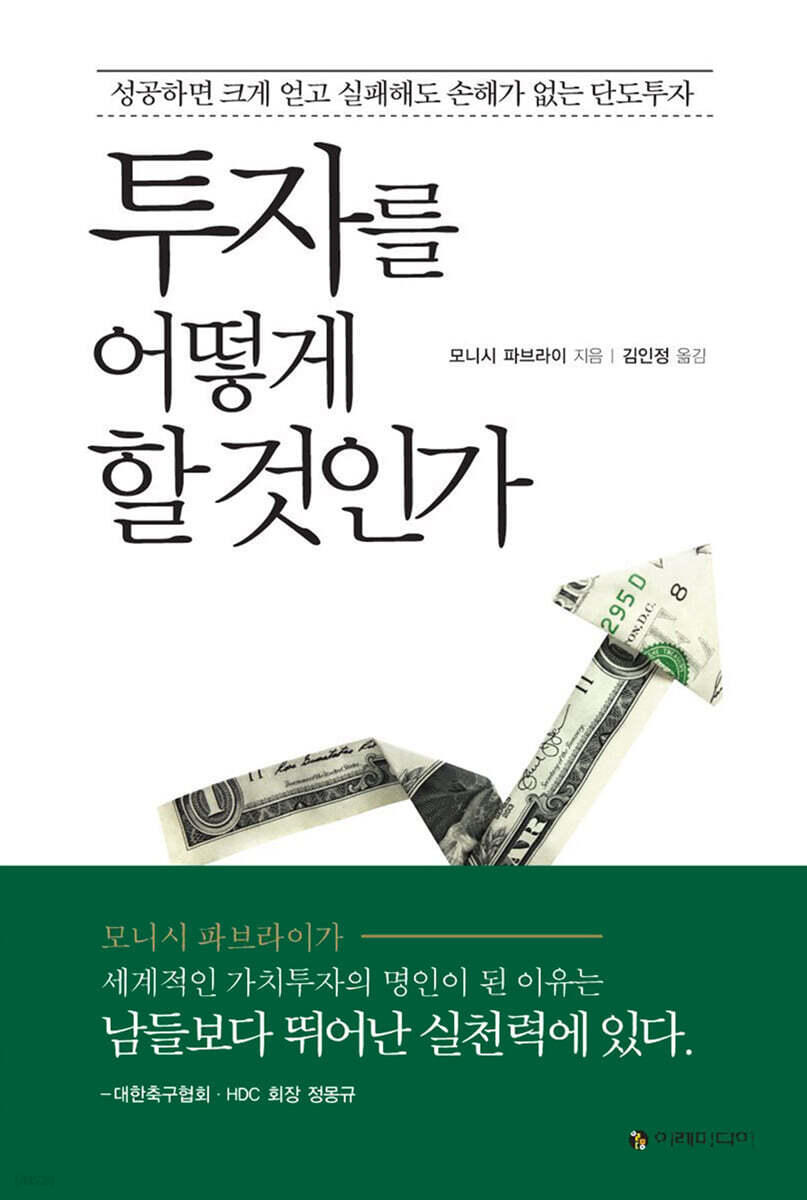
How to invest
 |
Description
Book Introduction
Mohnish Pabrai, a value investor following in the footsteps of Warren Buffett and Charlie Munger
We introduce the law of short-term investment, where success yields significant gains and failure yields minimal losses.
Who would you name as a legendary value investor?
There would be Benjamin Graham, the godfather of value investing; Warren Buffett, who started with nothing and became the world's richest man through investment; his great partner Charlie Munger; Seth Klarman, famous for his margin of safety; Joel Greenblatt, known for his magic formula; Peter Lynch; and Philip Fisher.
So who will be the next to continue this legacy of value investing legends? It's none other than Mohnish Pabrai, author of "How to Invest."
He is the head of the Pabrai Investment Fund investment group, which has achieved phenomenal returns in the market, modeled after a partnership founded by Warren Buffett.
He also had lunch with Warren Buffett in 2007 for $650,000, along with Guy Speer, author of "Lunch with Warren Buffett."
Pabrai is an avid follower of Warren Buffett, and is a person who has proven the method of "maximizing profits while minimizing risk" by developing Buffett's value investing method into a new level with his "short-sword investing" rule.
Not only ordinary investors, but anyone just starting out can learn how to maximize their wealth through "How to Invest" and follow its core investment principles and ideas.
We introduce the law of short-term investment, where success yields significant gains and failure yields minimal losses.
Who would you name as a legendary value investor?
There would be Benjamin Graham, the godfather of value investing; Warren Buffett, who started with nothing and became the world's richest man through investment; his great partner Charlie Munger; Seth Klarman, famous for his margin of safety; Joel Greenblatt, known for his magic formula; Peter Lynch; and Philip Fisher.
So who will be the next to continue this legacy of value investing legends? It's none other than Mohnish Pabrai, author of "How to Invest."
He is the head of the Pabrai Investment Fund investment group, which has achieved phenomenal returns in the market, modeled after a partnership founded by Warren Buffett.
He also had lunch with Warren Buffett in 2007 for $650,000, along with Guy Speer, author of "Lunch with Warren Buffett."
Pabrai is an avid follower of Warren Buffett, and is a person who has proven the method of "maximizing profits while minimizing risk" by developing Buffett's value investing method into a new level with his "short-sword investing" rule.
Not only ordinary investors, but anyone just starting out can learn how to maximize their wealth through "How to Invest" and follow its core investment principles and ideas.
- You can preview some of the book's contents.
Preview
index
Preface to the Korean edition
Acknowledgements
Translator's Note
Chapter 1: Papa Patel Starts a Motel Business
: Make risk-free investments
Chapter 2: Manilal Chaudhary, Focused Investment
: Occasionally make a fortune by focusing on a small number of stocks.
Chapter 3: Richard Branson Founds Virgin Atlantic with Just $2 Million and Achieves Great Success
: If you succeed, you will make a lot of money; if you fail, you will not lose anything.
Chapter 4: The Investment Story of Lakshmi Mittal, the World's Third Richest Person in 2005
: Be fearful when everyone is greedy, and be greedy when everyone is fearful.
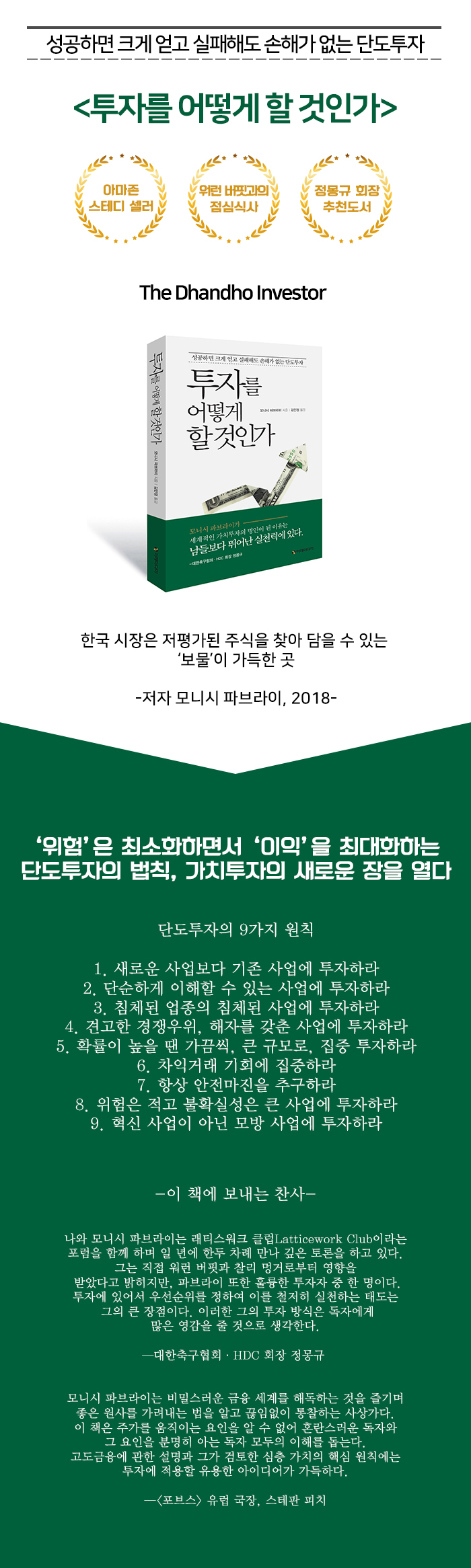
Chapter 5: Nine Principles of Short-Term Investing
①Invest in existing businesses rather than new ones.
②Invest in businesses that are simple to understand.
③ Invest in stagnant businesses in stagnant industries.
④Invest in businesses with a strong competitive edge and a moat.
⑤ When the odds are high, invest occasionally, with large amounts of money, and concentrate.
⑥ Focus on arbitrage opportunities.
⑦Always pursue a margin of safety.
⑧Invest in businesses with low risk and high uncertainty.
⑨Invest in copycat businesses, not innovative ones.
Chapter 6: Introduction to Short-Term Investment 1
: Invest in existing businesses rather than new ones.
Chapter 7: Introduction to Short-Term Investment 2
: Invest in businesses that are simple to understand.
Chapter 8: Beginner's Guide to Short-Term Investment 1
: Invest in stagnant businesses in stagnant industries.
Chapter 9: Beginner's Theory of Short-Term Investment 2
: Invest in businesses with a strong competitive edge and a moat.
Chapter 10: Intermediate Theory of Short-Term Investment 1
: When the odds are high, invest occasionally, with large amounts of cash, and in a concentrated manner.
Chapter 11: Intermediate Theory of Short-Term Investment 2
: Focus on arbitrage opportunities
Chapter 12: Advanced Theory of Short-Term Investment 1
: Always seek a margin of safety.
Chapter 13: Advanced Short-Term Investment Theory 2
: Invest in businesses with low risk and high uncertainty.
Chapter 14: Advanced Short-Term Investment Theory 3
: Invest in copycat businesses, not innovative ones.
Chapter 15: Abhimanyu's Dilemma
: The art of selling
Chapter 16: To Index or Not to Index: That is the Question
Chapter 17: Arjuna's Concentration
: Lessons of a Hero
References
Acknowledgements
Translator's Note
Chapter 1: Papa Patel Starts a Motel Business
: Make risk-free investments
Chapter 2: Manilal Chaudhary, Focused Investment
: Occasionally make a fortune by focusing on a small number of stocks.
Chapter 3: Richard Branson Founds Virgin Atlantic with Just $2 Million and Achieves Great Success
: If you succeed, you will make a lot of money; if you fail, you will not lose anything.
Chapter 4: The Investment Story of Lakshmi Mittal, the World's Third Richest Person in 2005
: Be fearful when everyone is greedy, and be greedy when everyone is fearful.
Chapter 5: Nine Principles of Short-Term Investing
①Invest in existing businesses rather than new ones.
②Invest in businesses that are simple to understand.
③ Invest in stagnant businesses in stagnant industries.
④Invest in businesses with a strong competitive edge and a moat.
⑤ When the odds are high, invest occasionally, with large amounts of money, and concentrate.
⑥ Focus on arbitrage opportunities.
⑦Always pursue a margin of safety.
⑧Invest in businesses with low risk and high uncertainty.
⑨Invest in copycat businesses, not innovative ones.
Chapter 6: Introduction to Short-Term Investment 1
: Invest in existing businesses rather than new ones.
Chapter 7: Introduction to Short-Term Investment 2
: Invest in businesses that are simple to understand.
Chapter 8: Beginner's Guide to Short-Term Investment 1
: Invest in stagnant businesses in stagnant industries.
Chapter 9: Beginner's Theory of Short-Term Investment 2
: Invest in businesses with a strong competitive edge and a moat.
Chapter 10: Intermediate Theory of Short-Term Investment 1
: When the odds are high, invest occasionally, with large amounts of cash, and in a concentrated manner.
Chapter 11: Intermediate Theory of Short-Term Investment 2
: Focus on arbitrage opportunities
Chapter 12: Advanced Theory of Short-Term Investment 1
: Always seek a margin of safety.
Chapter 13: Advanced Short-Term Investment Theory 2
: Invest in businesses with low risk and high uncertainty.
Chapter 14: Advanced Short-Term Investment Theory 3
: Invest in copycat businesses, not innovative ones.
Chapter 15: Abhimanyu's Dilemma
: The art of selling
Chapter 16: To Index or Not to Index: That is the Question
Chapter 17: Arjuna's Concentration
: Lessons of a Hero
References
Detailed image
Publisher's Review
A Preface for Korean Readers by Mohnish Pabrai
The Korean market is a treasure trove of undervalued stocks.
For ordinary investors, stock market volatility can cause a range of emotions, including excitement, frustration, and anxiety.
If this continues, work-life balance will collapse, making it impossible to make wise investments.
Additionally, the ability to utilize creativity is reduced, which ultimately leads to self-destructive speculation.
The solution to this problem is simple.
It's about directly following someone who is good at investing.
That is, seek investment advice or gain insight from wise people.
But most people do not have a teacher around them who can become a guru.
One way to do this is to read the books of investment experts.
Mohnish Pabrai, a world-renowned value investor, personally wrote the preface to the Korean edition of "How to Invest" for Korean readers.
Fabray describes Korea's current situation as an interesting market before it enters a dazzling upward trend.
In particular, he described the Korean stock market as a place "full of sparkling treasures," and advised that if the short-sword investment rule is well utilized in the Korean stock market in 2018, great results will be achieved in the future.
The world's third-richest man paid $650,000 for lunch with Omaha's Sage Warren Buffett.
Every year around June, there is a news story that becomes known all over the world.
This is the story of the world's most expensive lunch.
Why do so many investors spend so much money to have lunch with Warren Buffett? Perhaps it's because they want to indirectly experience his extensive experience and investment philosophy, hear his thoughts up close, and gain insight.
Mohnish Pabrai was the star of this famous lunch in 2007.
Guy Spier, author of "Lunch with Warren Buffett" and owner of the market-beating Aquamarine fund, had lunch with Warren Buffett, along with Mohnish Pabrai.
He is also a Warren Buffett follower and says he considers Pabrai his mentor and someone he admires.
In this way, Monish Pabrai is a man of abundance in life and investing, and he always values focus and discipline, especially when it comes to investing.
His powerful weapon, the dagger investment rule, is a very important principle that takes Buffett's value investing to the next level.
Discover Pabrai's core principles and value investing ideas in "How to Invest."
HDC Chairman Chung Mong-gyu focuses on Monish Pabrai's "practical skills."
What do business and investing have in common? They require careful consideration of crucial issues and wise decisions when investing large sums of money.
But there is something more important than this.
It's your attitude towards small things.
Some businesses can succeed with just one specific skill, but most businesses require countless small things to be done well.
If you keep doing simple, small things like expressing gratitude, listening to others, or treating others the way you want to be treated, the cumulative effect will lead to good things.
HDC (formerly Hyundai Development Company) and Korea Football Association Chairman Chung Mong-gyu have a close relationship with Monish Pabrai, author of “How to Invest.”
Since 2009, I have been meeting with Guy Spear and others at a forum called the Latticework Club.
This forum, held once or twice a year, is said to provide an opportunity for in-depth discussions on topics such as the role of the head of a household, including investment, education, and conflicts with partners.
Chairman Chung Mong-gyu evaluates Monish Pabrai as follows:
“Pabrai is one of the great investors.
In particular, his greatest strength is his attitude of prioritizing investments and thoroughly implementing them.
In other words, the reason he became a world-class value investor is because of his outstanding practical skills.”
The law of short-term investment that maximizes profits while minimizing risk.
Opening a new chapter in value investing
What is the short-term investment method advocated by Monish Pabrai, 'a method to maximize profits while minimizing risk'?
Dhandho is a Gujarati word in India that literally means 'efforts to create wealth'.
Pabrai introduces the simple capital allocation principles practiced by Patels, India's most savvy businessmen, and shows how ordinary investors can successfully apply and replicate them in the stock market.
Patels, a minority group that came to the United States as refugees in the early 1970s, are poorly educated and have little capital, but they now own half of the motels in the country.
Through their business methods, we can learn the wisdom of rolling a small snowball of capital into great wealth.
In this way, Pabrai combines the wisdom of legendary investors with his own sensibilities to present simple investment principles that are easily accessible to ordinary investors.
Through "How to Invest," we hope that anyone can find ways to significantly improve their investment performance and thoroughly beat the market.
The Korean market is a treasure trove of undervalued stocks.
For ordinary investors, stock market volatility can cause a range of emotions, including excitement, frustration, and anxiety.
If this continues, work-life balance will collapse, making it impossible to make wise investments.
Additionally, the ability to utilize creativity is reduced, which ultimately leads to self-destructive speculation.
The solution to this problem is simple.
It's about directly following someone who is good at investing.
That is, seek investment advice or gain insight from wise people.
But most people do not have a teacher around them who can become a guru.
One way to do this is to read the books of investment experts.
Mohnish Pabrai, a world-renowned value investor, personally wrote the preface to the Korean edition of "How to Invest" for Korean readers.
Fabray describes Korea's current situation as an interesting market before it enters a dazzling upward trend.
In particular, he described the Korean stock market as a place "full of sparkling treasures," and advised that if the short-sword investment rule is well utilized in the Korean stock market in 2018, great results will be achieved in the future.
The world's third-richest man paid $650,000 for lunch with Omaha's Sage Warren Buffett.
Every year around June, there is a news story that becomes known all over the world.
This is the story of the world's most expensive lunch.
Why do so many investors spend so much money to have lunch with Warren Buffett? Perhaps it's because they want to indirectly experience his extensive experience and investment philosophy, hear his thoughts up close, and gain insight.
Mohnish Pabrai was the star of this famous lunch in 2007.
Guy Spier, author of "Lunch with Warren Buffett" and owner of the market-beating Aquamarine fund, had lunch with Warren Buffett, along with Mohnish Pabrai.
He is also a Warren Buffett follower and says he considers Pabrai his mentor and someone he admires.
In this way, Monish Pabrai is a man of abundance in life and investing, and he always values focus and discipline, especially when it comes to investing.
His powerful weapon, the dagger investment rule, is a very important principle that takes Buffett's value investing to the next level.
Discover Pabrai's core principles and value investing ideas in "How to Invest."
HDC Chairman Chung Mong-gyu focuses on Monish Pabrai's "practical skills."
What do business and investing have in common? They require careful consideration of crucial issues and wise decisions when investing large sums of money.
But there is something more important than this.
It's your attitude towards small things.
Some businesses can succeed with just one specific skill, but most businesses require countless small things to be done well.
If you keep doing simple, small things like expressing gratitude, listening to others, or treating others the way you want to be treated, the cumulative effect will lead to good things.
HDC (formerly Hyundai Development Company) and Korea Football Association Chairman Chung Mong-gyu have a close relationship with Monish Pabrai, author of “How to Invest.”
Since 2009, I have been meeting with Guy Spear and others at a forum called the Latticework Club.
This forum, held once or twice a year, is said to provide an opportunity for in-depth discussions on topics such as the role of the head of a household, including investment, education, and conflicts with partners.
Chairman Chung Mong-gyu evaluates Monish Pabrai as follows:
“Pabrai is one of the great investors.
In particular, his greatest strength is his attitude of prioritizing investments and thoroughly implementing them.
In other words, the reason he became a world-class value investor is because of his outstanding practical skills.”
The law of short-term investment that maximizes profits while minimizing risk.
Opening a new chapter in value investing
What is the short-term investment method advocated by Monish Pabrai, 'a method to maximize profits while minimizing risk'?
Dhandho is a Gujarati word in India that literally means 'efforts to create wealth'.
Pabrai introduces the simple capital allocation principles practiced by Patels, India's most savvy businessmen, and shows how ordinary investors can successfully apply and replicate them in the stock market.
Patels, a minority group that came to the United States as refugees in the early 1970s, are poorly educated and have little capital, but they now own half of the motels in the country.
Through their business methods, we can learn the wisdom of rolling a small snowball of capital into great wealth.
In this way, Pabrai combines the wisdom of legendary investors with his own sensibilities to present simple investment principles that are easily accessible to ordinary investors.
Through "How to Invest," we hope that anyone can find ways to significantly improve their investment performance and thoroughly beat the market.
GOODS SPECIFICS
- Date of issue: July 5, 2018
- Page count, weight, size: 267 pages | 489g | 153*224*18mm
- ISBN13: 9791188279210
- ISBN10: 1188279211
You may also like
카테고리
korean


korean

![GQ KOREA Mark (Monthly): December [2025]](http://librairie.coreenne.fr/cdn/shop/files/8ef265dbbfbf186523ed75ba7319009d.jpg?v=1765340328&width=3840)


