

Rediscovering 10,000 Hours
 |
Description
Book Introduction
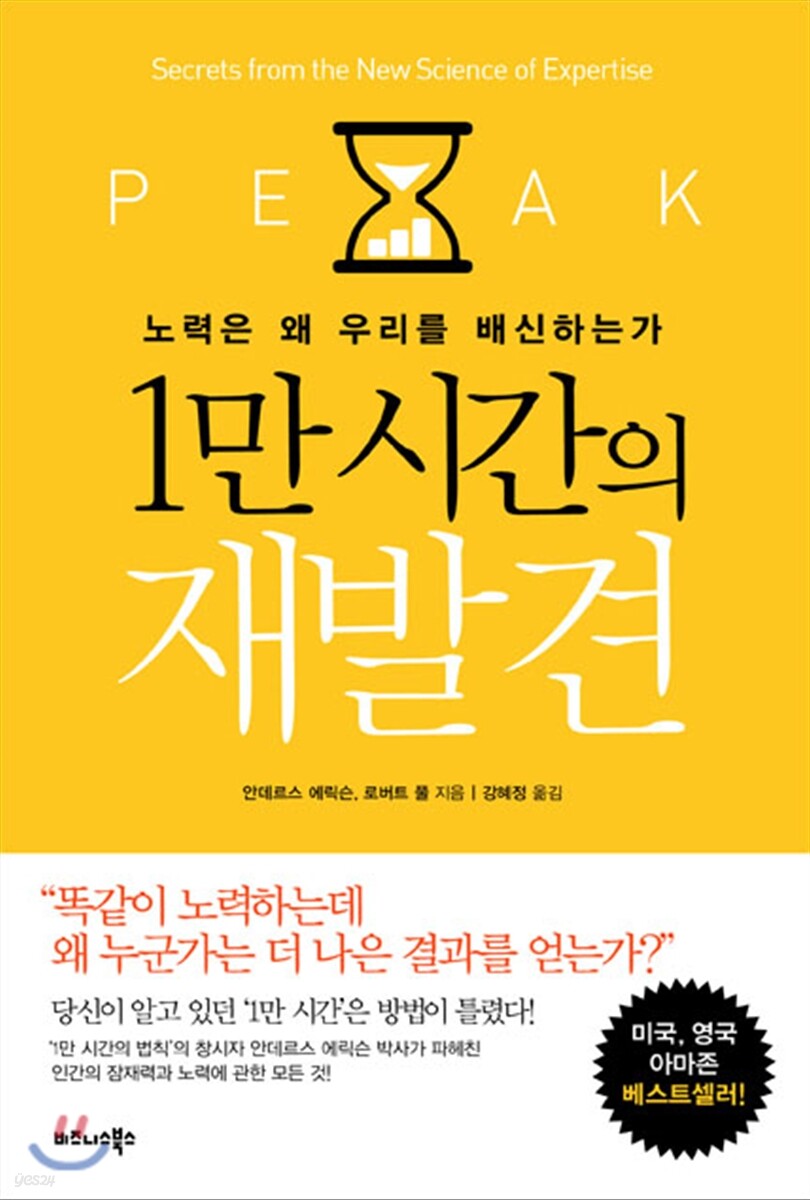
“It is madness to repeat the same method and expect different results!” _ Albert Einstein The '10,000 hours' method you knew was wrong! In the early 1990s, world-renowned psychologist Dr. Anders Ericsson published a paper in which he studied people who had reached the top of their fields and argued that behind their remarkable success was not innate talent but rather a long period of hard work. The content of this paper was introduced to Korea by Malcolm Gladwell, who cited it in his book Outliers, under the name of the '10,000-hour rule.' As the book became a bestseller, this law solidified as if it were an absolute principle for 'success', and was passed around in books and media, and spread through people like a magic spell that worked everywhere. While some people were motivated by the thought, "Yes, if I keep working hard, I can become the best in the world!", others (especially recently) have ridiculed it for the "long time it takes." In this way, the '10,000-hour rule' has been a topic of both praise and debate for a long time, with some calling it the truth of success and others calling it 'nonsense'. In conclusion, the '10,000-hour rule' is a thoroughly scientifically proven truth. However, the 10,000-hour rule, which was arbitrarily 'edited' by Malcolm Gladwell and blindly believed in by people, was completely misunderstood in terms of its 'methodology'. Until now, we've only known a fraction of this law, selectively hearing only what we "wanted to hear"! "Rediscovering the 10,000 Hours" is the first book published in Korea by Dr. Anders Ericsson, the founder of the "10,000 Hours" research. It corrects misconceptions about the "10,000 Hours" and presents a new way of thinking about human adaptability and achievement. |
- You can preview some of the book's contents.
Preview
index
Rediscovering 10,000 Hours
Author's Note
Introduction: There is no such thing as 'innate talent'.
The Myth of Absolute Pitch | Even Hard Work and Sincerity Require Strategy
[Chapter 1] Why do we encounter the 'betrayal of effort'?
The question is not time, but method.
What Happened to Humanity in 100 Years | Why 10,000 Hours of Working Doesn't Make You the Best | The Power of "Doing It Differently," Not "Working Harder" | The Most Correct Way to Work
[Chapter 2] How to Use Your Brain to Develop More with Use
How the Brain Changes Humans
The Brains of London Taxi Drivers | Don't Underestimate Adaptability | No Challenge, No Progress | The Unique Features of Einstein's Brain | Potential Can Be Unleashed
[Chapter 3] Understanding Mental Representations
The 'method' of practice is more important than motivation
The Mysterious Superpower of Chess Masters? | Absolute Time is Necessary, Anyway | Pattern Recognition and Reaction | Why What's Difficult for Me Comes Easy for Others | Think Like a Doctor | Modifying Mental Representations | How Experts Use Mental Representations | Even Physical Activity Is Ultimately Connected to the Mind
[Chapter 4] The Gold Standard
_Finding the best training method
The Crucial Difference Between Amateurs and Pros | 7 Principles of Deliberate Practice | Deliberate Practice Applies to All Fields | Misconceptions Surrounding the "10,000-Hour Rule"
[Chapter 5] Deliberate Practice in the Workplace
_Anyone can be the best.
But only if it is the right approach
Learning on the Job | The Power of Instant Feedback | Distinguishing Between What You Know and What You Can Do | A New Approach to Training
[Chapter 6] 'Conscious Practice' in Everyday Life
Create your own potential
Find the best teacher | Don't pretend, get immersed | Focus, fix, and repeat | How to break out of a plateau | The power of sustainable motivation
[Chapter 7] Roadmap to Extraordinaryness
How they got to the top
A Gentle Beginning Through Play | Transitioning to Serious Stages | Dedication to the Top | The Truth and Lies of Early Education | Can You "Learn" Absolute Pitch at 32 | People Who Are Breaking Through the Top and Forging New Paths
[Chapter 8] There is no shortcut to talent.
_Getting away from deep-rooted beliefs
The Magic of Paganini | The Truth About Mozart's Genius | Did He Really "Rise Like a Comet"? | How Should We Understand Savants? | Are We Born Dumb Without Talent? | The Battle Between Practice and Talent | The True Role of Talent | The Dark Side of Believing You Can't Beat Genius |
[Chapter 9] Towards 'Homo exercens'
_Which '10,000 hours' will you choose?
The Future Secured by 'Conscious Practice' | Homo Exercens, the Practicing Human
main
Author's Note
Introduction: There is no such thing as 'innate talent'.
The Myth of Absolute Pitch | Even Hard Work and Sincerity Require Strategy
[Chapter 1] Why do we encounter the 'betrayal of effort'?
The question is not time, but method.
What Happened to Humanity in 100 Years | Why 10,000 Hours of Working Doesn't Make You the Best | The Power of "Doing It Differently," Not "Working Harder" | The Most Correct Way to Work
[Chapter 2] How to Use Your Brain to Develop More with Use
How the Brain Changes Humans
The Brains of London Taxi Drivers | Don't Underestimate Adaptability | No Challenge, No Progress | The Unique Features of Einstein's Brain | Potential Can Be Unleashed
[Chapter 3] Understanding Mental Representations
The 'method' of practice is more important than motivation
The Mysterious Superpower of Chess Masters? | Absolute Time is Necessary, Anyway | Pattern Recognition and Reaction | Why What's Difficult for Me Comes Easy for Others | Think Like a Doctor | Modifying Mental Representations | How Experts Use Mental Representations | Even Physical Activity Is Ultimately Connected to the Mind
[Chapter 4] The Gold Standard
_Finding the best training method
The Crucial Difference Between Amateurs and Pros | 7 Principles of Deliberate Practice | Deliberate Practice Applies to All Fields | Misconceptions Surrounding the "10,000-Hour Rule"
[Chapter 5] Deliberate Practice in the Workplace
_Anyone can be the best.
But only if it is the right approach
Learning on the Job | The Power of Instant Feedback | Distinguishing Between What You Know and What You Can Do | A New Approach to Training
[Chapter 6] 'Conscious Practice' in Everyday Life
Create your own potential
Find the best teacher | Don't pretend, get immersed | Focus, fix, and repeat | How to break out of a plateau | The power of sustainable motivation
[Chapter 7] Roadmap to Extraordinaryness
How they got to the top
A Gentle Beginning Through Play | Transitioning to Serious Stages | Dedication to the Top | The Truth and Lies of Early Education | Can You "Learn" Absolute Pitch at 32 | People Who Are Breaking Through the Top and Forging New Paths
[Chapter 8] There is no shortcut to talent.
_Getting away from deep-rooted beliefs
The Magic of Paganini | The Truth About Mozart's Genius | Did He Really "Rise Like a Comet"? | How Should We Understand Savants? | Are We Born Dumb Without Talent? | The Battle Between Practice and Talent | The True Role of Talent | The Dark Side of Believing You Can't Beat Genius |
[Chapter 9] Towards 'Homo exercens'
_Which '10,000 hours' will you choose?
The Future Secured by 'Conscious Practice' | Homo Exercens, the Practicing Human
main
Into the book
Rediscovering 10,000 Hours
I have no intention of opposing this argument.
It's definitely important to let people know that they can get better with practice, and that they can get a lot better.
Otherwise, it will be difficult to even get the motivation to make an effort.
But these books sometimes give the impression that you can improve your performance if you truly want to and put in the effort.
“If you keep at it, you will reach your goal.” It may sound good, but it is actually wrong.
Only by practicing 'properly' over a sufficient period of time can you improve your skills and reach your desired goals.
There is no other way.
In this book, I will explain in detail what 'correct practice' is and how to practice it effectively.
---From "There is no such thing as 'innate talent'"
But there is one very important thing to understand here.
Whether it's driving, tennis, or baking a pie, once you reach this "satisfactory" level, this mechanical level, progress stops.
This is where people often misunderstand.
We see driving consistently, playing tennis, or baking pies as a form of exercise, and we think that if we keep doing it, we will get better.
I think that it will continue to develop, even if the pace is slow.
(…) But in fact, that is not the case.
Research has shown that once a person reaches a level of 'satisfactory' skill and can mechanically process something, further 'practice' does not lead to improvement in skill.
Rather, if there is a difference between a driver, doctor, or teacher who has been working in the field for 20 years and someone who has only been working for 5 years, it is possible that their skills are inferior to theirs.
Why is this? Because these mechanical abilities gradually deteriorate without any "conscious effort" to improve them.
---From "Why Do We Face the 'Betrayal of Effort'?"
Coincidentally, this area is also the one that caught the attention of neuroscientists who studied Albert Einstein's brain.
At the time, neuroscientists discovered that Einstein's inferior parietal lobule was significantly larger than average and had a very unusual shape.
Because of this, they speculated that Einstein's inferior parietal lobule may have played an important role in his abstract mathematical thinking ability.
Could it be that people like Einstein were born with a more developed inferior parietal lobule than the average person, and thus possessed an innate ability for mathematical thinking? Many people would probably think so.
However, when comparing the corresponding brain regions in mathematicians and non-mathematicians, the researchers found that the longer a mathematician had been working on mathematical tasks, the more gray matter they had in the right inferior parietal lobule.
This means that the increase in size of the area is the product of long-term mathematical thinking, not something that is innate.
---From "How to Use Your Brain to Develop the More You Use It"
You might take it as a challenge and get motivated by thinking, “If I just do this for 10,000 hours, I’ll be the best in the world!”, but most people will take it as a signal to give up because it’s too hard.
“If it takes 10,000 hours to get really good at something, why should I bother?” Dobert, the dog in Scott Adams’ satirical cartoon Dilbert, sarcastically remarks on the 10,000-hour rule.
“Practicing the same thing for 10,000 hours means you’re not in your right mind.”
But the core message I'm trying to convey is completely different.
In almost every area that requires human effort, we have a tremendous capacity to improve our performance.
As long as you train the 'right way'.
This is the core message I think.
If we practice something for hundreds of hours, we will definitely make a lot of progress (think about what Steve Fallon's 200 hours of practice did).
But this only scratches the surface of human potential.
We can keep moving forward and continue to improve.
How much you improve and develop your skills is up to you.
---From "The Golden Standard"
To effectively practice any skill without a teacher, it's helpful to keep in mind the so-called "3Fs."
Focus, Feedback, Fix it.
Break your skills down into repeatable and easily analytic components, then identify your weaknesses and figure out how to correct them.
Circus performers, ESL students, and Benjamin Franklin are classic examples of people who have wisely used this approach.
Franklin's method also provides an excellent example of developing mental representations when there is little or no information provided by the teacher.
In analyzing the articles in The Spectator and figuring out what makes a good piece of writing, Franklin was creating mental representations that he could use to guide his own writing.
I have no intention of opposing this argument.
It's definitely important to let people know that they can get better with practice, and that they can get a lot better.
Otherwise, it will be difficult to even get the motivation to make an effort.
But these books sometimes give the impression that you can improve your performance if you truly want to and put in the effort.
“If you keep at it, you will reach your goal.” It may sound good, but it is actually wrong.
Only by practicing 'properly' over a sufficient period of time can you improve your skills and reach your desired goals.
There is no other way.
In this book, I will explain in detail what 'correct practice' is and how to practice it effectively.
---From "There is no such thing as 'innate talent'"
But there is one very important thing to understand here.
Whether it's driving, tennis, or baking a pie, once you reach this "satisfactory" level, this mechanical level, progress stops.
This is where people often misunderstand.
We see driving consistently, playing tennis, or baking pies as a form of exercise, and we think that if we keep doing it, we will get better.
I think that it will continue to develop, even if the pace is slow.
(…) But in fact, that is not the case.
Research has shown that once a person reaches a level of 'satisfactory' skill and can mechanically process something, further 'practice' does not lead to improvement in skill.
Rather, if there is a difference between a driver, doctor, or teacher who has been working in the field for 20 years and someone who has only been working for 5 years, it is possible that their skills are inferior to theirs.
Why is this? Because these mechanical abilities gradually deteriorate without any "conscious effort" to improve them.
---From "Why Do We Face the 'Betrayal of Effort'?"
Coincidentally, this area is also the one that caught the attention of neuroscientists who studied Albert Einstein's brain.
At the time, neuroscientists discovered that Einstein's inferior parietal lobule was significantly larger than average and had a very unusual shape.
Because of this, they speculated that Einstein's inferior parietal lobule may have played an important role in his abstract mathematical thinking ability.
Could it be that people like Einstein were born with a more developed inferior parietal lobule than the average person, and thus possessed an innate ability for mathematical thinking? Many people would probably think so.
However, when comparing the corresponding brain regions in mathematicians and non-mathematicians, the researchers found that the longer a mathematician had been working on mathematical tasks, the more gray matter they had in the right inferior parietal lobule.
This means that the increase in size of the area is the product of long-term mathematical thinking, not something that is innate.
---From "How to Use Your Brain to Develop the More You Use It"
You might take it as a challenge and get motivated by thinking, “If I just do this for 10,000 hours, I’ll be the best in the world!”, but most people will take it as a signal to give up because it’s too hard.
“If it takes 10,000 hours to get really good at something, why should I bother?” Dobert, the dog in Scott Adams’ satirical cartoon Dilbert, sarcastically remarks on the 10,000-hour rule.
“Practicing the same thing for 10,000 hours means you’re not in your right mind.”
But the core message I'm trying to convey is completely different.
In almost every area that requires human effort, we have a tremendous capacity to improve our performance.
As long as you train the 'right way'.
This is the core message I think.
If we practice something for hundreds of hours, we will definitely make a lot of progress (think about what Steve Fallon's 200 hours of practice did).
But this only scratches the surface of human potential.
We can keep moving forward and continue to improve.
How much you improve and develop your skills is up to you.
---From "The Golden Standard"
To effectively practice any skill without a teacher, it's helpful to keep in mind the so-called "3Fs."
Focus, Feedback, Fix it.
Break your skills down into repeatable and easily analytic components, then identify your weaknesses and figure out how to correct them.
Circus performers, ESL students, and Benjamin Franklin are classic examples of people who have wisely used this approach.
Franklin's method also provides an excellent example of developing mental representations when there is little or no information provided by the teacher.
In analyzing the articles in The Spectator and figuring out what makes a good piece of writing, Franklin was creating mental representations that he could use to guide his own writing.
---From "Conscious Practice in Daily Life"
Publisher's Review
Rediscovering 10,000 Hours
How are their 24 hours different from my 24 hours?
Let's say there are two people who started working out to get a six-pack before summer.
One person exercises on his own based on information found on the Internet.
Another person works out with a personal trainer.
If both people work out for the same amount of time, who will achieve six-pack abs faster?
For a long time, we have believed that success is determined by 'how much time you pour into it.'
It was also common for expressions like '4-5-5' to be created, and it was also common for employees' abilities to be evaluated based on their overtime hours.
The reason why the '10,000-hour rule' was so loved by Korean readers is probably because this kind of thinking of 'just working hard will do the trick' was ingrained in the Korean readers.
But we see it all around us all the time.
The student who sits at his desk for a long time does not necessarily become the top student in the school, and the athlete who trains later than anyone else does not necessarily win the gold medal.
Why do some achieve better results despite working equally hard? This gap leads people to despair, believing, "No matter how hard I try, I can never beat those with natural talent," and to deny the power of hard work itself.
But what if the '10,000 hours' you've known all this time was a complete misunderstanding?
Dr. Anders Ericsson emphasizes that the key to the '10,000-hour rule' is not 'how long' but 'how correctly'.
In other words, the key to 10,000 hours is not to ‘work hard blindly’ but to ‘work hard in a different way.’
For a long time, we were obsessed with the number '10,000 hours' and thought that if we just worked hard for a long time, everything would be fine.
If I didn't see any results after a long time, I would fall into despair, saying, "It's because I don't have any natural talent."
But both are wrong.
Do you aim to achieve your goal of "10,000 hours" and become the best? If so, how and how you spend that time is just as important as the amount of time you spend! Dr. Ericsson suggests the right way to practice is "deliberate practice," which is summarized as "focus," "feedback," and "correction."
Based on 30 years of scientific research, 《10,000 Hours》 provides a detailed explanation of what this "deliberate practice" is, what differences there are in the time spent by those who have reached the top, and how this practice can help us further develop our abilities and ultimately reach the top.
There is no such thing as innate talent.
It is only created through systematic training!
The author distinguishes between naive practice, which is simple and mechanical practice, and deliberate practice, which is 'carefully designed and planned practice,' and says that this 'difference in method' is what makes the difference between extraordinary people and ordinary people.
Joshua Foer, who had an average memory that was bad at even remembering phone numbers, became the national memory champion by memorizing over 200 digits in just one year; a 32-year-old man who developed perfect pitch in just two months through training; an old man who became a black belt in karate at the age of 72; and a girl who became a chess grandmaster at the age of 15... ... The author emphasizes that behind the abilities we call 'extraordinary talent' regardless of the field, there was always systematic training and practice over a long period of time, and says that we too can become the best through this 'deliberate practice'.
So, what's the difference between deliberate practice, as the author puts it, and rote practice? First, deliberate practice must begin by stepping out of your "comfort zone," a familiar and comfortable situation.
American politician Benjamin Franklin reportedly played chess almost every day for 50 years, yet his chess skills were mediocre. (According to the "10,000-hour rule," he should have been at least as good as a professional chess player.) This case clearly shows the difference between "mere repetition" and "deliberate practice."
Because when anything reaches a 'satisfactory' level, a level that can be done mechanically, development stops there.
Second, deliberate practice must have clear and specific goals.
Aim for small, tangible, incremental changes, rather than vague, abstract, and "general improvements" (like "just" working harder).
Third, feedback and subsequent corrections must be made immediately.
This is similar to the reason why studying or exercising alone does not have much effect.
This is because even if you do something 'the wrong way', you don't realize it and so you can't correct your mistake.
As Einstein said, you can't expect good results by repeating wrong methods.
Are you still working hard and sweating, blindly believing the words, "Work harder," and "If you work hard, everything will come true"? Are you resenting the reality that others, seemingly working less hard, enjoy good schools, good jobs, and good salaries? The truth is, that's not true.
No matter how hard you try, unless you use a method specifically designed for your desired goals, the results won't change much.
There is no need to be disappointed though.
To put it the other way around, this means that anyone can reach the top if they find the 'right way'.
Author Anders Ericsson is like a guide who knows the best, most efficient, and effective path to 'normalcy' through over 30 years of research.
The best way to climb a mountain is through deliberate practice, and this book is your guide.
This book will show you the fastest way to the top.
The praise poured in for this book!
This book presents a revolutionary change to the existing way of thinking about human achievement.
Ericsson discovered that the difference between the best and the rest was not innate talent, but the "right form" of training and practice.
If everyone truly embraced the lessons of this book, we could truly change the world.
Joshua Foer, author of "The Man Who Became a Memory Genius in One Year"
This book presents a fascinating scientific study that explores how we can take our abilities to the next level and achieve excellence.
It will provide a breakthrough for those who question human potential.
Seth Godin, author of "Purple Cow"
'Important' books aren't very interesting.
An interesting book is not that important.
But this book kills both birds with one stone.
Who wouldn't want a better life than their current one? This book contains the essence of a lifetime of remarkable research.
Stephen Dubner, author of Freakonomics and Think Like a Freak
An inspiring book for readers who aspire to achieve excellence!
Publisher's Weekly
Anders Ericsson proves the simple truth that 'how you do something' is more important than 'how much you know' through his unwavering research.
This is a very useful book for parents and teachers who teach children.
Curcus Review
The science of excellence is divided into two periods, before and after Erickson.
The author's groundbreaking research, contained in this incredibly useful book, provides a blueprint for success in the most important task of changing your life.
In other words, a blueprint that will enable you to make progress little by little every day.
Daniel Coyle, author of The Talent Code
How are their 24 hours different from my 24 hours?
Let's say there are two people who started working out to get a six-pack before summer.
One person exercises on his own based on information found on the Internet.
Another person works out with a personal trainer.
If both people work out for the same amount of time, who will achieve six-pack abs faster?
For a long time, we have believed that success is determined by 'how much time you pour into it.'
It was also common for expressions like '4-5-5' to be created, and it was also common for employees' abilities to be evaluated based on their overtime hours.
The reason why the '10,000-hour rule' was so loved by Korean readers is probably because this kind of thinking of 'just working hard will do the trick' was ingrained in the Korean readers.
But we see it all around us all the time.
The student who sits at his desk for a long time does not necessarily become the top student in the school, and the athlete who trains later than anyone else does not necessarily win the gold medal.
Why do some achieve better results despite working equally hard? This gap leads people to despair, believing, "No matter how hard I try, I can never beat those with natural talent," and to deny the power of hard work itself.
But what if the '10,000 hours' you've known all this time was a complete misunderstanding?
Dr. Anders Ericsson emphasizes that the key to the '10,000-hour rule' is not 'how long' but 'how correctly'.
In other words, the key to 10,000 hours is not to ‘work hard blindly’ but to ‘work hard in a different way.’
For a long time, we were obsessed with the number '10,000 hours' and thought that if we just worked hard for a long time, everything would be fine.
If I didn't see any results after a long time, I would fall into despair, saying, "It's because I don't have any natural talent."
But both are wrong.
Do you aim to achieve your goal of "10,000 hours" and become the best? If so, how and how you spend that time is just as important as the amount of time you spend! Dr. Ericsson suggests the right way to practice is "deliberate practice," which is summarized as "focus," "feedback," and "correction."
Based on 30 years of scientific research, 《10,000 Hours》 provides a detailed explanation of what this "deliberate practice" is, what differences there are in the time spent by those who have reached the top, and how this practice can help us further develop our abilities and ultimately reach the top.
There is no such thing as innate talent.
It is only created through systematic training!
The author distinguishes between naive practice, which is simple and mechanical practice, and deliberate practice, which is 'carefully designed and planned practice,' and says that this 'difference in method' is what makes the difference between extraordinary people and ordinary people.
Joshua Foer, who had an average memory that was bad at even remembering phone numbers, became the national memory champion by memorizing over 200 digits in just one year; a 32-year-old man who developed perfect pitch in just two months through training; an old man who became a black belt in karate at the age of 72; and a girl who became a chess grandmaster at the age of 15... ... The author emphasizes that behind the abilities we call 'extraordinary talent' regardless of the field, there was always systematic training and practice over a long period of time, and says that we too can become the best through this 'deliberate practice'.
So, what's the difference between deliberate practice, as the author puts it, and rote practice? First, deliberate practice must begin by stepping out of your "comfort zone," a familiar and comfortable situation.
American politician Benjamin Franklin reportedly played chess almost every day for 50 years, yet his chess skills were mediocre. (According to the "10,000-hour rule," he should have been at least as good as a professional chess player.) This case clearly shows the difference between "mere repetition" and "deliberate practice."
Because when anything reaches a 'satisfactory' level, a level that can be done mechanically, development stops there.
Second, deliberate practice must have clear and specific goals.
Aim for small, tangible, incremental changes, rather than vague, abstract, and "general improvements" (like "just" working harder).
Third, feedback and subsequent corrections must be made immediately.
This is similar to the reason why studying or exercising alone does not have much effect.
This is because even if you do something 'the wrong way', you don't realize it and so you can't correct your mistake.
As Einstein said, you can't expect good results by repeating wrong methods.
Are you still working hard and sweating, blindly believing the words, "Work harder," and "If you work hard, everything will come true"? Are you resenting the reality that others, seemingly working less hard, enjoy good schools, good jobs, and good salaries? The truth is, that's not true.
No matter how hard you try, unless you use a method specifically designed for your desired goals, the results won't change much.
There is no need to be disappointed though.
To put it the other way around, this means that anyone can reach the top if they find the 'right way'.
Author Anders Ericsson is like a guide who knows the best, most efficient, and effective path to 'normalcy' through over 30 years of research.
The best way to climb a mountain is through deliberate practice, and this book is your guide.
This book will show you the fastest way to the top.
The praise poured in for this book!
This book presents a revolutionary change to the existing way of thinking about human achievement.
Ericsson discovered that the difference between the best and the rest was not innate talent, but the "right form" of training and practice.
If everyone truly embraced the lessons of this book, we could truly change the world.
Joshua Foer, author of "The Man Who Became a Memory Genius in One Year"
This book presents a fascinating scientific study that explores how we can take our abilities to the next level and achieve excellence.
It will provide a breakthrough for those who question human potential.
Seth Godin, author of "Purple Cow"
'Important' books aren't very interesting.
An interesting book is not that important.
But this book kills both birds with one stone.
Who wouldn't want a better life than their current one? This book contains the essence of a lifetime of remarkable research.
Stephen Dubner, author of Freakonomics and Think Like a Freak
An inspiring book for readers who aspire to achieve excellence!
Publisher's Weekly
Anders Ericsson proves the simple truth that 'how you do something' is more important than 'how much you know' through his unwavering research.
This is a very useful book for parents and teachers who teach children.
Curcus Review
The science of excellence is divided into two periods, before and after Erickson.
The author's groundbreaking research, contained in this incredibly useful book, provides a blueprint for success in the most important task of changing your life.
In other words, a blueprint that will enable you to make progress little by little every day.
Daniel Coyle, author of The Talent Code
GOODS SPECIFICS
- Date of issue: June 30, 2016
- Page count, weight, size: 416 pages | 624g | 152*225*30mm
- ISBN13: 9791186805282
- ISBN10: 1186805285
You may also like
카테고리
korean


korean

![GQ KOREA Mark (Monthly): December [2025]](http://librairie.coreenne.fr/cdn/shop/files/8ef265dbbfbf186523ed75ba7319009d.jpg?v=1765340328&width=3840)


