

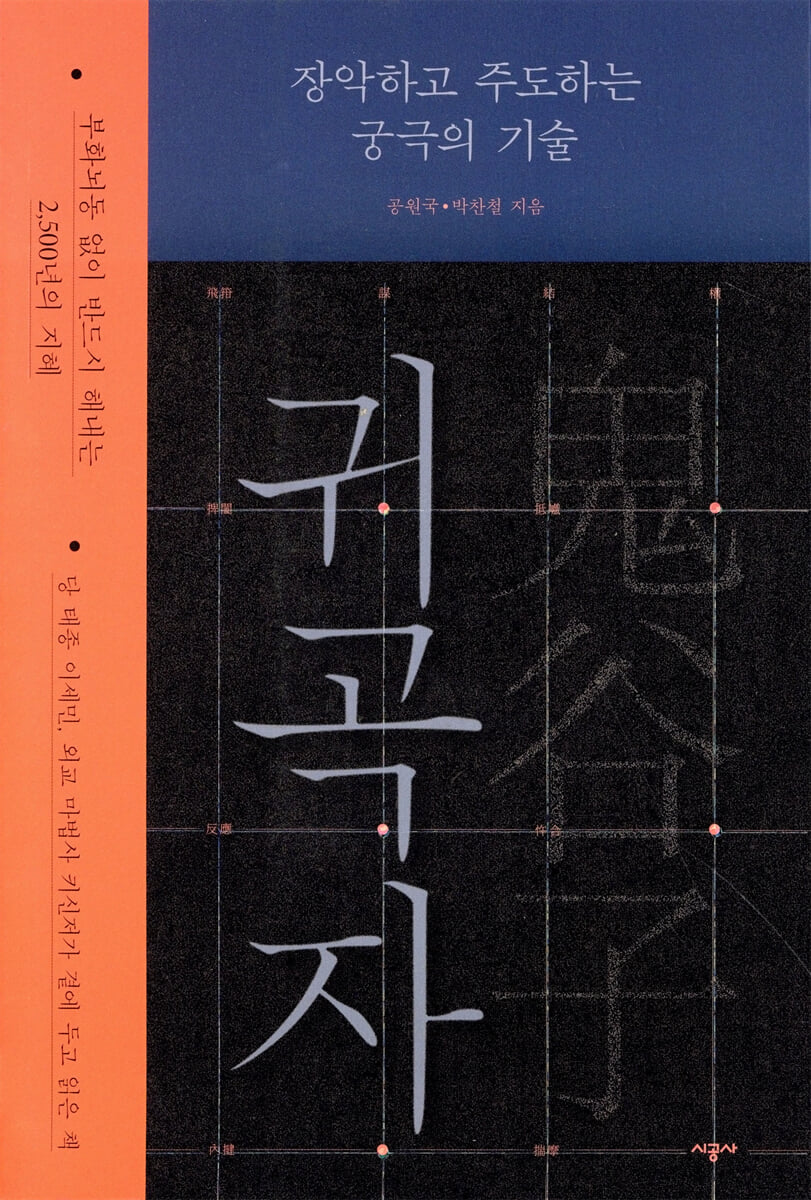
Guigoja
 |
Description
Book Introduction
“How to start a job,
How to proceed,
“How will it end?”
Without being shaken at any moment
2,500 years of wisdom and strategy that finally succeeded!
Two authors, both experts in China, have reinterpreted the Warring States period strategy book "Guiguzi" by adding over 40 Chinese idioms and the strategies used by great strategists in history, such as Cao Cao, Zhuge Liang, and Li Shimin, to achieve their goals. They have reinterpreted the message into something that can be applied even in modern times.
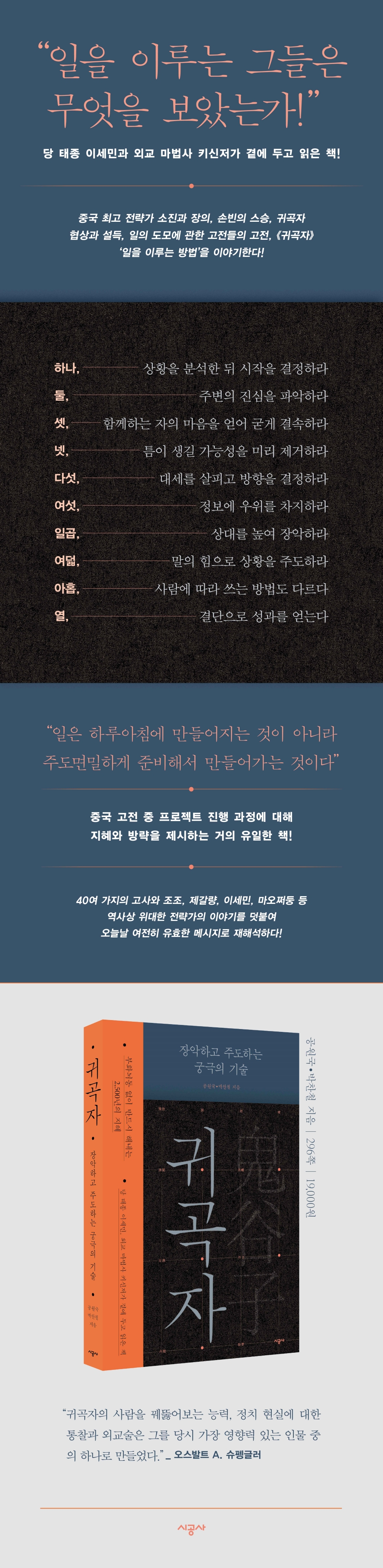
This book introduces methods for preparing, progressing, solving problems, making decisions, and successfully completing a task by accurately defining the task, grasping the objective circumstances surrounding it, assessing the situation, and building a network with the people you will work with.
Through this, executives at mid-sized companies or those in charge of large projects will be able to gain wisdom in planning and allocating personnel and resources.
Additionally, those responsible for planning small projects will learn the wisdom of establishing execution methods, persuading those around them to secure necessary resources, and achieving results within the organization.
How to proceed,
“How will it end?”
Without being shaken at any moment
2,500 years of wisdom and strategy that finally succeeded!
Two authors, both experts in China, have reinterpreted the Warring States period strategy book "Guiguzi" by adding over 40 Chinese idioms and the strategies used by great strategists in history, such as Cao Cao, Zhuge Liang, and Li Shimin, to achieve their goals. They have reinterpreted the message into something that can be applied even in modern times.
This book introduces methods for preparing, progressing, solving problems, making decisions, and successfully completing a task by accurately defining the task, grasping the objective circumstances surrounding it, assessing the situation, and building a network with the people you will work with.
Through this, executives at mid-sized companies or those in charge of large projects will be able to gain wisdom in planning and allocating personnel and resources.
Additionally, those responsible for planning small projects will learn the wisdom of establishing execution methods, persuading those around them to secure necessary resources, and achieving results within the organization.
- You can preview some of the book's contents.
Preview
index
Part 1: General Introduction
1.
Analyze the situation and then decide to start _ Paehap (?闔)
Understand the situation | Share your vision with those around you | Be broad and detailed when opening, and secretive when closing | Success and failure are not permanent | [Original text interpretation]
Part 2 Preparation Stage
2.
Understand the true feelings of those around you - Reaction
Listen to the other person's thoughts | Use metaphors and symbols to understand the other person's true feelings | [Original text interpretation]
3.
Win the hearts of those who are with you and unite them firmly _ Naegeon (內?)
Demonstrate that you and your colleagues share the same views | Identify the needs of the organization and its people | If you fail to unite, step down without hesitation | [Original text interpretation]
4.
Eliminate the possibility of gaps in advance _ We (抵?)
Blocking small gaps in advance can save you a lot of work. | The method of blocking gaps varies depending on the situation. | If you use us carelessly, you can create gaps that didn't exist. | [Original text interpretation]
Part 3: Execution Phase
5.
Observe the trend and decide the direction _ Ohap (?合)
Reading trends through repeated observation | Principles and justification are crucial | Create a dominant situation | [Original text interpretation]
6.
Gain an information advantage _ Cheema (?摩)
Understand the magnitude and direction of your opponent's power | To know their true intentions, secretly stimulate their desires | [Original text interpretation]
7.
Elevate and dominate your opponents _ Flying Arrow
Before praising someone, understand their true feelings. Give them the praise they need. [Original text]
8.
Take control of the situation with the power of words _ Kwon
Trust the power of words | Don't try to defeat your opponent, but use them appropriately | Avoid using words that put yourself at risk | [Original text]
9.
The way of writing varies from person to person _ Mo (謀)
You can use everyone; Explain the situation objectively rather than making claims; Keep secrets until you've accomplished something; Flexibility and change multiply the power of wisdom; Let go of the small to gain the bigger; Being passive will cause you to lose momentum; [Original text interpretation]
Part 4 Final Stage
10.
Achieve results through determination _ Kyeol (結)
The purpose of a decision is concrete gain | Make decisions that fit your abilities and circumstances | Decisions require justification and responsibility, along with gain | [Original text interpretation]
1.
Analyze the situation and then decide to start _ Paehap (?闔)
Understand the situation | Share your vision with those around you | Be broad and detailed when opening, and secretive when closing | Success and failure are not permanent | [Original text interpretation]
Part 2 Preparation Stage
2.
Understand the true feelings of those around you - Reaction
Listen to the other person's thoughts | Use metaphors and symbols to understand the other person's true feelings | [Original text interpretation]
3.
Win the hearts of those who are with you and unite them firmly _ Naegeon (內?)
Demonstrate that you and your colleagues share the same views | Identify the needs of the organization and its people | If you fail to unite, step down without hesitation | [Original text interpretation]
4.
Eliminate the possibility of gaps in advance _ We (抵?)
Blocking small gaps in advance can save you a lot of work. | The method of blocking gaps varies depending on the situation. | If you use us carelessly, you can create gaps that didn't exist. | [Original text interpretation]
Part 3: Execution Phase
5.
Observe the trend and decide the direction _ Ohap (?合)
Reading trends through repeated observation | Principles and justification are crucial | Create a dominant situation | [Original text interpretation]
6.
Gain an information advantage _ Cheema (?摩)
Understand the magnitude and direction of your opponent's power | To know their true intentions, secretly stimulate their desires | [Original text interpretation]
7.
Elevate and dominate your opponents _ Flying Arrow
Before praising someone, understand their true feelings. Give them the praise they need. [Original text]
8.
Take control of the situation with the power of words _ Kwon
Trust the power of words | Don't try to defeat your opponent, but use them appropriately | Avoid using words that put yourself at risk | [Original text]
9.
The way of writing varies from person to person _ Mo (謀)
You can use everyone; Explain the situation objectively rather than making claims; Keep secrets until you've accomplished something; Flexibility and change multiply the power of wisdom; Let go of the small to gain the bigger; Being passive will cause you to lose momentum; [Original text interpretation]
Part 4 Final Stage
10.
Achieve results through determination _ Kyeol (結)
The purpose of a decision is concrete gain | Make decisions that fit your abilities and circumstances | Decisions require justification and responsibility, along with gain | [Original text interpretation]
Detailed image
Into the book
What is the key to becoming a missionary, as suggested by Guigokja? It is that you must take the initiative.
Being proactive means taking control of your work rather than being swayed by it.
But to get things under control, there's something you have to do first.
It is about thinking, ‘Is this something I can really do?’ and assessing the entire task.
Ultimately, it is a losing battle to first assess the entire situation and then proactively decide whether to advance or retreat.
---「1.
Analyze the situation and then decide to start _ From "Paehap"
In the 'Reaction' section, we discuss how to understand the other person's true feelings before attempting to do something, through what is revealed on the outside, that is, through what the other person says.
The point here is to listen carefully to what others say.
My words are not necessary to make a point, but to accurately understand the other person's intentions.
---「2.
Understand the true feelings of those around you _ Reaction"
The word 'nae' has two meanings: going inside and being located inside.
And 'Geon' means to have a very close relationship. (Omitted) In short, 'Geon' means to have an inseparable relationship, like a community of shared destiny, with the person who plays the most important role in your work.
---「3.
Be strong and unite _ from "My Will"
Before starting work, the curator says to first remove any signs of cracking.
A tiny gap opens up and becomes a huge crack, eventually causing the huge structure to collapse.
Sometimes a project can be ruined by a small gap.
If you first figure out where the gaps are, your project will be more well-managed, saving you a lot of money and effort.
---「4.
Eliminate the possibility of gaps in advance _ Among us
The meaning of Ohap is to properly observe the heavenly timing, ride the changing patterns of the heavenly timing, and once you ride the changing patterns, do your best.
It means that you should first look at the time of heaven, examine your own abilities to see if you can live up to that time of heaven, and then, when you are confident, set a direction and accomplish the task.
When you have the will and the ability, and can turn the situation to your advantage, you can immediately 'twist' the direction.
---「5.
Observe the trend and decide the direction _ From "Ohhap"
If you've been focusing on understanding the overall situation so far, it's now time to directly identify the opponent you're trying to attack.
Simply put, the technique of understanding the objective situation and intention of the opponent is the pancreas and the mind.
(Omitted) The key to this chapter is to thoroughly investigate your opponent before using your wisdom on him.
---「6.
Gain an information advantage _ from "Pancreas"
Bigyeom means to hold tightly by lifting it up, and its meaning is very strong.
So this chapter has been criticized by Confucian scholars since ancient times.
To paraphrase a bit, doesn't this mean captivating someone's heart by flattering them and flattering them? The man who fiercely criticized this art of flattery was Mencius, the Confucian scholar.
Mencius was displeased with those who did not behave like a great man and instead relied on the power of words.
---「7.
Elevate and dominate your opponent _ From "Bigyeom"
The key point that the wise man emphasizes is that you should not waste your energy trying to break the other person's words.
When speaking, you must not tire the other person out.
The other person is just as busy as I am talking.
First, you have to give that person what he needs.
If you give the other person what they really want, they will forget their fatigue.
It's not too late to say more then.
---「8.
From "Lead the situation with the power of words _ Volume"
'Mo' actually means to accomplish something by using strategy.
Now it's time to remove obstacles, compete with others, and work together to achieve results.
The Guigoja always tells us not to try to beat the other person, but to go with the flow and do things.
One thing we must never forget again is that people do the work.
(Omitted) Next, we need to understand the characteristics of the people involved in the work.
Then you have to choose how to use people.
And you have to believe in yourself, persuade others, and allocate resources.
---「9.
The way of writing is different for each person _ Among the "Mo"
Making a decision means, in a word, organizing your current uncertain situation, that is, your doubts, and focusing your energy on them.
And the criterion for decision is concrete benefit.
Decisions that do not guarantee concrete benefits are vulnerable to changes in circumstances.
Being proactive means taking control of your work rather than being swayed by it.
But to get things under control, there's something you have to do first.
It is about thinking, ‘Is this something I can really do?’ and assessing the entire task.
Ultimately, it is a losing battle to first assess the entire situation and then proactively decide whether to advance or retreat.
---「1.
Analyze the situation and then decide to start _ From "Paehap"
In the 'Reaction' section, we discuss how to understand the other person's true feelings before attempting to do something, through what is revealed on the outside, that is, through what the other person says.
The point here is to listen carefully to what others say.
My words are not necessary to make a point, but to accurately understand the other person's intentions.
---「2.
Understand the true feelings of those around you _ Reaction"
The word 'nae' has two meanings: going inside and being located inside.
And 'Geon' means to have a very close relationship. (Omitted) In short, 'Geon' means to have an inseparable relationship, like a community of shared destiny, with the person who plays the most important role in your work.
---「3.
Be strong and unite _ from "My Will"
Before starting work, the curator says to first remove any signs of cracking.
A tiny gap opens up and becomes a huge crack, eventually causing the huge structure to collapse.
Sometimes a project can be ruined by a small gap.
If you first figure out where the gaps are, your project will be more well-managed, saving you a lot of money and effort.
---「4.
Eliminate the possibility of gaps in advance _ Among us
The meaning of Ohap is to properly observe the heavenly timing, ride the changing patterns of the heavenly timing, and once you ride the changing patterns, do your best.
It means that you should first look at the time of heaven, examine your own abilities to see if you can live up to that time of heaven, and then, when you are confident, set a direction and accomplish the task.
When you have the will and the ability, and can turn the situation to your advantage, you can immediately 'twist' the direction.
---「5.
Observe the trend and decide the direction _ From "Ohhap"
If you've been focusing on understanding the overall situation so far, it's now time to directly identify the opponent you're trying to attack.
Simply put, the technique of understanding the objective situation and intention of the opponent is the pancreas and the mind.
(Omitted) The key to this chapter is to thoroughly investigate your opponent before using your wisdom on him.
---「6.
Gain an information advantage _ from "Pancreas"
Bigyeom means to hold tightly by lifting it up, and its meaning is very strong.
So this chapter has been criticized by Confucian scholars since ancient times.
To paraphrase a bit, doesn't this mean captivating someone's heart by flattering them and flattering them? The man who fiercely criticized this art of flattery was Mencius, the Confucian scholar.
Mencius was displeased with those who did not behave like a great man and instead relied on the power of words.
---「7.
Elevate and dominate your opponent _ From "Bigyeom"
The key point that the wise man emphasizes is that you should not waste your energy trying to break the other person's words.
When speaking, you must not tire the other person out.
The other person is just as busy as I am talking.
First, you have to give that person what he needs.
If you give the other person what they really want, they will forget their fatigue.
It's not too late to say more then.
---「8.
From "Lead the situation with the power of words _ Volume"
'Mo' actually means to accomplish something by using strategy.
Now it's time to remove obstacles, compete with others, and work together to achieve results.
The Guigoja always tells us not to try to beat the other person, but to go with the flow and do things.
One thing we must never forget again is that people do the work.
(Omitted) Next, we need to understand the characteristics of the people involved in the work.
Then you have to choose how to use people.
And you have to believe in yourself, persuade others, and allocate resources.
---「9.
The way of writing is different for each person _ Among the "Mo"
Making a decision means, in a word, organizing your current uncertain situation, that is, your doubts, and focusing your energy on them.
And the criterion for decision is concrete benefit.
Decisions that do not guarantee concrete benefits are vulnerable to changes in circumstances.
---「10.
Achieving results through determination _ From "Decision"
Achieving results through determination _ From "Decision"
Publisher's Review
Why, is it 『Gwigokja』 now?
Talk about 'how to get things done'!
China, 2,500 years ago, known as the Warring States Period, was an arena where numerous vassal states competed for hegemony based on their respective military power.
The vassal states competed with each other to become the masters of the world, shouting about a rich and powerful nation with limited resources and limited space. To win or survive this competition, “every imaginable talent had to be mobilized.” Naturally, the vassal states needed talented people, and these talented people went on to serve in various countries to realize their ambitions and ideals.
During this period, unlike other scholars of the Hundred Schools of Thought, Guiguzi taught his disciples “practical principles and methods for those who wish to pursue their careers to achieve their ambitions.”
『Gwigokja』, which contains the ‘practical principles and methods’ taught by Gwigokja, is a book that explains the “steps to accomplishing a great task,” and talks about ‘how to start a task, how to proceed, and how to finish it.’
To this end, it presents means and methods that are still valid today, 2,500 years later, such as “the method needed to ‘define work accurately, grasp the objective situation around you, build a network with people to work with, and make decisions.’”
This is why 『Gwigokja』, which contains the stark wisdom of the Warring States Period when life depended on victory or defeat, is considered a must-read for elites in politics, economics, national defense, and diplomacy in China today.
Once you start something, take the lead!
The importance of 'taking control and leading' still holds true today.
This book defines the essence of 『Gwigokja』 as ‘something that must be done proactively.’
Whether deciding to start a project, trying to win the hearts of those you work with, determining direction by observing trends, or making a decision to finish a task, what is most important is a proactive attitude.
Being proactive means taking control of your work rather than being swayed by it.
The essence of 『Gwigokja』 is further concretized through the authors' addition of over 40 anecdotes and stories of important strategists in history, including Cao Cao, Zhuge Liang, Li Shimin, Wu Sangui, Seo Xi, Jiang Wei, Gao Xianzhi, Mao Zedong, and Deng Xiaoping.
The importance of leading and controlling can be seen in the story of Emperor Taizong of Tang, Li Shimin, who laid the foundation for the founding of the Tang Dynasty, and the story of Wu Sangui, who opened the gates of Shanhai Pass and forced the Ming Dynasty to surrender to the Qing Dynasty, confirming that failure to control is inevitable.
In this way, the various stories and characters introduced by the authors in this book serve as another means of proving that the methods presented in 『Gwigokja』 were and still are effective in the past and present.
Talk about 'how to get things done'!
China, 2,500 years ago, known as the Warring States Period, was an arena where numerous vassal states competed for hegemony based on their respective military power.
The vassal states competed with each other to become the masters of the world, shouting about a rich and powerful nation with limited resources and limited space. To win or survive this competition, “every imaginable talent had to be mobilized.” Naturally, the vassal states needed talented people, and these talented people went on to serve in various countries to realize their ambitions and ideals.
During this period, unlike other scholars of the Hundred Schools of Thought, Guiguzi taught his disciples “practical principles and methods for those who wish to pursue their careers to achieve their ambitions.”
『Gwigokja』, which contains the ‘practical principles and methods’ taught by Gwigokja, is a book that explains the “steps to accomplishing a great task,” and talks about ‘how to start a task, how to proceed, and how to finish it.’
To this end, it presents means and methods that are still valid today, 2,500 years later, such as “the method needed to ‘define work accurately, grasp the objective situation around you, build a network with people to work with, and make decisions.’”
This is why 『Gwigokja』, which contains the stark wisdom of the Warring States Period when life depended on victory or defeat, is considered a must-read for elites in politics, economics, national defense, and diplomacy in China today.
Once you start something, take the lead!
The importance of 'taking control and leading' still holds true today.
This book defines the essence of 『Gwigokja』 as ‘something that must be done proactively.’
Whether deciding to start a project, trying to win the hearts of those you work with, determining direction by observing trends, or making a decision to finish a task, what is most important is a proactive attitude.
Being proactive means taking control of your work rather than being swayed by it.
The essence of 『Gwigokja』 is further concretized through the authors' addition of over 40 anecdotes and stories of important strategists in history, including Cao Cao, Zhuge Liang, Li Shimin, Wu Sangui, Seo Xi, Jiang Wei, Gao Xianzhi, Mao Zedong, and Deng Xiaoping.
The importance of leading and controlling can be seen in the story of Emperor Taizong of Tang, Li Shimin, who laid the foundation for the founding of the Tang Dynasty, and the story of Wu Sangui, who opened the gates of Shanhai Pass and forced the Ming Dynasty to surrender to the Qing Dynasty, confirming that failure to control is inevitable.
In this way, the various stories and characters introduced by the authors in this book serve as another means of proving that the methods presented in 『Gwigokja』 were and still are effective in the past and present.
GOODS SPECIFICS
- Date of issue: March 20, 2023
- Page count, weight, size: 296 pages | 518g | 152*225*18mm
- ISBN13: 9791169256759
- ISBN10: 1169256759
You may also like
카테고리
korean


korean

![GQ KOREA Mark (Monthly): December [2025]](http://librairie.coreenne.fr/cdn/shop/files/8ef265dbbfbf186523ed75ba7319009d.jpg?v=1765340328&width=3840)


