

How to Use Emotions to Save Your Brain from Thinking
 |
Description
Book Introduction
Become familiar with the emotional brain, the starting point of all decision-making.
The happiness switch in my head turns on!
The first emotion in the brain: A simple and delightful neuroscience prescription from 'Rimby'
***#1 Self-Improvement Product on Amazon Germany!
***Reviewed and strongly recommended by Professor Dae-soo Kim of the Department of Brain and Cognitive Sciences at KAIST!
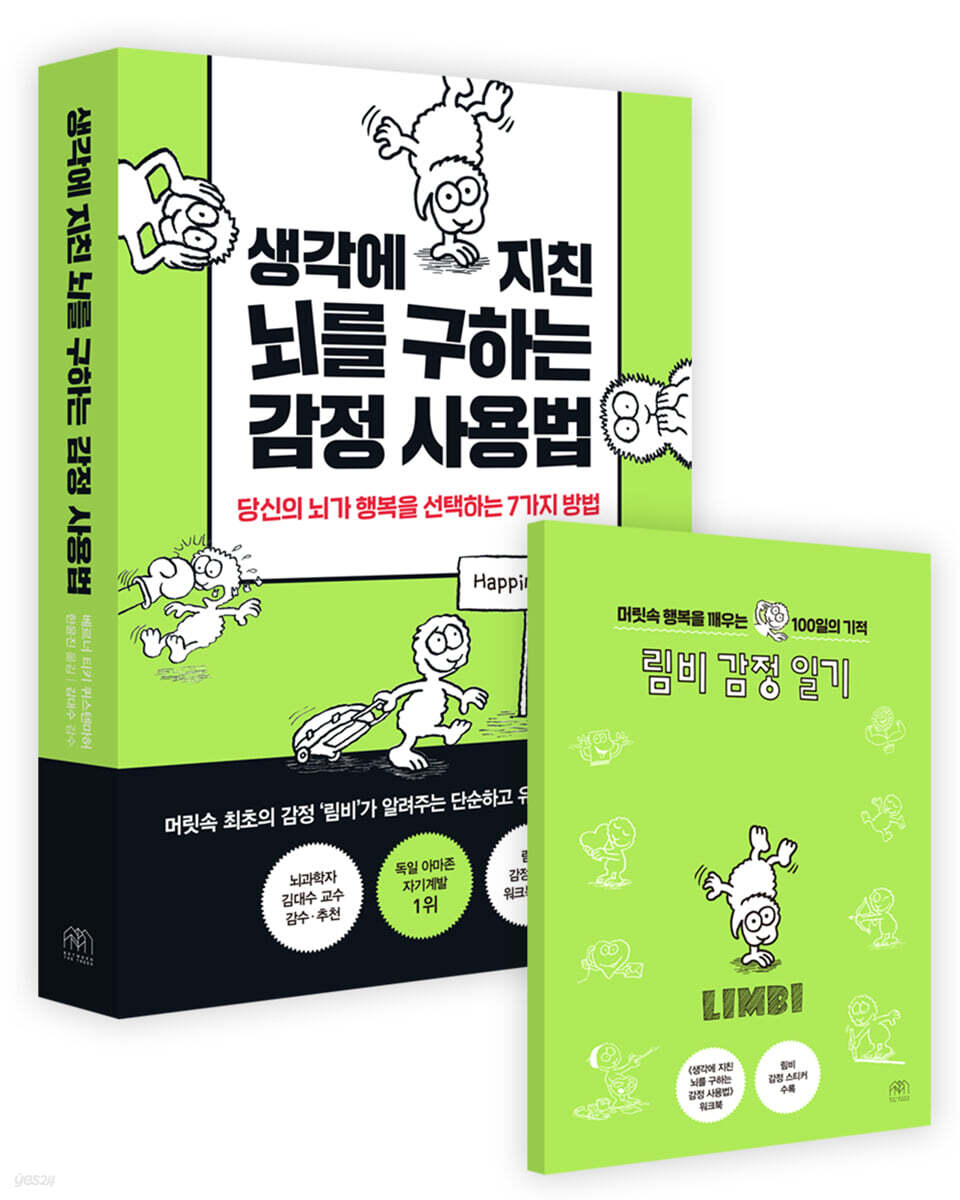
***Korean Edition Special Appendix: "Rimby's Emotional Diary" Workbook
When you think of the human brain, what comes to mind? Clarity of logic? Profound thought? All of these are unique strengths of the human brain.
But there is another part of the brain that has a decisive influence on our lives.
It's emotion! "People with frontal lobe damage and an inability to feel emotions were able to list the pros and cons of simple everyday decisions (brown shoes or black shoes?), but they couldn't lean toward one side or the other." (p. 126) Brain research has revealed that emotions are essential for humans to make decisions, no matter what.
The brain makes decisions by combining objectivity and subjectivity, facts and guesses, reason and emotion.
Yet, when faced with big and small decisions, people try to suppress their emotions and think rationally.
We may have learned to analyze sharply, but we have never learned to use our emotions properly.
Werner Küstenmacher, the bestselling author whose book "Live Simply" changed the lives of 10 million readers worldwide and 500,000 in Korea alone, found the solution to life at that very point.
Fascinated by the brain science that reveals the essence of human nature, he delved into it and was captivated by none other than the emotional brain, the limbic system.
The limbic system, which is not widely recognized by the public and is often the target of control, has realized that only those who can effectively utilize the immense power of this emotional brain will be able to hold the key to happiness.
To spread the word about the charm and power of the limbic system that he discovered, and how to effectively express that power, he recreated the limbic system as a cute character called 'Rimby'.
As I get to know the fluffy Rimby, I begin to understand myself better: why I keep losing focus and why I make impulse purchases that I later regret.
Not only that, but we also learn that with very simple environmental and behavioral changes, Rimby can unleash his ingenious creativity and make his love last indefinitely.
This book, which explains brain science knowledge in an easy and fun way, provides a wealth of simple tips to change our lives based on it, and even includes an emotional diary workbook to help you apply 'how to use the emotional brain' directly to your life, will become the perfect encyclopedia for a happy life.
The happiness switch in my head turns on!
The first emotion in the brain: A simple and delightful neuroscience prescription from 'Rimby'
***#1 Self-Improvement Product on Amazon Germany!
***Reviewed and strongly recommended by Professor Dae-soo Kim of the Department of Brain and Cognitive Sciences at KAIST!
***Korean Edition Special Appendix: "Rimby's Emotional Diary" Workbook
When you think of the human brain, what comes to mind? Clarity of logic? Profound thought? All of these are unique strengths of the human brain.
But there is another part of the brain that has a decisive influence on our lives.
It's emotion! "People with frontal lobe damage and an inability to feel emotions were able to list the pros and cons of simple everyday decisions (brown shoes or black shoes?), but they couldn't lean toward one side or the other." (p. 126) Brain research has revealed that emotions are essential for humans to make decisions, no matter what.
The brain makes decisions by combining objectivity and subjectivity, facts and guesses, reason and emotion.
Yet, when faced with big and small decisions, people try to suppress their emotions and think rationally.
We may have learned to analyze sharply, but we have never learned to use our emotions properly.
Werner Küstenmacher, the bestselling author whose book "Live Simply" changed the lives of 10 million readers worldwide and 500,000 in Korea alone, found the solution to life at that very point.
Fascinated by the brain science that reveals the essence of human nature, he delved into it and was captivated by none other than the emotional brain, the limbic system.
The limbic system, which is not widely recognized by the public and is often the target of control, has realized that only those who can effectively utilize the immense power of this emotional brain will be able to hold the key to happiness.
To spread the word about the charm and power of the limbic system that he discovered, and how to effectively express that power, he recreated the limbic system as a cute character called 'Rimby'.
As I get to know the fluffy Rimby, I begin to understand myself better: why I keep losing focus and why I make impulse purchases that I later regret.
Not only that, but we also learn that with very simple environmental and behavioral changes, Rimby can unleash his ingenious creativity and make his love last indefinitely.
This book, which explains brain science knowledge in an easy and fun way, provides a wealth of simple tips to change our lives based on it, and even includes an emotional diary workbook to help you apply 'how to use the emotional brain' directly to your life, will become the perfect encyclopedia for a happy life.
- You can preview some of the book's contents.
Preview
index
To Korean readers
Prologue Welcome to Happiness!
Say hello to Chief Limbi
The great world hidden in your head
Until now, we have suppressed the brain's potential.
How is happiness created?
Chapter 1: Rimbi and Time
Limbi's moments are life itself.
How to find the best rhythm for you
5 Exercises to Regain Your Focus
Laziness is a matter of emotion, not will.
The art of brain idling and turning off the nerves
Chapter 2 Rimbi and Space
If you want to be happy, start by organizing your desk.
How to Become a Tidying Master with Rimbi
Creating a dopamine-friendly space
Chapter 3: Rimbi and Don
Don't trust Rimbi when it comes to money!
Rimbi buys emotions, not things.
How to avoid impulse buying and regretting it every time
The Secret of the Numbers That Dazzle Limbi
What's Different About the Brains of the Rich
A New Definition of Success Revealed by Brain Science
Chapter 4: Rimbi and the Body
A healthy brain creates a healthy body.
Why You Fail at Diets Every Time
For those who are tired from lack of sleep every day
The brain has its own favorite exercise.
There's a secret pharmacy inside our bodies.
The unexpected benefits of olfactory training
Do you drink or does the alcohol drink you?
How to Break Free from Nicotine's Shackles Right Now
Chapter 5: Relationship with Rimbi
Why Limbi is Essential in Relationships
Advice for those who find relationships difficult
You can read other people's minds through body language.
The Art of Conversation: Getting Everyone on Your Side
The Brain Science Secrets of High-Performing Teams
10 Things Highly Effective People Have in Common
The adolescent brain needs empathy more than understanding.
How to Accept the Death of a Loved One
Chapter 6: Rimbi and Love
The Real Reason You Fall in Love with Your Lover
Neuroscience's Definition of "Perfect Love"
The secret to extending the lifespan of love indefinitely
The Art of Fighting: Building Healthy Relationships
5 Steps to Overcoming a Breakup After Love Ends
Chapter 7: Rimbi and Happiness
A happy brain makes life happy.
How to Use Memory to Take Back Control of Your Life
Who knew studying could be this fun?
The power of small habits that create happy feelings
How to Turn a Depressed Brain into a Happy Brain
The potential of the brain to grow beyond its limits
Find your own word for happiness
Epilogue: In the end, your relationship with Rimbi determines your happiness!
References
Prologue Welcome to Happiness!
Say hello to Chief Limbi
The great world hidden in your head
Until now, we have suppressed the brain's potential.
How is happiness created?
Chapter 1: Rimbi and Time
Limbi's moments are life itself.
How to find the best rhythm for you
5 Exercises to Regain Your Focus
Laziness is a matter of emotion, not will.
The art of brain idling and turning off the nerves
Chapter 2 Rimbi and Space
If you want to be happy, start by organizing your desk.
How to Become a Tidying Master with Rimbi
Creating a dopamine-friendly space
Chapter 3: Rimbi and Don
Don't trust Rimbi when it comes to money!
Rimbi buys emotions, not things.
How to avoid impulse buying and regretting it every time
The Secret of the Numbers That Dazzle Limbi
What's Different About the Brains of the Rich
A New Definition of Success Revealed by Brain Science
Chapter 4: Rimbi and the Body
A healthy brain creates a healthy body.
Why You Fail at Diets Every Time
For those who are tired from lack of sleep every day
The brain has its own favorite exercise.
There's a secret pharmacy inside our bodies.
The unexpected benefits of olfactory training
Do you drink or does the alcohol drink you?
How to Break Free from Nicotine's Shackles Right Now
Chapter 5: Relationship with Rimbi
Why Limbi is Essential in Relationships
Advice for those who find relationships difficult
You can read other people's minds through body language.
The Art of Conversation: Getting Everyone on Your Side
The Brain Science Secrets of High-Performing Teams
10 Things Highly Effective People Have in Common
The adolescent brain needs empathy more than understanding.
How to Accept the Death of a Loved One
Chapter 6: Rimbi and Love
The Real Reason You Fall in Love with Your Lover
Neuroscience's Definition of "Perfect Love"
The secret to extending the lifespan of love indefinitely
The Art of Fighting: Building Healthy Relationships
5 Steps to Overcoming a Breakup After Love Ends
Chapter 7: Rimbi and Happiness
A happy brain makes life happy.
How to Use Memory to Take Back Control of Your Life
Who knew studying could be this fun?
The power of small habits that create happy feelings
How to Turn a Depressed Brain into a Happy Brain
The potential of the brain to grow beyond its limits
Find your own word for happiness
Epilogue: In the end, your relationship with Rimbi determines your happiness!
References
Detailed image

Into the book
It is very important to properly understand Rimbi.
And you absolutely must learn to cooperate with this emotional brain to prevent Rimbi from acting on his own.
If we only had a rational cerebral cortex, we would be nothing more than biological robots.
On the other hand, if there was only Rimby, it would seem too naive or like a ferocious wild animal.
Only when these two things, emotion and reason, are in complete harmony do we become truly human.
Humans have great abilities that can only be realized through the cooperation of the limbic system and the cerebral cortex.
It's things like faith, hope, patience, love, and humor.
--- p.6, from “To Korean Readers”
The superstar of this book is the limbic system.
The limbic system is located in the middle layer of the brain and surrounds the brainstem.
It is also called the mammalian brain because it exists in common among mammals such as rats, cats, dogs, and monkeys.
… … I drew a cute caricature of this charming limbic system and showed it to my wife.
And I explained to her the importance of the limbic system.
When my wife heard that story, she immediately remembered the name of this little character.
“So this is Rimbi!”
--- p.19, from “The Great World Hidden in Your Head”
When you anticipate something, neurons in the limbic system produce dopamine.
This creates the feeling of happiness through chemical processes throughout the brain.
One of these processes takes place in the nucleus accumbens, also known as the "reward center."
There, dopamine improves concentration, increases work efficiency, and gives us a sense of accomplishment.
Endorphins, another happy substance, are called “natural painkillers” and, like morphine or opium, relieve pain and spread an overall good mood.
You can experience Rimbi's miraculous drug, endorphins, in moments of wonder in nature, in emotional moments of falling in love, or in everyday life, such as exercising or bursting into laughter.
--- p.36, from “How is happiness created?”
Wholehearted concentration is possible on only one thing at a time.
And 'sincerity' is related to Rimbi.
So, the key to living a brain-friendly life is this:
Take just one moment each day to immerse yourself in one thing and let Rimbi experience that moment fully.
A moment when you don't worry about what's to come and don't worry about what's past.
… … Of course, it won’t be as spectacular as spinning multiple plates at once.
But it would be great for you and Rimby.
Having a regular 'limbi-moment' like this every day can help you protect yourself from burnout.
--- p.57, from “5 Training Methods to Regain Lost Concentration”
The most common problem with resolutions like cleaning, organizing, quitting smoking, or dieting is pride.
I think I have to jump right in from the start and give up if I make even the slightest mistake.
… … So, let’s approach it more wisely, starting with ‘places we use frequently in our daily lives’.
Start with the top shelf of your desk drawer, where your most frequently worn clothes hang.
--- p.95, from “If you want to be happy, start by organizing your desk”
Economics classes teach us that prices are determined by supply and demand, but the reality is different.
In most cases, the actual price is calculated based on Rimbi's expectations.
… … If you pour a glass of wine from an expensive-looking bottle into a wine lover's hand and tell them that the wine costs 150,000 won, they will feel that the wine tastes better than if you pour the same wine from an ordinary bottle or pack.
For Rimby, this phenomenon is not a lie, but reality.
When drinking wine that was said to be expensive, we were able to confirm with fMRI that the nucleus accumbens, the center responsible for reward and motivation, was actually more strongly activated.
--- p.141, from “How to avoid impulse buying that you regret every time you buy something”
The reason laughter makes us feel good is because of the communication between the limbic system and other body parts.
As mentioned earlier, this communication works through somatic markers.
When Rimbi is happy, he contracts certain facial muscles, which activates temporal sensors that send signals to the cerebral cortex.
“Take a break! Feel good! Clear the alarm, this is a good sign!” … … Thanks to training yourself to smile intentionally, you can now regulate your mood as easily as your handwriting or your tennis serve.
--- p.189, from “To those who are tired from lack of sleep every day”
Saying, “Will you help me?” was significantly less effective than saying, “Will you be my assistant?”
Presumably, nouns are more closely connected to the ego, which has the effect of directly appealing to Rimby.
… … Instead of asking your spouse, “Would you like to help me cook?” try saying, “Honey, I want you to be the cook today!”
Depending on the situation, try applying the appropriate titles: pastry chef, sommelier, sauce expert, pizza chef, cheese expert, grill master, etc.
--- p.253, from “The Art of Conversation: Making Everyone on My Side”
Men are surprisingly devoted to their partners.
The reason was discovered by Donatella Marazziti, a psychologist at the University of Pisa.
People in love have significantly lower serotonin levels.
This means that the hormone of happiness decreases.
This is truly a clever move by evolution.
Lovers in love are only happy when they are together! Marachti also discovered another natural law.
In general, testosterone, a sex hormone, is secreted in much greater amounts in men than in women.
However, when falling in love, a man's testosterone levels drop sharply, while a woman's testosterone levels rise.
Men become a little more feminine and women become a little more masculine.
--- p.296, from “The Definition of ‘Perfect Love’ According to Neuroscience”
American neuroscientist Terence Seinowski has proven through experiments that our brain organizes and optimizes learning content during sleep.
Numerous other studies have also supported the idea that after a good night's sleep, what you studied the previous day becomes firmly established in your brain.
So, if you have a test or similar assignment coming up, review what you've studied so far the night before and get a good night's sleep.
… … Participants in the experiment remembered the material five times better than they did the night before!
--- p.353, from “Studying Can Be This Fun”
One great way to find your own happiness is to keep a gratitude journal every day.
If you carefully reflect on what moments during your day you felt grateful, you will be able to see more clearly what makes you happy.
Additionally, when we feel gratitude, specific parts of the cerebral cortex are activated, areas that are deeply connected to empathy, emotional regulation, and stress relief.
So, practicing gratitude makes both your body and mind healthy.
And you absolutely must learn to cooperate with this emotional brain to prevent Rimbi from acting on his own.
If we only had a rational cerebral cortex, we would be nothing more than biological robots.
On the other hand, if there was only Rimby, it would seem too naive or like a ferocious wild animal.
Only when these two things, emotion and reason, are in complete harmony do we become truly human.
Humans have great abilities that can only be realized through the cooperation of the limbic system and the cerebral cortex.
It's things like faith, hope, patience, love, and humor.
--- p.6, from “To Korean Readers”
The superstar of this book is the limbic system.
The limbic system is located in the middle layer of the brain and surrounds the brainstem.
It is also called the mammalian brain because it exists in common among mammals such as rats, cats, dogs, and monkeys.
… … I drew a cute caricature of this charming limbic system and showed it to my wife.
And I explained to her the importance of the limbic system.
When my wife heard that story, she immediately remembered the name of this little character.
“So this is Rimbi!”
--- p.19, from “The Great World Hidden in Your Head”
When you anticipate something, neurons in the limbic system produce dopamine.
This creates the feeling of happiness through chemical processes throughout the brain.
One of these processes takes place in the nucleus accumbens, also known as the "reward center."
There, dopamine improves concentration, increases work efficiency, and gives us a sense of accomplishment.
Endorphins, another happy substance, are called “natural painkillers” and, like morphine or opium, relieve pain and spread an overall good mood.
You can experience Rimbi's miraculous drug, endorphins, in moments of wonder in nature, in emotional moments of falling in love, or in everyday life, such as exercising or bursting into laughter.
--- p.36, from “How is happiness created?”
Wholehearted concentration is possible on only one thing at a time.
And 'sincerity' is related to Rimbi.
So, the key to living a brain-friendly life is this:
Take just one moment each day to immerse yourself in one thing and let Rimbi experience that moment fully.
A moment when you don't worry about what's to come and don't worry about what's past.
… … Of course, it won’t be as spectacular as spinning multiple plates at once.
But it would be great for you and Rimby.
Having a regular 'limbi-moment' like this every day can help you protect yourself from burnout.
--- p.57, from “5 Training Methods to Regain Lost Concentration”
The most common problem with resolutions like cleaning, organizing, quitting smoking, or dieting is pride.
I think I have to jump right in from the start and give up if I make even the slightest mistake.
… … So, let’s approach it more wisely, starting with ‘places we use frequently in our daily lives’.
Start with the top shelf of your desk drawer, where your most frequently worn clothes hang.
--- p.95, from “If you want to be happy, start by organizing your desk”
Economics classes teach us that prices are determined by supply and demand, but the reality is different.
In most cases, the actual price is calculated based on Rimbi's expectations.
… … If you pour a glass of wine from an expensive-looking bottle into a wine lover's hand and tell them that the wine costs 150,000 won, they will feel that the wine tastes better than if you pour the same wine from an ordinary bottle or pack.
For Rimby, this phenomenon is not a lie, but reality.
When drinking wine that was said to be expensive, we were able to confirm with fMRI that the nucleus accumbens, the center responsible for reward and motivation, was actually more strongly activated.
--- p.141, from “How to avoid impulse buying that you regret every time you buy something”
The reason laughter makes us feel good is because of the communication between the limbic system and other body parts.
As mentioned earlier, this communication works through somatic markers.
When Rimbi is happy, he contracts certain facial muscles, which activates temporal sensors that send signals to the cerebral cortex.
“Take a break! Feel good! Clear the alarm, this is a good sign!” … … Thanks to training yourself to smile intentionally, you can now regulate your mood as easily as your handwriting or your tennis serve.
--- p.189, from “To those who are tired from lack of sleep every day”
Saying, “Will you help me?” was significantly less effective than saying, “Will you be my assistant?”
Presumably, nouns are more closely connected to the ego, which has the effect of directly appealing to Rimby.
… … Instead of asking your spouse, “Would you like to help me cook?” try saying, “Honey, I want you to be the cook today!”
Depending on the situation, try applying the appropriate titles: pastry chef, sommelier, sauce expert, pizza chef, cheese expert, grill master, etc.
--- p.253, from “The Art of Conversation: Making Everyone on My Side”
Men are surprisingly devoted to their partners.
The reason was discovered by Donatella Marazziti, a psychologist at the University of Pisa.
People in love have significantly lower serotonin levels.
This means that the hormone of happiness decreases.
This is truly a clever move by evolution.
Lovers in love are only happy when they are together! Marachti also discovered another natural law.
In general, testosterone, a sex hormone, is secreted in much greater amounts in men than in women.
However, when falling in love, a man's testosterone levels drop sharply, while a woman's testosterone levels rise.
Men become a little more feminine and women become a little more masculine.
--- p.296, from “The Definition of ‘Perfect Love’ According to Neuroscience”
American neuroscientist Terence Seinowski has proven through experiments that our brain organizes and optimizes learning content during sleep.
Numerous other studies have also supported the idea that after a good night's sleep, what you studied the previous day becomes firmly established in your brain.
So, if you have a test or similar assignment coming up, review what you've studied so far the night before and get a good night's sleep.
… … Participants in the experiment remembered the material five times better than they did the night before!
--- p.353, from “Studying Can Be This Fun”
One great way to find your own happiness is to keep a gratitude journal every day.
If you carefully reflect on what moments during your day you felt grateful, you will be able to see more clearly what makes you happy.
Additionally, when we feel gratitude, specific parts of the cerebral cortex are activated, areas that are deeply connected to empathy, emotional regulation, and stress relief.
So, practicing gratitude makes both your body and mind healthy.
--- p.368, from “Find Your Own Words of Happiness”
Publisher's Review
Why should we focus on the 'emotional brain' now?
“Humans have great abilities that can only be realized through the cooperation of the limbic system and the cerebral cortex.
“It’s faith, hope, patience, love, and humor.” - From the author’s preface, “To Korean Readers”
"A message of hope for humanity weary of logic and reason." _Kim Dae-soo | Professor, Department of Brain and Cognitive Sciences, KAIST
Pixar's animation "Inside Out," which resonated with countless people around the world, features emotions that control the human mind as its main characters.
This was a completely different approach from the previous view that the human mind was a space for thoughts, reason, and memories.
Yet, the reason so many people, regardless of gender or age, were so enthusiastic about this movie is probably because everyone knew how much influence emotions have on their lives.
In our heads, the rational and logical cerebral cortex and the emotional and impulsive limbic system coexist.
We, who value human intelligence, often attribute everything from precise tasks to groundbreaking inventions to the cerebral cortex, and blame our limbic system for our poor and irrational choices.
In fact, the habit of sleeping in late in the morning and being unfoundedly wary of new people come from the limbic system.
Also, the irrational propaganda of politicians, and terrible things like war and terrorism, are caused by the limbic system going wild.
But given the right guidance, the limbic system can generate some of the most beautiful emotions in the world: passion, trust, joy, love, and more.
And these emotions are essential for the extraordinary work and human development that was once thought to be the domain of the cerebral cortex.
Therefore, in order to create a happy life and a healthy society, we must know how to use our emotions correctly.
Werner Tiki Küstenmacher, author of "Live Simply," which has changed the lives of 10 million readers around the world, searched for the one master plan to happiness and found the answer in brain science, specifically in the limbic system, the emotional brain.
He personally experienced that if you understand the allure of this emotional brain and harness its power well rather than blindly trying to suppress it, you can live much more happily and achieve what you want more effectively than before.
And to make this widely known to others, the limbic system was reborn as a cute character called 'Rimby', and through hundreds of Rimby drawings and witty storytelling, this book contains the influence of Rimby on all aspects of life, including time, space, money, body, relationships, and love, and how to change your life by working with Rimby.
If you want to be happy, look into your 'brain', not your heart!
A fun and cute brain science story you've never seen before.
"How to Use Emotions to Save Your Brain from Thinking" is based on brain science knowledge and research, but it's incredibly easy and fun to read without being difficult at all.
The author has devoted several years to studying brain science, and has selected information that is directly relevant to our lives and essential for working with Rimbi, and presented it in a way that anyone can relate to.
You will learn the neuroscientific reasons behind your behavior and emotions, such as why you keep failing at dieting or why you have such a hard time with team projects at university or collaborative projects at work.
Limby's illustrations, which delicately capture emotions and situations, Limby Mode pages that summarize key points at the end of each chapter, and QR codes hidden throughout the book allow even beginners in neuroscience to easily read the entire book.
This book is also full of practical instructions you can follow right away.
Rather than vaguely recommending that we control and manage our emotions, we provide simple actions that we can take to guide our emotions in the right direction.
The book is filled with dozens of tips from beginning to end that are so specific and small that you can easily apply them to your life, such as saying out loud what you need to do when you can't concentrate, slightly changing your posture when talking to others, or smiling for no reason before going to bed, but that clearly have the power to change our lives.
The message of this delightful book can be summed up in just one sentence:
Instead of trying to suppress Rimbi, cooperate with Rimbi.
To do this, you don't need to completely understand the brain or change your entire life.
Just show Rimby a little more respect and allow him to do what he likes a little more.
Our Rimbi is not overly greedy.
A being who can find happiness even in the little crumbs of cake left on a plate.
So, just reading a fun book with cute Rimby illustrations and incorporating some simple changes into your daily life right away will make your Rimby happy.
A 100-Day Miracle that Awakens Happiness in Your Mind: "Rimbi's Emotional Diary"
Experience the magic of life-changing results in just 10 minutes a day.
“Don’t just say, ‘Oh, I see,’ and move on. Be sure to try it out yourself!” This is the author’s repeated appeal throughout the book.
No matter how great a book you read, if you don't reflect on it in your life, all its good content will eventually be forgotten.
This is why you should pay attention to the “Rimby Emotional Diary” that is composed as a set.
The "Rimby Emotion Diary" workbook is the simplest and most visible way to practice the emotional usage skills learned with Rimby for 100 days.
Reflect on the emotions you felt throughout the day, think about why you felt that way, and sort the negative emotions into the trash can and the positive emotions into a precious place in your heart.
Lastly, I would like to offer a word of encouragement to Rimbi, the emotional brain who has been with me today, and draw a happy Rimbi with my own hands.
This workbook is a special supplement produced only in Korea, and was created based on the author's statement that "just drawing Limbi's smiling face has a positive effect on the limbic system."
If you live a busy life every day, you will likely forget how to cooperate with Rimbi and end up urging or suppressing Rimbi again.
But if I open my emotional diary at the end of the day and spend just 10 minutes talking to Rimby, even Rimby, who has been hunched over and frowning all day, will smile brightly.
If you make it a habit to spend time alone with Rimby like this, you'll get used to seeing Rimby as your strongest supporter, and you'll learn to balance your brain not only when writing your feelings journal, but even during the busiest moments of the day.
“Humans have great abilities that can only be realized through the cooperation of the limbic system and the cerebral cortex.
“It’s faith, hope, patience, love, and humor.” - From the author’s preface, “To Korean Readers”
"A message of hope for humanity weary of logic and reason." _Kim Dae-soo | Professor, Department of Brain and Cognitive Sciences, KAIST
Pixar's animation "Inside Out," which resonated with countless people around the world, features emotions that control the human mind as its main characters.
This was a completely different approach from the previous view that the human mind was a space for thoughts, reason, and memories.
Yet, the reason so many people, regardless of gender or age, were so enthusiastic about this movie is probably because everyone knew how much influence emotions have on their lives.
In our heads, the rational and logical cerebral cortex and the emotional and impulsive limbic system coexist.
We, who value human intelligence, often attribute everything from precise tasks to groundbreaking inventions to the cerebral cortex, and blame our limbic system for our poor and irrational choices.
In fact, the habit of sleeping in late in the morning and being unfoundedly wary of new people come from the limbic system.
Also, the irrational propaganda of politicians, and terrible things like war and terrorism, are caused by the limbic system going wild.
But given the right guidance, the limbic system can generate some of the most beautiful emotions in the world: passion, trust, joy, love, and more.
And these emotions are essential for the extraordinary work and human development that was once thought to be the domain of the cerebral cortex.
Therefore, in order to create a happy life and a healthy society, we must know how to use our emotions correctly.
Werner Tiki Küstenmacher, author of "Live Simply," which has changed the lives of 10 million readers around the world, searched for the one master plan to happiness and found the answer in brain science, specifically in the limbic system, the emotional brain.
He personally experienced that if you understand the allure of this emotional brain and harness its power well rather than blindly trying to suppress it, you can live much more happily and achieve what you want more effectively than before.
And to make this widely known to others, the limbic system was reborn as a cute character called 'Rimby', and through hundreds of Rimby drawings and witty storytelling, this book contains the influence of Rimby on all aspects of life, including time, space, money, body, relationships, and love, and how to change your life by working with Rimby.
If you want to be happy, look into your 'brain', not your heart!
A fun and cute brain science story you've never seen before.
"How to Use Emotions to Save Your Brain from Thinking" is based on brain science knowledge and research, but it's incredibly easy and fun to read without being difficult at all.
The author has devoted several years to studying brain science, and has selected information that is directly relevant to our lives and essential for working with Rimbi, and presented it in a way that anyone can relate to.
You will learn the neuroscientific reasons behind your behavior and emotions, such as why you keep failing at dieting or why you have such a hard time with team projects at university or collaborative projects at work.
Limby's illustrations, which delicately capture emotions and situations, Limby Mode pages that summarize key points at the end of each chapter, and QR codes hidden throughout the book allow even beginners in neuroscience to easily read the entire book.
This book is also full of practical instructions you can follow right away.
Rather than vaguely recommending that we control and manage our emotions, we provide simple actions that we can take to guide our emotions in the right direction.
The book is filled with dozens of tips from beginning to end that are so specific and small that you can easily apply them to your life, such as saying out loud what you need to do when you can't concentrate, slightly changing your posture when talking to others, or smiling for no reason before going to bed, but that clearly have the power to change our lives.
The message of this delightful book can be summed up in just one sentence:
Instead of trying to suppress Rimbi, cooperate with Rimbi.
To do this, you don't need to completely understand the brain or change your entire life.
Just show Rimby a little more respect and allow him to do what he likes a little more.
Our Rimbi is not overly greedy.
A being who can find happiness even in the little crumbs of cake left on a plate.
So, just reading a fun book with cute Rimby illustrations and incorporating some simple changes into your daily life right away will make your Rimby happy.
A 100-Day Miracle that Awakens Happiness in Your Mind: "Rimbi's Emotional Diary"
Experience the magic of life-changing results in just 10 minutes a day.
“Don’t just say, ‘Oh, I see,’ and move on. Be sure to try it out yourself!” This is the author’s repeated appeal throughout the book.
No matter how great a book you read, if you don't reflect on it in your life, all its good content will eventually be forgotten.
This is why you should pay attention to the “Rimby Emotional Diary” that is composed as a set.
The "Rimby Emotion Diary" workbook is the simplest and most visible way to practice the emotional usage skills learned with Rimby for 100 days.
Reflect on the emotions you felt throughout the day, think about why you felt that way, and sort the negative emotions into the trash can and the positive emotions into a precious place in your heart.
Lastly, I would like to offer a word of encouragement to Rimbi, the emotional brain who has been with me today, and draw a happy Rimbi with my own hands.
This workbook is a special supplement produced only in Korea, and was created based on the author's statement that "just drawing Limbi's smiling face has a positive effect on the limbic system."
If you live a busy life every day, you will likely forget how to cooperate with Rimbi and end up urging or suppressing Rimbi again.
But if I open my emotional diary at the end of the day and spend just 10 minutes talking to Rimby, even Rimby, who has been hunched over and frowning all day, will smile brightly.
If you make it a habit to spend time alone with Rimby like this, you'll get used to seeing Rimby as your strongest supporter, and you'll learn to balance your brain not only when writing your feelings journal, but even during the busiest moments of the day.
GOODS SPECIFICS
- Date of issue: January 29, 2025
- Page count, weight, size: 384 pages | 772g | 145*210*25mm
- ISBN13: 9791198721846
- ISBN10: 1198721847
You may also like
카테고리
korean


korean

![GQ KOREA Mark (Monthly): December [2025]](http://librairie.coreenne.fr/cdn/shop/files/8ef265dbbfbf186523ed75ba7319009d.jpg?v=1765340328&width=3840)


