

Starting Habits for Your 50s
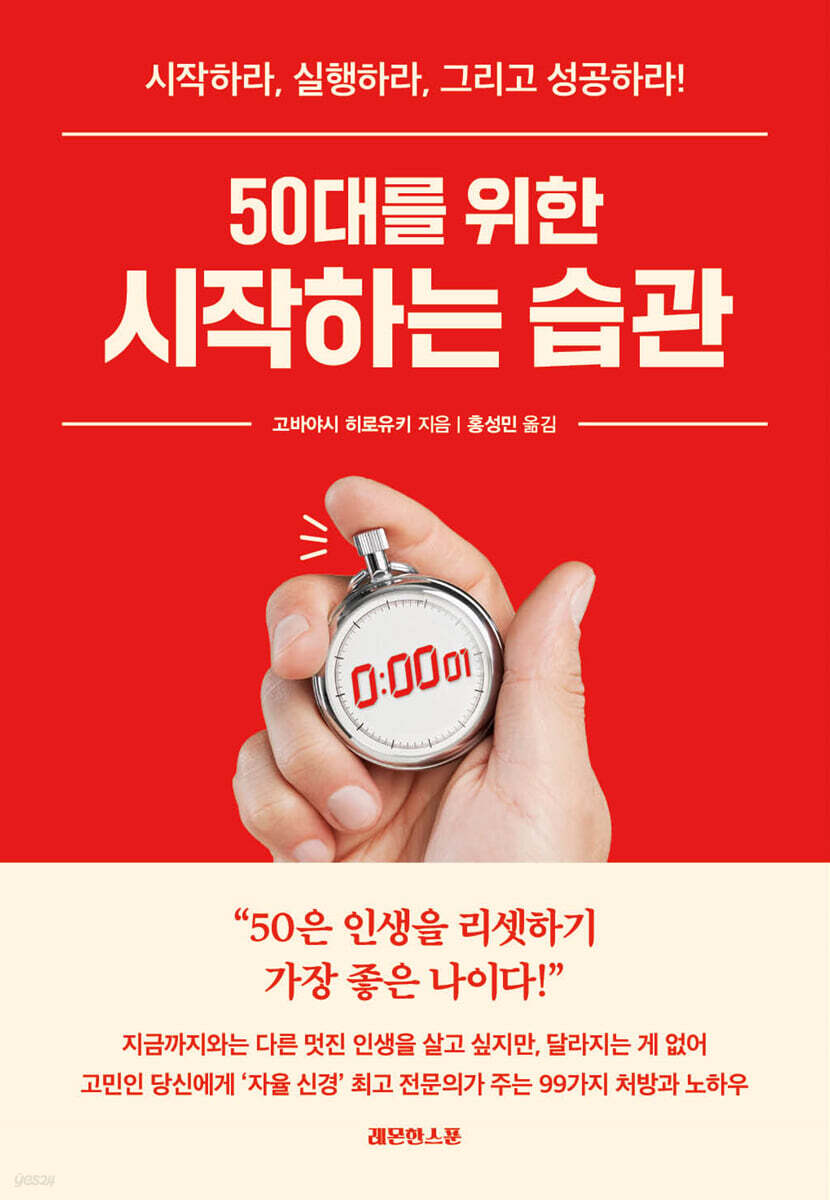 |
Description
Book Introduction
Start, do it, and succeed!
99 "Startup Habits" to Reset Your Life in Your 50s
People who have hundreds of plans in their heads but are frustrated because they can't put a single one into action, people who want to live a different life than before but are worried because nothing changes, people who make plans because they want to spend a wonderful day, week, month, and year, but they can't even get started, let alone get things done with momentum, and end up with nothing in the end...
"Starting Habits for Those in Their 50s" is a book for those who have breathlessly endured the tough times of their 40s and are now entering their 50s and want to reset their lives in a wonderful way.
This book will be your 'navigation' and 'secret map' that will lead you to success in life.
The author of this book does not give readers stereotypical advice.
The author, a respected doctor and Japan's leading authority on the 'autonomic nervous system,' explains in an easy-to-understand way that the autonomic nervous system of our body and mind is maintained by the exquisite harmony and balance of the 'sympathetic nervous system,' which corresponds to the accelerator of a car, and the 'parasympathetic nervous system,' which corresponds to the brakes.
That's why each of the 99 "starting habits" the author presents in this book are effective, practical, scientific, and systematic.
If you have the habit of starting, your life is 99 percent full.
If you master the 99 know-hows taught by the author, an autonomic nervous system specialist, in this book, you will be on the high-speed train to success and happiness.
Now, fill the last 1% to complete your life 100% with your own '00 Starting Habit'.
99 "Startup Habits" to Reset Your Life in Your 50s
People who have hundreds of plans in their heads but are frustrated because they can't put a single one into action, people who want to live a different life than before but are worried because nothing changes, people who make plans because they want to spend a wonderful day, week, month, and year, but they can't even get started, let alone get things done with momentum, and end up with nothing in the end...
"Starting Habits for Those in Their 50s" is a book for those who have breathlessly endured the tough times of their 40s and are now entering their 50s and want to reset their lives in a wonderful way.
This book will be your 'navigation' and 'secret map' that will lead you to success in life.
The author of this book does not give readers stereotypical advice.
The author, a respected doctor and Japan's leading authority on the 'autonomic nervous system,' explains in an easy-to-understand way that the autonomic nervous system of our body and mind is maintained by the exquisite harmony and balance of the 'sympathetic nervous system,' which corresponds to the accelerator of a car, and the 'parasympathetic nervous system,' which corresponds to the brakes.
That's why each of the 99 "starting habits" the author presents in this book are effective, practical, scientific, and systematic.
If you have the habit of starting, your life is 99 percent full.
If you master the 99 know-hows taught by the author, an autonomic nervous system specialist, in this book, you will be on the high-speed train to success and happiness.
Now, fill the last 1% to complete your life 100% with your own '00 Starting Habit'.
- You can preview some of the book's contents.
Preview
index
Chapter 1_ The Habit of Taking the First Step
1.
Lower the 'Wall of Beginnings'
2.
Start by organizing your desk.
3.
Throw away unnecessary items
4.
Don't jump in blindly
5.
Even annoying tasks can be transformed into something new by investing just 30 minutes a day.
6.
Learn skills in other fields
7.
Write down the things that bother you in a notebook and finish them within 3 days.
8.
Make a resolution every three days
Chapter 2: Habits for Living Wisely
9.
Don't avoid stress, face it wisely.
10.
Remember your actions by 'confirming them with words'
11.
Enhance cognitive function by changing the color of your bag and pouch.
12.
Use your 'Key Information Notebook' wisely
13.
Get into the habit of checking everything you can.
14.
Use "Pacemaker Work" to Increase Efficiency
15.
Get into the habit of using your brain differently than usual.
16.
Make one hour of your day your 'me-event'
17.
Don't dwell on problems you can't solve.
18.
Get into the habit of going around and around sometimes
Chapter 3: Habits of Governing the Mind
19.
Don't try to control the flow, just let it go.
20.
Don't be overjoyed or intoxicated by a sense of accomplishment.
21.
Don't be concerned about other people's opinions.
22.
Turn the tide in your favor
23.
When the flow is bad, bide your time.
24.
Get through today
25.
Pay attention to yourself when the flow is bad.
26.
Recite the magic spell, "Plus Minus Zero," every day.
27.
Build your skills in the 'standby'
28.
When the flow is bad, prepare secretly and quietly.
Chapter 4: The Habit of Not Being Swayed by Mood
29.
Give up and decide
30.
The more troublesome the task, the more slowly and thoroughly you should complete it.
31.
Stay away from people who don't know how to say "thank you."
32.
Don't try to change other people
33.
Don't have expectations of others
34.
Cherish those who encourage you.
35.
Consider yourself lucky
Chapter 5: Habits to Overcome Stress
36.
Take care of your health first
37.
Overcome stress with stress-fighting experiences
38.
Put yourself first, not others
39.
Stay in a good mood
40.
When you're feeling down, look up
41.
Talk to someone to get your thoughts straight.
42.
Use scents to keep you in a good mood
43.
Leave it to time
44.
Be grateful for the morning that comes every day.
Chapter 6: The Habit of Not Obsessing Over Trivial Things
45.
Live your life according to your age
46.
Distinguish between the important and the trivial
47.
Never stop infusing energy into your life.
48.
Don't be obsessed with status and role.
49.
Let go of the obsession with getting along with young people.
50.
Create 'exciting moments' every day
51.
Focus on the future you can control rather than the past you can't control.
52.
In your 50s and 60s, learn the wisdom of choice and focus.
53.
Don't show your unpleasant feelings to others.
54.
Increase your experience as a 'beginner'
Chapter 7: The Habit of Changing Yourself Every Day
55.
Change yourself starting with easy things
56.
Shake off your worries and steadily improve your constitution.
57.
Chew your food thoroughly and chew your gum often.
58.
Go to karaoke alone once or twice a week
59.
Consciously practice raising your voice.
60.
Eat only 60 percent full and reduce carbohydrate intake.
61.
On days when you lack sleep, try to be more active.
62.
Get into the habit of taking 10-minute breaks between tasks.
Chapter 8: Habits for Maintaining Optimal Condition
63.
Build your stamina and take your health to the next level.
64.
Get into the habit of taking one step at a time
65.
Change your shoes to sneakers right now.
66.
Be mindful of your condition when the weather is bad.
67.
Find your own pace and maintain a rhythm of life.
68.
Don't make a non-existent illness out of useless worry.
69.
Improve blood circulation with a sauna
70.
Repeat 7 minutes in the sauna and 2-3 cold showers.
71.
Activate your cells with strength training
72.
Build strength with isometric exercises
Chapter 9: Eating Habits for Maintaining a Healthy Body
73.
Boost your bowel function with two bananas a day.
74.
Protect your body with a hot smoothie
75.
Take a good look at the condition of the intestines
76.
Eat fermented foods with dinner
77.
Break free from the compulsion to "eat"
78.
Meat with vegetables? Eat it with fruit.
79.
Rejuvenate your cells with exosomes
Chapter 10: The Habit of Changing Yourself Every Day
80.
Live in a way that relaxes your autonomic nervous system.
81.
Do your best, but don't expect anything.
82.
Don't fool yourself into thinking, "Let's work happily."
83.
Don't think of yourself as your entire life within the organization.
84.
Prepare for the worst
85.
Finish most of your day's work in the morning.
86.
Move according to your own biological clock
87.
Don't be swayed by other people's opinions
88.
Speak softly about yourself
89.
Bet on what you're good at
Chapter 11: Lifestyle Habits that Enrich Your Life
90.
Say 'hello' and 'thank you' in a pleasant way.
91.
Practice without rest while you live
92.
Learn that escaping from reality doesn't make life easy.
93.
Focus on what can be done, not what happened.
94.
Get into the habit of thinking about results and evaluation separately.
95.
Don't go all out, just give 60-70 percent of your strength.
96.
Keep your body and mind moving
97.
Cooperate even with those you dislike
98.
Recognize the other person's 50 percent contribution as 100 percent contribution.
99.
Praise yourself by saying, "I had a good day today."
Epilogue: This book, not you, will save your life.
11 cheering messages to start your day
1.
Lower the 'Wall of Beginnings'
2.
Start by organizing your desk.
3.
Throw away unnecessary items
4.
Don't jump in blindly
5.
Even annoying tasks can be transformed into something new by investing just 30 minutes a day.
6.
Learn skills in other fields
7.
Write down the things that bother you in a notebook and finish them within 3 days.
8.
Make a resolution every three days
Chapter 2: Habits for Living Wisely
9.
Don't avoid stress, face it wisely.
10.
Remember your actions by 'confirming them with words'
11.
Enhance cognitive function by changing the color of your bag and pouch.
12.
Use your 'Key Information Notebook' wisely
13.
Get into the habit of checking everything you can.
14.
Use "Pacemaker Work" to Increase Efficiency
15.
Get into the habit of using your brain differently than usual.
16.
Make one hour of your day your 'me-event'
17.
Don't dwell on problems you can't solve.
18.
Get into the habit of going around and around sometimes
Chapter 3: Habits of Governing the Mind
19.
Don't try to control the flow, just let it go.
20.
Don't be overjoyed or intoxicated by a sense of accomplishment.
21.
Don't be concerned about other people's opinions.
22.
Turn the tide in your favor
23.
When the flow is bad, bide your time.
24.
Get through today
25.
Pay attention to yourself when the flow is bad.
26.
Recite the magic spell, "Plus Minus Zero," every day.
27.
Build your skills in the 'standby'
28.
When the flow is bad, prepare secretly and quietly.
Chapter 4: The Habit of Not Being Swayed by Mood
29.
Give up and decide
30.
The more troublesome the task, the more slowly and thoroughly you should complete it.
31.
Stay away from people who don't know how to say "thank you."
32.
Don't try to change other people
33.
Don't have expectations of others
34.
Cherish those who encourage you.
35.
Consider yourself lucky
Chapter 5: Habits to Overcome Stress
36.
Take care of your health first
37.
Overcome stress with stress-fighting experiences
38.
Put yourself first, not others
39.
Stay in a good mood
40.
When you're feeling down, look up
41.
Talk to someone to get your thoughts straight.
42.
Use scents to keep you in a good mood
43.
Leave it to time
44.
Be grateful for the morning that comes every day.
Chapter 6: The Habit of Not Obsessing Over Trivial Things
45.
Live your life according to your age
46.
Distinguish between the important and the trivial
47.
Never stop infusing energy into your life.
48.
Don't be obsessed with status and role.
49.
Let go of the obsession with getting along with young people.
50.
Create 'exciting moments' every day
51.
Focus on the future you can control rather than the past you can't control.
52.
In your 50s and 60s, learn the wisdom of choice and focus.
53.
Don't show your unpleasant feelings to others.
54.
Increase your experience as a 'beginner'
Chapter 7: The Habit of Changing Yourself Every Day
55.
Change yourself starting with easy things
56.
Shake off your worries and steadily improve your constitution.
57.
Chew your food thoroughly and chew your gum often.
58.
Go to karaoke alone once or twice a week
59.
Consciously practice raising your voice.
60.
Eat only 60 percent full and reduce carbohydrate intake.
61.
On days when you lack sleep, try to be more active.
62.
Get into the habit of taking 10-minute breaks between tasks.
Chapter 8: Habits for Maintaining Optimal Condition
63.
Build your stamina and take your health to the next level.
64.
Get into the habit of taking one step at a time
65.
Change your shoes to sneakers right now.
66.
Be mindful of your condition when the weather is bad.
67.
Find your own pace and maintain a rhythm of life.
68.
Don't make a non-existent illness out of useless worry.
69.
Improve blood circulation with a sauna
70.
Repeat 7 minutes in the sauna and 2-3 cold showers.
71.
Activate your cells with strength training
72.
Build strength with isometric exercises
Chapter 9: Eating Habits for Maintaining a Healthy Body
73.
Boost your bowel function with two bananas a day.
74.
Protect your body with a hot smoothie
75.
Take a good look at the condition of the intestines
76.
Eat fermented foods with dinner
77.
Break free from the compulsion to "eat"
78.
Meat with vegetables? Eat it with fruit.
79.
Rejuvenate your cells with exosomes
Chapter 10: The Habit of Changing Yourself Every Day
80.
Live in a way that relaxes your autonomic nervous system.
81.
Do your best, but don't expect anything.
82.
Don't fool yourself into thinking, "Let's work happily."
83.
Don't think of yourself as your entire life within the organization.
84.
Prepare for the worst
85.
Finish most of your day's work in the morning.
86.
Move according to your own biological clock
87.
Don't be swayed by other people's opinions
88.
Speak softly about yourself
89.
Bet on what you're good at
Chapter 11: Lifestyle Habits that Enrich Your Life
90.
Say 'hello' and 'thank you' in a pleasant way.
91.
Practice without rest while you live
92.
Learn that escaping from reality doesn't make life easy.
93.
Focus on what can be done, not what happened.
94.
Get into the habit of thinking about results and evaluation separately.
95.
Don't go all out, just give 60-70 percent of your strength.
96.
Keep your body and mind moving
97.
Cooperate even with those you dislike
98.
Recognize the other person's 50 percent contribution as 100 percent contribution.
99.
Praise yourself by saying, "I had a good day today."
Epilogue: This book, not you, will save your life.
11 cheering messages to start your day
Detailed image

Into the book
Neglecting things that bother you will dissipate your energy and reduce your focus, which will not do you any good.
Let's set a deadline of three days and deal with such matters within that time.
First, write down everything that worries you in a notebook.
Write down everything that is on your mind, including the types of things I mentioned above, such as 'dental checkups' and 'bank transfers'.
Then, concentrate and get those things done neatly within three days.
The advantage of writing things down like this is that it makes it clear what needs to be done and when it needs to be done.
Let's take the example of having a dinner appointment with a friend.
A normal person would not miss or postpone an appointment without a reason.
Because promises are important to everyone.
We can think about why people keep putting off things that bother them in this context.
That's because there's no clear deadline for when the work must be completed.
--- p.45, from “Write down the things that bother you in a notebook and finish them within 3 days”
A bad run is similar to being in the batter's box in baseball.
What should I do when I'm on standby? In preparation for the official at-bat soon, I need to maintain a balanced state of mind and body, and relax my muscles with light exercise or full-body stretching.
You can work towards further improving your skills, or you can find a different topic or task to challenge yourself with.
In the process, you can enthusiastically participate in new groups and broaden your network of relationships.
People who just complain about the bad flow around them and do nothing will not be able to perform well when their turn comes.
When I was studying abroad in England, a German professor said this during class.
“No one can take away the results.
--- p.95, from “Build your skills in the ‘standby’”
As I get older, I often meet people who say, “I understand young people’s emotions because I spend time with them.”
If he voluntarily chose that life, there would be no problem.
However, I don't think there's a need to force yourself to get along with young people.
Times have changed, so there are things that need to change.
The ideology of science and technology has changed.
If you go around abusing people here and there, saying that it wasn't a problem in the past, problems are bound to arise.
This part definitely needs to change.
Because it is an action that harms others.
I think this is the extent to which we need to understand the thoughts and emotions of young people.
I don't think there's any need to push it any further.
Whether you're in your 40s or 80s, each person has their own life story, their own way of life, and their own way of thinking.
It is perhaps natural that it varies depending on the era and generation.
There is no need to sacrifice your own comfortable life to try to please the tastes of the younger generation.
The consciousness to learn and acquire something new must never be lost.
But it doesn't necessarily have to be a youth culture.
--- pp.150-151, from “Let go of the obsession with getting along with young people”
At this time, it is foolish to narrow down your path by saying, 'I only want to do this' or 'I will only go down this path.'
During this period, many things end up being in vain.
But even such things become valuable experiences in your 20s and 30s.
When you reach your 40s, you enter a transition period where 'increase' and 'decrease' are balanced.
The 50s and 60s are undoubtedly a time of 'downsizing'.
I hope there is no misunderstanding.
Learning new things and taking on new challenges is something that everyone, of every generation, needs.
However, once you are in your 40s and 50s or 60s, you need to carefully consider and choose what you really need.
As you get older, your physical strength declines and your concentration and memory are no longer what they used to be.
This is an age where quality is more important than quantity.
In this 'time of downsizing', you need to seriously consider where to invest your remaining time and effort.
After your 60s, it's time to discard all unnecessary things and think more seriously about what to spend your time on.
This is the twilight of one's life.
The sun is setting, but life goes on.
Life expectancy is increasing, so there are still many days left to live.
Anyway, it can be said that after the age of 60, there is no time to spare for useless things.
--- pp.156-157, from “Learn the wisdom of choice and concentration in your 50s and 60s”
People who wear dress shoes or heels for work feel lighter and more refreshed when they put on sneakers.
Walk a little faster than usual or with longer strides.
In this way, you can practice a 'lifestyle that gives small loads' even when walking short distances such as to a bus stop or subway station.
One of the most recommended exercises is ‘stair climbing.’
Not only the stairs at the station, but also at work, we use the stairs instead of elevators or escalators.
On days when I wear sneakers, I walk up the stairs instead of taking the elevator, which is about 7 floors high.
Of course, it's not easy at first.
So, don't overdo it and start by going up and down one or two floors.
As you continue, you will feel yourself growing, saying things like, "I climbed up to the 4th floor today," or "I usually get out of breath when I climb up to the 7th floor, but today I feel like I can do it easily."
Just putting on sneakers makes my heart feel lighter.
The world becomes a little easier.
Feel how good it feels to run across a crosswalk a short distance away when the traffic light turns green, wearing sneakers.
It's not easy to muster up the courage to put on shoes.
--- pp.190-191, from “Change your shoes to ‘sneakers’ right now”
In this situation, you have to seriously consider whether the effort you are putting in is worth it.
Is the work you're doing, which is fraught with time pressure and stressful due to interpersonal relationships at work or in the community, truly something you should dedicate your life to? Let's think about this calmly and objectively.
In many cases, it is appropriate to only use 60 to 70 percent of our strength in our journey through life.
If you relax a little, whether physically or mentally, your autonomic nervous system will be activated. The topic of this chapter is 'Habits that enrich your life.'
What exactly constitutes a "rich life"? It may vary from person to person, but I believe it's "a life that's always exciting."
You may also feel a sense of abundance when you achieve something or make a lot of money.
But even without that, if you can spend every day with a sense of excitement, your life will be much richer.
To do that, you have to 'not rest'.
Saying you shouldn't rest doesn't mean you should keep working without taking a break.
What I want to convey is that the body and mind are stable.
This way you can achieve even better results.
If you feel like you're "a little tired" every day, you're probably pushing yourself too hard.
So, let's do most things with only 60-70 percent of our passion and energy.
Just recognizing this clearly makes it easier to find peace of mind.
Let's set a deadline of three days and deal with such matters within that time.
First, write down everything that worries you in a notebook.
Write down everything that is on your mind, including the types of things I mentioned above, such as 'dental checkups' and 'bank transfers'.
Then, concentrate and get those things done neatly within three days.
The advantage of writing things down like this is that it makes it clear what needs to be done and when it needs to be done.
Let's take the example of having a dinner appointment with a friend.
A normal person would not miss or postpone an appointment without a reason.
Because promises are important to everyone.
We can think about why people keep putting off things that bother them in this context.
That's because there's no clear deadline for when the work must be completed.
--- p.45, from “Write down the things that bother you in a notebook and finish them within 3 days”
A bad run is similar to being in the batter's box in baseball.
What should I do when I'm on standby? In preparation for the official at-bat soon, I need to maintain a balanced state of mind and body, and relax my muscles with light exercise or full-body stretching.
You can work towards further improving your skills, or you can find a different topic or task to challenge yourself with.
In the process, you can enthusiastically participate in new groups and broaden your network of relationships.
People who just complain about the bad flow around them and do nothing will not be able to perform well when their turn comes.
When I was studying abroad in England, a German professor said this during class.
“No one can take away the results.
--- p.95, from “Build your skills in the ‘standby’”
As I get older, I often meet people who say, “I understand young people’s emotions because I spend time with them.”
If he voluntarily chose that life, there would be no problem.
However, I don't think there's a need to force yourself to get along with young people.
Times have changed, so there are things that need to change.
The ideology of science and technology has changed.
If you go around abusing people here and there, saying that it wasn't a problem in the past, problems are bound to arise.
This part definitely needs to change.
Because it is an action that harms others.
I think this is the extent to which we need to understand the thoughts and emotions of young people.
I don't think there's any need to push it any further.
Whether you're in your 40s or 80s, each person has their own life story, their own way of life, and their own way of thinking.
It is perhaps natural that it varies depending on the era and generation.
There is no need to sacrifice your own comfortable life to try to please the tastes of the younger generation.
The consciousness to learn and acquire something new must never be lost.
But it doesn't necessarily have to be a youth culture.
--- pp.150-151, from “Let go of the obsession with getting along with young people”
At this time, it is foolish to narrow down your path by saying, 'I only want to do this' or 'I will only go down this path.'
During this period, many things end up being in vain.
But even such things become valuable experiences in your 20s and 30s.
When you reach your 40s, you enter a transition period where 'increase' and 'decrease' are balanced.
The 50s and 60s are undoubtedly a time of 'downsizing'.
I hope there is no misunderstanding.
Learning new things and taking on new challenges is something that everyone, of every generation, needs.
However, once you are in your 40s and 50s or 60s, you need to carefully consider and choose what you really need.
As you get older, your physical strength declines and your concentration and memory are no longer what they used to be.
This is an age where quality is more important than quantity.
In this 'time of downsizing', you need to seriously consider where to invest your remaining time and effort.
After your 60s, it's time to discard all unnecessary things and think more seriously about what to spend your time on.
This is the twilight of one's life.
The sun is setting, but life goes on.
Life expectancy is increasing, so there are still many days left to live.
Anyway, it can be said that after the age of 60, there is no time to spare for useless things.
--- pp.156-157, from “Learn the wisdom of choice and concentration in your 50s and 60s”
People who wear dress shoes or heels for work feel lighter and more refreshed when they put on sneakers.
Walk a little faster than usual or with longer strides.
In this way, you can practice a 'lifestyle that gives small loads' even when walking short distances such as to a bus stop or subway station.
One of the most recommended exercises is ‘stair climbing.’
Not only the stairs at the station, but also at work, we use the stairs instead of elevators or escalators.
On days when I wear sneakers, I walk up the stairs instead of taking the elevator, which is about 7 floors high.
Of course, it's not easy at first.
So, don't overdo it and start by going up and down one or two floors.
As you continue, you will feel yourself growing, saying things like, "I climbed up to the 4th floor today," or "I usually get out of breath when I climb up to the 7th floor, but today I feel like I can do it easily."
Just putting on sneakers makes my heart feel lighter.
The world becomes a little easier.
Feel how good it feels to run across a crosswalk a short distance away when the traffic light turns green, wearing sneakers.
It's not easy to muster up the courage to put on shoes.
--- pp.190-191, from “Change your shoes to ‘sneakers’ right now”
In this situation, you have to seriously consider whether the effort you are putting in is worth it.
Is the work you're doing, which is fraught with time pressure and stressful due to interpersonal relationships at work or in the community, truly something you should dedicate your life to? Let's think about this calmly and objectively.
In many cases, it is appropriate to only use 60 to 70 percent of our strength in our journey through life.
If you relax a little, whether physically or mentally, your autonomic nervous system will be activated. The topic of this chapter is 'Habits that enrich your life.'
What exactly constitutes a "rich life"? It may vary from person to person, but I believe it's "a life that's always exciting."
You may also feel a sense of abundance when you achieve something or make a lot of money.
But even without that, if you can spend every day with a sense of excitement, your life will be much richer.
To do that, you have to 'not rest'.
Saying you shouldn't rest doesn't mean you should keep working without taking a break.
What I want to convey is that the body and mind are stable.
This way you can achieve even better results.
If you feel like you're "a little tired" every day, you're probably pushing yourself too hard.
So, let's do most things with only 60-70 percent of our passion and energy.
Just recognizing this clearly makes it easier to find peace of mind.
--- pp.259-260, from “Learn the wisdom of choice and concentration in your 50s and 60s”
Publisher's Review
“50 is the best age to reset your life!”
To you who wants to live a wonderful life different from before, but is worried because nothing changes
99 Prescriptions and Know-How from a Top Autonomic Nervous System Specialist
Recently, the program '5060 Baby Boomer Report: A Country Without Retirement' produced and aired by MBC's 'PD Notebook' created a huge social response and formed a wide consensus.
The 5060 generation, the central generation featured in this program, and especially those in their 50s, belong to the second baby boomer generation (born between 1964 and 1974).
Therefore, it is no exaggeration to say that the '5060 Baby Boomer Report: A Country Without Retirement' is a program that contains the extremely realistic and poignant stories of people in their 50s in South Korea.
How can we define South Korea's second baby boomer generation, those in their fifties? First, they boast a larger population than any other age group, fitting the definition of "baby boomer."
More specifically, the population born between 1964 and 1974 was 9.54 million, accounting for 18.6 percent of the total population of South Korea.
This is a much larger number than the majority of those in their 60s, who constitute the first baby boom generation, born between 1955 and 1963, with a total population of 7.05 million.
The 50s are not just a large population.
They are not only the driving force behind the economic growth that brought the country's GDP per capita from less than $100 to $30,000 immediately after the Korean War, but they are also considered the main players in the democratization movement that took place in the 1980s, along with the first baby boomer generation.
As the 1964-born generation, the first generation of South Korea's second baby boomers with these characteristics, approaches the retirement age of 60, the line of people in their 50s who are currently retiring is expected to continue for the next 10 years.
This implies that South Koreans in their 50s are facing a critical crisis (danger + opportunity) as they must wrap up the first act of their lives and prepare for the second act, which is life after retirement.
The book 『Starting Habits for Those in Their 50s』, published by Lemon Spoon Publishing, contains 99 excellent prescriptions and know-hows given to those in their 50s who are worried and anxious about starting the second act of their lives by the author, a medical professor, specialist, and leading authority in the field of 'autonomic nervous system'.
In other words, this is a book that supports the new 'beginning' of readers in their 50s, who are approaching the turning point and second act of their lives as they approach the halfway point of the 100-year lifespan era.
The author does not give readers stereotypical advice.
As a respected doctor and a leading authority in the field of the 'autonomic nervous system,' he explains in an easy-to-understand way that the autonomic nervous system of our body and mind is maintained by the exquisite harmony and balance of the 'sympathetic nervous system,' which corresponds to the accelerator of a car, and the 'parasympathetic nervous system,' which corresponds to the brakes.
That's why each of the 99 "starting habits" the author presents in this book are effective, practical, scientific, and systematic.
In addition, the author strives to positively change the lives of readers through content that helps them establish lifestyle habits such as “Clean up your desk first,” “Throw away unnecessary items,” “Write down things that bother you in a notebook and finish them within 3 days,” and “Strengthen cognitive function by changing the color of your bag and pouch,” as well as content that helps them take care of their body and mind such as “Chew your food thoroughly and chew gum often,” “Fill only 60% of your stomach and reduce carbohydrate intake,” “Repeat 7 minutes of sauna and 2-3 cold showers,” “Pay attention to managing your condition when the weather is bad,” “Overcome stress by experiencing how to overcome stress,” and “Maintain a good mood using scents.”
Now, let's get into some more specific details.
Resetting your life as you turn 50
99 'Getting Started' Habits
05.
Even annoying tasks can be transformed into something new by investing just 30 minutes a day.
Starting something new isn't the only thing that's new.
Doing what you have done so far with a new determination and a new mind is also a meaningful 'beginning'.
If you have been working in a rut without any motivation or passion, stop what you are doing right now and take 5 or 6 deep breaths.
Then, change your mind and say, 'Let's do it for just 30 minutes with a new feeling.'
It's an important task that you absolutely must do, but the more unpleasant and bothersome it is, the more you should devote yourself to it 'for just 30 minutes, with a new feeling' during the day.
Just this one small habit can start to change your life.
07.
Write down the things that bother you in a notebook and finish them within 3 days.
If you are the type of person who habitually procrastinates, set a deadline of three days and get into the habit of finishing it within that time.
First, write down in a notebook all the things that bother you and that you absolutely have to do but can't seem to get to.
Then, concentrate as much as possible and finish those tasks neatly within three days.
This habit will transform you into a competent person.
08.
Make a resolution every three days
Many people confide in me, saying, “I start something, but I can’t continue.”
Are you one of those people? If so, don't be discouraged.
Because it's not just you who starts something with enthusiasm only to have it end after three days.
While the degree may vary, I think most people are like that. Very few people can continue something they've started without stopping.
It's okay if you can't continue with something you've just started, and it's okay if you quit in the middle.
Nothing big will happen if you stop in the middle.
You just need to make it a habit to pick up where you left off or start something new.
Instead of blaming yourself and being pessimistic about not giving up after three days, just give up after three days.
27.
Build your skills in the 'standby'
How you handle bad times determines your life.
Luckily, if the flow of your life is good right now, you can just ride it with humility and gratitude.
The question is how to get through times when the flow is bad.
A bad run is similar to being in the "standby" position in baseball.
What should I do when I'm on standby? In preparation for the official at-bat soon, I need to maintain a balanced state of mind and body, and relax my muscles with light exercise or full-body stretching.
It's the same in life.
If the flow of your life is not good right now, consider yourself to be in a 'standby' position and maintain balance in body and mind.
And keep building your skills.
A good flow will come to you soon.
Then show your strength and prove your skills.
52.
In your 50s and 60s, learn the wisdom of choice and focus.
Physical conditions differ depending on the generation, and consciousness and ways of thinking also change.
First, the 20s and 30s are a ‘period of growth.’
During this period, many things become possible through various experiences.
Even if it takes a long way, experience accumulates little by little.
After passing the transition period of 'increase' and 'decrease' in your 40s, when you reach your 50s or 60s, you must carefully consider and choose what you desperately need.
As you get older, your physical strength declines and your concentration and memory are no longer what they used to be.
This is an age where quality is more important than quantity.
In this 'time of downsizing', you need to seriously consider where to invest your remaining time and effort.
54.
Increase your experience as a 'beginner'
As we age, we all experience a decline in physical strength and energy.
Starting something new can be scary.
Then, the stimulation becomes less and less, and time passes more and more quickly.
In short, the vicious cycle repeats itself.
The degree to which your heart flutters is proportional to your youth.
People who live a rigid, unchanging daily life are bound to age quickly.
Because there is no excitement.
Think carefully about what makes you excited.
It doesn't matter whether it's raising a dog, growing plants, studying English conversation, or learning woodworking.
Increase your experience of being a 'beginner' at something.
89.
Bet on what you're good at
Everyone has to compete in the area they excel in.
Everyone has things they are good at and things they are not good at.
Since you can't pour your physical and mental energy into everything, it's better to use your wisdom of selection and focus to do what you're good at.
In other words, this means that it is important to invest passion, energy, and time in things that can be accomplished with effort.
93.
Focus on what can be done, not what happened.
Instead of worrying and fretting over things you can't change, focus on what you can do now and do your best.
The turning point in life doesn't come the moment something happens, but the moment after.
Let's take an example where someone has been in a terrible accident.
For him, the turning point in his life was not the moment he had the accident, but the moment he decided to live positively and started making an effort after the accident.
99 "Startup Habits" to Reset Your Life in Your 50s
5.
Even annoying tasks can be transformed into something new by investing just 30 minutes a day.
7.
Write down the things that bother you in a notebook and finish them within 3 days.
10.
Remember your actions by 'confirming them with words'
11.
Enhance cognitive function by changing the color of your bag and pouch.
14.
Use "Pacemaker Work" to Increase Efficiency
15.
Get into the habit of using your brain differently than usual.
16.
Make one hour of your day your 'me-event'
25.
Pay attention to yourself when the flow is bad.
27.
Build your skills in the 'standby'
29.
Give up and decide
40.
When you're feeling down, look up
49.
Let go of the obsession with getting along with young people.
52.
In your 50s and 60s, the "downsizing" period, learn the wisdom of choice and focus.
54.
Increase your experience as a 'beginner'
57.
Chew your food thoroughly and chew your gum often.
60.
Eat only 60 percent full and reduce carbohydrate intake.
61.
On days when you lack sleep, try to be more active.
64.
Get into the habit of taking one step at a time
65.
Change your shoes to sneakers right now.
70.
Repeat 7 minutes in the sauna and 2-3 cold showers.
73.
Boost your bowel function with two bananas a day.
76.
Eat fermented foods with dinner
81.
Do your best, but don't expect anything.
85.
Finish most of your day's work in the morning.
90.
Say "hello" and "thank you" to the other person in a pleasant way.
93.
Focus on what can be done, not what happened.
95.
Don't go all out, just give 60-70 percent of your strength.
97.
Cooperate even with those you dislike
98.
Recognize 100% of the work that the other person contributed 50%.
To you who wants to live a wonderful life different from before, but is worried because nothing changes
99 Prescriptions and Know-How from a Top Autonomic Nervous System Specialist
Recently, the program '5060 Baby Boomer Report: A Country Without Retirement' produced and aired by MBC's 'PD Notebook' created a huge social response and formed a wide consensus.
The 5060 generation, the central generation featured in this program, and especially those in their 50s, belong to the second baby boomer generation (born between 1964 and 1974).
Therefore, it is no exaggeration to say that the '5060 Baby Boomer Report: A Country Without Retirement' is a program that contains the extremely realistic and poignant stories of people in their 50s in South Korea.
How can we define South Korea's second baby boomer generation, those in their fifties? First, they boast a larger population than any other age group, fitting the definition of "baby boomer."
More specifically, the population born between 1964 and 1974 was 9.54 million, accounting for 18.6 percent of the total population of South Korea.
This is a much larger number than the majority of those in their 60s, who constitute the first baby boom generation, born between 1955 and 1963, with a total population of 7.05 million.
The 50s are not just a large population.
They are not only the driving force behind the economic growth that brought the country's GDP per capita from less than $100 to $30,000 immediately after the Korean War, but they are also considered the main players in the democratization movement that took place in the 1980s, along with the first baby boomer generation.
As the 1964-born generation, the first generation of South Korea's second baby boomers with these characteristics, approaches the retirement age of 60, the line of people in their 50s who are currently retiring is expected to continue for the next 10 years.
This implies that South Koreans in their 50s are facing a critical crisis (danger + opportunity) as they must wrap up the first act of their lives and prepare for the second act, which is life after retirement.
The book 『Starting Habits for Those in Their 50s』, published by Lemon Spoon Publishing, contains 99 excellent prescriptions and know-hows given to those in their 50s who are worried and anxious about starting the second act of their lives by the author, a medical professor, specialist, and leading authority in the field of 'autonomic nervous system'.
In other words, this is a book that supports the new 'beginning' of readers in their 50s, who are approaching the turning point and second act of their lives as they approach the halfway point of the 100-year lifespan era.
The author does not give readers stereotypical advice.
As a respected doctor and a leading authority in the field of the 'autonomic nervous system,' he explains in an easy-to-understand way that the autonomic nervous system of our body and mind is maintained by the exquisite harmony and balance of the 'sympathetic nervous system,' which corresponds to the accelerator of a car, and the 'parasympathetic nervous system,' which corresponds to the brakes.
That's why each of the 99 "starting habits" the author presents in this book are effective, practical, scientific, and systematic.
In addition, the author strives to positively change the lives of readers through content that helps them establish lifestyle habits such as “Clean up your desk first,” “Throw away unnecessary items,” “Write down things that bother you in a notebook and finish them within 3 days,” and “Strengthen cognitive function by changing the color of your bag and pouch,” as well as content that helps them take care of their body and mind such as “Chew your food thoroughly and chew gum often,” “Fill only 60% of your stomach and reduce carbohydrate intake,” “Repeat 7 minutes of sauna and 2-3 cold showers,” “Pay attention to managing your condition when the weather is bad,” “Overcome stress by experiencing how to overcome stress,” and “Maintain a good mood using scents.”
Now, let's get into some more specific details.
Resetting your life as you turn 50
99 'Getting Started' Habits
05.
Even annoying tasks can be transformed into something new by investing just 30 minutes a day.
Starting something new isn't the only thing that's new.
Doing what you have done so far with a new determination and a new mind is also a meaningful 'beginning'.
If you have been working in a rut without any motivation or passion, stop what you are doing right now and take 5 or 6 deep breaths.
Then, change your mind and say, 'Let's do it for just 30 minutes with a new feeling.'
It's an important task that you absolutely must do, but the more unpleasant and bothersome it is, the more you should devote yourself to it 'for just 30 minutes, with a new feeling' during the day.
Just this one small habit can start to change your life.
07.
Write down the things that bother you in a notebook and finish them within 3 days.
If you are the type of person who habitually procrastinates, set a deadline of three days and get into the habit of finishing it within that time.
First, write down in a notebook all the things that bother you and that you absolutely have to do but can't seem to get to.
Then, concentrate as much as possible and finish those tasks neatly within three days.
This habit will transform you into a competent person.
08.
Make a resolution every three days
Many people confide in me, saying, “I start something, but I can’t continue.”
Are you one of those people? If so, don't be discouraged.
Because it's not just you who starts something with enthusiasm only to have it end after three days.
While the degree may vary, I think most people are like that. Very few people can continue something they've started without stopping.
It's okay if you can't continue with something you've just started, and it's okay if you quit in the middle.
Nothing big will happen if you stop in the middle.
You just need to make it a habit to pick up where you left off or start something new.
Instead of blaming yourself and being pessimistic about not giving up after three days, just give up after three days.
27.
Build your skills in the 'standby'
How you handle bad times determines your life.
Luckily, if the flow of your life is good right now, you can just ride it with humility and gratitude.
The question is how to get through times when the flow is bad.
A bad run is similar to being in the "standby" position in baseball.
What should I do when I'm on standby? In preparation for the official at-bat soon, I need to maintain a balanced state of mind and body, and relax my muscles with light exercise or full-body stretching.
It's the same in life.
If the flow of your life is not good right now, consider yourself to be in a 'standby' position and maintain balance in body and mind.
And keep building your skills.
A good flow will come to you soon.
Then show your strength and prove your skills.
52.
In your 50s and 60s, learn the wisdom of choice and focus.
Physical conditions differ depending on the generation, and consciousness and ways of thinking also change.
First, the 20s and 30s are a ‘period of growth.’
During this period, many things become possible through various experiences.
Even if it takes a long way, experience accumulates little by little.
After passing the transition period of 'increase' and 'decrease' in your 40s, when you reach your 50s or 60s, you must carefully consider and choose what you desperately need.
As you get older, your physical strength declines and your concentration and memory are no longer what they used to be.
This is an age where quality is more important than quantity.
In this 'time of downsizing', you need to seriously consider where to invest your remaining time and effort.
54.
Increase your experience as a 'beginner'
As we age, we all experience a decline in physical strength and energy.
Starting something new can be scary.
Then, the stimulation becomes less and less, and time passes more and more quickly.
In short, the vicious cycle repeats itself.
The degree to which your heart flutters is proportional to your youth.
People who live a rigid, unchanging daily life are bound to age quickly.
Because there is no excitement.
Think carefully about what makes you excited.
It doesn't matter whether it's raising a dog, growing plants, studying English conversation, or learning woodworking.
Increase your experience of being a 'beginner' at something.
89.
Bet on what you're good at
Everyone has to compete in the area they excel in.
Everyone has things they are good at and things they are not good at.
Since you can't pour your physical and mental energy into everything, it's better to use your wisdom of selection and focus to do what you're good at.
In other words, this means that it is important to invest passion, energy, and time in things that can be accomplished with effort.
93.
Focus on what can be done, not what happened.
Instead of worrying and fretting over things you can't change, focus on what you can do now and do your best.
The turning point in life doesn't come the moment something happens, but the moment after.
Let's take an example where someone has been in a terrible accident.
For him, the turning point in his life was not the moment he had the accident, but the moment he decided to live positively and started making an effort after the accident.
99 "Startup Habits" to Reset Your Life in Your 50s
5.
Even annoying tasks can be transformed into something new by investing just 30 minutes a day.
7.
Write down the things that bother you in a notebook and finish them within 3 days.
10.
Remember your actions by 'confirming them with words'
11.
Enhance cognitive function by changing the color of your bag and pouch.
14.
Use "Pacemaker Work" to Increase Efficiency
15.
Get into the habit of using your brain differently than usual.
16.
Make one hour of your day your 'me-event'
25.
Pay attention to yourself when the flow is bad.
27.
Build your skills in the 'standby'
29.
Give up and decide
40.
When you're feeling down, look up
49.
Let go of the obsession with getting along with young people.
52.
In your 50s and 60s, the "downsizing" period, learn the wisdom of choice and focus.
54.
Increase your experience as a 'beginner'
57.
Chew your food thoroughly and chew your gum often.
60.
Eat only 60 percent full and reduce carbohydrate intake.
61.
On days when you lack sleep, try to be more active.
64.
Get into the habit of taking one step at a time
65.
Change your shoes to sneakers right now.
70.
Repeat 7 minutes in the sauna and 2-3 cold showers.
73.
Boost your bowel function with two bananas a day.
76.
Eat fermented foods with dinner
81.
Do your best, but don't expect anything.
85.
Finish most of your day's work in the morning.
90.
Say "hello" and "thank you" to the other person in a pleasant way.
93.
Focus on what can be done, not what happened.
95.
Don't go all out, just give 60-70 percent of your strength.
97.
Cooperate even with those you dislike
98.
Recognize 100% of the work that the other person contributed 50%.
GOODS SPECIFICS
- Date of issue: January 10, 2025
- Page count, weight, size: 274 pages | 384g | 130*188*22mm
- ISBN13: 9791198936318
- ISBN10: 1198936312
You may also like
카테고리
korean


korean

![GQ KOREA Mark (Monthly): December [2025]](http://librairie.coreenne.fr/cdn/shop/files/8ef265dbbfbf186523ed75ba7319009d.jpg?v=1765340328&width=3840)


