

Playing and Growing with Autistic Infants and Toddlers
 |
Description
Book Introduction
Playing and Growing with Autistic Infants and Toddlers
A Parent's Guide to NDBI in Everyday Life
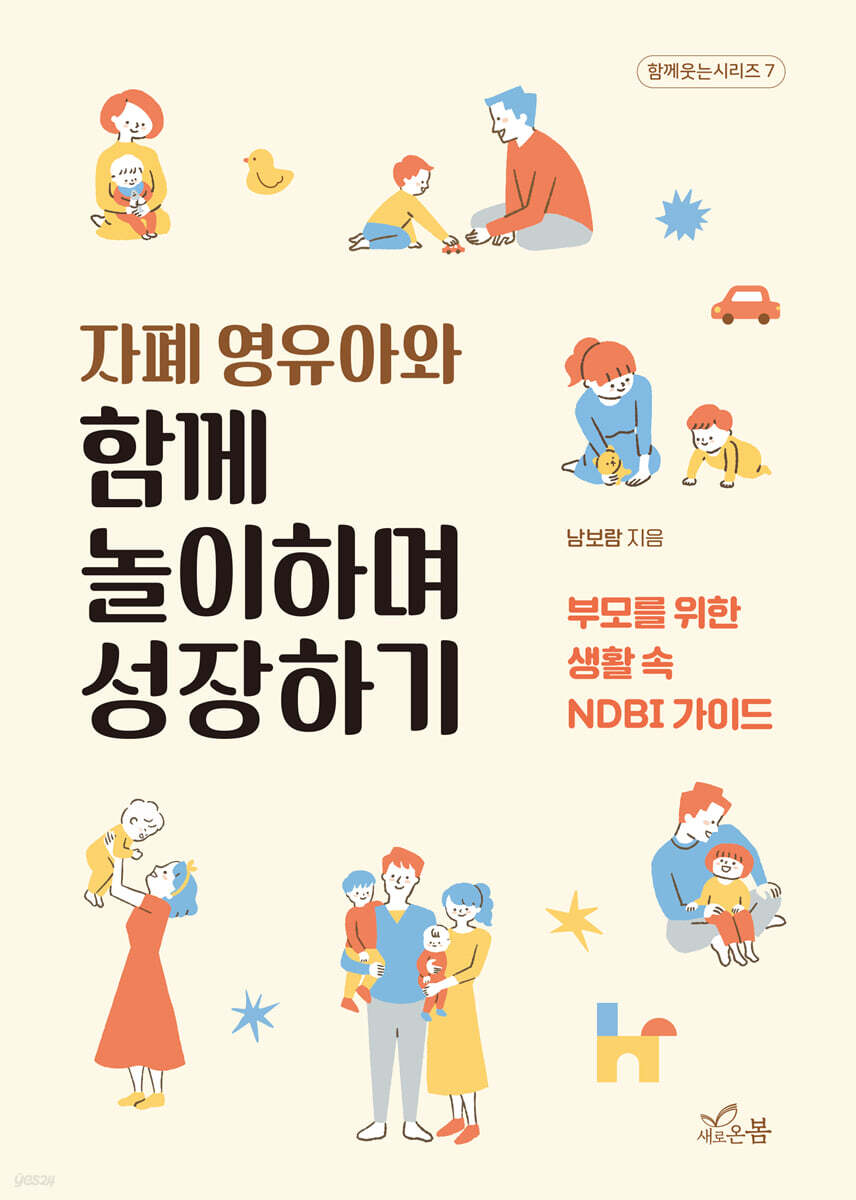
This book was published with the purpose of providing parents of autistic infants and toddlers with accurate information about autism and guiding them on how to play and learn together in everyday life. It is the 7th book in the 'Guidebook for Social Adaptation of People with Developmental Disabilities' series, produced by the Together Laughing Foundation with support from the Hana Financial Group Sharing Foundation.
The author is an expert in the education of autistic infants and toddlers.
The author, an early intervention specialist who majored in special education in college and earned a doctorate in special education through research on 'NDBI', contains the problems and answers he encountered while supporting autistic infants and toddlers and their families in early childhood education classes, daycare centers, therapy rooms, and kindergartens at welfare centers.
Our society still has a lot of misinformation and unproven treatments about autism.
Autistic infants and toddlers are constantly being shuttled between various treatment rooms, often lacking a peaceful daily routine. It's also difficult for parents to know how to connect with their children, play with them, and learn from them in their daily lives.
To this end, the author systematically organizes scientific and proven effective parenting and education methods for autistic infants and toddlers to provide parents with the right direction.
NDBI, which the author suggests as a core direction, is a parental intervention (Intervention) based on developmental science (Developmental) and utilizing behavioral science (Behavioral) in a natural environment (Naturalistic) of daily life.
It is more effective for autistic infants and toddlers to develop social and communication skills by interacting with their parents and playing in natural environments in their daily lives.
The book provides detailed instructions so that parents can easily understand the method.
You will easily understand how to play together and teach in everyday life.
This book will be of great help to autistic infants and toddlers and their parents as they escape from excessive treatment and energy drain, find a stable daily routine, and grow through play and learning together in everyday environments.
A Parent's Guide to NDBI in Everyday Life
This book was published with the purpose of providing parents of autistic infants and toddlers with accurate information about autism and guiding them on how to play and learn together in everyday life. It is the 7th book in the 'Guidebook for Social Adaptation of People with Developmental Disabilities' series, produced by the Together Laughing Foundation with support from the Hana Financial Group Sharing Foundation.
The author is an expert in the education of autistic infants and toddlers.
The author, an early intervention specialist who majored in special education in college and earned a doctorate in special education through research on 'NDBI', contains the problems and answers he encountered while supporting autistic infants and toddlers and their families in early childhood education classes, daycare centers, therapy rooms, and kindergartens at welfare centers.
Our society still has a lot of misinformation and unproven treatments about autism.
Autistic infants and toddlers are constantly being shuttled between various treatment rooms, often lacking a peaceful daily routine. It's also difficult for parents to know how to connect with their children, play with them, and learn from them in their daily lives.
To this end, the author systematically organizes scientific and proven effective parenting and education methods for autistic infants and toddlers to provide parents with the right direction.
NDBI, which the author suggests as a core direction, is a parental intervention (Intervention) based on developmental science (Developmental) and utilizing behavioral science (Behavioral) in a natural environment (Naturalistic) of daily life.
It is more effective for autistic infants and toddlers to develop social and communication skills by interacting with their parents and playing in natural environments in their daily lives.
The book provides detailed instructions so that parents can easily understand the method.
You will easily understand how to play together and teach in everyday life.
This book will be of great help to autistic infants and toddlers and their parents as they escape from excessive treatment and energy drain, find a stable daily routine, and grow through play and learning together in everyday environments.
index
Recommendation
Part 1: Welcome to the World of Autism
Why is my child like this?
Understanding Autism
What 'Spectrum' Tells Us
It's not wrong, it's just different
Is there a miracle cure?
NDBI: Natural Developmental Behavioral Intervention
Part 2: Love Play Learn
Chapter 1: Growing Up Through Play
Love Play, Learn
A child who grows while playing
Chapter 2 Love
Look at the child with warm eyes
Becoming a perfect mom and dad
Look me in the eye and tell me
Chapter 3 Play
Create special playtime
Where to play
Have fun playing
Follow your child's lead
imitating a child
Modeling
Play together
Balanced turn giving and receiving
Broaden your focus
Chapter 4 Learn
The ABCs of Behavioral Learning
Let me hear your voice
Informing and helping
Providing natural reinforcement
How does Grandma get her children to eat carrots?
Part 3: In daily life
NDBI completes laundry with one click
The joy of growing together
Part 1: Welcome to the World of Autism
Why is my child like this?
Understanding Autism
What 'Spectrum' Tells Us
It's not wrong, it's just different
Is there a miracle cure?
NDBI: Natural Developmental Behavioral Intervention
Part 2: Love Play Learn
Chapter 1: Growing Up Through Play
Love Play, Learn
A child who grows while playing
Chapter 2 Love
Look at the child with warm eyes
Becoming a perfect mom and dad
Look me in the eye and tell me
Chapter 3 Play
Create special playtime
Where to play
Have fun playing
Follow your child's lead
imitating a child
Modeling
Play together
Balanced turn giving and receiving
Broaden your focus
Chapter 4 Learn
The ABCs of Behavioral Learning
Let me hear your voice
Informing and helping
Providing natural reinforcement
How does Grandma get her children to eat carrots?
Part 3: In daily life
NDBI completes laundry with one click
The joy of growing together
Into the book
This book provides parents with scientifically proven, accurate information about autism and systematically organizes detailed methods to guide their children's development through everyday play.
--- p.18
Just as important as the diagnosis is the child's current development.
Parents raising children with social communication difficulties due to autism, language delays, and other factors need a good guide on how to be with their children at home and in daily life, and what roles and efforts can be made to help their children grow and develop.
This is because parents are the ones who can closely observe their child's development and have the most diverse interactions that can promote development.
This book scientifically and systematically guides you on how to incorporate it into your daily life.
--- p.19
Above all, parents must become experts.
I'm not saying you have to become a doctor, a teacher, or a therapist.
During infancy and early childhood, the place where a child spends the most time is home, and the people they spend the most time with are mom and dad.
If you know your child better than anyone else and help them develop properly, you can be a great helper in their development.
--- p.22
Not only is there no miracle cure, but unproven treatments can actually be harmful.
We have limited time and money.
--- p.58
The NDBI we will be looking at is an intervention that synthesizes various evidence-based practices.
It is an intervention method that collects various evidence-based practices known to be effective in developing daily life skills, problem behaviors, communication, play, and social skills, which are especially essential in infants and toddlers, and applies them to children's play and daily life.
--- p.62
Effective interventions for promoting the development of young children with autism and reducing the difficulties associated with autism symptoms were those that were 1) naturalistic, 2) based on developmental science, and 3) utilized behavioral science.
The first letters of these three elements are combined to form the name Natural Developmental Behavioral Intervention (NDBI).
--- p.64
So, NDBI emphasizes that parents teach their children naturally through play within the home routine.
Moreover, because children need to learn through play, NDBI emphasizes engaging children in play for as long and as enjoyable as possible.
This way, you can utilize what your child likes and increase his motivation.
--- p.67
NDBI refers to an intervention that combines the principles of developmental science and behavioral science and implements them in the ordinary daily lives of infants and toddlers with autism to promote their development.
--- p.75
For a child to grow well, he or she must experience Love, Play, and Learn.
Loving, playing together, and learning through play are all important, but there is a sequence.
--- p.82
So how do we teach eye contact? "Look at Mom!" "Look straight into my eyes!" Like that? No.
Eye contact should be natural.
Rather than teaching the child to look to mom and dad, mom and dad should go to the child's eyes.
You have to feel like you're going to be there at the crossroads where your eyes pass.
--- p.116
I call this play time where I focus entirely on my child “special play time.”
So how much of this time do you need to support your child's development? The good news is that just 15 minutes a day of special playtime is enough.
--- p.123
Our goal is to enable our children to live in ways they enjoy, with meaningful relationships and with people who are meaningful to them.
If the trust, love, and respect of mom and dad are passed on, our children will surely be able to live happily with others.
--- p.18
Just as important as the diagnosis is the child's current development.
Parents raising children with social communication difficulties due to autism, language delays, and other factors need a good guide on how to be with their children at home and in daily life, and what roles and efforts can be made to help their children grow and develop.
This is because parents are the ones who can closely observe their child's development and have the most diverse interactions that can promote development.
This book scientifically and systematically guides you on how to incorporate it into your daily life.
--- p.19
Above all, parents must become experts.
I'm not saying you have to become a doctor, a teacher, or a therapist.
During infancy and early childhood, the place where a child spends the most time is home, and the people they spend the most time with are mom and dad.
If you know your child better than anyone else and help them develop properly, you can be a great helper in their development.
--- p.22
Not only is there no miracle cure, but unproven treatments can actually be harmful.
We have limited time and money.
--- p.58
The NDBI we will be looking at is an intervention that synthesizes various evidence-based practices.
It is an intervention method that collects various evidence-based practices known to be effective in developing daily life skills, problem behaviors, communication, play, and social skills, which are especially essential in infants and toddlers, and applies them to children's play and daily life.
--- p.62
Effective interventions for promoting the development of young children with autism and reducing the difficulties associated with autism symptoms were those that were 1) naturalistic, 2) based on developmental science, and 3) utilized behavioral science.
The first letters of these three elements are combined to form the name Natural Developmental Behavioral Intervention (NDBI).
--- p.64
So, NDBI emphasizes that parents teach their children naturally through play within the home routine.
Moreover, because children need to learn through play, NDBI emphasizes engaging children in play for as long and as enjoyable as possible.
This way, you can utilize what your child likes and increase his motivation.
--- p.67
NDBI refers to an intervention that combines the principles of developmental science and behavioral science and implements them in the ordinary daily lives of infants and toddlers with autism to promote their development.
--- p.75
For a child to grow well, he or she must experience Love, Play, and Learn.
Loving, playing together, and learning through play are all important, but there is a sequence.
--- p.82
So how do we teach eye contact? "Look at Mom!" "Look straight into my eyes!" Like that? No.
Eye contact should be natural.
Rather than teaching the child to look to mom and dad, mom and dad should go to the child's eyes.
You have to feel like you're going to be there at the crossroads where your eyes pass.
--- p.116
I call this play time where I focus entirely on my child “special play time.”
So how much of this time do you need to support your child's development? The good news is that just 15 minutes a day of special playtime is enough.
--- p.123
Our goal is to enable our children to live in ways they enjoy, with meaningful relationships and with people who are meaningful to them.
If the trust, love, and respect of mom and dad are passed on, our children will surely be able to live happily with others.
--- p.338
Publisher's Review
The key to raising a child with autism is to fill their daily lives with play together.
This book will be an excellent teaching aid and guide for parents to use in their daily lives with their children.
Many parents who have raised autistic children to adulthood often say things like this.
"I should have played with my child more then." "I should have spent my days comfortably at home with my child instead of going to all sorts of places."
'Instead of being anxious and worried about everything, I should have paid more attention to my child, tried to understand him, and spent more time with my family.'
We all have one life, including children, and how we spend that time will have a huge impact on our lives.
Even if there are options A and B in a child's life (development and education), the choice is up to the parents.
This is why parents' thoughts and judgments are especially important to children during the developmental stages of infants and toddlers.
Raising a new life is not easy, and it is often difficult to determine the best way to raise it.
So I also thought it would be nice to have some kind of parental testing (or education).
Since there is no such thing, it is helpful to take one step at a time, using the advice of seniors or experts as a guide.
Guides must be sufficiently (scientifically) validated and have a positive impact on development.
This book is designed to help parents learn and implement intervention methods based on naturalistic, developmental, and behavioral science, which have been thoroughly verified by autism researchers.
The book guides parents through very detailed, step-by-step activities and assessments to teach their autistic children to love, play (with), and learn social interactions.
First of all, if parents understand their child's characteristics and follow how to communicate and interact with their child, they will become excellent caregivers and therapists(?) for their child.
You will trust your child's potential and abilities and become more relaxed about your child.
An environment of anxiety and tension will change into a peaceful atmosphere of increasing stability and leisure.
Children thrive in homes and environments where they feel safe and accepting, with parents and caregivers who support them.
This is because the intention and conclusion of this book is to help both parents and children with autism grow up well in a comfortable everyday environment.
This book will be an excellent teaching aid and guide for parents to use in their daily lives with their children.
Many parents who have raised autistic children to adulthood often say things like this.
"I should have played with my child more then." "I should have spent my days comfortably at home with my child instead of going to all sorts of places."
'Instead of being anxious and worried about everything, I should have paid more attention to my child, tried to understand him, and spent more time with my family.'
We all have one life, including children, and how we spend that time will have a huge impact on our lives.
Even if there are options A and B in a child's life (development and education), the choice is up to the parents.
This is why parents' thoughts and judgments are especially important to children during the developmental stages of infants and toddlers.
Raising a new life is not easy, and it is often difficult to determine the best way to raise it.
So I also thought it would be nice to have some kind of parental testing (or education).
Since there is no such thing, it is helpful to take one step at a time, using the advice of seniors or experts as a guide.
Guides must be sufficiently (scientifically) validated and have a positive impact on development.
This book is designed to help parents learn and implement intervention methods based on naturalistic, developmental, and behavioral science, which have been thoroughly verified by autism researchers.
The book guides parents through very detailed, step-by-step activities and assessments to teach their autistic children to love, play (with), and learn social interactions.
First of all, if parents understand their child's characteristics and follow how to communicate and interact with their child, they will become excellent caregivers and therapists(?) for their child.
You will trust your child's potential and abilities and become more relaxed about your child.
An environment of anxiety and tension will change into a peaceful atmosphere of increasing stability and leisure.
Children thrive in homes and environments where they feel safe and accepting, with parents and caregivers who support them.
This is because the intention and conclusion of this book is to help both parents and children with autism grow up well in a comfortable everyday environment.
GOODS SPECIFICS
- Date of issue: May 5, 2024
- Page count, weight, size: 344 pages | 150*210*16mm
- ISBN13: 9791198741301
You may also like
카테고리
korean


korean

![GQ KOREA Mark (Monthly): December [2025]](http://librairie.coreenne.fr/cdn/shop/files/8ef265dbbfbf186523ed75ba7319009d.jpg?v=1765340328&width=3840)


