

I have the right to destroy myself
 |
Description
Book Introduction
The most powerful self-emergence of a shocking newcomer!
I Have the Right to Destroy Myself Revised Edition
The 'Bokbokseoga x Kim Young-ha Novels' series began to commemorate the 25th anniversary of Kim Young-ha's debut.
"I Have the Right to Destroy Myself," which features a narrator with the bizarre profession of a "suicide guide" and tells the story of the deviant lives and deaths of the "clients" he meets, is a problematic work that divides the sensibilities of Korean literature into those before and after the emergence of Kim Young-ha.
Unlike previous revised editions that were faithful to the purpose of preserving the appearance of the first edition from 1996, this edition appears to be the final, definitive edition that has been meticulously polished by the author who has reached his maturity.
While many critics have taken the novel's narrative elements literally and analyzed them seriously, its most original aspect is its treatment of 'destruction' as a form of play.
Unlike the characters in the novel who drift, run wild, and fall apart, the character who consistently carries out his work with a clean tone and manner, that is, the suicide guide, is doing nothing other than 'writing'.
The suicide guide's other occupation is artist, and he is a person who chose novels as a means of enduring the boredom imposed by life as a surplus.
Perhaps, the novel "I Have the Right to Destroy Myself" was a foreshadowing of the pied piper of the new novelist Kim Young-ha, who would lure countless readers into the fictional world he had created.
I Have the Right to Destroy Myself Revised Edition
The 'Bokbokseoga x Kim Young-ha Novels' series began to commemorate the 25th anniversary of Kim Young-ha's debut.
"I Have the Right to Destroy Myself," which features a narrator with the bizarre profession of a "suicide guide" and tells the story of the deviant lives and deaths of the "clients" he meets, is a problematic work that divides the sensibilities of Korean literature into those before and after the emergence of Kim Young-ha.
Unlike previous revised editions that were faithful to the purpose of preserving the appearance of the first edition from 1996, this edition appears to be the final, definitive edition that has been meticulously polished by the author who has reached his maturity.
While many critics have taken the novel's narrative elements literally and analyzed them seriously, its most original aspect is its treatment of 'destruction' as a form of play.
Unlike the characters in the novel who drift, run wild, and fall apart, the character who consistently carries out his work with a clean tone and manner, that is, the suicide guide, is doing nothing other than 'writing'.
The suicide guide's other occupation is artist, and he is a person who chose novels as a means of enduring the boredom imposed by life as a surplus.
Perhaps, the novel "I Have the Right to Destroy Myself" was a foreshadowing of the pied piper of the new novelist Kim Young-ha, who would lure countless readers into the fictional world he had created.
- You can preview some of the book's contents.
Preview
index
1.
The Death of Mara _ 7
2.
Judith _16
3.
Evian _ 49
4.
Mimi _ 80
5.
The Death of Sardanapal _116
Commentary: The Ethics of Suicide (Ryu Bo-seon, literary critic) _121
Revised Edition Author's Note _166
The Death of Mara _ 7
2.
Judith _16
3.
Evian _ 49
4.
Mimi _ 80
5.
The Death of Sardanapal _116
Commentary: The Ethics of Suicide (Ryu Bo-seon, literary critic) _121
Revised Edition Author's Note _166
Into the book
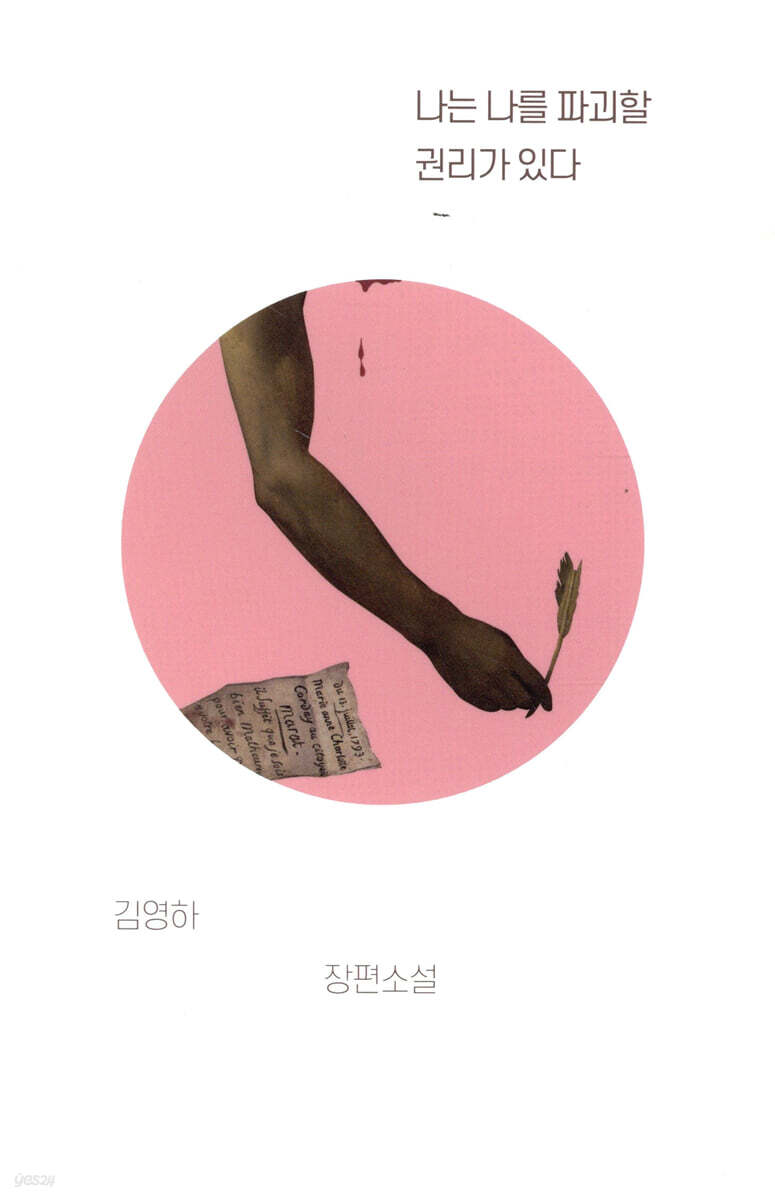
David's Marat is comfortable yet painful, hateful yet understanding.
David expressed all these conflicting emotions within a human being through the facial expressions of the dead.
When someone first sees this painting, their eyes first linger on Mara's face.
The expression on your face says nothing.
So the gaze moves largely in two directions.
Your gaze either shifts to the letter in one hand or follows the other arm hanging out of the bathtub.
Dead Mara is not missing these two things: the letter and the pen.
The assassin, who approached her under the pretense of sending a false letter, stabbed Mara in the chest as she was about to write a reply.
The pen that Mara holds tightly to the end adds tension to this calm and quiet painting.
David is cool.
Passion does not create passion.
It should be dry and cool.
This is the artist's earthly virtue.
--- p.7~8
Those who don't know how to compress are shameless.
The same goes for those who are just prolonging their messy lives.
Those who do not know the aesthetics of compression will die without ever knowing the secret of life.
I will go to Paris.
There I would spend my days reading Henry Miller or Oscar Wilde, or copying Ingres at the Louvre.
A person who reads travel brochures even after going on a trip will be a boring person.
After I go on a trip, I read novels.
Instead, novels are not read in this city.
The novel is a form suited to the surplus of life.
--- p.10
Is this what life is like?
K thinks.
Anyway, the outcome is decided at the beginning.
The failures of my life were probably trivial, like three points.
There is no chance that Segeut can beat Gwangdaeng in the first place.
Those who are extremely lucky and have a decent hand either die from being surprised by their bluff or end up in a game where they only have one or two cards.
It's only one of those two.
Even so, the stakes he can scrape together are only small.
Hurry up, hurry up, the game is over and you're getting a new card.
That path is the only hope.
--- p.25
Even without the curator's warning, his mind was already on edge.
He never forgot that those who had pushed him into the abyss were always the ones who had fascinated him.
A bond called Fascination assigned to him.
The first moneylenders were stuffed butterflies.
He was still unable to free himself from the fantasy of butterflies with pins stuck in their bodies being reborn and still flying around with the pins still stuck in them.
--- p.91
Everyone reading this will meet me, like Judith and Mimi, at least once in their lives, in Marronnier Park or on a quiet street corner.
I will approach you without warning and ask.
Even though I've come a long way, nothing has changed, right?
Or, do you not want to rest?
Then take my hand and follow me.
Those who don't have that confidence should never look back.
Even if it is painful and boring, go your own way.
I don't want too many clients.
And more than anything, now I want to rest.
Like the clusters of artificial flowers blooming all over my living room, my life is always unchanging and endlessly boring.
David expressed all these conflicting emotions within a human being through the facial expressions of the dead.
When someone first sees this painting, their eyes first linger on Mara's face.
The expression on your face says nothing.
So the gaze moves largely in two directions.
Your gaze either shifts to the letter in one hand or follows the other arm hanging out of the bathtub.
Dead Mara is not missing these two things: the letter and the pen.
The assassin, who approached her under the pretense of sending a false letter, stabbed Mara in the chest as she was about to write a reply.
The pen that Mara holds tightly to the end adds tension to this calm and quiet painting.
David is cool.
Passion does not create passion.
It should be dry and cool.
This is the artist's earthly virtue.
--- p.7~8
Those who don't know how to compress are shameless.
The same goes for those who are just prolonging their messy lives.
Those who do not know the aesthetics of compression will die without ever knowing the secret of life.
I will go to Paris.
There I would spend my days reading Henry Miller or Oscar Wilde, or copying Ingres at the Louvre.
A person who reads travel brochures even after going on a trip will be a boring person.
After I go on a trip, I read novels.
Instead, novels are not read in this city.
The novel is a form suited to the surplus of life.
--- p.10
Is this what life is like?
K thinks.
Anyway, the outcome is decided at the beginning.
The failures of my life were probably trivial, like three points.
There is no chance that Segeut can beat Gwangdaeng in the first place.
Those who are extremely lucky and have a decent hand either die from being surprised by their bluff or end up in a game where they only have one or two cards.
It's only one of those two.
Even so, the stakes he can scrape together are only small.
Hurry up, hurry up, the game is over and you're getting a new card.
That path is the only hope.
--- p.25
Even without the curator's warning, his mind was already on edge.
He never forgot that those who had pushed him into the abyss were always the ones who had fascinated him.
A bond called Fascination assigned to him.
The first moneylenders were stuffed butterflies.
He was still unable to free himself from the fantasy of butterflies with pins stuck in their bodies being reborn and still flying around with the pins still stuck in them.
--- p.91
Everyone reading this will meet me, like Judith and Mimi, at least once in their lives, in Marronnier Park or on a quiet street corner.
I will approach you without warning and ask.
Even though I've come a long way, nothing has changed, right?
Or, do you not want to rest?
Then take my hand and follow me.
Those who don't have that confidence should never look back.
Even if it is painful and boring, go your own way.
I don't want too many clients.
And more than anything, now I want to rest.
Like the clusters of artificial flowers blooming all over my living room, my life is always unchanging and endlessly boring.
--- p.119~120
Publisher's Review
The most powerful self-emergence of a shocking newcomer!
I Have the Right to Destroy Myself Revised Edition
The second installment of the three novels in the 'Bokbokseoga x Kim Young-ha Novels' series, which began to commemorate the 25th anniversary of Kim Young-ha's debut, has been published.
Kim Young-ha's first full-length novel, "I Have the Right to Destroy Myself," which made his name known to the literary world and the public, "Empire of Light," which set a new milestone in the history of Korean literature after the division of the country, and his relatively recent short story collection, "Only Two People."
"I Have the Right to Destroy Myself," which features a narrator with the bizarre profession of a "suicide guide" and tells the story of the deviant lives and deaths of the "clients" he meets, is a problematic work that divides the sensibilities of Korean literature into those before and after the emergence of Kim Young-ha.
Unlike previous revised editions that were faithful to the purpose of preserving the appearance of the first edition from 1996, this edition appears to be the final, definitive edition that has been meticulously polished by the author who has reached his maturity.
The fin-de-siècle "I Have the Right to Destroy Myself"
Kim Young-ha has three types of readers.
The first is a literature reader who ‘once liked Kim Young-ha.’
They experienced a thrilling vicarious satisfaction watching Kim Young-ha defeat romanticism and sentimentalism, the emotional foundations of modern Korean literature, with a single novel.
In every aspect of its material, theme, characters, and style, "I Have the Right to Destroy Myself" was radical.
The narrative compressed into speed, sex, and suicide was a syndrome that heralded the end of the 20th century, a century marked by war and ideological struggle.
The narcissism and eroticism in this novel reveal the poverty of comfort that a fragmented, lonely individual can rely on amidst the torrent of 'consumer capitalism and the post-information society.'
The characters in the work are all mentally orphans, although they have different genders, occupations, and nationalities.
For those who live in conditions where blood ties justify violence and intimate bonds justify exploitation, it is safer to be orphaned.
But at the same time, when there are no relationships that can prove the continuity of 'me', anyone can easily give up fidelity to their own life.
The fin-de-siècle novel "I Have the Right to Destroy Myself" was about volumeless beings crushed by the weight of an unimaginable void, a novel that sensually depicted the cynicism and depression of modern people.
The 21st Century's "I Have the Right to Destroy Myself"
Many authors and works that emerged in the spotlight and were loved for a while have since been forgotten.
Contemporary Korean novels have a short lifespan, unable to withstand even a dozen years, and perhaps there is little pursuit of works that transcend time.
But Kim Young-ha is still going strong, and thanks to him, he has a second group of readers.
These are readers who first encountered the relatively recent work, “Memoir of a Murderer,” or travel essays through various channels.
It's hard to believe that for this group of readers, "I Have the Right to Destroy Myself" was synonymous with "outrage" and "provocation."
In an age overflowing with all kinds of provocative narratives regardless of genre or medium, this is a classic.
The sentiment of decadence and nihilism that has departed from contemporary consensus may at first glance appear to be a theatrical gesture.
Readers are always excited about the emergence of new authors, but for writers, the most important thing is how long they can keep writing.
An author's new work is always a struggle against his previous works.
Thus, as Kim Young-ha's list of works is successfully updated, "I Have the Right to Destroy Myself" is increasingly pushed into the past.
However, 『I Have the Right to Destroy Myself』 was more thoroughly 1990s than any other novel, and thus, as time passed, it acquired the status of a meaningful 'period novel'.
"I Have the Right to Destroy Myself" as a Public Good
While many critics have taken the novel's narrative elements literally and analyzed them seriously, its most original aspect is its treatment of 'destruction' as a form of play.
Unlike the characters in the novel who drift, run wild, and fall apart, the character who consistently carries out his work with a clean tone and manner, that is, the suicide guide, is doing nothing other than 'writing'.
The suicide guide's other occupation is artist, and he is a person who chose novels as a means of enduring the boredom imposed by life as a surplus.
Perhaps, the novel "I Have the Right to Destroy Myself" was a foreshadowing of the pied piper of the new novelist Kim Young-ha, who would lure countless readers into the fictional world he had created.
In the author's note for this revised edition, Kim Young-ha says this:
“This novel is a product of its time, and because it has been out in the world for a long time and met readers, it now feels to some extent like a public good.” Kim Young-ha’s Third Reader functions as a part of this public good.
The author and the reader are accomplices, each carrying out their assigned tasks in the 'role-play of destruction' that takes place through the novel.
The author's ultimate goal is to make us question the banality of life that we consider inevitable.
And his clients, the readers, dream of wonderfully breaking down the 'fake me' stuffed into their daily lives with the help of this experienced assistant.
Recommendation
"I Have the Right to Destroy Myself" convincingly brings back the terrifying yet fascinating realities that had been obscured by the narrow and rigid system of fantasy, such as the loneliness, decadence, and boredom of modern society, and the eroticism and death drive that result from them.
In this way, 『Destruction』 discovers the countless boiling realities that have been obscured by the normativity of Korean literature and intensively textualizes them, which can be said to be the triumphant achievement of 『Destruction』.
So, you could say it like this.
With 『Destruction』, Korean literature finally began to take a deep and sober look at the gloomy existence of modern times.
(…) In this way, 『Destruction』 can be said to be a novel that corresponds to an event in the sense of Alain Badiou that practically cuts off the entirety of Korean novels from the novels before 『Destruction』, and at the same time, it can be said to be an origin of novels after 『Destruction』, that is, it determined the fate of novels that appeared after it.
―Ryu Bo-seon (literary critic)
Kim Young-ha's first full-length novel depicts the rise of a new generation in Korea in the 1990s, people who enjoy freedom in an affluent economy, but who also lose their sense of direction and fall into confusion as a result.
The author's consistently dark and cold voice, and his expressionless, unwavering demeanor, make you lose yourself in the moment.
―Booklist
When this novel was first published in Korea, Kim Young-ha was both a "shooting star" and a "scandal" in the Korean literary world.
He belongs to a generation that broke away from post-war Asian literature and ideological literature, and belongs to a group that perceives itself as a cosmopolitan of a globalized metropolis.
"I Have the Right to Destroy Myself" is a terribly dark novel, but the way it's written is brilliant.
—Christoph von Ungern-Sternberg, Welt am Sonntag
Meaningful themes, multifaceted narratives, and changing characters.
This novel, which explores the alienating effects of fin-de-siècle human existence with a sophisticated yet eerie sensibility, is a solid literary achievement in every sense.
―Entertainment Weekly
Kim Young-ha's novels are art built on art.
His writing style is similar to Kafka's, and his novel's philosophy that life is worthless and insignificant is similar to Camus and Sartre.
_Los Angeles Times
This work stands at a completely different level from existing Korean literature.
That's why you should read this work.
_Süddeutsche Zeitung
A strange novel packed with countless implications.
Kim Young-ha's work is a self-conscious literary exploration of truth, death, desire, and identity.
―Publisher's Weekly
I Have the Right to Destroy Myself Revised Edition
The second installment of the three novels in the 'Bokbokseoga x Kim Young-ha Novels' series, which began to commemorate the 25th anniversary of Kim Young-ha's debut, has been published.
Kim Young-ha's first full-length novel, "I Have the Right to Destroy Myself," which made his name known to the literary world and the public, "Empire of Light," which set a new milestone in the history of Korean literature after the division of the country, and his relatively recent short story collection, "Only Two People."
"I Have the Right to Destroy Myself," which features a narrator with the bizarre profession of a "suicide guide" and tells the story of the deviant lives and deaths of the "clients" he meets, is a problematic work that divides the sensibilities of Korean literature into those before and after the emergence of Kim Young-ha.
Unlike previous revised editions that were faithful to the purpose of preserving the appearance of the first edition from 1996, this edition appears to be the final, definitive edition that has been meticulously polished by the author who has reached his maturity.
The fin-de-siècle "I Have the Right to Destroy Myself"
Kim Young-ha has three types of readers.
The first is a literature reader who ‘once liked Kim Young-ha.’
They experienced a thrilling vicarious satisfaction watching Kim Young-ha defeat romanticism and sentimentalism, the emotional foundations of modern Korean literature, with a single novel.
In every aspect of its material, theme, characters, and style, "I Have the Right to Destroy Myself" was radical.
The narrative compressed into speed, sex, and suicide was a syndrome that heralded the end of the 20th century, a century marked by war and ideological struggle.
The narcissism and eroticism in this novel reveal the poverty of comfort that a fragmented, lonely individual can rely on amidst the torrent of 'consumer capitalism and the post-information society.'
The characters in the work are all mentally orphans, although they have different genders, occupations, and nationalities.
For those who live in conditions where blood ties justify violence and intimate bonds justify exploitation, it is safer to be orphaned.
But at the same time, when there are no relationships that can prove the continuity of 'me', anyone can easily give up fidelity to their own life.
The fin-de-siècle novel "I Have the Right to Destroy Myself" was about volumeless beings crushed by the weight of an unimaginable void, a novel that sensually depicted the cynicism and depression of modern people.
The 21st Century's "I Have the Right to Destroy Myself"
Many authors and works that emerged in the spotlight and were loved for a while have since been forgotten.
Contemporary Korean novels have a short lifespan, unable to withstand even a dozen years, and perhaps there is little pursuit of works that transcend time.
But Kim Young-ha is still going strong, and thanks to him, he has a second group of readers.
These are readers who first encountered the relatively recent work, “Memoir of a Murderer,” or travel essays through various channels.
It's hard to believe that for this group of readers, "I Have the Right to Destroy Myself" was synonymous with "outrage" and "provocation."
In an age overflowing with all kinds of provocative narratives regardless of genre or medium, this is a classic.
The sentiment of decadence and nihilism that has departed from contemporary consensus may at first glance appear to be a theatrical gesture.
Readers are always excited about the emergence of new authors, but for writers, the most important thing is how long they can keep writing.
An author's new work is always a struggle against his previous works.
Thus, as Kim Young-ha's list of works is successfully updated, "I Have the Right to Destroy Myself" is increasingly pushed into the past.
However, 『I Have the Right to Destroy Myself』 was more thoroughly 1990s than any other novel, and thus, as time passed, it acquired the status of a meaningful 'period novel'.
"I Have the Right to Destroy Myself" as a Public Good
While many critics have taken the novel's narrative elements literally and analyzed them seriously, its most original aspect is its treatment of 'destruction' as a form of play.
Unlike the characters in the novel who drift, run wild, and fall apart, the character who consistently carries out his work with a clean tone and manner, that is, the suicide guide, is doing nothing other than 'writing'.
The suicide guide's other occupation is artist, and he is a person who chose novels as a means of enduring the boredom imposed by life as a surplus.
Perhaps, the novel "I Have the Right to Destroy Myself" was a foreshadowing of the pied piper of the new novelist Kim Young-ha, who would lure countless readers into the fictional world he had created.
In the author's note for this revised edition, Kim Young-ha says this:
“This novel is a product of its time, and because it has been out in the world for a long time and met readers, it now feels to some extent like a public good.” Kim Young-ha’s Third Reader functions as a part of this public good.
The author and the reader are accomplices, each carrying out their assigned tasks in the 'role-play of destruction' that takes place through the novel.
The author's ultimate goal is to make us question the banality of life that we consider inevitable.
And his clients, the readers, dream of wonderfully breaking down the 'fake me' stuffed into their daily lives with the help of this experienced assistant.
Recommendation
"I Have the Right to Destroy Myself" convincingly brings back the terrifying yet fascinating realities that had been obscured by the narrow and rigid system of fantasy, such as the loneliness, decadence, and boredom of modern society, and the eroticism and death drive that result from them.
In this way, 『Destruction』 discovers the countless boiling realities that have been obscured by the normativity of Korean literature and intensively textualizes them, which can be said to be the triumphant achievement of 『Destruction』.
So, you could say it like this.
With 『Destruction』, Korean literature finally began to take a deep and sober look at the gloomy existence of modern times.
(…) In this way, 『Destruction』 can be said to be a novel that corresponds to an event in the sense of Alain Badiou that practically cuts off the entirety of Korean novels from the novels before 『Destruction』, and at the same time, it can be said to be an origin of novels after 『Destruction』, that is, it determined the fate of novels that appeared after it.
―Ryu Bo-seon (literary critic)
Kim Young-ha's first full-length novel depicts the rise of a new generation in Korea in the 1990s, people who enjoy freedom in an affluent economy, but who also lose their sense of direction and fall into confusion as a result.
The author's consistently dark and cold voice, and his expressionless, unwavering demeanor, make you lose yourself in the moment.
―Booklist
When this novel was first published in Korea, Kim Young-ha was both a "shooting star" and a "scandal" in the Korean literary world.
He belongs to a generation that broke away from post-war Asian literature and ideological literature, and belongs to a group that perceives itself as a cosmopolitan of a globalized metropolis.
"I Have the Right to Destroy Myself" is a terribly dark novel, but the way it's written is brilliant.
—Christoph von Ungern-Sternberg, Welt am Sonntag
Meaningful themes, multifaceted narratives, and changing characters.
This novel, which explores the alienating effects of fin-de-siècle human existence with a sophisticated yet eerie sensibility, is a solid literary achievement in every sense.
―Entertainment Weekly
Kim Young-ha's novels are art built on art.
His writing style is similar to Kafka's, and his novel's philosophy that life is worthless and insignificant is similar to Camus and Sartre.
_Los Angeles Times
This work stands at a completely different level from existing Korean literature.
That's why you should read this work.
_Süddeutsche Zeitung
A strange novel packed with countless implications.
Kim Young-ha's work is a self-conscious literary exploration of truth, death, desire, and identity.
―Publisher's Weekly
GOODS SPECIFICS
- Publication date: May 23, 2022
- Page count, weight, size: 176 pages | 204g | 128*198*11mm
- ISBN13: 9791191114072
- ISBN10: 1191114074
You may also like
카테고리
korean


korean

![ELLE 엘르 스페셜 에디션 A형 : 12월 [2025]](http://librairie.coreenne.fr/cdn/shop/files/b8e27a3de6c9538896439686c6b0e8fb.jpg?v=1766436872&width=3840)


