

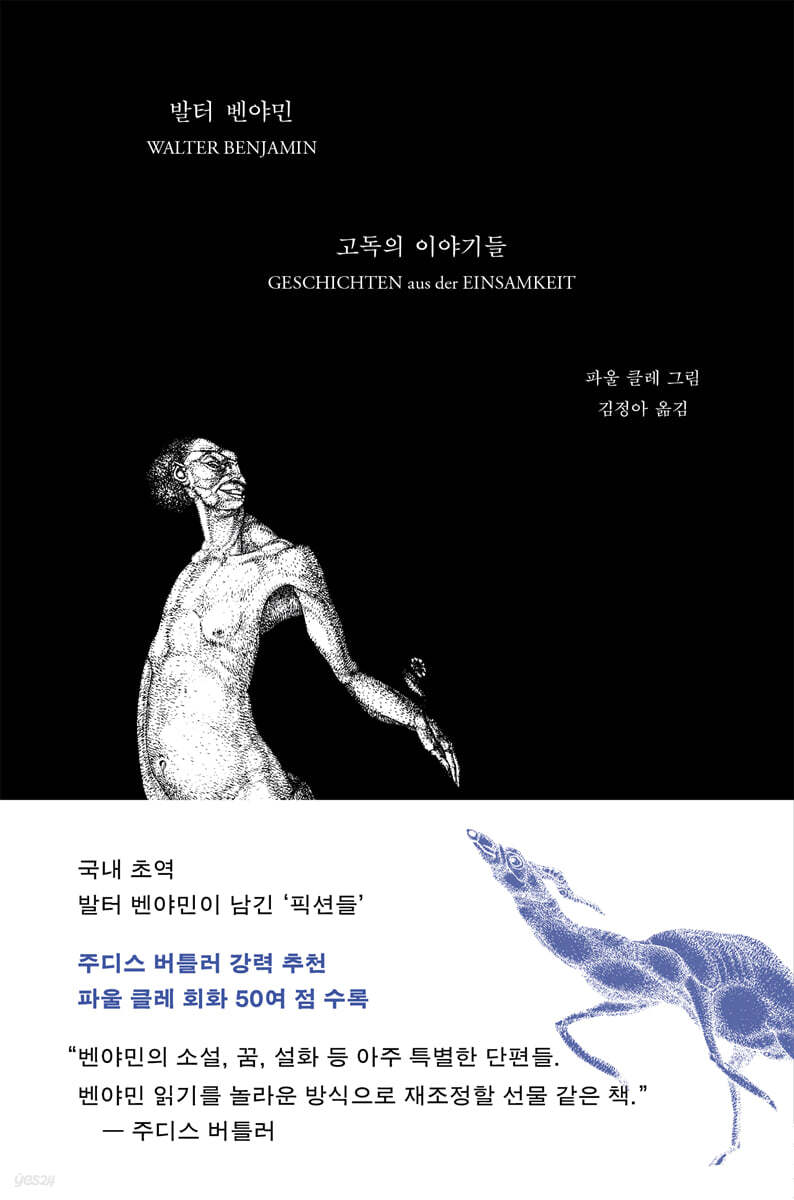
Stories of Loneliness
 |
Description
Book Introduction
“The literary works written by Benjamin have not been bound into one book so far.
“It’s surprising that it has never been published.” - The Guardian
Arendt, Adorno, Brecht, Butler, Eagleton, Zizek, Sontag, Coetzee, Berger…
A witness to modernity admired by numerous modern intellectuals,
I wanted to hold on to the memories that passed by “like a flash”
Walter Benjamin, a man of letters and a thinker who cannot be categorized into anything
The only literary collection published under his name, first translated in Korea
Includes over 50 paintings by Paul Klee, a modernist painter loved by Benjamin.
Judith Butler, J.
M. Kutsi highly recommends
Walter Benjamin's literary collection, "Stories of Solitude," which brings together his novels, dream accounts, and folk tales for the first time, has been translated and published in Korean.
Although relatively less well-known due to his work in the philosophy of language, media theory, and literary criticism, Benjamin wrote novels, dreams, tales, fables, parables, and riddles throughout his life.
Judith Butler, an American philosopher who is more knowledgeable about Benjamin's thought than anyone else, said of this book, "It is a tremendous gift that will recalibrate reading Benjamin in a surprising way."
The forty-two stories in this book explore themes that preoccupied Benjamin throughout his life: the dream world that straddles the threshold between the realms of reason and fantasy, the erotic tensions of metropolitan life, the imagination unleashed during movement and travel, the unique potential of human language in children, the importance of play spaces and activities, and the unique relationship between gambling, fortune-telling, and wishing.
Meanwhile, this book adds liveliness to the story by including paintings by Paul Klee, a modernist artist loved by Benjamin, on the pages where each short story begins.
“It’s surprising that it has never been published.” - The Guardian
Arendt, Adorno, Brecht, Butler, Eagleton, Zizek, Sontag, Coetzee, Berger…
A witness to modernity admired by numerous modern intellectuals,
I wanted to hold on to the memories that passed by “like a flash”
Walter Benjamin, a man of letters and a thinker who cannot be categorized into anything
The only literary collection published under his name, first translated in Korea
Includes over 50 paintings by Paul Klee, a modernist painter loved by Benjamin.
Judith Butler, J.
M. Kutsi highly recommends
Walter Benjamin's literary collection, "Stories of Solitude," which brings together his novels, dream accounts, and folk tales for the first time, has been translated and published in Korean.
Although relatively less well-known due to his work in the philosophy of language, media theory, and literary criticism, Benjamin wrote novels, dreams, tales, fables, parables, and riddles throughout his life.
Judith Butler, an American philosopher who is more knowledgeable about Benjamin's thought than anyone else, said of this book, "It is a tremendous gift that will recalibrate reading Benjamin in a surprising way."
The forty-two stories in this book explore themes that preoccupied Benjamin throughout his life: the dream world that straddles the threshold between the realms of reason and fantasy, the erotic tensions of metropolitan life, the imagination unleashed during movement and travel, the unique potential of human language in children, the importance of play spaces and activities, and the unique relationship between gambling, fortune-telling, and wishing.
Meanwhile, this book adds liveliness to the story by including paintings by Paul Klee, a modernist artist loved by Benjamin, on the pages where each short story begins.
- You can preview some of the book's contents.
Preview
index
Part 1: Dreams and Daydreams
dream
1.
Schiller and Goethe: A Layman's Vision
2.
In a Big Old City: An Unfinished Novel
3.
A scene with a patient with hypochondria
4.
The Empress's Morning
5.
Evening Shepherd
6.
Second Self: A Story for New Year's Eve Reflection
dream
7.
Dreams from Ignaz Jezober's Book of Dreams
8.
So close
9.
Dream in Ibiza
10.
Self-portraits of a dreamer
Grandson | Observer | Suitor | Scholar | Secret Keeper | Almanac Compiler
11.
Dream 1
12.
Dream 2
13.
One more time
14.
Letter to Toot Blaupotton Carter
15.
A Christmas Carol
16.
moon
Welty's "Moonlit Night" | Water Glass | Moon 1 | In the Dark | Dream | Moon 2
17.
diary
18.
Book Review: Albert Béguin, The Romantic Soul and Dreams
Part 2: Travel
Cities and Mobility
19.
The hidden story
20.
airman
21.
The Death of the Father: A Novel
22.
Siren
23.
Scattered in the dust: Novelle
24.
D...y mansion
25.
Book review: Franz Hessel, Intimate Berlin
26.
Book Review: Crime Fiction on the Journey
Landscapes of land and sea
27.
Nordic seas
City | Flowers | Furniture | Light | Seagull | Sculpture
28.
Stories of Loneliness
Wall | Pipe | Light
29.
Mascote's Voyage
30.
cactus fence
31.
Book Review: Landscape and Travel
Part 3: Play and Education
32.
Book Review: Frankfurt Children's Song Collection
33.
Sentence fantasy
34.
1927 wall calendar produced by Die Literarische Welt
35.
puzzle
A foreigner's answer | Concisely
36.
Radio Game
37.
Short stories
Why we call elephants 'elephants' | How ships were invented, and why we call them 'ships' | Funny story: When people didn't exist yet
38.
Four stories
Warning | Signature | Wish | Thanks
39.
Not a minute too much or too little
40.
Lucky Hands: A Conversation About Gambling
41.
Colonial Education: A Review of Alois Yalkotszy's Fairy Tale and Modernity
42.
A Green Foundation: A Review of Tom Seidemann-Freud's Introduction to Play 2 and Introduction to Play 3—Further Discussion on Introductions to Play
Editor's Note: Walter Benjamin and the Allure of Wordplay
main
Editor's Note
About Paul Klee
dream
1.
Schiller and Goethe: A Layman's Vision
2.
In a Big Old City: An Unfinished Novel
3.
A scene with a patient with hypochondria
4.
The Empress's Morning
5.
Evening Shepherd
6.
Second Self: A Story for New Year's Eve Reflection
dream
7.
Dreams from Ignaz Jezober's Book of Dreams
8.
So close
9.
Dream in Ibiza
10.
Self-portraits of a dreamer
Grandson | Observer | Suitor | Scholar | Secret Keeper | Almanac Compiler
11.
Dream 1
12.
Dream 2
13.
One more time
14.
Letter to Toot Blaupotton Carter
15.
A Christmas Carol
16.
moon
Welty's "Moonlit Night" | Water Glass | Moon 1 | In the Dark | Dream | Moon 2
17.
diary
18.
Book Review: Albert Béguin, The Romantic Soul and Dreams
Part 2: Travel
Cities and Mobility
19.
The hidden story
20.
airman
21.
The Death of the Father: A Novel
22.
Siren
23.
Scattered in the dust: Novelle
24.
D...y mansion
25.
Book review: Franz Hessel, Intimate Berlin
26.
Book Review: Crime Fiction on the Journey
Landscapes of land and sea
27.
Nordic seas
City | Flowers | Furniture | Light | Seagull | Sculpture
28.
Stories of Loneliness
Wall | Pipe | Light
29.
Mascote's Voyage
30.
cactus fence
31.
Book Review: Landscape and Travel
Part 3: Play and Education
32.
Book Review: Frankfurt Children's Song Collection
33.
Sentence fantasy
34.
1927 wall calendar produced by Die Literarische Welt
35.
puzzle
A foreigner's answer | Concisely
36.
Radio Game
37.
Short stories
Why we call elephants 'elephants' | How ships were invented, and why we call them 'ships' | Funny story: When people didn't exist yet
38.
Four stories
Warning | Signature | Wish | Thanks
39.
Not a minute too much or too little
40.
Lucky Hands: A Conversation About Gambling
41.
Colonial Education: A Review of Alois Yalkotszy's Fairy Tale and Modernity
42.
A Green Foundation: A Review of Tom Seidemann-Freud's Introduction to Play 2 and Introduction to Play 3—Further Discussion on Introductions to Play
Editor's Note: Walter Benjamin and the Allure of Wordplay
main
Editor's Note
About Paul Klee
Detailed image
.jpg)
Into the book
The climb has begun.
At first it wasn't difficult at all.
As I ascended the wide marble steps, I saw a cliff on one side, a ruined temple jutting out high above the cliff, and from below the cliff came the sad roar of the mighty river.
A chubby man was sitting on a bench in front of a cliff.
The way he rubbed his hands together looked comfortable, and his smiling expression was relaxed.
In front of the man were beeswax and an iron pen.
He saw us and slowly began to write something.
“Horace, the first man of letters,” my guide said clearly, his voice a little sharp.
I wondered how far I had gone, and suddenly stopped.
On one of the steps stood a man wearing a heavily pleated toga.
He was giving a speech, his frail body trembling as he tried to keep talking, and although he was shouting loudly, his voice was completely inaudible, and there was no one around.
I was shocked.
--- From "Schiller and Goethe"
An old man with white hair and a young man were standing there, silently, like a period.
They were moving a stretcher that was not carrying a patient.
The younger man occasionally glanced at the stretcher, tears welling up in his eyes.
After a while, a sad song flowed from his mouth and echoed like thousands of sobs from the mountain cliffs.
“Red morning, red morning, lead me to an early death.”
--- From "A Scene with a Patient with Hypochondria"
She tracked down one problem.
It was not known what the problem was.
There were times when the Empress did discuss the matter with those around her, but each time she received only vague answers, dull evasions almost to the point of infuriation, so that she had to take the matter lower and lower, from her companion to her maid, from her maid to the stable-keeper, from the stable-keeper to the kitchen-maid, and finally to her children.
The children seemed to understand her problem, but she could only understand their language to the extent that she could understand the language of thunder.
I knelt down at the prayer table in front of the window and prayed to God repeatedly.
--- From "The Empress's Morning"
Why was the object of my longing so distorted, beyond recognition? Answer: Because I was so close to it in my dream.
The longing I experienced for the first time then, the longing that overwhelmed me as I was completely inside the object of longing, was not a longing that arose from being far away from the object and ended with drawing it.
It was a blessed longing.
A longing that has already crossed the threshold between imagining and possessing.
Such longing only knows what a name can do.
The person you miss comes to life in your name, changes your body, becomes old, and becomes young.
He who dwells without form in the name is the refuge of all forms.
--- From "Too Close"
As the faintly swaying light of the night stabilized my hand and myself, I would realize that there was nothing left in this world but one persistent question.
Perhaps the question was hanging in the folds of the curtains that hung in front of my room to block out noise.
Perhaps that question was just the residue of countless nights gone by.
If not even that, perhaps the question was the other side of the wonder the moon had instilled in me.
The question was this:
Why does the world exist? Why does the world exist? I've always been amazed at how there's nothing in the world that forces you to think about it.
Even if I had doubts at that time about whether the world really existed, they would not have been more severe than doubts about whether the world really existed.
It seemed as if the existence of the world was winking at the nothingness of it.
The moon was winning a slight victory over the world's existence.
--- From "The Moon"
Hasn't everyone at least once reached for those fluttering books, not for the pleasure of reading, but with the vague feeling that they are doing something the railroad gods would like?
The passenger knows that if he now puts a coin in the offering box and becomes a believer, the god of the hearth that burns brightly at night, the spirits of smoke that play throughout the train, and the ghosts of the cozy cabin who know all the lullabies in the world will watch over him.
The passenger knows all about it because he saw all the gods in his dreams.
--- From "Book Review: Crime Novels Are on a Journey"
If you go into the time warehouse, you will see a sight of unused days piled up.
The days when the Earth was frozen thousands of years ago.
Humans spend a day every twenty-four hours, but the Earth only spends a day like this once every six months.
It is thanks to him that this place is still safe.
Time did not reach the small trees in the windless, quiet garden, nor did the sailors reach the small boat floating on the calm water.
Two light bulbs meet above those untouched by anyone's hand, share them like clouds, and send you home empty-handed.
--- From "The Northern Seas"
Prime Minister Potemkin suffered from severe depression, which relapsed almost periodically, and during such periods it was strictly forbidden to approach him or enter his office.
No one at court ever brought up his depression (especially since everyone knew that mentioning it would put anyone in Queen Catherine's disfavor). One time, the minister's depression became particularly prolonged, resulting in serious mismanagement.
There was a pile of papers that the Queen had ordered processed, but it was impossible to process them without Potemkin's signature.
High-ranking officials were helpless.
--- From "Four Stories"
Benjamin wrote about Proust, the greatest storyteller:
“He collapsed on the bed, wounded with longing.
The world he longed for so much was a world that resembled reality but was distorted, a world where the surreality, the true face of reality, suddenly appeared.” The same could be said of Benjamin and of his own fiction.
At first it wasn't difficult at all.
As I ascended the wide marble steps, I saw a cliff on one side, a ruined temple jutting out high above the cliff, and from below the cliff came the sad roar of the mighty river.
A chubby man was sitting on a bench in front of a cliff.
The way he rubbed his hands together looked comfortable, and his smiling expression was relaxed.
In front of the man were beeswax and an iron pen.
He saw us and slowly began to write something.
“Horace, the first man of letters,” my guide said clearly, his voice a little sharp.
I wondered how far I had gone, and suddenly stopped.
On one of the steps stood a man wearing a heavily pleated toga.
He was giving a speech, his frail body trembling as he tried to keep talking, and although he was shouting loudly, his voice was completely inaudible, and there was no one around.
I was shocked.
--- From "Schiller and Goethe"
An old man with white hair and a young man were standing there, silently, like a period.
They were moving a stretcher that was not carrying a patient.
The younger man occasionally glanced at the stretcher, tears welling up in his eyes.
After a while, a sad song flowed from his mouth and echoed like thousands of sobs from the mountain cliffs.
“Red morning, red morning, lead me to an early death.”
--- From "A Scene with a Patient with Hypochondria"
She tracked down one problem.
It was not known what the problem was.
There were times when the Empress did discuss the matter with those around her, but each time she received only vague answers, dull evasions almost to the point of infuriation, so that she had to take the matter lower and lower, from her companion to her maid, from her maid to the stable-keeper, from the stable-keeper to the kitchen-maid, and finally to her children.
The children seemed to understand her problem, but she could only understand their language to the extent that she could understand the language of thunder.
I knelt down at the prayer table in front of the window and prayed to God repeatedly.
--- From "The Empress's Morning"
Why was the object of my longing so distorted, beyond recognition? Answer: Because I was so close to it in my dream.
The longing I experienced for the first time then, the longing that overwhelmed me as I was completely inside the object of longing, was not a longing that arose from being far away from the object and ended with drawing it.
It was a blessed longing.
A longing that has already crossed the threshold between imagining and possessing.
Such longing only knows what a name can do.
The person you miss comes to life in your name, changes your body, becomes old, and becomes young.
He who dwells without form in the name is the refuge of all forms.
--- From "Too Close"
As the faintly swaying light of the night stabilized my hand and myself, I would realize that there was nothing left in this world but one persistent question.
Perhaps the question was hanging in the folds of the curtains that hung in front of my room to block out noise.
Perhaps that question was just the residue of countless nights gone by.
If not even that, perhaps the question was the other side of the wonder the moon had instilled in me.
The question was this:
Why does the world exist? Why does the world exist? I've always been amazed at how there's nothing in the world that forces you to think about it.
Even if I had doubts at that time about whether the world really existed, they would not have been more severe than doubts about whether the world really existed.
It seemed as if the existence of the world was winking at the nothingness of it.
The moon was winning a slight victory over the world's existence.
--- From "The Moon"
Hasn't everyone at least once reached for those fluttering books, not for the pleasure of reading, but with the vague feeling that they are doing something the railroad gods would like?
The passenger knows that if he now puts a coin in the offering box and becomes a believer, the god of the hearth that burns brightly at night, the spirits of smoke that play throughout the train, and the ghosts of the cozy cabin who know all the lullabies in the world will watch over him.
The passenger knows all about it because he saw all the gods in his dreams.
--- From "Book Review: Crime Novels Are on a Journey"
If you go into the time warehouse, you will see a sight of unused days piled up.
The days when the Earth was frozen thousands of years ago.
Humans spend a day every twenty-four hours, but the Earth only spends a day like this once every six months.
It is thanks to him that this place is still safe.
Time did not reach the small trees in the windless, quiet garden, nor did the sailors reach the small boat floating on the calm water.
Two light bulbs meet above those untouched by anyone's hand, share them like clouds, and send you home empty-handed.
--- From "The Northern Seas"
Prime Minister Potemkin suffered from severe depression, which relapsed almost periodically, and during such periods it was strictly forbidden to approach him or enter his office.
No one at court ever brought up his depression (especially since everyone knew that mentioning it would put anyone in Queen Catherine's disfavor). One time, the minister's depression became particularly prolonged, resulting in serious mismanagement.
There was a pile of papers that the Queen had ordered processed, but it was impossible to process them without Potemkin's signature.
High-ranking officials were helpless.
--- From "Four Stories"
Benjamin wrote about Proust, the greatest storyteller:
“He collapsed on the bed, wounded with longing.
The world he longed for so much was a world that resembled reality but was distorted, a world where the surreality, the true face of reality, suddenly appeared.” The same could be said of Benjamin and of his own fiction.
--- From "Editor's Note: Walter Benjamin and the Power of Wordplay"
Publisher's Review
Arendt, Adorno, Brecht, Butler, Eagleton, Zizek, Sontag, Coetzee, Berger…
A witness to modernity admired by numerous modern intellectuals
I wanted to hold on to the memories that passed by “like a flash”
Walter Benjamin, a writer who cannot be categorized into anything
The only literary collection published under his name, first translated in Korea
Includes over 50 paintings by Paul Klee, a modernist painter loved by Benjamin.
Highly recommended by Judith Butler and John Coetzee
Walter Benjamin's literary collection, "Stories of Solitude," which brings together his novels, dream accounts, and folk tales for the first time, has been translated and published in Korean.
Although relatively less well-known due to his work in the philosophy of language, media theory, and literary criticism, Benjamin wrote novels, dreams, tales, fables, parables, and riddles throughout his life.
Judith Butler, an American philosopher who is more knowledgeable about Benjamin's thought than anyone else, said of this book, "It is a tremendous gift that will recalibrate reading Benjamin in a surprising way."
The forty-two stories in this book explore themes that preoccupied Benjamin throughout his life: the dream world that straddles the threshold between the realms of reason and fantasy, the erotic tensions of metropolitan life, the imagination unleashed during movement and travel, the unique potential of human language in children, the importance of play spaces and activities, and the unique relationship between gambling, fortune-telling, and wishing.
Meanwhile, this book adds liveliness to the story by including paintings by Paul Klee, a modernist artist loved by Benjamin, on the pages where each short story begins.
What kind of literature did the great writers and thinkers dream of?
His literary works became a sounding board for Benjamin's theory.
Benjamin had little interest in the boundaries between literary and critical writing.
Even in many of his sentences known to date, literary flashes are glimpsed, and furthermore, his writing itself is of a kind that could not have arisen without poetry.
Therefore, readers who have encountered Benjamin's writings have probably imagined Benjamin writing a literary work at least once.
"If Benjamin were to write fiction, what kind of works would he have created?" "What kind of literature would Benjamin have wanted to craft from the stories he imagined?" This literary collection, which includes novellas, dream accounts, philosophical fables, parables, tales, and riddles, provides a captivating answer to these long-standing questions.
This book is all the more special in its publication because it contains texts that were largely unpublished during Benjamin's lifetime and have long been overlooked.
Another special aspect of this book is that the works included here predate Benjamin's ideas and movements of thought.
For example, the tsar's low-ranking official Shuvalkin and the Jewish pietist beggar who appear in "Four Stories" reappear in an essay on Franz Kafka.
The 'Kaiserpanorama' that appears in "The Second Self" echoes the text in "One-Way Street" while also bringing to mind "The Work of Art in the Age of Mechanical Reproduction" and the autobiographical sketches placed in "Childhood in Berlin circa 1900."
In this way, this book exemplifies how Benjamin directed, performed, and presented his theoretical interests.
Benjamin's theory and practice-experiment on storytelling
Connecting the possibilities of storytelling in an age where the transmission of experience is impossible
Benjamin's continued literary writing stems from his own theory of narrative.
He dealt with the theory of 'storytelling' in several texts, and 'The Storyteller' is a representative example.
Here he argues that before World War I, experiences were passed down from generation to generation in the form of folk tales and fairy tales.
However, the “red thread of experience” that had connected generations was severed with the war.
The survivors' "fragile bodies" kept them silent, unable to speak of their experiences being caught in the "field of effluent and explosion that devastated all directions."
The possibility of transmitting experience was disappearing.
He reimagines the possibilities of transmitting experiences that are disappearing.
The method Benjamin found was to convey experience by telling stories that imitate the oral tradition, rather than using the language of 'journalism', which evaporates experience.
He layers voices in his literary texts, mimicking oral traditions.
For example, a captain tells a story to a passenger, a friend tells another friend about a strange experience, a person tells another friend about an acquaintance, and the person who heard the story tells us the story he heard.
These stories create a world of quotes, enigmatic sayings, and perspectives.
This extends the long tradition of storytelling and retelling.
And it is here that experience finds new ground.
In other words, what Benjamin attempted was to revitalize the orality of storytelling under changing conditions.
So what kind of stories are needed in the trenches? The themes he repeatedly explored through his literary experiments included dreams and fantasy, travel and alienation, play and educational theory.
A world of stories that push forward in an outrageous way and then crumble like a child
The book's structure: (1) Dreams and Daydreams, (2) Travel and Movement, (3) Play and Education Theory
This book divides Benjamin's literary works into three parts: Dreams and Dreamworks, Travel and Movement, and Play and Education.
In the essays included here, Benjamin focuses on content while pushing form in surprising directions, to the point where it might collapse on its own.
First, the writings in Part 1 are centered around dreams and visions.
If the dreams he had at night reflect and exaggerate the suffering of this world today, the fantasy works he wrote depict a vision of a 'world without suffering.'
The recurring theme of eerie wanderings in dreamlike landscapes reflects and exaggerates such suffering, and the colors depicted in "In a Big Old City" and "The Faun in the Evening" come alive against the backdrop of a vision of a "world without pain."
Part 2, which deals with travel, consists of stories of passing through landscapes on land and at sea, stories of passing through cities large and small, and the erotic longings stimulated there.
Traveling means leaving behind the familiar.
Travel opens up new rules and a new life.
For example, in "The Voyage of the Mascote," the ship is a magical city on the sea.
Madness is the norm and the captain has no authority.
Travel also visualizes thresholds.
Train stations and ports are gateways to another world.
In travel stories like "The Nordic Sea," the threshold separating the world of rational reason and the world of fantasy is lowered.
Above all, travel - movement - leads somewhere.
It also lures you to places you shouldn't go, like in "The Hidden Story."
Here, events sometimes happen and sometimes don't happen.
But those who go there witness many things they would not have known if they had not gone there.
Part 3 presents play and educational theory as two intertwined aspects of Benjamin's thought.
Several pieces explore puns and play.
In light of Benjamin's thinking, adults should learn the joy of wordplay and play from children.
In that vein, there are also gambling and fortune telling.
The theme of "Lucky Hand" is a game disguised as gambling.
Learning through play is also a key aspect of utilizing science and technology, and "Not a Minute Too Much or Too Little" addresses the question of how to learn to interact with the radio medium in a playful way.
The forty-two essays in this book are mostly short.
Benjamin experimented with narrative form, compressing the energy of a story into a short piece, thus concentrating that energy to the maximum possible intensity.
It creates a condensation of realities that already exist and realities that might one day exist and permeates them.
Such writings, while presenting something of the world that is tangible and recognizable in a realistic way, also make what we encounter and what appears before us sometimes magical, fantastical, overwhelming, and mystical.
The works included in this book were written in fragments during Benjamin's unstable life, constantly moving from place to place, and were therefore largely unpublished during his lifetime. Therefore, until they were properly edited, they might have seemed like meaningless, scattered fragments.
However, thanks to the diligent editing and categorization of Benjamin scholars, the commentary that penetrates Benjamin's thoughts and art theory, and finally the effort to link each text with the paintings of Paul Klee, the modernist painter Benjamin loved, this collection completes the mysterious constellation that is Benjamin.
The value of "Stories of Solitude" goes beyond the fact that "Benjamin attempted to write literary works amidst the perilous political reality and existence, and this is the first book to compile them."
This book visualizes a previously undiscovered context, examining how to interpret Benjamin's lifelong interests—storytelling as a transmitted experience, dreams and fantasies, travel, and the problem of alienation prominent in modern capitalist society—through his thought.
As Judith Butler praised, this book will transform the mechanism of reading Benjamin and will establish itself as a book that condenses the starting points of Benjamin's own thought.
『Stories of Loneliness』 is a complete translation of Walter Benjamin, The Storyteller: Tales out of Loneliness (London and New York: Verso, 2023), edited and translated by Sam Dolbear, Esther Leslie, and Sebastian Truskolaski. The Korean edition is co-authored with Walter Benjamin, Gesammelte Schriften III, IV, VI, VII (Frankfurt am Main: Suhrkamp, 1991).
The title on the cover is written in German, as used by Benjamin, and, judging that it is closely related to this book, I have additionally translated and included “The Moon” from “Childhood in Berlin around 1900.”
All were approved by the original editors.
A witness to modernity admired by numerous modern intellectuals
I wanted to hold on to the memories that passed by “like a flash”
Walter Benjamin, a writer who cannot be categorized into anything
The only literary collection published under his name, first translated in Korea
Includes over 50 paintings by Paul Klee, a modernist painter loved by Benjamin.
Highly recommended by Judith Butler and John Coetzee
Walter Benjamin's literary collection, "Stories of Solitude," which brings together his novels, dream accounts, and folk tales for the first time, has been translated and published in Korean.
Although relatively less well-known due to his work in the philosophy of language, media theory, and literary criticism, Benjamin wrote novels, dreams, tales, fables, parables, and riddles throughout his life.
Judith Butler, an American philosopher who is more knowledgeable about Benjamin's thought than anyone else, said of this book, "It is a tremendous gift that will recalibrate reading Benjamin in a surprising way."
The forty-two stories in this book explore themes that preoccupied Benjamin throughout his life: the dream world that straddles the threshold between the realms of reason and fantasy, the erotic tensions of metropolitan life, the imagination unleashed during movement and travel, the unique potential of human language in children, the importance of play spaces and activities, and the unique relationship between gambling, fortune-telling, and wishing.
Meanwhile, this book adds liveliness to the story by including paintings by Paul Klee, a modernist artist loved by Benjamin, on the pages where each short story begins.
What kind of literature did the great writers and thinkers dream of?
His literary works became a sounding board for Benjamin's theory.
Benjamin had little interest in the boundaries between literary and critical writing.
Even in many of his sentences known to date, literary flashes are glimpsed, and furthermore, his writing itself is of a kind that could not have arisen without poetry.
Therefore, readers who have encountered Benjamin's writings have probably imagined Benjamin writing a literary work at least once.
"If Benjamin were to write fiction, what kind of works would he have created?" "What kind of literature would Benjamin have wanted to craft from the stories he imagined?" This literary collection, which includes novellas, dream accounts, philosophical fables, parables, tales, and riddles, provides a captivating answer to these long-standing questions.
This book is all the more special in its publication because it contains texts that were largely unpublished during Benjamin's lifetime and have long been overlooked.
Another special aspect of this book is that the works included here predate Benjamin's ideas and movements of thought.
For example, the tsar's low-ranking official Shuvalkin and the Jewish pietist beggar who appear in "Four Stories" reappear in an essay on Franz Kafka.
The 'Kaiserpanorama' that appears in "The Second Self" echoes the text in "One-Way Street" while also bringing to mind "The Work of Art in the Age of Mechanical Reproduction" and the autobiographical sketches placed in "Childhood in Berlin circa 1900."
In this way, this book exemplifies how Benjamin directed, performed, and presented his theoretical interests.
Benjamin's theory and practice-experiment on storytelling
Connecting the possibilities of storytelling in an age where the transmission of experience is impossible
Benjamin's continued literary writing stems from his own theory of narrative.
He dealt with the theory of 'storytelling' in several texts, and 'The Storyteller' is a representative example.
Here he argues that before World War I, experiences were passed down from generation to generation in the form of folk tales and fairy tales.
However, the “red thread of experience” that had connected generations was severed with the war.
The survivors' "fragile bodies" kept them silent, unable to speak of their experiences being caught in the "field of effluent and explosion that devastated all directions."
The possibility of transmitting experience was disappearing.
He reimagines the possibilities of transmitting experiences that are disappearing.
The method Benjamin found was to convey experience by telling stories that imitate the oral tradition, rather than using the language of 'journalism', which evaporates experience.
He layers voices in his literary texts, mimicking oral traditions.
For example, a captain tells a story to a passenger, a friend tells another friend about a strange experience, a person tells another friend about an acquaintance, and the person who heard the story tells us the story he heard.
These stories create a world of quotes, enigmatic sayings, and perspectives.
This extends the long tradition of storytelling and retelling.
And it is here that experience finds new ground.
In other words, what Benjamin attempted was to revitalize the orality of storytelling under changing conditions.
So what kind of stories are needed in the trenches? The themes he repeatedly explored through his literary experiments included dreams and fantasy, travel and alienation, play and educational theory.
A world of stories that push forward in an outrageous way and then crumble like a child
The book's structure: (1) Dreams and Daydreams, (2) Travel and Movement, (3) Play and Education Theory
This book divides Benjamin's literary works into three parts: Dreams and Dreamworks, Travel and Movement, and Play and Education.
In the essays included here, Benjamin focuses on content while pushing form in surprising directions, to the point where it might collapse on its own.
First, the writings in Part 1 are centered around dreams and visions.
If the dreams he had at night reflect and exaggerate the suffering of this world today, the fantasy works he wrote depict a vision of a 'world without suffering.'
The recurring theme of eerie wanderings in dreamlike landscapes reflects and exaggerates such suffering, and the colors depicted in "In a Big Old City" and "The Faun in the Evening" come alive against the backdrop of a vision of a "world without pain."
Part 2, which deals with travel, consists of stories of passing through landscapes on land and at sea, stories of passing through cities large and small, and the erotic longings stimulated there.
Traveling means leaving behind the familiar.
Travel opens up new rules and a new life.
For example, in "The Voyage of the Mascote," the ship is a magical city on the sea.
Madness is the norm and the captain has no authority.
Travel also visualizes thresholds.
Train stations and ports are gateways to another world.
In travel stories like "The Nordic Sea," the threshold separating the world of rational reason and the world of fantasy is lowered.
Above all, travel - movement - leads somewhere.
It also lures you to places you shouldn't go, like in "The Hidden Story."
Here, events sometimes happen and sometimes don't happen.
But those who go there witness many things they would not have known if they had not gone there.
Part 3 presents play and educational theory as two intertwined aspects of Benjamin's thought.
Several pieces explore puns and play.
In light of Benjamin's thinking, adults should learn the joy of wordplay and play from children.
In that vein, there are also gambling and fortune telling.
The theme of "Lucky Hand" is a game disguised as gambling.
Learning through play is also a key aspect of utilizing science and technology, and "Not a Minute Too Much or Too Little" addresses the question of how to learn to interact with the radio medium in a playful way.
The forty-two essays in this book are mostly short.
Benjamin experimented with narrative form, compressing the energy of a story into a short piece, thus concentrating that energy to the maximum possible intensity.
It creates a condensation of realities that already exist and realities that might one day exist and permeates them.
Such writings, while presenting something of the world that is tangible and recognizable in a realistic way, also make what we encounter and what appears before us sometimes magical, fantastical, overwhelming, and mystical.
The works included in this book were written in fragments during Benjamin's unstable life, constantly moving from place to place, and were therefore largely unpublished during his lifetime. Therefore, until they were properly edited, they might have seemed like meaningless, scattered fragments.
However, thanks to the diligent editing and categorization of Benjamin scholars, the commentary that penetrates Benjamin's thoughts and art theory, and finally the effort to link each text with the paintings of Paul Klee, the modernist painter Benjamin loved, this collection completes the mysterious constellation that is Benjamin.
The value of "Stories of Solitude" goes beyond the fact that "Benjamin attempted to write literary works amidst the perilous political reality and existence, and this is the first book to compile them."
This book visualizes a previously undiscovered context, examining how to interpret Benjamin's lifelong interests—storytelling as a transmitted experience, dreams and fantasies, travel, and the problem of alienation prominent in modern capitalist society—through his thought.
As Judith Butler praised, this book will transform the mechanism of reading Benjamin and will establish itself as a book that condenses the starting points of Benjamin's own thought.
『Stories of Loneliness』 is a complete translation of Walter Benjamin, The Storyteller: Tales out of Loneliness (London and New York: Verso, 2023), edited and translated by Sam Dolbear, Esther Leslie, and Sebastian Truskolaski. The Korean edition is co-authored with Walter Benjamin, Gesammelte Schriften III, IV, VI, VII (Frankfurt am Main: Suhrkamp, 1991).
The title on the cover is written in German, as used by Benjamin, and, judging that it is closely related to this book, I have additionally translated and included “The Moon” from “Childhood in Berlin around 1900.”
All were approved by the original editors.
GOODS SPECIFICS
- Date of issue: April 2, 2025
- Format: Hardcover book binding method guide
- Page count, weight, size: 344 pages | 426g | 124*188*22mm
- ISBN13: 9791191247527
You may also like
카테고리
korean


korean

![ELLE 엘르 스페셜 에디션 A형 : 12월 [2025]](http://librairie.coreenne.fr/cdn/shop/files/b8e27a3de6c9538896439686c6b0e8fb.jpg?v=1766436872&width=3840)


