

Yellow-spotted Newt
 |
Description
Book Introduction
2024 Nobel Prize in Literature winner Han Kang
To live as a human being in this world until the end,
About that miraculous event
A classic of Han River literature reborn
On the road, quietly tie a knot
A deep line drawn by connecting three dots
Read the Han River of yesterday that made the Han River of today.
This is a revised edition of all the short story collections (three volumes in total) published by Han Kang to date, who began her literary career in 1993 when she published the poem “Winter of Seoul” and four other pieces in the winter edition of the quarterly Literature and Society and the following year when her short story “Red Anchor” was selected for the Seoul Shinmun New Year’s literary contest.
Han Kang, winner of the Korean Novel Literature Award (1999), Today's Young Artist Award (2000), Yi Sang Literary Award (2005), Dongni Literature Award (2010), Manhae Literature Award (2014), Hwang Sun-won Literature Award (2015), International Booker Prize (2016), Malaparte Literature Award (2017), Kim Yu-jeong Literature Award (2018), San Clemente Literature Award (2019), Daesan Literature Award (2022), Médicis Prize for Foreign Literature (2023), Émile Guimet Prize for Asian Literature (2024), and Nobel Prize in Literature (2024), resonates with our times as she examines the loneliness and pain at the root of life through her solid and delicate prose.
Han Kang, Korea's first Nobel Prize winner in Literature, has published three short story collections to date.
The three books, which contain works written over a period of 17 years, from 1995 to 2012, were reissued in 2018.
It could be said that it was a task of carefully connecting three books, each with different colors and formats, and placing them on a single line.
Han Kang's first collection of short stories, "Love in Yeosu," published in 1995, is a collection of short stories written in a flurry over the course of a year by the author when she was twenty-three or twenty-four.
In her second collection of short stories, 『The Fruit of My Woman』, published after five years, Han Kang seems to have encountered the simple truth that “the process of change, like flowing water, is me,” but soon asks again.
“Who was the person who wrote each of these novels?” (Author’s Note) And 12 years later, he published his third collection of short stories, “Yellow-Patterned Eternity.”
In the meantime, the novels 『Your Cold Hands』 『The Vegetarian』 『The Wind Blows, Go Away』 and 『Greek Lessons』 were written.
The short story has something like a match spark.
First, pull the fire and watch with all your might until it goes out.
Those moments pushed me forward with all my might.
―'Author's Note' (2012), 『Yellow-Striped Eternity』
To live as a human being in this world until the end,
About that miraculous event
A classic of Han River literature reborn
On the road, quietly tie a knot
A deep line drawn by connecting three dots
Read the Han River of yesterday that made the Han River of today.
This is a revised edition of all the short story collections (three volumes in total) published by Han Kang to date, who began her literary career in 1993 when she published the poem “Winter of Seoul” and four other pieces in the winter edition of the quarterly Literature and Society and the following year when her short story “Red Anchor” was selected for the Seoul Shinmun New Year’s literary contest.
Han Kang, winner of the Korean Novel Literature Award (1999), Today's Young Artist Award (2000), Yi Sang Literary Award (2005), Dongni Literature Award (2010), Manhae Literature Award (2014), Hwang Sun-won Literature Award (2015), International Booker Prize (2016), Malaparte Literature Award (2017), Kim Yu-jeong Literature Award (2018), San Clemente Literature Award (2019), Daesan Literature Award (2022), Médicis Prize for Foreign Literature (2023), Émile Guimet Prize for Asian Literature (2024), and Nobel Prize in Literature (2024), resonates with our times as she examines the loneliness and pain at the root of life through her solid and delicate prose.
Han Kang, Korea's first Nobel Prize winner in Literature, has published three short story collections to date.
The three books, which contain works written over a period of 17 years, from 1995 to 2012, were reissued in 2018.
It could be said that it was a task of carefully connecting three books, each with different colors and formats, and placing them on a single line.
Han Kang's first collection of short stories, "Love in Yeosu," published in 1995, is a collection of short stories written in a flurry over the course of a year by the author when she was twenty-three or twenty-four.
In her second collection of short stories, 『The Fruit of My Woman』, published after five years, Han Kang seems to have encountered the simple truth that “the process of change, like flowing water, is me,” but soon asks again.
“Who was the person who wrote each of these novels?” (Author’s Note) And 12 years later, he published his third collection of short stories, “Yellow-Patterned Eternity.”
In the meantime, the novels 『Your Cold Hands』 『The Vegetarian』 『The Wind Blows, Go Away』 and 『Greek Lessons』 were written.
The short story has something like a match spark.
First, pull the fire and watch with all your might until it goes out.
Those moments pushed me forward with all my might.
―'Author's Note' (2012), 『Yellow-Striped Eternity』
- You can preview some of the book's contents.
Preview
index
Before it gets bright
recovering human
Europa
Hunza
blue stone
left hand
Yellow-spotted Newt
Preface | Layers and Sides_Jo Kang-seok
Author's Note
recovering human
Europa
Hunza
blue stone
left hand
Yellow-spotted Newt
Preface | Layers and Sides_Jo Kang-seok
Author's Note
Into the book
Don't do that.
If we are at fault, it is that we were born flawed from the start.
It's just designed so you can't see even an inch ahead.
Don't live by covering up a non-existent monstrous sin with a thin cloth and embracing it as if it were your life.
Don't lose sleep.
Don't have nightmares.
Don't believe anyone's accusations.
--- p.35 From "Before It Brightens"
One night I had a dream.
In my dream, I was already dead.
I can't tell you how relieved I was.
I walked along the stream, taking in the sunlight.
I looked into the stream and the water was so clear that I could see the bottom, but I could see rocks.
They were round pebbles, washed clean like the pupils of an eye.
It was really pretty.
Among them, I liked the blue stone the most, so I reached out to pick it up.
[… … ]
Then suddenly I realized.
You have to live to pick it up.
That I have to come back to life.
--- p.151 From "The Blue Stone"
All I shared with him was silence.
Neither tragic nor depressing, just silence.
The warmth of the body is engraved more deeply because it was not spoken.
If we are at fault, it is that we were born flawed from the start.
It's just designed so you can't see even an inch ahead.
Don't live by covering up a non-existent monstrous sin with a thin cloth and embracing it as if it were your life.
Don't lose sleep.
Don't have nightmares.
Don't believe anyone's accusations.
--- p.35 From "Before It Brightens"
One night I had a dream.
In my dream, I was already dead.
I can't tell you how relieved I was.
I walked along the stream, taking in the sunlight.
I looked into the stream and the water was so clear that I could see the bottom, but I could see rocks.
They were round pebbles, washed clean like the pupils of an eye.
It was really pretty.
Among them, I liked the blue stone the most, so I reached out to pick it up.
[… … ]
Then suddenly I realized.
You have to live to pick it up.
That I have to come back to life.
--- p.151 From "The Blue Stone"
All I shared with him was silence.
Neither tragic nor depressing, just silence.
The warmth of the body is engraved more deeply because it was not spoken.
--- p.270 From "Yellow-Striped Eternity"
Publisher's Review
You have to look back to find the trajectory.
Over the course of the three volumes of her short stories, there are some things that have changed and some that have not changed in Han Kang's short stories.
In 『Love of Yeosu』, the lonely and isolated beings who desperately express their longing for humanity and the world, and who leave, abandon, wander, and fall, end up falling out of sync and getting hurt as they clumsily try to accept the world and each other that they so desperately longed for in 『The Fruit of My Woman』.
And in 『Yellow Patterned Eternity』, the will to regenerate and the life force burn even stronger in despair.
The dignified being, still in pain, finally tries to embrace the other.
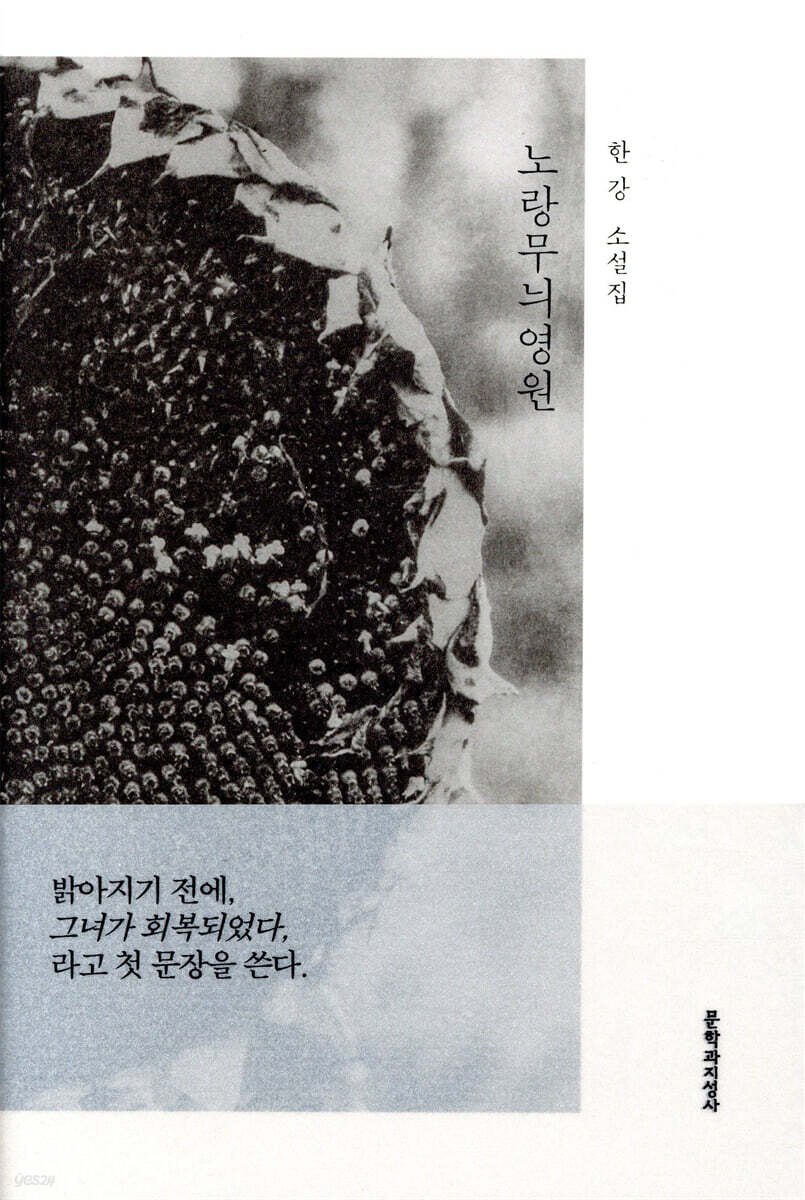
The place we must eventually return to, the leaves pushing up their veins, the flowers blooming during the recovery period, the natural changes and flow that we tried to capture during the 'connecting the dots' work are in harmony with the work of photographer Lee Jeong-jin used on the cover.
On the other hand, isn't the Han River's fierce question unchanging?
He never lets go of the questions, “I want to live, I must live, how should I live?” and asks about human existence, life and death, and this world throughout his twenty-one novels, but inevitably he cannot reach an answer.
But the question itself, like a faint flame, and the heat of loneliness and delicate sadness that arise from the question, become the force that draws them in the work and keeps us, the ones we love, alive.
Because it has changed but not changed, I have carefully rearranged the arrangement of the novels and touched up some expressions, but left what needed to be left as is.
In response to the author's own question in "The Fruit of My Woman," which previously asked "who," we will now look at the author's newly written words in "Yellow-Patterned Eternity."
I encourage you to retrace that trajectory together.
Someone has been writing alone for over twenty years.
The Han River is still walking.
I know.
The twelve years I spent writing these novels can no longer be returned, nor can I ever meet the vivid self that wrote all these sentences again.
I don't think that fact should be felt as a loss.
This should never be a goodbye, because I am someone who wants to live and keep writing.
―Author's Note (2018), 『Yellow-Striped Eternity』
A momentary movement and a quiet silence are passionately engraved
Han Kang's third collection of short stories,
Yellow-patterned Eternity
This is Han Kang's third collection of short stories, which contains seven works written and published over 12 years, including the short story "Yellow-patterned Eternity," written over seven months starting in the summer of 2002, and the short story "Recovering Human," which was named as the author's major work when she won the 2024 Nobel Prize in Literature ("True recovery does not occur, and suffering appears as a fundamental existential experience that cannot be reduced to a passing pain," Swedish Academy).
While the seasons changed dozens of times, all of Han Kang's strength and senses, which explored the origin of existence and the world, stayed in pain or in the traces of pain, and while doing so, short and medium-length novels closely connected and in harmony with long novels such as "The Vegetarian" and "The Wind Blows, Go Away" were written, and those traces were fully captured.
If you ask the characters in 『Yellow-Striped Eternity』, who live believing that “a heartless and listless attitude is the only shield I have against life” (「Europa」), “How come you don’t get so tired?”, they will only answer.
“No, that’s not true.
“I’m tired, but I just have to endure.” (“Hunza”) “I grit my teeth and toss and turn until dawn, answering those persistent and burning questions.” (“Recovering Human”) The will to regenerate and the vitality to move forward little by little burn even more fiercely in despair.
“I have gone as far as I can go inside of me.
There was no way out but to go outside.
[… …] I knew I couldn’t live like I was holding a funeral anymore.” (Europa)
Han Kang's sentences reproduce not only the heavy pain and suffering, but also "a moment of light, a tremble, an inhaled breath, the stillness of water" on the manuscript.
The author's intuition, which overwhelms experience and concepts, will be conveyed to us, the readers, like paint seeping into the grain of paper.
Author's Note
These novels were written without any requests for manuscripts.
I wrote it by myself, put it in a drawer, and opened it whenever I remembered it and revised it little by little.
Maybe it's because I spend months writing each piece like that, but I feel like I'm ingrained in the entire book.
Of course, it is not a direct translation of personal experiences, but there are emotions that have been irrevocably imbued.
Thick and thick.
Desperately.
Sometimes strangely clear.
It causes stabbing pain.
I know.
The twelve years I spent writing these novels can no longer be returned, nor can I ever meet the vivid self that wrote all these sentences again.
I don't think that fact should be felt as a loss.
This should never be a goodbye, because I am someone who wants to live and keep writing.
I would like to express my gratitude to the members of Munhak-kwa-Jiseong-sa, who have quietly tied a knot, for watching over me.
I would like to thank author Lee Jeong-jin for allowing me to use his photo on the cover.
On a dazzlingly bright afternoon in the fall of 2018
Han River
Over the course of the three volumes of her short stories, there are some things that have changed and some that have not changed in Han Kang's short stories.
In 『Love of Yeosu』, the lonely and isolated beings who desperately express their longing for humanity and the world, and who leave, abandon, wander, and fall, end up falling out of sync and getting hurt as they clumsily try to accept the world and each other that they so desperately longed for in 『The Fruit of My Woman』.
And in 『Yellow Patterned Eternity』, the will to regenerate and the life force burn even stronger in despair.
The dignified being, still in pain, finally tries to embrace the other.
The place we must eventually return to, the leaves pushing up their veins, the flowers blooming during the recovery period, the natural changes and flow that we tried to capture during the 'connecting the dots' work are in harmony with the work of photographer Lee Jeong-jin used on the cover.
On the other hand, isn't the Han River's fierce question unchanging?
He never lets go of the questions, “I want to live, I must live, how should I live?” and asks about human existence, life and death, and this world throughout his twenty-one novels, but inevitably he cannot reach an answer.
But the question itself, like a faint flame, and the heat of loneliness and delicate sadness that arise from the question, become the force that draws them in the work and keeps us, the ones we love, alive.
Because it has changed but not changed, I have carefully rearranged the arrangement of the novels and touched up some expressions, but left what needed to be left as is.
In response to the author's own question in "The Fruit of My Woman," which previously asked "who," we will now look at the author's newly written words in "Yellow-Patterned Eternity."
I encourage you to retrace that trajectory together.
Someone has been writing alone for over twenty years.
The Han River is still walking.
I know.
The twelve years I spent writing these novels can no longer be returned, nor can I ever meet the vivid self that wrote all these sentences again.
I don't think that fact should be felt as a loss.
This should never be a goodbye, because I am someone who wants to live and keep writing.
―Author's Note (2018), 『Yellow-Striped Eternity』
A momentary movement and a quiet silence are passionately engraved
Han Kang's third collection of short stories,
Yellow-patterned Eternity
This is Han Kang's third collection of short stories, which contains seven works written and published over 12 years, including the short story "Yellow-patterned Eternity," written over seven months starting in the summer of 2002, and the short story "Recovering Human," which was named as the author's major work when she won the 2024 Nobel Prize in Literature ("True recovery does not occur, and suffering appears as a fundamental existential experience that cannot be reduced to a passing pain," Swedish Academy).
While the seasons changed dozens of times, all of Han Kang's strength and senses, which explored the origin of existence and the world, stayed in pain or in the traces of pain, and while doing so, short and medium-length novels closely connected and in harmony with long novels such as "The Vegetarian" and "The Wind Blows, Go Away" were written, and those traces were fully captured.
If you ask the characters in 『Yellow-Striped Eternity』, who live believing that “a heartless and listless attitude is the only shield I have against life” (「Europa」), “How come you don’t get so tired?”, they will only answer.
“No, that’s not true.
“I’m tired, but I just have to endure.” (“Hunza”) “I grit my teeth and toss and turn until dawn, answering those persistent and burning questions.” (“Recovering Human”) The will to regenerate and the vitality to move forward little by little burn even more fiercely in despair.
“I have gone as far as I can go inside of me.
There was no way out but to go outside.
[… …] I knew I couldn’t live like I was holding a funeral anymore.” (Europa)
Han Kang's sentences reproduce not only the heavy pain and suffering, but also "a moment of light, a tremble, an inhaled breath, the stillness of water" on the manuscript.
The author's intuition, which overwhelms experience and concepts, will be conveyed to us, the readers, like paint seeping into the grain of paper.
Author's Note
These novels were written without any requests for manuscripts.
I wrote it by myself, put it in a drawer, and opened it whenever I remembered it and revised it little by little.
Maybe it's because I spend months writing each piece like that, but I feel like I'm ingrained in the entire book.
Of course, it is not a direct translation of personal experiences, but there are emotions that have been irrevocably imbued.
Thick and thick.
Desperately.
Sometimes strangely clear.
It causes stabbing pain.
I know.
The twelve years I spent writing these novels can no longer be returned, nor can I ever meet the vivid self that wrote all these sentences again.
I don't think that fact should be felt as a loss.
This should never be a goodbye, because I am someone who wants to live and keep writing.
I would like to express my gratitude to the members of Munhak-kwa-Jiseong-sa, who have quietly tied a knot, for watching over me.
I would like to thank author Lee Jeong-jin for allowing me to use his photo on the cover.
On a dazzlingly bright afternoon in the fall of 2018
Han River
GOODS SPECIFICS
- Publication date: November 9, 2018
- Page count, weight, size: 308 pages | 358g | 130*195*30mm
- ISBN13: 9788932034836
- ISBN10: 8932034834
You may also like
카테고리
korean


korean

![ELLE 엘르 스페셜 에디션 A형 : 12월 [2025]](http://librairie.coreenne.fr/cdn/shop/files/b8e27a3de6c9538896439686c6b0e8fb.jpg?v=1766436872&width=3840)


