

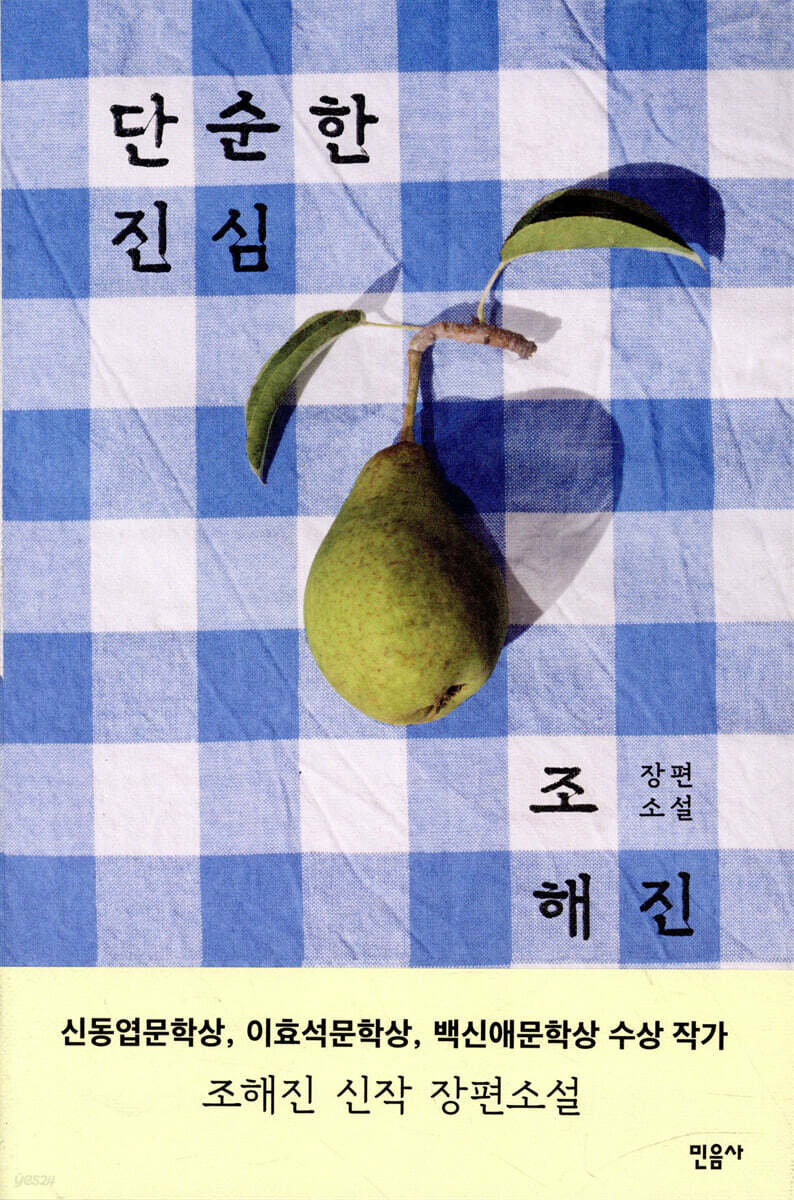
Simple sincerity
 |
Description
Book Introduction
- A word from MD
-
Jo Hae-jin's new work depicts the heart of caring for one another.A novel about Nana, who was adopted to France and goes to Korea to find her real name, a home where our identity and presence reside. It is a story about everyone finding their own name.
It is a 'novel of the side' that does not ignore the accidental strangers who appear in life, but rather willingly calls their names and embraces them.
July 16, 2019. Novel/Poetry PD Kim Do-hoon
People who have drawn life into their lives by chance
A caring heart that begins with calling someone's name
Winner of the Shin Dong-yup Literary Award and the Lee Hyo-seok Literary Award
Jo Hae-jin's new novel
The new full-length novel, "Simple Sincerity," by Jo Hae-jin, winner of the Shin Dong-yup Literary Award and the Lee Hyo-seok Literary Award, has been published.
"Simple Truth" tells the story of Nana, a Korean playwright adopted to France, who, after discovering an unexpected pregnancy, decides to travel to Korea in search of her origins and meets people she never thought she would encounter in her life.
Jo Hae-jin has consistently presented works that focus on individuals wounded by historical violence.
In this new work, he again raises the issue of overseas adoption and the existence of women in camp towns with his unique sensibility.
It delves into the deepest emotions of those who are lonely like lost property, while at the same time not leaving them alone.
It depicts characters who are involved with others one step further and one step deeper.
The author, who has comforted many readers with the "novel of light" that suggests that people can be each other's moments of illumination and salvation, presents a "novel of the side" through "Simple Sincerity" in which people do not turn away from the random strangers who appear in their lives, but rather willingly call out their names and embrace them.
A caring heart that begins with calling someone's name
Winner of the Shin Dong-yup Literary Award and the Lee Hyo-seok Literary Award
Jo Hae-jin's new novel
The new full-length novel, "Simple Sincerity," by Jo Hae-jin, winner of the Shin Dong-yup Literary Award and the Lee Hyo-seok Literary Award, has been published.
"Simple Truth" tells the story of Nana, a Korean playwright adopted to France, who, after discovering an unexpected pregnancy, decides to travel to Korea in search of her origins and meets people she never thought she would encounter in her life.
Jo Hae-jin has consistently presented works that focus on individuals wounded by historical violence.
In this new work, he again raises the issue of overseas adoption and the existence of women in camp towns with his unique sensibility.
It delves into the deepest emotions of those who are lonely like lost property, while at the same time not leaving them alone.
It depicts characters who are involved with others one step further and one step deeper.
The author, who has comforted many readers with the "novel of light" that suggests that people can be each other's moments of illumination and salvation, presents a "novel of the side" through "Simple Sincerity" in which people do not turn away from the random strangers who appear in their lives, but rather willingly call out their names and embrace them.
- You can preview some of the book's contents.
Preview
index
Simple Truth 7
Author's Note 255
Recommendation 259
Author's Note 255
Recommendation 259
Into the book
Because the name is house.
Seoyoung's second email began like this.
I think our name is our identity, or the house where our existence resides.
Things are forgotten so quickly here, and I believe that remembering even one name is a courtesy to a world gone by.
--- p.17
The engineer was the one who saved me from the tracks.
To be more precise, he suddenly stopped the train he was driving and saved me from being hit by it.
For some reason, he did not immediately send an unidentified girl who was crying in fear in front of a stopped train to the police station or an orphanage. Instead, he took her to the house where she lived with her mother and protected her, calling her Moon-ju.
If, as Seoyoung said, the name is a house, then I have lived in that name for nearly a year.
--- p.20
Outside my life, there was a gatekeeper.
If we assume that Moon-ju, who remained in Korea, unlike me who left for France, lived in Korea and aged at the same rate as me, then it would not be impossible for two parallel lives to exist.
On special days, on days when I feel good, on days when I doubt my good mood and end up with miserable memories, on days when I have a premonition that I will be abandoned by everyone around me without any basis or context, I would summon Moonju, who was outside the screen, as if looking for an emergency medicine.
I liked imagining Moonju.
--- p.58
As I opened the door and stepped outside, summer sunlight was pouring down everywhere I looked.
Like green ink spreading through a small earthenware bowl, the summer that was spreading through my body for a while would become even thicker.
That also meant that the bones and blood, organs and skin of the universe were ripening like fruit.
Seoyoung's second email began like this.
I think our name is our identity, or the house where our existence resides.
Things are forgotten so quickly here, and I believe that remembering even one name is a courtesy to a world gone by.
--- p.17
The engineer was the one who saved me from the tracks.
To be more precise, he suddenly stopped the train he was driving and saved me from being hit by it.
For some reason, he did not immediately send an unidentified girl who was crying in fear in front of a stopped train to the police station or an orphanage. Instead, he took her to the house where she lived with her mother and protected her, calling her Moon-ju.
If, as Seoyoung said, the name is a house, then I have lived in that name for nearly a year.
--- p.20
Outside my life, there was a gatekeeper.
If we assume that Moon-ju, who remained in Korea, unlike me who left for France, lived in Korea and aged at the same rate as me, then it would not be impossible for two parallel lives to exist.
On special days, on days when I feel good, on days when I doubt my good mood and end up with miserable memories, on days when I have a premonition that I will be abandoned by everyone around me without any basis or context, I would summon Moonju, who was outside the screen, as if looking for an emergency medicine.
I liked imagining Moonju.
--- p.58
As I opened the door and stepped outside, summer sunlight was pouring down everywhere I looked.
Like green ink spreading through a small earthenware bowl, the summer that was spreading through my body for a while would become even thicker.
That also meant that the bones and blood, organs and skin of the universe were ripening like fruit.
--- p.68
Publisher's Review
What is your name?
The main character of 'Simple Truth', 'Nana', decided to go to Korea despite being pregnant because of an email from a Korean college student, 'Seoyoung', that touched a long-held need in her.
Seoyoung reveals that she wants to make a film about the process of finding the meaning of Nana's pre-adoption name, 'Moonju.'
So, Nana, who came to Korea, is obsessed with remembering not only her own name, but also the names of others she meets along the way.
Ask the names of the people you meet, ask about the place names of places in Seoul you pass through, and ask about their meanings.
In "Simple Truth," people who meet by chance after traveling through distant times and spaces struggle to learn each other's names.
In an interview, Jo Hae-jin said, “I think the story of people separated by time and space communicating and bonding is one of the destinations of hope that I can reach.”
After reading this novel, readers will be able to feel the author's final destination of hope in their hands.
A subtle but definitely warm temperature of hope, about one degree higher than body temperature, will be conveyed.
We are witnesses to each other
The characters in 'Simple Truth' willingly become involved with each other.
Seoyoung captures Nana's life in her film, retracing the railroad tracks of Cheongnyangni Station where Nana was abandoned and then rescued, the house of the engineer who lived under the name of 'Munju', and the orphanage in Incheon where she lived under the name of 'Esther'.
Nana hears the welcoming and protective words from the grandmother who owns the 'Bokhee Restaurant' on the first floor of the building where she is staying, saying, "You don't lift heavy things when you have a baby," and imagines the life of an old man she had never met.
During the few months and summers that Nana came to Korea with her baby in her womb, they became more closely intertwined than any other relationship.
A single word from another person can gradually resolve the deep-rooted misunderstandings and hatred that one has harbored throughout one's life.
The strangers in 'Simple Truth' seep into each other's lives in this way.
In Jo Hae-jin's novels, the exploration of oneself and the gaze directed at others have always coexisted.
The strength of Jo Hae-jin's novels and the humanity he believes in are the hearts that reach out to the lives of others rather than falling into despair alone.
The main character of 'Simple Truth', 'Nana', decided to go to Korea despite being pregnant because of an email from a Korean college student, 'Seoyoung', that touched a long-held need in her.
Seoyoung reveals that she wants to make a film about the process of finding the meaning of Nana's pre-adoption name, 'Moonju.'
So, Nana, who came to Korea, is obsessed with remembering not only her own name, but also the names of others she meets along the way.
Ask the names of the people you meet, ask about the place names of places in Seoul you pass through, and ask about their meanings.
In "Simple Truth," people who meet by chance after traveling through distant times and spaces struggle to learn each other's names.
In an interview, Jo Hae-jin said, “I think the story of people separated by time and space communicating and bonding is one of the destinations of hope that I can reach.”
After reading this novel, readers will be able to feel the author's final destination of hope in their hands.
A subtle but definitely warm temperature of hope, about one degree higher than body temperature, will be conveyed.
We are witnesses to each other
The characters in 'Simple Truth' willingly become involved with each other.
Seoyoung captures Nana's life in her film, retracing the railroad tracks of Cheongnyangni Station where Nana was abandoned and then rescued, the house of the engineer who lived under the name of 'Munju', and the orphanage in Incheon where she lived under the name of 'Esther'.
Nana hears the welcoming and protective words from the grandmother who owns the 'Bokhee Restaurant' on the first floor of the building where she is staying, saying, "You don't lift heavy things when you have a baby," and imagines the life of an old man she had never met.
During the few months and summers that Nana came to Korea with her baby in her womb, they became more closely intertwined than any other relationship.
A single word from another person can gradually resolve the deep-rooted misunderstandings and hatred that one has harbored throughout one's life.
The strangers in 'Simple Truth' seep into each other's lives in this way.
In Jo Hae-jin's novels, the exploration of oneself and the gaze directed at others have always coexisted.
The strength of Jo Hae-jin's novels and the humanity he believes in are the hearts that reach out to the lives of others rather than falling into despair alone.
GOODS SPECIFICS
- Date of issue: July 5, 2019
- Page count, weight, size: 268 pages | 330g | 135*205*20mm
- ISBN13: 9788937441943
- ISBN10: 8937441942
You may also like
카테고리
korean


korean

![ELLE 엘르 스페셜 에디션 A형 : 12월 [2025]](http://librairie.coreenne.fr/cdn/shop/files/b8e27a3de6c9538896439686c6b0e8fb.jpg?v=1766436872&width=3840)


