

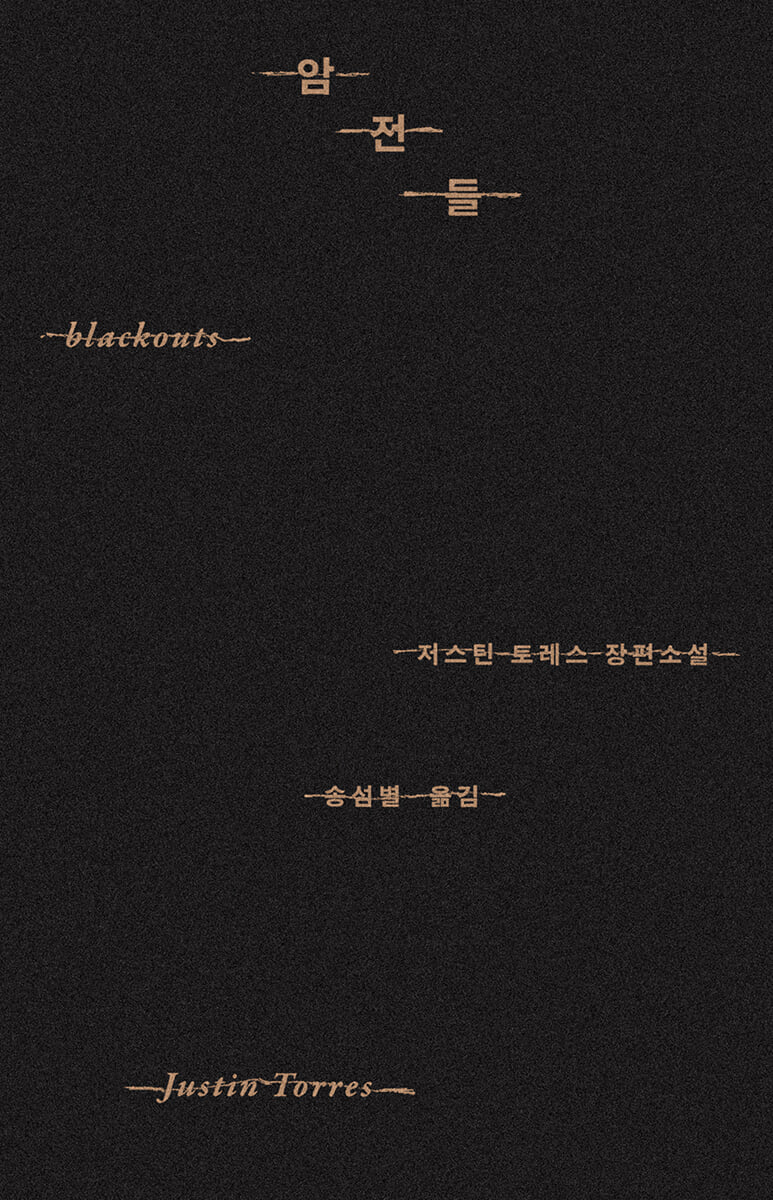
Blackouts
 |
Description
Book Introduction
2023 National Book Award Winner
A powerful new voice in American literature, unlike any other book.
A fascinating reconstruction of censored desires, identities, and dislocated memories.
The most intense current in queer literature
To be lost or absorbed by what is deleted and suppressed—sometimes captivating, sometimes overflowing—page 373
Justin Torres, whose debut work We the Animals (2011) became an instant bestseller and received explosive responses, establishing him as one of the most notable queer writers in the United States, has published his full-length novel, Darkness, through Open Books.
His debut work was selected as one of the "Most Important Books of the 21st Century" by the New York Times, and he is said to have once again established "queer literature" as an important field in English-speaking literature with just two novels. He won the 2023 National Book Award for his novel "Darkness," which he published after 12 years.
『Dark Fronts』 is a masterpiece that has drawn praise as a “poetic and rich rediscovery of cultural heritage.”
This novel, a unique reimagining of archival material about queer voices erased and censored from history, draws on the actual research work Sex Variants: A Study in Homosexual Patterns.
This groundbreaking study, which included interviews with actual queer people conducted by the early 20th-century queer sociologist Jan Gay, was later appropriated by the Committee for the Study of Sexual Variations, and his name was buried.
Juan Gay, an old man living in the desert Palace, a home for wanderers on the border between reality and fantasy, hands over this study book, stained with blackened pages, to an unnamed narrator who comes to visit him one day.
While Juan waits for death, two queers of different generations begin to connect their lives, loves, memories and stories through countless texts and images over the darkened history… … .
A powerful new voice in American literature, unlike any other book.
A fascinating reconstruction of censored desires, identities, and dislocated memories.
The most intense current in queer literature
To be lost or absorbed by what is deleted and suppressed—sometimes captivating, sometimes overflowing—page 373
Justin Torres, whose debut work We the Animals (2011) became an instant bestseller and received explosive responses, establishing him as one of the most notable queer writers in the United States, has published his full-length novel, Darkness, through Open Books.
His debut work was selected as one of the "Most Important Books of the 21st Century" by the New York Times, and he is said to have once again established "queer literature" as an important field in English-speaking literature with just two novels. He won the 2023 National Book Award for his novel "Darkness," which he published after 12 years.
『Dark Fronts』 is a masterpiece that has drawn praise as a “poetic and rich rediscovery of cultural heritage.”
This novel, a unique reimagining of archival material about queer voices erased and censored from history, draws on the actual research work Sex Variants: A Study in Homosexual Patterns.
This groundbreaking study, which included interviews with actual queer people conducted by the early 20th-century queer sociologist Jan Gay, was later appropriated by the Committee for the Study of Sexual Variations, and his name was buried.
Juan Gay, an old man living in the desert Palace, a home for wanderers on the border between reality and fantasy, hands over this study book, stained with blackened pages, to an unnamed narrator who comes to visit him one day.
While Juan waits for death, two queers of different generations begin to connect their lives, loves, memories and stories through countless texts and images over the darkened history… … .
- You can preview some of the book's contents.
Preview
Detailed image

Into the book
In the blackout, I remembered, or rather, I lived again, and sometimes I lived again a life that wasn't mine.
--- p.35
Late at night, a nurse came and said,
“You shouldn’t be shaking like that.” I didn’t even realize I was shaking.
The nurse said.
"I have something to give you." What? I wanted to ask.
What could you give me? I just turned my head to the wall, let the nurse pinch the chubby part of my arm, and there was nothing behind me.
doesn't exist.
--- p.43
In a state where dreams and reality intertwine, I would suddenly wake up from a dreamscape of my past life and think, "Oh my God, what is going on?"
Perhaps he even said it out loud sometimes, sometimes Juan would say in a reassuringly clear voice, "Nothing's wrong, yes yes."
He simply replied, "You just don't have it."
--- p.95
"So that I can keep singing?" "And keep burning, yes yes."
--- p.112
What good is reading a book in order? Open any page and you'll find an endless stream of sketches of lives rising from the past, each a single testimony to what the character has overcome, or failed to overcome.
--- p.117
I wanted to feel that way.
Getting out of myself.
Rising up.
--- pp.128-129
It's half real, half a rearrangement of a sleeping mind... ... .
This was a similar saying.
When I first read this passage, it felt like a warning - to return to that place, that misremembered past, that half-dream area from which I cannot remember how to escape.
A warning not to lose.
--- p.142
“Black hairs resembling spider legs covered Papi’s knuckles… … .
The rotational force of the hand that slapped the cheek… … .
Mami, crying, electricity, mascara… … A short line of a nursery rhyme that was repeated over and over again, “Aros con leche, se kere kasar”… … .
All the little shocks and residues of physical differences… … The strangeness, the perceptible oddity, that was forced into the bodies of me, my sisters, my brother, and my mother, which were nothing but bones… … Trapped under the skin, it wouldn’t be surprising if one day it burst and bubbled out… … .
And yes, yes, even now the words pouring out of my mouth are so far from the indescribable center and yet so close, and so surprising and disappointing.
--- p.157
10 years.
I wore that necklace for 10 years.
What's important about that fact is that I'm not a seeker, I'm a loser.
chronic loser.
--- p.177
Whether you call or not, yesterday is here.
I joked that I would carve this quote into my tombstone, and immediately regretted it.
Do you remember when you had your eyes tested, yes yes? They placed one finger on one of your temples and slowly moved it toward your eye.
The past is always right there, lurking in your immediate vicinity, rising to the surface.
--- p.35
Late at night, a nurse came and said,
“You shouldn’t be shaking like that.” I didn’t even realize I was shaking.
The nurse said.
"I have something to give you." What? I wanted to ask.
What could you give me? I just turned my head to the wall, let the nurse pinch the chubby part of my arm, and there was nothing behind me.
doesn't exist.
--- p.43
In a state where dreams and reality intertwine, I would suddenly wake up from a dreamscape of my past life and think, "Oh my God, what is going on?"
Perhaps he even said it out loud sometimes, sometimes Juan would say in a reassuringly clear voice, "Nothing's wrong, yes yes."
He simply replied, "You just don't have it."
--- p.95
"So that I can keep singing?" "And keep burning, yes yes."
--- p.112
What good is reading a book in order? Open any page and you'll find an endless stream of sketches of lives rising from the past, each a single testimony to what the character has overcome, or failed to overcome.
--- p.117
I wanted to feel that way.
Getting out of myself.
Rising up.
--- pp.128-129
It's half real, half a rearrangement of a sleeping mind... ... .
This was a similar saying.
When I first read this passage, it felt like a warning - to return to that place, that misremembered past, that half-dream area from which I cannot remember how to escape.
A warning not to lose.
--- p.142
“Black hairs resembling spider legs covered Papi’s knuckles… … .
The rotational force of the hand that slapped the cheek… … .
Mami, crying, electricity, mascara… … A short line of a nursery rhyme that was repeated over and over again, “Aros con leche, se kere kasar”… … .
All the little shocks and residues of physical differences… … The strangeness, the perceptible oddity, that was forced into the bodies of me, my sisters, my brother, and my mother, which were nothing but bones… … Trapped under the skin, it wouldn’t be surprising if one day it burst and bubbled out… … .
And yes, yes, even now the words pouring out of my mouth are so far from the indescribable center and yet so close, and so surprising and disappointing.
--- p.157
10 years.
I wore that necklace for 10 years.
What's important about that fact is that I'm not a seeker, I'm a loser.
chronic loser.
--- p.177
Whether you call or not, yesterday is here.
I joked that I would carve this quote into my tombstone, and immediately regretted it.
Do you remember when you had your eyes tested, yes yes? They placed one finger on one of your temples and slowly moved it toward your eye.
The past is always right there, lurking in your immediate vicinity, rising to the surface.
--- p.371
Publisher's Review
Traversing deleted texts, fragmented memories, and punctured histories
Rebuilding a path in the dark
Open any page and you'll find an endless stream of sketches of lives rising from the past, each one a single testimony of what the character has overcome or failed to overcome.
― Page 117
The original title, "blackouts," has several meanings in the novel, including blackouts, temporary memory loss, and erasing writing in black.
When we open a book, the first thing we see are pages marked with black marker.
At the heart of this deleted text is the existential study Sexual Variants and the forgotten name behind it, Jan Gay.
In the 1930s, sociologist Jan Gay, a queer researcher and lesbian herself, collected testimonies from over 300 homosexuals about their lives and desires.
Due to institutional limitations that only allowed publication under the name of a prominent male physician, Gay relinquished his research to others. He believed he was finally bringing it to light, but in reality, at that moment, the testimonies were shrouded in darkness. Jane Gay's name was erased, queer testimonies were filled with pathological diagnoses, and desire was translated into disability.
Those who came to testify are left with blurred nude photos.
The novel begins its story right at that erased spot.
This novel captivatingly occupies the void created by darkness, holes, and blackouts, sensually reconstructing stories through the cracks of suppressed history through fiction.
The unique format, intertwining numerous images, case studies, film scripts and flashbacks, instantly draws the reader in, while the words cut unsteadily between the deleted texts come back to life with a poetic and dissonant tone, along with a sense of unfamiliarity.
The novel vividly portrays the vitality of things that can only be revealed and approached in such darkness.
Our stories survive in silence, seclusion, omission, and void.
How to "Reread" in Queer Sense
But promise me, yes yes.
To twist, lie, fabricate and craft something inert.
I promise, Juan.
― Page 147
In a small room in the Palace, a desert ruin and a home for wanderers, the nameless narrator, with nowhere to go, takes care of the dying old man, Juan Gay.
Juan hands over the blackened pages of his study, Sexual Variants, to the narrator, nicknamed "Nene."
While Juan awaits death, two queers from different generations begin to connect their lives, loves, memories, and stories, moving back and forth between countless texts and images over this darkened history.
They exchange fragmented memories, such as the vicious jokes about the "corrective" words they exchanged while incarcerated in a mental hospital, Juan's childhood days with Jan Gay, and Nene's brazen seduction of men as a child sex worker.
Nene questions her own existence and desires, and Juan continues his testimony by revealing a broader queer history—a history of Puerto Rican race and immigration, pathologization and discrimination.
Meanwhile, their conversations are filled with trivial and sensual things.
The nursery rhyme that lingers in my head, my father's shining necklace, the image of a policeman who seems to be taking me somewhere other than here, a barking dog wearing an expensive jacket, the beautifully whispered lines of a fairy tale that struck me as 〈queer〉 in the most uncanny way… … .
Like pages from "Sexual Mutants" with parts blown away, they gently weave fragmented and disjointed stories together in the darkness.
This novel, which frequently blacks out and then begins anew in a completely different place, makes us look again at the complexly intertwined places of desire and memory.
The stories of Juan and Nene are fictional.
These “twisting and fabricating lies” set in motion the past that seems fixed, the history that has been forced into silence, and the things that have been erased and omitted.
The dissonant words that arise and clash between memory, desire, and identity are themselves a record of restoration that “sings all the time, and therefore can burn all the time.”
So, a new path to places that seemed inaccessible, including the missing history of Jane Gay, a way to reread history and the past in a queer sense, “getting lost by the erased and the suppressed.
It shows us how to “become sometimes possessed, sometimes enriched.”
To sing all the time, to burn all the time
We must not stop talking
Let me tell you something you must not forget.
There is no need to completely clear up any ambiguities.
― Pages 274-275
Torres comments on "The Dark Side":
〈As with the history of the gay community, what I find most uncomfortable about queer history is that it is full of pathological explanations.
There is also the difficulty of encountering so many things in history—all these ephemeral artifacts, photographs, letters, things that we don't quite know how to interpret or put into context.
(……) But I wanted to keep the readers in a state of ambiguity, without trying to make everything clear.
I also wanted to ignite curiosity about the narrative potential of the past.
“So that you can feel deeply immersed in the way the past speaks to the present,” says translator Song Seom-byeol.
This book is about how to tell a history that has been silenced, and how to listen to the stories told in small voices.
I have always kept in mind that our real stories survive in silence, seclusion, omission, footnotes, and blank spaces, and that we must never stop speaking to rescue them from the darkness.
The history of queerness is a history of recovery and restoration, and we share that tender mystery with one another.〉 In this way, 『Blackouts』 makes us reimagine stories from dark, swept-away places and swept-away traces.
And so it offers us a new way of looking at a world full of ghostly shadows and flashes of truth, between the past we inherit and the past we create, a way to be fulfilled while still being lost in ambiguity.
A word from the translator
"The Dark War" is a book about how to tell a history that has been silenced, and how to listen to the stories told in small voices.
I have always kept in mind that our real stories survive in silence, seclusion, omission, footnotes, and blank spaces, and that we must never stop speaking to rescue them from the darkness.
Queer history is a history of recovery and restoration, and we share that tender mystery with one another.
I hope readers will listen too.
I wish we could lie side by side in the darkness and listen until the end.
Rebuilding a path in the dark
Open any page and you'll find an endless stream of sketches of lives rising from the past, each one a single testimony of what the character has overcome or failed to overcome.
― Page 117
The original title, "blackouts," has several meanings in the novel, including blackouts, temporary memory loss, and erasing writing in black.
When we open a book, the first thing we see are pages marked with black marker.
At the heart of this deleted text is the existential study Sexual Variants and the forgotten name behind it, Jan Gay.
In the 1930s, sociologist Jan Gay, a queer researcher and lesbian herself, collected testimonies from over 300 homosexuals about their lives and desires.
Due to institutional limitations that only allowed publication under the name of a prominent male physician, Gay relinquished his research to others. He believed he was finally bringing it to light, but in reality, at that moment, the testimonies were shrouded in darkness. Jane Gay's name was erased, queer testimonies were filled with pathological diagnoses, and desire was translated into disability.
Those who came to testify are left with blurred nude photos.
The novel begins its story right at that erased spot.
This novel captivatingly occupies the void created by darkness, holes, and blackouts, sensually reconstructing stories through the cracks of suppressed history through fiction.
The unique format, intertwining numerous images, case studies, film scripts and flashbacks, instantly draws the reader in, while the words cut unsteadily between the deleted texts come back to life with a poetic and dissonant tone, along with a sense of unfamiliarity.
The novel vividly portrays the vitality of things that can only be revealed and approached in such darkness.
Our stories survive in silence, seclusion, omission, and void.
How to "Reread" in Queer Sense
But promise me, yes yes.
To twist, lie, fabricate and craft something inert.
I promise, Juan.
― Page 147
In a small room in the Palace, a desert ruin and a home for wanderers, the nameless narrator, with nowhere to go, takes care of the dying old man, Juan Gay.
Juan hands over the blackened pages of his study, Sexual Variants, to the narrator, nicknamed "Nene."
While Juan awaits death, two queers from different generations begin to connect their lives, loves, memories, and stories, moving back and forth between countless texts and images over this darkened history.
They exchange fragmented memories, such as the vicious jokes about the "corrective" words they exchanged while incarcerated in a mental hospital, Juan's childhood days with Jan Gay, and Nene's brazen seduction of men as a child sex worker.
Nene questions her own existence and desires, and Juan continues his testimony by revealing a broader queer history—a history of Puerto Rican race and immigration, pathologization and discrimination.
Meanwhile, their conversations are filled with trivial and sensual things.
The nursery rhyme that lingers in my head, my father's shining necklace, the image of a policeman who seems to be taking me somewhere other than here, a barking dog wearing an expensive jacket, the beautifully whispered lines of a fairy tale that struck me as 〈queer〉 in the most uncanny way… … .
Like pages from "Sexual Mutants" with parts blown away, they gently weave fragmented and disjointed stories together in the darkness.
This novel, which frequently blacks out and then begins anew in a completely different place, makes us look again at the complexly intertwined places of desire and memory.
The stories of Juan and Nene are fictional.
These “twisting and fabricating lies” set in motion the past that seems fixed, the history that has been forced into silence, and the things that have been erased and omitted.
The dissonant words that arise and clash between memory, desire, and identity are themselves a record of restoration that “sings all the time, and therefore can burn all the time.”
So, a new path to places that seemed inaccessible, including the missing history of Jane Gay, a way to reread history and the past in a queer sense, “getting lost by the erased and the suppressed.
It shows us how to “become sometimes possessed, sometimes enriched.”
To sing all the time, to burn all the time
We must not stop talking
Let me tell you something you must not forget.
There is no need to completely clear up any ambiguities.
― Pages 274-275
Torres comments on "The Dark Side":
〈As with the history of the gay community, what I find most uncomfortable about queer history is that it is full of pathological explanations.
There is also the difficulty of encountering so many things in history—all these ephemeral artifacts, photographs, letters, things that we don't quite know how to interpret or put into context.
(……) But I wanted to keep the readers in a state of ambiguity, without trying to make everything clear.
I also wanted to ignite curiosity about the narrative potential of the past.
“So that you can feel deeply immersed in the way the past speaks to the present,” says translator Song Seom-byeol.
This book is about how to tell a history that has been silenced, and how to listen to the stories told in small voices.
I have always kept in mind that our real stories survive in silence, seclusion, omission, footnotes, and blank spaces, and that we must never stop speaking to rescue them from the darkness.
The history of queerness is a history of recovery and restoration, and we share that tender mystery with one another.〉 In this way, 『Blackouts』 makes us reimagine stories from dark, swept-away places and swept-away traces.
And so it offers us a new way of looking at a world full of ghostly shadows and flashes of truth, between the past we inherit and the past we create, a way to be fulfilled while still being lost in ambiguity.
A word from the translator
"The Dark War" is a book about how to tell a history that has been silenced, and how to listen to the stories told in small voices.
I have always kept in mind that our real stories survive in silence, seclusion, omission, footnotes, and blank spaces, and that we must never stop speaking to rescue them from the darkness.
Queer history is a history of recovery and restoration, and we share that tender mystery with one another.
I hope readers will listen too.
I wish we could lie side by side in the darkness and listen until the end.
GOODS SPECIFICS
- Date of issue: October 20, 2025
- Format: Hardcover book binding method guide
- Page count, weight, size: 416 pages | 506g | 128*188*28mm
- ISBN13: 9788932925448
- ISBN10: 8932925445
You may also like
카테고리
korean


korean

![ELLE 엘르 스페셜 에디션 A형 : 12월 [2025]](http://librairie.coreenne.fr/cdn/shop/files/b8e27a3de6c9538896439686c6b0e8fb.jpg?v=1766436872&width=3840)


