

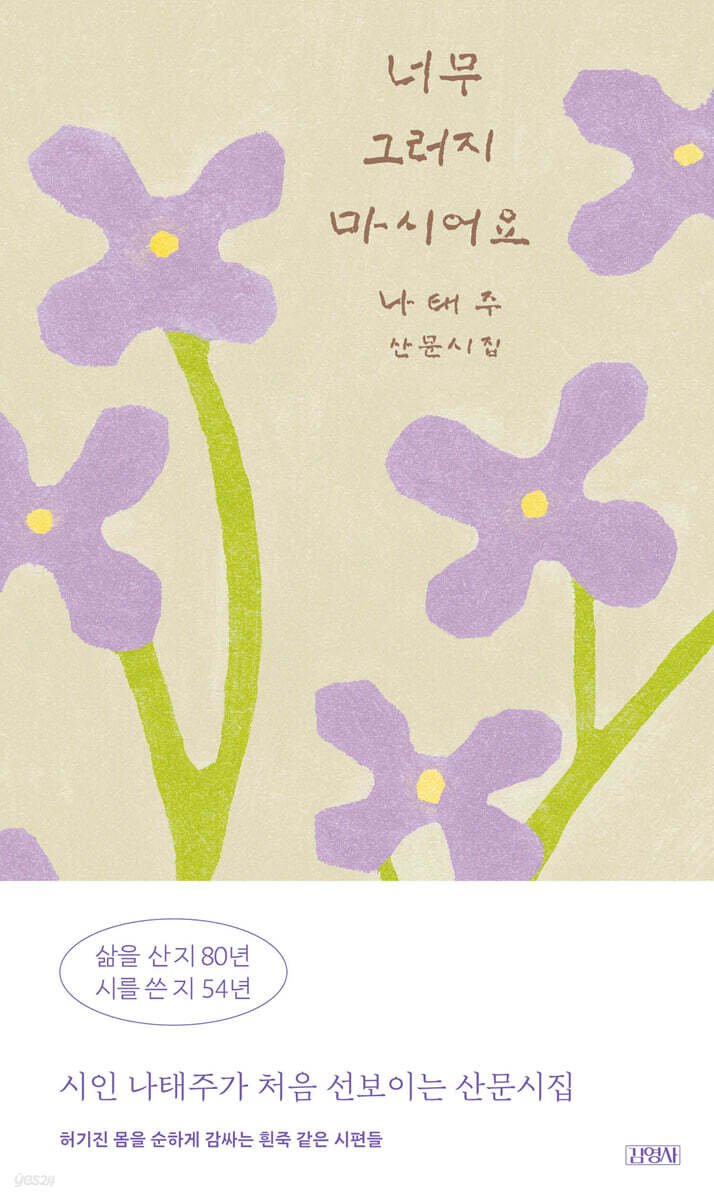
Please don't do that too much
 |
Description
Book Introduction
Poet Na Tae-ju's first collection of prose poems
What makes a person human?
123 poems that reflect on that quiet question
This is the first collection of prose poems by the national poet Na Tae-ju, who delivers gentle comfort through affectionate verse.
It contains the essence of deep thoughts cultivated over 80 years of life and 54 years of poetry.
This book is a compilation of prose poems selected from the first collection of poems, “Under the Bamboo Grove,” published in 1973, to the 50th collection of poems, “Let’s Have a Good Day,” published in 2023, and the 54th collection of poems, “Falling Water Poems,” which has not yet been published.
In "Please Don't Be Like That," the poet focuses on the fragile life, the small and low flowers of grass, and the wavering self and life, and finds enlightenment in them.
I ask myself why I couldn't live "without hesitation," and I hum to myself, "Let's try to become someone who has fewer regrets as much as possible," to live "the way I want to live," and to be grateful for today, "when I can climb a mountain with legs that don't tremble."
These are poems like “white porridge” that gently embrace a hungry body.
This book offers warm encouragement and resonance to everyone who is working hard to write their own “life drama.”
What makes a person human?
123 poems that reflect on that quiet question
This is the first collection of prose poems by the national poet Na Tae-ju, who delivers gentle comfort through affectionate verse.
It contains the essence of deep thoughts cultivated over 80 years of life and 54 years of poetry.
This book is a compilation of prose poems selected from the first collection of poems, “Under the Bamboo Grove,” published in 1973, to the 50th collection of poems, “Let’s Have a Good Day,” published in 2023, and the 54th collection of poems, “Falling Water Poems,” which has not yet been published.
In "Please Don't Be Like That," the poet focuses on the fragile life, the small and low flowers of grass, and the wavering self and life, and finds enlightenment in them.
I ask myself why I couldn't live "without hesitation," and I hum to myself, "Let's try to become someone who has fewer regrets as much as possible," to live "the way I want to live," and to be grateful for today, "when I can climb a mountain with legs that don't tremble."
These are poems like “white porridge” that gently embrace a hungry body.
This book offers warm encouragement and resonance to everyone who is working hard to write their own “life drama.”
- You can preview some of the book's contents.
Preview
index
Part 1.
We are in tears
flower garden
The Sound of the Pine Wind 5
A scene in the mountains
A letter from the mountains
A heart that looks at a poplar tree
convolvulus
barley grass
pedestal
Frontier 35
Frontier 36
Frontier 44
Frontier 45
Frontier 47
Frontier 48
Clouds, Dreaming Clouds 57
Teacher's thoughts
Part 2.
I couldn't help but laugh
violet
Which snowy night
Twenty years later
low prayer
White clouds seen in the orchard
Teachers' College Alumni Association
Geumhak-dong
Seoul out-of-town
Hong Ki-hwa
Jang Yang-sook
Lee Dong-seop
three boys
Shiitake mushroom soup restaurant
Donghak Revolution Tower
urinal
China News 1
China News 2
Part 3.
You may come and read it.
close
mantis
gift
double pattern
Gunja meat
heavy snow
Baekdu Mountain to visit
Chinko
A rare clear sky
Into the grass
neighbors
Mother's rice spoon
reconciliation
Chicken gomtang
Three generations
On the way home from work
morning glory
paddle
The way down
morning
The sea on the hill
Military thoughts
happy ending
pine tree
Dawn Dream
Baekdu Mountain again
Forget-me-not
regret
Two names
Sad Legacy
When your heart feels tight
It's your fault
Above the white clouds
People who are worried
A premonition of separation
Autumn Reflection
Good day
Wings of Goguryeo
The diary I know
reason
moved
It was a long time ago
apricot tree
Sister
While tying a tie
lizard
There was a tree there
Sleep with holes in it
barbarity
Ah! Mother
Please don't do that too much
Part 4.
A short but not short life drama
I saw you 2
house
Short but not short
Reckless remarks
This bad guy
Tree, an old friend
star
backboard
Poison chalice
Little Poet
September Hiking
safety
Red camellia, beautiful longing
Shaking
Lost Poems
larva
Not selling
To my daughter-in-law
oasis
wind
Lecture attendance
Mother's wishes
Part 5.
What a blessing
The third nightmare
I feel a little sad
Internal injuries
star
premature death
The day we are not in this world
I'm not here
thorn
Sending you the dawn feeling
White porridge
reversal
forest
Children of Makdong-ri
Sea 2
earthen house
Mr. Gyesu 2
On behalf of the letter
List of poems
We are in tears
flower garden
The Sound of the Pine Wind 5
A scene in the mountains
A letter from the mountains
A heart that looks at a poplar tree
convolvulus
barley grass
pedestal
Frontier 35
Frontier 36
Frontier 44
Frontier 45
Frontier 47
Frontier 48
Clouds, Dreaming Clouds 57
Teacher's thoughts
Part 2.
I couldn't help but laugh
violet
Which snowy night
Twenty years later
low prayer
White clouds seen in the orchard
Teachers' College Alumni Association
Geumhak-dong
Seoul out-of-town
Hong Ki-hwa
Jang Yang-sook
Lee Dong-seop
three boys
Shiitake mushroom soup restaurant
Donghak Revolution Tower
urinal
China News 1
China News 2
Part 3.
You may come and read it.
close
mantis
gift
double pattern
Gunja meat
heavy snow
Baekdu Mountain to visit
Chinko
A rare clear sky
Into the grass
neighbors
Mother's rice spoon
reconciliation
Chicken gomtang
Three generations
On the way home from work
morning glory
paddle
The way down
morning
The sea on the hill
Military thoughts
happy ending
pine tree
Dawn Dream
Baekdu Mountain again
Forget-me-not
regret
Two names
Sad Legacy
When your heart feels tight
It's your fault
Above the white clouds
People who are worried
A premonition of separation
Autumn Reflection
Good day
Wings of Goguryeo
The diary I know
reason
moved
It was a long time ago
apricot tree
Sister
While tying a tie
lizard
There was a tree there
Sleep with holes in it
barbarity
Ah! Mother
Please don't do that too much
Part 4.
A short but not short life drama
I saw you 2
house
Short but not short
Reckless remarks
This bad guy
Tree, an old friend
star
backboard
Poison chalice
Little Poet
September Hiking
safety
Red camellia, beautiful longing
Shaking
Lost Poems
larva
Not selling
To my daughter-in-law
oasis
wind
Lecture attendance
Mother's wishes
Part 5.
What a blessing
The third nightmare
I feel a little sad
Internal injuries
star
premature death
The day we are not in this world
I'm not here
thorn
Sending you the dawn feeling
White porridge
reversal
forest
Children of Makdong-ri
Sea 2
earthen house
Mr. Gyesu 2
On behalf of the letter
List of poems
Detailed image
.jpg)
Into the book
Honey, let's meet up with people we know and eat together often when it's mealtime.
So that people can say that we were the ones who ate a meal together when we were no longer in this world.
--- From "The Day We Were Not in the World"
I'm just going to live recklessly! I'm going to live the way I want to live! I really can't just collapse like this, can I? That resentment, resentment, and injustice slowly lifted me from my sickbed.
Ah, that's one extreme prescription.
It was from then on that I learned that sometimes poison can be a better medicine than medicine.
--- From "Poison Cup"
It's all useless, it's all useless.
It took me a long time to learn even something like this.
Learning one thing like this is actually learning a lot.
--- From "Tying a Necktie"
The sky gave me a mind to think, a mind to dream of tomorrow rather than today, and a mind to long for the distant future.
It gave me the loneliness of reading books and drawing pictures alone, and especially, it gave me the ability to like people.
So in the end I was able to become a little poet.
Today, I see those wildflowers blooming abandoned between the sidewalk blocks on the roadside.
I listen to the sound of water and birds in the mountain village that no one listens to.
Will there be no blessings from heaven for them?
no.
They too will receive the blessings, care and love they deserve.
So there is no need to feel too sorry for them.
They too are just living the best of their lives today.
They, too, are living on this earth as little poets, just like me.
--- From "The Little Poet"
When I was young and came home from school feeling sick, I would go to my room, cover myself with a blanket, and sleep.
Then, she came over to my grandmother's side, touched her forehead, said that she was in a lot of pain, and made her some white porridge.
White porridge made by finely dissolving rice grains.
White porridge, which slowly improved my aching body as I ate it by spooning it into soy sauce.
My grandmother's heart is contained in the white porridge.
--- From "White Porridge"
My father would look at the newly bloomed flowers with curiosity.
Even the deep wrinkles of life have been dyed with flowers, and even the nerves that have been sick from a long stroke have been dyed with grass. Perhaps the flowers are seen as your sons and daughters… … .
My father is a flower garden that he cultivated in the raw land, and my brothers and I are the flowers that bloom in that flower garden.
Oh, my heart that hopes for such a thing, my heart that lives with such a hope, like the sky.
--- From "Flower Garden"
When the autumn evening sky begins to glow with the setting sun, all the children in Makdong-ri rush out into the alley and head out into the fields where darkness is beginning to fall.
Even babies who can't walk well are carried on the backs of older children, competing to get ahead as they make their way to the middle of the sunset field.
No one calls them out in the middle of the field, no one orders them to do it, yet the children continue to do it every evening.
--- From "Children of Makdong-ri"
We didn't know it was cold even when it was cold, and we didn't know we were poor even when we were poor.
How can poverty be a sin to us?
How can poverty be a shame to us?
So that people can say that we were the ones who ate a meal together when we were no longer in this world.
--- From "The Day We Were Not in the World"
I'm just going to live recklessly! I'm going to live the way I want to live! I really can't just collapse like this, can I? That resentment, resentment, and injustice slowly lifted me from my sickbed.
Ah, that's one extreme prescription.
It was from then on that I learned that sometimes poison can be a better medicine than medicine.
--- From "Poison Cup"
It's all useless, it's all useless.
It took me a long time to learn even something like this.
Learning one thing like this is actually learning a lot.
--- From "Tying a Necktie"
The sky gave me a mind to think, a mind to dream of tomorrow rather than today, and a mind to long for the distant future.
It gave me the loneliness of reading books and drawing pictures alone, and especially, it gave me the ability to like people.
So in the end I was able to become a little poet.
Today, I see those wildflowers blooming abandoned between the sidewalk blocks on the roadside.
I listen to the sound of water and birds in the mountain village that no one listens to.
Will there be no blessings from heaven for them?
no.
They too will receive the blessings, care and love they deserve.
So there is no need to feel too sorry for them.
They too are just living the best of their lives today.
They, too, are living on this earth as little poets, just like me.
--- From "The Little Poet"
When I was young and came home from school feeling sick, I would go to my room, cover myself with a blanket, and sleep.
Then, she came over to my grandmother's side, touched her forehead, said that she was in a lot of pain, and made her some white porridge.
White porridge made by finely dissolving rice grains.
White porridge, which slowly improved my aching body as I ate it by spooning it into soy sauce.
My grandmother's heart is contained in the white porridge.
--- From "White Porridge"
My father would look at the newly bloomed flowers with curiosity.
Even the deep wrinkles of life have been dyed with flowers, and even the nerves that have been sick from a long stroke have been dyed with grass. Perhaps the flowers are seen as your sons and daughters… … .
My father is a flower garden that he cultivated in the raw land, and my brothers and I are the flowers that bloom in that flower garden.
Oh, my heart that hopes for such a thing, my heart that lives with such a hope, like the sky.
--- From "Flower Garden"
When the autumn evening sky begins to glow with the setting sun, all the children in Makdong-ri rush out into the alley and head out into the fields where darkness is beginning to fall.
Even babies who can't walk well are carried on the backs of older children, competing to get ahead as they make their way to the middle of the sunset field.
No one calls them out in the middle of the field, no one orders them to do it, yet the children continue to do it every evening.
--- From "Children of Makdong-ri"
We didn't know it was cold even when it was cold, and we didn't know we were poor even when we were poor.
How can poverty be a sin to us?
How can poverty be a shame to us?
--- From "The Forest"
Publisher's Review
“He was a person who was not lonely even when he was lonely, and not alone even when he was alone.”
A song of life written by the national poet Na Tae-ju over 54 years.
Psalms like white porridge that gently embrace a hungry body
It was 18 years ago.
He said he only had three days to live.
He said, "He's already dead."
They said that they would perform the surgery but that there was no guarantee of survival afterwards.
The name of the disease is biliary tract infection.
While the poet lay in the intensive care unit, people were preparing for the funeral.
The poet wrote a poem praying to God while looking at his wife who was nursing him.
The title of the poem is “Please Don’t Be Like That.”
He chose this poem as the title piece of his first prose poetry collection.
"Please Don't Be Like That" is a monumental book that compiles only prose poems from over 50 volumes of poetry collections published by poet Na Tae-ju over the past 54 years since his debut in 1971.
The poet, who had been writing poetry that had been stripped down and emptied, occasionally wrote prose poems, and it took half a century for those prose poems to be compiled into a single volume.
Thus, this collection of poems condenses his entire poetic career, from the poem “Flower Garden” written during his unknown days when he had to publish his first collection at his own expense, to the poem “White Bamboo” written more recently when he was a famous poet but still dreamed of becoming a useful poet.
The poetry collection is divided into five parts and organized in order of publication.
Part 1, 'We Were Bringing Tears to Our Eyes', contains poems written in the 1970s and 1980s, Part 2, 'I Had No Choice But to Laugh', in the 1990s, Part 3, 'I Wish You Could Come and Read', in the 2000s, Part 4, 'A Short But Not-So-Short Drama of Life', in the 2010s, and Part 5, 'What a Fortunately', in the 2020s.
Among them, the last part of Part 5 includes prose poems that have never been included in any other poetry collection, such as “Forest,” “Children of Makdong-ri,” “Sea 2,” “Todam House,” “Mr. Gyesu 2,” and “In Place of a Letter.”
The poems, which comfort difficult hearts with easy language, sing of a life that is “lonely, sad, lonely, and desolate” (“Alleyway”), while at the same time hoping for “the happiest life is to live doing one’s best for others” (“Worried Person”).
It's like, "Honey, let's meet up with people we know and eat together often when it's mealtime.
It becomes stronger with the determination that “On days when we are no longer in this world, people will be able to say that we were the ones who ate a meal together” (〈On days when we are no longer in this world〉).
“Honey, if we have two things, let’s give one to someone else.
So that when we are no longer in this world, people will be able to say that we are people who shared what we had. // Honey, when you meet someone who has a lot to say, at least listen to what they have to say.
“I hope that on the day we are no longer in this world, people will be able to say that we are good listeners.” (〈The Day We Are No Longer in This World〉)
“One living person knows another living person.”
The ethics of a fragile being who does not lose affection
On living as a person who willingly gives by your side
Whenever we are tired, we find comfort in reading poet Na Tae-ju's poetry.
Because the poet's poetry is free from pretense and contains tears.
This is because he does not forget the times when he cried and does not turn away from the “tearful eyes” (〈Star〉) around him.
Thus, through his poetry, we reflect on his “young, pure, and lovely days” (Teacher’s School Class Reunion), realize that “I am just grateful to be alive” (Going to Lecture), and when everything feels insignificant and insignificant, we say, “I love you.
I think of the words “It will be like that for a long time to come” (〈Wind〉), and I feel and ask myself what “humanity” is.
As we read his poetry, we come to understand the difference between a life of boasting and a life of humility, a life of being led and a life of leading, a life of loving and a life of turning our backs on love.
“I seriously think about whether I, too, have been living for too long on this earth, struggling and panting, as someone who has caused such humiliation and pain to others” (〈Yoseol〉), and I come to realize the sorrow and joy of sitting below and facing each other rather than standing above and looking down, and the need for a love that is “broader, brighter, and fuller” (〈Jingko〉).
The poet has been writing poetry as if he were praying and expressing his inner feelings as if he were confessing.
Ultimately, it sang of warm humanity and harmless plants.
He recorded what he felt in his youth, what he learned through pain, and what he still lives by writing, and sublimated it into poetry.
Like a child, “Couldn’t I have lived a life of hardship? Even after writing a few lines of poetry, I would diligently insert my name and send it out into the world, enduring fifty years of hardship!” (〈Handle Handle〉). Reflecting on this, he gently told me not to try too hard to do well, to be good, to live well, but to live the way I like.
Poet Na Tae-ju, who is now an old poet, says that he became an “old child” to write poetry.
I am cautious about adding annotations to his poetry collection, fearing that it might be confining the poetry within the confines of language. However, if I were to carefully summarize his prose poetry collection in one phrase, I would write, "Poetry like white porridge that wraps around a hungry body."
Psalms that are not flashy, not stimulating, not overly dopamine-releasing, but rather pleasant and soothing to the weary body.
“In the end, I was able to become a little poet.
Today, I see those wildflowers blooming abandoned between the sidewalk blocks.
I listen to the sound of water and birds in the mountain village that no one listens to.
Will there be no blessings from heaven for them?
no.
They too will receive the blessings, care and love they deserve.
So there is no need to feel too sorry for them.
They too are just living the best of their lives today.
“They, too, are living on this earth as little poets, just like me.” (The Little Poet)
“Please let me whisper in a low voice as I face the flames of anger that should truly be howling.
(……) When I realized how burdensome it is to live and how tedious and rather painful punishment it is to wait and think of each other, I asked for the grace to be able to lie down on the dry ground and cry alone for days and nights” (〈Low Prayer〉), the poet Na Tae-ju.
Isn't this what the little poet has been asking for over half a century?
How does a person become a person?
“How difficult it is for one living person to know another living person” (In lieu of a letter).
How should we live to smile “at the end of life, together” (“Dawn Emotions to You”)?
Read aloud the title of his first collection of prose poems.
'Please don't be like that.'
A song of life written by the national poet Na Tae-ju over 54 years.
Psalms like white porridge that gently embrace a hungry body
It was 18 years ago.
He said he only had three days to live.
He said, "He's already dead."
They said that they would perform the surgery but that there was no guarantee of survival afterwards.
The name of the disease is biliary tract infection.
While the poet lay in the intensive care unit, people were preparing for the funeral.
The poet wrote a poem praying to God while looking at his wife who was nursing him.
The title of the poem is “Please Don’t Be Like That.”
He chose this poem as the title piece of his first prose poetry collection.
"Please Don't Be Like That" is a monumental book that compiles only prose poems from over 50 volumes of poetry collections published by poet Na Tae-ju over the past 54 years since his debut in 1971.
The poet, who had been writing poetry that had been stripped down and emptied, occasionally wrote prose poems, and it took half a century for those prose poems to be compiled into a single volume.
Thus, this collection of poems condenses his entire poetic career, from the poem “Flower Garden” written during his unknown days when he had to publish his first collection at his own expense, to the poem “White Bamboo” written more recently when he was a famous poet but still dreamed of becoming a useful poet.
The poetry collection is divided into five parts and organized in order of publication.
Part 1, 'We Were Bringing Tears to Our Eyes', contains poems written in the 1970s and 1980s, Part 2, 'I Had No Choice But to Laugh', in the 1990s, Part 3, 'I Wish You Could Come and Read', in the 2000s, Part 4, 'A Short But Not-So-Short Drama of Life', in the 2010s, and Part 5, 'What a Fortunately', in the 2020s.
Among them, the last part of Part 5 includes prose poems that have never been included in any other poetry collection, such as “Forest,” “Children of Makdong-ri,” “Sea 2,” “Todam House,” “Mr. Gyesu 2,” and “In Place of a Letter.”
The poems, which comfort difficult hearts with easy language, sing of a life that is “lonely, sad, lonely, and desolate” (“Alleyway”), while at the same time hoping for “the happiest life is to live doing one’s best for others” (“Worried Person”).
It's like, "Honey, let's meet up with people we know and eat together often when it's mealtime.
It becomes stronger with the determination that “On days when we are no longer in this world, people will be able to say that we were the ones who ate a meal together” (〈On days when we are no longer in this world〉).
“Honey, if we have two things, let’s give one to someone else.
So that when we are no longer in this world, people will be able to say that we are people who shared what we had. // Honey, when you meet someone who has a lot to say, at least listen to what they have to say.
“I hope that on the day we are no longer in this world, people will be able to say that we are good listeners.” (〈The Day We Are No Longer in This World〉)
“One living person knows another living person.”
The ethics of a fragile being who does not lose affection
On living as a person who willingly gives by your side
Whenever we are tired, we find comfort in reading poet Na Tae-ju's poetry.
Because the poet's poetry is free from pretense and contains tears.
This is because he does not forget the times when he cried and does not turn away from the “tearful eyes” (〈Star〉) around him.
Thus, through his poetry, we reflect on his “young, pure, and lovely days” (Teacher’s School Class Reunion), realize that “I am just grateful to be alive” (Going to Lecture), and when everything feels insignificant and insignificant, we say, “I love you.
I think of the words “It will be like that for a long time to come” (〈Wind〉), and I feel and ask myself what “humanity” is.
As we read his poetry, we come to understand the difference between a life of boasting and a life of humility, a life of being led and a life of leading, a life of loving and a life of turning our backs on love.
“I seriously think about whether I, too, have been living for too long on this earth, struggling and panting, as someone who has caused such humiliation and pain to others” (〈Yoseol〉), and I come to realize the sorrow and joy of sitting below and facing each other rather than standing above and looking down, and the need for a love that is “broader, brighter, and fuller” (〈Jingko〉).
The poet has been writing poetry as if he were praying and expressing his inner feelings as if he were confessing.
Ultimately, it sang of warm humanity and harmless plants.
He recorded what he felt in his youth, what he learned through pain, and what he still lives by writing, and sublimated it into poetry.
Like a child, “Couldn’t I have lived a life of hardship? Even after writing a few lines of poetry, I would diligently insert my name and send it out into the world, enduring fifty years of hardship!” (〈Handle Handle〉). Reflecting on this, he gently told me not to try too hard to do well, to be good, to live well, but to live the way I like.
Poet Na Tae-ju, who is now an old poet, says that he became an “old child” to write poetry.
I am cautious about adding annotations to his poetry collection, fearing that it might be confining the poetry within the confines of language. However, if I were to carefully summarize his prose poetry collection in one phrase, I would write, "Poetry like white porridge that wraps around a hungry body."
Psalms that are not flashy, not stimulating, not overly dopamine-releasing, but rather pleasant and soothing to the weary body.
“In the end, I was able to become a little poet.
Today, I see those wildflowers blooming abandoned between the sidewalk blocks.
I listen to the sound of water and birds in the mountain village that no one listens to.
Will there be no blessings from heaven for them?
no.
They too will receive the blessings, care and love they deserve.
So there is no need to feel too sorry for them.
They too are just living the best of their lives today.
“They, too, are living on this earth as little poets, just like me.” (The Little Poet)
“Please let me whisper in a low voice as I face the flames of anger that should truly be howling.
(……) When I realized how burdensome it is to live and how tedious and rather painful punishment it is to wait and think of each other, I asked for the grace to be able to lie down on the dry ground and cry alone for days and nights” (〈Low Prayer〉), the poet Na Tae-ju.
Isn't this what the little poet has been asking for over half a century?
How does a person become a person?
“How difficult it is for one living person to know another living person” (In lieu of a letter).
How should we live to smile “at the end of life, together” (“Dawn Emotions to You”)?
Read aloud the title of his first collection of prose poems.
'Please don't be like that.'
GOODS SPECIFICS
- Date of issue: June 12, 2025
- Pages, weight, size: 212 pages | 236g | 125*210*12mm
- ISBN13: 9791173322334
- ISBN10: 1173322337
You may also like
카테고리
korean


korean

![ELLE 엘르 스페셜 에디션 A형 : 12월 [2025]](http://librairie.coreenne.fr/cdn/shop/files/b8e27a3de6c9538896439686c6b0e8fb.jpg?v=1766436872&width=3840)


