

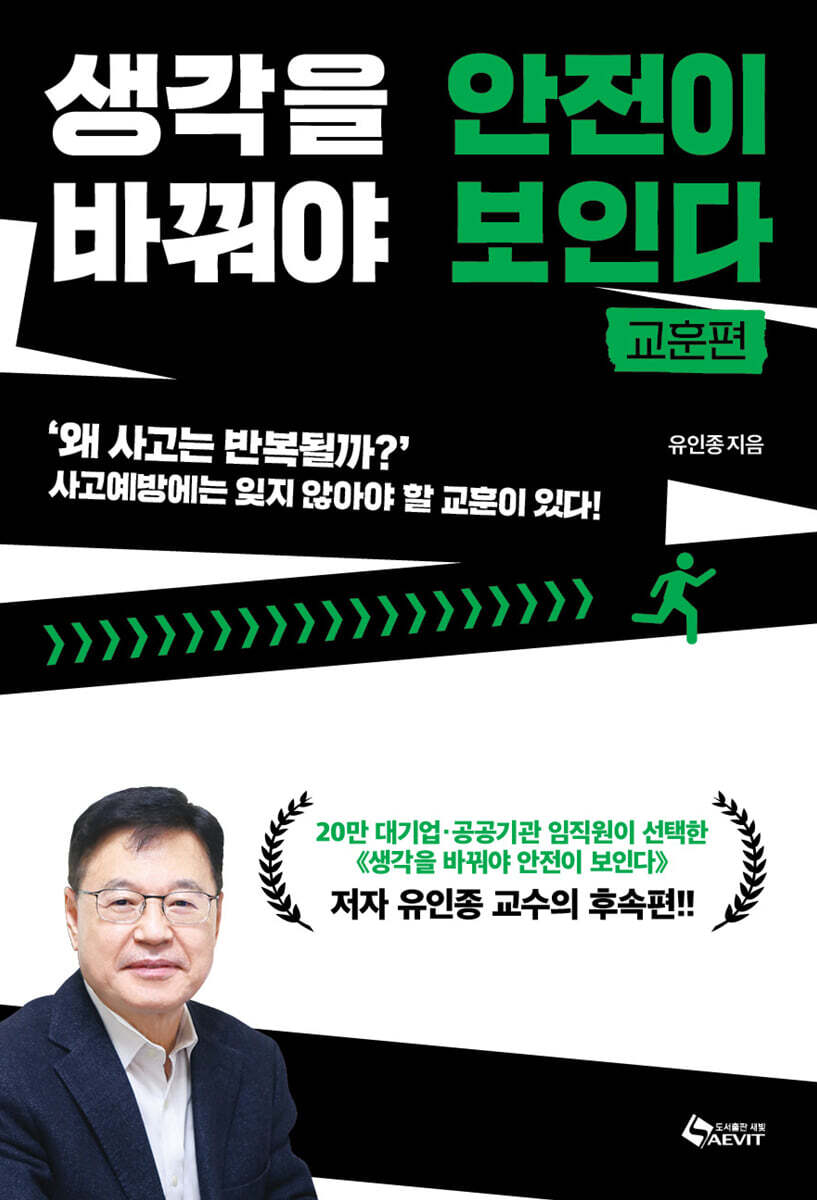
Safety is Seen Through Changing Your Mindset - Lessons
 |
Description
Book Introduction
Why do accidents keep happening?
There is a lesson to be learned in accident prevention.
Safe Korea: A Practical Guide Through History and Reality
It has been five years since the publication of "Change Your Thinking to See Safety," a popular safety book that was loved as a textbook by executives and employees of large corporations and public institutions, as well as students in safety-related departments.
One day, Professor Yoo In-jong, the author, left his 36-year career in the field to move to a university. He suddenly wondered how much safety in Korea would have changed between five years ago and now in 2025.
Although many legal and institutional measures, such as the Serious Disaster Punishment Act, have been put in place and public safety awareness has improved significantly, various social disasters, fire disasters, and serious industrial accidents have not significantly decreased.
So the author investigated various social disasters, fire disasters, and major industrial accidents that occurred in the past and are occurring today.
And the conclusion reached was that accidents identical or similar to those that occurred in the past were occurring again and again.
In other words, most of the large-scale disasters and catastrophes in our society are accidents that have occurred in the past.
Therefore, it also means that most accidents can be prevented if we properly understand and manage the accidents that occurred in the past.
A representative example is the fire at the construction site of the Banyan Tree Resort in Busan (2025), in which six people died.
1. Even if we only look at the accident that occurred on the 25th, it was an accident caused by poor management of fire work that has occurred countless times in the past at the Icheon Logistics Center and other locations.
The reason for writing this book can be summarized in one word: “Let’s learn from accidents that have occurred in our society, learn from them, and prevent them from happening again.”
Furthermore, I hope that we can use the wisdom contained in the idioms, which contain the long experience and wisdom of the sages, as a mirror to apply what we can to safety, thereby helping prevent accidents.
This book is largely divided into two parts.
Part 1 is “The History of Disasters in Our Country.”
One thing the author found regrettable while working in safety at the workplace was that there were no clearly organized records of accidents that occurred in the past.
So, with the thought that the same accidents might be repeating themselves, I wrote about the current status of disaster and safety accidents in our country, the problems, and the countermeasures based on what I saw, heard, and felt through related materials.
And we've compiled the major social disasters and fire disasters that occurred in our country from the 1970s to the 2020s into an easy-to-view chronological list.
In Korea, a major disaster is usually defined as an accident with 10 or more deaths, but this book also includes accidents below that standard, but which are new types of accidents or symbolic accidents that can serve as lessons.
This is because I hope that people working in related fields or in safety-related jobs in the same or similar industries will understand and manage this well.
Part 2 is “Disaster Safety Learning from the Classics.”
Among the classical idioms, those related to disaster safety were broadly classified into preventive management, post-disaster management, and safety leadership, and their meanings and origins were examined.
In addition, we have described content that can be directly applied or provide insight in connection with disaster safety management.
I believe that if this part is utilized well when conducting safety training on site, it will be able to increase the effectiveness of the training.
There are cases where the cause of social disasters or major industrial accidents is structural problems such as costs and interests that permeate society as a whole.
However, accidents that commonly occur in our society, such as ship sinkings, fires caused by welding sparks during hot work, falls at construction or industrial sites, and suffocation in confined spaces, are accidents that can be prevented with just a little bit of attention and effort.
If we start by practicing what we can in our surroundings, most of the accidents that occur in our society can be prevented.
To do that, we must first change our thinking about safety.
There is a lesson to be learned in accident prevention.
Safe Korea: A Practical Guide Through History and Reality
It has been five years since the publication of "Change Your Thinking to See Safety," a popular safety book that was loved as a textbook by executives and employees of large corporations and public institutions, as well as students in safety-related departments.
One day, Professor Yoo In-jong, the author, left his 36-year career in the field to move to a university. He suddenly wondered how much safety in Korea would have changed between five years ago and now in 2025.
Although many legal and institutional measures, such as the Serious Disaster Punishment Act, have been put in place and public safety awareness has improved significantly, various social disasters, fire disasters, and serious industrial accidents have not significantly decreased.
So the author investigated various social disasters, fire disasters, and major industrial accidents that occurred in the past and are occurring today.
And the conclusion reached was that accidents identical or similar to those that occurred in the past were occurring again and again.
In other words, most of the large-scale disasters and catastrophes in our society are accidents that have occurred in the past.
Therefore, it also means that most accidents can be prevented if we properly understand and manage the accidents that occurred in the past.
A representative example is the fire at the construction site of the Banyan Tree Resort in Busan (2025), in which six people died.
1. Even if we only look at the accident that occurred on the 25th, it was an accident caused by poor management of fire work that has occurred countless times in the past at the Icheon Logistics Center and other locations.
The reason for writing this book can be summarized in one word: “Let’s learn from accidents that have occurred in our society, learn from them, and prevent them from happening again.”
Furthermore, I hope that we can use the wisdom contained in the idioms, which contain the long experience and wisdom of the sages, as a mirror to apply what we can to safety, thereby helping prevent accidents.
This book is largely divided into two parts.
Part 1 is “The History of Disasters in Our Country.”
One thing the author found regrettable while working in safety at the workplace was that there were no clearly organized records of accidents that occurred in the past.
So, with the thought that the same accidents might be repeating themselves, I wrote about the current status of disaster and safety accidents in our country, the problems, and the countermeasures based on what I saw, heard, and felt through related materials.
And we've compiled the major social disasters and fire disasters that occurred in our country from the 1970s to the 2020s into an easy-to-view chronological list.
In Korea, a major disaster is usually defined as an accident with 10 or more deaths, but this book also includes accidents below that standard, but which are new types of accidents or symbolic accidents that can serve as lessons.
This is because I hope that people working in related fields or in safety-related jobs in the same or similar industries will understand and manage this well.
Part 2 is “Disaster Safety Learning from the Classics.”
Among the classical idioms, those related to disaster safety were broadly classified into preventive management, post-disaster management, and safety leadership, and their meanings and origins were examined.
In addition, we have described content that can be directly applied or provide insight in connection with disaster safety management.
I believe that if this part is utilized well when conducting safety training on site, it will be able to increase the effectiveness of the training.
There are cases where the cause of social disasters or major industrial accidents is structural problems such as costs and interests that permeate society as a whole.
However, accidents that commonly occur in our society, such as ship sinkings, fires caused by welding sparks during hot work, falls at construction or industrial sites, and suffocation in confined spaces, are accidents that can be prevented with just a little bit of attention and effort.
If we start by practicing what we can in our surroundings, most of the accidents that occur in our society can be prevented.
To do that, we must first change our thinking about safety.
- You can preview some of the book's contents.
Preview
index
Introduction
Part 1: History of Disasters
Chapter 1.
social disaster
Chapter 2.
Chronicle of Social Disasters
1.
The Shadow of Industrialization_1970s
2.
Politics, Society, and Disaster_1980s
3.
Crumbling Infrastructure (Structuring Irresponsibility)_1990s
4.
Safety is still underdeveloped (safety insensitivity)_2000s
5.
Recurring System Failures_2010s
6.
The Age of Complex Disasters_2020s
7.
Implications of Social Disasters by Era
Chapter 3.
Fire disaster
1.
Fire outbreak status
2.
Status of fires related to hot work
3.
Fire prevention during hot work
Chapter 4.
Chronicle of the Fire Disaster
1.
Closed spaces, closed exits_1970s-1980s
1.
Systemic failures and repeated disasters in the 1990s
1.
Disasters that have become a daily occurrence (safety insensitivity)_2000s
1.
A System That Doesn't Work (Limitations of the Manual)_2010s
1.
Sparks of the Complex Risk Era: The 2020s
1.
Commonalities and Lessons from Major Disasters
Part 2: Disaster Safety from the Classics
Chapter 1.
Disaster (accident) prevention management
1.
Why should we study history and classics?
2.
Accident prevention management
3.
Management of Near Miss
4.
Risk Management and Risk Assessment
5.
Risk management in familiar places (people)
6.
Establishment of accident prevention measures
7.
Goal and Process Management
8.
Occupational safety and health education management
9.
Management of risk factors and safety standards
10.
Implementation of safety measures
11.
Roles and attitudes by class
Chapter 2.
Disaster post-management
1.
Continuity of accidents
2.
Wisdom learned from failure
3.
Lessons from similar and similar thinking
4.
Succession and development of safety management
Chapter 3.
Safety Leadership
1.
The character and personality of safe people
2.
Cultivation of safety knowledge and skills
3.
Attitude and conduct in safety management
4.
Managing the minds of those who are safe
Part 1: History of Disasters
Chapter 1.
social disaster
Chapter 2.
Chronicle of Social Disasters
1.
The Shadow of Industrialization_1970s
2.
Politics, Society, and Disaster_1980s
3.
Crumbling Infrastructure (Structuring Irresponsibility)_1990s
4.
Safety is still underdeveloped (safety insensitivity)_2000s
5.
Recurring System Failures_2010s
6.
The Age of Complex Disasters_2020s
7.
Implications of Social Disasters by Era
Chapter 3.
Fire disaster
1.
Fire outbreak status
2.
Status of fires related to hot work
3.
Fire prevention during hot work
Chapter 4.
Chronicle of the Fire Disaster
1.
Closed spaces, closed exits_1970s-1980s
1.
Systemic failures and repeated disasters in the 1990s
1.
Disasters that have become a daily occurrence (safety insensitivity)_2000s
1.
A System That Doesn't Work (Limitations of the Manual)_2010s
1.
Sparks of the Complex Risk Era: The 2020s
1.
Commonalities and Lessons from Major Disasters
Part 2: Disaster Safety from the Classics
Chapter 1.
Disaster (accident) prevention management
1.
Why should we study history and classics?
2.
Accident prevention management
3.
Management of Near Miss
4.
Risk Management and Risk Assessment
5.
Risk management in familiar places (people)
6.
Establishment of accident prevention measures
7.
Goal and Process Management
8.
Occupational safety and health education management
9.
Management of risk factors and safety standards
10.
Implementation of safety measures
11.
Roles and attitudes by class
Chapter 2.
Disaster post-management
1.
Continuity of accidents
2.
Wisdom learned from failure
3.
Lessons from similar and similar thinking
4.
Succession and development of safety management
Chapter 3.
Safety Leadership
1.
The character and personality of safe people
2.
Cultivation of safety knowledge and skills
3.
Attitude and conduct in safety management
4.
Managing the minds of those who are safe
Detailed image
Into the book
Is our society safe today? Safety awareness and systems are gradually improving, and the public's awareness and concern for safety are also growing. However, the fundamental national safety management system and public safety awareness do not seem to have significantly improved.
Even after the Sewol ferry disaster, we continue to experience social disasters such as the Itaewon stampede, the flooding of the Osong underpass in Cheongju, and the runway derailment at Muan Airport in South Jeolla Province. However, the anger, resentment, determination, and resolve felt at the time of the disaster have faded over time, and no fundamental or groundbreaking measures for safety have been taken.
This is because there are many structural problems, such as conflicts of interest and costs surrounding the cause of the disaster.
That is also because there has been no social consensus to accept such burdens for the sake of safety.
Even so, shouldn't we at least make sure that the same accident never happens again?
---From "Part 1, Chapter 1 - Is Our Society Safe?"
The occurrence of social disasters or major accidents can be caused by structural problems such as costs and interests that permeate society as a whole.
However, accidents that commonly occur in our society, such as the sinking of ships, fires caused by welding sparks during hot work, falls at construction or industrial sites, or suffocation in confined spaces, are accidents that can be prevented with just a little bit of attention and effort.
---From "Part 1, Chapter 1 - Why We Must Understand and Examine the History of Disasters"
We have compiled examples of various large-scale disasters that have occurred in our country over the past half century.
From ship sinkings to fires that occur not only in industrial sites but also in hotels and other places throughout society, the recurring social disasters are all too similar, with only the time, place, and victims changing.
---From "Part 1, Chapter 4 - Commonalities and Lessons from Major Disasters"
German psychologist Hermann Ebbinghaus (H.
There is something called Ebbinghaus's "The Forgetting Curve".
The forgetting curve is a graphical representation of the general rate of forgetting over time, showing the extent to which memory loss occurs over time in the absence of additional attempts to retain memory, that is, conscious repetitive learning.
This forgetting curve, which is common to everyone, is why repeated and regular safety training for workers is necessary and has been legislated.
---From "Part 1, Chapter 4 - Commonalities and Lessons from Major Disasters"
The three brothers Bian Quan and An Zi
My older brother knows the patient's serious illness from his facial expression and tone of voice before he even feels pain, so the patient doesn't even know that the doctor has cured him of his serious illness.
Also, although the second brother is not as good as the eldest brother, he is treated at the early stage of the illness, so no one notices that if left untreated, it could have developed into a serious illness that could have taken his life.
I treat seriously ill patients without even realizing it until they are seriously ill, and my reputation is bound to spread far and wide.
---From "Part 2, Chapter 1 - Why We Should Study History and Classics"
居 (to live), 安 (to be comfortable), 思 (to think), 危 (to be in danger)
Even when you live comfortably, don't forget to think about crises and prepare for them.
· If life is comfortable, you should think about danger, and if you think about it and prepare, you can avoid disaster.
· "Fix the roof while the sun is shining"_ John.
President F. Kennedy
· When there is peace and there are no disasters or accidents, we must prepare for various disasters.
---From "Part 2, Chapter 1 - Accident Prevention and Management"
In addition to the original meaning of preventing fire by preparing for the root cause of the problem, the saying “곡돌사신 (曲突徙薪)” is also used to mean that the person who talked about fire prevention measures will not receive a reward, but the person who puts out the fire after it has started will receive a reward.
This is a story that provides many implications for those involved in safety management.
---From "Part 2, Chapter 1 - Accident Prevention and Management"
Must (must) write (to write) 於 (particle 어) 細 (small)
- All great things in the world always begin with small things.
Nothing in the world happens suddenly.
· There are numerous signs in the body that a serious illness is about to occur.
· A major disaster occurs after several minor or major injuries have occurred.
That is, there are signs
---From "Part 2, Chapter 1 - Managing Accidents"
Not (not) Think (think) Go (go) Worry (worry)
- A great disaster (worry, concern) occurs in an unexpected place.
· Unexpected disasters or worries
· Disasters or unfortunate situations that may arise if advance preparation is insufficient
· In difficult situations that are expected, people anticipate in advance and prepare thoroughly, but when they do not anticipate at all,
Because an unexpected crisis occurs when you are unprepared, the damage can be severe.
---From "Part 2, Chapter 1 - Risk Management and Risk Assessment"
Good (to do well) Swim (to swim) A bastard (to drown)
- A good swimmer drowns.
· A good horseman falls off his horse and dies.
· If you overreact and act based on your own talent, you will get into trouble.
· Indirectly expressing that even if you are confident, you should let go of your pride and behave humbly.
---From "Part 2, Chapter 1 - Risk Management in Familiar Places (People)"
狡 (cunning), 兎 (rabbit), 三 (stone), 堀 (cave)
- The clever rabbit digs three holes in which to hide.
· Avoid crises with clever wisdom or prepare in advance before disaster strikes.
· Prepare several measures (countermeasures) in advance for safety.
· Prepare various countermeasures and alternatives in advance to prepare for future crises that may occur at any time.
If you let go, you won't suffer any misfortune
---From "Part 2, Chapter 1 - Establishing Accident Prevention Measures"
To respond (to respond) to do (to do) to use (to use) to refine (to refine)
- When responding to work, you must do it with sincerity (precision, precision).
· When doing something, you must do it with sincerity and not with superficiality or deception.
· When dealing with people or doing work, you must be passionate and sincere to maintain good relationships.
Can achieve results
· Work related to safety related to human life is done with care and attention to detail and precision.
Accident prevention measures must be established.
---From "Part 2, Chapter 1 - Establishing Accident Prevention Measures"
Jipsagwangik (集思廣益) is a meeting management method that is essential when making important meetings or decisions in companies or organizations in modern society.
In terms of safety, a proactive approach is needed to identify the cause of problems and devise countermeasures, listening to and reflecting the opinions of various stakeholders.
The safety field is one that requires more than any other field to listen to the opinions and diverse voices of people from all walks of life.
---From "Part 2, Chapter 1 - Establishing Accident Prevention Measures"
I think the safety field is a representative field that does not require a strategy of blooming flowers on a tree.
Regardless of what anyone says, we must focus solely on zero accidents and establishing a culture of safety. To achieve this goal, we must research and find the most effective methods that maximize output relative to input.
---From "Part 2, Chapter 1 - The Importance of Safety Objective Management"
The saying, “Seeing with your eyes is better than hearing with your ears” (耳聞不如目見), which we hear a lot and use frequently in our daily lives, has the same meaning as “Seeing with your eyes is better than hearing with your ears” (百聞不如一見).
That is to say, 'hearing something a hundred times is not as good as seeing it once.'
This idiom is especially necessary for managers, supervisors, and safety managers who are responsible for the site, as they can go to the site and see for themselves and find realistic alternatives that fit the situation.
---From "Part 2, Chapter 1 - Safety and Health Education Management"
The saying, “Winning first and seeking victory” is an old saying that clearly shows what the principles of safety in industrial settings should be.
Ensure safety first, then start work.
When working, isn't it perfectly normal to prioritize safety before embarking on the task? News of major disasters, heard every so often, and the words of the ancients' tales resonate deeply with me.
The old saying goes! This is truly a clear secret to victory.
---From “Part 2, Chapter 1 - Risk Factors and Safety Management Standards”
Disasters and misfortunes do not come one at a time.
That means bad things always come all at once.
It is similar to Murphy's Law, a modern term that refers to a series of bad luck, which means that misfortunes and disasters do not end in one single event but tend to overlap.
---From "Part 2, Chapter 2 - Continuity of Thought"
The saying "repairing the pen after losing the sheep" (亡羊補牢) means to repair the pen after losing the sheep, meaning to try to recover from a mistake only after it has been made.
The difference between this and the post-mortem prescription is that the Mangyangbore has a strong meaning of regret and reflection on not having prepared in advance.
---From "Part 2, Chapter 2 - Wisdom Learned from Failure"
The saying "Mabujakchim" (馬斧作針) teaches us the importance of consistent effort and perseverance, and that even if something seems impossible, if we do not give up and continue to put in effort, we will definitely achieve it.
No matter how difficult safety management is, if you constantly research and work hard, you can achieve your desired goals.
Even after the Sewol ferry disaster, we continue to experience social disasters such as the Itaewon stampede, the flooding of the Osong underpass in Cheongju, and the runway derailment at Muan Airport in South Jeolla Province. However, the anger, resentment, determination, and resolve felt at the time of the disaster have faded over time, and no fundamental or groundbreaking measures for safety have been taken.
This is because there are many structural problems, such as conflicts of interest and costs surrounding the cause of the disaster.
That is also because there has been no social consensus to accept such burdens for the sake of safety.
Even so, shouldn't we at least make sure that the same accident never happens again?
---From "Part 1, Chapter 1 - Is Our Society Safe?"
The occurrence of social disasters or major accidents can be caused by structural problems such as costs and interests that permeate society as a whole.
However, accidents that commonly occur in our society, such as the sinking of ships, fires caused by welding sparks during hot work, falls at construction or industrial sites, or suffocation in confined spaces, are accidents that can be prevented with just a little bit of attention and effort.
---From "Part 1, Chapter 1 - Why We Must Understand and Examine the History of Disasters"
We have compiled examples of various large-scale disasters that have occurred in our country over the past half century.
From ship sinkings to fires that occur not only in industrial sites but also in hotels and other places throughout society, the recurring social disasters are all too similar, with only the time, place, and victims changing.
---From "Part 1, Chapter 4 - Commonalities and Lessons from Major Disasters"
German psychologist Hermann Ebbinghaus (H.
There is something called Ebbinghaus's "The Forgetting Curve".
The forgetting curve is a graphical representation of the general rate of forgetting over time, showing the extent to which memory loss occurs over time in the absence of additional attempts to retain memory, that is, conscious repetitive learning.
This forgetting curve, which is common to everyone, is why repeated and regular safety training for workers is necessary and has been legislated.
---From "Part 1, Chapter 4 - Commonalities and Lessons from Major Disasters"
The three brothers Bian Quan and An Zi
My older brother knows the patient's serious illness from his facial expression and tone of voice before he even feels pain, so the patient doesn't even know that the doctor has cured him of his serious illness.
Also, although the second brother is not as good as the eldest brother, he is treated at the early stage of the illness, so no one notices that if left untreated, it could have developed into a serious illness that could have taken his life.
I treat seriously ill patients without even realizing it until they are seriously ill, and my reputation is bound to spread far and wide.
---From "Part 2, Chapter 1 - Why We Should Study History and Classics"
居 (to live), 安 (to be comfortable), 思 (to think), 危 (to be in danger)
Even when you live comfortably, don't forget to think about crises and prepare for them.
· If life is comfortable, you should think about danger, and if you think about it and prepare, you can avoid disaster.
· "Fix the roof while the sun is shining"_ John.
President F. Kennedy
· When there is peace and there are no disasters or accidents, we must prepare for various disasters.
---From "Part 2, Chapter 1 - Accident Prevention and Management"
In addition to the original meaning of preventing fire by preparing for the root cause of the problem, the saying “곡돌사신 (曲突徙薪)” is also used to mean that the person who talked about fire prevention measures will not receive a reward, but the person who puts out the fire after it has started will receive a reward.
This is a story that provides many implications for those involved in safety management.
---From "Part 2, Chapter 1 - Accident Prevention and Management"
Must (must) write (to write) 於 (particle 어) 細 (small)
- All great things in the world always begin with small things.
Nothing in the world happens suddenly.
· There are numerous signs in the body that a serious illness is about to occur.
· A major disaster occurs after several minor or major injuries have occurred.
That is, there are signs
---From "Part 2, Chapter 1 - Managing Accidents"
Not (not) Think (think) Go (go) Worry (worry)
- A great disaster (worry, concern) occurs in an unexpected place.
· Unexpected disasters or worries
· Disasters or unfortunate situations that may arise if advance preparation is insufficient
· In difficult situations that are expected, people anticipate in advance and prepare thoroughly, but when they do not anticipate at all,
Because an unexpected crisis occurs when you are unprepared, the damage can be severe.
---From "Part 2, Chapter 1 - Risk Management and Risk Assessment"
Good (to do well) Swim (to swim) A bastard (to drown)
- A good swimmer drowns.
· A good horseman falls off his horse and dies.
· If you overreact and act based on your own talent, you will get into trouble.
· Indirectly expressing that even if you are confident, you should let go of your pride and behave humbly.
---From "Part 2, Chapter 1 - Risk Management in Familiar Places (People)"
狡 (cunning), 兎 (rabbit), 三 (stone), 堀 (cave)
- The clever rabbit digs three holes in which to hide.
· Avoid crises with clever wisdom or prepare in advance before disaster strikes.
· Prepare several measures (countermeasures) in advance for safety.
· Prepare various countermeasures and alternatives in advance to prepare for future crises that may occur at any time.
If you let go, you won't suffer any misfortune
---From "Part 2, Chapter 1 - Establishing Accident Prevention Measures"
To respond (to respond) to do (to do) to use (to use) to refine (to refine)
- When responding to work, you must do it with sincerity (precision, precision).
· When doing something, you must do it with sincerity and not with superficiality or deception.
· When dealing with people or doing work, you must be passionate and sincere to maintain good relationships.
Can achieve results
· Work related to safety related to human life is done with care and attention to detail and precision.
Accident prevention measures must be established.
---From "Part 2, Chapter 1 - Establishing Accident Prevention Measures"
Jipsagwangik (集思廣益) is a meeting management method that is essential when making important meetings or decisions in companies or organizations in modern society.
In terms of safety, a proactive approach is needed to identify the cause of problems and devise countermeasures, listening to and reflecting the opinions of various stakeholders.
The safety field is one that requires more than any other field to listen to the opinions and diverse voices of people from all walks of life.
---From "Part 2, Chapter 1 - Establishing Accident Prevention Measures"
I think the safety field is a representative field that does not require a strategy of blooming flowers on a tree.
Regardless of what anyone says, we must focus solely on zero accidents and establishing a culture of safety. To achieve this goal, we must research and find the most effective methods that maximize output relative to input.
---From "Part 2, Chapter 1 - The Importance of Safety Objective Management"
The saying, “Seeing with your eyes is better than hearing with your ears” (耳聞不如目見), which we hear a lot and use frequently in our daily lives, has the same meaning as “Seeing with your eyes is better than hearing with your ears” (百聞不如一見).
That is to say, 'hearing something a hundred times is not as good as seeing it once.'
This idiom is especially necessary for managers, supervisors, and safety managers who are responsible for the site, as they can go to the site and see for themselves and find realistic alternatives that fit the situation.
---From "Part 2, Chapter 1 - Safety and Health Education Management"
The saying, “Winning first and seeking victory” is an old saying that clearly shows what the principles of safety in industrial settings should be.
Ensure safety first, then start work.
When working, isn't it perfectly normal to prioritize safety before embarking on the task? News of major disasters, heard every so often, and the words of the ancients' tales resonate deeply with me.
The old saying goes! This is truly a clear secret to victory.
---From “Part 2, Chapter 1 - Risk Factors and Safety Management Standards”
Disasters and misfortunes do not come one at a time.
That means bad things always come all at once.
It is similar to Murphy's Law, a modern term that refers to a series of bad luck, which means that misfortunes and disasters do not end in one single event but tend to overlap.
---From "Part 2, Chapter 2 - Continuity of Thought"
The saying "repairing the pen after losing the sheep" (亡羊補牢) means to repair the pen after losing the sheep, meaning to try to recover from a mistake only after it has been made.
The difference between this and the post-mortem prescription is that the Mangyangbore has a strong meaning of regret and reflection on not having prepared in advance.
---From "Part 2, Chapter 2 - Wisdom Learned from Failure"
The saying "Mabujakchim" (馬斧作針) teaches us the importance of consistent effort and perseverance, and that even if something seems impossible, if we do not give up and continue to put in effort, we will definitely achieve it.
No matter how difficult safety management is, if you constantly research and work hard, you can achieve your desired goals.
---From "Part 2, Chapter 2 - Cultivating Safety Knowledge and Technology"
Publisher's Review
Korea's first doctorate in disaster safety and Samsung Group's first safety manager-turned-executive
Pay attention to Professor Yoo In-jong's message.
Since the new administration took office, President Lee Jae-myung has consistently delivered strong messages regarding industrial accident prevention measures during corporate visits and Cabinet meetings. This demonstrates the president's strong commitment to shedding the stigma of having the highest industrial accident fatality rate among OECD countries, and to emphasizing the role of the government and businesses in ensuring workers' "right not to die on the job."
In this situation, five years have passed since the author, Professor Yoo In-jong, published “Safety is Visible Only When You Change Your Mindset,” which summarizes his thoughts and feelings about the efforts he made to prevent accidents during his 33 years of working at Samsung and what our companies and society should do to prevent accidents.
The author left Samsung and joined Coupang, which had been embroiled in safety issues, and established and stabilized an accident prevention management system with the mindset of starting over with safety in a new culture and environment.
My experience at Coupang also provided me with the opportunity to directly and indirectly learn about the current state and reality of safety management in Korea's industrial settings, as well as the awareness and level of managers, supervisors, and safety managers.
It was a valuable experience that opened my eyes to safety in a way I would not have known if I had only worked at Samsung.
The author majored in safety engineering and began his career as a safety manager. He has worked for Samsung Group and Coupang for 36 years, putting workplaces and companies struggling with safety issues back on solid ground in diverse industries, including heavy chemicals, construction, service, and logistics.
In recognition of his achievements, he was awarded the “Proud Samsung Person of the Year” by Samsung Group and the Industrial Service Medal for Contribution to Industrial Accident Prevention by the government. He is the best safety manager in Korea.
This book organizes the occurrence and causes of accidents that serve as lessons learned chronologically and presents lessons and implications to help prevent the recurrence of social disasters that are identical to those that occurred in the past in our society.
It also interprets safety-related idioms and suggests things to do and methods to prevent accidents.
· Safety will never be improved by mere slogans, slogans, rhetoric, or fancy slogans.
So, we must not forget that safety has conditions and that safety is guaranteed only when those conditions are met.
· Safety doesn't come for free.
You can only get it if you pay a price.
· The reason we learn about past events and history is because we can understand present problems and gain wisdom to prepare for the future through past events.
· We all live in a reality where the loss of precious lives and property due to various accidents and disasters is truly enormous, and we cannot guarantee that we and our beloved families will not be affected.
· The recurrence of accidents means that our society and businesses have not yet learned enough lessons and properly found solutions to prevent accidents through repeated accidents.
· Accidents can happen at any time.
So why don't similar accidents recur in developed countries? It's because, when it comes to disasters and safety incidents, they analyze the causes from multiple angles, establish fundamental improvement measures, and tenaciously persist until improvements are achieved.
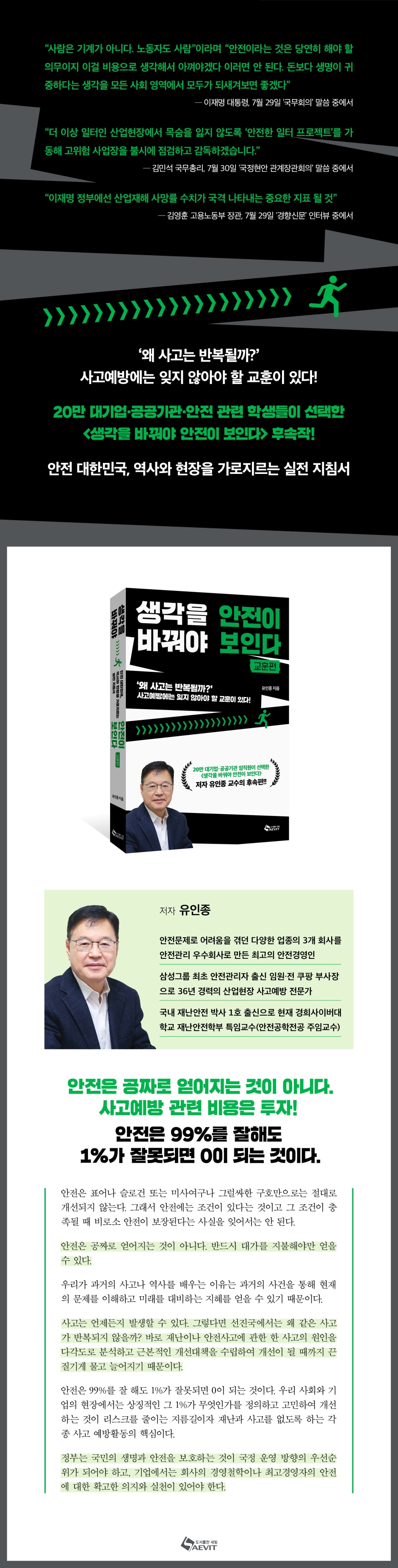
· Safety is something that even if you do 99% well, if 1% goes wrong, it becomes 0.
In our society and business, defining, reflecting on, and improving that symbolic 1% is a shortcut to reducing risk and a key to various accident prevention activities that prevent disasters and accidents.
· The government must prioritize protecting the lives and safety of its citizens, and companies must have a firm commitment to safety and a strong commitment to safety from their management philosophy and CEO.
Pay attention to Professor Yoo In-jong's message.
Since the new administration took office, President Lee Jae-myung has consistently delivered strong messages regarding industrial accident prevention measures during corporate visits and Cabinet meetings. This demonstrates the president's strong commitment to shedding the stigma of having the highest industrial accident fatality rate among OECD countries, and to emphasizing the role of the government and businesses in ensuring workers' "right not to die on the job."
In this situation, five years have passed since the author, Professor Yoo In-jong, published “Safety is Visible Only When You Change Your Mindset,” which summarizes his thoughts and feelings about the efforts he made to prevent accidents during his 33 years of working at Samsung and what our companies and society should do to prevent accidents.
The author left Samsung and joined Coupang, which had been embroiled in safety issues, and established and stabilized an accident prevention management system with the mindset of starting over with safety in a new culture and environment.
My experience at Coupang also provided me with the opportunity to directly and indirectly learn about the current state and reality of safety management in Korea's industrial settings, as well as the awareness and level of managers, supervisors, and safety managers.
It was a valuable experience that opened my eyes to safety in a way I would not have known if I had only worked at Samsung.
The author majored in safety engineering and began his career as a safety manager. He has worked for Samsung Group and Coupang for 36 years, putting workplaces and companies struggling with safety issues back on solid ground in diverse industries, including heavy chemicals, construction, service, and logistics.
In recognition of his achievements, he was awarded the “Proud Samsung Person of the Year” by Samsung Group and the Industrial Service Medal for Contribution to Industrial Accident Prevention by the government. He is the best safety manager in Korea.
This book organizes the occurrence and causes of accidents that serve as lessons learned chronologically and presents lessons and implications to help prevent the recurrence of social disasters that are identical to those that occurred in the past in our society.
It also interprets safety-related idioms and suggests things to do and methods to prevent accidents.
· Safety will never be improved by mere slogans, slogans, rhetoric, or fancy slogans.
So, we must not forget that safety has conditions and that safety is guaranteed only when those conditions are met.
· Safety doesn't come for free.
You can only get it if you pay a price.
· The reason we learn about past events and history is because we can understand present problems and gain wisdom to prepare for the future through past events.
· We all live in a reality where the loss of precious lives and property due to various accidents and disasters is truly enormous, and we cannot guarantee that we and our beloved families will not be affected.
· The recurrence of accidents means that our society and businesses have not yet learned enough lessons and properly found solutions to prevent accidents through repeated accidents.
· Accidents can happen at any time.
So why don't similar accidents recur in developed countries? It's because, when it comes to disasters and safety incidents, they analyze the causes from multiple angles, establish fundamental improvement measures, and tenaciously persist until improvements are achieved.
· Safety is something that even if you do 99% well, if 1% goes wrong, it becomes 0.
In our society and business, defining, reflecting on, and improving that symbolic 1% is a shortcut to reducing risk and a key to various accident prevention activities that prevent disasters and accidents.
· The government must prioritize protecting the lives and safety of its citizens, and companies must have a firm commitment to safety and a strong commitment to safety from their management philosophy and CEO.
GOODS SPECIFICS
- Date of issue: August 15, 2025
- Page count, weight, size: 372 pages | 528g | 152*220*20mm
- ISBN13: 9791194885146
- ISBN10: 1194885144
You may also like
카테고리
korean


korean

![GQ KOREA Mark (Monthly): December [2025]](http://librairie.coreenne.fr/cdn/shop/files/8ef265dbbfbf186523ed75ba7319009d.jpg?v=1765340328&width=3840)


