

What a wise teacher says
 |
Description
Book Introduction
Bringing positive change to children without hurting them
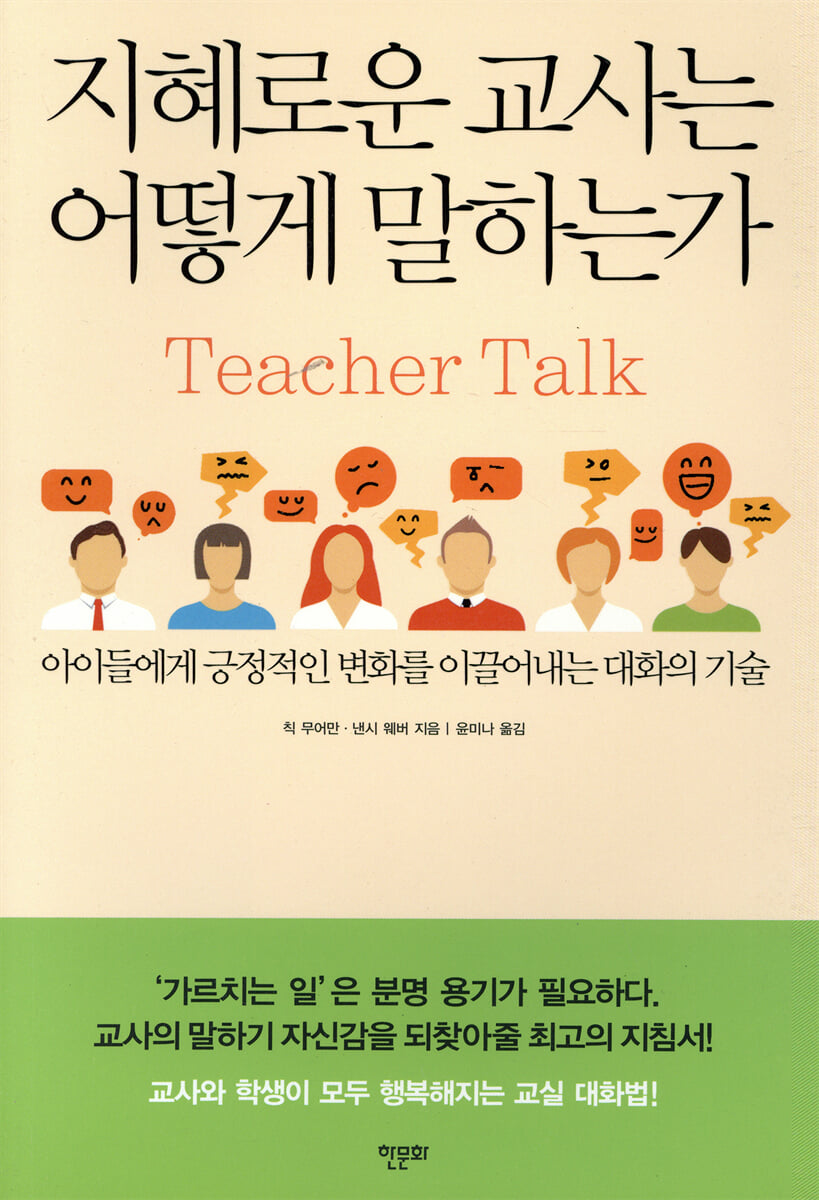
67 Classroom Conversation Tips from a Wise Teacher
A classroom is a place where conversations between one teacher and many students continue continuously.
But if you look closely, 80% of classroom speech is made up of the teacher's words, and most of what the teacher says is one-sided explanations or control, demands, and commands such as "Do ~!" and "Don't ~!" rather than conversation.
However, a single word from a teacher can leave a lifelong scar on some children, while it can be a lifelong encouragement to others.
"What a Wise Teacher Speaks" first asks whether what teachers say to children every day is truly producing the desired results.
And it provides specific communication methods that can help students communicate more effectively and peacefully in the classroom.
It presents 67 conversational expressions that teachers use so often that they have become patterns, and explains in detail the positive and negative effects these expressions have on students.
In case of negative expressions, a variety of alternative expressions are provided.
Furthermore, this book honestly shows how not only the outward expressions but also the unspoken messages hidden in words (intentions that even the speaking teacher is unaware of) affect students, prompting teachers to reflect on their language habits and consider their communication methods.
It contains not only positive teacher conversation methods such as words that increase self-esteem and build inner strength, words that teach choice and responsibility, words that develop the ability to cope with situations and find solutions, words that teach how to express emotions, and words that foster cooperation and bonds, but also conversation methods that teachers should not use in the classroom, such as words that increase conflict with children and words that make children feel helpless.
67 Classroom Conversation Tips from a Wise Teacher
A classroom is a place where conversations between one teacher and many students continue continuously.
But if you look closely, 80% of classroom speech is made up of the teacher's words, and most of what the teacher says is one-sided explanations or control, demands, and commands such as "Do ~!" and "Don't ~!" rather than conversation.
However, a single word from a teacher can leave a lifelong scar on some children, while it can be a lifelong encouragement to others.
"What a Wise Teacher Speaks" first asks whether what teachers say to children every day is truly producing the desired results.
And it provides specific communication methods that can help students communicate more effectively and peacefully in the classroom.
It presents 67 conversational expressions that teachers use so often that they have become patterns, and explains in detail the positive and negative effects these expressions have on students.
In case of negative expressions, a variety of alternative expressions are provided.
Furthermore, this book honestly shows how not only the outward expressions but also the unspoken messages hidden in words (intentions that even the speaking teacher is unaware of) affect students, prompting teachers to reflect on their language habits and consider their communication methods.
It contains not only positive teacher conversation methods such as words that increase self-esteem and build inner strength, words that teach choice and responsibility, words that develop the ability to cope with situations and find solutions, words that teach how to express emotions, and words that foster cooperation and bonds, but also conversation methods that teachers should not use in the classroom, such as words that increase conflict with children and words that make children feel helpless.
- You can preview some of the book's contents.
Preview
index
A Word of Recommendation / A Wise Teacher Thinks About How to Convey Sincerity
Before reading this book / A teacher's language habits are connected to the lives students will create.
Chapter 1: Words of Praise and Rebuke
Look at the picture Andy drew!
The teacher really likes the way Linda sits.
You always ~! You never ~!
Your teacher is proud of you.
Well done!
You wrote with the lines aligned neatly!
Thank you for your hard work!
This is so pathetic!
Chapter 2: Words that boost self-esteem and cultivate inner strength
What other answers are there?
Listen to your inner voice
First, answer in your mind!
Thank you for your courage!
You are so persistent!
You're lucky!
What are you going to do?
Act as if you are ~
Circle your two favorites!
Let's stand in one line, men and women!
Step by step
Chapter 3: Words that teach how to express emotions
I'm really sick of your behavior
I don't like what you just said.
If you were angry, could you say it differently?
What was it you really wanted to say?
I'm running out of patience!
I apologize!
I know how you feel
Chapter 4: Words that Increase Conflict with Children
You're late!
What on earth were you doing when I was explaining?
Stop talking and sit down!
Stop whining!
If I were you, I would ~
Why did you do that?
Did you win?
You guys don't have time to rest!
Who told you to say that to your teacher?
Put away the baseball cards! It's math time.
Chapter 5: Words that teach choice and responsibility
You chose to ~
You decide
Now, will you make a decision?
Would you like to make another choice?
Thank you for sharing your thoughts.
But that's not an option
That's not a good excuse!
Chapter 6: Words that develop the ability to cope with situations and find solutions
Take a good look!
Next time, I hope you ~!
Would you like to talk more?
Yeah, it looks like we have a problem!
I believe you can do it!
Every problem has an answer
Should the teacher help you or give you more time?
Can't we look at this problem differently?
Different people have different needs.
Let's draw a picture in our heads
Chapter 7 Words that Make Children Helpless
Hurry up!
This is going to be hard
There you go again!
Who did that?
This is easy
Please pay for the night!
Stop thinking useless thoughts!
Always do your best!
Chapter 8: Words that Build Bonds
I wish you could help me solve this problem!
How can you both get what you want?
Tell me whose side you're on!
In our class...
Before asking the teacher, would you like to ask three people?
Someone in your group will know
Is this a question that represents Joe?
You have to touch your friend affectionately
In closing / Children are sensitive not only to their teachers' words but also to their tone, intonation, and gestures.
References
Search
Before reading this book / A teacher's language habits are connected to the lives students will create.
Chapter 1: Words of Praise and Rebuke
Look at the picture Andy drew!
The teacher really likes the way Linda sits.
You always ~! You never ~!
Your teacher is proud of you.
Well done!
You wrote with the lines aligned neatly!
Thank you for your hard work!
This is so pathetic!
Chapter 2: Words that boost self-esteem and cultivate inner strength
What other answers are there?
Listen to your inner voice
First, answer in your mind!
Thank you for your courage!
You are so persistent!
You're lucky!
What are you going to do?
Act as if you are ~
Circle your two favorites!
Let's stand in one line, men and women!
Step by step
Chapter 3: Words that teach how to express emotions
I'm really sick of your behavior
I don't like what you just said.
If you were angry, could you say it differently?
What was it you really wanted to say?
I'm running out of patience!
I apologize!
I know how you feel
Chapter 4: Words that Increase Conflict with Children
You're late!
What on earth were you doing when I was explaining?
Stop talking and sit down!
Stop whining!
If I were you, I would ~
Why did you do that?
Did you win?
You guys don't have time to rest!
Who told you to say that to your teacher?
Put away the baseball cards! It's math time.
Chapter 5: Words that teach choice and responsibility
You chose to ~
You decide
Now, will you make a decision?
Would you like to make another choice?
Thank you for sharing your thoughts.
But that's not an option
That's not a good excuse!
Chapter 6: Words that develop the ability to cope with situations and find solutions
Take a good look!
Next time, I hope you ~!
Would you like to talk more?
Yeah, it looks like we have a problem!
I believe you can do it!
Every problem has an answer
Should the teacher help you or give you more time?
Can't we look at this problem differently?
Different people have different needs.
Let's draw a picture in our heads
Chapter 7 Words that Make Children Helpless
Hurry up!
This is going to be hard
There you go again!
Who did that?
This is easy
Please pay for the night!
Stop thinking useless thoughts!
Always do your best!
Chapter 8: Words that Build Bonds
I wish you could help me solve this problem!
How can you both get what you want?
Tell me whose side you're on!
In our class...
Before asking the teacher, would you like to ask three people?
Someone in your group will know
Is this a question that represents Joe?
You have to touch your friend affectionately
In closing / Children are sensitive not only to their teachers' words but also to their tone, intonation, and gestures.
References
Search
Into the book
The phrase "You did a great job!" is a prime example of evaluative praise.... Children who are accustomed to evaluative praise become anxious and nervous if they do not hear continuous praise.
These kids don't know how to praise themselves.
Overuse of evaluative praise makes children more obsessed with proving their abilities to others.
And if no one around you acknowledges your achievements, you cannot enjoy them.
Because they rely on others to prove their own importance and abilities, they fail to develop an adequate internal standard of self-worth. --- "Chapter 1: Words of Praise and Words of Criticism"
Lifelong beliefs formed in childhood are likely to last a lifetime.
But teachers have a powerful influence that can change that belief.
Because lifelong beliefs are not yet deeply rooted in children's consciousness during childhood and adolescence, a wise teacher can change them through dialogue with students. --- "Chapter 2: Words that Raise Self-Esteem and Develop Inner Strength"
"I'm sorry, I apologize!" is a phrase that teachers often use with their students.
The teacher may have good intentions when he says these words, but the real message behind them is this:
"Forget what you really wanted to say.
Even if you're angry, hold it in and don't get upset.
"Suppress your true feelings and act like you're not!" It is not advisable for teachers to force angry students to apologize.
Because it teaches children to deny their emotions. --- "Chapter 3: Words that teach how to express emotions"
Next time you ask, "Why did you do that?", consider your intentions first.
Is it a question or an accusation? Is it a means to find a solution, or a means to blame the child? Is it to help the child, or to hold them accountable? And does the "why" really matter? --- "Chapter 4: Words That Increase Conflict with Children"
When students disrupt class or behave inappropriately, teachers try to change their behavior by using orders and instructions.
Such an approach is far from respecting or caring for children.
Rather than changing children's behavior, it is more likely to cause them to resist the teacher's words.
But asking, "Would you make a different choice?" shares some of the power with the student, allowing them to take responsibility for their own actions. --- "Chapter 5: Words That Teach Choice and Responsibility"
The teacher said in words and actions, "Every problem has a solution.
When we clearly communicate the belief that "it's possible," we can encourage students to move beyond feelings of helplessness and build confidence in their abilities.
Let's teach them to accept the obstacles they encounter in life as opportunities for learning and growth.
Instead of complaining or shifting blame whenever students encounter a problem, teachers should guide students to face the problem head-on and work towards solving it. --- "Chapter 6: Words to Develop the Ability to Cope with Situations and Find Solutions"
The teacher asks, "Who did it?" to get information.
But this conversation method avoids the core of the problem.
Focus on who is the problem rather than what is the problem.
It labels someone as a loser, labels them as a "bad kid," and focuses on blaming someone rather than finding solutions. --- Chapter 7: Words That Make Children Helpless
Children in conflict are usually focused on 'winning'.
Because their experience has taught them that compromising means giving up something they want.
The "How can we both get what we want?" conversation helps children see the essence of the problem in a new light, not in terms of winning or losing, but in terms of what they want and what they need.
A new possibility opens up that didn't seem to exist until you heard it.
This expression encourages cooperation so that everyone wins.
These kids don't know how to praise themselves.
Overuse of evaluative praise makes children more obsessed with proving their abilities to others.
And if no one around you acknowledges your achievements, you cannot enjoy them.
Because they rely on others to prove their own importance and abilities, they fail to develop an adequate internal standard of self-worth. --- "Chapter 1: Words of Praise and Words of Criticism"
Lifelong beliefs formed in childhood are likely to last a lifetime.
But teachers have a powerful influence that can change that belief.
Because lifelong beliefs are not yet deeply rooted in children's consciousness during childhood and adolescence, a wise teacher can change them through dialogue with students. --- "Chapter 2: Words that Raise Self-Esteem and Develop Inner Strength"
"I'm sorry, I apologize!" is a phrase that teachers often use with their students.
The teacher may have good intentions when he says these words, but the real message behind them is this:
"Forget what you really wanted to say.
Even if you're angry, hold it in and don't get upset.
"Suppress your true feelings and act like you're not!" It is not advisable for teachers to force angry students to apologize.
Because it teaches children to deny their emotions. --- "Chapter 3: Words that teach how to express emotions"
Next time you ask, "Why did you do that?", consider your intentions first.
Is it a question or an accusation? Is it a means to find a solution, or a means to blame the child? Is it to help the child, or to hold them accountable? And does the "why" really matter? --- "Chapter 4: Words That Increase Conflict with Children"
When students disrupt class or behave inappropriately, teachers try to change their behavior by using orders and instructions.
Such an approach is far from respecting or caring for children.
Rather than changing children's behavior, it is more likely to cause them to resist the teacher's words.
But asking, "Would you make a different choice?" shares some of the power with the student, allowing them to take responsibility for their own actions. --- "Chapter 5: Words That Teach Choice and Responsibility"
The teacher said in words and actions, "Every problem has a solution.
When we clearly communicate the belief that "it's possible," we can encourage students to move beyond feelings of helplessness and build confidence in their abilities.
Let's teach them to accept the obstacles they encounter in life as opportunities for learning and growth.
Instead of complaining or shifting blame whenever students encounter a problem, teachers should guide students to face the problem head-on and work towards solving it. --- "Chapter 6: Words to Develop the Ability to Cope with Situations and Find Solutions"
The teacher asks, "Who did it?" to get information.
But this conversation method avoids the core of the problem.
Focus on who is the problem rather than what is the problem.
It labels someone as a loser, labels them as a "bad kid," and focuses on blaming someone rather than finding solutions. --- Chapter 7: Words That Make Children Helpless
Children in conflict are usually focused on 'winning'.
Because their experience has taught them that compromising means giving up something they want.
The "How can we both get what we want?" conversation helps children see the essence of the problem in a new light, not in terms of winning or losing, but in terms of what they want and what they need.
A new possibility opens up that didn't seem to exist until you heard it.
This expression encourages cooperation so that everyone wins.
--- "Chapter 8: Words That Build Bonds"
Publisher's Review
How to do this without hurting the children
Can I properly convey the teacher's feelings?
I clearly started the conversation with concern and care for my child, but before I knew it, I was angry and scolding them, contrary to my intentions! I thought I should convey educational values well, but when I actually stand in front of them, it's all lectures or orders! I scolded them to reflect on their mistakes, but instead of changing their behavior, their resistance only grew! I don't know where I went wrong, but the more I talk to my child, the more I go astray! I see myself reacting reflexively to most of their words and actions! Now, no matter what I say, my children neither resist nor agree! Teaching is becoming increasingly difficult! Every teacher has probably found themselves in this frustrating situation.
Is it only possible in dramas to imagine teachers quietly discussing their problems with their children, encouraging them to solve their own problems? Leading the conversation leisurely, without impatience or pressure, without being swayed by their reactions? Waiting patiently and calmly, trusting their children. How can a teacher truly convey their feelings to children without hurting them?
Conversational skills that will restore teachers' speaking confidence!
The classroom is not a place of silence.
It is a place where conversations between one teacher and many students continue continuously.
But if you look closely, 80% of classroom speech is made up of the teacher's words, and most of what the teacher says is one-sided explanations or control, demands, and commands such as "Do ~!" and "Don't ~!" rather than conversation.
However, a single word from a teacher can leave a lifelong scar on some children, while it can be a lifelong encouragement to others.
In order to properly use the different words 'ah' and 'eo', it is necessary to have the skill to handle them appropriately, but most Koreans are not good at properly expressing their feelings or thoughts through words.
Teachers, too, are often not taught how to communicate with students in everyday classroom settings, let alone through conversation as a specialized counseling technique.
"What a Wise Teacher Speaks" first asks whether what teachers say to children every day is truly producing the desired results.
And it provides specific communication methods that can help students communicate more effectively and peacefully in the classroom.
The author, Chick Moorman, is an educational researcher who has experienced firsthand how small differences in speech can have a huge impact on children's lives while teaching children for 40 years. He has shared his experiences with parents and teachers through numerous seminars and workshops and has included them in his books.
If 『Conversation Skills for Smart Parents』 is for parents, then this book 『How Wise Teachers Speak』 is for teachers.
Bringing positive change to children without hurting them
67 Classroom Conversation Tips from a Wise Teacher
While reading the book, readers can encounter real-life classroom situations that they encounter every day in the educational field, and learn appropriate conversation techniques for those situations.
The book presents 67 conversational techniques that teachers frequently use, and the book explains in detail the positive and negative impacts these expressions have on students.
In case of negative expressions, a variety of alternative expressions are provided.
Furthermore, this book honestly shows how not only the outward expressions but also the unspoken messages hidden in words (intentions that even the speaking teacher is unaware of) affect students, prompting teachers to reflect on their language habits and consider their communication methods.
It contains not only positive teacher conversation methods such as words that increase self-esteem and build inner strength, words that teach choice and responsibility, words that develop the ability to cope with situations and find solutions, words that teach how to express emotions, and words that foster cooperation and bonds, but also conversation methods that teachers should not use in the classroom, such as words that increase conflict with children and words that make children feel helpless.
In particular, he points out that among the well-intentioned words that are often said to praise or encourage children, such as “Well done,” “I’m proud of you,” and “You should always do your best,” there are some that can actually be ‘toxic.’
There are three types of praise: evaluation, explanation, and recognition. This shows specifically that some types of praise are helpful to children, while others can actually be hurtful.
He points out that the reason why everyday expressions that teachers habitually use can leave fatal scars on children is because teachers do not fully understand the children's developmental stages.
While reading this book, readers will realize that in order to change children for the better, teachers themselves must change first, that teachers' unilateral judgment of the situation and their awakening methods do not lead to voluntary behavioral improvement, and that teachers should be mediators who adjust situations and help students understand each other, rather than judges who judge right and wrong.
What is clear is that teachers need more courage and patience than ever before to bring about positive change without hurting children.
"How Wise Teachers Speak" will be the ultimate guide to ending power struggles with students, breaking free from ineffective, habitual conversations, and creating a classroom where both teachers and students are happy.
Can I properly convey the teacher's feelings?
I clearly started the conversation with concern and care for my child, but before I knew it, I was angry and scolding them, contrary to my intentions! I thought I should convey educational values well, but when I actually stand in front of them, it's all lectures or orders! I scolded them to reflect on their mistakes, but instead of changing their behavior, their resistance only grew! I don't know where I went wrong, but the more I talk to my child, the more I go astray! I see myself reacting reflexively to most of their words and actions! Now, no matter what I say, my children neither resist nor agree! Teaching is becoming increasingly difficult! Every teacher has probably found themselves in this frustrating situation.
Is it only possible in dramas to imagine teachers quietly discussing their problems with their children, encouraging them to solve their own problems? Leading the conversation leisurely, without impatience or pressure, without being swayed by their reactions? Waiting patiently and calmly, trusting their children. How can a teacher truly convey their feelings to children without hurting them?
Conversational skills that will restore teachers' speaking confidence!
The classroom is not a place of silence.
It is a place where conversations between one teacher and many students continue continuously.
But if you look closely, 80% of classroom speech is made up of the teacher's words, and most of what the teacher says is one-sided explanations or control, demands, and commands such as "Do ~!" and "Don't ~!" rather than conversation.
However, a single word from a teacher can leave a lifelong scar on some children, while it can be a lifelong encouragement to others.
In order to properly use the different words 'ah' and 'eo', it is necessary to have the skill to handle them appropriately, but most Koreans are not good at properly expressing their feelings or thoughts through words.
Teachers, too, are often not taught how to communicate with students in everyday classroom settings, let alone through conversation as a specialized counseling technique.
"What a Wise Teacher Speaks" first asks whether what teachers say to children every day is truly producing the desired results.
And it provides specific communication methods that can help students communicate more effectively and peacefully in the classroom.
The author, Chick Moorman, is an educational researcher who has experienced firsthand how small differences in speech can have a huge impact on children's lives while teaching children for 40 years. He has shared his experiences with parents and teachers through numerous seminars and workshops and has included them in his books.
If 『Conversation Skills for Smart Parents』 is for parents, then this book 『How Wise Teachers Speak』 is for teachers.
Bringing positive change to children without hurting them
67 Classroom Conversation Tips from a Wise Teacher
While reading the book, readers can encounter real-life classroom situations that they encounter every day in the educational field, and learn appropriate conversation techniques for those situations.
The book presents 67 conversational techniques that teachers frequently use, and the book explains in detail the positive and negative impacts these expressions have on students.
In case of negative expressions, a variety of alternative expressions are provided.
Furthermore, this book honestly shows how not only the outward expressions but also the unspoken messages hidden in words (intentions that even the speaking teacher is unaware of) affect students, prompting teachers to reflect on their language habits and consider their communication methods.
It contains not only positive teacher conversation methods such as words that increase self-esteem and build inner strength, words that teach choice and responsibility, words that develop the ability to cope with situations and find solutions, words that teach how to express emotions, and words that foster cooperation and bonds, but also conversation methods that teachers should not use in the classroom, such as words that increase conflict with children and words that make children feel helpless.
In particular, he points out that among the well-intentioned words that are often said to praise or encourage children, such as “Well done,” “I’m proud of you,” and “You should always do your best,” there are some that can actually be ‘toxic.’
There are three types of praise: evaluation, explanation, and recognition. This shows specifically that some types of praise are helpful to children, while others can actually be hurtful.
He points out that the reason why everyday expressions that teachers habitually use can leave fatal scars on children is because teachers do not fully understand the children's developmental stages.
While reading this book, readers will realize that in order to change children for the better, teachers themselves must change first, that teachers' unilateral judgment of the situation and their awakening methods do not lead to voluntary behavioral improvement, and that teachers should be mediators who adjust situations and help students understand each other, rather than judges who judge right and wrong.
What is clear is that teachers need more courage and patience than ever before to bring about positive change without hurting children.
"How Wise Teachers Speak" will be the ultimate guide to ending power struggles with students, breaking free from ineffective, habitual conversations, and creating a classroom where both teachers and students are happy.
GOODS SPECIFICS
- Date of publication: July 25, 2013
- Page count, weight, size: 272 pages | 426g | 143*210*20mm
- ISBN13: 9788956991634
- ISBN10: 8956991634
You may also like
카테고리
korean


korean

![GQ KOREA Mark (Monthly): December [2025]](http://librairie.coreenne.fr/cdn/shop/files/8ef265dbbfbf186523ed75ba7319009d.jpg?v=1765340328&width=3840)


