

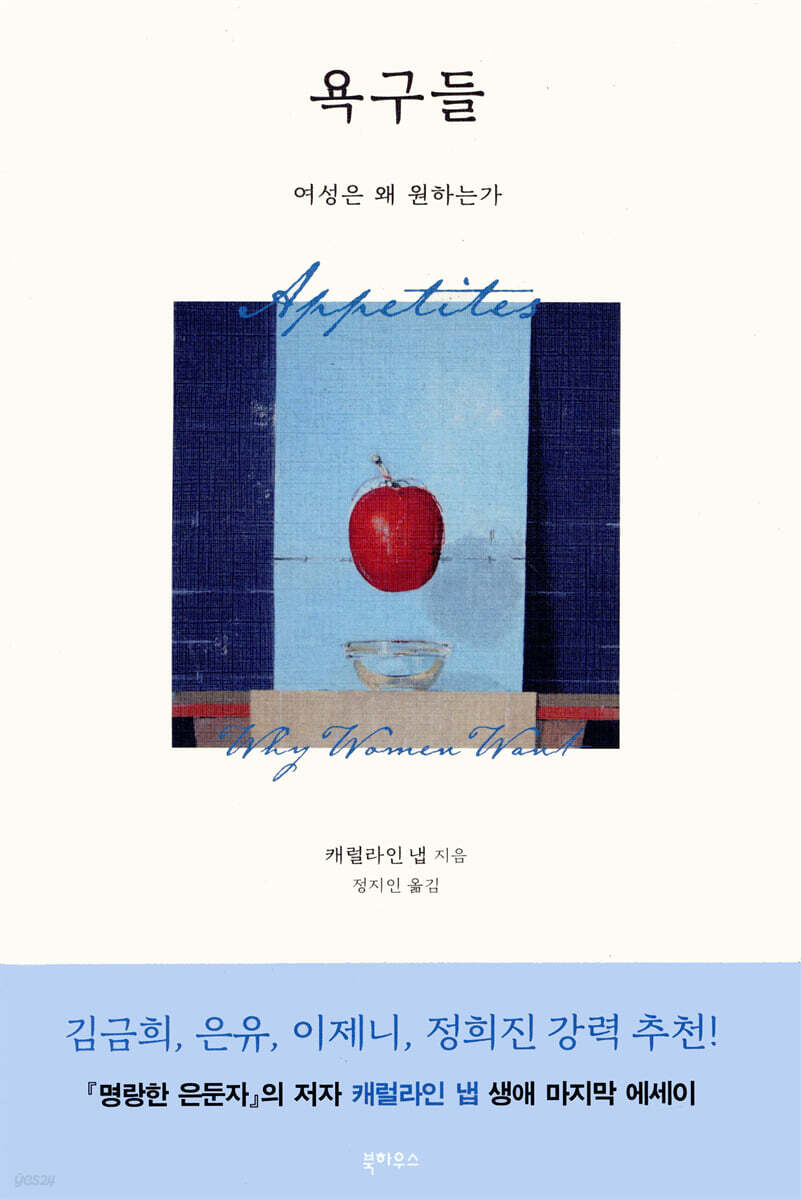
desires
 |
Description
Book Introduction
- A word from MD
-
The Merry Hermit: Caroline Knapp's Final EssayThe final essay written by Caroline Knapp, author of "The Merry Recluse," reflecting on her struggles with anorexia.
We look into the various inner desires of women who constantly torment themselves with the thought of whether or not to eat food in front of them.
It makes us ponder why women had no choice but to suppress their desires for not only food but also love, material possessions, possessions, and social success.
Her intellectual thinking shines as she swims through the sea of suffering and finds hope.
May 21, 2021. Essay PD Kim Tae-hee
Jeong Hee-jin: “A book you can’t help but encounter and love.”
Kim Geum-hee: “A book that will do its best to rescue our sisters who are struggling in self-loathing and the tyranny of the ego.”
Metaphor “There is no time to be bored.
Insights from the pain of being torn apart, the sentences are dense with speed and density.”
Now, “This is a book that is painful, precious, and meaningful at every moment, as it brings out the soul’s long-hidden cries.”
Strongly recommended by feminist scholar Jeong Hee-jin, novelist Kim Geum-hee, essayist Eun-yu, and poet Lee Je-ni.
A monumental book that expands our thinking about desire.
Caroline Knapp, author of 『The Merry Hermit』, 『Drinking, the Fatal Temptation』, and 『I Like Dogs More Than Men』, and a writer who fiercely and beautifully depicted the inner lives of women in our time, has published her last essay, 『Desires: Why Women Want』, a new Korean translation more than 20 years after its first publication in English-speaking countries.
In this book, the author recalls the time when she suffered from anorexia, and writes in a sophisticated and eloquent manner about the various desires of women, such as 'appetite', 'sexual desire', 'attachment', 'desire for recognition', and 'satisfaction', as well as the socio-cultural pressures.
When this book was published in 2003, it was a bestseller, receiving praise from numerous media outlets including Publisher's Weekly, Kirkus Reviews, Library Journal, and The New York Times, and loved by readers, and it opened the door to more in-depth discussion of anorexia.
In 2011, a revised edition was published with a foreword by Gale Caldwell, Pulitzer Prize-winning author and longtime friend of Caroline Knapp, creating a buzz once again, and it has established itself as a text that shines even more brightly with time.
Kim Geum-hee: “A book that will do its best to rescue our sisters who are struggling in self-loathing and the tyranny of the ego.”
Metaphor “There is no time to be bored.
Insights from the pain of being torn apart, the sentences are dense with speed and density.”
Now, “This is a book that is painful, precious, and meaningful at every moment, as it brings out the soul’s long-hidden cries.”
Strongly recommended by feminist scholar Jeong Hee-jin, novelist Kim Geum-hee, essayist Eun-yu, and poet Lee Je-ni.
A monumental book that expands our thinking about desire.
Caroline Knapp, author of 『The Merry Hermit』, 『Drinking, the Fatal Temptation』, and 『I Like Dogs More Than Men』, and a writer who fiercely and beautifully depicted the inner lives of women in our time, has published her last essay, 『Desires: Why Women Want』, a new Korean translation more than 20 years after its first publication in English-speaking countries.
In this book, the author recalls the time when she suffered from anorexia, and writes in a sophisticated and eloquent manner about the various desires of women, such as 'appetite', 'sexual desire', 'attachment', 'desire for recognition', and 'satisfaction', as well as the socio-cultural pressures.
When this book was published in 2003, it was a bestseller, receiving praise from numerous media outlets including Publisher's Weekly, Kirkus Reviews, Library Journal, and The New York Times, and loved by readers, and it opened the door to more in-depth discussion of anorexia.
In 2011, a revised edition was published with a foreword by Gale Caldwell, Pulitzer Prize-winning author and longtime friend of Caroline Knapp, creating a buzz once again, and it has established itself as a text that shines even more brightly with time.
- You can preview some of the book's contents.
Preview
index
introduction
Prologue: Desire as depicted by Renoir
Introduction: Desire in a 'Don't Do' World
Chapter 1: Adding Cake, Subtracting Self-Esteem—The Math of Anxiety and Desire
Chapter 2: Relationship with Mother - Hunger, and the Price of Freedom
Chapter 3: I Hate My Belly, I Hate My Thighs—Physical Disgust, and the Learned Embrace of Suppression
Chapter 4: From Bra Burning to a Shopping Spree—Desire and the Zeitgeist
Chapter 5: The Body that Became a Voice—The Hidden Pantomime of Sorrow
Chapter 6: Swimming Toward Hope—Faith, Agency, and Reaching Out to Satisfaction
Epilogue
Americas
References
Translator's Note
Prologue: Desire as depicted by Renoir
Introduction: Desire in a 'Don't Do' World
Chapter 1: Adding Cake, Subtracting Self-Esteem—The Math of Anxiety and Desire
Chapter 2: Relationship with Mother - Hunger, and the Price of Freedom
Chapter 3: I Hate My Belly, I Hate My Thighs—Physical Disgust, and the Learned Embrace of Suppression
Chapter 4: From Bra Burning to a Shopping Spree—Desire and the Zeitgeist
Chapter 5: The Body that Became a Voice—The Hidden Pantomime of Sorrow
Chapter 6: Swimming Toward Hope—Faith, Agency, and Reaching Out to Satisfaction
Epilogue
Americas
References
Translator's Note
Detailed image

Into the book
Once upon a time, in a world as different from Renoir's as Earth and Jupiter, I weighed 37 kilograms.
He was twenty-one years old, 162 centimeters tall, and his thighs were thinner than his knees.
The standard weight is about 54 kilograms, so the task of losing 17 kilograms, or about a third of the body, was a tremendous effort comparable to the labor of Hercules, an effort that would change one's life, and if you think about it strictly, it was an effort that only women did.
--- p.15
For three years I ate the same thing every day.
For breakfast, I had a plain sesame bagel, for lunch, a coffee-flavored yogurt from Danone, and for dinner, an apple and a small cheese cube.
And I ran.
With a stick-like body and a grimacing face, he walked for several kilometers.
I was always cold, even in summer, and terribly depressed, and I had no idea what it all meant, where this obsession with starvation came from and drove me so far, or what it meant about me, or about women in general, or about the larger problem of human longing.
I just acted and reacted like that.
--- p.16
Appetite is the hook on which I hang all my secondary sufferings, the sea from which all the rivers flowing within me (myself and countless women) spring.
Of course, the word appetite/desire is primarily about eating.
While this part of eating determines the lives of countless women, and is something I know all too well, the word also encompasses a much broader range of longings, yearnings, and needs.
Desire is about a deeper level of desire to engage with the world, to feel a sense of abundance and possibility in life, and to experience pleasure.
--- p.18
Now I eat.
While this statement in itself is a triumphant statement, the road to a more peaceful relationship with food—which, of course, means a more peaceful relationship with my body, myself, and the things that bother me—has been a long, winding road and (hopefully not) filled with companions.
Is there any woman who hasn't suffered, to varying degrees, from the exact same fears, emotions, and pressures that drove me to starvation?
--- p.31
Self-help books on eating disorders are separated from those on relationship issues, books on compulsive shopping are separated from those on female sexuality, and books on culture and media are separated from those on women's psychology.
Name something that applies to you, a demon that torments you.
In one camp there are women who love too much, in another camp there are women who eat too much, and in yet another camp there are women who shop too much.
In fact, the three camps are not that different from each other.
The thread of the problem of desire unites all camps.
--- pp.34-35
We have enjoyed more discretionary opportunities and freedom than any other group of women in any other era, to do anything, to be anything, to make decisions about our lives as we see fit.
And yet, at the age of twenty-one, I witnessed myself being reduced to a skeletal form.
At that time, my entire being was directed towards the denial of desire.
And even now, at forty-two, I still feel myself hesitating on the periphery of desire.
I often peek through the cracks of those doors that seem so vastly apart from me, and I'm still not entirely sure if I should venture inside.
--- p.47
The world moves in a direction that serves male desires.
It was like that when I was growing up and it still is like that now.
(…) Mothers feed them, fathers model dogmatic self-assertion and blatant competitiveness, and teachers encourage unbridled bravado.
At home and at work, men usually have helpers, usually women, who clean, cook, shop, type, organize files, and run errands.
And wherever they turn, on billboards, magazine covers and advertisements, men are surrounded by images of availability: images of breasts, parted lips and fiery eyes that tell them they can have it any time.
While opportunities in women's lives have vastly increased, there is no comparable effort to meet their needs, no comparable image of service and provision, and no fundamental expectation that others will do their utmost to meet our needs or satisfy our longings.
--- pp.81-82
Freedom to choose, in other words, is the freedom to make mistakes, the freedom to stumble and fail, the freedom to confront our flaws, limitations, fears, and secrets, the freedom to live with the terrible uncertainty that inevitably accompanies the destruction of the self.
/ I think this is the pulse of agitation that constantly beats behind an unresolved desire.
--- pp.95-96
I sat in my room every night for three and a half years, almost without exception.
Without anyone knowing, I carefully and painstakingly cut an apple and a piece of cheddar cheese, each about the size of a finger joint, into small pieces.
The sixteen apple slices were each so thin that light could be seen through them when held up to a light.
Then I lined up the apple slices on a small porcelain plate and placed a very small square piece of cheese on top of each.
Then I ate them one by one.
(…) I craved nothing but apples and cheese cubes, and I cut off all other desires, and with them all other anxieties.
--- pp.100-101
Obsessions—even mild ones, the common, mundane, everyday obsessions that constantly intrude on a woman's thoughts (Will these jeans make my butt look too big? Should I go to the gym?)—have an extraordinary power of distortion.
Obsession stops the progression of desire, drives it underground, twists and disguises the form of that desire, and then sends it out into the world again as a completely different form of desire, a form so sinister in its seeming realness.
--- p.102
“As she enters adulthood and the world, a daughter suddenly risks incurring her mother’s envy and jealousy, but worse than that, more painful and disturbing to contemplate, she is now in the position of reminding her mother of her own failures and shortcomings.” Chernin sees this dilemma as central to eating disorders, and that the assault a woman inflicts on her own body conceals “a bitter war against her mother.”
“It is the guilt we feel and the hidden anger we cannot express.”
--- p.151
There always seemed to be a pervasive, vaporous air of embarrassment, accompanied by a nervous laughter, about the body's unpredictability, a low-key worry about its power to leak, to stink, to cause shame.
I also remember well the fear of being seen as too much at school—too loud, too smart, too busty, too small, too sexual, too slutty.
Underlying these regulations is a premise that, though not explicitly stated, is clearly understood by everyone: that there are lines to be followed, controls to be enforced, and excesses that must not be exposed.
--- pp.204-205
During my career as a journalist, I was particularly drawn to women's issues.
I wrote about discrimination, abortion, and violence against women.
She has also written about women's health, gender discrimination in the media, and cultural images.
I even wrote about (other) women with eating disorders.
But in my private life, I was quietly starving and driving myself half to death.
This is exactly it.
Having intellectual beliefs but no corresponding emotional roots.
I understand the power of feminism intellectually, but I don't feel it in my body in any way.
--- pp.243-244
“Shopping is a two-kilogram bag into which you can pour twenty kilograms of your crazy heart,” a friend once said.
(…) that shopping is something you can do at any time, something that is just there, a way to release all the confusing cravings that you don't usually allow yourself in the rest of your life.
Eating too much is taboo.
Sex is annoying.
The body's strange pairing of physical impulses and psychological cravings is a mysterious and frightening thing.
But go into the store.
Suddenly, nothing is forbidden or unattainable, and the intangible becomes clear, vivid, and possessible.
--- pp.278-279
The very serious young mother said very simply and clearly, “I know that if I don’t talk, I will eat.”
It was a very personal statement about his life, and he understood that his overeating was a way to push down the anger and disappointment he felt when he couldn't tell the people in his life what he needed.
(Omitted) Suffering thrives in isolation and thrives in secrecy.
Words are the nemesis of pain, and naming it is the first step toward soothing it, and speaking about the mud a woman struggles through—the writhing of self-loathing and guilt, the echoes of emptiness and desire—is a prerequisite for getting out of it.
--- pp.303-304
Sadness stubbornly resists insight.
I can fit together the pieces of anxiety, guilt, and self-loathing to complete the puzzle, draw a clean line between where culture ends and alienation from body and self begins, and trace the roots of each piece of my anorexic history back to this moment and that, to this lesson and that message.
There is sadness underlying all of this.
Grief is a profoundly mysterious force, as deep as the earth, yet at the same time free-floating, drawing upon the problems of desire and casting a strong and unique light upon them.
All the individual longings we already knew become blurred and indistinguishable in the face of that blazing light.
Anorexia didn't protect me from these feelings of sadness, and recovery from it didn't change anything.
--- pp.319-320
How much of those losses of childhood could one bear? How much of that hunger could one endure? How much of that loss and hunger was mixed with confusion, rejection, or hurt? And how much of that self-centeredness was left deprived, disenfranchised, and filled with sadness and self-loathing?
--- p.334
There are moments in life that may be the best thing you can ever have.
A fleeting sense of satisfaction, a glimmer of hope, a taste, a taste, a fleeting moment to be savored and enjoyed to the fullest, like a pie.
--- p.371
While desires may have been physically liberated, they lack social and institutional support, and the social movements that fueled the first half of change remain dormant and in the fog of oblivion that began in the 1980s.
The momentum of feminism tends to ebb and flow like the tide, peaking and then subsiding in cycles of about 30 years, which may mean that a feminist revival is imminent.
But I'm worried about that very forgetfulness.
This is partly because that forgetfulness seems so persistent, and partly because progress is so closely intertwined with our own political and historical consciousness, with the degree to which it improves or worsens the level of awareness of women and the fate allotted to us.
He was twenty-one years old, 162 centimeters tall, and his thighs were thinner than his knees.
The standard weight is about 54 kilograms, so the task of losing 17 kilograms, or about a third of the body, was a tremendous effort comparable to the labor of Hercules, an effort that would change one's life, and if you think about it strictly, it was an effort that only women did.
--- p.15
For three years I ate the same thing every day.
For breakfast, I had a plain sesame bagel, for lunch, a coffee-flavored yogurt from Danone, and for dinner, an apple and a small cheese cube.
And I ran.
With a stick-like body and a grimacing face, he walked for several kilometers.
I was always cold, even in summer, and terribly depressed, and I had no idea what it all meant, where this obsession with starvation came from and drove me so far, or what it meant about me, or about women in general, or about the larger problem of human longing.
I just acted and reacted like that.
--- p.16
Appetite is the hook on which I hang all my secondary sufferings, the sea from which all the rivers flowing within me (myself and countless women) spring.
Of course, the word appetite/desire is primarily about eating.
While this part of eating determines the lives of countless women, and is something I know all too well, the word also encompasses a much broader range of longings, yearnings, and needs.
Desire is about a deeper level of desire to engage with the world, to feel a sense of abundance and possibility in life, and to experience pleasure.
--- p.18
Now I eat.
While this statement in itself is a triumphant statement, the road to a more peaceful relationship with food—which, of course, means a more peaceful relationship with my body, myself, and the things that bother me—has been a long, winding road and (hopefully not) filled with companions.
Is there any woman who hasn't suffered, to varying degrees, from the exact same fears, emotions, and pressures that drove me to starvation?
--- p.31
Self-help books on eating disorders are separated from those on relationship issues, books on compulsive shopping are separated from those on female sexuality, and books on culture and media are separated from those on women's psychology.
Name something that applies to you, a demon that torments you.
In one camp there are women who love too much, in another camp there are women who eat too much, and in yet another camp there are women who shop too much.
In fact, the three camps are not that different from each other.
The thread of the problem of desire unites all camps.
--- pp.34-35
We have enjoyed more discretionary opportunities and freedom than any other group of women in any other era, to do anything, to be anything, to make decisions about our lives as we see fit.
And yet, at the age of twenty-one, I witnessed myself being reduced to a skeletal form.
At that time, my entire being was directed towards the denial of desire.
And even now, at forty-two, I still feel myself hesitating on the periphery of desire.
I often peek through the cracks of those doors that seem so vastly apart from me, and I'm still not entirely sure if I should venture inside.
--- p.47
The world moves in a direction that serves male desires.
It was like that when I was growing up and it still is like that now.
(…) Mothers feed them, fathers model dogmatic self-assertion and blatant competitiveness, and teachers encourage unbridled bravado.
At home and at work, men usually have helpers, usually women, who clean, cook, shop, type, organize files, and run errands.
And wherever they turn, on billboards, magazine covers and advertisements, men are surrounded by images of availability: images of breasts, parted lips and fiery eyes that tell them they can have it any time.
While opportunities in women's lives have vastly increased, there is no comparable effort to meet their needs, no comparable image of service and provision, and no fundamental expectation that others will do their utmost to meet our needs or satisfy our longings.
--- pp.81-82
Freedom to choose, in other words, is the freedom to make mistakes, the freedom to stumble and fail, the freedom to confront our flaws, limitations, fears, and secrets, the freedom to live with the terrible uncertainty that inevitably accompanies the destruction of the self.
/ I think this is the pulse of agitation that constantly beats behind an unresolved desire.
--- pp.95-96
I sat in my room every night for three and a half years, almost without exception.
Without anyone knowing, I carefully and painstakingly cut an apple and a piece of cheddar cheese, each about the size of a finger joint, into small pieces.
The sixteen apple slices were each so thin that light could be seen through them when held up to a light.
Then I lined up the apple slices on a small porcelain plate and placed a very small square piece of cheese on top of each.
Then I ate them one by one.
(…) I craved nothing but apples and cheese cubes, and I cut off all other desires, and with them all other anxieties.
--- pp.100-101
Obsessions—even mild ones, the common, mundane, everyday obsessions that constantly intrude on a woman's thoughts (Will these jeans make my butt look too big? Should I go to the gym?)—have an extraordinary power of distortion.
Obsession stops the progression of desire, drives it underground, twists and disguises the form of that desire, and then sends it out into the world again as a completely different form of desire, a form so sinister in its seeming realness.
--- p.102
“As she enters adulthood and the world, a daughter suddenly risks incurring her mother’s envy and jealousy, but worse than that, more painful and disturbing to contemplate, she is now in the position of reminding her mother of her own failures and shortcomings.” Chernin sees this dilemma as central to eating disorders, and that the assault a woman inflicts on her own body conceals “a bitter war against her mother.”
“It is the guilt we feel and the hidden anger we cannot express.”
--- p.151
There always seemed to be a pervasive, vaporous air of embarrassment, accompanied by a nervous laughter, about the body's unpredictability, a low-key worry about its power to leak, to stink, to cause shame.
I also remember well the fear of being seen as too much at school—too loud, too smart, too busty, too small, too sexual, too slutty.
Underlying these regulations is a premise that, though not explicitly stated, is clearly understood by everyone: that there are lines to be followed, controls to be enforced, and excesses that must not be exposed.
--- pp.204-205
During my career as a journalist, I was particularly drawn to women's issues.
I wrote about discrimination, abortion, and violence against women.
She has also written about women's health, gender discrimination in the media, and cultural images.
I even wrote about (other) women with eating disorders.
But in my private life, I was quietly starving and driving myself half to death.
This is exactly it.
Having intellectual beliefs but no corresponding emotional roots.
I understand the power of feminism intellectually, but I don't feel it in my body in any way.
--- pp.243-244
“Shopping is a two-kilogram bag into which you can pour twenty kilograms of your crazy heart,” a friend once said.
(…) that shopping is something you can do at any time, something that is just there, a way to release all the confusing cravings that you don't usually allow yourself in the rest of your life.
Eating too much is taboo.
Sex is annoying.
The body's strange pairing of physical impulses and psychological cravings is a mysterious and frightening thing.
But go into the store.
Suddenly, nothing is forbidden or unattainable, and the intangible becomes clear, vivid, and possessible.
--- pp.278-279
The very serious young mother said very simply and clearly, “I know that if I don’t talk, I will eat.”
It was a very personal statement about his life, and he understood that his overeating was a way to push down the anger and disappointment he felt when he couldn't tell the people in his life what he needed.
(Omitted) Suffering thrives in isolation and thrives in secrecy.
Words are the nemesis of pain, and naming it is the first step toward soothing it, and speaking about the mud a woman struggles through—the writhing of self-loathing and guilt, the echoes of emptiness and desire—is a prerequisite for getting out of it.
--- pp.303-304
Sadness stubbornly resists insight.
I can fit together the pieces of anxiety, guilt, and self-loathing to complete the puzzle, draw a clean line between where culture ends and alienation from body and self begins, and trace the roots of each piece of my anorexic history back to this moment and that, to this lesson and that message.
There is sadness underlying all of this.
Grief is a profoundly mysterious force, as deep as the earth, yet at the same time free-floating, drawing upon the problems of desire and casting a strong and unique light upon them.
All the individual longings we already knew become blurred and indistinguishable in the face of that blazing light.
Anorexia didn't protect me from these feelings of sadness, and recovery from it didn't change anything.
--- pp.319-320
How much of those losses of childhood could one bear? How much of that hunger could one endure? How much of that loss and hunger was mixed with confusion, rejection, or hurt? And how much of that self-centeredness was left deprived, disenfranchised, and filled with sadness and self-loathing?
--- p.334
There are moments in life that may be the best thing you can ever have.
A fleeting sense of satisfaction, a glimmer of hope, a taste, a taste, a fleeting moment to be savored and enjoyed to the fullest, like a pie.
--- p.371
While desires may have been physically liberated, they lack social and institutional support, and the social movements that fueled the first half of change remain dormant and in the fog of oblivion that began in the 1980s.
The momentum of feminism tends to ebb and flow like the tide, peaking and then subsiding in cycles of about 30 years, which may mean that a feminist revival is imminent.
But I'm worried about that very forgetfulness.
This is partly because that forgetfulness seems so persistent, and partly because progress is so closely intertwined with our own political and historical consciousness, with the degree to which it improves or worsens the level of awareness of women and the fate allotted to us.
--- p.382
Publisher's Review
A posthumous essay by Caroline Knapp, a writer who lovingly illuminated the inner lives of women in our time.
The most intense writing, written with the body in a "room of one's own" without mirrors or scales.
Caroline Knapp captivated readers with her intelligent, elegant, humorous, and engaging writing, and her honest and candid confessions about addiction and recovery.
He published three books in a period of about eight years, from the publication of Alice K's Guide to Life in 1994 until his early death at the age of forty-two in 2002.
"Desires: Why Women Want" is a posthumous work completed two months before she was diagnosed with cancer, and is a masterpiece that demonstrates how far the essay genre can go.
The themes that have preoccupied Napp throughout his life are isolation, attachment, and, above all, addiction.
To wash away his anxiety, turmoil, and sadness, to stop his self-reproach and self-destruction, he started drinking alcohol in his teens.
But the fear that alcohol couldn't get rid of, the shame of that fear, my body, the hunger itself, I found another way.
It was a starvation, surviving on only one apple and one small piece of cheese a day.
A young woman in her early twenties, when the doors of possibility seemed wide open before her, but who lacked the belief in satiety, fulfillment, and pleasure.
He tried to control himself by turning all his attention to something small, concrete, and manageable on his own—food—rather than to something huge, vague, and overwhelming like work, career, or love.
Women who starve, buy, and steal, women who fall in love and harm themselves.
What I realized while looking back on my time with anorexia.
All those desires are connected
A book that illuminates "me" and "us" through the world of women in our time.
The word 'appetite', which is also the title of this book, is often used in relation to eating or food.
Napdo staked his soul on hunger more than any other desire.
But the word encompasses a much broader range of longing, yearning, and need.
In its dictionary meaning, it refers to ‘natural desire,’ ‘innate or habitual desire or tendency to satisfy or fulfill,’ and ‘object of desire.’
So to speak, desire is about a deeper level of desire to engage with the world, to feel a sense of abundance and possibility in life, to experience pleasure.
Desire exists in a cycle, as Knapp puts it: “Food is love, love is sex, sex is connection, and connection is food.” But for many women, imagining and fulfilling this desire unfolds in a particularly passionate and painful way.
This is because many people believe that desire itself is somehow unfair or wrong, that the right to enjoy whatever one wants comes with a price, that satisfying desires requires making sacrifices.
This is true not only of appetite and food, but also of love and sex, of objects and possessions, and of social success.
According to Knapp's analysis, this guilt and fear stem from the stereotypes women are instilled with throughout their lives: that their desires must be suppressed and fulfilled only in socially acceptable ways.
A more important issue is that the problems arising from these individual-social dynamics are being analyzed in fragmented pieces.
Women who suffer from anorexia, women who steal, women who harm themselves, women who fall in love that destroys their souls… as if these are all completely different phenomena.
But the roots of these longings, analyzed in different ways, are the same; their anxiety, guilt, shame, and sadness are all connected.
Where Napp's analysis shines is in its broad perspective on the background and underlying causes of these connected phenomena.
Contemplation with sorrow, the most intellectual thought that leads to subjective action
Moments of contentment, moments when body, mind, and spirit are connected, finally arrive.
In theory, women today have the freedom and resources to satisfy their desires in any way they choose.
But we have relatively little freedom to decide for ourselves what desires we should harbor or what true satisfaction looks and feels like.
To address these issues, and above all, to reflect on her own recovery, the author gathers case studies from conversations with many women similar to herself, while also reading deeply into various intellectual texts on women, the body, desire, and need, including those by Kim Chernin, Elizabeth Gross, Carol Gilligan, Peggy Orenstein, and Freud, Lacan, and Foucault, to elaborately support her own experiences and reflections.
Even if Napp had stopped at confessing the pain of anorexia and analyzing its causes through his own personal past, this book would have been a great essay.
It would have been relatable and wonderful to see the wounded girl, once down to 37 kilograms, mature into a courageous, composed, self-controlled woman and writer.
But beyond that clear, sharp, and analytical voice, Knapp offers readers a blueprint for dealing with desire with a gaze that is profoundly generous, beautiful, and hopeful.
He willingly immersed himself in our suffering, not just the suffering he experienced, and opened up layer upon layer of exits and passages for those who escaped from it.
Through this multi-layered process, Napp ultimately demonstrated how far he, as an essayist and journalist, could go with his writing.
The many stories in this book are still ongoing: the cruelty girls show to themselves, the sorrows of daughters and mothers, the hungers, both fulfilled and unfulfilled, that shape us into who we are.
But now we have new clues in our hands through the experiences, reflections, and language that Napp left behind.
We can begin to gauge what we want and how much we can afford to want.
Now you can be angry enough.
It's okay to cry a lot before changing direction.
Rather than just blaming yourself and your early family, you can also make an emotional shift.
It is because of the profound hope that Nap conveyed, and it is also the reason why we set out to find little books that contain our own stories.
Readers of this book will come to see all of Caroline Knapp's work as readers and subjects.
The wonder of a heart consumed by sadness, numbness, and fear; the voluntary isolation that prevents it from easily revealing itself to others; the clarity of mind that sharpens calm and intelligent thought.
I hope that readers who followed Nap will, as they close the last chapter, reflect deeply on what they want, on the desires of women, and on their own place in life.
The most intense writing, written with the body in a "room of one's own" without mirrors or scales.
Caroline Knapp captivated readers with her intelligent, elegant, humorous, and engaging writing, and her honest and candid confessions about addiction and recovery.
He published three books in a period of about eight years, from the publication of Alice K's Guide to Life in 1994 until his early death at the age of forty-two in 2002.
"Desires: Why Women Want" is a posthumous work completed two months before she was diagnosed with cancer, and is a masterpiece that demonstrates how far the essay genre can go.
The themes that have preoccupied Napp throughout his life are isolation, attachment, and, above all, addiction.
To wash away his anxiety, turmoil, and sadness, to stop his self-reproach and self-destruction, he started drinking alcohol in his teens.
But the fear that alcohol couldn't get rid of, the shame of that fear, my body, the hunger itself, I found another way.
It was a starvation, surviving on only one apple and one small piece of cheese a day.
A young woman in her early twenties, when the doors of possibility seemed wide open before her, but who lacked the belief in satiety, fulfillment, and pleasure.
He tried to control himself by turning all his attention to something small, concrete, and manageable on his own—food—rather than to something huge, vague, and overwhelming like work, career, or love.
Women who starve, buy, and steal, women who fall in love and harm themselves.
What I realized while looking back on my time with anorexia.
All those desires are connected
A book that illuminates "me" and "us" through the world of women in our time.
The word 'appetite', which is also the title of this book, is often used in relation to eating or food.
Napdo staked his soul on hunger more than any other desire.
But the word encompasses a much broader range of longing, yearning, and need.
In its dictionary meaning, it refers to ‘natural desire,’ ‘innate or habitual desire or tendency to satisfy or fulfill,’ and ‘object of desire.’
So to speak, desire is about a deeper level of desire to engage with the world, to feel a sense of abundance and possibility in life, to experience pleasure.
Desire exists in a cycle, as Knapp puts it: “Food is love, love is sex, sex is connection, and connection is food.” But for many women, imagining and fulfilling this desire unfolds in a particularly passionate and painful way.
This is because many people believe that desire itself is somehow unfair or wrong, that the right to enjoy whatever one wants comes with a price, that satisfying desires requires making sacrifices.
This is true not only of appetite and food, but also of love and sex, of objects and possessions, and of social success.
According to Knapp's analysis, this guilt and fear stem from the stereotypes women are instilled with throughout their lives: that their desires must be suppressed and fulfilled only in socially acceptable ways.
A more important issue is that the problems arising from these individual-social dynamics are being analyzed in fragmented pieces.
Women who suffer from anorexia, women who steal, women who harm themselves, women who fall in love that destroys their souls… as if these are all completely different phenomena.
But the roots of these longings, analyzed in different ways, are the same; their anxiety, guilt, shame, and sadness are all connected.
Where Napp's analysis shines is in its broad perspective on the background and underlying causes of these connected phenomena.
Contemplation with sorrow, the most intellectual thought that leads to subjective action
Moments of contentment, moments when body, mind, and spirit are connected, finally arrive.
In theory, women today have the freedom and resources to satisfy their desires in any way they choose.
But we have relatively little freedom to decide for ourselves what desires we should harbor or what true satisfaction looks and feels like.
To address these issues, and above all, to reflect on her own recovery, the author gathers case studies from conversations with many women similar to herself, while also reading deeply into various intellectual texts on women, the body, desire, and need, including those by Kim Chernin, Elizabeth Gross, Carol Gilligan, Peggy Orenstein, and Freud, Lacan, and Foucault, to elaborately support her own experiences and reflections.
Even if Napp had stopped at confessing the pain of anorexia and analyzing its causes through his own personal past, this book would have been a great essay.
It would have been relatable and wonderful to see the wounded girl, once down to 37 kilograms, mature into a courageous, composed, self-controlled woman and writer.
But beyond that clear, sharp, and analytical voice, Knapp offers readers a blueprint for dealing with desire with a gaze that is profoundly generous, beautiful, and hopeful.
He willingly immersed himself in our suffering, not just the suffering he experienced, and opened up layer upon layer of exits and passages for those who escaped from it.
Through this multi-layered process, Napp ultimately demonstrated how far he, as an essayist and journalist, could go with his writing.
The many stories in this book are still ongoing: the cruelty girls show to themselves, the sorrows of daughters and mothers, the hungers, both fulfilled and unfulfilled, that shape us into who we are.
But now we have new clues in our hands through the experiences, reflections, and language that Napp left behind.
We can begin to gauge what we want and how much we can afford to want.
Now you can be angry enough.
It's okay to cry a lot before changing direction.
Rather than just blaming yourself and your early family, you can also make an emotional shift.
It is because of the profound hope that Nap conveyed, and it is also the reason why we set out to find little books that contain our own stories.
Readers of this book will come to see all of Caroline Knapp's work as readers and subjects.
The wonder of a heart consumed by sadness, numbness, and fear; the voluntary isolation that prevents it from easily revealing itself to others; the clarity of mind that sharpens calm and intelligent thought.
I hope that readers who followed Nap will, as they close the last chapter, reflect deeply on what they want, on the desires of women, and on their own place in life.
GOODS SPECIFICS
- Publication date: May 17, 2021
- Page count, weight, size: 400 pages | 508g | 140*210*19mm
- ISBN13: 9791164051069
- ISBN10: 1164051067
You may also like
카테고리
korean


korean

![GQ KOREA Mark (Monthly): December [2025]](http://librairie.coreenne.fr/cdn/shop/files/8ef265dbbfbf186523ed75ba7319009d.jpg?v=1765340328&width=3840)


