

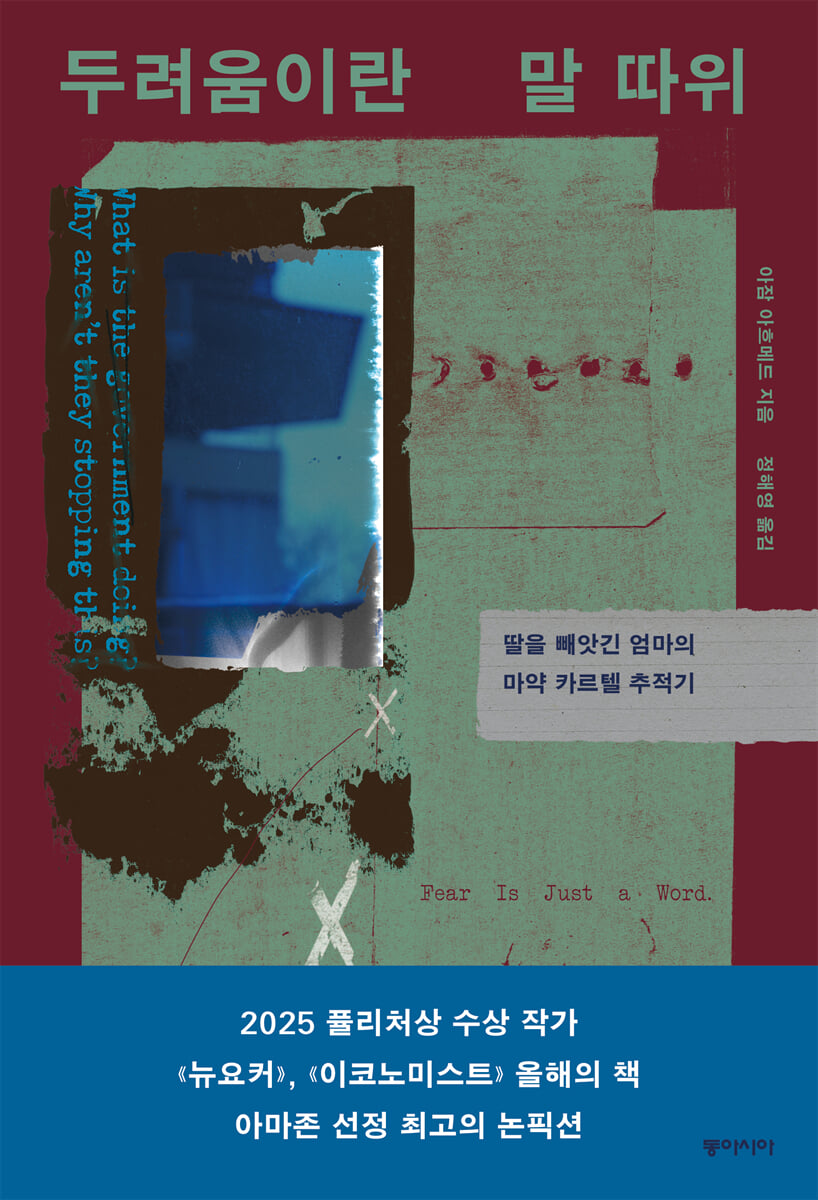
Words like fear
 |
Description
Book Introduction
- A word from MD
-
A mother's revenge for losing her daughter to a drug gangIt's like a movie? It's a story.
Miriam Rodriguez was an ordinary mother raising her children in Mexico.
Things change when a gang takes over the town.
The drug cartel Sepas kidnapped his daughter Karen.
Karen never returns home.
The police are incompetent, and Mom is determined.
Decided to find the culprit myself?November 3, 2025. Min-gyu Son, Social and Political PD
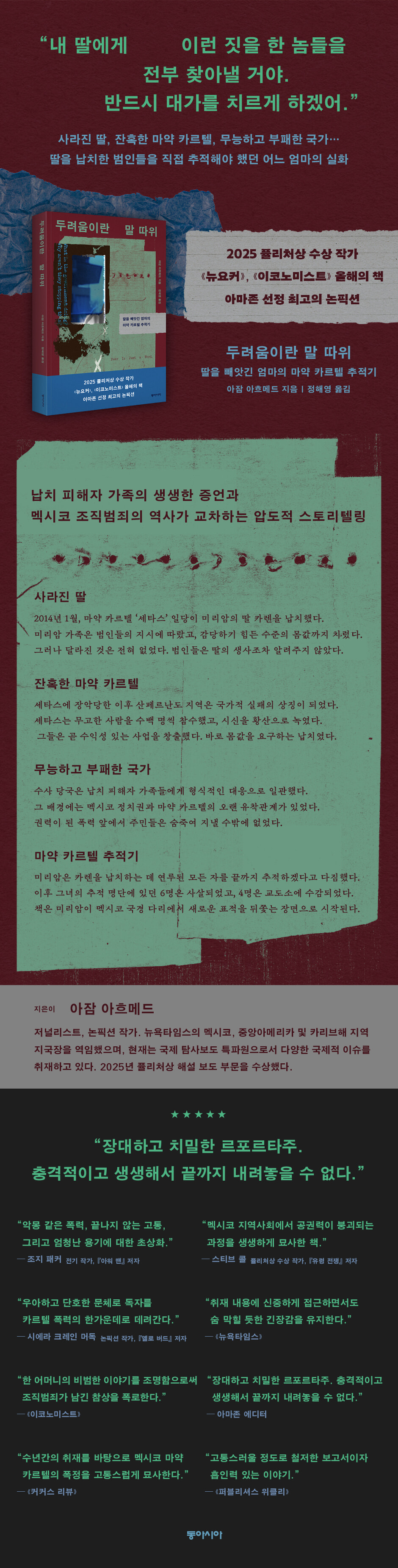
“Those who did this to my daughter
I'll find them all.
“I will make sure you pay the price.”
The true story of a mother who had to personally track down her daughter's kidnappers.
2025 Pulitzer Prize-winning crime reportage by a New York Times correspondent
“It handles its subject matter with care while maintaining a breathtaking tension.” _The New York Times
“By illuminating one mother’s extraordinary story, it exposes the horrors of organized crime.” _The Economist
"Fear is a Word" is the life story of Miriam Rodriguez, who had to personally track down her daughter's kidnappers, and is a crime reportage depicting the collapse of Mexican communities by drug cartels.
Author Azam Ahmed, winner of the 2025 Pulitzer Prize for Explanatory Reporting and currently the New York Times' international investigative correspondent, spent four years interviewing hundreds of hours of people involved, collecting case records, and tracing the genealogy of drug cartels to create a “magnificent and meticulous reportage” that intersects Miriam’s heroic life with Mexico’s violent modern history.
The author vividly describes Miriam's tracker, which is "more novel than novel," while also exposing the long-standing collusion between public power and organized crime.
In January 2014, Miriam Rodriguez's daughter Karen was kidnapped by members of the Zetas drug cartel that controlled the San Fernando region of Tamaulipas, Mexico.
Miriam's family, who received a call from the criminals, followed every instruction and even paid the exorbitant ransom.
However, the criminals did not even properly inform her of Karen's life or death, and the incompetent and corrupt investigative authorities consistently responded with indifference and formality, turning a blind eye to Miriam's family.
Eventually, Miriam, an ordinary middle-aged woman, decides to personally track down all the suspects involved in her daughter's kidnapping.
The book begins with a tense scene where Miriam pursues one of the kidnapping suspects, the Florist, on the border bridge between Mexico and Texas.
In just two years since Miriam began her pursuit, six of the suspects on her list are in prison, and four have been killed by Marines who raided the Setas stronghold.
And throughout all of this, Miriam played a key role.
While it's a remarkable story that an ordinary individual, prior to his daughter's disappearance, took the lead in arresting members of a notorious drug cartel, it leaves the bitter question of why the victim's family had to fend for themselves.
The author points to a community gripped by fear of violence, public power reduced to complicity with organized crime, and a long history of one-party dictatorship as the backdrop, and goes beyond simply consuming Miriam's life as a story to portray it as a portrait symbolizing the various contradictions of Mexican society.
I'll find them all.
“I will make sure you pay the price.”
The true story of a mother who had to personally track down her daughter's kidnappers.
2025 Pulitzer Prize-winning crime reportage by a New York Times correspondent
“It handles its subject matter with care while maintaining a breathtaking tension.” _The New York Times
“By illuminating one mother’s extraordinary story, it exposes the horrors of organized crime.” _The Economist
"Fear is a Word" is the life story of Miriam Rodriguez, who had to personally track down her daughter's kidnappers, and is a crime reportage depicting the collapse of Mexican communities by drug cartels.
Author Azam Ahmed, winner of the 2025 Pulitzer Prize for Explanatory Reporting and currently the New York Times' international investigative correspondent, spent four years interviewing hundreds of hours of people involved, collecting case records, and tracing the genealogy of drug cartels to create a “magnificent and meticulous reportage” that intersects Miriam’s heroic life with Mexico’s violent modern history.
The author vividly describes Miriam's tracker, which is "more novel than novel," while also exposing the long-standing collusion between public power and organized crime.
In January 2014, Miriam Rodriguez's daughter Karen was kidnapped by members of the Zetas drug cartel that controlled the San Fernando region of Tamaulipas, Mexico.
Miriam's family, who received a call from the criminals, followed every instruction and even paid the exorbitant ransom.
However, the criminals did not even properly inform her of Karen's life or death, and the incompetent and corrupt investigative authorities consistently responded with indifference and formality, turning a blind eye to Miriam's family.
Eventually, Miriam, an ordinary middle-aged woman, decides to personally track down all the suspects involved in her daughter's kidnapping.
The book begins with a tense scene where Miriam pursues one of the kidnapping suspects, the Florist, on the border bridge between Mexico and Texas.
In just two years since Miriam began her pursuit, six of the suspects on her list are in prison, and four have been killed by Marines who raided the Setas stronghold.
And throughout all of this, Miriam played a key role.
While it's a remarkable story that an ordinary individual, prior to his daughter's disappearance, took the lead in arresting members of a notorious drug cartel, it leaves the bitter question of why the victim's family had to fend for themselves.
The author points to a community gripped by fear of violence, public power reduced to complicity with organized crime, and a long history of one-party dictatorship as the backdrop, and goes beyond simply consuming Miriam's life as a story to portray it as a portrait symbolizing the various contradictions of Mexican society.
- You can preview some of the book's contents.
Preview
index
prolog
Chapter 1: The Lost Daughter
Chapter 2 Two Histories
Chapter 3: The Age of Cartels
Chapter 4: Violence Becomes Power
Chapter 5: The Disappeared
Chapter 6: The Cursed Family
Chapter 7 Target List
Chapter 8: Solidarity
Chapter 9 What's Left Behind
Chapter 10 Guns and Bones
Chapter 11 Mother's Day
Chapter 12: An Unexpected Legacy
Chapter 13 Conclusion
Epilogue
Acknowledgements
main
References
Chapter 1: The Lost Daughter
Chapter 2 Two Histories
Chapter 3: The Age of Cartels
Chapter 4: Violence Becomes Power
Chapter 5: The Disappeared
Chapter 6: The Cursed Family
Chapter 7 Target List
Chapter 8: Solidarity
Chapter 9 What's Left Behind
Chapter 10 Guns and Bones
Chapter 11 Mother's Day
Chapter 12: An Unexpected Legacy
Chapter 13 Conclusion
Epilogue
Acknowledgements
main
References
Detailed image
Into the book
Two years ago, in January 2014, the Setas gang, including the florist, kidnapped Karen.
Miriam begged and complied with all of Setas's instructions, even paying a ransom that was too high to bear.
But nothing changed at all.
--- p.12
Criminal organizations engaged in increasingly bloody competition.
In 2011, the year after the Gulf and Zetas split, there were 28,000 homicides in Mexico.
--- p.17
For two years, Miriam continued to pursue those involved in the kidnapping, achieving considerable success.
Four were awaiting trial in prison, and six were killed in an attack by Mexican Marines.
--- p.21
San Fernando gradually became a symbol of national failure.
A symbol of the worsening situation during the war on drugs, and the inability to rectify the situation while the conflict between the Gulf and Zetas changed the course of violence.
--- p.25~26
“How on earth could this happen?” Miriam continued to ask.
"What on earth is the government doing? Why isn't it stopping this?"
--- p.36
Pricing was more art than science.
The amount that the victim's family can afford depends on guesswork and negotiation.
If you pay the ransom too quickly, the kidnappers will think they have more money to extort and will try to renegotiate.
--- p.46
During Guerra's leadership, organized crime began to take root in Mexico's national fabric.
Gera's smugglers used his political connections to ensure a free and stable supply chain.
Ultimately, the government became an accomplice in smuggling, laying the foundation for corruption, collusion, crime, and violence.
--- p.68
The Setas acted like parasites, causing misery and sucking money out of the community.
They soon created a profitable business.
It was a kidnapping for ransom.
--- p.99
Many men disappeared without a trace in San Fernando and nearby cities.
Their bodies were often found buried in empty lots in the suburbs.
People who went missing or whose whereabouts were unknown were called 'los desaparecidos'.
It was as if their very existence had been erased.
--- p.104
All six dead were connected in some way to the disappearance of Miriam's daughter Karen.
And it was Miriam who helped in this operation to surprise, kill, and wipe them out.
She was there from beginning to end, her identity hidden.
--- p.146
Miriam's case file became a filing cabinet filled with detailed procedures, using all sorts of arcane legal terminology.
Each and every document that piled up was filled with notes on legal procedures.
To understand what the government was and wasn't doing, I had to read these documents page by page, wading through a swamp of footnotes.
--- p.188
After a while, Miriam learned that the number of families suffering from disappearances was surprisingly large.
I started writing down names one by one, and soon there were dozens.
As word of Miriam spread, many people came to tell her stories and join the community.
--- p.202
Miriam's story was as moving as a sermon, illuminating the anger, frustration, and pain of the people gathered.
She said everyone should raise their voices and call for attention.
He said there was no need to be afraid anymore, no need to run away from what had happened to him.
--- p.220
Azalea wondered if her mother, who had accomplished things she never imagined, would finally keep her promise.
Everyone around was worried about Miriam's safety and their own.
It's crazy enough to fight against regular organized crime, but to send members of the Zetas to prison and threaten the very existence of the criminal organization.
It was an act of volunteering to die.
--- p.252
Miriam was not a prosecutor.
I didn't know exactly how to lead the case.
That weakness was further highlighted in Mexico's antiquated judicial system.
But Miriam did not give in.
They sought to make the members of the Setas organization pay the price for their crimes by using evidence of recurring patterns in their criminal activities.
They linked the crimes of individual members to the entire Zetas organization and found a way to pin Zetas as the mastermind behind the kidnappings in San Fernando.
--- p.254
“Never be afraid.
There is no reason to be afraid.
“You must not be swayed by fear, especially women.”
--- p.277
Miriam stood up to injustice, forced the government to do her bidding, and dedicated herself to changing the paradigm.
Miriam begged and complied with all of Setas's instructions, even paying a ransom that was too high to bear.
But nothing changed at all.
--- p.12
Criminal organizations engaged in increasingly bloody competition.
In 2011, the year after the Gulf and Zetas split, there were 28,000 homicides in Mexico.
--- p.17
For two years, Miriam continued to pursue those involved in the kidnapping, achieving considerable success.
Four were awaiting trial in prison, and six were killed in an attack by Mexican Marines.
--- p.21
San Fernando gradually became a symbol of national failure.
A symbol of the worsening situation during the war on drugs, and the inability to rectify the situation while the conflict between the Gulf and Zetas changed the course of violence.
--- p.25~26
“How on earth could this happen?” Miriam continued to ask.
"What on earth is the government doing? Why isn't it stopping this?"
--- p.36
Pricing was more art than science.
The amount that the victim's family can afford depends on guesswork and negotiation.
If you pay the ransom too quickly, the kidnappers will think they have more money to extort and will try to renegotiate.
--- p.46
During Guerra's leadership, organized crime began to take root in Mexico's national fabric.
Gera's smugglers used his political connections to ensure a free and stable supply chain.
Ultimately, the government became an accomplice in smuggling, laying the foundation for corruption, collusion, crime, and violence.
--- p.68
The Setas acted like parasites, causing misery and sucking money out of the community.
They soon created a profitable business.
It was a kidnapping for ransom.
--- p.99
Many men disappeared without a trace in San Fernando and nearby cities.
Their bodies were often found buried in empty lots in the suburbs.
People who went missing or whose whereabouts were unknown were called 'los desaparecidos'.
It was as if their very existence had been erased.
--- p.104
All six dead were connected in some way to the disappearance of Miriam's daughter Karen.
And it was Miriam who helped in this operation to surprise, kill, and wipe them out.
She was there from beginning to end, her identity hidden.
--- p.146
Miriam's case file became a filing cabinet filled with detailed procedures, using all sorts of arcane legal terminology.
Each and every document that piled up was filled with notes on legal procedures.
To understand what the government was and wasn't doing, I had to read these documents page by page, wading through a swamp of footnotes.
--- p.188
After a while, Miriam learned that the number of families suffering from disappearances was surprisingly large.
I started writing down names one by one, and soon there were dozens.
As word of Miriam spread, many people came to tell her stories and join the community.
--- p.202
Miriam's story was as moving as a sermon, illuminating the anger, frustration, and pain of the people gathered.
She said everyone should raise their voices and call for attention.
He said there was no need to be afraid anymore, no need to run away from what had happened to him.
--- p.220
Azalea wondered if her mother, who had accomplished things she never imagined, would finally keep her promise.
Everyone around was worried about Miriam's safety and their own.
It's crazy enough to fight against regular organized crime, but to send members of the Zetas to prison and threaten the very existence of the criminal organization.
It was an act of volunteering to die.
--- p.252
Miriam was not a prosecutor.
I didn't know exactly how to lead the case.
That weakness was further highlighted in Mexico's antiquated judicial system.
But Miriam did not give in.
They sought to make the members of the Setas organization pay the price for their crimes by using evidence of recurring patterns in their criminal activities.
They linked the crimes of individual members to the entire Zetas organization and found a way to pin Zetas as the mastermind behind the kidnappings in San Fernando.
--- p.254
“Never be afraid.
There is no reason to be afraid.
“You must not be swayed by fear, especially women.”
--- p.277
Miriam stood up to injustice, forced the government to do her bidding, and dedicated herself to changing the paradigm.
--- p.338
Publisher's Review
“How can this happen?
“What on earth is the government doing?”
From inter-cartel wars to civilian massacres and kidnappings for ransom.
Violence beyond state control is increasingly directed downward.
Drug cartels grew under the aegis of the Institutional Revolutionary Party, which ruled Mexico for over 70 years from 1929 to 2000.
The Gulf Cartel dominated Mexico's smuggling industry for a century, beginning in the 1920s when Prohibition was implemented in the United States, and in the process developed extensive ties with police, prosecutors, customs officials, and even PRI politicians.
The Gulf Cartel took them on as partners, providing them with bribes and benefits, in return securing a stable supply chain and virtual immunity.
The problem arose as the power structure changed in the late 1990s.
The collapse of the one-party dictatorship of the Institutional Revolutionary Party created a power vacuum, which was filled by drug cartels.
The government has lost control over organized crime.
As competition between drug cartels intensified, bloodshed broke out in various places.
The Mexican government declared a "war on drugs" in 2006, but it was not enough to quell the chaos.
Repeated armed conflicts between the military and cartels have left innocent civilians harmed.
The Gulf Cartel created the Zetas paramilitary group to expand its territory, leaving its members free to do whatever it took to make money.
The Setas organization members collected rent from market vendors and carried out kidnappings for ransom.
To make matters worse, in 2010, the Zetas, who had split from the Gulf Cartel, took control of San Fernando, terrorizing the local population.
The Zetas suspected that there were remnants of the Gulf Cartel in San Fernando and did not hesitate to carry out mass killings.
The number of people missing due to the violence of Mexican cartels reaches 100,000.
Drawing on extensive research, the author meticulously depicts how Mexico's authorities gradually lose control and the drug cartels' violence increasingly targets ordinary people like Miriam's family.
The sight of a cartel leader who has become a social giant escaping criminal charges despite clear evidence, the repeated promises of truth-finding and rigorous investigations whenever civilian massacres or mass disappearances occur, and the hasty policies that only exacerbate the damage may feel familiar to Korean readers.
This is why the sentence in the epilogue, “Every action was a display of violence, every tragedy foreshadowed the next tragedy,” feels like a chilling warning.
“The pain of losing a loved one
Anyone who knows the meaning
“Only those who have experienced that pain.”
Miriam Rodriguez's Life: From Revenge to Solidarity
About the courage to never yield in the face of violence that has become power.
The driving force that enabled Miriam to pour everything she had into tracking down the kidnapper was, of course, revenge.
However, Miriam gradually began to devote her efforts to helping other families of missing persons victims.
Although Mexican federal law provides several support measures for crime victims, most families of missing persons victims were unaware of the existence of the relevant laws.
Miriam, on the other hand, knew very well how to navigate Mexican bureaucracy to secure her rights as a victim's family member.
Miriam has worked with people from all over Tamaulipas state who have heard rumors and have come to visit, founded an organization for families of missing victims, and organized a DNA testing task force within the investigative authorities to pressure the government to identify remains recovered from mass graves.
The author also shares the stories of other missing persons victims' families who have suffered similar hardships to Miriam's.
In the process, the irresponsibility and incompetence of the investigative authorities are highlighted as much as the cartel's brutality.
The families of missing persons were often refused even reports at the police station.
The most moving passage in the book is when Miriam decides to help the family of a low-ranking member of the Cetas organization killed by the Marines receive government support as a missing person.
This decision marks the moment when Miriam recognizes that the government authorities are also complicit in the horrific violence, and it becomes a turning point in her transition from unwavering revenge to social solidarity.
Miriam's tracker may be open to criticism, but no one can easily disparage her entire life.
“She wanted to involve as many victims’ families as she could in the organization.
I used to convince people that while individual people are likely to be ignored, if they organize into a group, things will change.
He argued that the way to find his beloved family was in the documents, so he had to document the incident and file a complaint.
He told me to spread the word through people around me, such as friends, family, and neighbors.
If you don't have a cell phone, write down the phone number of an acquaintance on the list.
“As the number of members of victims’ families’ groups grows, personal tragedies become social crises, and he argued that fostering a sense of crisis is the only way to spur government action.” _Page 221
“What on earth is the government doing?”
From inter-cartel wars to civilian massacres and kidnappings for ransom.
Violence beyond state control is increasingly directed downward.
Drug cartels grew under the aegis of the Institutional Revolutionary Party, which ruled Mexico for over 70 years from 1929 to 2000.
The Gulf Cartel dominated Mexico's smuggling industry for a century, beginning in the 1920s when Prohibition was implemented in the United States, and in the process developed extensive ties with police, prosecutors, customs officials, and even PRI politicians.
The Gulf Cartel took them on as partners, providing them with bribes and benefits, in return securing a stable supply chain and virtual immunity.
The problem arose as the power structure changed in the late 1990s.
The collapse of the one-party dictatorship of the Institutional Revolutionary Party created a power vacuum, which was filled by drug cartels.
The government has lost control over organized crime.
As competition between drug cartels intensified, bloodshed broke out in various places.
The Mexican government declared a "war on drugs" in 2006, but it was not enough to quell the chaos.
Repeated armed conflicts between the military and cartels have left innocent civilians harmed.
The Gulf Cartel created the Zetas paramilitary group to expand its territory, leaving its members free to do whatever it took to make money.
The Setas organization members collected rent from market vendors and carried out kidnappings for ransom.
To make matters worse, in 2010, the Zetas, who had split from the Gulf Cartel, took control of San Fernando, terrorizing the local population.
The Zetas suspected that there were remnants of the Gulf Cartel in San Fernando and did not hesitate to carry out mass killings.
The number of people missing due to the violence of Mexican cartels reaches 100,000.
Drawing on extensive research, the author meticulously depicts how Mexico's authorities gradually lose control and the drug cartels' violence increasingly targets ordinary people like Miriam's family.
The sight of a cartel leader who has become a social giant escaping criminal charges despite clear evidence, the repeated promises of truth-finding and rigorous investigations whenever civilian massacres or mass disappearances occur, and the hasty policies that only exacerbate the damage may feel familiar to Korean readers.
This is why the sentence in the epilogue, “Every action was a display of violence, every tragedy foreshadowed the next tragedy,” feels like a chilling warning.
“The pain of losing a loved one
Anyone who knows the meaning
“Only those who have experienced that pain.”
Miriam Rodriguez's Life: From Revenge to Solidarity
About the courage to never yield in the face of violence that has become power.
The driving force that enabled Miriam to pour everything she had into tracking down the kidnapper was, of course, revenge.
However, Miriam gradually began to devote her efforts to helping other families of missing persons victims.
Although Mexican federal law provides several support measures for crime victims, most families of missing persons victims were unaware of the existence of the relevant laws.
Miriam, on the other hand, knew very well how to navigate Mexican bureaucracy to secure her rights as a victim's family member.
Miriam has worked with people from all over Tamaulipas state who have heard rumors and have come to visit, founded an organization for families of missing victims, and organized a DNA testing task force within the investigative authorities to pressure the government to identify remains recovered from mass graves.
The author also shares the stories of other missing persons victims' families who have suffered similar hardships to Miriam's.
In the process, the irresponsibility and incompetence of the investigative authorities are highlighted as much as the cartel's brutality.
The families of missing persons were often refused even reports at the police station.
The most moving passage in the book is when Miriam decides to help the family of a low-ranking member of the Cetas organization killed by the Marines receive government support as a missing person.
This decision marks the moment when Miriam recognizes that the government authorities are also complicit in the horrific violence, and it becomes a turning point in her transition from unwavering revenge to social solidarity.
Miriam's tracker may be open to criticism, but no one can easily disparage her entire life.
“She wanted to involve as many victims’ families as she could in the organization.
I used to convince people that while individual people are likely to be ignored, if they organize into a group, things will change.
He argued that the way to find his beloved family was in the documents, so he had to document the incident and file a complaint.
He told me to spread the word through people around me, such as friends, family, and neighbors.
If you don't have a cell phone, write down the phone number of an acquaintance on the list.
“As the number of members of victims’ families’ groups grows, personal tragedies become social crises, and he argued that fostering a sense of crisis is the only way to spur government action.” _Page 221
GOODS SPECIFICS
- Date of issue: November 12, 2025
- Page count, weight, size: 424 pages | 624g | 151*220*25mm
- ISBN13: 9788962626780
You may also like
카테고리
korean


korean

![GQ KOREA Mark (Monthly): December [2025]](http://librairie.coreenne.fr/cdn/shop/files/8ef265dbbfbf186523ed75ba7319009d.jpg?v=1765340328&width=3840)


