

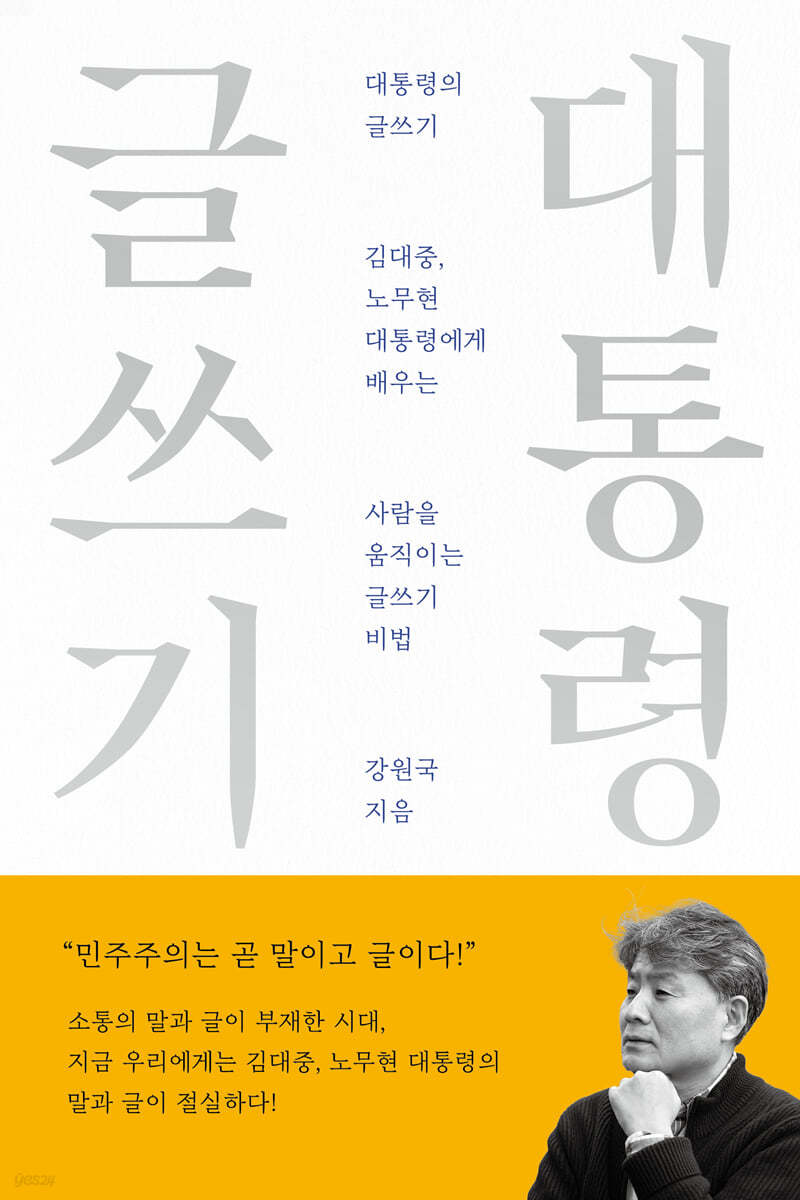
The President's Writing
 |
Description
Book Introduction
Kang Won-guk's first book, "The President's Writing"
Special edition commemorating 500,000 copies sold and 10th anniversary!
Author Kang Won-guk's first book, "The President's Writing," has sold over 500,000 copies and is celebrating its 10th anniversary with a special edition.
Author Kang Won-guk, who worked as a speech secretary at the Blue House for eight years and learned the methodology of communication in the democratic era from two of South Korea's greatest orators, Presidents Kim Dae-jung and Roh Moo-hyun.
"The President's Writing" contains not only the secrets of writing that move people's hearts that he learned from the two presidents, but also the attitudes and sincerity toward the words and writings of the two presidents, Kim Dae-jung and Roh Moo-hyun, who tried to communicate with the people.
In this 10th anniversary special edition, some content has been refined for younger readers who did not directly experience Presidents Kim Dae-jung and Roh Moo-hyun.
The observations of the two presidents, captured through the loving gaze of author Kang Won-guk, bring these two men, now historical figures, back to us.
Special edition commemorating 500,000 copies sold and 10th anniversary!
Author Kang Won-guk's first book, "The President's Writing," has sold over 500,000 copies and is celebrating its 10th anniversary with a special edition.
Author Kang Won-guk, who worked as a speech secretary at the Blue House for eight years and learned the methodology of communication in the democratic era from two of South Korea's greatest orators, Presidents Kim Dae-jung and Roh Moo-hyun.
"The President's Writing" contains not only the secrets of writing that move people's hearts that he learned from the two presidents, but also the attitudes and sincerity toward the words and writings of the two presidents, Kim Dae-jung and Roh Moo-hyun, who tried to communicate with the people.
In this 10th anniversary special edition, some content has been refined for younger readers who did not directly experience Presidents Kim Dae-jung and Roh Moo-hyun.
The observations of the two presidents, captured through the loving gaze of author Kang Won-guk, bring these two men, now historical figures, back to us.
- You can preview some of the book's contents.
Preview
index
Publishing a special edition commemorating the 10th anniversary
In this age of confusion between words and writing, I miss Presidents Kim Dae-jung and Roh Moo-hyun.
Prologue: A Call from the Blue House
1.
The 'Bomb' Dropped to the Secretary's Office - How to Overcome the Fear of Writing
2.
Two Hour Lecture at the Official Residence Table - President Roh Moo-hyun's Writing Guidelines
3.
Playing Soccer with the President - Take Time to Reflect
4.
How about the expression "people"? - Connect with your readers.
Story One: 50 Days of Writing for the Transition Committee
5.
What Prison Letters Tell Us - The Power of Focus and Immersion
6.
The Position of Blue House Leadership Secretary - The Source of Writing: Reading
7.
The president practices in front of a secretary as young as his granddaughter—it all comes down to time and effort.
8.
The story of crawling out of the bathroom after receiving a call from the president - Take note, only those who write will survive.
Story 2: Life at the Blue House and Irritable Bowel Syndrome
9.
“I don’t know what you’re trying to say” - if you don’t want your writing to be rambling
10.
Is it a solemn atmosphere? A festive atmosphere? - Set the tone.
11.
You can't make vegetables with straw sandals - data is key
12.
Writing is all about structure - how to create a structure for your writing
Story 3: “If he had apologized, wouldn’t he have been impeached?”
13.
Words and Writing Are Half the Work - 16 Ways to Get Off to a Good Start
14.
The President's Writing Tips (1) - 15 Things to Keep in Mind for Effective Writing
15.
The President's Writing Tips (2) - 20 Ways to Express Sentences
16.
All's Well That Ends Well - 12 Ways to Write a Closing Remark
Story Four: Why the Gwangbokjeol Commemorative Address Disappeared
17.
Dear citizens, the 'dog year' has dawned - A checklist for your retirement is more important than your first draft.
18.
Titles are the finishing touch to writing: How to create great titles
19.
A page of the affidavit written on the morning of March 1st - Writing is a message.
20.
The President's Resignation Speech at Bongha - The Power of Short Words
Story Five: A Tale Told by a Master Speaker
21.
The President's Language vs. the Common People's Language - Write Simply
22.
One thing President Roh ordered in writing the report: Write clearly.
23.
"Looking at the days you've lived reveals the days ahead." - Win with sincerity.
24.
Is that the only time you become president of a country? - Ad-lib is also a method.
Story Six: Become an Invisible Ghost
25.
President Kim, who wrote "Silence" on his wristwatch - Listen carefully and speak more.
26.
Five near-death experiences, six years in prison - create your own content.
27.
What's the Difference Between Video and Written Messages? Format Matters, Too
28.
The Greatest Oratory of All: Tears - Think of Images
Story Seven: A Special Journey with the President
29.
"We are strong, no matter how weak we are" - Even writing requires courage.
30.
Why Hold Readings in the Speech Secretary's Office - Actively Show Your Writing to People Around You
31.
"Cars Want to Go Home" - The Power of Humor
32.
The grand coalition proposal wasn't a surprise - timing matters.
Story Eight: Overcoming Six Crises
33.
“Bring me what he wrote” - Write your own.
34.
The Birth of the Lower Floor, Upper Floor Theory - Decorate Moderately
35.
Mandela Dinner Speech Delivered Unedited - Praise Requires Art
36.
Etiquette vs. Empathy: The Difference Between Two Presidential Speeches
Story Nine: The Blood-Drying Process of Writing an Inaugural Address
37.
A Letter of Unrequited Love to the People - There Are Times When You Need to Write a Letter
38.
He who would wear the crown, must write - The qualifications of a leader
39.
When President Kim Dae-jung folded a piece of paper in half - Writing is a healing process.
40.
When I called your name, you became a flower - The importance of naming
Story Heat: "The Glory of the Family"
Epilogue: A Happy Time with the Two Presidents
I hope that "The President's Writing" does not sell well under the new administration.
Appendix: President Kim Dae-jung's 15th Presidential Inaugural Address | President Roh Moo-hyun's 16th Presidential Inaugural Address
In this age of confusion between words and writing, I miss Presidents Kim Dae-jung and Roh Moo-hyun.
Prologue: A Call from the Blue House
1.
The 'Bomb' Dropped to the Secretary's Office - How to Overcome the Fear of Writing
2.
Two Hour Lecture at the Official Residence Table - President Roh Moo-hyun's Writing Guidelines
3.
Playing Soccer with the President - Take Time to Reflect
4.
How about the expression "people"? - Connect with your readers.
Story One: 50 Days of Writing for the Transition Committee
5.
What Prison Letters Tell Us - The Power of Focus and Immersion
6.
The Position of Blue House Leadership Secretary - The Source of Writing: Reading
7.
The president practices in front of a secretary as young as his granddaughter—it all comes down to time and effort.
8.
The story of crawling out of the bathroom after receiving a call from the president - Take note, only those who write will survive.
Story 2: Life at the Blue House and Irritable Bowel Syndrome
9.
“I don’t know what you’re trying to say” - if you don’t want your writing to be rambling
10.
Is it a solemn atmosphere? A festive atmosphere? - Set the tone.
11.
You can't make vegetables with straw sandals - data is key
12.
Writing is all about structure - how to create a structure for your writing
Story 3: “If he had apologized, wouldn’t he have been impeached?”
13.
Words and Writing Are Half the Work - 16 Ways to Get Off to a Good Start
14.
The President's Writing Tips (1) - 15 Things to Keep in Mind for Effective Writing
15.
The President's Writing Tips (2) - 20 Ways to Express Sentences
16.
All's Well That Ends Well - 12 Ways to Write a Closing Remark
Story Four: Why the Gwangbokjeol Commemorative Address Disappeared
17.
Dear citizens, the 'dog year' has dawned - A checklist for your retirement is more important than your first draft.
18.
Titles are the finishing touch to writing: How to create great titles
19.
A page of the affidavit written on the morning of March 1st - Writing is a message.
20.
The President's Resignation Speech at Bongha - The Power of Short Words
Story Five: A Tale Told by a Master Speaker
21.
The President's Language vs. the Common People's Language - Write Simply
22.
One thing President Roh ordered in writing the report: Write clearly.
23.
"Looking at the days you've lived reveals the days ahead." - Win with sincerity.
24.
Is that the only time you become president of a country? - Ad-lib is also a method.
Story Six: Become an Invisible Ghost
25.
President Kim, who wrote "Silence" on his wristwatch - Listen carefully and speak more.
26.
Five near-death experiences, six years in prison - create your own content.
27.
What's the Difference Between Video and Written Messages? Format Matters, Too
28.
The Greatest Oratory of All: Tears - Think of Images
Story Seven: A Special Journey with the President
29.
"We are strong, no matter how weak we are" - Even writing requires courage.
30.
Why Hold Readings in the Speech Secretary's Office - Actively Show Your Writing to People Around You
31.
"Cars Want to Go Home" - The Power of Humor
32.
The grand coalition proposal wasn't a surprise - timing matters.
Story Eight: Overcoming Six Crises
33.
“Bring me what he wrote” - Write your own.
34.
The Birth of the Lower Floor, Upper Floor Theory - Decorate Moderately
35.
Mandela Dinner Speech Delivered Unedited - Praise Requires Art
36.
Etiquette vs. Empathy: The Difference Between Two Presidential Speeches
Story Nine: The Blood-Drying Process of Writing an Inaugural Address
37.
A Letter of Unrequited Love to the People - There Are Times When You Need to Write a Letter
38.
He who would wear the crown, must write - The qualifications of a leader
39.
When President Kim Dae-jung folded a piece of paper in half - Writing is a healing process.
40.
When I called your name, you became a flower - The importance of naming
Story Heat: "The Glory of the Family"
Epilogue: A Happy Time with the Two Presidents
I hope that "The President's Writing" does not sell well under the new administration.
Appendix: President Kim Dae-jung's 15th Presidential Inaugural Address | President Roh Moo-hyun's 16th Presidential Inaugural Address
Detailed image
.jpg)
Into the book
Many people said that they learned how important the position of the president is, what kind of thoughts and feelings the two presidents, Kim Dae-jung and Roh Moo-hyun, had while in office, and what process and agony it took for the presidents to say what we know them to be. Many people also said that from then on, they no longer listen to the president's inaugural speeches or speeches in vain.
Above all, many people said that they were glad that the two presidents were in their country, that they were grateful, and that they missed them.
Me too.
---From “Publishing the 10th Anniversary Special Edition”
Let's say there's an employee in a company who's in charge of writing the CEO's speech.
Who should he be aware of? First, the president.
Second, the employees listening to the speech.
Third, the journalists reporting on the content of this speech.
Finally, it will be the customers, shareholders, and employees' families who will see the press articles.
Even in a single corporate speech, there are many targets.
There is no such thing as too much research on each of these.
It's not just words and writing.
The answer to how to write lies in the image of President Roh Moo-hyun spreading his legs wide to match the height of a child when taking a picture.
---「4.
What about the expression "people"? - From "Communicate with Readers"
For presidents, reading was a source of writing.
Both presidents read the book, underlining and taking notes.
The parts that are mainly helpful for writing and policy making are underlined.
President Kim Dae-jung said that the completion of reading means being able to digest the book as one's own and express it in speech or writing.
President Roh Moo-hyun also aimed to reflect the knowledge and inspiration he gained through reading in his policies or to compile his thoughts into a book.
---「6.
The position of Blue House Leadership Secretary - From "The Source of Writing is Reading"
During the so-called "3 Kims era," President Kim Dae-jung's words and speeches had a complete structure, to the point that reporters would say, "No matter how much you take YS's words, there will be nothing to write about in the end, whereas DJ's words will become news as they are."
---「12.
Writing ultimately depends on the structure of the text - from "How to create a structure for writing"
President Roh Moo-hyun always worked tirelessly to find a single word or sentence that encapsulates what he wanted to convey.
For example, the firmness against asking for favors was implied in the saying, “If you ask for favors, you will ruin your family,” and the will to eradicate real estate speculation was implied in the saying, “If Gangnam is undefeated, the president is undefeated.”
These words were an expression of the will not to succumb to the tricks of real estate agents and speculative forces.
President Roh's theory is that readers and audiences only remember one word or one sentence in a long text or long speech.
When writing, you have to find that sentence right away.
This one sentence, commonly called the topic sentence, was also called a 'slogan', 'copy', and 'proposition' by President Roh.
I've always struggled with this slogan, copy, and proposition.
---「20.
From the President's Resignation Speech in Bongha - The Power of Short Words
No one hates compliments.
The more praise you give, both verbally and in writing, the better.
This is especially true in speeches.
Both presidents were generous with their praise.
President Kim Dae-jung always included praiseworthy points in his speeches.
We also took great care to ensure that no one was left out who needed to be praised.
In a way, the position of president is a position of praise.
Complimenting hard work, encouraging those in need, and expressing gratitude for good deeds—all of these are praise.
---「35.
From the Mandela Dinner Speech, delivered without revision - Praise also requires skill
For President Kim Dae-jung, writing was a process of self-healing.
President Roh Moo-hyun did the same.
It was hard work, but I put a lot of meaning into writing.
I tried to communicate with the public through writing.
During his tenure, he created a so-called 'writing group' and personally chaired meetings.
It was a gathering of people who wrote a lot inside the Blue House.
There was no special purpose.
It was because I felt like I had to write something down.
Perhaps he wanted to be evaluated by history by leaving a message.
And in his memoir, he called writing a 'struggle to survive.'
When the President couldn't write, hope was also lost.
---「39.
When President Kim Dae-jung folded the paper in half - Writing is a healing process
There were many people who were good at writing and had many thoughts.
But there weren't many people who had thoughts, could put them into words, and put those thoughts into practice.
I think that if a piece of writing ends with just writing, it has no meaning.
Writing must go hand in hand with action.
I met two unusual people who made that possible.
It was truly an honor beyond my means.
Above all, many people said that they were glad that the two presidents were in their country, that they were grateful, and that they missed them.
Me too.
---From “Publishing the 10th Anniversary Special Edition”
Let's say there's an employee in a company who's in charge of writing the CEO's speech.
Who should he be aware of? First, the president.
Second, the employees listening to the speech.
Third, the journalists reporting on the content of this speech.
Finally, it will be the customers, shareholders, and employees' families who will see the press articles.
Even in a single corporate speech, there are many targets.
There is no such thing as too much research on each of these.
It's not just words and writing.
The answer to how to write lies in the image of President Roh Moo-hyun spreading his legs wide to match the height of a child when taking a picture.
---「4.
What about the expression "people"? - From "Communicate with Readers"
For presidents, reading was a source of writing.
Both presidents read the book, underlining and taking notes.
The parts that are mainly helpful for writing and policy making are underlined.
President Kim Dae-jung said that the completion of reading means being able to digest the book as one's own and express it in speech or writing.
President Roh Moo-hyun also aimed to reflect the knowledge and inspiration he gained through reading in his policies or to compile his thoughts into a book.
---「6.
The position of Blue House Leadership Secretary - From "The Source of Writing is Reading"
During the so-called "3 Kims era," President Kim Dae-jung's words and speeches had a complete structure, to the point that reporters would say, "No matter how much you take YS's words, there will be nothing to write about in the end, whereas DJ's words will become news as they are."
---「12.
Writing ultimately depends on the structure of the text - from "How to create a structure for writing"
President Roh Moo-hyun always worked tirelessly to find a single word or sentence that encapsulates what he wanted to convey.
For example, the firmness against asking for favors was implied in the saying, “If you ask for favors, you will ruin your family,” and the will to eradicate real estate speculation was implied in the saying, “If Gangnam is undefeated, the president is undefeated.”
These words were an expression of the will not to succumb to the tricks of real estate agents and speculative forces.
President Roh's theory is that readers and audiences only remember one word or one sentence in a long text or long speech.
When writing, you have to find that sentence right away.
This one sentence, commonly called the topic sentence, was also called a 'slogan', 'copy', and 'proposition' by President Roh.
I've always struggled with this slogan, copy, and proposition.
---「20.
From the President's Resignation Speech in Bongha - The Power of Short Words
No one hates compliments.
The more praise you give, both verbally and in writing, the better.
This is especially true in speeches.
Both presidents were generous with their praise.
President Kim Dae-jung always included praiseworthy points in his speeches.
We also took great care to ensure that no one was left out who needed to be praised.
In a way, the position of president is a position of praise.
Complimenting hard work, encouraging those in need, and expressing gratitude for good deeds—all of these are praise.
---「35.
From the Mandela Dinner Speech, delivered without revision - Praise also requires skill
For President Kim Dae-jung, writing was a process of self-healing.
President Roh Moo-hyun did the same.
It was hard work, but I put a lot of meaning into writing.
I tried to communicate with the public through writing.
During his tenure, he created a so-called 'writing group' and personally chaired meetings.
It was a gathering of people who wrote a lot inside the Blue House.
There was no special purpose.
It was because I felt like I had to write something down.
Perhaps he wanted to be evaluated by history by leaving a message.
And in his memoir, he called writing a 'struggle to survive.'
When the President couldn't write, hope was also lost.
---「39.
When President Kim Dae-jung folded the paper in half - Writing is a healing process
There were many people who were good at writing and had many thoughts.
But there weren't many people who had thoughts, could put them into words, and put those thoughts into practice.
I think that if a piece of writing ends with just writing, it has no meaning.
Writing must go hand in hand with action.
I met two unusual people who made that possible.
It was truly an honor beyond my means.
---From "Story Heat: "The Glory of the Family""
Publisher's Review
Kang Won-guk's first book, "The President's Writing"
10th Anniversary Special Edition Released!
The first book in Kangwon-guk's life, "The President's Writing," which made him who he is today, has celebrated its 10th anniversary.
“The President’s Writing,” which has long been loved by readers, began with the ‘order’ of the late President Roh Moo-hyun.
“We need to raise the level of writing in our country.
This is especially true for public officials.
Write a book about writing.
“Write a book sharing the writing know-how you learned while working in the speechwriting office.”
This book, published in response to the current president's 'order' to publish a book on writing know-how in order to raise the standard of writing in our country, has since brought about two major changes.
First, it led to a boom in books related to writing.
This book, which summarizes the writing secrets of two presidents, Kim Dae-jung and Roh Moo-hyun, into 40 points, was selected as the Book of the Year by a major daily newspaper in 2014 and received praise from numerous readers, which subsequently led to the expansion of the writing-related book market.
The second is the birth of writer Kang Won-guk.
Author Kang Won-guk, who worked as a speechwriter for Daewoo Group Chairman Kim Woo-choong and Hyosung Group Chairman Cho Seok-rae, and as a speech secretary at the Blue House, has refined the words and writings of others. This book has led him to pursue the path of an author, lecturer, and broadcaster who speaks and writes his own words.
The Secret to 10 Years of Reader Love for "The President's Writing"
《The President's Writing》 has met with countless readers over the past 10 years.
Students, job seekers, office workers, and civil servants have consistently commented that this book has been very helpful in writing self-introductions, taking essay tests, and writing reports.
On the other hand, there were those who said that through this book, they learned how important the position of the president is, what thoughts and feelings the two presidents, Kim Dae-jung and Roh Moo-hyun, had while in that position, usually had while approaching state affairs, and what process and agony they went through to write a single speech.
Some people said that after reading this book, they stopped listening to the president's inaugural speeches and speeches in vain.
And now that they know what kind of people the two presidents were, there were many who said they were really glad to have them, were thankful, and wanted to see them.
The fact that this book has been consistently read for ten years is thanks to those who miss Presidents Kim Dae-jung and Roh Moo-hyun, who brought about the era of democracy through words and writing.
“Democracy is words and writing!”
An era in which democracy was realized through speech and writing,
We have Presidents Kim Dae-jung and Roh Moo-hyun!
Those who experienced President Park Geun-hye's silence and silence through the Choi Soon-sil Gate scandal in 2016 came to realize the stark reality that "the president governs through her words and writings, and her words and writings are the very power of the president."
Especially in times of lack of communication, when the president's words and writings waver, I find myself looking back at the words and writings of Kim Dae-jung and Roh Moo-hyun.
Because the crisis of speech and writing is the crisis of the president, and the crisis of the president is the crisis of the Republic of Korea.
President Kim Dae-jung, who once said, “A leader must be able to speak and write his thoughts in an organized, easy, and concise manner,” persuaded the people through words and writings honed through reading until the end of his life. President Roh Moo-hyun, who once said, “You cannot be a leader if you cannot write your own speeches,” meticulously polished each word and writing to communicate with the people in the honest and straightforward language of the common people.
We are grateful and fortunate just to have had two presidents like these.
Kim Dae-jung, whose words were like writing, vs. President Roh Moo-hyun, who wrote like he spoke.
― The words and writings of the two presidents as seen through Kang Won-guk's loving gaze
The president conveys his will to the people and governs through speeches.
Presidents Kim Dae-jung and Roh Moo-hyun, who have been struggling with how to move the hearts of the people, each preferred similar yet different methods.
Kang Won-guk, who served as a speech secretary for eight years, pointed out the differences between the two presidents in detail.
President Kim Dae-jung, who placed great importance on logic, sought to have a logical structure of introduction, development, turn, and conclusion even in short texts such as written messages or congratulatory messages, so much so that his words could be put into writing without any problems.
“Life is beautiful and history moves forward”, “Sunshine Policy”, etc., so that anyone can easily understand, metaphors and proverbs were frequently used to express it as simply and clearly as possible.
Because he mainly used expressions of humility and liked to explain things in a kind and detailed manner, his speeches were generally long.
President Roh Moo-hyun often used dynamic, honest, straightforward, and emphatic language, trying to write as if speaking in the language of the common people that anyone could easily understand. He tried to include his own unique logic and arguments rather than general theories, preferred confident expressions over humble ones, and preferred interactive speeches that directly interacted with the audience on the spot.
The differences in the writing styles of these two presidents provide readers with a guide to find a writing style that suits them.
The 10th Anniversary Special Edition includes the presidential inauguration speeches of Presidents Kim Dae-jung and Roh Moo-hyun, which are considered the pinnacle of their speeches, as an appendix. This allows readers to see not only the differences in the format of the two presidents' speeches, but also how the two presidents intended to run the country.
10th Anniversary Special Edition Released!
The first book in Kangwon-guk's life, "The President's Writing," which made him who he is today, has celebrated its 10th anniversary.
“The President’s Writing,” which has long been loved by readers, began with the ‘order’ of the late President Roh Moo-hyun.
“We need to raise the level of writing in our country.
This is especially true for public officials.
Write a book about writing.
“Write a book sharing the writing know-how you learned while working in the speechwriting office.”
This book, published in response to the current president's 'order' to publish a book on writing know-how in order to raise the standard of writing in our country, has since brought about two major changes.
First, it led to a boom in books related to writing.
This book, which summarizes the writing secrets of two presidents, Kim Dae-jung and Roh Moo-hyun, into 40 points, was selected as the Book of the Year by a major daily newspaper in 2014 and received praise from numerous readers, which subsequently led to the expansion of the writing-related book market.
The second is the birth of writer Kang Won-guk.
Author Kang Won-guk, who worked as a speechwriter for Daewoo Group Chairman Kim Woo-choong and Hyosung Group Chairman Cho Seok-rae, and as a speech secretary at the Blue House, has refined the words and writings of others. This book has led him to pursue the path of an author, lecturer, and broadcaster who speaks and writes his own words.
The Secret to 10 Years of Reader Love for "The President's Writing"
《The President's Writing》 has met with countless readers over the past 10 years.
Students, job seekers, office workers, and civil servants have consistently commented that this book has been very helpful in writing self-introductions, taking essay tests, and writing reports.
On the other hand, there were those who said that through this book, they learned how important the position of the president is, what thoughts and feelings the two presidents, Kim Dae-jung and Roh Moo-hyun, had while in that position, usually had while approaching state affairs, and what process and agony they went through to write a single speech.
Some people said that after reading this book, they stopped listening to the president's inaugural speeches and speeches in vain.
And now that they know what kind of people the two presidents were, there were many who said they were really glad to have them, were thankful, and wanted to see them.
The fact that this book has been consistently read for ten years is thanks to those who miss Presidents Kim Dae-jung and Roh Moo-hyun, who brought about the era of democracy through words and writing.
“Democracy is words and writing!”
An era in which democracy was realized through speech and writing,
We have Presidents Kim Dae-jung and Roh Moo-hyun!
Those who experienced President Park Geun-hye's silence and silence through the Choi Soon-sil Gate scandal in 2016 came to realize the stark reality that "the president governs through her words and writings, and her words and writings are the very power of the president."
Especially in times of lack of communication, when the president's words and writings waver, I find myself looking back at the words and writings of Kim Dae-jung and Roh Moo-hyun.
Because the crisis of speech and writing is the crisis of the president, and the crisis of the president is the crisis of the Republic of Korea.
President Kim Dae-jung, who once said, “A leader must be able to speak and write his thoughts in an organized, easy, and concise manner,” persuaded the people through words and writings honed through reading until the end of his life. President Roh Moo-hyun, who once said, “You cannot be a leader if you cannot write your own speeches,” meticulously polished each word and writing to communicate with the people in the honest and straightforward language of the common people.
We are grateful and fortunate just to have had two presidents like these.
Kim Dae-jung, whose words were like writing, vs. President Roh Moo-hyun, who wrote like he spoke.
― The words and writings of the two presidents as seen through Kang Won-guk's loving gaze
The president conveys his will to the people and governs through speeches.
Presidents Kim Dae-jung and Roh Moo-hyun, who have been struggling with how to move the hearts of the people, each preferred similar yet different methods.
Kang Won-guk, who served as a speech secretary for eight years, pointed out the differences between the two presidents in detail.
President Kim Dae-jung, who placed great importance on logic, sought to have a logical structure of introduction, development, turn, and conclusion even in short texts such as written messages or congratulatory messages, so much so that his words could be put into writing without any problems.
“Life is beautiful and history moves forward”, “Sunshine Policy”, etc., so that anyone can easily understand, metaphors and proverbs were frequently used to express it as simply and clearly as possible.
Because he mainly used expressions of humility and liked to explain things in a kind and detailed manner, his speeches were generally long.
President Roh Moo-hyun often used dynamic, honest, straightforward, and emphatic language, trying to write as if speaking in the language of the common people that anyone could easily understand. He tried to include his own unique logic and arguments rather than general theories, preferred confident expressions over humble ones, and preferred interactive speeches that directly interacted with the audience on the spot.
The differences in the writing styles of these two presidents provide readers with a guide to find a writing style that suits them.
The 10th Anniversary Special Edition includes the presidential inauguration speeches of Presidents Kim Dae-jung and Roh Moo-hyun, which are considered the pinnacle of their speeches, as an appendix. This allows readers to see not only the differences in the format of the two presidents' speeches, but also how the two presidents intended to run the country.
GOODS SPECIFICS
- Date of issue: April 10, 2024
- Pages, weight, size: 376 pages | 580g | 140*210*20mm
- ISBN13: 9791157063482
- ISBN10: 1157063489
You may also like
카테고리
korean


korean

![GQ KOREA Mark (Monthly): December [2025]](http://librairie.coreenne.fr/cdn/shop/files/8ef265dbbfbf186523ed75ba7319009d.jpg?v=1765340328&width=3840)


