

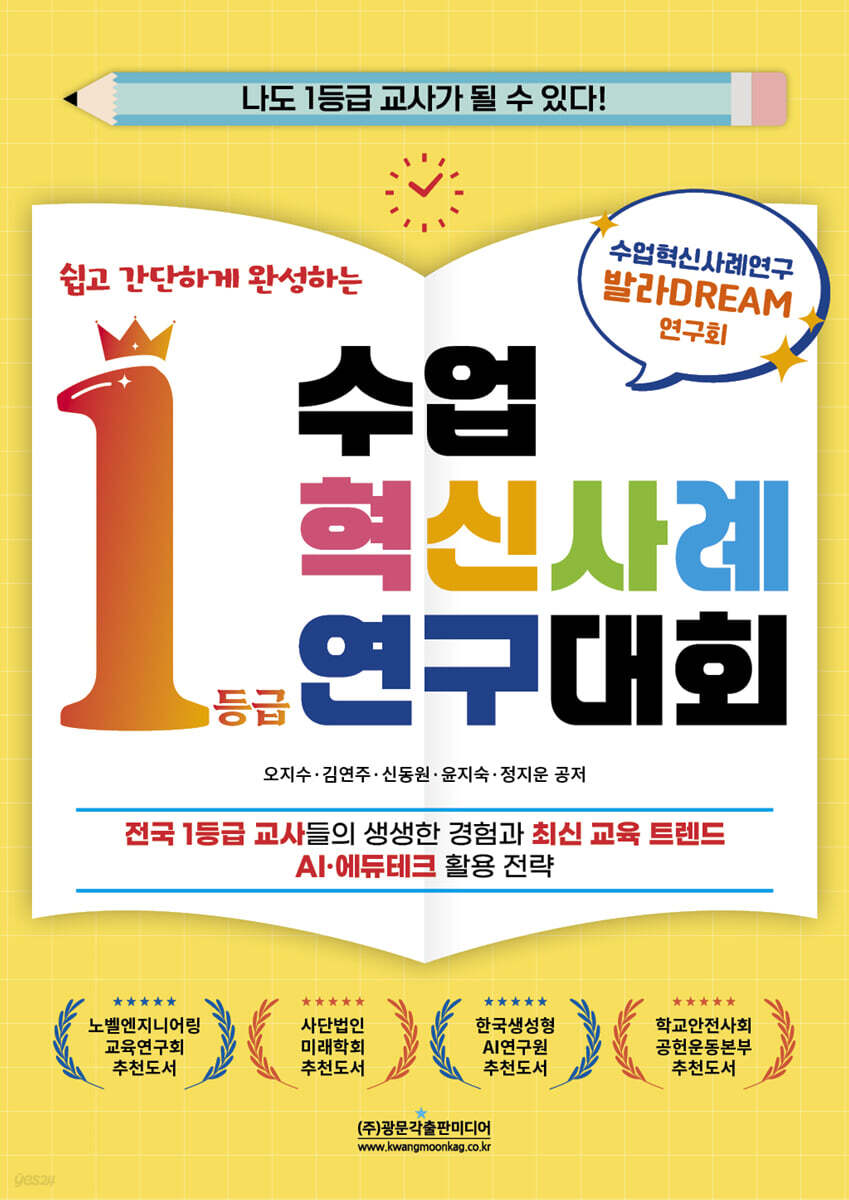
1st place in the Easy and Simple Class Innovation Case Study Contest
 |
Description
index
Recommendation
preface
Prologue: Reflection on Classrooms, the Beginning of Innovation - Classroom Innovation Case Study Conference
Chapter 01.
A Complete Analysis of the Class Innovation Case Study Contest
1.
What is the Class Innovation Case Study Contest?
go.
Introduction to the Class Innovation Case Study Contest
me.
Purpose and significance of the competition
all.
Reading the changing trends of the competition
la.
Structure of competition operation
mind.
Annual Promotion Schedule
2.
How to participate in the Class Innovation Case Study Contest?
go.
Research areas and participation forms
me.
Submission Conditions and Notes
all.
Judging criteria and scoring
la.
Grading method and ratio
mind.
Awards and follow-up support system
bar.
Submission materials and methods, notes
Chapter 02.
Setting a different research direction from the beginning
1.
Designing a proactive research environment
go.
Is it better to be a homeroom teacher or a subject teacher?
me.
Which grade is best for research?
all.
Which area is more advantageous: academics, creative writing, or convergence?
la.
What criteria should I use to select subjects, creative fields, and convergence areas?
Ma. Analyze the research environment through self-assessment of faculty competencies related to AI and edutech utilization.
2.
Analysis and reflection of the latest educational trends
go.
Implications for Research Directions through Analysis of the Ministry of Education's Website Policy Key Work Plan
me.
Establishing research directions through analysis of the objectives of research conferences organized by the Ministry of Education and city/provincial offices of education.
all.
Establishing research direction through analysis of the previous year's nationally ranked research results
la.
Establishing research directions that reflect educational theories emphasized in the era of digital transformation.
mind.
Setting research directions using Edunet, Together School, and Knowledge Spring
3.
2022 Revised Curriculum Overview and Analysis and Reflection of Curriculum Characteristics
go.
Key contents and research implications of the 2022 revised curriculum
me.
Key contents of the curriculum and implications for research directions
4.
Analysis and reflection of learner characteristics
5.
Purpose and necessity of analyzing prior research
Chapter 03.
Research titles that captivate judges
1.
Conditions for a noteworthy research title
Chapter 04.
How to Write a Persuasive Research Proposal
1.
Robust research design
go.
Research design process
me.
Setting research direction and checking research title
all.
Key elements of research design
la.
A modified version of the research design elements (example) Report ⑤
2.
How to Write a Solid Research Proposal
Chapter 05.
Research Report Structure Strategy
1.
Mastering Research Reports
2.
Write a report outline
Chapter 06.
A Step-by-Step Guide to Writing a Research Report
1.
Research Report Phase 1 - Getting Started
go.
The need for research
me.
Purpose of the study
all.
Definition of Terms
2.
Research Report Step 2 - Preparation
go.
Theoretical background
me.
Analysis of prior research
all.
Fact-finding survey
la.
Research subjects and effectiveness verification plan
mind.
Research Outlook
bar.
Creating conditions
3.
Research Report Step 3 - Implementation
go.
Program design
me.
Run the program
all.
Research generalization
4.
Research Report Step 4 - Results
go.
Research validation methods
me.
Quantitative verification
all.
Qualitative verification
la.
Research Conclusions and Recommendations
Chapter 07.
How to Write a Meaningful Appendix
1.
Teaching and Learning Process Plan
go.
Selection of teaching and learning curriculum
me.
Writing tips for each key element
2.
Class log
3.
Other materials
Chapter 08.
How to Write a Summary That's Easy to Understand at a Glance
1.
Tips for Writing a Summary
go.
When will it be written?
me.
What items should I include?
all.
How should the portions be distributed?
la.
How to design
2.
Analysis of sample abstracts
Chapter 09.
Report Editing Strategies for Completing a Grade 1 Research Report
1.
Portion distribution strategy
2.
Document Design Strategy
go.
Organizing titles and subheadings
me.
Uniform format
all.
Emphasis and moderation
la.
Strategic Use of Visuals
3.
Data organization strategy
go.
Student Results Summary
me.
Placement of teacher and student comments
all.
Organizing class materials and activity sheets
la.
Strategizing the way data is presented
mind.
Technical standards for data organization
4.
Photo attachment strategy
go.
Selecting meaningful class scenes
me.
Ensuring connectivity with the flow of the text
all.
Using captions to help understand visual materials
la.
Composing materials for black and white printing
mind.
Tips for Using Editing Tools
Chapter 10.
How to film a vivid class video
1.
Preliminary preparation stage
go.
Check the class video review criteria and submission method
me.
Selecting a class that can show the core of the research
all.
Deciding on the shooting equipment and shooting method
la.
Repeated practice for utilizing edtech tools
mind.
Pre-learning the flow of online open classes
bar.
Pre-recording of practice lessons
2.
Steps for filming class videos
go.
Check before class!
me.
Setting the shooting position and angle
all.
Strategic placement of student seats
la.
Preparing for emergencies in EdTech-based classes
mind.
Calm response in a mistake situation
bar.
Consider making classes public
3.
Editing and summarizing class videos
go.
Selecting an editing program
me.
Insert subtitles
all.
Utilize close-up and zoom-in features
la.
volume control
mind.
Summary video production
bar.
Confirm consistency between the teaching/learning curriculum and class videos
4.
Practical tips
go.
Don't be too burdened by filming and editing.
me.
Let's finish filming the class videos by mid-June at the latest.
all.
Let's get into the habit of recording every public class.
la.
Get the portrait rights consent form in advance.
Chapter 11.
Research Contest Timeline: From Competition Selection to Submission
1.
Prologue: Selecting a Research Competition
2.
February-March: Building a research foundation
3.
April to June: Conducting and documenting research
4.
July-September: Submissions and preparation for national competitions
Chapter 12.
Into the field investigation through case studies
1.
D-day 1.2.3. Field Trip to Develop HIM (Power) in Math with PLAN
2.
Developing MIRRAE citizenship skills through the GPT Lively Program, a customized student book.
3.
Developing core English skills through story-based international collaborative WORLD projects.
Chapter 13.
A third-class city/provincial competition report is reborn as a first-class national report.
1. Become an ON citizen through the HI-COSE program
2.
D-day 1.2.3. Developing HIM (Strength) in Math with PLAN
3.
Developing core English skills through story-based international collaborative WORLD projects.
4.
Developing MIRRAE citizenship skills through the GPT Lively Program, a customized student book.
5.
Student-tailored CHAT
Developing Collaborative Communication Skills in Science Classes
Chapter 14.
(Practical) Establishing a Research Plan Easily and Simply
1.
Developing my research plan
2.
Choosing a Notable Research Title
3.
Designing a Robust Study
Chapter 15.
(Practical) Strategies for Using EdTech in the Classroom
1. AI/Edutech Selection Criteria
2.
AI and EdTech Application Cases at Each Class Level
go.
Introduction phase
me.
Development stage
all.
Clean-up stage
3.
Setting your own edtech selection criteria
Chapter 16.
The Secret to Top-Ranking Research: Complete Your Checklist
1.
Research Proposal Essentials Checklist at a Glance
2.
A Compass for Research and Practice by Period to Achieve Grade 1
3.
Final Check Guide for Perfect Submission
Chapter 17.
Q&A on the Classroom Innovation Case Study Contest
1.
A small but helpful Q&A from the research conference
Conclusion: The Classroom Innovation Case Study Contest: Beyond Its Value
preface
Prologue: Reflection on Classrooms, the Beginning of Innovation - Classroom Innovation Case Study Conference
Chapter 01.
A Complete Analysis of the Class Innovation Case Study Contest
1.
What is the Class Innovation Case Study Contest?
go.
Introduction to the Class Innovation Case Study Contest
me.
Purpose and significance of the competition
all.
Reading the changing trends of the competition
la.
Structure of competition operation
mind.
Annual Promotion Schedule
2.
How to participate in the Class Innovation Case Study Contest?
go.
Research areas and participation forms
me.
Submission Conditions and Notes
all.
Judging criteria and scoring
la.
Grading method and ratio
mind.
Awards and follow-up support system
bar.
Submission materials and methods, notes
Chapter 02.
Setting a different research direction from the beginning
1.
Designing a proactive research environment
go.
Is it better to be a homeroom teacher or a subject teacher?
me.
Which grade is best for research?
all.
Which area is more advantageous: academics, creative writing, or convergence?
la.
What criteria should I use to select subjects, creative fields, and convergence areas?
Ma. Analyze the research environment through self-assessment of faculty competencies related to AI and edutech utilization.
2.
Analysis and reflection of the latest educational trends
go.
Implications for Research Directions through Analysis of the Ministry of Education's Website Policy Key Work Plan
me.
Establishing research directions through analysis of the objectives of research conferences organized by the Ministry of Education and city/provincial offices of education.
all.
Establishing research direction through analysis of the previous year's nationally ranked research results
la.
Establishing research directions that reflect educational theories emphasized in the era of digital transformation.
mind.
Setting research directions using Edunet, Together School, and Knowledge Spring
3.
2022 Revised Curriculum Overview and Analysis and Reflection of Curriculum Characteristics
go.
Key contents and research implications of the 2022 revised curriculum
me.
Key contents of the curriculum and implications for research directions
4.
Analysis and reflection of learner characteristics
5.
Purpose and necessity of analyzing prior research
Chapter 03.
Research titles that captivate judges
1.
Conditions for a noteworthy research title
Chapter 04.
How to Write a Persuasive Research Proposal
1.
Robust research design
go.
Research design process
me.
Setting research direction and checking research title
all.
Key elements of research design
la.
A modified version of the research design elements (example) Report ⑤
2.
How to Write a Solid Research Proposal
Chapter 05.
Research Report Structure Strategy
1.
Mastering Research Reports
2.
Write a report outline
Chapter 06.
A Step-by-Step Guide to Writing a Research Report
1.
Research Report Phase 1 - Getting Started
go.
The need for research
me.
Purpose of the study
all.
Definition of Terms
2.
Research Report Step 2 - Preparation
go.
Theoretical background
me.
Analysis of prior research
all.
Fact-finding survey
la.
Research subjects and effectiveness verification plan
mind.
Research Outlook
bar.
Creating conditions
3.
Research Report Step 3 - Implementation
go.
Program design
me.
Run the program
all.
Research generalization
4.
Research Report Step 4 - Results
go.
Research validation methods
me.
Quantitative verification
all.
Qualitative verification
la.
Research Conclusions and Recommendations
Chapter 07.
How to Write a Meaningful Appendix
1.
Teaching and Learning Process Plan
go.
Selection of teaching and learning curriculum
me.
Writing tips for each key element
2.
Class log
3.
Other materials
Chapter 08.
How to Write a Summary That's Easy to Understand at a Glance
1.
Tips for Writing a Summary
go.
When will it be written?
me.
What items should I include?
all.
How should the portions be distributed?
la.
How to design
2.
Analysis of sample abstracts
Chapter 09.
Report Editing Strategies for Completing a Grade 1 Research Report
1.
Portion distribution strategy
2.
Document Design Strategy
go.
Organizing titles and subheadings
me.
Uniform format
all.
Emphasis and moderation
la.
Strategic Use of Visuals
3.
Data organization strategy
go.
Student Results Summary
me.
Placement of teacher and student comments
all.
Organizing class materials and activity sheets
la.
Strategizing the way data is presented
mind.
Technical standards for data organization
4.
Photo attachment strategy
go.
Selecting meaningful class scenes
me.
Ensuring connectivity with the flow of the text
all.
Using captions to help understand visual materials
la.
Composing materials for black and white printing
mind.
Tips for Using Editing Tools
Chapter 10.
How to film a vivid class video
1.
Preliminary preparation stage
go.
Check the class video review criteria and submission method
me.
Selecting a class that can show the core of the research
all.
Deciding on the shooting equipment and shooting method
la.
Repeated practice for utilizing edtech tools
mind.
Pre-learning the flow of online open classes
bar.
Pre-recording of practice lessons
2.
Steps for filming class videos
go.
Check before class!
me.
Setting the shooting position and angle
all.
Strategic placement of student seats
la.
Preparing for emergencies in EdTech-based classes
mind.
Calm response in a mistake situation
bar.
Consider making classes public
3.
Editing and summarizing class videos
go.
Selecting an editing program
me.
Insert subtitles
all.
Utilize close-up and zoom-in features
la.
volume control
mind.
Summary video production
bar.
Confirm consistency between the teaching/learning curriculum and class videos
4.
Practical tips
go.
Don't be too burdened by filming and editing.
me.
Let's finish filming the class videos by mid-June at the latest.
all.
Let's get into the habit of recording every public class.
la.
Get the portrait rights consent form in advance.
Chapter 11.
Research Contest Timeline: From Competition Selection to Submission
1.
Prologue: Selecting a Research Competition
2.
February-March: Building a research foundation
3.
April to June: Conducting and documenting research
4.
July-September: Submissions and preparation for national competitions
Chapter 12.
Into the field investigation through case studies
1.
D-day 1.2.3. Field Trip to Develop HIM (Power) in Math with PLAN
2.
Developing MIRRAE citizenship skills through the GPT Lively Program, a customized student book.
3.
Developing core English skills through story-based international collaborative WORLD projects.
Chapter 13.
A third-class city/provincial competition report is reborn as a first-class national report.
1. Become an ON citizen through the HI-COSE program
2.
D-day 1.2.3. Developing HIM (Strength) in Math with PLAN
3.
Developing core English skills through story-based international collaborative WORLD projects.
4.
Developing MIRRAE citizenship skills through the GPT Lively Program, a customized student book.
5.
Student-tailored CHAT
Developing Collaborative Communication Skills in Science Classes
Chapter 14.
(Practical) Establishing a Research Plan Easily and Simply
1.
Developing my research plan
2.
Choosing a Notable Research Title
3.
Designing a Robust Study
Chapter 15.
(Practical) Strategies for Using EdTech in the Classroom
1. AI/Edutech Selection Criteria
2.
AI and EdTech Application Cases at Each Class Level
go.
Introduction phase
me.
Development stage
all.
Clean-up stage
3.
Setting your own edtech selection criteria
Chapter 16.
The Secret to Top-Ranking Research: Complete Your Checklist
1.
Research Proposal Essentials Checklist at a Glance
2.
A Compass for Research and Practice by Period to Achieve Grade 1
3.
Final Check Guide for Perfect Submission
Chapter 17.
Q&A on the Classroom Innovation Case Study Contest
1.
A small but helpful Q&A from the research conference
Conclusion: The Classroom Innovation Case Study Contest: Beyond Its Value
Detailed image

Publisher's Review
When I recall the first time I took on the Class Innovation Case Study Contest, I still feel a twinge of excitement and nervousness.
"Can I do it too?", "Where should I start?" I confess that the beginning, filled with a mixture of confusion, fear, and unknown expectations, was not much different from the feelings of the teachers who opened this book.
Preparing for the research conference was by no means an easy journey.
I vividly remember researching countless resources, pondering research topics and directions, and hesitating late into the night before even writing the first sentence of my report.
Failure, frustration, and the joy of small successes were repeated every day, and looking back, every moment was a moment of growth and remains as a warm and beautiful memory.
The Class Innovation Case Study Contest is not simply a process of accumulating achievements.
As a teacher, it was a valuable experience that allowed me to deeply reflect on my classes, grow with my students, and once again feel the rewards and pride of teaching.
Preparing for this competition allowed me to focus more on the small changes each student makes, and sharing ideas with fellow teachers allowed me to experience the power of transforming classrooms and, by extension, schools.
This book was started with the hope of alleviating some of the sense of helplessness and fear felt by teachers who are taking on this challenge for the first time.
As the title suggests, “Easy and Simple,” we wanted to create a book with friendly explanations and detailed guidance that anyone can follow right away, rather than complicated explanations or difficult terms.
In particular, this book contains the vivid experiences of top-tier teachers nationwide, the latest educational trends, and even strategies for utilizing AI and edutech.
By reading and following through each step of the preparation process for the Classroom Innovation Case Study Contest—from writing a research plan, selecting a research topic and title, to writing a report and filming a class video, to preparing for the field trip—I promise you'll have the amazing experience of transforming your fear of "Can I do this?" into the confidence of "I can do it, too."
For teachers who have experience participating in research competitions and winning awards but unfortunately haven't achieved top grades, I believe the workbook and checklist in this book will be a great help in incorporating their unique teaching expertise into their reports.
By honestly sharing the trials, errors, failures, and vivid growth experiences of five top-tier teachers across the country, I hope to help you overcome any obstacles you may have encountered during your research.
Of course, this book isn't the answer to everything.
Each city/province competition has different detailed judging criteria, and the same report may be evaluated differently depending on the judge's perspective.
The methods and know-how presented in this book are merely a guide. We hope that each teacher will flexibly apply them to their own circumstances and teaching practices, adding their own unique touches.
It's okay if it's not perfect.
What matters is the challenge, and the learning and growth that comes from it.
The Classroom Innovation Case Study Contest will serve as a valuable starting point for driving change for both teachers and students.
Start making small changes now with this book.
Your challenge will change your classroom and your life as a teacher.
We sincerely support your challenges and growth.
I hope this book will be a strong companion for you on your first steps.
And I hope that one day your story will become a seed of courage and change for other teachers and students.
On a cool, breezy day in 2025,
With humility, I present to you five authors.
"Can I do it too?", "Where should I start?" I confess that the beginning, filled with a mixture of confusion, fear, and unknown expectations, was not much different from the feelings of the teachers who opened this book.
Preparing for the research conference was by no means an easy journey.
I vividly remember researching countless resources, pondering research topics and directions, and hesitating late into the night before even writing the first sentence of my report.
Failure, frustration, and the joy of small successes were repeated every day, and looking back, every moment was a moment of growth and remains as a warm and beautiful memory.
The Class Innovation Case Study Contest is not simply a process of accumulating achievements.
As a teacher, it was a valuable experience that allowed me to deeply reflect on my classes, grow with my students, and once again feel the rewards and pride of teaching.
Preparing for this competition allowed me to focus more on the small changes each student makes, and sharing ideas with fellow teachers allowed me to experience the power of transforming classrooms and, by extension, schools.
This book was started with the hope of alleviating some of the sense of helplessness and fear felt by teachers who are taking on this challenge for the first time.
As the title suggests, “Easy and Simple,” we wanted to create a book with friendly explanations and detailed guidance that anyone can follow right away, rather than complicated explanations or difficult terms.
In particular, this book contains the vivid experiences of top-tier teachers nationwide, the latest educational trends, and even strategies for utilizing AI and edutech.
By reading and following through each step of the preparation process for the Classroom Innovation Case Study Contest—from writing a research plan, selecting a research topic and title, to writing a report and filming a class video, to preparing for the field trip—I promise you'll have the amazing experience of transforming your fear of "Can I do this?" into the confidence of "I can do it, too."
For teachers who have experience participating in research competitions and winning awards but unfortunately haven't achieved top grades, I believe the workbook and checklist in this book will be a great help in incorporating their unique teaching expertise into their reports.
By honestly sharing the trials, errors, failures, and vivid growth experiences of five top-tier teachers across the country, I hope to help you overcome any obstacles you may have encountered during your research.
Of course, this book isn't the answer to everything.
Each city/province competition has different detailed judging criteria, and the same report may be evaluated differently depending on the judge's perspective.
The methods and know-how presented in this book are merely a guide. We hope that each teacher will flexibly apply them to their own circumstances and teaching practices, adding their own unique touches.
It's okay if it's not perfect.
What matters is the challenge, and the learning and growth that comes from it.
The Classroom Innovation Case Study Contest will serve as a valuable starting point for driving change for both teachers and students.
Start making small changes now with this book.
Your challenge will change your classroom and your life as a teacher.
We sincerely support your challenges and growth.
I hope this book will be a strong companion for you on your first steps.
And I hope that one day your story will become a seed of courage and change for other teachers and students.
On a cool, breezy day in 2025,
With humility, I present to you five authors.
GOODS SPECIFICS
- Date of issue: July 30, 2025
- Page count, weight, size: 272 pages | 642g | 174*246*16mm
- ISBN13: 9791193205679
- ISBN10: 1193205670
You may also like
카테고리
korean


korean

![GQ KOREA Mark (Monthly): December [2025]](http://librairie.coreenne.fr/cdn/shop/files/8ef265dbbfbf186523ed75ba7319009d.jpg?v=1765340328&width=3840)


