

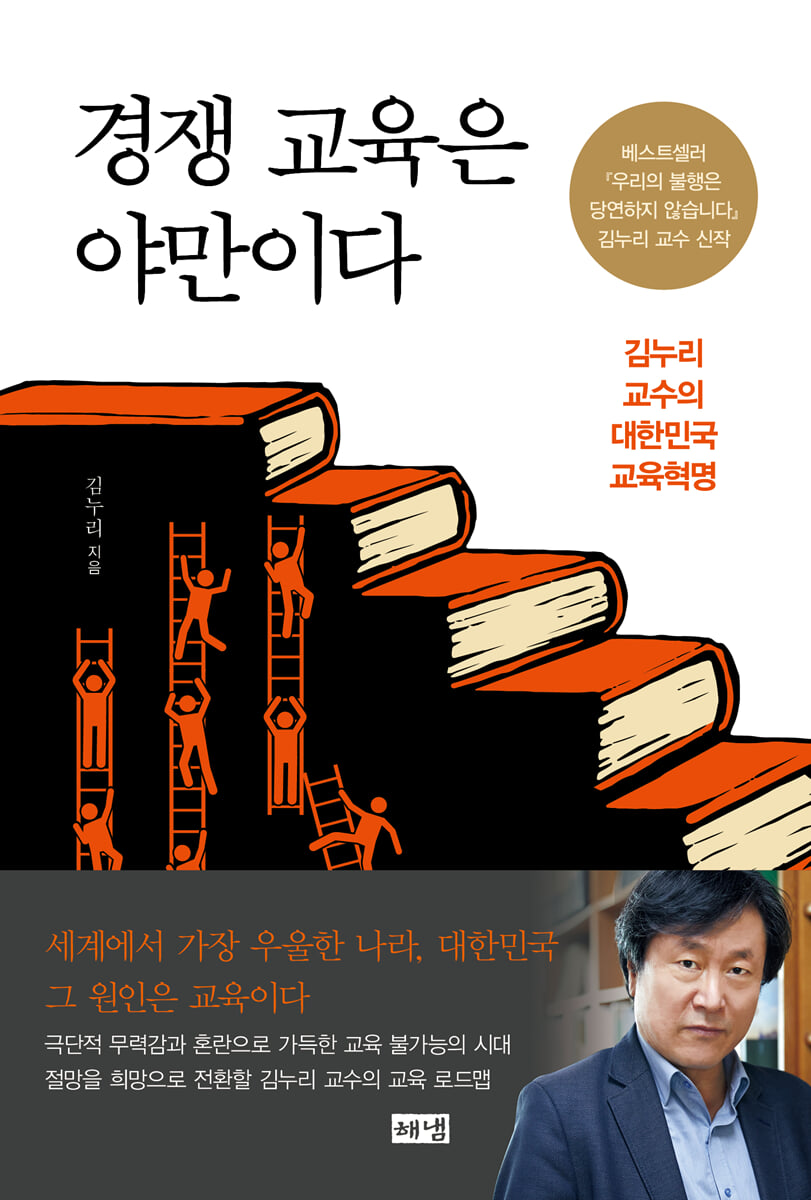
Competitive education is barbaric
 |
Description
Book Introduction
Our society's future depends on education change. Professor Kim Nu-ri shares the true face of Korean education and offers revolutionary solutions. A book that will save our children from deep-rooted misfortune! “I traveled to the most depressing country in the world.” This comment by Mark Manson, a famous American author, who recently visited Korea, on his YouTube channel has caused a huge stir. South Korea has achieved economic growth at an unprecedented rate and achieved a democratic revolution that has been praised around the world. Why are we so deeply depressed and apathetic? Professor Kim Nu-ri of the German Language and Literature Department at Chung-Ang University, who pointed out the reasons why our society has become an anachronistic hell through her best-selling book, “Our Misfortune is Not Natural,” diagnoses that the cause of the “depressed country” of South Korea is extreme competition, especially competitive education. In this regard, we will delve into the true nature of competitive education and propose solutions to shift its paradigm in our new book, “Competitive Education is Barbaric.” In particular, through numerous lectures and discussions held at kindergartens, elementary, middle, and high schools, universities, and various institutions across the country, I have once again realized that education is a fundamental issue that governs the lives of Koreans. |
- You can preview some of the book's contents.
Preview
index
Introduction: To save our unfortunate children
Part 1: A country that has never had a proper education
Chapter 1: Setting Wrong Educational Goals and a Class-Based Society
Imperial Subjects, Industrial Warriors, and Human Resources│The Language of Capital That Dominates Humanity│Unhappiness Begins in the Classroom│The Immaturity and Arrogance of the Korean Elite
Chapter 2: A Classroom Where Inferiority and Humiliation Are Internalized
Killing Children's Potential│Ego-Crushing Education│Computer-Graded College Entrance Exams│Consumers and Workers That Capital Wants
Chapter 3: Schools that Obstruct Democracy
The Classroom Is a Graveyard for Democracy│A Culture of Violence Caused by Extreme Competition
Chapter 4: The University is Dead
The ultimate destination of Korean education: a slave to capital, a servant of the power of the conglomerates. Losing its social reform function. The kingdom of private universities, murderous tuition fees.
Part 2: The Savage Triangle: Why Is South Korea Collapsed?
Chapter 1: Competitive Education is Barbaric
The Fatal Root of All Problems│Korean Society Dominated by the Ideology of Competition│Stereotypes About Competitive Education│Does Education Without Competition Lead to Downward Standardization?│Why Korean Education is Both a Source of Despair and Hope│Children Divided into Winners and Losers
Chapter 2: Meritocracy is a Tyranny
If you work hard, you can achieve anything? │Why the monster called 'Trump' emerged│A country that forces people to choose suicide over revolution
Chapter 3: The Process is a Trap of Justice
There is no end to the climb│A society that encourages self-exploitation│What the candlelight vigils ask and what we ignore│Fairness, a double-edged sword│Logic that justifies inequality│Tests, a tool to rank by grades
Part 3: How Korean Education Should Change
Chapter 1: German Education: It May Not Be the Answer, But It Could Be a Solution
The Miracle of a Million Refugees│Children Playing on a University Campus│Germany: A Common-Sense Education Society│Students Freely Choose Their Careers│Why We Need to Look into German Education
Chapter 2: A School Without Competition and Rankings
German universities are open to everyone. The wage gap between large and small companies is minimal. Lotteries are used instead of competition, and waiting periods are used instead of scores. Korean students choose their departments based on their grades.
Chapter 3: Critical Education: Cultivating Thinking People
Only dead fish flow with the current│The terrifying truth about multiple-choice and short-answer questions│Auschwitz must not be repeated│Elementary school students protest against injustice
Chapter 4: Sex Education: Building a Strong, Responsible Self
The Dark Side of the Endless Sexual Crimes│Korean Sex Education Remains on Biological and Ethical Levels│Sex Education is Self-Education and Political Education│Sex: A Happiness Deserved of Its Own
Chapter 5: Ecological Education: Solidarity and Coexistence Are Essential
Living Together│Ecological Imagination Beyond Cost-Effectiveness│Consumption Abandonment Movement│Responsibility for Future Life
Part 4: Educational Revolution: Students, Teachers, and Parents Must Be the Main Players
Chapter 1: The Great Current of Resistance and Liberation
Which comes first: educational reform or social reform? │ Germany, liberated from past oppression │ Korea's '86 generation distorted education
Chapter 2: Who Suffers Most in Korean Education?
Not Educational Reform, but Educational Revolution│From a Community of Suffering to a Community of Hope│Educational Revolution Can Lead to Social Reform
Chapter 3: In Search of the Lost Authority of Teachers
Teachers are the protagonists of the educational revolution. │ Korean teachers vs. German teachers. │ How teachers became politically incompetent. │ Developing the ability to discern agitators. │ New teachers for a new education.
Chapter 4: Restoring Children's Right to Education
The Biggest Victim of Korean Education│Self-Liberation of Oppressed Students│Free Tuition: What a Change in Perspective Reveals
Chapter 5: University: Rethinking its Reason for Existence
Professors, Those Who Speak to Power│Pay College Students Research Allowances│March into the System│Conditions for the Revival of Universities
Part 5: A Paradigm Shift in Education in South Korea
Chapter 1: If We Don't Change Education, We Have No Future
A society without society│Educational principles_ From meritocracy to dignity│Educational goals_ From 'human resources' to democratic citizens│Educational methods_ From competitive education to solidarity education│Educational effects_ From unhappiness to happiness
Chapter 2: Educational Revolution: Let's Abolish Three Things
First, let's abolish the college entrance exam. Will abolishing the college entrance exam rob people of opportunities for social mobility? Second, let's abolish the university ranking system. Network national universities and nationalize private universities. Third, let's abolish university tuition.
Part 1: A country that has never had a proper education
Chapter 1: Setting Wrong Educational Goals and a Class-Based Society
Imperial Subjects, Industrial Warriors, and Human Resources│The Language of Capital That Dominates Humanity│Unhappiness Begins in the Classroom│The Immaturity and Arrogance of the Korean Elite
Chapter 2: A Classroom Where Inferiority and Humiliation Are Internalized
Killing Children's Potential│Ego-Crushing Education│Computer-Graded College Entrance Exams│Consumers and Workers That Capital Wants
Chapter 3: Schools that Obstruct Democracy
The Classroom Is a Graveyard for Democracy│A Culture of Violence Caused by Extreme Competition
Chapter 4: The University is Dead
The ultimate destination of Korean education: a slave to capital, a servant of the power of the conglomerates. Losing its social reform function. The kingdom of private universities, murderous tuition fees.
Part 2: The Savage Triangle: Why Is South Korea Collapsed?
Chapter 1: Competitive Education is Barbaric
The Fatal Root of All Problems│Korean Society Dominated by the Ideology of Competition│Stereotypes About Competitive Education│Does Education Without Competition Lead to Downward Standardization?│Why Korean Education is Both a Source of Despair and Hope│Children Divided into Winners and Losers
Chapter 2: Meritocracy is a Tyranny
If you work hard, you can achieve anything? │Why the monster called 'Trump' emerged│A country that forces people to choose suicide over revolution
Chapter 3: The Process is a Trap of Justice
There is no end to the climb│A society that encourages self-exploitation│What the candlelight vigils ask and what we ignore│Fairness, a double-edged sword│Logic that justifies inequality│Tests, a tool to rank by grades
Part 3: How Korean Education Should Change
Chapter 1: German Education: It May Not Be the Answer, But It Could Be a Solution
The Miracle of a Million Refugees│Children Playing on a University Campus│Germany: A Common-Sense Education Society│Students Freely Choose Their Careers│Why We Need to Look into German Education
Chapter 2: A School Without Competition and Rankings
German universities are open to everyone. The wage gap between large and small companies is minimal. Lotteries are used instead of competition, and waiting periods are used instead of scores. Korean students choose their departments based on their grades.
Chapter 3: Critical Education: Cultivating Thinking People
Only dead fish flow with the current│The terrifying truth about multiple-choice and short-answer questions│Auschwitz must not be repeated│Elementary school students protest against injustice
Chapter 4: Sex Education: Building a Strong, Responsible Self
The Dark Side of the Endless Sexual Crimes│Korean Sex Education Remains on Biological and Ethical Levels│Sex Education is Self-Education and Political Education│Sex: A Happiness Deserved of Its Own
Chapter 5: Ecological Education: Solidarity and Coexistence Are Essential
Living Together│Ecological Imagination Beyond Cost-Effectiveness│Consumption Abandonment Movement│Responsibility for Future Life
Part 4: Educational Revolution: Students, Teachers, and Parents Must Be the Main Players
Chapter 1: The Great Current of Resistance and Liberation
Which comes first: educational reform or social reform? │ Germany, liberated from past oppression │ Korea's '86 generation distorted education
Chapter 2: Who Suffers Most in Korean Education?
Not Educational Reform, but Educational Revolution│From a Community of Suffering to a Community of Hope│Educational Revolution Can Lead to Social Reform
Chapter 3: In Search of the Lost Authority of Teachers
Teachers are the protagonists of the educational revolution. │ Korean teachers vs. German teachers. │ How teachers became politically incompetent. │ Developing the ability to discern agitators. │ New teachers for a new education.
Chapter 4: Restoring Children's Right to Education
The Biggest Victim of Korean Education│Self-Liberation of Oppressed Students│Free Tuition: What a Change in Perspective Reveals
Chapter 5: University: Rethinking its Reason for Existence
Professors, Those Who Speak to Power│Pay College Students Research Allowances│March into the System│Conditions for the Revival of Universities
Part 5: A Paradigm Shift in Education in South Korea
Chapter 1: If We Don't Change Education, We Have No Future
A society without society│Educational principles_ From meritocracy to dignity│Educational goals_ From 'human resources' to democratic citizens│Educational methods_ From competitive education to solidarity education│Educational effects_ From unhappiness to happiness
Chapter 2: Educational Revolution: Let's Abolish Three Things
First, let's abolish the college entrance exam. Will abolishing the college entrance exam rob people of opportunities for social mobility? Second, let's abolish the university ranking system. Network national universities and nationalize private universities. Third, let's abolish university tuition.
Detailed image

Into the book
To save our unfortunate children
Nelson Mandela said, “Nothing reveals the soul of a society more accurately than the way it treats its children.”
What is the 'soul of our society'?
How does our society treat children?
Do you respect them as human beings and value their lives?
What are you doing for their happiness?
In short, are we raising our children to be dignified human beings, mature citizens, and individualistic free beings?
Eight out of ten of our citizens believe the government should step in to alleviate the suffering of competitive education.
Now, the nation, no, all of us, must step up to end competitive education and rescue our abused and trampled children from this extreme suffering.
I fear for the future of our society, which will be created by unfortunate children, children hurt by competition, oppressed children, and thoughtless children.
The misfortune of children is the reserved misfortune of society.
If we save our children, they will save the Republic of Korea.
---From "Introductory Remarks"
From competition to solidarity, from ability to dignity, from knowledge to reason
Korean education is an education that creates a few winners and many losers.
It is a structure where the winner takes everything and the loser loses everything.
So it's no wonder that classrooms become battlefields.
In these battlefields, the winners internalize arrogance, and the losers internalize inferiority.
This is the structure of 'arrogance and contempt' and forms the basis of social psychology.
The problems facing Korean society today are fundamentally rooted in our educational reality, which is no different from a battlefield.
---From "1-1 'Setting Wrong Educational Goals, Academic Class Society'"
The reality that universities have become slaves to power rather than champions of critique is clearly revealed when we look at university campuses.
No matter what social tragedy occurs, no matter what political corruption is exposed, no matter what international disaster occurs, not a single poster is posted in Korean universities.
Korean university campuses have become completely depoliticized.
This is a stark contrast to the situation in Germany.
Whenever I go to Germany, I usually stay at a German university.
A visit to Menza, the university cafeteria, will immediately reveal what German university students are interested in.
Just the pamphlets that students handed out while we were eating were a handful.
There is no issue they do not address, including ecological climate change, deepening social inequality, and discrimination between countries within the European Union.
But the flyers that now flood our college campuses are full of nothing but job information.
---From "1-4 'University is Dead'"
We are not very sensitive to the concepts of fairness and justice.
Fairness and justice are concepts of quite different dimensions.
In fact, they are not concepts with the same value.
Fairness is a rule, justice is a principle.
Fairness is common sense, justice is philosophy.
Fairness is a means, justice is an end.
Above all, fairness is the logic of the market, and justice is the logic of society.
In a way, fairness is the logic of managing competition more fiercely.
It is a declaration to create a society where competition becomes more rational, more heated, more thorough, and more suffocating, and a resolution to drive the losers of competition further to their deaths.
It is questionable whether fair competition and fair trade can be the means to reform this most unequal country.
It is likely to become a means of further deepening and legitimizing inequality.
---From "2-3 'Fairness is the trap of justice'"
In German universities, medical schools are just as popular as ours in the science field.
Almost all medical, dental, veterinary, and pharmacy schools have NC departments.
There is no choice but to limit the number of students as they flock to the school.
In such cases, there has been much debate in Germany as well, trying to find a "just" way to respect students' freedom of choice as much as possible within the limits that universities can accept.
Initially, most states preferred lotteries.
I thought that the democratic method of 'lottery' was better than the method of making children compete in the name of 'ability'.
Naturally, there were many people who expressed dissatisfaction with the lottery method.
I really want to go to medical school and become a doctor, but I keep getting rejected in the lottery.
In the case of the NC department, they requested that the Abitur grades be reflected.
So several states have taken this feedback and started incorporating it into their Abitur scores.
But that too was done within certain limits.
---From "3-2 'A School Without Competition and Ranking'"
Sex education is essentially self-education.
It is a confrontation with the 'me within me'.
In other words, the core of sex education is to help people see for themselves the divide between their 'real biological self' and their 'morally idealized self.'
In Germany, we are taught not to feel guilty about sex.
Since the goal of German sex education is to cultivate democratic citizens with a strong ego, I believe that instilling a sense of guilt that weakens the ego is fascist education that runs counter to democratic citizenship education.
The first principle of sex education in Germany is that "no ethical judgments should be made about sex."
Sex has nothing to do with ethics, and the development of sexual desire at a certain age is a kind of blessing.
It is a natural biological phenomenon and not a question of good and evil.
However, while we teach that we should not feel 'guilty' about performance, we also emphasize that we should have a strong 'sense of responsibility' about performance.
Because sex is considered a field related to life and human rights, very strong punishment is imposed on sex-related crimes such as sexual harassment and sexual violence.
---From "3-4 'Sex Education_ Building a Strong and Responsible Self'"
Who should be the driving force behind the educational revolution? History teaches us.
The history of mankind has always been a history of liberation, and all liberation has been self-liberation.
In other words, the suffering became the subject of the revolution.
Black liberation was led by black people, and women's liberation was led by women.
The typist cannot replace it.
Therefore, the question of who is the subject of educational liberation can be reduced to the question, “Who suffers the most in Korean education?”
Who could that be?
First and foremost, the party that suffers the most is the student.
And the students and their parents, who form a 'community of suffering', also share in the suffering.
Teachers who share life with students in collapsed classrooms are also important members of the 'community of suffering.'
In short, students, parents, and teachers are all victims of the suffering inflicted by Korean education.
I believe they should be key players in the educational revolution.
---From "4-2 'Who suffers the most in Korean education?'"
Teachers are a profession with enormous political and social influence in any country.
In Germany, teachers make up roughly 13 to 15 percent of the federal parliament in Berlin.
After lawyers, teachers are the second-largest profession in producing legislators. The OECD average is around 10 percent, and in the Finnish parliament, teachers make up around 20 percent, making them the occupation with the largest number of legislators.
Generally speaking, the democratic maturity of a society and the political participation of its teachers are usually directly proportional.
The more mature the democracy and the happier the welfare state, the higher the political participation of teachers.
---From "4-3 'In Search of the Lost Authority of Teachers'"
Amid the coronavirus pandemic, college students have demanded tuition refunds.
The argument was that students should have their tuition refunded because they were unable to receive a proper university education due to the coronavirus pandemic.
I welcome the college students' raising of the issue, but I believe the logic they put forward is fundamentally flawed.
What students should be demanding is not 'refund tuition fees', but 'eliminate tuition fees'.
First of all, I think students should study university history more seriously.
We must ask ourselves what a university is and what history Korean universities have had, and seek answers.
What is the logic behind demanding a tuition refund? It's fundamentally based on a "market-oriented view of the university."
In other words, the logic is that I paid money to purchase a university education in the higher education market, and now that there is a 'defect' in that educational product, I should demand compensation.
While this demand itself is valid, the view of the university that underpins this claim is flawed.
This is because it is an argument that starts from the view of universities that see university education as a product to be purchased in the market.
The fact that college students are making these claims is proof that they are completely captured by the ideology of capitalism and the free market economy.
Nelson Mandela said, “Nothing reveals the soul of a society more accurately than the way it treats its children.”
What is the 'soul of our society'?
How does our society treat children?
Do you respect them as human beings and value their lives?
What are you doing for their happiness?
In short, are we raising our children to be dignified human beings, mature citizens, and individualistic free beings?
Eight out of ten of our citizens believe the government should step in to alleviate the suffering of competitive education.
Now, the nation, no, all of us, must step up to end competitive education and rescue our abused and trampled children from this extreme suffering.
I fear for the future of our society, which will be created by unfortunate children, children hurt by competition, oppressed children, and thoughtless children.
The misfortune of children is the reserved misfortune of society.
If we save our children, they will save the Republic of Korea.
---From "Introductory Remarks"
From competition to solidarity, from ability to dignity, from knowledge to reason
Korean education is an education that creates a few winners and many losers.
It is a structure where the winner takes everything and the loser loses everything.
So it's no wonder that classrooms become battlefields.
In these battlefields, the winners internalize arrogance, and the losers internalize inferiority.
This is the structure of 'arrogance and contempt' and forms the basis of social psychology.
The problems facing Korean society today are fundamentally rooted in our educational reality, which is no different from a battlefield.
---From "1-1 'Setting Wrong Educational Goals, Academic Class Society'"
The reality that universities have become slaves to power rather than champions of critique is clearly revealed when we look at university campuses.
No matter what social tragedy occurs, no matter what political corruption is exposed, no matter what international disaster occurs, not a single poster is posted in Korean universities.
Korean university campuses have become completely depoliticized.
This is a stark contrast to the situation in Germany.
Whenever I go to Germany, I usually stay at a German university.
A visit to Menza, the university cafeteria, will immediately reveal what German university students are interested in.
Just the pamphlets that students handed out while we were eating were a handful.
There is no issue they do not address, including ecological climate change, deepening social inequality, and discrimination between countries within the European Union.
But the flyers that now flood our college campuses are full of nothing but job information.
---From "1-4 'University is Dead'"
We are not very sensitive to the concepts of fairness and justice.
Fairness and justice are concepts of quite different dimensions.
In fact, they are not concepts with the same value.
Fairness is a rule, justice is a principle.
Fairness is common sense, justice is philosophy.
Fairness is a means, justice is an end.
Above all, fairness is the logic of the market, and justice is the logic of society.
In a way, fairness is the logic of managing competition more fiercely.
It is a declaration to create a society where competition becomes more rational, more heated, more thorough, and more suffocating, and a resolution to drive the losers of competition further to their deaths.
It is questionable whether fair competition and fair trade can be the means to reform this most unequal country.
It is likely to become a means of further deepening and legitimizing inequality.
---From "2-3 'Fairness is the trap of justice'"
In German universities, medical schools are just as popular as ours in the science field.
Almost all medical, dental, veterinary, and pharmacy schools have NC departments.
There is no choice but to limit the number of students as they flock to the school.
In such cases, there has been much debate in Germany as well, trying to find a "just" way to respect students' freedom of choice as much as possible within the limits that universities can accept.
Initially, most states preferred lotteries.
I thought that the democratic method of 'lottery' was better than the method of making children compete in the name of 'ability'.
Naturally, there were many people who expressed dissatisfaction with the lottery method.
I really want to go to medical school and become a doctor, but I keep getting rejected in the lottery.
In the case of the NC department, they requested that the Abitur grades be reflected.
So several states have taken this feedback and started incorporating it into their Abitur scores.
But that too was done within certain limits.
---From "3-2 'A School Without Competition and Ranking'"
Sex education is essentially self-education.
It is a confrontation with the 'me within me'.
In other words, the core of sex education is to help people see for themselves the divide between their 'real biological self' and their 'morally idealized self.'
In Germany, we are taught not to feel guilty about sex.
Since the goal of German sex education is to cultivate democratic citizens with a strong ego, I believe that instilling a sense of guilt that weakens the ego is fascist education that runs counter to democratic citizenship education.
The first principle of sex education in Germany is that "no ethical judgments should be made about sex."
Sex has nothing to do with ethics, and the development of sexual desire at a certain age is a kind of blessing.
It is a natural biological phenomenon and not a question of good and evil.
However, while we teach that we should not feel 'guilty' about performance, we also emphasize that we should have a strong 'sense of responsibility' about performance.
Because sex is considered a field related to life and human rights, very strong punishment is imposed on sex-related crimes such as sexual harassment and sexual violence.
---From "3-4 'Sex Education_ Building a Strong and Responsible Self'"
Who should be the driving force behind the educational revolution? History teaches us.
The history of mankind has always been a history of liberation, and all liberation has been self-liberation.
In other words, the suffering became the subject of the revolution.
Black liberation was led by black people, and women's liberation was led by women.
The typist cannot replace it.
Therefore, the question of who is the subject of educational liberation can be reduced to the question, “Who suffers the most in Korean education?”
Who could that be?
First and foremost, the party that suffers the most is the student.
And the students and their parents, who form a 'community of suffering', also share in the suffering.
Teachers who share life with students in collapsed classrooms are also important members of the 'community of suffering.'
In short, students, parents, and teachers are all victims of the suffering inflicted by Korean education.
I believe they should be key players in the educational revolution.
---From "4-2 'Who suffers the most in Korean education?'"
Teachers are a profession with enormous political and social influence in any country.
In Germany, teachers make up roughly 13 to 15 percent of the federal parliament in Berlin.
After lawyers, teachers are the second-largest profession in producing legislators. The OECD average is around 10 percent, and in the Finnish parliament, teachers make up around 20 percent, making them the occupation with the largest number of legislators.
Generally speaking, the democratic maturity of a society and the political participation of its teachers are usually directly proportional.
The more mature the democracy and the happier the welfare state, the higher the political participation of teachers.
---From "4-3 'In Search of the Lost Authority of Teachers'"
Amid the coronavirus pandemic, college students have demanded tuition refunds.
The argument was that students should have their tuition refunded because they were unable to receive a proper university education due to the coronavirus pandemic.
I welcome the college students' raising of the issue, but I believe the logic they put forward is fundamentally flawed.
What students should be demanding is not 'refund tuition fees', but 'eliminate tuition fees'.
First of all, I think students should study university history more seriously.
We must ask ourselves what a university is and what history Korean universities have had, and seek answers.
What is the logic behind demanding a tuition refund? It's fundamentally based on a "market-oriented view of the university."
In other words, the logic is that I paid money to purchase a university education in the higher education market, and now that there is a 'defect' in that educational product, I should demand compensation.
While this demand itself is valid, the view of the university that underpins this claim is flawed.
This is because it is an argument that starts from the view of universities that see university education as a product to be purchased in the market.
The fact that college students are making these claims is proof that they are completely captured by the ideology of capitalism and the free market economy.
---From "4-4 'To Restore Children's Right to Education'"
Publisher's Review
The 'Savage Triangle' That's Destroying South Korea
The deaths of teachers one after another, the suicides of countless students… Our classrooms are in chaos and apathy.
In particular, the education system in a society where 'academic background' is almost the only criterion for creating new status, class, and privilege is fueling a cutthroat competition toward top universities.
In reality, children in the classroom suffer from severe learning labor for 12 years, internalizing feelings of inferiority and humiliation as they are divided into a few winners and a large number of losers.
The cycle of misfortune that begins in the classroom continues into society.
This is also why our society is seeing an increase in immature elites and individuals who are driving themselves to death through habitual self-exploitation.
That is why the problem of education is also a social problem.
Why can't we stop this competitive education that is making society sick?
This is because the ideology of competition is eroding the consciousness of Koreans beyond the principles that operate Korean society.
The results of competition are justified by the ideology of meritocracy, and the process of competition is rationalized by the ideology of fairness.
The ideology of 'competition, meritocracy, and fairness' forms a 'triangle of barbarism,' further fueling competition and exacerbating numerous inequalities in Korean society.
Long ago, philosopher Theodor Adorno criticized competition as a principle that fundamentally runs counter to human education.
The title of this book, 'Competitive education is barbarism', is an excerpt from Adorno's thought, and became the motto when educational reform was implemented in Germany in 1970.
Now, under this motto, the author emphasizes that it is time for us to begin an educational revolution.
The author has organized the roadmap for our education into 5 parts and 18 chapters.
Part 1 starkly shows the reality of schools that internalize feelings of inferiority and humiliation and universities that are consumed by capital.
Part 2 dissects the ideology of 'competition, meritocracy, and fairness' that dominates Korean society and permeates the education system.
Part 3 shows why competitive education is barbaric through the example of German education, which is free from competition and hierarchy.
Part 4 reminds us that students, teachers, and parents, the suffering parties, must become the main actors in the educational revolution to restore children's right to education and teachers' lost authority.
Part 5 presents ways for our education to transition from meritocracy to dignity, from human resources to democratic citizenship, and from competitive education to solidarity education.
Furthermore, we emphasize that the starting point of the educational revolution is the abolition of the university entrance exam, the ultimate destination of our education.
Educational reform can lead to social reform.
Can children who internalize unhappiness during their school years truly enjoy happy lives as adults? Can children who never experienced true happiness in elementary, middle, and high school truly work for the happiness of others as adults? These questions transcend education and touch on the health of society and the very existence of our nation.
Professor Kim Nu-ri insists that hope lies in education.
The author argues that if we can overcome the pathological socio-cultural phenomenon of a 'class society based on academic background,' we can move toward a democratic, equal, and free society.
He cites Germany as the basis for this claim.
The author's argument is supported by the example of Germany, which, after the historical mistake symbolized by Auschwitz, fostered a "New German" different from the past through the May 1968 Revolution and educational reform, and transformed into a society where common sense prevailed.
As an educator and humanist concerned about Korean education, Professor Kim Nu-ri has consistently raised questions about issues that everyone knows about but has largely ignored.
In particular, the author has given numerous lectures across the country and has incorporated into this book not only his urgent voice for educational change, but also various materials on educational theories and methods that will restore human dignity.
His sharp critiques and fresh perspectives on education will prevent the "great regression" of today's rapidly intensifying competitive education, and will once again awaken not only the education sector, which is suffering from a deep sense of powerlessness, but also the entire Republic of Korea.
The deaths of teachers one after another, the suicides of countless students… Our classrooms are in chaos and apathy.
In particular, the education system in a society where 'academic background' is almost the only criterion for creating new status, class, and privilege is fueling a cutthroat competition toward top universities.
In reality, children in the classroom suffer from severe learning labor for 12 years, internalizing feelings of inferiority and humiliation as they are divided into a few winners and a large number of losers.
The cycle of misfortune that begins in the classroom continues into society.
This is also why our society is seeing an increase in immature elites and individuals who are driving themselves to death through habitual self-exploitation.
That is why the problem of education is also a social problem.
Why can't we stop this competitive education that is making society sick?
This is because the ideology of competition is eroding the consciousness of Koreans beyond the principles that operate Korean society.
The results of competition are justified by the ideology of meritocracy, and the process of competition is rationalized by the ideology of fairness.
The ideology of 'competition, meritocracy, and fairness' forms a 'triangle of barbarism,' further fueling competition and exacerbating numerous inequalities in Korean society.
Long ago, philosopher Theodor Adorno criticized competition as a principle that fundamentally runs counter to human education.
The title of this book, 'Competitive education is barbarism', is an excerpt from Adorno's thought, and became the motto when educational reform was implemented in Germany in 1970.
Now, under this motto, the author emphasizes that it is time for us to begin an educational revolution.
The author has organized the roadmap for our education into 5 parts and 18 chapters.
Part 1 starkly shows the reality of schools that internalize feelings of inferiority and humiliation and universities that are consumed by capital.
Part 2 dissects the ideology of 'competition, meritocracy, and fairness' that dominates Korean society and permeates the education system.
Part 3 shows why competitive education is barbaric through the example of German education, which is free from competition and hierarchy.
Part 4 reminds us that students, teachers, and parents, the suffering parties, must become the main actors in the educational revolution to restore children's right to education and teachers' lost authority.
Part 5 presents ways for our education to transition from meritocracy to dignity, from human resources to democratic citizenship, and from competitive education to solidarity education.
Furthermore, we emphasize that the starting point of the educational revolution is the abolition of the university entrance exam, the ultimate destination of our education.
Educational reform can lead to social reform.
Can children who internalize unhappiness during their school years truly enjoy happy lives as adults? Can children who never experienced true happiness in elementary, middle, and high school truly work for the happiness of others as adults? These questions transcend education and touch on the health of society and the very existence of our nation.
Professor Kim Nu-ri insists that hope lies in education.
The author argues that if we can overcome the pathological socio-cultural phenomenon of a 'class society based on academic background,' we can move toward a democratic, equal, and free society.
He cites Germany as the basis for this claim.
The author's argument is supported by the example of Germany, which, after the historical mistake symbolized by Auschwitz, fostered a "New German" different from the past through the May 1968 Revolution and educational reform, and transformed into a society where common sense prevailed.
As an educator and humanist concerned about Korean education, Professor Kim Nu-ri has consistently raised questions about issues that everyone knows about but has largely ignored.
In particular, the author has given numerous lectures across the country and has incorporated into this book not only his urgent voice for educational change, but also various materials on educational theories and methods that will restore human dignity.
His sharp critiques and fresh perspectives on education will prevent the "great regression" of today's rapidly intensifying competitive education, and will once again awaken not only the education sector, which is suffering from a deep sense of powerlessness, but also the entire Republic of Korea.
GOODS SPECIFICS
- Date of issue: March 18, 2024
- Page count, weight, size: 336 pages | 428g | 140*207*17mm
- ISBN13: 9791167140791
- ISBN10: 1167140796
You may also like
카테고리
korean


korean

![GQ KOREA Mark (Monthly): December [2025]](http://librairie.coreenne.fr/cdn/shop/files/8ef265dbbfbf186523ed75ba7319009d.jpg?v=1765340328&width=3840)


