

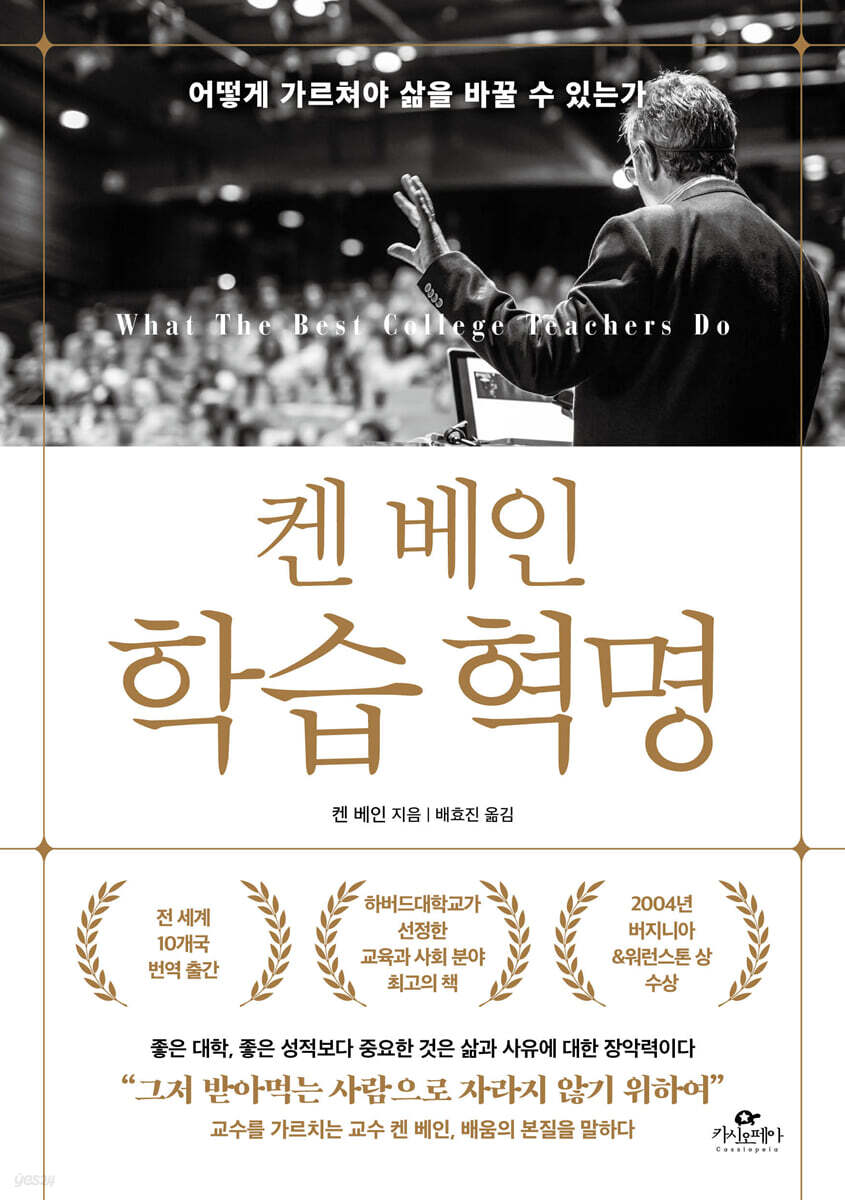
Ken Bain's Learning Revolution
 |
Description
Book Introduction
★Published in 10 countries worldwide★
★Harvard University's Best Books on Education and Society★
★2004 Virginia & Warren Stone Award Winner★
Recommended by Richard Wright and Park Moon-ho
The one book that changed the standard of education around the world
The "Education Bible" chosen by Harvard, MIT, and Oxford
A renowned educational work adopted as a teaching material by universities around the world for over 20 years.
Educators around the world say:
“There may be teachers who haven’t read this book, but there is no teacher who hasn’t changed after reading this book.”
"Ken Bain's Learning Revolution" is the culmination of Ken Bain's exploration of "the best education" through his direct observations and analyses of the world's leading educators, as taught by Ken Bain, an educational innovator known as "the professor who teaches professors" at top American universities such as Harvard, Northwestern, and New York University.
Upon its publication, this book set a record by being selected as the "Best Book in the Field of Education and Society" by Harvard University, winning the Virginia and Warren Stone Award, and being translated and published in 10 languages, thereby changing the paradigm of educational philosophy around the world.
Harvard University Professor Richard Wright praised the book, saying, “It is a book that teachers cannot put down,” and Korean scientist Dr. Park Moon-ho also said, “It is a book that clearly shows that teaching and learning are one.”
In this book, Ken Bain asks, "What is the best education?"
What are your standards for education and learning? Do such standards even exist in Korean society today? We're still repeating the gluttonous approach of "pouring content" on students.
As a result, students become increasingly sick and lose interest in the essence of learning.
There are countless students who finish a semester with good grades but leave without really understanding the core of the class.
So how do true educators, those who inspire students' thinking and revive the joy of learning, teach? Ken Bain's Learning Revolution answers that very question.
How do we listen to students' opinions, engage them with genuine interest in class, and design growth experiences through assignments and assessments?
In this way, this book views teaching not as 'the transmission of information' but as 'the art of changing lives'.
This is a must-read for anyone who teaches anything, and anyone who has ever thought about 'good education'.
★Harvard University's Best Books on Education and Society★
★2004 Virginia & Warren Stone Award Winner★
Recommended by Richard Wright and Park Moon-ho
The one book that changed the standard of education around the world
The "Education Bible" chosen by Harvard, MIT, and Oxford
A renowned educational work adopted as a teaching material by universities around the world for over 20 years.
Educators around the world say:
“There may be teachers who haven’t read this book, but there is no teacher who hasn’t changed after reading this book.”
"Ken Bain's Learning Revolution" is the culmination of Ken Bain's exploration of "the best education" through his direct observations and analyses of the world's leading educators, as taught by Ken Bain, an educational innovator known as "the professor who teaches professors" at top American universities such as Harvard, Northwestern, and New York University.
Upon its publication, this book set a record by being selected as the "Best Book in the Field of Education and Society" by Harvard University, winning the Virginia and Warren Stone Award, and being translated and published in 10 languages, thereby changing the paradigm of educational philosophy around the world.
Harvard University Professor Richard Wright praised the book, saying, “It is a book that teachers cannot put down,” and Korean scientist Dr. Park Moon-ho also said, “It is a book that clearly shows that teaching and learning are one.”
In this book, Ken Bain asks, "What is the best education?"
What are your standards for education and learning? Do such standards even exist in Korean society today? We're still repeating the gluttonous approach of "pouring content" on students.
As a result, students become increasingly sick and lose interest in the essence of learning.
There are countless students who finish a semester with good grades but leave without really understanding the core of the class.
So how do true educators, those who inspire students' thinking and revive the joy of learning, teach? Ken Bain's Learning Revolution answers that very question.
How do we listen to students' opinions, engage them with genuine interest in class, and design growth experiences through assignments and assessments?
In this way, this book views teaching not as 'the transmission of information' but as 'the art of changing lives'.
This is a must-read for anyone who teaches anything, and anyone who has ever thought about 'good education'.
- You can preview some of the book's contents.
Preview
index
1.
First, what is education?
What is a good education? │In search of the essence of teaching│The beginning of a full-fledged study│Aren't lecture evaluations simply a rating of likeability?│Six questions│Find your own path.
2.
How, What, and Why We Learn
Can test scores truly measure learning outcomes? Knowledge alone isn't enough. Four fundamental concepts of learning that apply to any subject. What makes students lose interest? Connect learning to real-life situations. Three types of learners: active, strategic, and avoidant. How should students learn? What should education be like?
3.
Ask, experience, and realize
Questions to Ask Yourself Before Class│Thirteen Things to Consider When Preparing for a Lecture
4.
Students grow as much as expected.
Belief Transforms Students│How to Overcome Hurdles│Key Elements of a Lesson Plan│The Art of Giving Good Feedback│Moving Low-Performing Students to High-Performance Classes│Teaching Is Believing in Possibility│Ten Checklists to Develop Logical Thinking│We Teach Humans
5.
Which classes are effective?
Are Lectures Really Unhelpful? │ Seven Principles of Successful Teaching │ How Important Is Speaking in Class?
6.
How should students be treated?
Interest Changes Students│Attitudes Educators Should Have│Trust Students│Good Teachers Empathize with Students' Difficulties│How to Deal with Failure│Teach with Endless Interest
7.
How should the evaluation be done?
Assessment should be a mirror reflecting teaching. Will the bonus and deduction system motivate students? Knowing students well leads to good results. How should we use tests? How am I teaching? What should I learn from student assessments? A better learning assessment system?
Epilogue: What Can You Gain from a Great Educator?
About the appendix study
index
Acknowledgements
First, what is education?
What is a good education? │In search of the essence of teaching│The beginning of a full-fledged study│Aren't lecture evaluations simply a rating of likeability?│Six questions│Find your own path.
2.
How, What, and Why We Learn
Can test scores truly measure learning outcomes? Knowledge alone isn't enough. Four fundamental concepts of learning that apply to any subject. What makes students lose interest? Connect learning to real-life situations. Three types of learners: active, strategic, and avoidant. How should students learn? What should education be like?
3.
Ask, experience, and realize
Questions to Ask Yourself Before Class│Thirteen Things to Consider When Preparing for a Lecture
4.
Students grow as much as expected.
Belief Transforms Students│How to Overcome Hurdles│Key Elements of a Lesson Plan│The Art of Giving Good Feedback│Moving Low-Performing Students to High-Performance Classes│Teaching Is Believing in Possibility│Ten Checklists to Develop Logical Thinking│We Teach Humans
5.
Which classes are effective?
Are Lectures Really Unhelpful? │ Seven Principles of Successful Teaching │ How Important Is Speaking in Class?
6.
How should students be treated?
Interest Changes Students│Attitudes Educators Should Have│Trust Students│Good Teachers Empathize with Students' Difficulties│How to Deal with Failure│Teach with Endless Interest
7.
How should the evaluation be done?
Assessment should be a mirror reflecting teaching. Will the bonus and deduction system motivate students? Knowing students well leads to good results. How should we use tests? How am I teaching? What should I learn from student assessments? A better learning assessment system?
Epilogue: What Can You Gain from a Great Educator?
About the appendix study
index
Acknowledgements
Detailed image

Into the book
For example, some educators say that we need to build warehouses in our students' brains where they can store information.
On the other hand, educators who were the subjects of the study emphasize that learners must wrestle with ideas and information to construct their own understanding.
A clear difference in perception of what learning means emerges between them.
While typical educators are satisfied with students' test scores, great educators do not consider learning to be true unless it leads to lasting and substantive changes in thinking, behavior, and emotions.
--- 「1.
First, from “What is Education”
How can we encourage students to engage in "deep learning," rather than simply "surface learning" for the sake of passing exams? According to leading educators, this requires students to meet three requirements:
First, we must face a situation where we cannot understand or resolve a phenomenon.
Second, we must not ignore the failure but confront the problem head-on.
Third, you must be able to handle the emotional shock that comes when long-held beliefs crumble.
--- 「2.
From “How, What, and Why We Learn”
To what extent do I interact with my students? Do I have time for one-on-one conversations with them outside of reviewing assignments? How do I schedule these meetings, and what support do I provide? If meeting individually is difficult, can I break them into small groups to understand their challenges and their learning styles, thought processes, and reactions to the class? Can I create a system for students to give and receive feedback from one another? What can I do to improve the quality of student-to-student feedback? Can I have graduate students or students who took this class last semester mentor their juniors? Can I help students work together to solve problems in class and provide group feedback on the process?
--- 「3.
From “Ask, Experience, and Realize”
Steele and her colleagues found that eliminating the idea that someone might view you in a negative stereotype can make a big difference in your performance.
For example, when women taking a difficult math test were told, “You can do as well as boys,” their scores actually turned out that way.
--- 「4.
From “Students grow as much as they are expected to grow”
Don Sari combines stories and questions to get students thinking critically about calculus concepts.
“I hope that by the end of this course, students will feel as if they have invented calculus.
“I think I would have surpassed Newton if I hadn’t been unlucky enough to be born so late.” The key was to break the process down into concepts rather than steps, and to let students figure out how to calculate the area under a curve on their own.
At every moment of impasse, he opened the way with Socratic questions.
Rather than simply showing students calculus, we encouraged them to think about the process themselves and consider how to find the meaning and answers to the questions.
Then you can tell the story of how you solved the problem.
--- 「5.
From “Which Classes Are Effective”
Another way to build special trust with students is to share your own frustrations and failures.
Share with students your secrets: how you became interested in this field, what questions came to mind, and how those questions led to other interests.
These personal confessions are by no means a tedious recounting of past exploits.
After talking with the educator, one student said:
“I’m really surprised that you also found chemistry difficult at first.
Thanks to you, I was able to gain the confidence to study hard.
In the past, I thought people like professors were born with all the knowledge.
“Actually, many people do that.”
--- 「6.
From “How should students be treated?”
Great educators focus on learning rather than performance.
Of course, not all educators use the same methods, but they are moving away from traditional formats and boldly eliminating practices that make education unnecessarily difficult.
Grades are a test of a student's thinking, not how well they followed certain rules.
Someone said this:
“It took a very long time to complete the ceiling painting of the Sistine Chapel.
Does that mean its beauty is diminished? Just because a work is late in its deadline doesn't mean its quality has changed."
On the other hand, educators who were the subjects of the study emphasize that learners must wrestle with ideas and information to construct their own understanding.
A clear difference in perception of what learning means emerges between them.
While typical educators are satisfied with students' test scores, great educators do not consider learning to be true unless it leads to lasting and substantive changes in thinking, behavior, and emotions.
--- 「1.
First, from “What is Education”
How can we encourage students to engage in "deep learning," rather than simply "surface learning" for the sake of passing exams? According to leading educators, this requires students to meet three requirements:
First, we must face a situation where we cannot understand or resolve a phenomenon.
Second, we must not ignore the failure but confront the problem head-on.
Third, you must be able to handle the emotional shock that comes when long-held beliefs crumble.
--- 「2.
From “How, What, and Why We Learn”
To what extent do I interact with my students? Do I have time for one-on-one conversations with them outside of reviewing assignments? How do I schedule these meetings, and what support do I provide? If meeting individually is difficult, can I break them into small groups to understand their challenges and their learning styles, thought processes, and reactions to the class? Can I create a system for students to give and receive feedback from one another? What can I do to improve the quality of student-to-student feedback? Can I have graduate students or students who took this class last semester mentor their juniors? Can I help students work together to solve problems in class and provide group feedback on the process?
--- 「3.
From “Ask, Experience, and Realize”
Steele and her colleagues found that eliminating the idea that someone might view you in a negative stereotype can make a big difference in your performance.
For example, when women taking a difficult math test were told, “You can do as well as boys,” their scores actually turned out that way.
--- 「4.
From “Students grow as much as they are expected to grow”
Don Sari combines stories and questions to get students thinking critically about calculus concepts.
“I hope that by the end of this course, students will feel as if they have invented calculus.
“I think I would have surpassed Newton if I hadn’t been unlucky enough to be born so late.” The key was to break the process down into concepts rather than steps, and to let students figure out how to calculate the area under a curve on their own.
At every moment of impasse, he opened the way with Socratic questions.
Rather than simply showing students calculus, we encouraged them to think about the process themselves and consider how to find the meaning and answers to the questions.
Then you can tell the story of how you solved the problem.
--- 「5.
From “Which Classes Are Effective”
Another way to build special trust with students is to share your own frustrations and failures.
Share with students your secrets: how you became interested in this field, what questions came to mind, and how those questions led to other interests.
These personal confessions are by no means a tedious recounting of past exploits.
After talking with the educator, one student said:
“I’m really surprised that you also found chemistry difficult at first.
Thanks to you, I was able to gain the confidence to study hard.
In the past, I thought people like professors were born with all the knowledge.
“Actually, many people do that.”
--- 「6.
From “How should students be treated?”
Great educators focus on learning rather than performance.
Of course, not all educators use the same methods, but they are moving away from traditional formats and boldly eliminating practices that make education unnecessarily difficult.
Grades are a test of a student's thinking, not how well they followed certain rules.
Someone said this:
“It took a very long time to complete the ceiling painting of the Sistine Chapel.
Does that mean its beauty is diminished? Just because a work is late in its deadline doesn't mean its quality has changed."
--- 「7.
From “How should evaluation be done?”
From “How should evaluation be done?”
Publisher's Review
No child is left behind
There are only classrooms where we don't learn together.
Here's a group of students whose grades are below average, and you're the teacher.
What can be done to improve the performance of this group? Most Korean education systems have adopted the approach of "making children study more" through supplementary classes and supplementary lessons.
However, according to Ken Bain's research, this type of education lowers the quality of learning by instilling in children the idea that "you are different from other children" and "you are slightly behind other children."
In this situation, no matter how much you teach, it will only be like pouring water into a bottomless pit.
So what choice should we make? If we truly want good results, we should spend more time teaching our students in an honors class.
Because the difference in learning is never a matter of ability, but rather a matter of opportunity and environment.
Would you be able to make such a choice? This book will respect your choice and provide you with educational data.
Anyone who teaches someone should read this book at least once.
The purpose of learning is not 'scores'
Redefining 'growth'
Education is not simply about imparting knowledge.
It is a noble task to guide learners to step into the world of learning on their own, stand alone, and find their own path.
However, in actual educational settings, the act of 'teaching' is often reduced to the results of grades, advancement to higher education, and employment.
This book goes beyond such stereotypes and asks where the essence of teaching and learning lies.
Ken Bain's in-depth study of America's top educators demonstrates that their excellence comes not from mere teaching methods or techniques.
The strengths they have in common are their ‘attitude toward learners’ and ‘philosophy toward education.’
They ask questions, encourage students to think for themselves, and help them realize how knowledge connects to life.
Ultimately, education should not be an event that imparts knowledge, but an experience that fosters new human growth.
Ken Bain's Learning Revolution makes us rethink the nature of education.
It reminds us that the true purpose of education is not to achieve external achievements such as a good school, good grades, and a good job, but to help learners grow into 'better people.'
This book will present a new path in education not only to teachers and educators, but also to all readers who ponder the meaning of learning today.
There are only classrooms where we don't learn together.
Here's a group of students whose grades are below average, and you're the teacher.
What can be done to improve the performance of this group? Most Korean education systems have adopted the approach of "making children study more" through supplementary classes and supplementary lessons.
However, according to Ken Bain's research, this type of education lowers the quality of learning by instilling in children the idea that "you are different from other children" and "you are slightly behind other children."
In this situation, no matter how much you teach, it will only be like pouring water into a bottomless pit.
So what choice should we make? If we truly want good results, we should spend more time teaching our students in an honors class.
Because the difference in learning is never a matter of ability, but rather a matter of opportunity and environment.
Would you be able to make such a choice? This book will respect your choice and provide you with educational data.
Anyone who teaches someone should read this book at least once.
The purpose of learning is not 'scores'
Redefining 'growth'
Education is not simply about imparting knowledge.
It is a noble task to guide learners to step into the world of learning on their own, stand alone, and find their own path.
However, in actual educational settings, the act of 'teaching' is often reduced to the results of grades, advancement to higher education, and employment.
This book goes beyond such stereotypes and asks where the essence of teaching and learning lies.
Ken Bain's in-depth study of America's top educators demonstrates that their excellence comes not from mere teaching methods or techniques.
The strengths they have in common are their ‘attitude toward learners’ and ‘philosophy toward education.’
They ask questions, encourage students to think for themselves, and help them realize how knowledge connects to life.
Ultimately, education should not be an event that imparts knowledge, but an experience that fosters new human growth.
Ken Bain's Learning Revolution makes us rethink the nature of education.
It reminds us that the true purpose of education is not to achieve external achievements such as a good school, good grades, and a good job, but to help learners grow into 'better people.'
This book will present a new path in education not only to teachers and educators, but also to all readers who ponder the meaning of learning today.
GOODS SPECIFICS
- Date of issue: October 20, 2025
- Page count, weight, size: 280 pages | 396g | 148*210*17mm
- ISBN13: 9791168273511
- ISBN10: 116827351X
You may also like
카테고리
korean


korean

![GQ KOREA Mark (Monthly): December [2025]](http://librairie.coreenne.fr/cdn/shop/files/8ef265dbbfbf186523ed75ba7319009d.jpg?v=1765340328&width=3840)


