

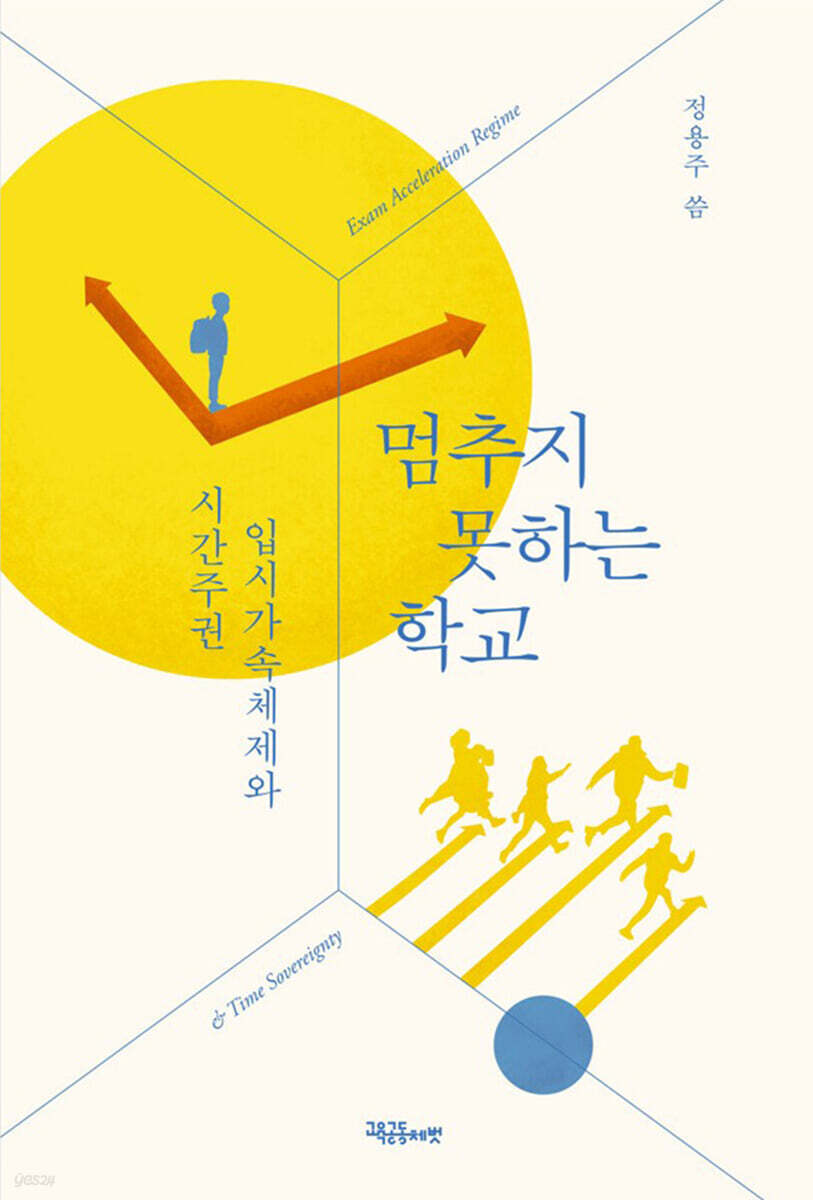
School that can't stop
 |
Description
Book Introduction
“I was so busy today too.”
“I don’t have time to do ○○.”
“I’m so tired.”
In today's schools, both teachers and students are very busy.
In Korean society, where college entrance exams have become an order rather than a system, we
Rather than living in the present, we are living a 'compressed present' for the future.
'In education, who owns time, and who designs it?'
"What have we lost in a school where we can't stop, driven by speed?"
Not a being that chases time, but a being that lives in time.
Thinking about the slow school that is being created by restoring time sovereignty.
“I don’t have time to do ○○.”
“I’m so tired.”
In today's schools, both teachers and students are very busy.
In Korean society, where college entrance exams have become an order rather than a system, we
Rather than living in the present, we are living a 'compressed present' for the future.
'In education, who owns time, and who designs it?'
"What have we lost in a school where we can't stop, driven by speed?"
Not a being that chases time, but a being that lives in time.
Thinking about the slow school that is being created by restoring time sovereignty.
- You can preview some of the book's contents.
Preview
index
Recommendation
Publishing a Book / Disappearing Beings in a Never-ending School
Preface/ The School That Never Arrived: Re-Planning Democracy
Ground Zero: A Place to Rethink Korean Education
Section 1 | The entrenched survival value system: a place that persists even after economic growth.
Section 2 | Outsourcing Schools and the Loss of Learning: Outsourced Responsibilities and Empowered Learning Spaces
Section 3 | Deepening Democratic Inequality: The Paradox of Meritocracy
Section 4 | Family Individualism and the Private Consumption of Education: The Disintegration of Social Solidarity and the Commodification of Education
Verse 5 | The Fear That Universal Life Doesn't Universalize: Life on the Boundaries of Existence
Veins of Ground Zero Thought
Part 1 - The Entrance Exam Acceleration System and Time Politics
Chapter 1: The Structure of the Speed of Swallowing Existence
Section 1 | What is an Accelerated Society?: How Acceleration Reshapes Existence
Section 2 | Three Forms of Acceleration: The Network Created by the Acceleration of Technology, Society, and Life
Section 3 | The Deconstruction of Rhythm, the Segmentation of Everyday Life: Multitasking and the Normalization of Asynchrony
Section 4 | How Acceleration Dismantles Community: Relationships, Ritual, and the Crisis of Identity
Section 5 | The Information Storm, the Loss of Understanding: The Superficiality of Cognitive Structures and the Crisis of Education
Chapter 2: Formation and Establishment of an Accelerated College Entrance Exam System
Section 1 | College Entrance Exams Are Not a System, But an Order: The Emergence of the Concept of an Accelerated College Entrance Exam System
Section 2 | Time Politics in College Entrance Exams: Why Time Doesn't Belong to Students
Section 3 | Structuring Comparison and Competition: Evaluation Systems and Hierarchical Reproduction
Section 4 | From the Time of Being to the Time of Function: The Sensory Deconstruction of Learning
Section 5 | Are Schools the Vanguard of College Entrance Exams?: The College Entrance Exam Acceleration System and the Transformation of Public Education
Chapter 3: How the Entrance Exam Acceleration System Works
Section 1 | Thinking about college entrance exams as a system: Luhmann's social systems theory and the self-referentiality of the education system
Section 2 | Three Time Codes of the Entrance Exam Acceleration System: Compression of Selection, Prediction, and Accumulation
Section 3 | The Uncontrollability of the Education System and the Self-Reinforcing Structure of Acceleration: Structural Uncertainty and Intrasystemic Mobility
Section 4 | Can the Accelerated Entrance Exam System Embrace the IB?: The System's Self-Reference and the Rupture of External Alternatives
Chapter 4: Six Pathologies of the College Entrance Exam Acceleration System
Section 1 | Alienation of Being: Education That Ignores Coexistence with Others
Section 2 | The Dominance of Self-Producedness: Performance Replaces Existence
Section 3 | The Collapse of Ritual and the Crisis of Narrative: Schools Without Repetition, Learning Without Memory
Section 4 | The End of Sensitivity and Resonance: Unresponsive Classrooms, Emotionless Classes
Section 5 | Strengthening Managerial Leadership: Schools Are Emotionally Controlled Organizations
Section 6 | The Hierarchy of Existential Possibilities: A Society Where Even the Sense of Life Is Unequal
Chapter 5: The Problem of Time as the Foundation of Pathology
Section 1 | Time is Not Neutral: Control and Standardization of Time
Verse 2 | Time is Politics: Who Determines the Flow of Time?
Section 3 | The Structure of Time Colonization: Compression, Linearization, and Optimization
Section 4 | Analysis of the Temporal Structure of Six Pathologies: The Ethics of Distorted Time
Part 1: The Vessels of Reason
Part 2: Accelerated School - Accelerated School, Exhausting Being
Chapter 1: The Classroom of Acceleration: Learning in a Time-Pushing World
Section 1 | Compressing the Curriculum Structure: Progress Tables and Discontinuous Placement of Knowledge
Section 2 | Multitasking in Teaching and Learning: Multitasking Teachers, Disengaged Students
Section 3 | Unitizing Class Time and Eliminating Emotions: Designing Emotion-Free Classes
Verse 4 | No Room for Learning: The Eradication of Slowness and the Dismantling of Concentration
Chapter 2: Evaluating Acceleration: Numbers Take Over Education
Section 1 | Evaluation Without Waiting and Eliminating Delayed Understanding: An Evaluation System Based on Immediacy and Quantitativeness
Section 2 | Rubric- and Indicator-Based Instructional Feedback Systems: Standardized Feedback and Instructional Monitoring Structures
Section 3 | The Chronopolitics of Achievement Standards and Learning Standardization: Curriculum Competency and Time Control
Section 4 | Self-Direction and Internalized Performance: The Structure of Student-Oriented Performance Internalization
Chapter 3: The Organization of Acceleration: Automating Decision-Making and Leadership
Section 1 | Normalizing Speed: An Organizational Culture of Quick Meetings and Immediate Approvals
Section 2 | The Republic of the Guidelines: Uncreative Hierarchical Order and the Collapse of Autonomy
Section 3 | Competition for Workload and the Erosion of Teacher Autonomy: Strengthening Teacher Accountability and Weakening Teacher Autonomy
Section 4 | Lack of Leadership Sensitivity: The Routine of Control and Fatigue
Chapter 4: The Culture of Acceleration: The School of Erased Existence
Section 1 | Speeding Up Routines and Ignoring Emotions: Automation of Everyday Life and Emotional Alienation
Section 2 | Empathy-Free Relationships, Automated Interactions: Technologization of Relationships and the Dislocation of Emotions
Section 3 | Predictable Students, Standardized Teachers: Data-Driven Classification and Behavior Standardization
Section 4 | Meaningless Events and Identity Instability: Narrativeless Rituals and the Exhausting Sense of Belonging
Chapter 5: Accelerated Schools and the Crisis of School Democracy: The Chronopolitics of Bureaucracy
Section 1 | The Administrativeization of Time: Controlled Flow and the Predictable Violence of Time
Section 2 | The Priority of Rules and Forms: The Organization of the Undecidable and the Expansion of "Procedural Time"
Section 3 | Standardization of Time and the Erosion of Teacher Autonomy: A Quantitative Time Structure of "Motivation-Process-Outcome"
Section 4 | Time Separation of Policy and Implementation: The Asymmetry of Time: Decisions are Fast, but Execution is Delayed
Section 5 | Timeless Participation, Autonomy Transformed into Surveillance: The Educational Harm of Anti-Democratic Time Structures
Part 2: The Blood Vessels of Reason
Part 3 - Hyper-Accelerated School: Unhumble Technology and the Cries of the Field
Chapter 1: AI Digital Transformation and Hyper-Accelerated Schools
Section 1 | Hyperacceleration: The Shockwaves Technological Acceleration Sends Through Schools
Section 2 | Curriculum as an Algorithmic Progress Chart: Automating Planning and Execution and the Dehumanization of Education
Section 3 | Profiling Teaching and Learning: The Role of Predictable Learners and Automated Teachers
Section 4 | Evaluation as a Tracking, Automation, and Answer-Oriented Surveillance System: Controllability of Technology and Datafication of Subjects
Section 5 | Lost Deliberation and Platformized Schools: Platform-Based Governance and the Decline of Democracy
Chapter 2: The Paradox of the Discourse on Individualized Education
Section 1 | The Origins and Politics of Individualized Education Discourse: The Contradictory Structure of Specialization and Standardization
Section 2 | The Temporal Politics of Technological Individualization: The Temporal Structure of Prediction, Optimization, and Rhythm Disintegration
Section 3 | The Dual Operation of Competence Discourse in a Hyper-Accelerated Society: The Production of Self-Regulating and Manageable Subjects
Section 4 | The Paradox of "Learner-Centered": Individualized Control and Integrated Self-Discipline
Section 5 | Rethinking the Ethics of Education: Meritocracy, Publicness, and Technopolitics
Part 3: The Blood Vessels of Reason
Part 4 - Slow School: Education that Regains Time Sovereignty
Chapter 1: The Sovereign Transition of Time
Section 1 | The Rise of the Time-Capacity Debate and the Technological Trap: Who Designs the "Power to Manage Time"?
Section 2 | The Protectionist Limits of Time Rights Discourse: Who Has the Right to Interfere with Others' Time?
Section 3 | Defining the Concept of Temporal Sovereignty: Sovereignty, Power, and Self-Time
Section 4 | How Temporal Sovereignty Works in Education: Time Recovery Strategies in Educational Settings
Section 5 | Five Components of Temporal Sovereignty: Rhythm Sovereignty, Leisure Sovereignty, Semantic Sovereignty, Emotional Sovereignty, and Action Sovereignty
Chapter 2: Design Principles of Slow Schools
Section 1 | Revisiting Ground Zero in Education: School as a Starting Point for the Restoration of Existence
Section 2 | Simultaneity in Asynchrony: An Educational Space Where Different Times Coexist
Section 3 | A New Possibility of Slow Schools: A School Experiment Centered on the Rhythm of Being, Not Speed
Section 4 | Six Transitional Principles of Slow School: Structuring Education to Restore Relationships, Emotions, and Rhythms
Section 5 | Design Principles of Slow Democracy: Public Education Designing a Time Structure for Sensitivity, Deliberation, and Participation
Part 4: Blood Vessels of Reason
End/Slow Education Declaration
Publishing a Book / Disappearing Beings in a Never-ending School
Preface/ The School That Never Arrived: Re-Planning Democracy
Ground Zero: A Place to Rethink Korean Education
Section 1 | The entrenched survival value system: a place that persists even after economic growth.
Section 2 | Outsourcing Schools and the Loss of Learning: Outsourced Responsibilities and Empowered Learning Spaces
Section 3 | Deepening Democratic Inequality: The Paradox of Meritocracy
Section 4 | Family Individualism and the Private Consumption of Education: The Disintegration of Social Solidarity and the Commodification of Education
Verse 5 | The Fear That Universal Life Doesn't Universalize: Life on the Boundaries of Existence
Veins of Ground Zero Thought
Part 1 - The Entrance Exam Acceleration System and Time Politics
Chapter 1: The Structure of the Speed of Swallowing Existence
Section 1 | What is an Accelerated Society?: How Acceleration Reshapes Existence
Section 2 | Three Forms of Acceleration: The Network Created by the Acceleration of Technology, Society, and Life
Section 3 | The Deconstruction of Rhythm, the Segmentation of Everyday Life: Multitasking and the Normalization of Asynchrony
Section 4 | How Acceleration Dismantles Community: Relationships, Ritual, and the Crisis of Identity
Section 5 | The Information Storm, the Loss of Understanding: The Superficiality of Cognitive Structures and the Crisis of Education
Chapter 2: Formation and Establishment of an Accelerated College Entrance Exam System
Section 1 | College Entrance Exams Are Not a System, But an Order: The Emergence of the Concept of an Accelerated College Entrance Exam System
Section 2 | Time Politics in College Entrance Exams: Why Time Doesn't Belong to Students
Section 3 | Structuring Comparison and Competition: Evaluation Systems and Hierarchical Reproduction
Section 4 | From the Time of Being to the Time of Function: The Sensory Deconstruction of Learning
Section 5 | Are Schools the Vanguard of College Entrance Exams?: The College Entrance Exam Acceleration System and the Transformation of Public Education
Chapter 3: How the Entrance Exam Acceleration System Works
Section 1 | Thinking about college entrance exams as a system: Luhmann's social systems theory and the self-referentiality of the education system
Section 2 | Three Time Codes of the Entrance Exam Acceleration System: Compression of Selection, Prediction, and Accumulation
Section 3 | The Uncontrollability of the Education System and the Self-Reinforcing Structure of Acceleration: Structural Uncertainty and Intrasystemic Mobility
Section 4 | Can the Accelerated Entrance Exam System Embrace the IB?: The System's Self-Reference and the Rupture of External Alternatives
Chapter 4: Six Pathologies of the College Entrance Exam Acceleration System
Section 1 | Alienation of Being: Education That Ignores Coexistence with Others
Section 2 | The Dominance of Self-Producedness: Performance Replaces Existence
Section 3 | The Collapse of Ritual and the Crisis of Narrative: Schools Without Repetition, Learning Without Memory
Section 4 | The End of Sensitivity and Resonance: Unresponsive Classrooms, Emotionless Classes
Section 5 | Strengthening Managerial Leadership: Schools Are Emotionally Controlled Organizations
Section 6 | The Hierarchy of Existential Possibilities: A Society Where Even the Sense of Life Is Unequal
Chapter 5: The Problem of Time as the Foundation of Pathology
Section 1 | Time is Not Neutral: Control and Standardization of Time
Verse 2 | Time is Politics: Who Determines the Flow of Time?
Section 3 | The Structure of Time Colonization: Compression, Linearization, and Optimization
Section 4 | Analysis of the Temporal Structure of Six Pathologies: The Ethics of Distorted Time
Part 1: The Vessels of Reason
Part 2: Accelerated School - Accelerated School, Exhausting Being
Chapter 1: The Classroom of Acceleration: Learning in a Time-Pushing World
Section 1 | Compressing the Curriculum Structure: Progress Tables and Discontinuous Placement of Knowledge
Section 2 | Multitasking in Teaching and Learning: Multitasking Teachers, Disengaged Students
Section 3 | Unitizing Class Time and Eliminating Emotions: Designing Emotion-Free Classes
Verse 4 | No Room for Learning: The Eradication of Slowness and the Dismantling of Concentration
Chapter 2: Evaluating Acceleration: Numbers Take Over Education
Section 1 | Evaluation Without Waiting and Eliminating Delayed Understanding: An Evaluation System Based on Immediacy and Quantitativeness
Section 2 | Rubric- and Indicator-Based Instructional Feedback Systems: Standardized Feedback and Instructional Monitoring Structures
Section 3 | The Chronopolitics of Achievement Standards and Learning Standardization: Curriculum Competency and Time Control
Section 4 | Self-Direction and Internalized Performance: The Structure of Student-Oriented Performance Internalization
Chapter 3: The Organization of Acceleration: Automating Decision-Making and Leadership
Section 1 | Normalizing Speed: An Organizational Culture of Quick Meetings and Immediate Approvals
Section 2 | The Republic of the Guidelines: Uncreative Hierarchical Order and the Collapse of Autonomy
Section 3 | Competition for Workload and the Erosion of Teacher Autonomy: Strengthening Teacher Accountability and Weakening Teacher Autonomy
Section 4 | Lack of Leadership Sensitivity: The Routine of Control and Fatigue
Chapter 4: The Culture of Acceleration: The School of Erased Existence
Section 1 | Speeding Up Routines and Ignoring Emotions: Automation of Everyday Life and Emotional Alienation
Section 2 | Empathy-Free Relationships, Automated Interactions: Technologization of Relationships and the Dislocation of Emotions
Section 3 | Predictable Students, Standardized Teachers: Data-Driven Classification and Behavior Standardization
Section 4 | Meaningless Events and Identity Instability: Narrativeless Rituals and the Exhausting Sense of Belonging
Chapter 5: Accelerated Schools and the Crisis of School Democracy: The Chronopolitics of Bureaucracy
Section 1 | The Administrativeization of Time: Controlled Flow and the Predictable Violence of Time
Section 2 | The Priority of Rules and Forms: The Organization of the Undecidable and the Expansion of "Procedural Time"
Section 3 | Standardization of Time and the Erosion of Teacher Autonomy: A Quantitative Time Structure of "Motivation-Process-Outcome"
Section 4 | Time Separation of Policy and Implementation: The Asymmetry of Time: Decisions are Fast, but Execution is Delayed
Section 5 | Timeless Participation, Autonomy Transformed into Surveillance: The Educational Harm of Anti-Democratic Time Structures
Part 2: The Blood Vessels of Reason
Part 3 - Hyper-Accelerated School: Unhumble Technology and the Cries of the Field
Chapter 1: AI Digital Transformation and Hyper-Accelerated Schools
Section 1 | Hyperacceleration: The Shockwaves Technological Acceleration Sends Through Schools
Section 2 | Curriculum as an Algorithmic Progress Chart: Automating Planning and Execution and the Dehumanization of Education
Section 3 | Profiling Teaching and Learning: The Role of Predictable Learners and Automated Teachers
Section 4 | Evaluation as a Tracking, Automation, and Answer-Oriented Surveillance System: Controllability of Technology and Datafication of Subjects
Section 5 | Lost Deliberation and Platformized Schools: Platform-Based Governance and the Decline of Democracy
Chapter 2: The Paradox of the Discourse on Individualized Education
Section 1 | The Origins and Politics of Individualized Education Discourse: The Contradictory Structure of Specialization and Standardization
Section 2 | The Temporal Politics of Technological Individualization: The Temporal Structure of Prediction, Optimization, and Rhythm Disintegration
Section 3 | The Dual Operation of Competence Discourse in a Hyper-Accelerated Society: The Production of Self-Regulating and Manageable Subjects
Section 4 | The Paradox of "Learner-Centered": Individualized Control and Integrated Self-Discipline
Section 5 | Rethinking the Ethics of Education: Meritocracy, Publicness, and Technopolitics
Part 3: The Blood Vessels of Reason
Part 4 - Slow School: Education that Regains Time Sovereignty
Chapter 1: The Sovereign Transition of Time
Section 1 | The Rise of the Time-Capacity Debate and the Technological Trap: Who Designs the "Power to Manage Time"?
Section 2 | The Protectionist Limits of Time Rights Discourse: Who Has the Right to Interfere with Others' Time?
Section 3 | Defining the Concept of Temporal Sovereignty: Sovereignty, Power, and Self-Time
Section 4 | How Temporal Sovereignty Works in Education: Time Recovery Strategies in Educational Settings
Section 5 | Five Components of Temporal Sovereignty: Rhythm Sovereignty, Leisure Sovereignty, Semantic Sovereignty, Emotional Sovereignty, and Action Sovereignty
Chapter 2: Design Principles of Slow Schools
Section 1 | Revisiting Ground Zero in Education: School as a Starting Point for the Restoration of Existence
Section 2 | Simultaneity in Asynchrony: An Educational Space Where Different Times Coexist
Section 3 | A New Possibility of Slow Schools: A School Experiment Centered on the Rhythm of Being, Not Speed
Section 4 | Six Transitional Principles of Slow School: Structuring Education to Restore Relationships, Emotions, and Rhythms
Section 5 | Design Principles of Slow Democracy: Public Education Designing a Time Structure for Sensitivity, Deliberation, and Participation
Part 4: Blood Vessels of Reason
End/Slow Education Declaration
GOODS SPECIFICS
- Date of issue: August 25, 2025
- Page count, weight, size: 492 pages | 636g | 152*225*28mm
- ISBN13: 9788968801945
- ISBN10: 8968801940
You may also like
카테고리
korean


korean

![GQ KOREA Mark (Monthly): December [2025]](http://librairie.coreenne.fr/cdn/shop/files/8ef265dbbfbf186523ed75ba7319009d.jpg?v=1765340328&width=3840)


