

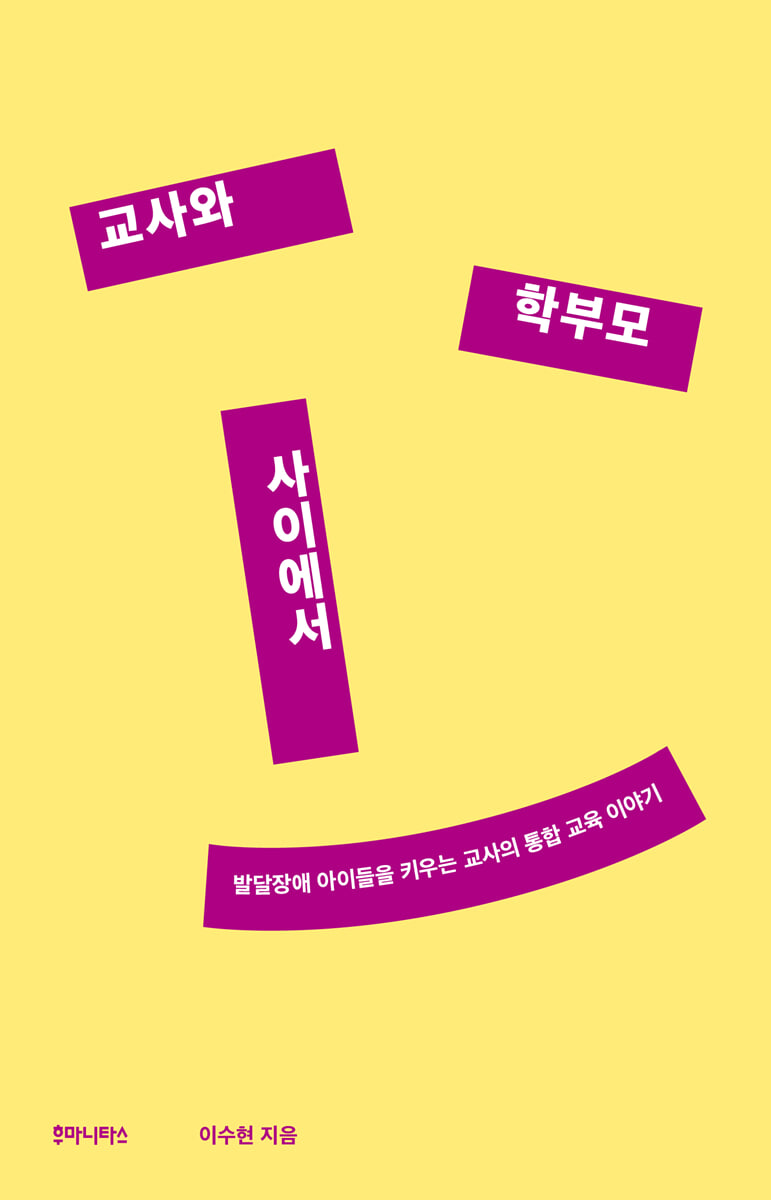
Between teachers and parents
 |
Description
Book Introduction
“I am learning to love as I am.”
A mother caring for two children with developmental disabilities, and a middle school English teacher struggling to achieve her dream of integrated education where disabled and non-disabled students learn from each other.
It's clear that I'm a parent and a teacher, but sometimes I become something other than a parent or a teacher.
Thanks to that, I have compiled the funny, heartbreaking, sad, and refreshing stories I have shared with countless teachers, parents, and students I have met on the street, in classrooms, and at lecture halls.
No matter how much teachers teach 'respect,' I pledged to create a time of education and growth together for the children who learn much more 'by seeing' in the classroom.
“Our children learn more by interacting with people in the world.
And that the world needs to learn about our children.
“Now I know it so well.”
A mother caring for two children with developmental disabilities, and a middle school English teacher struggling to achieve her dream of integrated education where disabled and non-disabled students learn from each other.
It's clear that I'm a parent and a teacher, but sometimes I become something other than a parent or a teacher.
Thanks to that, I have compiled the funny, heartbreaking, sad, and refreshing stories I have shared with countless teachers, parents, and students I have met on the street, in classrooms, and at lecture halls.
No matter how much teachers teach 'respect,' I pledged to create a time of education and growth together for the children who learn much more 'by seeing' in the classroom.
“Our children learn more by interacting with people in the world.
And that the world needs to learn about our children.
“Now I know it so well.”
- You can preview some of the book's contents.
Preview
index
Prologue 10
Chapter 1.
The children who made me a parent
Of course I have to give birth 14
The Child I Wished For 17
Hospital Shopping 20
Pseudotherapy 28
Mom, look at this 40
Dreams Changed Lives 47
Children Singing 52
56 young children taking the exam
59 to five-year-old Yeonwoo
If I could go back to that time 63
Helping Hands 66
Real Prayer 71
Chaebi 74
The Future of My Child 78
Chapter 2.
School for my child
Invisible Child 86
People come first 90
Fighting Moms 98
School 108 for My Child
Public Education Returns 112
Discrimination 119, not a mistake
If you pull down your pants, you can't go to school. 132
Why shouldn't we ask that question? 137
144 Deciding Not to Be an Impatient Mom
Language of Respect 148
Is Jeong-woo disabled? 152
155 Co-Education Shown by the Kakdugi Rule
Chapter 3.
The world through a mother's eyes
Love as It Is 162
I want to learn too 165
Everyone has the right to enjoy childhood.
People who are dismissed as disabled 172
Day 176, when I ate a bus
Savage Society 181
Please give me a plate of bread 187
Thanks for looking back 192
Unexpressed Feelings 195
Daughter's Puberty 198
Beautiful Reverse 201
Echoes of Love 206
Carefully laying the bridge 210
Chapter 4.
Classrooms Together, Growth Together
How Weaknesses Become Strengths 216
Lesson Design for Everyone 220
Classroom Together, Growth Together 224
Dignity in the Classroom 234
Shouldn't he go to a special school? 240
Between Consideration and Exclusion 243
How can we address the burden of integrated education on teachers? 247
258 Children Being Evaluated Without Learning
All Parents Are Sick 268
Every Action Has a Reason 272
Children Lying Together 277
282 Children Who Talk About Their Disabilities Proudly
Is that really so obvious? 285
Breaking Bad News 289
Teacher, it's actually hard 292
They're all flowers 297
Cheers to your tomorrow 299
304 Things to Consider Before Recording
Mom holding the microphone 308
Epilogue 311
Chapter 1.
The children who made me a parent
Of course I have to give birth 14
The Child I Wished For 17
Hospital Shopping 20
Pseudotherapy 28
Mom, look at this 40
Dreams Changed Lives 47
Children Singing 52
56 young children taking the exam
59 to five-year-old Yeonwoo
If I could go back to that time 63
Helping Hands 66
Real Prayer 71
Chaebi 74
The Future of My Child 78
Chapter 2.
School for my child
Invisible Child 86
People come first 90
Fighting Moms 98
School 108 for My Child
Public Education Returns 112
Discrimination 119, not a mistake
If you pull down your pants, you can't go to school. 132
Why shouldn't we ask that question? 137
144 Deciding Not to Be an Impatient Mom
Language of Respect 148
Is Jeong-woo disabled? 152
155 Co-Education Shown by the Kakdugi Rule
Chapter 3.
The world through a mother's eyes
Love as It Is 162
I want to learn too 165
Everyone has the right to enjoy childhood.
People who are dismissed as disabled 172
Day 176, when I ate a bus
Savage Society 181
Please give me a plate of bread 187
Thanks for looking back 192
Unexpressed Feelings 195
Daughter's Puberty 198
Beautiful Reverse 201
Echoes of Love 206
Carefully laying the bridge 210
Chapter 4.
Classrooms Together, Growth Together
How Weaknesses Become Strengths 216
Lesson Design for Everyone 220
Classroom Together, Growth Together 224
Dignity in the Classroom 234
Shouldn't he go to a special school? 240
Between Consideration and Exclusion 243
How can we address the burden of integrated education on teachers? 247
258 Children Being Evaluated Without Learning
All Parents Are Sick 268
Every Action Has a Reason 272
Children Lying Together 277
282 Children Who Talk About Their Disabilities Proudly
Is that really so obvious? 285
Breaking Bad News 289
Teacher, it's actually hard 292
They're all flowers 297
Cheers to your tomorrow 299
304 Things to Consider Before Recording
Mom holding the microphone 308
Epilogue 311
Into the book
The summer when the child turned six, hell began.
My child has autism and is sensitive to seasonal changes, so summer is difficult every year.
But that year, a pain that could not be expressed in words came upon me.
The child started crying for no reason as soon as he opened his eyes in the morning.
He paused for a moment while eating, then started crying again.
Until I closed my eyes at night, the crying didn't stop.
The cries were varied.
Groans, groans of annoyance, and increasingly loud cries.
As time went on, it all sounded the same torturous sound to me.
"There must be a reason." No matter how many times I asked the child, there was no answer.
--- From "Pseudo-Treatment"
I was no longer the same person I used to be.
The person who only wanted to be the cool number one became a completely different person.
I became a teacher who cared more than anyone else about the neglected children who no one cared about, the children who existed but were treated as if they did not exist.
For me, who was always concerned about raising test scores by even just one point, my goal became to raise students with the kind of heart that could provide warm love to the marginalized.
So, every day, I meet my students with the same heart as I see my own children.
Because the students I meet are the world and future that my children will live in.
--- From "A Life Changed by Dreams"
How many people have ever been kicked out of a cafe? One day, my family was kicked out of a cafe for eating bread.
“The guests are uncomfortable.
“I’m sorry, but please clean up and leave.”
I didn't even call out that loudly, I just called out very briefly and stopped.
You weren't even asking me to stop singing, you were asking me to leave? And you were a seven-year-old who should be welcomed everywhere.
The cafe customers who were watching us with all their senses, their gaze elsewhere, and the chilly air that filled the space were unforgettable.
--- From "The Singing Child"
If I could go back, if I could go back to that time with the enlightenment I have now, I would want to live a normal life with my child without being tied down by the word 'autism.'
I want to let my children experience the world naturally, like parents of non-disabled children, by going to the playground and traveling.
Learn in the world, not in the treatment room.
Of course, you will still face people's discriminatory gazes, and there will be moments when your heart breaks, but it won't be as difficult as it used to be.
Because now I know.
That you can't learn language or social skills just by staying in the treatment room.
Our children learn more by interacting with people in the world.
And that the world needs to learn about our children.
--- From "To Five-Year-Old Yeonwoo"
I'm glad you found out now.
I'm glad I have more days left to live than the days I've lived with you.
Just as it makes me incredibly happy to be your child, I hope it makes you incredibly happy to be your mother.
--- From "If I Go Back Then"
The year my daughter started menstruating, I requested a female support worker, but as expected, no one was assigned.
The Board of Education said it would assign a social worker who could not supervise the female student's personal safety.
When I protested again, the person in charge said this.
"Mom, are you discriminating against men and women? Then male special education teachers can't teach female students?"
I realized it through that experience.
Filing a complaint is a hopeless fight between powerless low-level employees and citizens.
I realized with a bitterness that this was just a fight between people who were completely incapable of solving the problem, and those who were suffering the most on the front lines.
--- From "Fighting Mothers"
“Teacher, do we have anything for Yeonwoo?”
“Oh my, Mother… I’m so sorry.
I made a mistake.
I forgot.
I'm so sorry.
Actually, there's nothing special to prepare.
“Clay, colored paper, and a few crafting materials…”
The teacher tried to calm me down, but it only made me feel more hurt.
'You said it wasn't a big deal... why did you leave out my child?'
This is something that most special education students have experienced at least once in school.
For example, there was a time when my child was missing from the class photo.
There were times when my child's work was not shown at an exhibition.
At events like field trips or presentations, children without disabilities were asked questions they would not hear, such as, “Is it okay for me to participate?”
--- From "It's Not a Mistake, It's Discrimination"
I wouldn't be surprised if my child pulled down his pants at school.
Because I know full well that my child has a disability, that is precisely the nature of that disability.
However, it is always regrettable that the school is not taking any educational measures other than the sudden separation.
This doesn't just happen to our children.
I hope that our education system can at least grasp the insight that 'separation' is not 'education' but blatant 'discrimination', and that it is uneducational not only for students with disabilities but also for non-disabled children in the same space.
--- From "If You Pull Down Your Pants, You Can't Go to School"
“Is Jeongwoo disabled?”
I was speechless for a long time, looking into the child's amazingly pure eyes.
"No, if he's not disabled, then why on earth do you think Jeong-woo is like this? Can't this child see Jeong-woo's disability?"
Yes, it was Jungwoo who was visible to the children.
To his friends, Jeong-woo was just Jeong-woo.
How could we not have felt uncomfortable when we spent every day together? There must have been difficult and challenging moments as we adapted to each other, but we naturally accepted these as part of each other's diverse characteristics, not as a result of our disabilities.
In that kind of natural atmosphere, perhaps Jeong-woo also found the courage to greet others again?
--- From "Is Jeong-woo disabled?"
“Yeonwoo is a radish kimchi.
Got it?”
When throwing balls at Yeonwoo, the children threw carefully so that Yeonwoo could catch them well, and they tried their best to catch the balls that Yeonwoo threw.
During the game, the children changed the rules that applied to them, such as 'use only your left foot' or 'carry your bags behind your back and don't use your hands'.
Yeonwoo's presence became another rule of the game.
Yeonwoo and the children quickly became absorbed in the play, their cheeks turning bright red.
“Hey guys, what is kimchi?”
I asked because I was curious about the exact meaning.
The children explained excitedly.
There was a lot of fuss about trying to explain to each other what the rules of kimchi were.
--- From "Education Together as Shown by the Rules of Kakdugi"
When I think about my child's disability, my heart aches, but I quickly shake that feeling off, worried that I might not be able to love myself when I see my parents suffering because of me.
We are becoming parents in such a painful way.
I am learning to love as I am.
--- From "Love as It Is"
My doctor told me this when I was bombarded with questions about how to raise a child diagnosed with autism.
“Get rid of the idea that you are different from other children.
Just think of it as raising a child in the same way and raise them.”
That answer stayed in my mind for a long time.
It's been about 10 years since my older child was diagnosed with autism.
In the meantime, positive changes have been seen, such as the airing of popular dramas related to developmental disabilities and increased discussions about deinstitutionalization.
However, there are still many places where you cannot go with children, and you often encounter people looking at you with disapproval.
Perhaps it's because many people still don't know much about it, and the fear that comes from being unfamiliar is great.
As someone who lives with children, I don't find their disabilities inconvenient at all at home.
Most of the time, we live without even being aware of our disability.
But I hope that once I step outside the gate, I can live a normal life like any other child.
As the doctor said, I hope we can create a society where children are welcomed everywhere simply because they are children, to the point where parents can let go of the idea that their child is different.
I hope that my children will one day live in a society where everyone can freely express and talk about their disabilities without feeling unfamiliar or uncomfortable, an environment where children with disabilities can learn whatever they want, and a world where everyone can be friends regardless of their disability.
Because everyone has the right to enjoy their childhood, whether it's children with disabilities or my children.
--- From "Everyone has the right to enjoy childhood"
“Ready, ready to go!”
A loud whistle blew through the inline skating rink.
As the children at the starting line stood there blankly with bewildered expressions, their parents shouted from behind.
“Let’s go! Go forward!”
When our children heard their father's voice, they held each other's hands without saying a word.
Without even realizing that they were competing with each other.
“Let go of my hand! Let go of my hand!”
When Yeonwoo was shouted at to let go, she became anxious and ran to the staff member who had blown the whistle, grabbed his arm, and shouted that she would not play.
“I won’t do it! I won’t do it!”
I was flustered and quickly ran over and pulled Yeonwoo away.
An excited Yeonwoo ran off the track and into the grass.
Jeong-woo, who was running alone, turned around and started driving in the opposite direction when his older sister did not come.
I grabbed Yeonwoo on the grass and persuaded her to run again, and eventually Yeonwoo and Jeongwoo ran side by side and crossed the finish line.
…
I will never forget the sight of our children holding each other's hands as they started off to compete in an inline skating competition.
Our children may already instinctively know that it is happier to go together than to go ahead.
--- From "Beautiful Reverse Driving"
“Yes, sir.
If that's what you want, I'll place the extra-large student in Class 8 in your class.
But let's keep it a secret that the teacher is raising a child with a disability.
It's been so long since I've been back to work as a teacher, so I don't know much about it. I'm scared of the teaching profession.
“The moment the teacher says that, I feel vulnerable.”
That day, the class 8 teacher was upset because she had chosen a combined class.
I sighed deeply as I asked the special education teacher how many hours of integrated classes there would be.
Watching that scene, my heart ached and my face burned.
'My child will become a hated child even before we meet.'
--- From "From Weakness to Strength"
What I, as a teacher, have to do is widen the gates so that the space we call 'class' can be comfortably opened to everyone.
If we prioritize universality, we can easily neglect more special situations. However, if we examine the most special cases first, we can expand education to include everyone.
Ultimately, I realized, albeit a little late, that acknowledging "special" means embracing diversity, and that the process of understanding and caring for such diverse children enriches our learning experience.
--- From "Class Design for Everyone"
“Should Jinhyuk also give a presentation like his friends?”
"no, I do not want."
Jinhyuk's words, which were always the first to say no, were often not sincere.
The idea suddenly occurred to me that I should take advantage of Jinhyuk's characteristic of liking people.
“Then, should I present it with my friend?”
At first, I refused, but when my friend said he would come with me, I came forward hesitantly.
A friend was holding Jinhyuk's drawing next to him, and Jinhyuk began to stammer his presentation.
Although he couldn't do it in English, he tried hard to explain the car in Korean, his own language.
It was one of the most touching moments in my teaching career.
It wasn't that Jinhyuk was impressed because it was his first time presenting.
I can't forget the expressions on the children's faces as they looked at Jinhyuk at that moment.
The children looked at Jinhyuk with warm smiles.
It was an expression of support, as if she were Jinhyuk's mother.
--- From "Classroom Together, Growth Together"
“If I can’t even understand the lessons, wouldn’t it be better to study in a special class?”
“Wouldn’t it be more helpful to go to a special school and study at a level appropriate to your level?”
This is a question frequently asked in educational settings.
When we segregate children because they cannot learn in an inclusive classroom, non-disabled students naturally learn that they will be excluded if they have a disability or lack the ability.
No matter how much teachers teach 'respect,' children learn much more 'by seeing' in the classroom.
Seeing disabled students being excluded makes us accept discrimination as normal.
The same goes for special schools.
Even though they live in the same neighborhood, if they have to go to a special school that is far away, they end up learning that people with disabilities should be segregated.
Segregation in education ultimately leads to segregation in society.
--- From "Shouldn't I go to a special school?"
That's because I don't know.
Everyone thinks they are a good person who does not discriminate, but because they have so little experience with disabilities, they cannot even tell what constitutes discrimination.
If you get angry and press someone to ask why you are discriminating against them, it is natural to start defending yourself.
We must kindly inform and support them.
So, although it is not easy for me, I try to share as many cases and lessons learned through trial and error as possible.
I may not know all the various cases and difficulties of inclusive education, but I will at least share my experiences as much as possible.
This year, we will continue to work hard on the ground, thinking, educating, reflecting, sharing, and helping.
--- From "Between Consideration and Exclusion"
The social studies teacher approached cautiously and asked.
“I have a question. What should I do in this situation?”
“What is it, sir? Please tell me.”
“I’m learning about human rights in social studies these days.
I was teaching in Hyun-gyu's class, a special education student, when Hyun-gyu suddenly started talking loudly.
"Teacher! I have a developmental disability! Can I get a job too? I'm studying hard at the center for the disabled!"
I smiled.
“Hyun-gyu is a very healthy child.
It's a good attitude to be proud and not be ashamed of the fact that you have a disability.
When that moment comes, don't panic, just praise Hyun-gyu.
And tell the other kids too.
“The courage to be honest about your strengths and weaknesses can change the world.”
--- From "A Child Who Speaks Confidently About His Disability"
“I am a mother and teacher of a child with a developmental disability.”
When I start a lecture like this, even the audience members who were looking at their phones look up.
Even the teachers who were sitting there without any expectations, just because it was mandatory training, looked at me.
I smile and say this, seeing the surprise in their eyes.
“Are you surprised? Do I look like the mother of a disabled person?”
With children in school, the problems on the ground become closer and more pressing.
There are days when it's hard to live alone as a mother, but the strength that gives me the strength to keep going always comes from my children.
Thanks to my children, who make me both infinitely weak and infinitely strong, I am living a new life as a teacher and a lecturer.
My child has autism and is sensitive to seasonal changes, so summer is difficult every year.
But that year, a pain that could not be expressed in words came upon me.
The child started crying for no reason as soon as he opened his eyes in the morning.
He paused for a moment while eating, then started crying again.
Until I closed my eyes at night, the crying didn't stop.
The cries were varied.
Groans, groans of annoyance, and increasingly loud cries.
As time went on, it all sounded the same torturous sound to me.
"There must be a reason." No matter how many times I asked the child, there was no answer.
--- From "Pseudo-Treatment"
I was no longer the same person I used to be.
The person who only wanted to be the cool number one became a completely different person.
I became a teacher who cared more than anyone else about the neglected children who no one cared about, the children who existed but were treated as if they did not exist.
For me, who was always concerned about raising test scores by even just one point, my goal became to raise students with the kind of heart that could provide warm love to the marginalized.
So, every day, I meet my students with the same heart as I see my own children.
Because the students I meet are the world and future that my children will live in.
--- From "A Life Changed by Dreams"
How many people have ever been kicked out of a cafe? One day, my family was kicked out of a cafe for eating bread.
“The guests are uncomfortable.
“I’m sorry, but please clean up and leave.”
I didn't even call out that loudly, I just called out very briefly and stopped.
You weren't even asking me to stop singing, you were asking me to leave? And you were a seven-year-old who should be welcomed everywhere.
The cafe customers who were watching us with all their senses, their gaze elsewhere, and the chilly air that filled the space were unforgettable.
--- From "The Singing Child"
If I could go back, if I could go back to that time with the enlightenment I have now, I would want to live a normal life with my child without being tied down by the word 'autism.'
I want to let my children experience the world naturally, like parents of non-disabled children, by going to the playground and traveling.
Learn in the world, not in the treatment room.
Of course, you will still face people's discriminatory gazes, and there will be moments when your heart breaks, but it won't be as difficult as it used to be.
Because now I know.
That you can't learn language or social skills just by staying in the treatment room.
Our children learn more by interacting with people in the world.
And that the world needs to learn about our children.
--- From "To Five-Year-Old Yeonwoo"
I'm glad you found out now.
I'm glad I have more days left to live than the days I've lived with you.
Just as it makes me incredibly happy to be your child, I hope it makes you incredibly happy to be your mother.
--- From "If I Go Back Then"
The year my daughter started menstruating, I requested a female support worker, but as expected, no one was assigned.
The Board of Education said it would assign a social worker who could not supervise the female student's personal safety.
When I protested again, the person in charge said this.
"Mom, are you discriminating against men and women? Then male special education teachers can't teach female students?"
I realized it through that experience.
Filing a complaint is a hopeless fight between powerless low-level employees and citizens.
I realized with a bitterness that this was just a fight between people who were completely incapable of solving the problem, and those who were suffering the most on the front lines.
--- From "Fighting Mothers"
“Teacher, do we have anything for Yeonwoo?”
“Oh my, Mother… I’m so sorry.
I made a mistake.
I forgot.
I'm so sorry.
Actually, there's nothing special to prepare.
“Clay, colored paper, and a few crafting materials…”
The teacher tried to calm me down, but it only made me feel more hurt.
'You said it wasn't a big deal... why did you leave out my child?'
This is something that most special education students have experienced at least once in school.
For example, there was a time when my child was missing from the class photo.
There were times when my child's work was not shown at an exhibition.
At events like field trips or presentations, children without disabilities were asked questions they would not hear, such as, “Is it okay for me to participate?”
--- From "It's Not a Mistake, It's Discrimination"
I wouldn't be surprised if my child pulled down his pants at school.
Because I know full well that my child has a disability, that is precisely the nature of that disability.
However, it is always regrettable that the school is not taking any educational measures other than the sudden separation.
This doesn't just happen to our children.
I hope that our education system can at least grasp the insight that 'separation' is not 'education' but blatant 'discrimination', and that it is uneducational not only for students with disabilities but also for non-disabled children in the same space.
--- From "If You Pull Down Your Pants, You Can't Go to School"
“Is Jeongwoo disabled?”
I was speechless for a long time, looking into the child's amazingly pure eyes.
"No, if he's not disabled, then why on earth do you think Jeong-woo is like this? Can't this child see Jeong-woo's disability?"
Yes, it was Jungwoo who was visible to the children.
To his friends, Jeong-woo was just Jeong-woo.
How could we not have felt uncomfortable when we spent every day together? There must have been difficult and challenging moments as we adapted to each other, but we naturally accepted these as part of each other's diverse characteristics, not as a result of our disabilities.
In that kind of natural atmosphere, perhaps Jeong-woo also found the courage to greet others again?
--- From "Is Jeong-woo disabled?"
“Yeonwoo is a radish kimchi.
Got it?”
When throwing balls at Yeonwoo, the children threw carefully so that Yeonwoo could catch them well, and they tried their best to catch the balls that Yeonwoo threw.
During the game, the children changed the rules that applied to them, such as 'use only your left foot' or 'carry your bags behind your back and don't use your hands'.
Yeonwoo's presence became another rule of the game.
Yeonwoo and the children quickly became absorbed in the play, their cheeks turning bright red.
“Hey guys, what is kimchi?”
I asked because I was curious about the exact meaning.
The children explained excitedly.
There was a lot of fuss about trying to explain to each other what the rules of kimchi were.
--- From "Education Together as Shown by the Rules of Kakdugi"
When I think about my child's disability, my heart aches, but I quickly shake that feeling off, worried that I might not be able to love myself when I see my parents suffering because of me.
We are becoming parents in such a painful way.
I am learning to love as I am.
--- From "Love as It Is"
My doctor told me this when I was bombarded with questions about how to raise a child diagnosed with autism.
“Get rid of the idea that you are different from other children.
Just think of it as raising a child in the same way and raise them.”
That answer stayed in my mind for a long time.
It's been about 10 years since my older child was diagnosed with autism.
In the meantime, positive changes have been seen, such as the airing of popular dramas related to developmental disabilities and increased discussions about deinstitutionalization.
However, there are still many places where you cannot go with children, and you often encounter people looking at you with disapproval.
Perhaps it's because many people still don't know much about it, and the fear that comes from being unfamiliar is great.
As someone who lives with children, I don't find their disabilities inconvenient at all at home.
Most of the time, we live without even being aware of our disability.
But I hope that once I step outside the gate, I can live a normal life like any other child.
As the doctor said, I hope we can create a society where children are welcomed everywhere simply because they are children, to the point where parents can let go of the idea that their child is different.
I hope that my children will one day live in a society where everyone can freely express and talk about their disabilities without feeling unfamiliar or uncomfortable, an environment where children with disabilities can learn whatever they want, and a world where everyone can be friends regardless of their disability.
Because everyone has the right to enjoy their childhood, whether it's children with disabilities or my children.
--- From "Everyone has the right to enjoy childhood"
“Ready, ready to go!”
A loud whistle blew through the inline skating rink.
As the children at the starting line stood there blankly with bewildered expressions, their parents shouted from behind.
“Let’s go! Go forward!”
When our children heard their father's voice, they held each other's hands without saying a word.
Without even realizing that they were competing with each other.
“Let go of my hand! Let go of my hand!”
When Yeonwoo was shouted at to let go, she became anxious and ran to the staff member who had blown the whistle, grabbed his arm, and shouted that she would not play.
“I won’t do it! I won’t do it!”
I was flustered and quickly ran over and pulled Yeonwoo away.
An excited Yeonwoo ran off the track and into the grass.
Jeong-woo, who was running alone, turned around and started driving in the opposite direction when his older sister did not come.
I grabbed Yeonwoo on the grass and persuaded her to run again, and eventually Yeonwoo and Jeongwoo ran side by side and crossed the finish line.
…
I will never forget the sight of our children holding each other's hands as they started off to compete in an inline skating competition.
Our children may already instinctively know that it is happier to go together than to go ahead.
--- From "Beautiful Reverse Driving"
“Yes, sir.
If that's what you want, I'll place the extra-large student in Class 8 in your class.
But let's keep it a secret that the teacher is raising a child with a disability.
It's been so long since I've been back to work as a teacher, so I don't know much about it. I'm scared of the teaching profession.
“The moment the teacher says that, I feel vulnerable.”
That day, the class 8 teacher was upset because she had chosen a combined class.
I sighed deeply as I asked the special education teacher how many hours of integrated classes there would be.
Watching that scene, my heart ached and my face burned.
'My child will become a hated child even before we meet.'
--- From "From Weakness to Strength"
What I, as a teacher, have to do is widen the gates so that the space we call 'class' can be comfortably opened to everyone.
If we prioritize universality, we can easily neglect more special situations. However, if we examine the most special cases first, we can expand education to include everyone.
Ultimately, I realized, albeit a little late, that acknowledging "special" means embracing diversity, and that the process of understanding and caring for such diverse children enriches our learning experience.
--- From "Class Design for Everyone"
“Should Jinhyuk also give a presentation like his friends?”
"no, I do not want."
Jinhyuk's words, which were always the first to say no, were often not sincere.
The idea suddenly occurred to me that I should take advantage of Jinhyuk's characteristic of liking people.
“Then, should I present it with my friend?”
At first, I refused, but when my friend said he would come with me, I came forward hesitantly.
A friend was holding Jinhyuk's drawing next to him, and Jinhyuk began to stammer his presentation.
Although he couldn't do it in English, he tried hard to explain the car in Korean, his own language.
It was one of the most touching moments in my teaching career.
It wasn't that Jinhyuk was impressed because it was his first time presenting.
I can't forget the expressions on the children's faces as they looked at Jinhyuk at that moment.
The children looked at Jinhyuk with warm smiles.
It was an expression of support, as if she were Jinhyuk's mother.
--- From "Classroom Together, Growth Together"
“If I can’t even understand the lessons, wouldn’t it be better to study in a special class?”
“Wouldn’t it be more helpful to go to a special school and study at a level appropriate to your level?”
This is a question frequently asked in educational settings.
When we segregate children because they cannot learn in an inclusive classroom, non-disabled students naturally learn that they will be excluded if they have a disability or lack the ability.
No matter how much teachers teach 'respect,' children learn much more 'by seeing' in the classroom.
Seeing disabled students being excluded makes us accept discrimination as normal.
The same goes for special schools.
Even though they live in the same neighborhood, if they have to go to a special school that is far away, they end up learning that people with disabilities should be segregated.
Segregation in education ultimately leads to segregation in society.
--- From "Shouldn't I go to a special school?"
That's because I don't know.
Everyone thinks they are a good person who does not discriminate, but because they have so little experience with disabilities, they cannot even tell what constitutes discrimination.
If you get angry and press someone to ask why you are discriminating against them, it is natural to start defending yourself.
We must kindly inform and support them.
So, although it is not easy for me, I try to share as many cases and lessons learned through trial and error as possible.
I may not know all the various cases and difficulties of inclusive education, but I will at least share my experiences as much as possible.
This year, we will continue to work hard on the ground, thinking, educating, reflecting, sharing, and helping.
--- From "Between Consideration and Exclusion"
The social studies teacher approached cautiously and asked.
“I have a question. What should I do in this situation?”
“What is it, sir? Please tell me.”
“I’m learning about human rights in social studies these days.
I was teaching in Hyun-gyu's class, a special education student, when Hyun-gyu suddenly started talking loudly.
"Teacher! I have a developmental disability! Can I get a job too? I'm studying hard at the center for the disabled!"
I smiled.
“Hyun-gyu is a very healthy child.
It's a good attitude to be proud and not be ashamed of the fact that you have a disability.
When that moment comes, don't panic, just praise Hyun-gyu.
And tell the other kids too.
“The courage to be honest about your strengths and weaknesses can change the world.”
--- From "A Child Who Speaks Confidently About His Disability"
“I am a mother and teacher of a child with a developmental disability.”
When I start a lecture like this, even the audience members who were looking at their phones look up.
Even the teachers who were sitting there without any expectations, just because it was mandatory training, looked at me.
I smile and say this, seeing the surprise in their eyes.
“Are you surprised? Do I look like the mother of a disabled person?”
With children in school, the problems on the ground become closer and more pressing.
There are days when it's hard to live alone as a mother, but the strength that gives me the strength to keep going always comes from my children.
Thanks to my children, who make me both infinitely weak and infinitely strong, I am living a new life as a teacher and a lecturer.
--- From "Mom on the Mic"
Publisher's Review
“I am learning to love as I am.
“We now know all too well that our children learn more by interacting with people in the world, and that the world has much to learn about our children.”
…
“The guests are uncomfortable.
“I’m sorry, but please clean up and leave.”
“If I can’t even understand the lessons, wouldn’t it be better to study in a special class or special school?”
“It’s dangerous. Is it okay for me to take survival swimming lessons?”
“Please consider the academy’s position as well.
“When a disabled child comes into the school, parents complain a lot.”
* A society that separates people because they have a 'disability' but says that is not 'discrimination'
“Jeongwoo is disabled? He’s just my friend.”
"Isn't raising a child a journey of failure? Our children have the right to fail, too."
“Participation in class is not an option, it is a fundamental right.”
“There will always be a way for us to get along.
“Let’s think about it together.”
* Education that includes everyone without exclusion, which should begin at school, the starting point of society.
No matter how much teachers teach 'respect,' children learn much more by 'seeing with their own eyes' in the classroom.
What do schools and societies teach children when they relegate students with disabilities to special classes or schools simply because of their disabilities or their inability to keep up with classwork? Don't they assume exclusion is normal for those with disabilities or insufficient abilities? Will the world these students create be a world free of discrimination? Perhaps the segregation pervasive in society begins in the classroom? This book chronicles the struggles of a middle school English teacher to create a classroom where students with and without disabilities learn from each other and grow together.
This is a compilation of articles I have consistently written about inclusive education and developmental disabilities, as well as stories I have shared with numerous teachers and parents while working as a lecturer at teacher training and parent education events.
Seeing that my teaching and lectures were new and sometimes shocking to some, I wondered, "How could I not know this?" However, the honest realization that before giving birth to and raising two developmentally disabled siblings, I had only considered disabilities as a personal problem and never considered them as the responsibility of teachers, schools, society, or the country led me to write this book.
“I wish we could create a society where children are welcomed simply because they are children.
I hope that my children will one day live in a society where everyone can freely express and talk about their disabilities without feeling unfamiliar or uncomfortable, an environment where children with disabilities can learn whatever they want, and a world where everyone can be friends regardless of their disability.
“Because everyone has the right to enjoy childhood, including children with disabilities and my children.” - From the book
As a parent of a child with a disability, 'Mom Lee Su-hyeon' faces high walls everywhere and despairs.
Every winter before the new school year, I had to prove how severe my child's condition was, and when my daughter started menstruating, I went to the Office of Education to fight for female support staff, but they refused to send in social workers who could not provide guidance to female students.
There were many times when I saw class photos with only my child missing, and when my child's work was not displayed in exhibitions.
Before events like field trips or presentations, I was at a loss as to how to answer questions that non-disabled children might not have heard: “Is it okay to let them participate?”
However, this experience rather led teacher Lee Su-hyeon, who had been on leave for seven years due to childcare leave and caregiving leave, to return to the classroom.
There are days when it's hard to live alone as a mother, but because my children are in school, the problems on the ground seem closer and more urgent.
The author says that his job as a teacher is to widen the gates so that the space he calls "class" can be comfortably opened to everyone.
If we prioritize universality, we can easily neglect more special situations, but if we examine the most special cases first, we can expand education to all. Therefore, I want to share with more people the fact that acknowledging the "special" is embracing diversity, and that the process of understanding and caring for such diverse children enriches our learning.
For those of us who have so little experience living with people with disabilities that we can't even tell what discrimination is, this book, "Between Teachers and Parents," which shows the reality and possibility of "integrated education" where students with and without disabilities live together, will allow us to imagine a society without discrimination.
“I was no longer the person I used to be.
The person who only wanted to be the cool number one became a completely different person.
I became a teacher who cared more than anyone else about the neglected children who no one cared about, the children who existed but were treated as if they did not exist.
For me, who was always concerned about raising test scores by even just one point, my goal became to raise students with the kind of heart that could provide warm love to the marginalized.
So, every day, I meet my students with the same heart as I see my own children.
“The students I meet are the world and future that my children will live in.” - From the book
“We now know all too well that our children learn more by interacting with people in the world, and that the world has much to learn about our children.”
…
“The guests are uncomfortable.
“I’m sorry, but please clean up and leave.”
“If I can’t even understand the lessons, wouldn’t it be better to study in a special class or special school?”
“It’s dangerous. Is it okay for me to take survival swimming lessons?”
“Please consider the academy’s position as well.
“When a disabled child comes into the school, parents complain a lot.”
* A society that separates people because they have a 'disability' but says that is not 'discrimination'
“Jeongwoo is disabled? He’s just my friend.”
"Isn't raising a child a journey of failure? Our children have the right to fail, too."
“Participation in class is not an option, it is a fundamental right.”
“There will always be a way for us to get along.
“Let’s think about it together.”
* Education that includes everyone without exclusion, which should begin at school, the starting point of society.
No matter how much teachers teach 'respect,' children learn much more by 'seeing with their own eyes' in the classroom.
What do schools and societies teach children when they relegate students with disabilities to special classes or schools simply because of their disabilities or their inability to keep up with classwork? Don't they assume exclusion is normal for those with disabilities or insufficient abilities? Will the world these students create be a world free of discrimination? Perhaps the segregation pervasive in society begins in the classroom? This book chronicles the struggles of a middle school English teacher to create a classroom where students with and without disabilities learn from each other and grow together.
This is a compilation of articles I have consistently written about inclusive education and developmental disabilities, as well as stories I have shared with numerous teachers and parents while working as a lecturer at teacher training and parent education events.
Seeing that my teaching and lectures were new and sometimes shocking to some, I wondered, "How could I not know this?" However, the honest realization that before giving birth to and raising two developmentally disabled siblings, I had only considered disabilities as a personal problem and never considered them as the responsibility of teachers, schools, society, or the country led me to write this book.
“I wish we could create a society where children are welcomed simply because they are children.
I hope that my children will one day live in a society where everyone can freely express and talk about their disabilities without feeling unfamiliar or uncomfortable, an environment where children with disabilities can learn whatever they want, and a world where everyone can be friends regardless of their disability.
“Because everyone has the right to enjoy childhood, including children with disabilities and my children.” - From the book
As a parent of a child with a disability, 'Mom Lee Su-hyeon' faces high walls everywhere and despairs.
Every winter before the new school year, I had to prove how severe my child's condition was, and when my daughter started menstruating, I went to the Office of Education to fight for female support staff, but they refused to send in social workers who could not provide guidance to female students.
There were many times when I saw class photos with only my child missing, and when my child's work was not displayed in exhibitions.
Before events like field trips or presentations, I was at a loss as to how to answer questions that non-disabled children might not have heard: “Is it okay to let them participate?”
However, this experience rather led teacher Lee Su-hyeon, who had been on leave for seven years due to childcare leave and caregiving leave, to return to the classroom.
There are days when it's hard to live alone as a mother, but because my children are in school, the problems on the ground seem closer and more urgent.
The author says that his job as a teacher is to widen the gates so that the space he calls "class" can be comfortably opened to everyone.
If we prioritize universality, we can easily neglect more special situations, but if we examine the most special cases first, we can expand education to all. Therefore, I want to share with more people the fact that acknowledging the "special" is embracing diversity, and that the process of understanding and caring for such diverse children enriches our learning.
For those of us who have so little experience living with people with disabilities that we can't even tell what discrimination is, this book, "Between Teachers and Parents," which shows the reality and possibility of "integrated education" where students with and without disabilities live together, will allow us to imagine a society without discrimination.
“I was no longer the person I used to be.
The person who only wanted to be the cool number one became a completely different person.
I became a teacher who cared more than anyone else about the neglected children who no one cared about, the children who existed but were treated as if they did not exist.
For me, who was always concerned about raising test scores by even just one point, my goal became to raise students with the kind of heart that could provide warm love to the marginalized.
So, every day, I meet my students with the same heart as I see my own children.
“The students I meet are the world and future that my children will live in.” - From the book
GOODS SPECIFICS
- Date of issue: July 21, 2025
- Page count, weight, size: 312 pages | 390g | 135*210*23mm
- ISBN13: 9788964374894
- ISBN10: 8964374894
You may also like
카테고리
korean


korean

![GQ KOREA Mark (Monthly): December [2025]](http://librairie.coreenne.fr/cdn/shop/files/8ef265dbbfbf186523ed75ba7319009d.jpg?v=1765340328&width=3840)


