

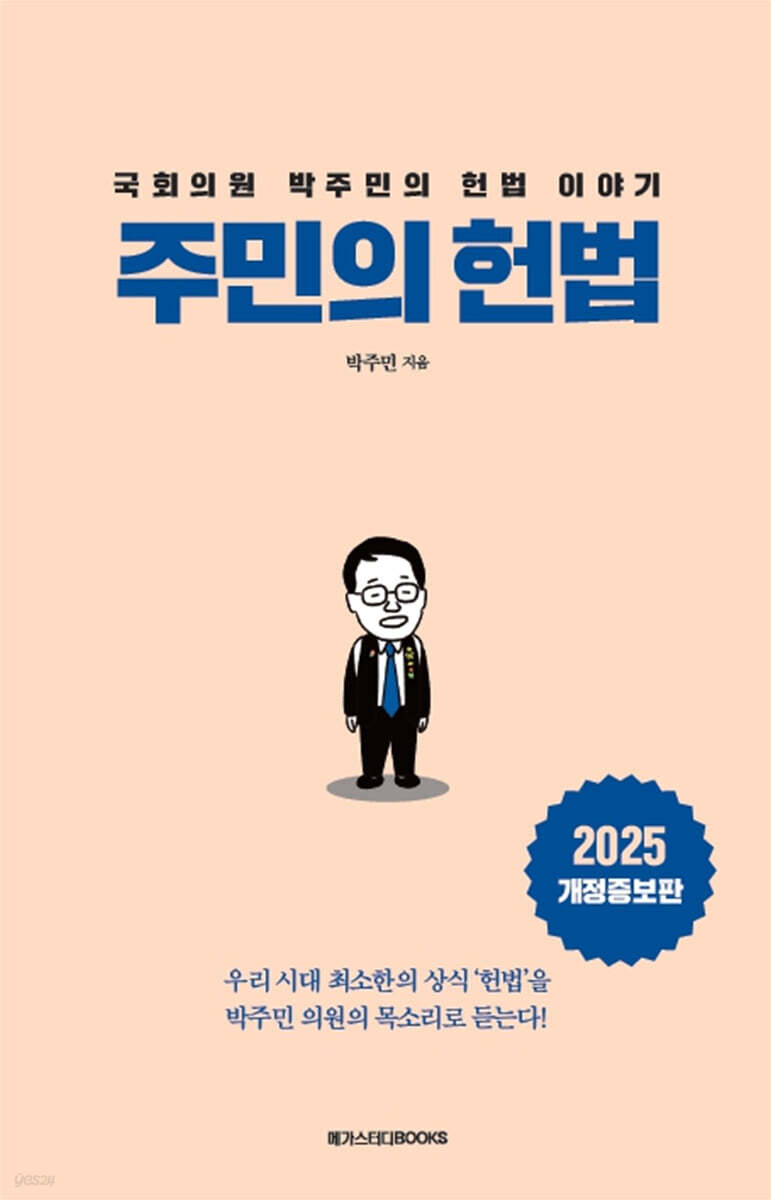
Constitution of the People
 |
Description
Book Introduction
Prosecutorial reform, the Corruption Investigation Office for High-ranking Officials, prosecution power, internal strife, impeachment…
In this confusing era where difficult and frustrating words are pouring out,
The minimum common sense you need to know to read the flow of the world and protect your rights is the 'Constitution'.
Listen to the voice of Representative Park Ju-min along with the current political situation!
A series of national events in recent years have heightened interest in the nation, government, and democracy.
In this process, the public's interest in law and politics has increased, and as a result, the Constitution has also received attention.
By now, most people would know Article 1, Paragraph 1 of the Constitution, which states, “The Republic of Korea shall be a democratic republic.” and Paragraph 2, “The sovereignty of the Republic of Korea shall reside in the people, and all state authority shall emanate from the people.”
Many people think that the Constitution is about the size of a thick law book, but in fact, it is a relatively short text consisting of 130 articles that can be read in about 15 minutes.
However, this short content contains the ideology and values of the Republic of Korea government, as in the above article, and the basis for judgment on all matters occurring within the country.
Some might say, 'Do ordinary people really need to know the Constitution? What does reading it have to do with my livelihood?'
Of course, you can live without knowing.
But knowing this will help me make wiser judgments about what is right and what is wrong in the many things happening around me and in my life.
So it allows me to discern what I should be energized by and what I should be angry about.
In this confusing era where difficult and frustrating words are pouring out,
The minimum common sense you need to know to read the flow of the world and protect your rights is the 'Constitution'.
Listen to the voice of Representative Park Ju-min along with the current political situation!
A series of national events in recent years have heightened interest in the nation, government, and democracy.
In this process, the public's interest in law and politics has increased, and as a result, the Constitution has also received attention.
By now, most people would know Article 1, Paragraph 1 of the Constitution, which states, “The Republic of Korea shall be a democratic republic.” and Paragraph 2, “The sovereignty of the Republic of Korea shall reside in the people, and all state authority shall emanate from the people.”
Many people think that the Constitution is about the size of a thick law book, but in fact, it is a relatively short text consisting of 130 articles that can be read in about 15 minutes.
However, this short content contains the ideology and values of the Republic of Korea government, as in the above article, and the basis for judgment on all matters occurring within the country.
Some might say, 'Do ordinary people really need to know the Constitution? What does reading it have to do with my livelihood?'
Of course, you can live without knowing.
But knowing this will help me make wiser judgments about what is right and what is wrong in the many things happening around me and in my life.
So it allows me to discern what I should be energized by and what I should be angry about.
- You can preview some of the book's contents.
Preview
index
Introduction_Why are we talking about the Constitution now?
specialty
Chapter 1 General Provisions
Chapter 2 Rights and Obligations of Citizens
Chapter 3 National Assembly
Chapter 4 Government
Chapter 5 Courts
Chapter 6 Constitutional Court
Chapter 7 Election Management
Chapter 8 Local Autonomy
Chapter 9 Economy
Chapter 10 Constitutional Amendment
Supplementary provisions
Conclusion
specialty
Chapter 1 General Provisions
Chapter 2 Rights and Obligations of Citizens
Chapter 3 National Assembly
Chapter 4 Government
Chapter 5 Courts
Chapter 6 Constitutional Court
Chapter 7 Election Management
Chapter 8 Local Autonomy
Chapter 9 Economy
Chapter 10 Constitutional Amendment
Supplementary provisions
Conclusion
Detailed image

Into the book
Most citizens probably have never read the Constitution.
Some people might say, “What’s the point of reading the Constitution?”
But you can get a lot of information just by reading the Constitution.
There is more useful information applicable to our daily lives than we think.
And that's not all.
I guarantee that your perspective on society will also change.
Moreover, it is not that difficult to read.
When people think of the Constitution, they think of it as a massive volume, like a thick law book.
no.
The Constitution is very short.
The text is very short, so anyone can read it quickly.
This short law is the basis for all other laws in our country.
--- From "Introduction"
What's the significance of addressing historical events in the Constitution? It's because the Constitution can reveal the process through which our country was formed and the events that developed democracy.
Through the March 1st Movement, the efforts to achieve independence from Japanese occupation were incorporated into the Constitution, and through the April 19th Revolution, the spirit of pursuing democracy was incorporated into the Constitution.
--- From "Expert"
There is a tendency to think that just being arrested makes you a criminal.
Detention is not a final sentence, but rather a status in which investigation or trial is in progress.
So the prosecution is trying to get him arrested by any means necessary.
I think it's a success if you can get them arrested.
Especially in political cases.
They think they've succeeded because when they arrest someone, the people think they're guilty.
Even if you are later found not guilty, people won't remember.
People think that if the perpetrator is punished through a (criminal) trial, the victim will recover to some extent.
But in reality, it is said that this is not the case.
Why? Since I can't go to trial, testify, or participate, the trial proceeds as if it were someone else's business.
The results just come out over time.
That's why I don't feel like I'm recovering.
Recently, there has been a lot of talk about changing the criminal process to include victims from the beginning and listen to their stories, called the "restorative criminal process."
You just learned that the Constitution covers the minimum wage, right? Sometimes, economic commentators and some members of the National Assembly claim they don't understand why Korea has one, given that few countries in the world have one. Politicians shouldn't make such claims without even reading the Constitution.
The minimum wage system is implemented according to the Constitution because it is mandated by the Constitution.
The military service bonus points system was ruled unconstitutional by the Constitutional Court and disappeared.
The person who won the unconstitutional ruling was a man. Why did he think the military bonus points system was unconstitutional? He was disabled.
I couldn't go to the military.
When they gave extra points to someone who had served in the military, he filed a lawsuit, saying, "What am I, who couldn't serve in the military?"
Many people mistakenly believe that this system disappeared because women filed lawsuits, but that is not true.
--- From Chapter 2, Rights and Duties of Citizens
The justices say they are dying because they have so many cases per person to deal with.
So they say that we need to create something called an appellate court to make their work easier.
On the other hand, people like Minbyun say that instead of creating an appellate court, why not just increase the number of Supreme Court justices?
If we increase the number of Supreme Court justices, the workload per justice will decrease.
But the Supreme Court justices say that increasing the number of justices is absolutely not allowed.
Why would that be? What's the difference in authority between being one of 13 and one of 100?
--- From Chapter 3, National Assembly
In order for trials to truly be conducted independently, it is necessary to block not only external but also internal influences, and in particular, it is necessary to dismantle organizations such as the Court Administration Office and release the power to appoint judges from the hands of the Supreme Court.
Currently, a revision to the Court Organization Act with this content has been submitted to the National Assembly, but it has not yet been properly discussed.
Some people might say, “What’s the point of reading the Constitution?”
But you can get a lot of information just by reading the Constitution.
There is more useful information applicable to our daily lives than we think.
And that's not all.
I guarantee that your perspective on society will also change.
Moreover, it is not that difficult to read.
When people think of the Constitution, they think of it as a massive volume, like a thick law book.
no.
The Constitution is very short.
The text is very short, so anyone can read it quickly.
This short law is the basis for all other laws in our country.
--- From "Introduction"
What's the significance of addressing historical events in the Constitution? It's because the Constitution can reveal the process through which our country was formed and the events that developed democracy.
Through the March 1st Movement, the efforts to achieve independence from Japanese occupation were incorporated into the Constitution, and through the April 19th Revolution, the spirit of pursuing democracy was incorporated into the Constitution.
--- From "Expert"
There is a tendency to think that just being arrested makes you a criminal.
Detention is not a final sentence, but rather a status in which investigation or trial is in progress.
So the prosecution is trying to get him arrested by any means necessary.
I think it's a success if you can get them arrested.
Especially in political cases.
They think they've succeeded because when they arrest someone, the people think they're guilty.
Even if you are later found not guilty, people won't remember.
People think that if the perpetrator is punished through a (criminal) trial, the victim will recover to some extent.
But in reality, it is said that this is not the case.
Why? Since I can't go to trial, testify, or participate, the trial proceeds as if it were someone else's business.
The results just come out over time.
That's why I don't feel like I'm recovering.
Recently, there has been a lot of talk about changing the criminal process to include victims from the beginning and listen to their stories, called the "restorative criminal process."
You just learned that the Constitution covers the minimum wage, right? Sometimes, economic commentators and some members of the National Assembly claim they don't understand why Korea has one, given that few countries in the world have one. Politicians shouldn't make such claims without even reading the Constitution.
The minimum wage system is implemented according to the Constitution because it is mandated by the Constitution.
The military service bonus points system was ruled unconstitutional by the Constitutional Court and disappeared.
The person who won the unconstitutional ruling was a man. Why did he think the military bonus points system was unconstitutional? He was disabled.
I couldn't go to the military.
When they gave extra points to someone who had served in the military, he filed a lawsuit, saying, "What am I, who couldn't serve in the military?"
Many people mistakenly believe that this system disappeared because women filed lawsuits, but that is not true.
--- From Chapter 2, Rights and Duties of Citizens
The justices say they are dying because they have so many cases per person to deal with.
So they say that we need to create something called an appellate court to make their work easier.
On the other hand, people like Minbyun say that instead of creating an appellate court, why not just increase the number of Supreme Court justices?
If we increase the number of Supreme Court justices, the workload per justice will decrease.
But the Supreme Court justices say that increasing the number of justices is absolutely not allowed.
Why would that be? What's the difference in authority between being one of 13 and one of 100?
--- From Chapter 3, National Assembly
In order for trials to truly be conducted independently, it is necessary to block not only external but also internal influences, and in particular, it is necessary to dismantle organizations such as the Court Administration Office and release the power to appoint judges from the hands of the Supreme Court.
Currently, a revision to the Court Organization Act with this content has been submitted to the National Assembly, but it has not yet been properly discussed.
--- From Chapter 5, Court
Publisher's Review
This book interprets the Constitution through the eyes of Park Ju-min, a three-term National Assembly member who is a familiar politician known by various nicknames such as 'Beggar's Wallet', 'Street Lawyer', 'Bal-ui-Bal-ui-Park-ju-Bal-ui', and 'Legislative Prince' to the general public, and has demonstrated the best legislative activities, including winning the 'Baekbong Shin Sa-sa Award', given to the most exemplary member of the National Assembly selected by political reporters, three times in a row, and being selected as an excellent member of the National Assembly audit NGO monitoring group for three times in a row. It explains the Constitution, which contains the minimum common sense that the citizens of the Republic of Korea must know in order to protect their given rights, in an easy and clear way.
As a constitutional book written by a sitting member of the National Assembly, the book's greatest strength is that it retains both the logic of a lawyer and the experience of working in the field as a legislator.
In addition, explanations that go beyond theory and practice, such as the basic structure of the Constitution and the interpretation of related laws, current issues related to the Constitution, and points of contention in the National Assembly regarding constitutional amendments, help to approach the Constitution in a more interesting way.
Furthermore, in keeping with the author's commitment to stimulating the general public's interest in law and politics, this book focuses on relevant issues and case law regarding provisions directly related to the lives of ordinary citizens, rather than analyzing the history of law or legal theory.
In addition, it is worth noting that the composition satisfies the needs of readers who want to read the Constitution from beginning to end by meticulously adding ‘Park Ju-min’s interpretation’ to each and every article from the ‘preamble’ that opens the Constitution to the last 130 articles.
The lively illustrations of Kim Bo-tong, the famous illustrator and author of 『DP』 『Alive, Dazzlingly』 and 『Not Unhappy Yet』, make the book even more interesting.
This revised and expanded edition adds 40 pages to the book, revising and supplementing the content and adding cases based on current political and social issues and new legislation.
In addition, a separate preface to the revised and expanded edition clearly contains the author's thoughts on why knowing the Constitution is more important and meaningful in this current situation.
As a constitutional book written by a sitting member of the National Assembly, the book's greatest strength is that it retains both the logic of a lawyer and the experience of working in the field as a legislator.
In addition, explanations that go beyond theory and practice, such as the basic structure of the Constitution and the interpretation of related laws, current issues related to the Constitution, and points of contention in the National Assembly regarding constitutional amendments, help to approach the Constitution in a more interesting way.
Furthermore, in keeping with the author's commitment to stimulating the general public's interest in law and politics, this book focuses on relevant issues and case law regarding provisions directly related to the lives of ordinary citizens, rather than analyzing the history of law or legal theory.
In addition, it is worth noting that the composition satisfies the needs of readers who want to read the Constitution from beginning to end by meticulously adding ‘Park Ju-min’s interpretation’ to each and every article from the ‘preamble’ that opens the Constitution to the last 130 articles.
The lively illustrations of Kim Bo-tong, the famous illustrator and author of 『DP』 『Alive, Dazzlingly』 and 『Not Unhappy Yet』, make the book even more interesting.
This revised and expanded edition adds 40 pages to the book, revising and supplementing the content and adding cases based on current political and social issues and new legislation.
In addition, a separate preface to the revised and expanded edition clearly contains the author's thoughts on why knowing the Constitution is more important and meaningful in this current situation.
GOODS SPECIFICS
- Date of issue: March 10, 2025
- Page count, weight, size: 400 pages | 140*210*30mm
- ISBN13: 9791129714558
- ISBN10: 1129714551
You may also like
카테고리
korean


korean

![GQ KOREA Mark (Monthly): December [2025]](http://librairie.coreenne.fr/cdn/shop/files/8ef265dbbfbf186523ed75ba7319009d.jpg?v=1765340328&width=3840)


