

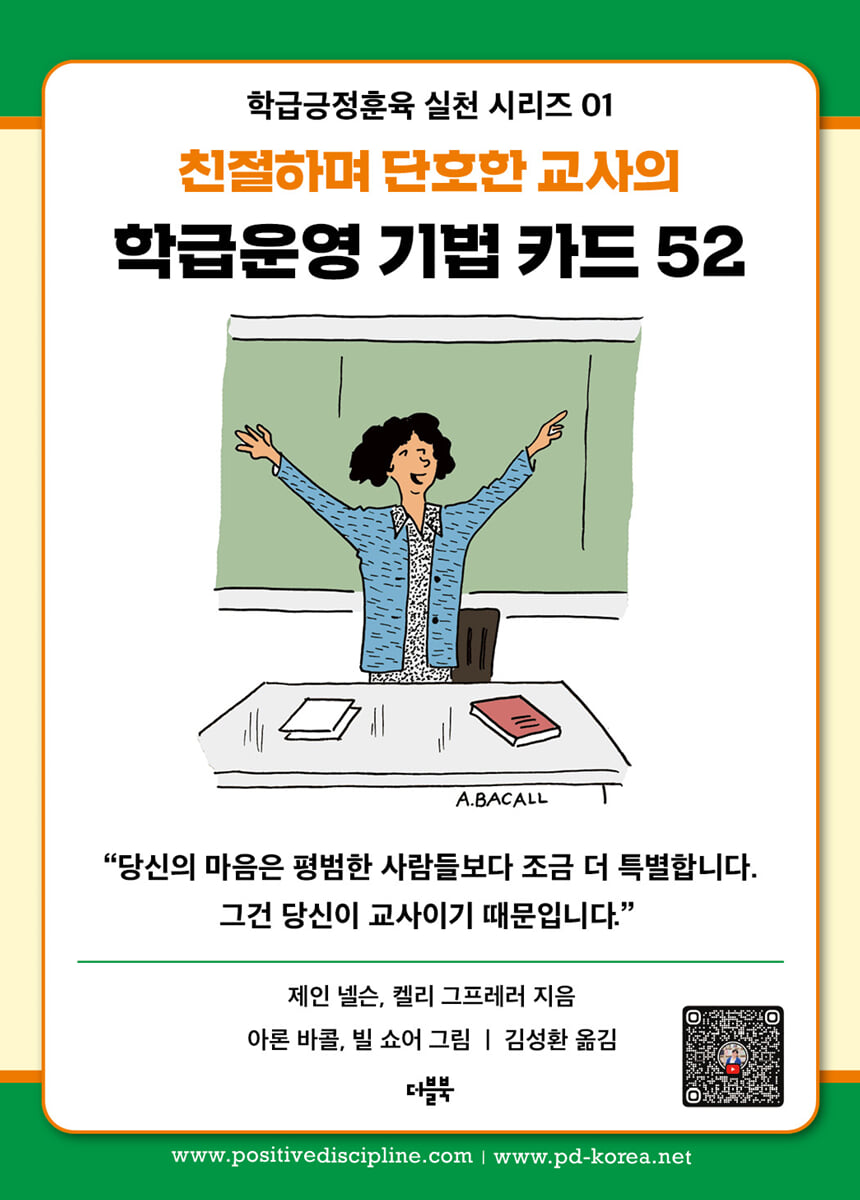
Classroom Management Techniques Card 52
 |
Description
Book Introduction
"The Secret of a Kind and Firm Teacher"
A classroom positive discipline program introduced in 52 countries around the world.
Discover 52 classroom management skills and methods on cards.
The biggest challenge for teachers is guiding students' 'inappropriate behavior'.
Based on the research of psychologists Adler and Dreikers, 'Positive Discipline in the Classroom' kindly teaches teachers the techniques and methods to guide students.
"Classroom Management Techniques Card 52" features 52 tools that promote social-emotional learning. Instead of relying on ineffective discipline and punishment, it demonstrates a teacher's genuine heart and strong belief in their students, motivating them to become more proactive in problem-solving.
By consistently practicing these 52 classroom management techniques throughout the year, you can connect with your children with kindness, encourage them, and guide them toward growth with firmness, while maintaining principled and unwavering classroom management.
A classroom positive discipline program introduced in 52 countries around the world.
Discover 52 classroom management skills and methods on cards.
The biggest challenge for teachers is guiding students' 'inappropriate behavior'.
Based on the research of psychologists Adler and Dreikers, 'Positive Discipline in the Classroom' kindly teaches teachers the techniques and methods to guide students.
"Classroom Management Techniques Card 52" features 52 tools that promote social-emotional learning. Instead of relying on ineffective discipline and punishment, it demonstrates a teacher's genuine heart and strong belief in their students, motivating them to become more proactive in problem-solving.
By consistently practicing these 52 classroom management techniques throughout the year, you can connect with your children with kindness, encourage them, and guide them toward growth with firmness, while maintaining principled and unwavering classroom management.
index
Five Criteria for Positive Discipline | Guidelines
1.
Act without saying a word
2.
agreement
3.
Anger Selection Wheel
4.
Don't argue
5.
Understanding the Brain
6.
consideration
7.
class meeting
8.
encouragement
9.
Parent-Teacher-Student Conference
10.
Connection before behavior modification
11.
Contribution
12.
Behavior control
13.
Curious Question: Conversation
14.
Curiosity Question: Motivation
15.
Deciding what the teacher should do
16.
Encouragement vs.
compliment
17.
Encouraging words
18.
eye contact
19.
Trust
20.
Focus on the solution
21.
See it through to the end
22.
Finding the Goal of Action
23.
greeting
24.
Class guidelines
25.
humor
26.
“Me” message
27.
meaningful role
28.
Kindness and firmness
29.
Limited selection
30.
ear
31.
logical consequence
32.
Becoming a misaligned team leader
33.
Attracting too much attention
34.
misuse of power
35.
plural
36.
lethargy
37.
Recovering from mistakes
38.
mistake
39.
One word
40.
4 Steps to Troubleshooting
41.
Teaching Positive Timeout
42.
Using positive timeouts
43.
Avoid compensation
44.
Role play
45.
Burning a boat
46.
self-care
47.
special time
48.
Take your time and practice
49.
speech
50.
Do something unexpected
51.
Check your feelings
52.
Selection wheel
1.
Act without saying a word
2.
agreement
3.
Anger Selection Wheel
4.
Don't argue
5.
Understanding the Brain
6.
consideration
7.
class meeting
8.
encouragement
9.
Parent-Teacher-Student Conference
10.
Connection before behavior modification
11.
Contribution
12.
Behavior control
13.
Curious Question: Conversation
14.
Curiosity Question: Motivation
15.
Deciding what the teacher should do
16.
Encouragement vs.
compliment
17.
Encouraging words
18.
eye contact
19.
Trust
20.
Focus on the solution
21.
See it through to the end
22.
Finding the Goal of Action
23.
greeting
24.
Class guidelines
25.
humor
26.
“Me” message
27.
meaningful role
28.
Kindness and firmness
29.
Limited selection
30.
ear
31.
logical consequence
32.
Becoming a misaligned team leader
33.
Attracting too much attention
34.
misuse of power
35.
plural
36.
lethargy
37.
Recovering from mistakes
38.
mistake
39.
One word
40.
4 Steps to Troubleshooting
41.
Teaching Positive Timeout
42.
Using positive timeouts
43.
Avoid compensation
44.
Role play
45.
Burning a boat
46.
self-care
47.
special time
48.
Take your time and practice
49.
speech
50.
Do something unexpected
51.
Check your feelings
52.
Selection wheel
Detailed image

Publisher's Review
Leading positive change in the classroom
52 Classroom Management Techniques Cards
Card composition
『Classroom Management Techniques Guard 52』 consists of 52 chapters.
If you practice one card per week, it will take 52 weeks, so there are 52 cards.
There are three types of cards.
1.
Cards that cover how to understand students' minds
2.
Cards to connect and encourage students
3.
A card that helps you run your class in an orderly manner using decisive techniques and methods.
Use of cards
1.
Utilization for the entire class
- It consists of 52 cards.
Practice with your children in the order of the numbers on the cards, one per week.
- If you are having difficulty managing the classroom with children, randomly draw three cards.
Then, choose one of the three chapters that you like and put it into practice.
2.
Utilization for a specific child
- If you have a child you want to help solve a problem, use Card 32, “Finding Misaligned Goals,” to understand their goals.
- This card has friendly problem-solving skills and decisive problem-solving skills.
If your child is permissive, choose the firm card. If you are not connected to your child, choose the kind card.
- Randomly pick one of the cards and try it out.
Trust and practice the card, the students, and the teachers themselves.
It would also be helpful for parents raising children if they could read the contents of the card as if the teacher part was the parent and the student part was the child.
Additionally, if you apply the various techniques on the cards to yourself, rather than to your students, you will encourage yourself and become a more professional teacher.
To study more
1.
Mr. Kim Seonghwan, who translated this card, was the first to introduce positive classroom discipline in Korea and has been doing so for 10 years.
are being practiced in the classroom.
Professor Kim Seonghwan explains in detail the techniques and methods shown in this card.
This is the video that was introduced.
Try using YouTube www.youtube.com/@아이용김.
2.
The techniques and methods on the cards are most effective when practiced in practice.
I need training at school
Asking is also a good way to practice. (kaba97@naver.com)
3.
We have monthly PDC (Positive Discipline in the Classroom) training.
More professional training on positive classroom discipline
Get the meat. Sign up on the PDC National Teachers' Association band (https://band.us/@pdc)
52 Classroom Management Techniques Cards
Card composition
『Classroom Management Techniques Guard 52』 consists of 52 chapters.
If you practice one card per week, it will take 52 weeks, so there are 52 cards.
There are three types of cards.
1.
Cards that cover how to understand students' minds
2.
Cards to connect and encourage students
3.
A card that helps you run your class in an orderly manner using decisive techniques and methods.
Use of cards
1.
Utilization for the entire class
- It consists of 52 cards.
Practice with your children in the order of the numbers on the cards, one per week.
- If you are having difficulty managing the classroom with children, randomly draw three cards.
Then, choose one of the three chapters that you like and put it into practice.
2.
Utilization for a specific child
- If you have a child you want to help solve a problem, use Card 32, “Finding Misaligned Goals,” to understand their goals.
- This card has friendly problem-solving skills and decisive problem-solving skills.
If your child is permissive, choose the firm card. If you are not connected to your child, choose the kind card.
- Randomly pick one of the cards and try it out.
Trust and practice the card, the students, and the teachers themselves.
It would also be helpful for parents raising children if they could read the contents of the card as if the teacher part was the parent and the student part was the child.
Additionally, if you apply the various techniques on the cards to yourself, rather than to your students, you will encourage yourself and become a more professional teacher.
To study more
1.
Mr. Kim Seonghwan, who translated this card, was the first to introduce positive classroom discipline in Korea and has been doing so for 10 years.
are being practiced in the classroom.
Professor Kim Seonghwan explains in detail the techniques and methods shown in this card.
This is the video that was introduced.
Try using YouTube www.youtube.com/@아이용김.
2.
The techniques and methods on the cards are most effective when practiced in practice.
I need training at school
Asking is also a good way to practice. (kaba97@naver.com)
3.
We have monthly PDC (Positive Discipline in the Classroom) training.
More professional training on positive classroom discipline
Get the meat. Sign up on the PDC National Teachers' Association band (https://band.us/@pdc)
GOODS SPECIFICS
- Date of issue: February 21, 2025
- Page count, weight, size: 108 pages | 89*124*20mm
- ISBN13: 9791193153543
- ISBN10: 1193153549
You may also like
카테고리
korean


korean

![GQ KOREA Mark (Monthly): December [2025]](http://librairie.coreenne.fr/cdn/shop/files/8ef265dbbfbf186523ed75ba7319009d.jpg?v=1765340328&width=3840)


