

Strange Normal Family
 |
Description
Book Introduction
★★★ Revised and expanded edition published, reflecting changes over the past five years.
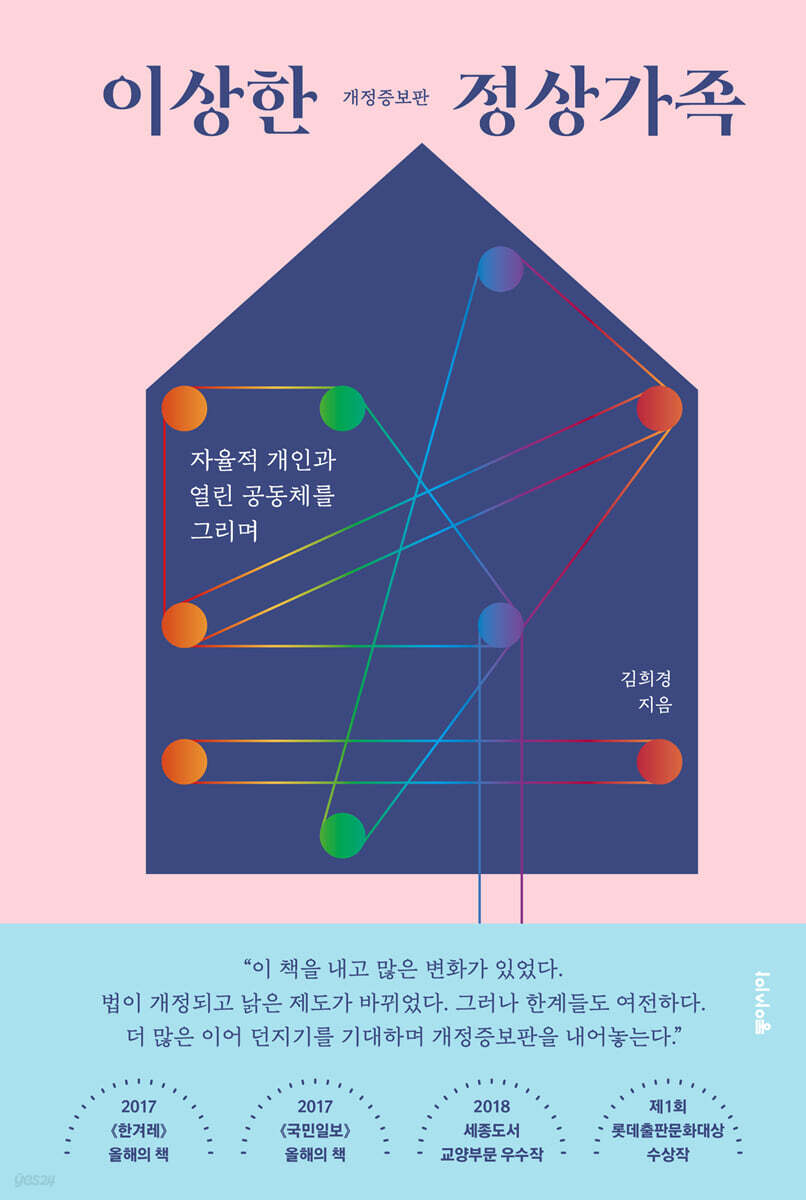
“After this book was published, the law was revised and the old system was changed.
But limitations still remain.
We are releasing this revised and expanded edition in anticipation of further follow-up.”
The very book to which President Moon Jae-in sent a letter of encouragement!
★2017 Hankyoreh Book of the Year ★2017 Kukmin Ilbo Book of the Year
★2018 Sejong Books Culture Category Excellence Award ★1st Lotte Publishing Culture Award Winner
From Head of Save the Children's Business Headquarters to Vice Minister of Gender Equality and Family!
Experience gained directly in the field
Rewritten based on extensive data
A monumental report on the "normal family" in Korean society.
“After this book was published, the law was revised and the old system was changed.
But limitations still remain.
We are releasing this revised and expanded edition in anticipation of further follow-up.”
The very book to which President Moon Jae-in sent a letter of encouragement!
★2017 Hankyoreh Book of the Year ★2017 Kukmin Ilbo Book of the Year
★2018 Sejong Books Culture Category Excellence Award ★1st Lotte Publishing Culture Award Winner
From Head of Save the Children's Business Headquarters to Vice Minister of Gender Equality and Family!
Experience gained directly in the field
Rewritten based on extensive data
A monumental report on the "normal family" in Korean society.
- You can preview some of the book's contents.
Preview
index
Introducing the Revised and Expanded Edition: The Stones We Throw Will Travel Farther
Prologue to the First Edition: Little People, Big Rights
1.
Is family really a fence?
In the family - children are my possessions
Intimate violence and corporal punishment for "you, who are mine"
? How we treat children speaks volumes about our society.
? Overprotection or neglect, what happens when you treat your children like possessions?
On the impossibility of 'family suicide'
? Parental authority is not a right
2.
Living as an 'abnormal' family in Korea
Outside the family - only the 'normal' are on our side
Why are there only single mothers and no single fathers?
? Adoption, babies exported to 'normal families'
What it means to have a family with different skin colors living in Korea
3.
Who defines normal and abnormal families?
The established belief that 'you can only trust your family'
Why has family become so important in Korea?
A society where families, not individuals, climb the ladder
Why has familism spread to companies, schools, and society?
4.
If family is such a problem
What we must do to live together
How will the Parental Corporal Punishment Ban Act change society?
Life is individual, solutions are collective
? Living together, burdening the family to society
Epilogue: Drawing on Autonomous Individuals and Open Communities
A subjective list of books worth reading
main
Prologue to the First Edition: Little People, Big Rights
1.
Is family really a fence?
In the family - children are my possessions
Intimate violence and corporal punishment for "you, who are mine"
? How we treat children speaks volumes about our society.
? Overprotection or neglect, what happens when you treat your children like possessions?
On the impossibility of 'family suicide'
? Parental authority is not a right
2.
Living as an 'abnormal' family in Korea
Outside the family - only the 'normal' are on our side
Why are there only single mothers and no single fathers?
? Adoption, babies exported to 'normal families'
What it means to have a family with different skin colors living in Korea
3.
Who defines normal and abnormal families?
The established belief that 'you can only trust your family'
Why has family become so important in Korea?
A society where families, not individuals, climb the ladder
Why has familism spread to companies, schools, and society?
4.
If family is such a problem
What we must do to live together
How will the Parental Corporal Punishment Ban Act change society?
Life is individual, solutions are collective
? Living together, burdening the family to society
Epilogue: Drawing on Autonomous Individuals and Open Communities
A subjective list of books worth reading
main
Detailed image

Into the book
In the revised and expanded edition, I tried to include both aspects of reality: the changed reality and the unchanged reality.
Issues that are universally accepted in our society, such as child allowances, were omitted from the revised edition. However, for issues that are still ongoing, even though they have changed slightly, subsequent developments were recorded in addition to the contents of the first edition.
I have rewritten this book in a way that reveals the process of change as much as possible to show how our society's approach to addressing the issues pointed out and highlighted in this book has changed.
--- p.6~7
Ordinary parents often view corporal punishment and abuse separately.
But if you reread the above answers, imagining them as relationships between adults, you'll see how strange these criteria for corporal punishment and abuse are.
For example, if you hit someone after agreeing on a set of principles, it is not violence. If the person being hit does not have their self-esteem or emotions hurt, it is not violence. If you aim to correct the other person's behavior, it is not violence. If you control your emotions while hitting, it is not violence...
Aren't these two statements impossible to establish? If so, they shouldn't be applicable to children either.
When determining what not to do to people, children should not be treated differently from adults.
Violence is even more so.
--- p.32
Korea is a country where parental authority over children is excessively strong.
Parents' rights over their children are more of a duty than a right, as they are fundamental rights granted to protect children rather than the freedom of parents.
Parenting styles within the family are not an extraterritorial area of 'natural law' and should be subject to state sanctions to protect human rights.
It's not that I prefer a large country.
Because only when public intervention is allowed even within closed doors can the vulnerable within the family breathe and become free.
--- p.62~63
Even in the middle class, where it would have been unthinkable to make such a tragic choice for economic reasons, mothers are still screaming under the burden of single-parent care.
Mothers who, consumed by economic and emotional pain, choose the terrible ending of killing their children and then committing suicide.
And mothers of middle-class families who go back and forth between work and home alone, struggling with their worries, but are criticized as being 'mom-chung'.
Although they are women who would never encounter each other, the shadow of our society, where families, especially mothers, are expected to shoulder all the burden, looms over both of them.
--- p.97~98
The phrase “heartless maternal love” almost always appears in the titles of articles reporting on infant abandonment cases.
Titles such as “About 100 babies abandoned every year… A mother’s love is cruel due to ignorance” and “Life is difficult, a cruel mother abandons three newborns” follow.
As is often the case with this type of reporting, the comments are full of lamentations about the harsh disregard for human life and the indiscriminate sexual indulgence.
But is that really true? Are single mothers' sense of responsibility for life so weak? Before condemning the heartless mother who neglected her infant, shouldn't we examine who is truly the "culprit" behind this situation?
--- p.119
“Bullying, dirty, appearance, communication, Africa, chocolate, jajangmyeon, black people, misfortune….”
He said that among the students at that school, there were no children from multicultural families who could be easily recognized by their appearance.
The list of hateful thoughts that students who responded to the survey attached to the very concept of "multiculturalism" was striking, regardless of whether they had ever personally seen a child from a multicultural family.
--- p.162
As family life becomes more polarized, the greatest harm is borne by children.
As the overheated private education trend shows, the middle class struggles to avoid falling into a lower social class and engages in all-out competition from a young age.
Since we have to move towards that high place, there is little room to consider the child's autonomy and individuality.
On the other hand, low-income families with unstable income and financial stability fall into a state of 'care gap' where they are unable to care for their children.
Because of this, children are often neglected and become targets of stress relief, and the number of children suffering from abuse is increasing.
--- p.190
Within a pseudo-family bound by school ties and regional ties, people identify themselves with their in-group.
Within the in-group, authoritarianism, hierarchy, and indiscriminate paternalism are prevalent, while exclusionism is prominent towards the out-group.
People with a quasi-familial tendency tend to pursue overt stratification, and thus exhibit a strong attitude of exclusive regional egoism.
--- p.212
One day, when her young son was not listening to her, she asked her son to bring her a cane so that she could teach him how to use it, as she was a young mother in a time when the belief was widespread that sparing the rod would spoil the child.
This is a method that many Korean mothers also use.
By having children bring their own whips and decide how many times they will be hit, this method was intended to give them an opportunity to reflect on their own actions, along with a warning such as, “You know your sins.”
But it is said that this boy went out to look for a whirlpool, and after a long time came back crying, holding out a small stone and saying this.
“I couldn’t find any sticks that could be used as a whip.
Instead, throw this stone at me.”
--- p.225~226
There is also an argument that the family should be viewed not as a fixed form, but as a 'family practice that constitutes who is considered family.'
Rather than setting family norms and trying to exclude or change relationships that don't fit those norms, why not look at family as the way people feel close to each other and the relationships they have with each other and how they care for and rely on each other?
Embracing diversity will become increasingly important.
Family is now an activity rather than a state, a verb rather than a noun.
Issues that are universally accepted in our society, such as child allowances, were omitted from the revised edition. However, for issues that are still ongoing, even though they have changed slightly, subsequent developments were recorded in addition to the contents of the first edition.
I have rewritten this book in a way that reveals the process of change as much as possible to show how our society's approach to addressing the issues pointed out and highlighted in this book has changed.
--- p.6~7
Ordinary parents often view corporal punishment and abuse separately.
But if you reread the above answers, imagining them as relationships between adults, you'll see how strange these criteria for corporal punishment and abuse are.
For example, if you hit someone after agreeing on a set of principles, it is not violence. If the person being hit does not have their self-esteem or emotions hurt, it is not violence. If you aim to correct the other person's behavior, it is not violence. If you control your emotions while hitting, it is not violence...
Aren't these two statements impossible to establish? If so, they shouldn't be applicable to children either.
When determining what not to do to people, children should not be treated differently from adults.
Violence is even more so.
--- p.32
Korea is a country where parental authority over children is excessively strong.
Parents' rights over their children are more of a duty than a right, as they are fundamental rights granted to protect children rather than the freedom of parents.
Parenting styles within the family are not an extraterritorial area of 'natural law' and should be subject to state sanctions to protect human rights.
It's not that I prefer a large country.
Because only when public intervention is allowed even within closed doors can the vulnerable within the family breathe and become free.
--- p.62~63
Even in the middle class, where it would have been unthinkable to make such a tragic choice for economic reasons, mothers are still screaming under the burden of single-parent care.
Mothers who, consumed by economic and emotional pain, choose the terrible ending of killing their children and then committing suicide.
And mothers of middle-class families who go back and forth between work and home alone, struggling with their worries, but are criticized as being 'mom-chung'.
Although they are women who would never encounter each other, the shadow of our society, where families, especially mothers, are expected to shoulder all the burden, looms over both of them.
--- p.97~98
The phrase “heartless maternal love” almost always appears in the titles of articles reporting on infant abandonment cases.
Titles such as “About 100 babies abandoned every year… A mother’s love is cruel due to ignorance” and “Life is difficult, a cruel mother abandons three newborns” follow.
As is often the case with this type of reporting, the comments are full of lamentations about the harsh disregard for human life and the indiscriminate sexual indulgence.
But is that really true? Are single mothers' sense of responsibility for life so weak? Before condemning the heartless mother who neglected her infant, shouldn't we examine who is truly the "culprit" behind this situation?
--- p.119
“Bullying, dirty, appearance, communication, Africa, chocolate, jajangmyeon, black people, misfortune….”
He said that among the students at that school, there were no children from multicultural families who could be easily recognized by their appearance.
The list of hateful thoughts that students who responded to the survey attached to the very concept of "multiculturalism" was striking, regardless of whether they had ever personally seen a child from a multicultural family.
--- p.162
As family life becomes more polarized, the greatest harm is borne by children.
As the overheated private education trend shows, the middle class struggles to avoid falling into a lower social class and engages in all-out competition from a young age.
Since we have to move towards that high place, there is little room to consider the child's autonomy and individuality.
On the other hand, low-income families with unstable income and financial stability fall into a state of 'care gap' where they are unable to care for their children.
Because of this, children are often neglected and become targets of stress relief, and the number of children suffering from abuse is increasing.
--- p.190
Within a pseudo-family bound by school ties and regional ties, people identify themselves with their in-group.
Within the in-group, authoritarianism, hierarchy, and indiscriminate paternalism are prevalent, while exclusionism is prominent towards the out-group.
People with a quasi-familial tendency tend to pursue overt stratification, and thus exhibit a strong attitude of exclusive regional egoism.
--- p.212
One day, when her young son was not listening to her, she asked her son to bring her a cane so that she could teach him how to use it, as she was a young mother in a time when the belief was widespread that sparing the rod would spoil the child.
This is a method that many Korean mothers also use.
By having children bring their own whips and decide how many times they will be hit, this method was intended to give them an opportunity to reflect on their own actions, along with a warning such as, “You know your sins.”
But it is said that this boy went out to look for a whirlpool, and after a long time came back crying, holding out a small stone and saying this.
“I couldn’t find any sticks that could be used as a whip.
Instead, throw this stone at me.”
--- p.225~226
There is also an argument that the family should be viewed not as a fixed form, but as a 'family practice that constitutes who is considered family.'
Rather than setting family norms and trying to exclude or change relationships that don't fit those norms, why not look at family as the way people feel close to each other and the relationships they have with each other and how they care for and rely on each other?
Embracing diversity will become increasingly important.
Family is now an activity rather than a state, a verb rather than a noun.
--- p.259~260
Publisher's Review
Kim Hee-kyung's 2017 book, "Strange Normal Family," sounded an alarm in our society by comprehensively addressing the sensitive topics of children's rights and family policy.
The author, who was appointed Vice Minister of Gender Equality and Family after the book was published, directly participated in solving the problems raised in the book.
The revised and expanded edition of "Strange Normal Family," published after five years, is based on firsthand experience and meticulous research, meticulously detailing how laws and systems related to children's rights and family policies have changed over time and what limitations still remain.
The 'universal child allowance' highlighted by the author in the first edition became a reality with the revision of the Child Allowance Act in January 2019.
Children under the age of 6 will receive a child allowance of 100,000 won per month regardless of their parents' income or assets.
In addition, the abolition of the "disciplinary power" clause of the Civil Code, which was strongly advocated in the first edition, was finally abolished two years after it was included in the "Inclusive Nation Child Policy" after passing the National Assembly in January 2021.
The public's role in preventing abuse and protecting children has also been strengthened. In particular, the child abuse response system was completely reorganized in October 2020. As pointed out in the first edition, local government officials are now responsible for receiving reports of child abuse, conducting on-site investigations, and providing emergency protection. Child protection agencies have been converted into dedicated case management agencies, creating a dual system.
The adoption process, previously handled by private organizations, was transferred to local governments in June 2021, and around the same time, the child protection budget was transferred to the general account and unified.
Support for single-parent child care, including single mothers, which was intensively covered in “Strange Normal Family,” has also been significantly strengthened.
The child support amount was increased from 120,000 won to 200,000 won per month, and the prohibition on overlapping benefits with basic livelihood security recipients was abolished, making it possible to receive both livelihood security and child support.
There have also been positive changes, such as the age of children eligible for child support being expanded from under 12 to under 18.
In addition, the obligation to support, which had been gradually abolished since 2017, will be completely abolished in October 2021, and the institutional practice of harshly enforcing the “family responsibility for welfare” will disappear after 60 years.
Meanwhile, limitations still remain.
Horrific child abuse deaths, including the 'Yangcheon Child Abuse Death Case' that shook the nation, followed one after another, and the child protection system's response showed an immature side, repeating a pattern not much different from the past.
International adoption continues, and neither a universal birth registration system nor an anti-discrimination law has been enacted to date.
The revised and expanded edition of "Strange Normal Family" contains both aspects of reality, both changed and unchanged.
We added to the content of the first edition and recorded the subsequent developments, rewriting it in a way that reveals the process of change as much as possible, and supplemented and updated articles, research, investigations, theses, and interviews.
Since publication, readers have provided a lot of feedback about the terminology used in the book.
The author welcomed the response of a society with heightened sensitivity to children's rights, and provided detailed opinions on some expressions and terms that were retained.
For example, the expression 'abandoned' was changed to 'did not receive care'.
The author, who was appointed Vice Minister of Gender Equality and Family after the book was published, directly participated in solving the problems raised in the book.
The revised and expanded edition of "Strange Normal Family," published after five years, is based on firsthand experience and meticulous research, meticulously detailing how laws and systems related to children's rights and family policies have changed over time and what limitations still remain.
The 'universal child allowance' highlighted by the author in the first edition became a reality with the revision of the Child Allowance Act in January 2019.
Children under the age of 6 will receive a child allowance of 100,000 won per month regardless of their parents' income or assets.
In addition, the abolition of the "disciplinary power" clause of the Civil Code, which was strongly advocated in the first edition, was finally abolished two years after it was included in the "Inclusive Nation Child Policy" after passing the National Assembly in January 2021.
The public's role in preventing abuse and protecting children has also been strengthened. In particular, the child abuse response system was completely reorganized in October 2020. As pointed out in the first edition, local government officials are now responsible for receiving reports of child abuse, conducting on-site investigations, and providing emergency protection. Child protection agencies have been converted into dedicated case management agencies, creating a dual system.
The adoption process, previously handled by private organizations, was transferred to local governments in June 2021, and around the same time, the child protection budget was transferred to the general account and unified.
Support for single-parent child care, including single mothers, which was intensively covered in “Strange Normal Family,” has also been significantly strengthened.
The child support amount was increased from 120,000 won to 200,000 won per month, and the prohibition on overlapping benefits with basic livelihood security recipients was abolished, making it possible to receive both livelihood security and child support.
There have also been positive changes, such as the age of children eligible for child support being expanded from under 12 to under 18.
In addition, the obligation to support, which had been gradually abolished since 2017, will be completely abolished in October 2021, and the institutional practice of harshly enforcing the “family responsibility for welfare” will disappear after 60 years.
Meanwhile, limitations still remain.
Horrific child abuse deaths, including the 'Yangcheon Child Abuse Death Case' that shook the nation, followed one after another, and the child protection system's response showed an immature side, repeating a pattern not much different from the past.
International adoption continues, and neither a universal birth registration system nor an anti-discrimination law has been enacted to date.
The revised and expanded edition of "Strange Normal Family" contains both aspects of reality, both changed and unchanged.
We added to the content of the first edition and recorded the subsequent developments, rewriting it in a way that reveals the process of change as much as possible, and supplemented and updated articles, research, investigations, theses, and interviews.
Since publication, readers have provided a lot of feedback about the terminology used in the book.
The author welcomed the response of a society with heightened sensitivity to children's rights, and provided detailed opinions on some expressions and terms that were retained.
For example, the expression 'abandoned' was changed to 'did not receive care'.
GOODS SPECIFICS
- Publication date: February 22, 2022
- Format: Hardcover book binding method guide
- Page count, weight, size: 308 pages | 548g | 135*205*30mm
- ISBN13: 9788962624175
- ISBN10: 8962624176
You may also like
카테고리
korean


korean

![GQ KOREA Mark (Monthly): December [2025]](http://librairie.coreenne.fr/cdn/shop/files/8ef265dbbfbf186523ed75ba7319009d.jpg?v=1765340328&width=3840)


