

Second sex
 |
Description
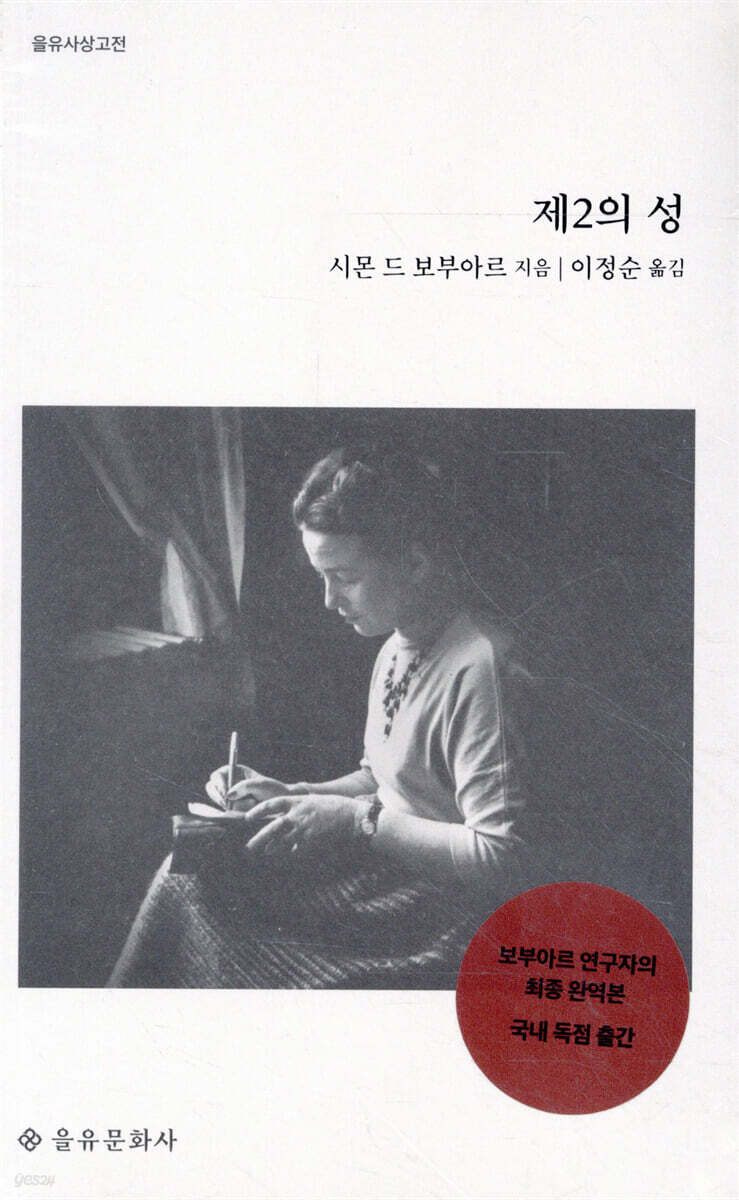
Book Introduction
“We are not born women, we become women.”
The women's studies bible that became the foundation of modern feminist thought
A complete translation by a Beauvoir scholar, published exclusively in Korea for the first time.
Simone de Beauvoir's "The Second Sex," the foundation of modern feminist thought, has been officially published in Korea for the first time by Eulyoo Publishing.
『The Second Sex』, which was translated completely from the French original by Lee Jeong-sun, a specialist in Beauvoir, over three years, rather than being an English or Japanese translation, is Simone de Beauvoir's representative work that keenly analyzes the situation of women from primitive society to the present day from the perspective of existentialist philosophy.
This book is a scientific and comprehensive study of the female condition, exploring the domination of women by men and the roles and images of women in all fields, including society, politics, mythology, and literature, using history, sociology, philosophy, anthropology, biology, and psychoanalysis.
The translation of this book was done by Professor Lee Jeong-sun, who received her master's and doctoral degrees in the philosophical thought and literary works of Beauvoir from the University of Paris IV in France and served as the director of the Institute for Women's Cultural Theory in Korea.
Here, the translator Lee Jeong-sun's "Commentary" and friendly translation notes, a detailed "Simone de Beauvoir Chronology" and over 50 related illustrations were added, and the editing, design, and production methods, such as combining pur binding and four-strand binding, were beautifully and solidly transformed to suit the times.
Published in France 70 years ago, The Second Sex still poses relevant questions, and offers a more compelling and powerful inspiration than ever before.
The women's studies bible that became the foundation of modern feminist thought
A complete translation by a Beauvoir scholar, published exclusively in Korea for the first time.
Simone de Beauvoir's "The Second Sex," the foundation of modern feminist thought, has been officially published in Korea for the first time by Eulyoo Publishing.
『The Second Sex』, which was translated completely from the French original by Lee Jeong-sun, a specialist in Beauvoir, over three years, rather than being an English or Japanese translation, is Simone de Beauvoir's representative work that keenly analyzes the situation of women from primitive society to the present day from the perspective of existentialist philosophy.
This book is a scientific and comprehensive study of the female condition, exploring the domination of women by men and the roles and images of women in all fields, including society, politics, mythology, and literature, using history, sociology, philosophy, anthropology, biology, and psychoanalysis.
The translation of this book was done by Professor Lee Jeong-sun, who received her master's and doctoral degrees in the philosophical thought and literary works of Beauvoir from the University of Paris IV in France and served as the director of the Institute for Women's Cultural Theory in Korea.
Here, the translator Lee Jeong-sun's "Commentary" and friendly translation notes, a detailed "Simone de Beauvoir Chronology" and over 50 related illustrations were added, and the editing, design, and production methods, such as combining pur binding and four-strand binding, were beautifully and solidly transformed to suit the times.
Published in France 70 years ago, The Second Sex still poses relevant questions, and offers a more compelling and powerful inspiration than ever before.
- You can preview some of the book's contents.
Preview
index
Volume 1: Facts and Myths
Translator's Preface
introduction
Part 1: Fate
Chapter 1 Biological Conditions
Chapter 2: Psychoanalytic Perspectives
Chapter 3: The Materialist Perspective
Part 2 History
1.
2.
3.
4.
5.
Part 3 Myth
Chapter 1
Chapter 2
1.
Monterlant or Bread of Disgust
2.
DH
Lawrence or Phallic Pride
3.
Claudel or the Lord's Handmaid
4.
Breton or City
5.
Stendhal or Novel Truth
6.
Chapter 3
Volume 2 Experience
introduction
Part 1 Formation
Chapter 1: Childhood
Chapter 2 The Young Maiden
Chapter 3: Introduction to Sex
Chapter 4 Lesbian
Part 2 Situation
Chapter 5: The Married Woman
Chapter 6 Mother
Chapter 7 Social Life
Chapter 8: Prostitutes and High-Class Whores
Chapter 9 From Maturity to Old Age
Chapter 10: The Woman's Situation and Character
Part 3 Justification
Chapter 11: The Narcissistic Woman
Chapter 12: A Woman in Love
Chapter 13: The Mystic Woman
Part 4: Towards Liberation
Chapter 14: The Independent Woman
conclusion
Release Lee Jeong-sun
Simone de Beauvoir Chronology
Source of the illustration
Search
Detailed image

Into the book
No man would ever think of writing a book about the peculiar situation male men occupy within the human race.
To define who I am, I must first declare, “I am a woman.”
This truth forms the background for another statement.
A man never begins by positioning himself as an individual belonging to any sex.
It goes without saying that he is a man.
Although the male and female entries in official records and on identification documents appear clearly symmetrical, the relationship between the sexes is not that of the poles of electricity or of the north and south poles.
The unique meaning of the word 'man' (vir) in Latin is identical with the general meaning of the word 'human' (homo), so much so that in French, the human race is said to be men (les hommes), indicating both the positive and the neutral gender.
Because women are seen as negative, they are seen as having a one-sidedly limited nature.
Sometimes, during abstract discussions, I get annoyed when men say, “You think that way because you’re a woman.”
I knew my only defense was to rule out subjectivity and answer, “I think that way because it’s true.”
There was no need to even reply, “And you think the opposite because you are a man.”
Because being a man is not something special, it is taken for granted.
Men are legal because they are men, and the fault lies with women.
Just as the ancients had an absolute vertical line to measure the slope of a slope, there is in fact an absolute human archetype called male.
--- p.27~28
Every individual who struggles to justify his or her existence experiences his or her existence as an infinite desire to transcend.
But what defines the female condition in a unique way is that, like all human beings, women are autonomous and free, yet they must discover themselves and make choices in a world where men force them to live as the other.
Woman is required to be fixed as an object and locked in immanence, because she will constantly be transcended by another essential and sovereign consciousness.
The tragedy of woman lies in the conflict between the fundamental claim of every subject to always establish herself as essential and the demands of circumstances to constitute her as inessential.
How can a human being achieve self-fulfillment within these feminine conditions? What paths are open to them? Which paths lead to dead ends? How can independence be regained amidst subordination? What situations restrict women's freedom, and can they truly overcome them? These are the fundamental questions we seek to address.
As we focus on individual opportunities, we will define these opportunities in terms of freedom rather than happiness.
--- p.42
The reason there have been so few female geniuses in history is because society has deprived women of any means of self-expression.
“All geniuses born as women perish for the public good.
“See how women attain the most difficult talents when given the means to do so by chance.” The worst handicap for women is the education that makes them fools.
The oppressor is always preoccupied with weakening the oppressed into useless beings.
It is intentional for a man to block opportunities for a woman.
“We leave dormant in women the most excellent and rich qualities that contribute to our happiness, as well as to their own.” A little girl of ten is more lively and sensitive than her brother.
At twenty, the mischievous boy becomes a witty man, and the girl becomes “a clumsy, timid fool who is afraid of even a spider.”
The fault lies in the education she received.
Girls should be provided with the same level of education as boys.
Anti-feminists oppose women's education, claiming that educated and intelligent women are monsters.
Such criticism stems from the fact that educated women still remain the exception.
If women could acquire culture naturally, just like men, they would utilize it just as naturally as men.
After crippling women, they are subjecting them to laws that are against nature.
In other words, they force women into marriages against their will, expect them to remain chaste, and even criticize women as if divorce were some kind of crime.
Even though there can be no happiness outside of work, most women are left in idleness.
Stendhal was indignant at this condition in which women were placed, and saw in it the source of all the faults for which they were accused.
Women are neither angels, nor demons, nor sphinxes, but merely human beings whom foolish customs have reduced to semi-slaves.
--- p.354~355
We are not born women, we become women.
No biological, psychological, or economic destiny determines the human female's role in society.
The whole civilization has been working hard to create something intermediate between man and castrated man, and has given it the name woman.
Only the intervention of others can constitute an individual as an other.
As long as a child exists for itself, it will not be aware that it is sexually distinct.
For girls and boys, the body is first and foremost an expression of subjectivity and a tool for realizing understanding of the world.
They perceive the world through their eyes and hands, not through their sexuality.
The drama of birth and weaning unfolds in the same way for infants of both sexes.
That is, they all have the same interests and pleasures.
To define who I am, I must first declare, “I am a woman.”
This truth forms the background for another statement.
A man never begins by positioning himself as an individual belonging to any sex.
It goes without saying that he is a man.
Although the male and female entries in official records and on identification documents appear clearly symmetrical, the relationship between the sexes is not that of the poles of electricity or of the north and south poles.
The unique meaning of the word 'man' (vir) in Latin is identical with the general meaning of the word 'human' (homo), so much so that in French, the human race is said to be men (les hommes), indicating both the positive and the neutral gender.
Because women are seen as negative, they are seen as having a one-sidedly limited nature.
Sometimes, during abstract discussions, I get annoyed when men say, “You think that way because you’re a woman.”
I knew my only defense was to rule out subjectivity and answer, “I think that way because it’s true.”
There was no need to even reply, “And you think the opposite because you are a man.”
Because being a man is not something special, it is taken for granted.
Men are legal because they are men, and the fault lies with women.
Just as the ancients had an absolute vertical line to measure the slope of a slope, there is in fact an absolute human archetype called male.
--- p.27~28
Every individual who struggles to justify his or her existence experiences his or her existence as an infinite desire to transcend.
But what defines the female condition in a unique way is that, like all human beings, women are autonomous and free, yet they must discover themselves and make choices in a world where men force them to live as the other.
Woman is required to be fixed as an object and locked in immanence, because she will constantly be transcended by another essential and sovereign consciousness.
The tragedy of woman lies in the conflict between the fundamental claim of every subject to always establish herself as essential and the demands of circumstances to constitute her as inessential.
How can a human being achieve self-fulfillment within these feminine conditions? What paths are open to them? Which paths lead to dead ends? How can independence be regained amidst subordination? What situations restrict women's freedom, and can they truly overcome them? These are the fundamental questions we seek to address.
As we focus on individual opportunities, we will define these opportunities in terms of freedom rather than happiness.
--- p.42
The reason there have been so few female geniuses in history is because society has deprived women of any means of self-expression.
“All geniuses born as women perish for the public good.
“See how women attain the most difficult talents when given the means to do so by chance.” The worst handicap for women is the education that makes them fools.
The oppressor is always preoccupied with weakening the oppressed into useless beings.
It is intentional for a man to block opportunities for a woman.
“We leave dormant in women the most excellent and rich qualities that contribute to our happiness, as well as to their own.” A little girl of ten is more lively and sensitive than her brother.
At twenty, the mischievous boy becomes a witty man, and the girl becomes “a clumsy, timid fool who is afraid of even a spider.”
The fault lies in the education she received.
Girls should be provided with the same level of education as boys.
Anti-feminists oppose women's education, claiming that educated and intelligent women are monsters.
Such criticism stems from the fact that educated women still remain the exception.
If women could acquire culture naturally, just like men, they would utilize it just as naturally as men.
After crippling women, they are subjecting them to laws that are against nature.
In other words, they force women into marriages against their will, expect them to remain chaste, and even criticize women as if divorce were some kind of crime.
Even though there can be no happiness outside of work, most women are left in idleness.
Stendhal was indignant at this condition in which women were placed, and saw in it the source of all the faults for which they were accused.
Women are neither angels, nor demons, nor sphinxes, but merely human beings whom foolish customs have reduced to semi-slaves.
--- p.354~355
We are not born women, we become women.
No biological, psychological, or economic destiny determines the human female's role in society.
The whole civilization has been working hard to create something intermediate between man and castrated man, and has given it the name woman.
Only the intervention of others can constitute an individual as an other.
As long as a child exists for itself, it will not be aware that it is sexually distinct.
For girls and boys, the body is first and foremost an expression of subjectivity and a tool for realizing understanding of the world.
They perceive the world through their eyes and hands, not through their sexuality.
The drama of birth and weaning unfolds in the same way for infants of both sexes.
That is, they all have the same interests and pleasures.
--- p.389
Publisher's Review
“We are not born women, we become women.”
The women's studies bible that became the foundation of modern feminist thought
A complete translation by a Beauvoir scholar, published exclusively in Korea for the first time.
『The Second Sex』 is a representative work of Simone de Beauvoir, known as a pioneer of women's liberation, and was first introduced in Korea by Eulyoo Publishing in 1973.
After 50 years, Eulyoo Publishing Co. has signed an official contract with a French copyright company and is presenting a new translation to suit the changing times.
This translation was done by Lee Jeong-sun, a Beauvoir expert who received her master's and doctoral degrees in the study of Beauvoir's philosophical thought and literary works from the University of Paris IV in France, and took over three years to complete.
Simone de Beauvoir, who had a profound influence on 20th-century feminism and became a symbol of modern women's liberation, left behind numerous works and activities that earned her the titles of existentialist philosopher, novelist, journalist, playwright, engaged intellectual, and radical feminist.
However, the work that brought Beauvoir world fame was undoubtedly The Second Sex.
When this book was published in 1949, it caused a huge stir in French patriarchal society, as it sharply exposed the fiction of myths about femininity, motherhood, love, and sexual difference that placed women in a subordinate position as the "other" of the male subject, while also advocating for equal rights and opportunities for both sexes.
Because of this, Beauvoir faced strong opposition and criticism from conservative male intellectuals regardless of left or right.
In particular, some male intellectuals, such as writers François Mauriac and Albert Camus, did not hesitate to launch vicious misogynistic personal attacks against Beauvoir.
On the other hand, it received the support of intellectuals of a certain type and the fervent support of countless female readers who discovered their own stories and truths in The Second Sex, and it played a major role in awakening the consciousness of women around the world, becoming the detonator of second-wave feminism.
"The Second Sex" sharply analyzes the situation of women from primitive society to the present day from the perspective of existentialist philosophy.
This book is a scientific and comprehensive study of the female condition, exploring the domination of women by men and the roles and images of women assigned by men in all fields, including society, politics, mythology, and literature, using history, sociology, philosophy, anthropology, biology, and psychoanalysis.
Through this book, Beauvoir urges women to become aware of their existential conditions and to be reborn as autonomous and independent subjects. Through the diverse experiences of women from different generations and Beauvoir's literary expressions, she offers warm and delicate comfort and empathy.
It also inspired academic researchers at the time and became the cornerstone of modern feminism and gender studies, and is considered a very important text in women's studies and a classic of feminism today.
“What did being a woman mean to me?”
A feminist classic that sharply analyzes the situation of women from the perspective of existentialist philosophy.
A comprehensive examination of women from the perspectives of history, literature, sociology, philosophy, biology, and psychoanalysis.
"The Second Sex" explores how the human relationship of intersubjectivity operates in a distorted manner within gender relations, and reveals the conditions and possibilities for women to escape the reality of being the Other and return to their true nature as subjects and essences.
It also condemns the male-centered world that forces women to live as subjects, while demonstrating ethical rigor toward the female subject who avoids taking responsibility for her own existence by achieving her own freedom.
Specifically, Volume 1, "Fact and Myth," studies and analyzes historical facts and myths to elucidate how women became the Other in the early days of humanity and how women's status as the Other developed and was maintained throughout human history.
Beauvoir sees women's inferiority as the situation of women who are placed in conditions that make them inferior.
Therefore, the deterministic viewpoint of biology and psychoanalysis that justifies 'femininity' as a biological condition is criticized in Part 1 of Volume 1, 'Fate'.
Part 2, "History," rejects the materialist view that women's subordination can be explained by technology and private property, and Part 3, "Myth," examines and critiques myths defined by men in various realities and literature.
Here, we can see Beauvoir's literary abilities, including her literary intuition and insight, metaphor and satire, sensibility and lyricism, along with her analysis of myth.
Volume 2, "Experience," analyzes how women's lives as others unfold in a male-centered patriarchal society, from childhood to old age, through the vivid experiences of women and extensive research data.
Part 1, "Formation," deals with the experiences of women from childhood to sexual initiation, as well as the issue of female homosexuality, which was taboo in French society at the time. Part 2, "Circumstances," criticizes the subordination of women through the institution of marriage and describes its specific aspects.
Patriarchal society assigns women only the roles of wife and mother.
Society glorifies and praises housework and motherhood, encouraging women to dedicate themselves to housework, childbirth, and childcare.
In short, married women's lives are often dependent and alienated, cut off from the outside world and communicating with society entirely through their husbands.
Beauvoir also sharply criticized the hypocrisy of the French patriarchal society of the time, which prohibited abortion and contraception and confined women to motherhood.
It also deals with the various situations and old age of adult women who are required to be fixed as objects and trapped in internality.
Part 3, "Justification," presents three types of women—"narcissistic women," "women in love," and "mystical women"—to illustrate how women's attempts at self-realization end in failure in a world that forces them to remain as the other.
Part 4, "Toward Liberation," closely examines the difficulties faced by socially and economically independent women on their path to self-realization as complete subjects, emphasizing that true liberation cannot be achieved without collective change.
Beauvoir urges women to become aware of their existential conditions and to be reborn as autonomous and independent subjects, while also demanding that men shake off the dream of self-alienation that idealizes them through the gaze of women, who are the other and objectified, and the privilege that makes that dream possible.
Thus, we appeal to women to regain their transcendence so that men and women can walk together on the path to freedom.
A classic that resonates and inspires young men and women today.
Completely revised with a new translation and a solid, beautiful design.
Includes friendly commentary, meticulous translation, and over 50 illustrations.
After being first introduced in Korea through Eulyoo Publishing in 1973, this book has been completely revised for the first time in about 50 years, correcting problems with the translation that existed until then, such as mistranslations, outdated expressions, and terms that are far from the philosophical foundations of The Second Sex, such as existentialism and phenomenology.
For example, feminite and virilite were mostly unified from 'femininity' and 'masculinity' to 'femininity' and 'masculinity', and in keeping with the changing times, feministe, which was translated as 'feminist' or 'women's liberationist', was changed to 'feminist' or 'feminist', and 'opponent of women's rights expansion' was changed to 'anti-feminist' or 'anti-feminist'.
'Sexualite', which was mistranslated as 'sexual desire' or 'sex', was translated as 'sexuality', and the existentialist and phenomenological terms mauvaise foi and intentionnalite were corrected to 'self-deception' and 'intentionality'.
Published in France over 70 years ago, The Second Sex continues to resonate and inspire with ever-increasing resonance as time passes, posing relevant questions to young Korean men and women today.
Faced with countless unresolved and, in fact, increasingly heated debates on the issues between men and women, Beauvoir's sharp analysis and extensive research provide readers living today with strong empathy, heartfelt comfort, and, above all, an opportunity for self-reflection.
Therefore, in the 2021 edition of Eulyoo Publishing, we have added a new "Commentary" in which Beauvoir researcher Lee Jeong-sun analyzes in detail so that you can get closer to Beauvoir's thoughts and works, and we have meticulously organized Simone de Beauvoir's life and feminist activities, her works, and even news of the international academic conference commemorating her death in the "Simone de Beauvoir Chronology."
In addition, to ensure that even today's young readers can easily understand it, the translator's explanations were kindly added in the footnotes, and the editing, design, and binding methods, such as combining four-strand binding and PUR binding, were carefully considered in the appearance, transforming it into a beautiful and sturdy book.
The women's studies bible that became the foundation of modern feminist thought
A complete translation by a Beauvoir scholar, published exclusively in Korea for the first time.
『The Second Sex』 is a representative work of Simone de Beauvoir, known as a pioneer of women's liberation, and was first introduced in Korea by Eulyoo Publishing in 1973.
After 50 years, Eulyoo Publishing Co. has signed an official contract with a French copyright company and is presenting a new translation to suit the changing times.
This translation was done by Lee Jeong-sun, a Beauvoir expert who received her master's and doctoral degrees in the study of Beauvoir's philosophical thought and literary works from the University of Paris IV in France, and took over three years to complete.
Simone de Beauvoir, who had a profound influence on 20th-century feminism and became a symbol of modern women's liberation, left behind numerous works and activities that earned her the titles of existentialist philosopher, novelist, journalist, playwright, engaged intellectual, and radical feminist.
However, the work that brought Beauvoir world fame was undoubtedly The Second Sex.
When this book was published in 1949, it caused a huge stir in French patriarchal society, as it sharply exposed the fiction of myths about femininity, motherhood, love, and sexual difference that placed women in a subordinate position as the "other" of the male subject, while also advocating for equal rights and opportunities for both sexes.
Because of this, Beauvoir faced strong opposition and criticism from conservative male intellectuals regardless of left or right.
In particular, some male intellectuals, such as writers François Mauriac and Albert Camus, did not hesitate to launch vicious misogynistic personal attacks against Beauvoir.
On the other hand, it received the support of intellectuals of a certain type and the fervent support of countless female readers who discovered their own stories and truths in The Second Sex, and it played a major role in awakening the consciousness of women around the world, becoming the detonator of second-wave feminism.
"The Second Sex" sharply analyzes the situation of women from primitive society to the present day from the perspective of existentialist philosophy.
This book is a scientific and comprehensive study of the female condition, exploring the domination of women by men and the roles and images of women assigned by men in all fields, including society, politics, mythology, and literature, using history, sociology, philosophy, anthropology, biology, and psychoanalysis.
Through this book, Beauvoir urges women to become aware of their existential conditions and to be reborn as autonomous and independent subjects. Through the diverse experiences of women from different generations and Beauvoir's literary expressions, she offers warm and delicate comfort and empathy.
It also inspired academic researchers at the time and became the cornerstone of modern feminism and gender studies, and is considered a very important text in women's studies and a classic of feminism today.
“What did being a woman mean to me?”
A feminist classic that sharply analyzes the situation of women from the perspective of existentialist philosophy.
A comprehensive examination of women from the perspectives of history, literature, sociology, philosophy, biology, and psychoanalysis.
"The Second Sex" explores how the human relationship of intersubjectivity operates in a distorted manner within gender relations, and reveals the conditions and possibilities for women to escape the reality of being the Other and return to their true nature as subjects and essences.
It also condemns the male-centered world that forces women to live as subjects, while demonstrating ethical rigor toward the female subject who avoids taking responsibility for her own existence by achieving her own freedom.
Specifically, Volume 1, "Fact and Myth," studies and analyzes historical facts and myths to elucidate how women became the Other in the early days of humanity and how women's status as the Other developed and was maintained throughout human history.
Beauvoir sees women's inferiority as the situation of women who are placed in conditions that make them inferior.
Therefore, the deterministic viewpoint of biology and psychoanalysis that justifies 'femininity' as a biological condition is criticized in Part 1 of Volume 1, 'Fate'.
Part 2, "History," rejects the materialist view that women's subordination can be explained by technology and private property, and Part 3, "Myth," examines and critiques myths defined by men in various realities and literature.
Here, we can see Beauvoir's literary abilities, including her literary intuition and insight, metaphor and satire, sensibility and lyricism, along with her analysis of myth.
Volume 2, "Experience," analyzes how women's lives as others unfold in a male-centered patriarchal society, from childhood to old age, through the vivid experiences of women and extensive research data.
Part 1, "Formation," deals with the experiences of women from childhood to sexual initiation, as well as the issue of female homosexuality, which was taboo in French society at the time. Part 2, "Circumstances," criticizes the subordination of women through the institution of marriage and describes its specific aspects.
Patriarchal society assigns women only the roles of wife and mother.
Society glorifies and praises housework and motherhood, encouraging women to dedicate themselves to housework, childbirth, and childcare.
In short, married women's lives are often dependent and alienated, cut off from the outside world and communicating with society entirely through their husbands.
Beauvoir also sharply criticized the hypocrisy of the French patriarchal society of the time, which prohibited abortion and contraception and confined women to motherhood.
It also deals with the various situations and old age of adult women who are required to be fixed as objects and trapped in internality.
Part 3, "Justification," presents three types of women—"narcissistic women," "women in love," and "mystical women"—to illustrate how women's attempts at self-realization end in failure in a world that forces them to remain as the other.
Part 4, "Toward Liberation," closely examines the difficulties faced by socially and economically independent women on their path to self-realization as complete subjects, emphasizing that true liberation cannot be achieved without collective change.
Beauvoir urges women to become aware of their existential conditions and to be reborn as autonomous and independent subjects, while also demanding that men shake off the dream of self-alienation that idealizes them through the gaze of women, who are the other and objectified, and the privilege that makes that dream possible.
Thus, we appeal to women to regain their transcendence so that men and women can walk together on the path to freedom.
A classic that resonates and inspires young men and women today.
Completely revised with a new translation and a solid, beautiful design.
Includes friendly commentary, meticulous translation, and over 50 illustrations.
After being first introduced in Korea through Eulyoo Publishing in 1973, this book has been completely revised for the first time in about 50 years, correcting problems with the translation that existed until then, such as mistranslations, outdated expressions, and terms that are far from the philosophical foundations of The Second Sex, such as existentialism and phenomenology.
For example, feminite and virilite were mostly unified from 'femininity' and 'masculinity' to 'femininity' and 'masculinity', and in keeping with the changing times, feministe, which was translated as 'feminist' or 'women's liberationist', was changed to 'feminist' or 'feminist', and 'opponent of women's rights expansion' was changed to 'anti-feminist' or 'anti-feminist'.
'Sexualite', which was mistranslated as 'sexual desire' or 'sex', was translated as 'sexuality', and the existentialist and phenomenological terms mauvaise foi and intentionnalite were corrected to 'self-deception' and 'intentionality'.
Published in France over 70 years ago, The Second Sex continues to resonate and inspire with ever-increasing resonance as time passes, posing relevant questions to young Korean men and women today.
Faced with countless unresolved and, in fact, increasingly heated debates on the issues between men and women, Beauvoir's sharp analysis and extensive research provide readers living today with strong empathy, heartfelt comfort, and, above all, an opportunity for self-reflection.
Therefore, in the 2021 edition of Eulyoo Publishing, we have added a new "Commentary" in which Beauvoir researcher Lee Jeong-sun analyzes in detail so that you can get closer to Beauvoir's thoughts and works, and we have meticulously organized Simone de Beauvoir's life and feminist activities, her works, and even news of the international academic conference commemorating her death in the "Simone de Beauvoir Chronology."
In addition, to ensure that even today's young readers can easily understand it, the translator's explanations were kindly added in the footnotes, and the editing, design, and binding methods, such as combining four-strand binding and PUR binding, were carefully considered in the appearance, transforming it into a beautiful and sturdy book.
GOODS SPECIFICS
- Publication date: September 10, 2021
- Page count, weight, size: 1,054 pages | 806g | 126*200*51mm
- ISBN13: 9788932440088
- ISBN10: 8932440085
You may also like
카테고리
korean


korean

![GQ KOREA Mark (Monthly): December [2025]](http://librairie.coreenne.fr/cdn/shop/files/8ef265dbbfbf186523ed75ba7319009d.jpg?v=1765340328&width=3840)


