

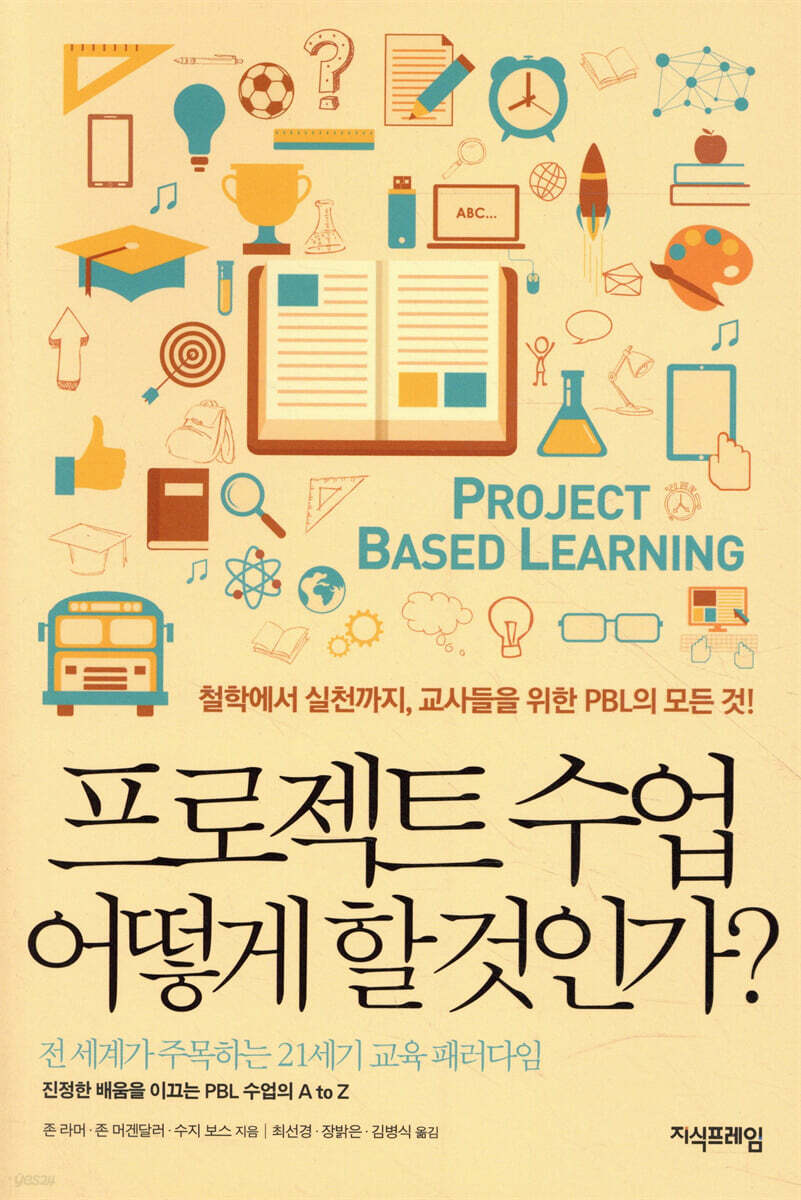
How should I do the project class?
 |
Description
Book Introduction
The 21st-century education paradigm that is attracting global attention
From philosophy to practice, everything about PBL for teachers!
The world has changed, but the classroom remains the same.
There were many educators who talked about how they would immediately turn public education around, saying that they needed to nurture talents like Steve Jobs, but the classrooms themselves did not change easily.
The huge obstacle of the college entrance exam is forcing students into outdated learning methods such as simple memorization and repetitive problem solving.
Teachers feel sorry for students who are losing interest in learning, but they cannot avoid responsibility for 'test scores.'
But not everyone stands still helplessly.
Despite practical challenges, many teachers are striving to create new, creative, and vibrant classes.
So how can we deliver unique and meaningful lessons without wasting students' time? The answer lies in project-based learning (PBL).
From philosophy to practice, everything about PBL for teachers!
The world has changed, but the classroom remains the same.
There were many educators who talked about how they would immediately turn public education around, saying that they needed to nurture talents like Steve Jobs, but the classrooms themselves did not change easily.
The huge obstacle of the college entrance exam is forcing students into outdated learning methods such as simple memorization and repetitive problem solving.
Teachers feel sorry for students who are losing interest in learning, but they cannot avoid responsibility for 'test scores.'
But not everyone stands still helplessly.
Despite practical challenges, many teachers are striving to create new, creative, and vibrant classes.
So how can we deliver unique and meaningful lessons without wasting students' time? The answer lies in project-based learning (PBL).
- You can preview some of the book's contents.
Preview
index
Translator's Note / Prologue
PART1_ What is PBL?
01. The Beginning of PBL and GSPBL
02. Conditions for becoming a GSPBL
03. The Role of Teachers in Realizing GSPBL
PBL Class Sneak Peek 01 [Gratitude for Farmers' Hard Work]
PBL Class Sneak Peek 02 [Healthy Community]
PBL Class Sneak Peek 03 [Our Cozy Home]
PART2_ Why do we do PBL?
01.
Motivate learning
02.
Preparing for future growth
03.
Preparing for new achievement standards and assessments
04.
Adding to the joy of teaching
05.
Learning to connect with the community
06. Studies proving the value of PBL
PBL Class Sneak Peek 04 [Overcoming Cancer]
PBL Class Sneak Peek 05 [Building My Own Home]
PBL Class Sneak Peek 06 [The One and Only Ivan in the World]
PART3_ Designing the Project
01.
When it comes to project design, the key is 'appropriateness.'
02. Activities that are difficult to view as PBL
03.
Five Types of Projects
04.
Project Design Step 1: Consider the Context
05.
Project Design Step 2: Brainstorming Ideas
06.
Project Design Step 3: Establishing the Framework
PBL Class Sneak Peek 07 [Considering the System]
PBL Class Sneak Peek 08 [Mathematician's Home Remodeling]
PBL Class Sneak Peek 09 [Global Happiness and Community Service]
PART4_ Running a Project
01.
Checking students' readiness
02.
Preparing the project
03.
Step 1: Starting the Project
04.
Step 2: Develop knowledge, understanding, and competency.
05.
Step 3: Critique and Improve
06.
Step 4: Presenting the Results
07.
Leveraging technology
PBL Class Sneak Peek 10 [Science and Technology in the Civil War]
PBL Class Sneak Peek 11 [Civil Activists in Our Area]
PBL Class Sneak Peek 12 [Designing a Mini Golf Course]
PART 5_ PBL outside of regular classes
01.
Is PBL useful even outside of regular classes?
02. Running a summer vacation program using PBL
03.
PBL in after-school programs
04. Opportunities provided by PBL
05.
Strategies for PBL in Non-Formal Education
PBL Class Sneak Peek 13 [The Key Players of Change]
PBL Class Sneak Peek 14 [American Exchange Student in France]
PART6_ PBL Guide for Managers
01. How to introduce PBL?
02.
Start small, have a big vision
03.
Creating Space for Teacher Change
04.
The Power of Peer Leadership
05.
Working with Community Partners
PBL Class Sneak Peek 15 [Sweet Meltdown]
PBL Class Sneak Peek 16 [South Central's Tomorrow]
Epilogue / References / Notes
PART1_ What is PBL?
01. The Beginning of PBL and GSPBL
02. Conditions for becoming a GSPBL
03. The Role of Teachers in Realizing GSPBL
PBL Class Sneak Peek 01 [Gratitude for Farmers' Hard Work]
PBL Class Sneak Peek 02 [Healthy Community]
PBL Class Sneak Peek 03 [Our Cozy Home]
PART2_ Why do we do PBL?
01.
Motivate learning
02.
Preparing for future growth
03.
Preparing for new achievement standards and assessments
04.
Adding to the joy of teaching
05.
Learning to connect with the community
06. Studies proving the value of PBL
PBL Class Sneak Peek 04 [Overcoming Cancer]
PBL Class Sneak Peek 05 [Building My Own Home]
PBL Class Sneak Peek 06 [The One and Only Ivan in the World]
PART3_ Designing the Project
01.
When it comes to project design, the key is 'appropriateness.'
02. Activities that are difficult to view as PBL
03.
Five Types of Projects
04.
Project Design Step 1: Consider the Context
05.
Project Design Step 2: Brainstorming Ideas
06.
Project Design Step 3: Establishing the Framework
PBL Class Sneak Peek 07 [Considering the System]
PBL Class Sneak Peek 08 [Mathematician's Home Remodeling]
PBL Class Sneak Peek 09 [Global Happiness and Community Service]
PART4_ Running a Project
01.
Checking students' readiness
02.
Preparing the project
03.
Step 1: Starting the Project
04.
Step 2: Develop knowledge, understanding, and competency.
05.
Step 3: Critique and Improve
06.
Step 4: Presenting the Results
07.
Leveraging technology
PBL Class Sneak Peek 10 [Science and Technology in the Civil War]
PBL Class Sneak Peek 11 [Civil Activists in Our Area]
PBL Class Sneak Peek 12 [Designing a Mini Golf Course]
PART 5_ PBL outside of regular classes
01.
Is PBL useful even outside of regular classes?
02. Running a summer vacation program using PBL
03.
PBL in after-school programs
04. Opportunities provided by PBL
05.
Strategies for PBL in Non-Formal Education
PBL Class Sneak Peek 13 [The Key Players of Change]
PBL Class Sneak Peek 14 [American Exchange Student in France]
PART6_ PBL Guide for Managers
01. How to introduce PBL?
02.
Start small, have a big vision
03.
Creating Space for Teacher Change
04.
The Power of Peer Leadership
05.
Working with Community Partners
PBL Class Sneak Peek 15 [Sweet Meltdown]
PBL Class Sneak Peek 16 [South Central's Tomorrow]
Epilogue / References / Notes
Into the book
The reason we are introducing PBL to Korean classrooms is because our education is currently entering a paradigm shift from teacher-led to student-centered.
What we particularly note is that the entire project process emphasizes collaboration among students and aims for "21st-century competency-centered education" that focuses on problem-solving based on critical thinking skills.
Since this is in line with the competency-centered curriculum that the 2015 revised curriculum aims for, it is expected that conditions and an atmosphere conducive to the practice of PBL will gradually be created in schools.
With the introduction of free semesters in middle schools and the expansion of academic transcript-based admissions in college admissions, the need for classroom instruction is growing, creating a favorable environment for the spread and successful establishment of PBL.
This book will be of great help to high school teachers who need to teach single subjects or integrated subjects, especially in preparation for the comprehensive student admissions process. --- From the "Translator's Note"
Traditional curricula and teaching methods often overlook the competencies that educators, parents, universities, and employers expect from high school graduates.
(…) But with a good project, all of this can be accomplished.
In a proper PBL, students not only recognize that they need to prepare themselves for the various competencies required for college and work, but they also learn and are assessed on those competencies.
Students are sometimes asked to self-evaluate how much their abilities have grown.
Students who have experience working on multiple projects with systematic support from their school have far more opportunities to develop these skills than those who have not. --- From "PART 2_Why do we do PBL?"
What most teachers want is to plan their own lessons and units, rather than simply "delivering content" based on ready-made materials or textbook progress.
Teachers want to teach about topics and issues that interest them and their students.
Teachers want to see students actively participating in class, and they themselves want to learn new things.
Rather than just standing at the front of the classroom and giving instructions to the entire class, I want to stand close to the growing sprouts and build relationships.
And all of this is possible in a PBL environment. --- From "PART2_Why PBL?"
“I love projects that have the potential to change students’ lives.
When students graduate and look back on their school days, I hope they'll say, "Thanks to that project I did in high school, I know exactly what I need to do now."
Especially for children growing up in impoverished areas, PBL connects them with experts and provides learning experiences they might not otherwise have had.
“I love the concept of ‘Life-Changing PBL.’”
What we particularly note is that the entire project process emphasizes collaboration among students and aims for "21st-century competency-centered education" that focuses on problem-solving based on critical thinking skills.
Since this is in line with the competency-centered curriculum that the 2015 revised curriculum aims for, it is expected that conditions and an atmosphere conducive to the practice of PBL will gradually be created in schools.
With the introduction of free semesters in middle schools and the expansion of academic transcript-based admissions in college admissions, the need for classroom instruction is growing, creating a favorable environment for the spread and successful establishment of PBL.
This book will be of great help to high school teachers who need to teach single subjects or integrated subjects, especially in preparation for the comprehensive student admissions process. --- From the "Translator's Note"
Traditional curricula and teaching methods often overlook the competencies that educators, parents, universities, and employers expect from high school graduates.
(…) But with a good project, all of this can be accomplished.
In a proper PBL, students not only recognize that they need to prepare themselves for the various competencies required for college and work, but they also learn and are assessed on those competencies.
Students are sometimes asked to self-evaluate how much their abilities have grown.
Students who have experience working on multiple projects with systematic support from their school have far more opportunities to develop these skills than those who have not. --- From "PART 2_Why do we do PBL?"
What most teachers want is to plan their own lessons and units, rather than simply "delivering content" based on ready-made materials or textbook progress.
Teachers want to teach about topics and issues that interest them and their students.
Teachers want to see students actively participating in class, and they themselves want to learn new things.
Rather than just standing at the front of the classroom and giving instructions to the entire class, I want to stand close to the growing sprouts and build relationships.
And all of this is possible in a PBL environment. --- From "PART2_Why PBL?"
“I love projects that have the potential to change students’ lives.
When students graduate and look back on their school days, I hope they'll say, "Thanks to that project I did in high school, I know exactly what I need to do now."
Especially for children growing up in impoverished areas, PBL connects them with experts and provides learning experiences they might not otherwise have had.
“I love the concept of ‘Life-Changing PBL.’”
---From "PBL Peek 05_Buying My Own Home"
Publisher's Review
Why PBL?
PBL is not a class that simply pursues fun.
Through carefully designed PBL, students not only gain a deeper understanding of the subject matter, but also develop "21st century competencies" such as critical thinking, problem-solving, collaboration, and self-management.
In other words, PBL is a 21st-century education that prepares students not only for test scores but also for the future, including college, work, and social life.
This book contains all the basic knowledge about PBL.
In particular, the role of teachers in PBL is given great importance.
Teachers shouldn't just sit back and watch after setting the stage. Instead, they should observe from the sidelines and constantly build bridges to help students reach their ultimate goal. While PBL emphasizes how and what students learn, it's the teacher who plays the most crucial role in facilitating that learning.
This book will serve as a helpful guide for teachers to play a central role in PBL classes.
Talking about a real PBL class!
In our school, there are quite a few classes that are implemented under the name of ‘project classes.’
But can everyone truly define this class as a "project-based learning"? The origins of PBL date back to 16th-century Italy.
PBL, which originated at an architecture school in Rome, was recognized for its excellence early on and became established as a model for vocational education.
William Kilpatrick and John Dewey played a major role in the subsequent use of PBL in primary and secondary education.
Meanwhile, problem-based learning, which began at McMaster University School of Medicine in Canada in the 1960s, is confirming the importance of teachers in PBL.
The Buck Institute for Education (BIE), to which the authors of this book belong, has been researching PBL for the past 20 years and has developed an ideal model called 'GSPBL'.
The GSPBL they put forward clearly indicates the final destination that teachers who practice PBL in the field must reach.
Through GSPBL, teachers will be able to more clearly understand the conditions that a desirable PBL class should have and what students should learn.
In particular, it presents the design and operation of PBL in detail step by step, and also carefully points out the precautions for each step.
PBL in practice as seen through class examples
The greatest strength of this book is its abundance of examples.
First graders at a rural elementary school in the United States carried out a project to support local farmers whose harvests were being disrupted by rain.
Students came up with their own ideas and planned a 'Farmers' Day of Appreciation' event.
While preparing for the event, I learned subject knowledge through activities related to social studies, Korean language, and mathematics, and also gained valuable experience communicating with the local community.
High school students who worked on the project [Global Happiness and Local Service] had time to study local history as part of their project activities.
Students chose a place related to local history, wrote a short essay about it, and posted it on the class website.
And after assigning a QR code to each article, we attached the QR code to the corresponding location.
People traveling through the village can scan a QR code to learn about the history of the place.
This book presents 16 real-world classroom examples.
By looking at excellent PBL examples implemented around the world, teachers can imagine their own classrooms.
From project planning and design to operation and final results, you can get a vivid glimpse into the process teachers and students went through to complete the project.
The trial and error shown by colleagues in the book will provide useful tips, and their shining successes will serve as considerable stimulation.
A PBL Guide for Administrators and Informal Education Programs
It is not easy for teachers to implement PBL alone without the support of administrators.
In particular, in order to actively introduce and practice PBL, the vision and leadership of managers are more important than anything else.
What vision should administrators present to establish PBL in schools, and how should they encourage and support teachers?
This book provides useful information to managers who are struggling with the vision of PBL.
In addition, we present a plan to utilize PBL in non-formal education programs such as after-school programs and summer vacations.
We emphasize that PBL can be implemented in a much freer and more diverse manner, especially in non-formal education programs where learning is not the primary goal, and introduce related cases.
PBL is not a class that simply pursues fun.
Through carefully designed PBL, students not only gain a deeper understanding of the subject matter, but also develop "21st century competencies" such as critical thinking, problem-solving, collaboration, and self-management.
In other words, PBL is a 21st-century education that prepares students not only for test scores but also for the future, including college, work, and social life.
This book contains all the basic knowledge about PBL.
In particular, the role of teachers in PBL is given great importance.
Teachers shouldn't just sit back and watch after setting the stage. Instead, they should observe from the sidelines and constantly build bridges to help students reach their ultimate goal. While PBL emphasizes how and what students learn, it's the teacher who plays the most crucial role in facilitating that learning.
This book will serve as a helpful guide for teachers to play a central role in PBL classes.
Talking about a real PBL class!
In our school, there are quite a few classes that are implemented under the name of ‘project classes.’
But can everyone truly define this class as a "project-based learning"? The origins of PBL date back to 16th-century Italy.
PBL, which originated at an architecture school in Rome, was recognized for its excellence early on and became established as a model for vocational education.
William Kilpatrick and John Dewey played a major role in the subsequent use of PBL in primary and secondary education.
Meanwhile, problem-based learning, which began at McMaster University School of Medicine in Canada in the 1960s, is confirming the importance of teachers in PBL.
The Buck Institute for Education (BIE), to which the authors of this book belong, has been researching PBL for the past 20 years and has developed an ideal model called 'GSPBL'.
The GSPBL they put forward clearly indicates the final destination that teachers who practice PBL in the field must reach.
Through GSPBL, teachers will be able to more clearly understand the conditions that a desirable PBL class should have and what students should learn.
In particular, it presents the design and operation of PBL in detail step by step, and also carefully points out the precautions for each step.
PBL in practice as seen through class examples
The greatest strength of this book is its abundance of examples.
First graders at a rural elementary school in the United States carried out a project to support local farmers whose harvests were being disrupted by rain.
Students came up with their own ideas and planned a 'Farmers' Day of Appreciation' event.
While preparing for the event, I learned subject knowledge through activities related to social studies, Korean language, and mathematics, and also gained valuable experience communicating with the local community.
High school students who worked on the project [Global Happiness and Local Service] had time to study local history as part of their project activities.
Students chose a place related to local history, wrote a short essay about it, and posted it on the class website.
And after assigning a QR code to each article, we attached the QR code to the corresponding location.
People traveling through the village can scan a QR code to learn about the history of the place.
This book presents 16 real-world classroom examples.
By looking at excellent PBL examples implemented around the world, teachers can imagine their own classrooms.
From project planning and design to operation and final results, you can get a vivid glimpse into the process teachers and students went through to complete the project.
The trial and error shown by colleagues in the book will provide useful tips, and their shining successes will serve as considerable stimulation.
A PBL Guide for Administrators and Informal Education Programs
It is not easy for teachers to implement PBL alone without the support of administrators.
In particular, in order to actively introduce and practice PBL, the vision and leadership of managers are more important than anything else.
What vision should administrators present to establish PBL in schools, and how should they encourage and support teachers?
This book provides useful information to managers who are struggling with the vision of PBL.
In addition, we present a plan to utilize PBL in non-formal education programs such as after-school programs and summer vacations.
We emphasize that PBL can be implemented in a much freer and more diverse manner, especially in non-formal education programs where learning is not the primary goal, and introduce related cases.
About the author
Buck Institute for Education (BIE)
A leading American non-profit educational organization researching project-based learning (PBL) and supporting teachers. It is considered the most authoritative organization on PBL.
In Korea, it was introduced as a representative American institution that trains teachers for PBL in the EBS program [Reconstruction of Study] broadcast in 2016.
The Buck Education Association develops a variety of educational programs and materials on PBL, holds annual workshops on PBL across the United States and in many countries around the world, and provides individual guidance to teachers.
We also provide long-term institutional support at the school and local education office level.
The Buck Education Association's PBL-related publications have been translated into nine languages and are trusted by educators worldwide.
John Larmer
He oversees the publishing division of the Buck Education Association and has written and edited books such as the Project Based Learning Handbook, PBL Stater Kit for Middle and High School Teachers, PBL in the Elementary Grades, and PBL for 21st Century Success.
We are also planning teacher professional development workshops and developing materials that teachers can use in the field.
He has also advised on PBL curricula for the National Academy Foundation, Oracle Education Foundation, and Pearson Education.
I developed educational programs at WestEd in San Francisco and taught social studies and language arts in high schools for 10 years.
John Mergendoller
He served as a founding research director of the Buck Education Association in 1989 and has served as an executive director since 2000.
We are supporting educators across the United States, as well as in China, Taiwan, Brazil, Greece, Romania, the United Kingdom, and numerous other countries, to learn and practice high-quality PBL.
Suzie Boss
I am interested in learning and teaching that develops individual lives and brings change to communities.
He has written books on education and innovation, including Bringing Innovation to School and Reinventing Project Based Learning.
He is a popular speaker at various conferences and is also an international education consultant.
Buck Institute for Education (BIE)
A leading American non-profit educational organization researching project-based learning (PBL) and supporting teachers. It is considered the most authoritative organization on PBL.
In Korea, it was introduced as a representative American institution that trains teachers for PBL in the EBS program [Reconstruction of Study] broadcast in 2016.
The Buck Education Association develops a variety of educational programs and materials on PBL, holds annual workshops on PBL across the United States and in many countries around the world, and provides individual guidance to teachers.
We also provide long-term institutional support at the school and local education office level.
The Buck Education Association's PBL-related publications have been translated into nine languages and are trusted by educators worldwide.
John Larmer
He oversees the publishing division of the Buck Education Association and has written and edited books such as the Project Based Learning Handbook, PBL Stater Kit for Middle and High School Teachers, PBL in the Elementary Grades, and PBL for 21st Century Success.
We are also planning teacher professional development workshops and developing materials that teachers can use in the field.
He has also advised on PBL curricula for the National Academy Foundation, Oracle Education Foundation, and Pearson Education.
I developed educational programs at WestEd in San Francisco and taught social studies and language arts in high schools for 10 years.
John Mergendoller
He served as a founding research director of the Buck Education Association in 1989 and has served as an executive director since 2000.
We are supporting educators across the United States, as well as in China, Taiwan, Brazil, Greece, Romania, the United Kingdom, and numerous other countries, to learn and practice high-quality PBL.
Suzie Boss
I am interested in learning and teaching that develops individual lives and brings change to communities.
He has written books on education and innovation, including Bringing Innovation to School and Reinventing Project Based Learning.
He is a popular speaker at various conferences and is also an international education consultant.
A leading American non-profit educational organization researching project-based learning (PBL) and supporting teachers. It is considered the most authoritative organization on PBL.
In Korea, it was introduced as a representative American institution that trains teachers for PBL in the EBS program [Reconstruction of Study] broadcast in 2016.
The Buck Education Association develops a variety of educational programs and materials on PBL, holds annual workshops on PBL across the United States and in many countries around the world, and provides individual guidance to teachers.
We also provide long-term institutional support at the school and local education office level.
The Buck Education Association's PBL-related publications have been translated into nine languages and are trusted by educators worldwide.
John Larmer
He oversees the publishing division of the Buck Education Association and has written and edited books such as the Project Based Learning Handbook, PBL Stater Kit for Middle and High School Teachers, PBL in the Elementary Grades, and PBL for 21st Century Success.
We are also planning teacher professional development workshops and developing materials that teachers can use in the field.
He has also advised on PBL curricula for the National Academy Foundation, Oracle Education Foundation, and Pearson Education.
I developed educational programs at WestEd in San Francisco and taught social studies and language arts in high schools for 10 years.
John Mergendoller
He served as a founding research director of the Buck Education Association in 1989 and has served as an executive director since 2000.
We are supporting educators across the United States, as well as in China, Taiwan, Brazil, Greece, Romania, the United Kingdom, and numerous other countries, to learn and practice high-quality PBL.
Suzie Boss
I am interested in learning and teaching that develops individual lives and brings change to communities.
He has written books on education and innovation, including Bringing Innovation to School and Reinventing Project Based Learning.
He is a popular speaker at various conferences and is also an international education consultant.
Buck Institute for Education (BIE)
A leading American non-profit educational organization researching project-based learning (PBL) and supporting teachers. It is considered the most authoritative organization on PBL.
In Korea, it was introduced as a representative American institution that trains teachers for PBL in the EBS program [Reconstruction of Study] broadcast in 2016.
The Buck Education Association develops a variety of educational programs and materials on PBL, holds annual workshops on PBL across the United States and in many countries around the world, and provides individual guidance to teachers.
We also provide long-term institutional support at the school and local education office level.
The Buck Education Association's PBL-related publications have been translated into nine languages and are trusted by educators worldwide.
John Larmer
He oversees the publishing division of the Buck Education Association and has written and edited books such as the Project Based Learning Handbook, PBL Stater Kit for Middle and High School Teachers, PBL in the Elementary Grades, and PBL for 21st Century Success.
We are also planning teacher professional development workshops and developing materials that teachers can use in the field.
He has also advised on PBL curricula for the National Academy Foundation, Oracle Education Foundation, and Pearson Education.
I developed educational programs at WestEd in San Francisco and taught social studies and language arts in high schools for 10 years.
John Mergendoller
He served as a founding research director of the Buck Education Association in 1989 and has served as an executive director since 2000.
We are supporting educators across the United States, as well as in China, Taiwan, Brazil, Greece, Romania, the United Kingdom, and numerous other countries, to learn and practice high-quality PBL.
Suzie Boss
I am interested in learning and teaching that develops individual lives and brings change to communities.
He has written books on education and innovation, including Bringing Innovation to School and Reinventing Project Based Learning.
He is a popular speaker at various conferences and is also an international education consultant.
GOODS SPECIFICS
- Date of issue: January 5, 2017
- Page count, weight, size: 408 pages | 594g | 153*224*30mm
- ISBN13: 9788994655543
- ISBN10: 8994655549
You may also like
카테고리
korean


korean

![GQ KOREA Mark (Monthly): December [2025]](http://librairie.coreenne.fr/cdn/shop/files/8ef265dbbfbf186523ed75ba7319009d.jpg?v=1765340328&width=3840)


