

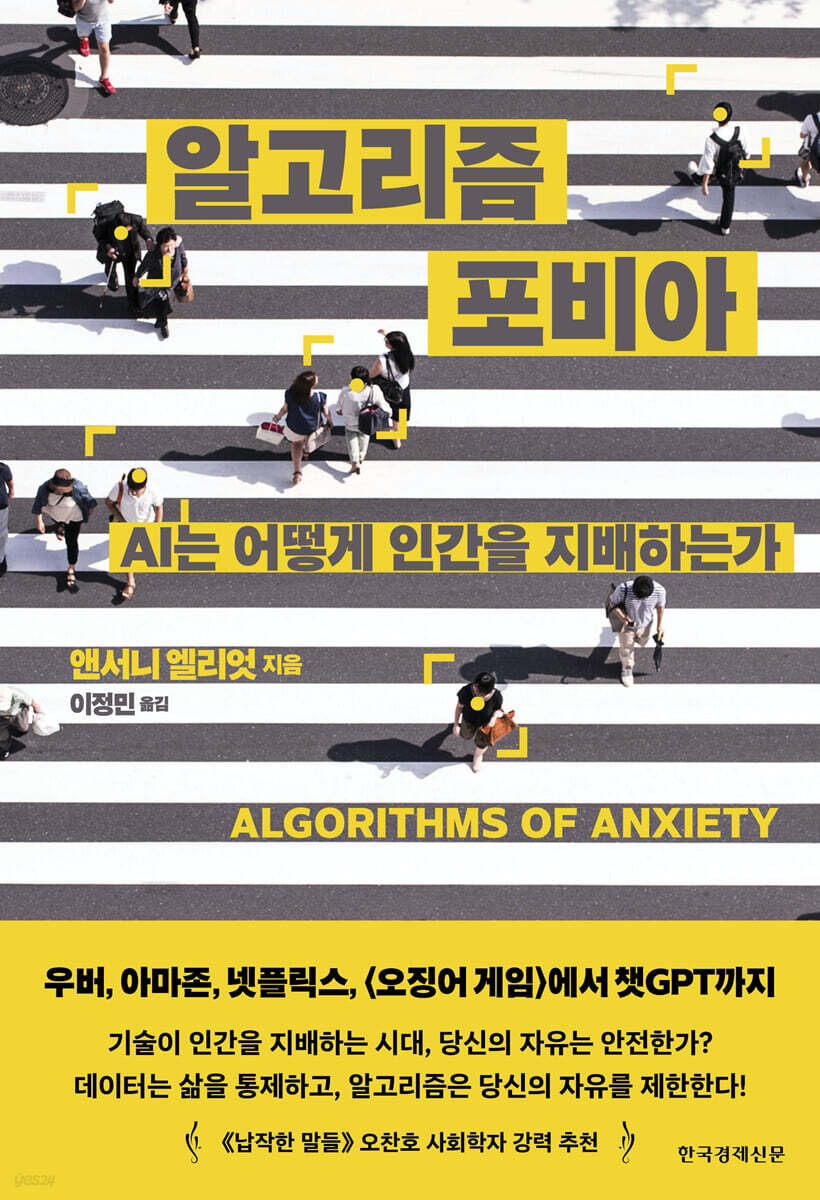
algorithm phobia
 |
Description
Book Introduction
Are algorithms a revolutionary science that will enrich our lives, or are they a technology of control that infringes on our autonomy?
We delve into the hidden side of algorithms that delve deep into the workplace, home, relationships, and emotions.
In an era where all decision-making is entrusted to AI, human anxiety remains unresolved.
AI algorithms are seen as a revolutionary science that enables more efficient and convenient lives, a utopia that can manage all uncertainties.
However, behind this lies the anxiety and fear that algorithms may strengthen surveillance and control over individuals and even infringe on their subjectivity.
Anthony Elliott, Professor of Sociology at the University of South Australia, exposes this inconvenient truth in his book Algorithm Phobia.
From real-world technological examples like Uber's automated management system, Amazon's labor control, and Netflix's recommendation algorithm, to the metaphors of competition and control reflected in the drama "Squid Game," and even the latest AI technologies like the metaverse and ChatGPT, Elliot analyzes both real-world phenomena and cultural symbols to show how algorithms are reshaping human life.
The author points out that, in the shadow of the "convenience" and "efficiency" promised by AI technology, humans are increasingly being incorporated into structures of control and surveillance.
Algorithms may seem to help us make better choices, but they actually predict and adjust our behavior, weakening our ability to think and make decisions for ourselves.
In exchange for efficiency, humans give up their subjectivity and are increasingly transformed into "datafied beings" in a life where emotions, desires, and even mistakes are eliminated.
This book shows what values we are losing behind the praise of technology.
We delve into the hidden side of algorithms that delve deep into the workplace, home, relationships, and emotions.
In an era where all decision-making is entrusted to AI, human anxiety remains unresolved.
AI algorithms are seen as a revolutionary science that enables more efficient and convenient lives, a utopia that can manage all uncertainties.
However, behind this lies the anxiety and fear that algorithms may strengthen surveillance and control over individuals and even infringe on their subjectivity.
Anthony Elliott, Professor of Sociology at the University of South Australia, exposes this inconvenient truth in his book Algorithm Phobia.
From real-world technological examples like Uber's automated management system, Amazon's labor control, and Netflix's recommendation algorithm, to the metaphors of competition and control reflected in the drama "Squid Game," and even the latest AI technologies like the metaverse and ChatGPT, Elliot analyzes both real-world phenomena and cultural symbols to show how algorithms are reshaping human life.
The author points out that, in the shadow of the "convenience" and "efficiency" promised by AI technology, humans are increasingly being incorporated into structures of control and surveillance.
Algorithms may seem to help us make better choices, but they actually predict and adjust our behavior, weakening our ability to think and make decisions for ourselves.
In exchange for efficiency, humans give up their subjectivity and are increasingly transformed into "datafied beings" in a life where emotions, desires, and even mistakes are eliminated.
This book shows what values we are losing behind the praise of technology.
- You can preview some of the book's contents.
Preview
index
Recommendation
Preface and Acknowledgments
Chapter 1: The Dominance of Algorithms and Pervasive Anxiety
Uber's system can't go wrong?
The technological ideology that underpins Uberland
How Algorithms Make Us Anxious
What if we leave human agency to algorithmic automation?
What the digital revolution has changed
Two Terms to Know When Exploring Anxiety in the Digital Age
Chapter 2: Amazon's Harsh Automation System
Surviving in an Automated System
Algorithms that manage and control workers
The tragedy brought about by digital technology
Amazon crushed my soul
Anxiety about uselessness
A reality where even the restoration of human subjectivity is being instrumentalized
Chapter 3: How Netflix's Recommendation System Consumes Modern Culture
Netflix's Predictive Algorithm Drives Success
Between algorithmic recommendations and subjective human beings
The magic spell called algorithm
Chapter 4: Identity and Emotion in the Algorithmic Age: A Look at the Squid Game
The precise control of AI demonstrated in "Squid Game"
The Inner World of Modern People as Seen Through "Squid Game"
The Fierce Battle for Survival in the Algorithm Age
The global violence brought about by algorithmic competition
A technological society racing toward a destructive world
Chapter 5: The Metaverse: Reimagining Humanity's Future
The digital world accelerating through the metaverse
The Metaverse: A Cultural Shift
Escape from the analog world into a 3D virtual world
Chapter 6: Artificial Intelligence: Will It Coexist or Dominate?
The Blurred Line Between Artificial Intelligence and Human Intelligence
Rethinking Human and Machine Intelligence
The emergence of ChatGPT, and concerns and expectations
Chapter 7: The Era of Artificial Intelligence: Requires Constant Self-Correction
Anxiety about generative AI
Modern people are gripped by existential anxiety and uncertainty.
Fear of the Algorithmic World
Fear of a surveillance society
Fear of being left out of information
Fear of being hacked
Fear in the digital age: How to break this vicious cycle
annotation
Preface and Acknowledgments
Chapter 1: The Dominance of Algorithms and Pervasive Anxiety
Uber's system can't go wrong?
The technological ideology that underpins Uberland
How Algorithms Make Us Anxious
What if we leave human agency to algorithmic automation?
What the digital revolution has changed
Two Terms to Know When Exploring Anxiety in the Digital Age
Chapter 2: Amazon's Harsh Automation System
Surviving in an Automated System
Algorithms that manage and control workers
The tragedy brought about by digital technology
Amazon crushed my soul
Anxiety about uselessness
A reality where even the restoration of human subjectivity is being instrumentalized
Chapter 3: How Netflix's Recommendation System Consumes Modern Culture
Netflix's Predictive Algorithm Drives Success
Between algorithmic recommendations and subjective human beings
The magic spell called algorithm
Chapter 4: Identity and Emotion in the Algorithmic Age: A Look at the Squid Game
The precise control of AI demonstrated in "Squid Game"
The Inner World of Modern People as Seen Through "Squid Game"
The Fierce Battle for Survival in the Algorithm Age
The global violence brought about by algorithmic competition
A technological society racing toward a destructive world
Chapter 5: The Metaverse: Reimagining Humanity's Future
The digital world accelerating through the metaverse
The Metaverse: A Cultural Shift
Escape from the analog world into a 3D virtual world
Chapter 6: Artificial Intelligence: Will It Coexist or Dominate?
The Blurred Line Between Artificial Intelligence and Human Intelligence
Rethinking Human and Machine Intelligence
The emergence of ChatGPT, and concerns and expectations
Chapter 7: The Era of Artificial Intelligence: Requires Constant Self-Correction
Anxiety about generative AI
Modern people are gripped by existential anxiety and uncertainty.
Fear of the Algorithmic World
Fear of a surveillance society
Fear of being left out of information
Fear of being hacked
Fear in the digital age: How to break this vicious cycle
annotation
Detailed image

Into the book
Modern society has a strong tendency to enthusiastically spread artificial intelligence.
AI, the "innovative science," is considered the source of powerful economic growth and will transform our lives today.
But the peculiar ambiguity has not yet been resolved.
The fear that inevitably follows us as we struggle through our daily lives where the online and offline worlds are interconnected, the anxiety that endlessly blossoms in the face of increasingly severe 'information overload', and the fear that we may bring about 'unintended consequences' by entrusting personal decision-making to automated machines are spreading.
While writing this book, I realized that predictive algorithms, far from alleviating our anxieties, actually amplify them, contrary to expectations.
--- From the "Preface and Acknowledgments"
The business of automated management of algorithms is in itself Kafkaesque (meaning an irrational, contradictory, oppressive, and chaotic situation, as characterized by Kafka's works - translator's note).
Machine learning algorithms promise to mathematically predict our future and finely tune our socioeconomic order, but the promises they deliver are often oppressive and elusive.
In an advanced automated society, predictive analytics and smart algorithms define and realize the market's "actual needs" and "potential desires."
The potential side effects of this trend extend beyond the coercive power of data, the risk of algorithmic bias, and the mass sale of private data for future market predictions.
Not only is anxiety spreading globally, but ominous feelings, disillusionment, and suspicion are blooming in their own, yet intertwined, forms.
--- From "Chapter 1: The Dominance of Algorithms, Pervasive Anxiety"
The likelihood of adapting to working life within a holistic data system that monitors, measures, quotas, targets, motivates, and provides various incentives to increase work speed and employee productivity seems surprisingly low.
Those who fail to complete the tasks and instructions that the automated management system endlessly delivers fall into a swamp of despair, regardless of the construction industry.
If this emotional exhaustion continues on a daily basis, the individual's life becomes overwhelmed by depression and even physically destroyed.
This is not the only side effect of algorithmic management suffocating workers.
The fear of being 'fired' has also become widespread.
This stems from the common belief that automated intelligent machines are increasingly replacing humans in many sectors.
American sociologist Richard Sennett called this “automation-induced uselessness anxiety.”
This fear has not only increased dramatically in recent years, but it also tends to lead to stress, fatigue, frustration, depression, and even violence.
In other words, the anxiety of uselessness due to automation is deeply ingrained.
--- From "Chapter 2: Amazon's Harsh Automation System"
Automated recommendations can even restrict and limit consumers.
People's interest in popular culture is multifaceted, and while individual identity is inherently diverse, mixed, and contradictory, it presents absurdly unified viewing preferences.
These cultural concerns have been amplified by the rise of algorithms that exert powerful agency.
But the process of leveraging algorithmic recommendation systems also reflects widespread fears about being dominated by automated forces.
Therefore, some argue that machine learning algorithms enable a life of continuous experimentation, free from the rigid conventions of existing society.
But machine predictions driven by algorithms actually exacerbate the anxiety of automated life by adding to the very uncertainty that AI was originally intended to eliminate, or at least reduce and limit.
Because the idea of 'getting out' of decision-making by handing over decision-making power to automated intelligent machines has been exposed as a kind of fraud.
One of the many problems of automated life is that 'escaping' from exercising subjectivity involves various forms of avoidance, escape, and rejection.
--- From "Chapter 3: How Netflix's Recommendation System Consumes Modern Culture"
I'd say this extremely violent Korean drama hits the nail on the head with the ever-evolving desires of a highly capitalist world dominated by cutting-edge technology.
If survivalism and barbarism clash yet share similarities, it is because the stubborn self-confidence of late capitalist society has led to the ever-more sophisticated development of technologies of power and exploitation.
In a fiercely competitive environment, where extreme economic instability and social inequality are prevalent, temporary alliances and destructive hostilities unfold.
But if war is defined as organized violence, then Squid Game seems to offer a new explanation for the “surplus” or “excess” of fear realized by digital technology.
According to Freud, the reason human destructiveness, aggression, and cruelty are so terrifying is because it is impossible to capture the fear that produces and amplifies them, but today's war algorithms accurately predict where the enemy is.
--- From "Chapter 4 Identity and Emotion in the Algorithm Age as Seen Through the Squid Game"
The perspective I will develop in the remainder of this chapter is based on the theory (which I have elaborated elsewhere) that digital technologies are deeply permeating sociality, culture, identity, desire, self, sexuality, and even the structure of the body.
As new computing capabilities and artificial reality become more widespread, we are entering a world where people are embracing automation technologies while also struggling to keep up with and control the expanding digital elements of their daily lives.
Building on these reflections, I aim to redefine the dynamics of hyperreality and the metaverse, reflecting on the potential consequences of current development trends.
But today, more and more people are struggling to construct a virtual identity, especially one that they can meaningfully embody.
People engage with virtual worlds and the events that unfold there in a form of digital immersion that is fundamentally different from the real context of everyday life.
To do this, you can participate in designing your avatar and modify your appearance (from 3D avatars to full-body avatars) to interact with others, share interests, or explore new social or job opportunities.
But no matter how hard we try to bridge the 3D virtual world with the standard analog world, a peculiar sense of instability and incurable anxiety persists.
--- From "Chapter 5: Metaverse, Imagining the Future of Anryu Differently"
However, the worldview that sees technology as the same as social development is bound to eventually be shaken and frustrated.
First of all, it has such a strong hyper-rationalist tone that it sees economic efficiency, social order, and progress as directly derived from the rational design and development of technology.
Of course, technology can sometimes be quite destructive, but it is nonetheless an essential element in the rational development of modern institutions.
In this approach, for example, microchip technology is seen as giving rise to a consumer society.
While it's easy to connect the emergence of new technologies to broader social change, the technological spirit of our time isn't always so aligned, nor is it necessarily governed by rationality or commercialism.
Machine intelligence offers endless temptations, as it promises to free us from the fear that we will run out of choices, that our individual potential will soon disappear, and that social alternatives will be exhausted.
At first, it's tempting to live in a fantasy world where you can delegate parts of your life (even the trivial or unimportant ones) to automated processes and experience a sense of liberation thanks to machine intelligence that completes tasks on time.
But this idealization and high valuation of automated machine intelligence comes at a price.
The temptation to outsource parts of our lives can lead to fears about handing over decision-making power to machines, or concerns about how best to communicate our intentions.
So, engaging with machine intelligence inevitably leaves us with the unpleasant feeling that we are dependent on something and could be replaced at any moment.
--- From Chapter 6, “Artificial Intelligence: Will It Coexist or Dominate?”
If anxiety about generative AI stems from concerns about employment and the future of work, it also extends to broader social, cultural, and political issues.
Fear is not only at the heart of people's concerns about the prospect of smart algorithms taking over their jobs, it's also a sentiment that spreads like a poisonous mushroom, dominating society's overall response to automated digital technologies.
Fear is a giant switchboard that controls the human psyche, playing a key role in technologically dismantling and reassembling individual egos, interpersonal relationships, and society as a whole.
This also elevates cultural anxiety to the level of an "existential threat to humanity," transforming it into the worst possible situation society could face.
Today, we are plagued by a multitude of fears: fear of information overload, fear of the metaverse, fear of the harmful effects of social media on young people, fear of technological unemployment, fear of algorithmic bias, fear of ChatGPT, fear of artificial general intelligence surpassing human intelligence, and more.
There are also fears of deepfakes and misinformation, fears of data deluge, fears of robots, fears of rapid cyberattacks, fears of autonomous drones, fears of CCTV cameras and surveillance capitalism, and fears that AI will invade our privacy or make us all useless.
Finally, there is the fear that artificial intelligence will destroy humanity, which can be called the “mother of all AI fears.”
This is the existential threat of AI, the fear that the world could suddenly end.
AI, the "innovative science," is considered the source of powerful economic growth and will transform our lives today.
But the peculiar ambiguity has not yet been resolved.
The fear that inevitably follows us as we struggle through our daily lives where the online and offline worlds are interconnected, the anxiety that endlessly blossoms in the face of increasingly severe 'information overload', and the fear that we may bring about 'unintended consequences' by entrusting personal decision-making to automated machines are spreading.
While writing this book, I realized that predictive algorithms, far from alleviating our anxieties, actually amplify them, contrary to expectations.
--- From the "Preface and Acknowledgments"
The business of automated management of algorithms is in itself Kafkaesque (meaning an irrational, contradictory, oppressive, and chaotic situation, as characterized by Kafka's works - translator's note).
Machine learning algorithms promise to mathematically predict our future and finely tune our socioeconomic order, but the promises they deliver are often oppressive and elusive.
In an advanced automated society, predictive analytics and smart algorithms define and realize the market's "actual needs" and "potential desires."
The potential side effects of this trend extend beyond the coercive power of data, the risk of algorithmic bias, and the mass sale of private data for future market predictions.
Not only is anxiety spreading globally, but ominous feelings, disillusionment, and suspicion are blooming in their own, yet intertwined, forms.
--- From "Chapter 1: The Dominance of Algorithms, Pervasive Anxiety"
The likelihood of adapting to working life within a holistic data system that monitors, measures, quotas, targets, motivates, and provides various incentives to increase work speed and employee productivity seems surprisingly low.
Those who fail to complete the tasks and instructions that the automated management system endlessly delivers fall into a swamp of despair, regardless of the construction industry.
If this emotional exhaustion continues on a daily basis, the individual's life becomes overwhelmed by depression and even physically destroyed.
This is not the only side effect of algorithmic management suffocating workers.
The fear of being 'fired' has also become widespread.
This stems from the common belief that automated intelligent machines are increasingly replacing humans in many sectors.
American sociologist Richard Sennett called this “automation-induced uselessness anxiety.”
This fear has not only increased dramatically in recent years, but it also tends to lead to stress, fatigue, frustration, depression, and even violence.
In other words, the anxiety of uselessness due to automation is deeply ingrained.
--- From "Chapter 2: Amazon's Harsh Automation System"
Automated recommendations can even restrict and limit consumers.
People's interest in popular culture is multifaceted, and while individual identity is inherently diverse, mixed, and contradictory, it presents absurdly unified viewing preferences.
These cultural concerns have been amplified by the rise of algorithms that exert powerful agency.
But the process of leveraging algorithmic recommendation systems also reflects widespread fears about being dominated by automated forces.
Therefore, some argue that machine learning algorithms enable a life of continuous experimentation, free from the rigid conventions of existing society.
But machine predictions driven by algorithms actually exacerbate the anxiety of automated life by adding to the very uncertainty that AI was originally intended to eliminate, or at least reduce and limit.
Because the idea of 'getting out' of decision-making by handing over decision-making power to automated intelligent machines has been exposed as a kind of fraud.
One of the many problems of automated life is that 'escaping' from exercising subjectivity involves various forms of avoidance, escape, and rejection.
--- From "Chapter 3: How Netflix's Recommendation System Consumes Modern Culture"
I'd say this extremely violent Korean drama hits the nail on the head with the ever-evolving desires of a highly capitalist world dominated by cutting-edge technology.
If survivalism and barbarism clash yet share similarities, it is because the stubborn self-confidence of late capitalist society has led to the ever-more sophisticated development of technologies of power and exploitation.
In a fiercely competitive environment, where extreme economic instability and social inequality are prevalent, temporary alliances and destructive hostilities unfold.
But if war is defined as organized violence, then Squid Game seems to offer a new explanation for the “surplus” or “excess” of fear realized by digital technology.
According to Freud, the reason human destructiveness, aggression, and cruelty are so terrifying is because it is impossible to capture the fear that produces and amplifies them, but today's war algorithms accurately predict where the enemy is.
--- From "Chapter 4 Identity and Emotion in the Algorithm Age as Seen Through the Squid Game"
The perspective I will develop in the remainder of this chapter is based on the theory (which I have elaborated elsewhere) that digital technologies are deeply permeating sociality, culture, identity, desire, self, sexuality, and even the structure of the body.
As new computing capabilities and artificial reality become more widespread, we are entering a world where people are embracing automation technologies while also struggling to keep up with and control the expanding digital elements of their daily lives.
Building on these reflections, I aim to redefine the dynamics of hyperreality and the metaverse, reflecting on the potential consequences of current development trends.
But today, more and more people are struggling to construct a virtual identity, especially one that they can meaningfully embody.
People engage with virtual worlds and the events that unfold there in a form of digital immersion that is fundamentally different from the real context of everyday life.
To do this, you can participate in designing your avatar and modify your appearance (from 3D avatars to full-body avatars) to interact with others, share interests, or explore new social or job opportunities.
But no matter how hard we try to bridge the 3D virtual world with the standard analog world, a peculiar sense of instability and incurable anxiety persists.
--- From "Chapter 5: Metaverse, Imagining the Future of Anryu Differently"
However, the worldview that sees technology as the same as social development is bound to eventually be shaken and frustrated.
First of all, it has such a strong hyper-rationalist tone that it sees economic efficiency, social order, and progress as directly derived from the rational design and development of technology.
Of course, technology can sometimes be quite destructive, but it is nonetheless an essential element in the rational development of modern institutions.
In this approach, for example, microchip technology is seen as giving rise to a consumer society.
While it's easy to connect the emergence of new technologies to broader social change, the technological spirit of our time isn't always so aligned, nor is it necessarily governed by rationality or commercialism.
Machine intelligence offers endless temptations, as it promises to free us from the fear that we will run out of choices, that our individual potential will soon disappear, and that social alternatives will be exhausted.
At first, it's tempting to live in a fantasy world where you can delegate parts of your life (even the trivial or unimportant ones) to automated processes and experience a sense of liberation thanks to machine intelligence that completes tasks on time.
But this idealization and high valuation of automated machine intelligence comes at a price.
The temptation to outsource parts of our lives can lead to fears about handing over decision-making power to machines, or concerns about how best to communicate our intentions.
So, engaging with machine intelligence inevitably leaves us with the unpleasant feeling that we are dependent on something and could be replaced at any moment.
--- From Chapter 6, “Artificial Intelligence: Will It Coexist or Dominate?”
If anxiety about generative AI stems from concerns about employment and the future of work, it also extends to broader social, cultural, and political issues.
Fear is not only at the heart of people's concerns about the prospect of smart algorithms taking over their jobs, it's also a sentiment that spreads like a poisonous mushroom, dominating society's overall response to automated digital technologies.
Fear is a giant switchboard that controls the human psyche, playing a key role in technologically dismantling and reassembling individual egos, interpersonal relationships, and society as a whole.
This also elevates cultural anxiety to the level of an "existential threat to humanity," transforming it into the worst possible situation society could face.
Today, we are plagued by a multitude of fears: fear of information overload, fear of the metaverse, fear of the harmful effects of social media on young people, fear of technological unemployment, fear of algorithmic bias, fear of ChatGPT, fear of artificial general intelligence surpassing human intelligence, and more.
There are also fears of deepfakes and misinformation, fears of data deluge, fears of robots, fears of rapid cyberattacks, fears of autonomous drones, fears of CCTV cameras and surveillance capitalism, and fears that AI will invade our privacy or make us all useless.
Finally, there is the fear that artificial intelligence will destroy humanity, which can be called the “mother of all AI fears.”
This is the existential threat of AI, the fear that the world could suddenly end.
--- From "Chapter 7: The Era of Artificial Intelligence Requiring Constant Self-Correction"
Publisher's Review
Watching the news these days, words like 'smart' and 'algorithm' sound increasingly ominous.
Robot vacuum cleaners are filming our homes and collecting our private information without our permission, performance evaluation systems are firing employees based on their scores, and a major European airport is paralyzed by a single cyberattack. AI algorithms, while bringing efficiency, are demanding a price: anxiety.
Human-created algorithms now manage, measure, and judge humans. Anthony Elliott, a distinguished professor of sociology at the University of South Australia who has studied the impact of AI technology on human culture and institutions, delves into the complex interconnections between algorithms and anxiety in his new book, Algorithm Phobia.
AI algorithms are the most powerful predictive tools humans have ever created, but their predictions make human life uncertain.
Anthony Elliott's "Algorithm Phobia" is a book that dissects this very paradox.
The author does not condemn technology.
Instead, it traces how the social anxiety surrounding AI and the culture of surveillance and efficiency reshape the human psyche. AI is not a machine that replaces humans, but a mirror that precisely measures and learns from human anxieties.
Elliott's "algorithm phobia" is the collective anxiety that humans have incurred as a result of entrusting their decision-making freedom to AI algorithms.
Algorithms absorb human subjectivity.
Uber driver Alexandru was automatically fired due to an error in Uber's evaluation system without being given a proper reason for his dismissal.
Uber's single statement, "There's no way the system was wrong," was more powerful than the law.
Through this incident, the author shows how the control methods of modern society have transformed into 'automated power.'
Algorithms promise fairness, but in practice they establish an unaccountable surveillance system.
In this world, humans constantly monitor their actions and internalize the judgment of machines.
Surveillance becomes an internal habit, not an external oppression.
Elliott calls this phenomenon the "Kafkaesque order of intelligent automation."
The orders are given transparently, but no one knows why.
People look for the cause of their mistakes in themselves, and renew their own feelings of guilt and anxiety.
This same logic of surveillance can also be found in the worker control algorithms in Amazon's warehouses.
Every time a worker scans an object with the scanner, the movement is recorded, and if they remain still for a few seconds, an alert appears immediately.
Even break times are calculated as data, and algorithms correct human rhythms under the guise of “inefficiency.”
In a structure where machines manage humans, fatigue, anxiety, and shame are all transformed into ‘productivity indicators.’
Elliot argues that this is not simply the automation of labor, but a new form of governance in which self-surveillance is internalized.
Uber's driver's seat and Amazon's warehouse are different spaces, but the algorithms that operate on them manage humans with the same language.
The language promises efficiency and transparency, but in reality it exploits human anxiety.
Netflix's recommendation system is a device that designs your tastes.
Netflix's recommendation system is a prime example of how technology manipulates our emotional structures.
A recommended content system is not simply a tool that reflects tastes, but a device that designs tastes.
The algorithm learns your viewing history and reactions to suggest “what you might like,” but the path to that selection is already designed in advance.
We believe we are making free choices, but in reality we are making predicted choices.
The author calls this the “temptation of prediction.”
The promise of eliminating uncertainty is tempting, but the system only works when anxiety persists.
The platform calculates our boredom and anxiety and provides new stimulation, which in turn leads to more clicks.
In this cycle, humans are no longer free subjects, but consumers of desires designed by algorithms.
Ultimately, recommendation systems become emotional machines that manage anxiety, not technologies of convenience.
Identity in an Algorithmic Society
In the globally popular Netflix drama "Squid Game," contestants believe they are free to choose, but all their decisions are already predicted by the rules of the game.
Through this work, Elliot interprets the algorithmic structure that simulates the competition and anxiety of modern people.
The violence in games isn't simply cruelty; it reveals human submission to the predictability of life.
Participants fit themselves into the system to survive, momentarily forgetting their anxieties as they eliminate others from it.
This process is no different from the everyday competition we engage in in our digital society to achieve achievement and recognition.
Just as cameras and sensors record participants' every move, our online behavior is also constantly evaluated and accumulated.
In this world, human emotions become tools of control, and anxiety becomes fuel for competition.
We have become beings who are adjusted to survive as 'humans fit for the algorithm' rather than fighting for survival.
These 'suitable humans' must now exist beyond reality and into virtual space.
The metaverse is a prime example.
It may seem like an alternative to relieving the anxiety of reality, but in reality it is a space where the same rules operate under different names.
Users believe they are free to design their selves and form relationships, but all of their actions are constrained within the platform's code.
Humans in the metaverse seem to enjoy more freedom, but that freedom is completely predictable.
The identity is simply transformed into an avatar.
The author calls this a new stage created to hide anxiety.
In that place, where people go to escape the tension of reality, they end up once again adjusting themselves within the order of algorithms.
In other words, the metaverse is not an escape, but another reality where anxiety is reproduced in digital form.
In an age of speed and efficiency, anxiety has become the norm.
Modern society is a society that is pressed for time.
Technology may seem like it will save us time, but it actually requires us to make more decisions.
With every message, with every click, we receive feedback from predictive algorithms.
In this process, humans become 'addicts to immediacy'.
The time for thinking disappears, leaving only the moment of choice.
Pointing out this phenomenon, the author quotes French philosopher Bernard Stiegler:
“The network moves 4 million times faster than the human body.
“Ultimately, humans are defeated by speed.” Algorithm Phobia traces the psychological consequences of this defeat.
The fear of falling behind, the compulsion to constantly update to exist, and the humiliation felt in front of a machine that knows me better than I know myself.
All these emotions operate not through technology but through the social energy of anxiety.
The Disintegration of Intimacy in the Algorithmic Age
The expansion of algorithms also impacts human relationships. Social media "likes" and streaming service recommendation algorithms translate human intimacy into scores.
Even love, friendship, and empathy are organized into predictable patterns.
The author diagnoses that humans are becoming more and more easily connected, but less and less intimate.
In a society where emotional depth has disappeared and the meaning of exchange has been reduced to a stream of data, individual identity is constantly in a state of self-revision.
‘I’ no longer exist as the sum of my memories and experiences, but as a trace of my data remembered by the platform.
This is what the author calls the 'algorithm of anxiety'.
Human identity is reconstructed through algorithmic recommendations and predictions, and as a result, the self becomes increasingly blurred.
Beyond Technological Optimism, Asking About the Future of Humanity
The author is neither a technological pessimist nor an optimist.
He views AI as the collective unconscious of modern society. AI is a social mirror projecting human desires and fears, a myth we've created ourselves.
His critique is not about rejecting technology, but about becoming aware of the ways in which technology redefines humanity.
In the world of predictive algorithms, freedom still exists, but it is something that must be consciously fought for.
Elliot says.
“Humans believe they control technology, but in fact, technology controls human anxiety.” The very desire to avoid anxiety becomes the most powerful fuel for the growth of technology.
This book returns to the essence of sociology and asks, "Where does today's anxiety come from?"
The moment we believe that predictive algorithms can eliminate human uncertainty, we reduce ourselves to “calculturable beings.”
The author defines this phenomenon as “a new form of social order in which prediction disciplines humans.”
His analysis is cool-headed, but at its core is a trust in humanity.
He suggests that rather than trying to eliminate anxiety, we should transform it into energy for reflection.
Anxiety is an emotion that humans feel because they are free, and it is also a sense of boundary to maintain that freedom.
“Why are we making ourselves predictable?” This question asks not about the future of technology, but about the future of humanity.
Robot vacuum cleaners are filming our homes and collecting our private information without our permission, performance evaluation systems are firing employees based on their scores, and a major European airport is paralyzed by a single cyberattack. AI algorithms, while bringing efficiency, are demanding a price: anxiety.
Human-created algorithms now manage, measure, and judge humans. Anthony Elliott, a distinguished professor of sociology at the University of South Australia who has studied the impact of AI technology on human culture and institutions, delves into the complex interconnections between algorithms and anxiety in his new book, Algorithm Phobia.
AI algorithms are the most powerful predictive tools humans have ever created, but their predictions make human life uncertain.
Anthony Elliott's "Algorithm Phobia" is a book that dissects this very paradox.
The author does not condemn technology.
Instead, it traces how the social anxiety surrounding AI and the culture of surveillance and efficiency reshape the human psyche. AI is not a machine that replaces humans, but a mirror that precisely measures and learns from human anxieties.
Elliott's "algorithm phobia" is the collective anxiety that humans have incurred as a result of entrusting their decision-making freedom to AI algorithms.
Algorithms absorb human subjectivity.
Uber driver Alexandru was automatically fired due to an error in Uber's evaluation system without being given a proper reason for his dismissal.
Uber's single statement, "There's no way the system was wrong," was more powerful than the law.
Through this incident, the author shows how the control methods of modern society have transformed into 'automated power.'
Algorithms promise fairness, but in practice they establish an unaccountable surveillance system.
In this world, humans constantly monitor their actions and internalize the judgment of machines.
Surveillance becomes an internal habit, not an external oppression.
Elliott calls this phenomenon the "Kafkaesque order of intelligent automation."
The orders are given transparently, but no one knows why.
People look for the cause of their mistakes in themselves, and renew their own feelings of guilt and anxiety.
This same logic of surveillance can also be found in the worker control algorithms in Amazon's warehouses.
Every time a worker scans an object with the scanner, the movement is recorded, and if they remain still for a few seconds, an alert appears immediately.
Even break times are calculated as data, and algorithms correct human rhythms under the guise of “inefficiency.”
In a structure where machines manage humans, fatigue, anxiety, and shame are all transformed into ‘productivity indicators.’
Elliot argues that this is not simply the automation of labor, but a new form of governance in which self-surveillance is internalized.
Uber's driver's seat and Amazon's warehouse are different spaces, but the algorithms that operate on them manage humans with the same language.
The language promises efficiency and transparency, but in reality it exploits human anxiety.
Netflix's recommendation system is a device that designs your tastes.
Netflix's recommendation system is a prime example of how technology manipulates our emotional structures.
A recommended content system is not simply a tool that reflects tastes, but a device that designs tastes.
The algorithm learns your viewing history and reactions to suggest “what you might like,” but the path to that selection is already designed in advance.
We believe we are making free choices, but in reality we are making predicted choices.
The author calls this the “temptation of prediction.”
The promise of eliminating uncertainty is tempting, but the system only works when anxiety persists.
The platform calculates our boredom and anxiety and provides new stimulation, which in turn leads to more clicks.
In this cycle, humans are no longer free subjects, but consumers of desires designed by algorithms.
Ultimately, recommendation systems become emotional machines that manage anxiety, not technologies of convenience.
Identity in an Algorithmic Society
In the globally popular Netflix drama "Squid Game," contestants believe they are free to choose, but all their decisions are already predicted by the rules of the game.
Through this work, Elliot interprets the algorithmic structure that simulates the competition and anxiety of modern people.
The violence in games isn't simply cruelty; it reveals human submission to the predictability of life.
Participants fit themselves into the system to survive, momentarily forgetting their anxieties as they eliminate others from it.
This process is no different from the everyday competition we engage in in our digital society to achieve achievement and recognition.
Just as cameras and sensors record participants' every move, our online behavior is also constantly evaluated and accumulated.
In this world, human emotions become tools of control, and anxiety becomes fuel for competition.
We have become beings who are adjusted to survive as 'humans fit for the algorithm' rather than fighting for survival.
These 'suitable humans' must now exist beyond reality and into virtual space.
The metaverse is a prime example.
It may seem like an alternative to relieving the anxiety of reality, but in reality it is a space where the same rules operate under different names.
Users believe they are free to design their selves and form relationships, but all of their actions are constrained within the platform's code.
Humans in the metaverse seem to enjoy more freedom, but that freedom is completely predictable.
The identity is simply transformed into an avatar.
The author calls this a new stage created to hide anxiety.
In that place, where people go to escape the tension of reality, they end up once again adjusting themselves within the order of algorithms.
In other words, the metaverse is not an escape, but another reality where anxiety is reproduced in digital form.
In an age of speed and efficiency, anxiety has become the norm.
Modern society is a society that is pressed for time.
Technology may seem like it will save us time, but it actually requires us to make more decisions.
With every message, with every click, we receive feedback from predictive algorithms.
In this process, humans become 'addicts to immediacy'.
The time for thinking disappears, leaving only the moment of choice.
Pointing out this phenomenon, the author quotes French philosopher Bernard Stiegler:
“The network moves 4 million times faster than the human body.
“Ultimately, humans are defeated by speed.” Algorithm Phobia traces the psychological consequences of this defeat.
The fear of falling behind, the compulsion to constantly update to exist, and the humiliation felt in front of a machine that knows me better than I know myself.
All these emotions operate not through technology but through the social energy of anxiety.
The Disintegration of Intimacy in the Algorithmic Age
The expansion of algorithms also impacts human relationships. Social media "likes" and streaming service recommendation algorithms translate human intimacy into scores.
Even love, friendship, and empathy are organized into predictable patterns.
The author diagnoses that humans are becoming more and more easily connected, but less and less intimate.
In a society where emotional depth has disappeared and the meaning of exchange has been reduced to a stream of data, individual identity is constantly in a state of self-revision.
‘I’ no longer exist as the sum of my memories and experiences, but as a trace of my data remembered by the platform.
This is what the author calls the 'algorithm of anxiety'.
Human identity is reconstructed through algorithmic recommendations and predictions, and as a result, the self becomes increasingly blurred.
Beyond Technological Optimism, Asking About the Future of Humanity
The author is neither a technological pessimist nor an optimist.
He views AI as the collective unconscious of modern society. AI is a social mirror projecting human desires and fears, a myth we've created ourselves.
His critique is not about rejecting technology, but about becoming aware of the ways in which technology redefines humanity.
In the world of predictive algorithms, freedom still exists, but it is something that must be consciously fought for.
Elliot says.
“Humans believe they control technology, but in fact, technology controls human anxiety.” The very desire to avoid anxiety becomes the most powerful fuel for the growth of technology.
This book returns to the essence of sociology and asks, "Where does today's anxiety come from?"
The moment we believe that predictive algorithms can eliminate human uncertainty, we reduce ourselves to “calculturable beings.”
The author defines this phenomenon as “a new form of social order in which prediction disciplines humans.”
His analysis is cool-headed, but at its core is a trust in humanity.
He suggests that rather than trying to eliminate anxiety, we should transform it into energy for reflection.
Anxiety is an emotion that humans feel because they are free, and it is also a sense of boundary to maintain that freedom.
“Why are we making ourselves predictable?” This question asks not about the future of technology, but about the future of humanity.
GOODS SPECIFICS
- Date of issue: October 16, 2025
- Page count, weight, size: 316 pages | 524g | 148*215*19mm
- ISBN13: 9788947502030
- ISBN10: 8947502030
You may also like
카테고리
korean


korean

![GQ KOREA Mark (Monthly): December [2025]](http://librairie.coreenne.fr/cdn/shop/files/8ef265dbbfbf186523ed75ba7319009d.jpg?v=1765340328&width=3840)


