

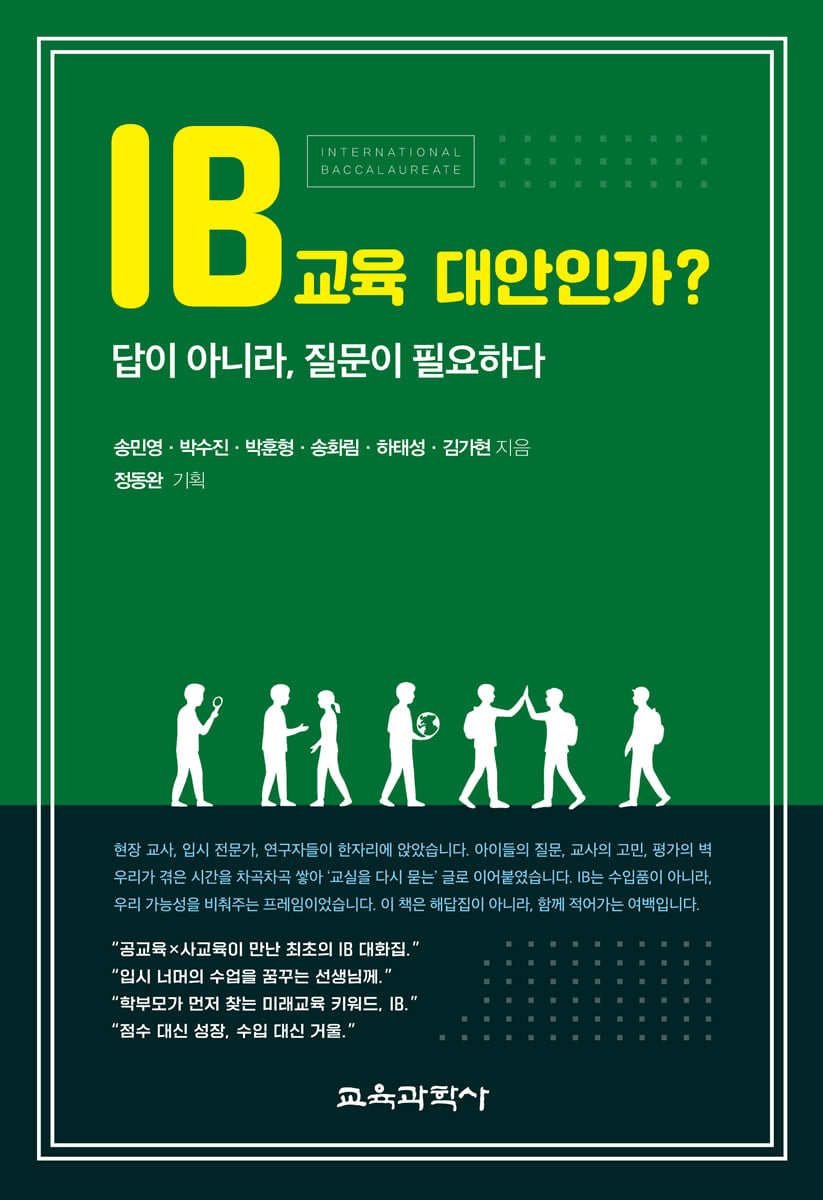
Is the IB Education an Alternative? Questions, Not Answers, Are Needed.
 |
Description
Book Introduction
IB education is often misunderstood as a foreign education system.
But the IB we encountered was neither a simple import nor an export target of an ideal educational model.
Rather, it was a system that precisely structured the educational questions we had long desired and practiced.
This book is not a proposal to 'copy' the IB.
Rather, it is an attempt to use the system as a 'mirror' to reflect on the possibilities and limitations of our education.
So the question, "Alternative or Confrontation?" ultimately also asks, "Where does education within us stand?"
The book does not simply list IB theories or cases.
This story was written by teachers who have actually practiced and researched the IB curriculum, and experts who have closely observed the trends in college entrance exams and advancement.
Through this book, we look back at Korean education through the lens of the IB, and at the same time, we continue to question the IB through the lens of the Korean educational landscape.
But the IB we encountered was neither a simple import nor an export target of an ideal educational model.
Rather, it was a system that precisely structured the educational questions we had long desired and practiced.
This book is not a proposal to 'copy' the IB.
Rather, it is an attempt to use the system as a 'mirror' to reflect on the possibilities and limitations of our education.
So the question, "Alternative or Confrontation?" ultimately also asks, "Where does education within us stand?"
The book does not simply list IB theories or cases.
This story was written by teachers who have actually practiced and researched the IB curriculum, and experts who have closely observed the trends in college entrance exams and advancement.
Through this book, we look back at Korean education through the lens of the IB, and at the same time, we continue to question the IB through the lens of the Korean educational landscape.
- You can preview some of the book's contents.
Preview
index
Preface IB, The Mirror Within Us, Not Outside 3
Prologue: Why Did We Start This Conversation? 4
PART 01 Looking in the Mirror: The "Changes That Have Already Begun" in Korean Education
CHAPTER 01 IB Education: Why Question Korean Education Now? 11
1.
Global Education Trends and the Emergence of the IB 11
2. The Meaning of Student Initiative in IB Education 28
3.
The Crisis in Korean Education: The Gap Between Education and College Admissions 30
CHAPTER 02: Changes in Seoul National University Admissions and a Turning Point in Learning 51
1.
The Interplay of Seoul National University's Admissions Reform and the IB Curriculum: Why the Attention? 51
2. The need to build a model that spreads the IB educational method throughout Korean public education and the future direction of education 69
CHAPTER 03: Finding "Pre-existing Possibilities" Rather Than "New Models" 77
1. IB is a 'reference point', not an alternative 77
2. What was gained and lost in the IB expansion discussion 83
3.
Conditions for Scalability: Records and Trust 86
PART 02 Shifting the Lens: Reimagining Teaching and Assessment Through the IB 97
CHAPTER 04 How the IB Education Organizes Learning 99
1. Overview of the IB Curriculum (PYP-MYP-DP) 99
CHAPTER 05: What's Similar to the 2022 Revised Curriculum? 113
1.
On Similar, Yet Different Paths: A Look into the Design Philosophy of the IB and Korean Curriculum 113
2.
What We Need to Learn and Where We Need to Go 125
3.
How the World Has Embraced IB: The Potential and Limitations of Korea's IB 135
4.
Core Competencies Lead to Learning for Life 151
PART 03 Expanding in the Classroom: Practices That Prove Possibility 167
CHAPTER 06 Teaching and Assessment: Attempts to Cross Boundaries 169
1.
To become a language of learning beyond evaluation and grades 171
2.
Have them write sentences instead of answers 179
3. IB's Essay-Based Assessment: Examining the Flow of Thought and Clarity of Logic 187
4. Bridging the Gap Between IB and Comprehensive Student Assessment and Evaluation Philosophy 191
CHAPTER 07: Creating Records that Connect Activities and Narratives 197
1.
197 Evaluations that Record, Evaluations that Open the Narrative
2.
Creating a Learner Growth Narrative Centered on Activity Records and Feedback 210
3.
Descriptive, portfolio-based, subject-selection-focused design 214
PART 04 Questioning the Direction of Education: Conditions for Transition 219
CHAPTER 08: Questioning the Direction of Education: Partners in the Ecosystem 221
CHAPTER 09 Structure and System, Enabling Scalability 237
1.
Structural Understanding and Redesign for Alignment of Curriculum, Assessment, and Admissions 237
2.
Spreading a Trust-Based Record Culture: A Condition for Restoring Integrity and Authenticity in Education 243
3.
Regional disparities in education and structural problems created by systemic imbalances 251
4.
Distribution of Educational Resources: The Starting Point for Fair Education 257
5.
Teacher Diversity, Educational Potential: Toward a Collaborative Teacher Competency System 264
Epilogue: Not Following IB, But Walking Alongside It 271
Reference 273
Prologue: Why Did We Start This Conversation? 4
PART 01 Looking in the Mirror: The "Changes That Have Already Begun" in Korean Education
CHAPTER 01 IB Education: Why Question Korean Education Now? 11
1.
Global Education Trends and the Emergence of the IB 11
2. The Meaning of Student Initiative in IB Education 28
3.
The Crisis in Korean Education: The Gap Between Education and College Admissions 30
CHAPTER 02: Changes in Seoul National University Admissions and a Turning Point in Learning 51
1.
The Interplay of Seoul National University's Admissions Reform and the IB Curriculum: Why the Attention? 51
2. The need to build a model that spreads the IB educational method throughout Korean public education and the future direction of education 69
CHAPTER 03: Finding "Pre-existing Possibilities" Rather Than "New Models" 77
1. IB is a 'reference point', not an alternative 77
2. What was gained and lost in the IB expansion discussion 83
3.
Conditions for Scalability: Records and Trust 86
PART 02 Shifting the Lens: Reimagining Teaching and Assessment Through the IB 97
CHAPTER 04 How the IB Education Organizes Learning 99
1. Overview of the IB Curriculum (PYP-MYP-DP) 99
CHAPTER 05: What's Similar to the 2022 Revised Curriculum? 113
1.
On Similar, Yet Different Paths: A Look into the Design Philosophy of the IB and Korean Curriculum 113
2.
What We Need to Learn and Where We Need to Go 125
3.
How the World Has Embraced IB: The Potential and Limitations of Korea's IB 135
4.
Core Competencies Lead to Learning for Life 151
PART 03 Expanding in the Classroom: Practices That Prove Possibility 167
CHAPTER 06 Teaching and Assessment: Attempts to Cross Boundaries 169
1.
To become a language of learning beyond evaluation and grades 171
2.
Have them write sentences instead of answers 179
3. IB's Essay-Based Assessment: Examining the Flow of Thought and Clarity of Logic 187
4. Bridging the Gap Between IB and Comprehensive Student Assessment and Evaluation Philosophy 191
CHAPTER 07: Creating Records that Connect Activities and Narratives 197
1.
197 Evaluations that Record, Evaluations that Open the Narrative
2.
Creating a Learner Growth Narrative Centered on Activity Records and Feedback 210
3.
Descriptive, portfolio-based, subject-selection-focused design 214
PART 04 Questioning the Direction of Education: Conditions for Transition 219
CHAPTER 08: Questioning the Direction of Education: Partners in the Ecosystem 221
CHAPTER 09 Structure and System, Enabling Scalability 237
1.
Structural Understanding and Redesign for Alignment of Curriculum, Assessment, and Admissions 237
2.
Spreading a Trust-Based Record Culture: A Condition for Restoring Integrity and Authenticity in Education 243
3.
Regional disparities in education and structural problems created by systemic imbalances 251
4.
Distribution of Educational Resources: The Starting Point for Fair Education 257
5.
Teacher Diversity, Educational Potential: Toward a Collaborative Teacher Competency System 264
Epilogue: Not Following IB, But Walking Alongside It 271
Reference 273
GOODS SPECIFICS
- Date of issue: September 30, 2025
- Page count, weight, size: 280 pages | 153*224*20mm
- ISBN13: 9788925419183
- ISBN10: 8925419181
You may also like
카테고리
korean


korean

![GQ KOREA Mark (Monthly): December [2025]](http://librairie.coreenne.fr/cdn/shop/files/8ef265dbbfbf186523ed75ba7319009d.jpg?v=1765340328&width=3840)


