

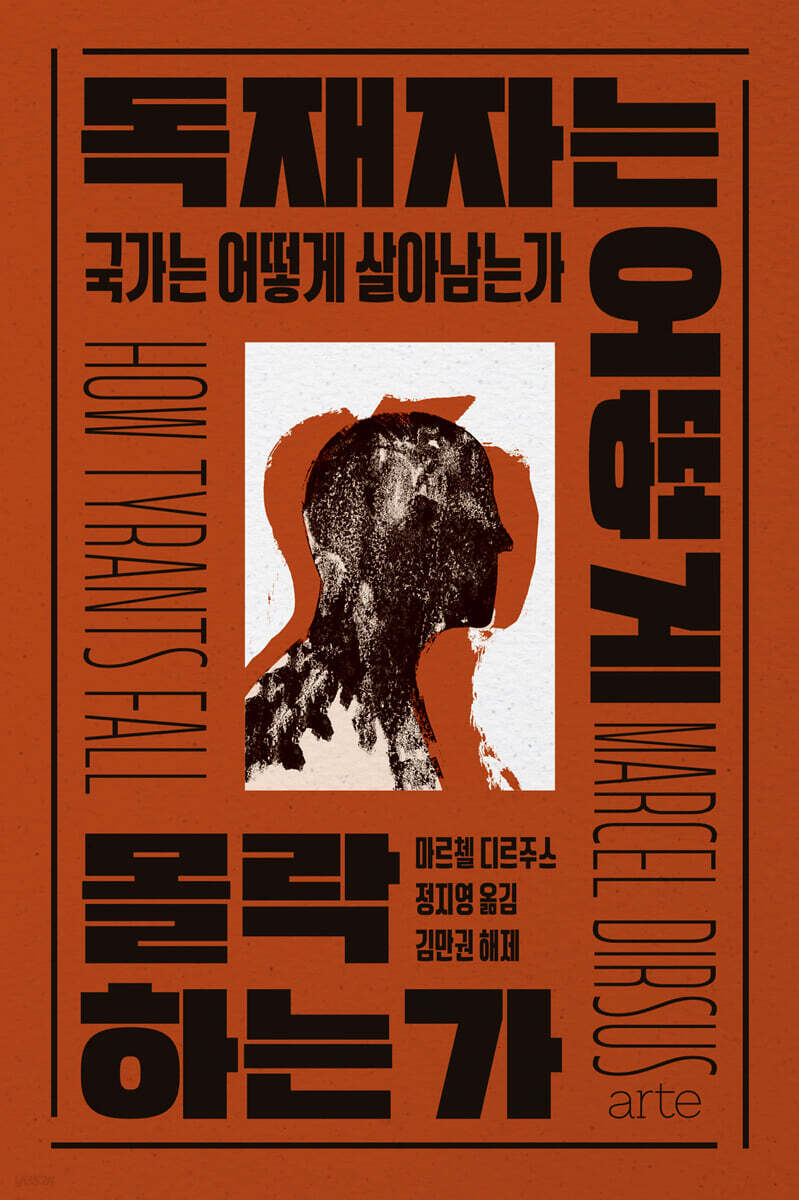
How Dictators Fall
 |
Description
Book Introduction
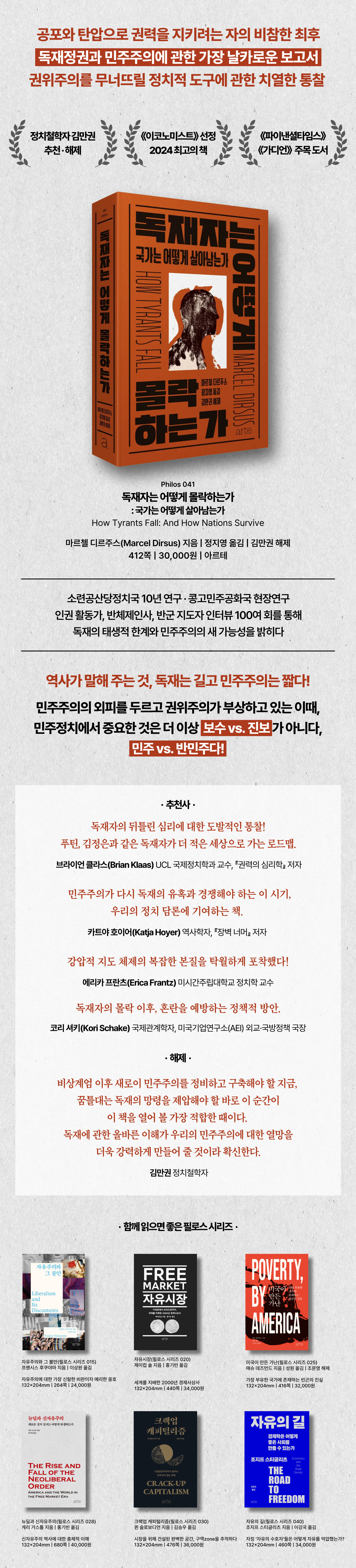
The miserable end of those who seek to maintain power through fear and oppression
The most incisive report on dictatorship and democracy
A fierce insight into the political tools that can overthrow authoritarianism.
★ The Economist's Best Books of 2024 ★
“A correct understanding of dictatorship will stimulate our desire for democracy.
I am confident that it will make you even more powerful.”
- Kim Man-kwon (political philosopher), commentary
In March 2025, the Institute for Democracy and Diversity (V-dem) at the University of Gothenburg in Sweden evaluated South Korea as an "Autocratization Country" for the second consecutive year, following 2024.
In particular, this year, South Korea lost its status as a “liberal democracy” and was classified as an “electoral democracy.”
A liberal democracy, as defined by the institute, is one that guarantees “protection of civil liberties, equality before the law, and judicial and legislative control over the executive branch.”
After the Cold War, it seemed as if the liberal democratic model had triumphed and become the new standard, with “less than 12 percent of countries maintaining closed dictatorships by 2012” (p. 37).
However, authoritarianism is currently on the rise again, not only in our country but also around the world.
According to the "Democracy Report 2025" published by the same institute, in 2024, for the first time in 22 years, authoritarian regimes took power in 91 countries, more than democratic countries (88).
In Eastern Europe, Hungary and Poland have been moving towards authoritarianism since the 2010s, and in several Western European countries, including Italy, France, and Germany, far-right parties have been on the rise over the past two to three years.
Democracy in the United States is also in retreat with the return of the Trump administration.
So how do authoritarian regimes acquire and maintain power? When and how does the seemingly unwavering power of dictators collapse? What happens when they fall? Marcel Dirsus addresses these questions in "How Dictators Fall: How Nations Survive" (Philos Series No. 41), exploring new possibilities for contemporary democracy.
The author, a political scientist, studied political science at Oxford University and studied dictatorships, including the Politburo of the Communist Party of the Soviet Union, for ten years. He is currently a visiting researcher at the Institute for Security Policy Studies at the University of Kiel and a member of the Konrad Adenauer Foundation's Standing Committee on Terrorism and Security, where he researches strategies for restoring democracy.
In this book, the author conducts an in-depth analysis of dictatorships through over 100 interviews with a diverse range of figures, including human rights activists, dissidents, and rebel leaders, and presents an original and empirical analysis of the tools and methods for overthrowing authoritarianism.
The Economist selected it as one of the best books of 2024, and political scientist Kim Man-kwon recommended it in the introduction, saying, “Now, when we must rebuild and establish democracy after martial law, when we must subdue the squirming specter of dictatorship, is the most appropriate time to open this book.”
In a time when democracy must once again compete with the temptations of dictatorship, "How Dictators Fall" will be a must-read, providing crucial points that must be addressed in current political discourse.
The most incisive report on dictatorship and democracy
A fierce insight into the political tools that can overthrow authoritarianism.
★ The Economist's Best Books of 2024 ★
“A correct understanding of dictatorship will stimulate our desire for democracy.
I am confident that it will make you even more powerful.”
- Kim Man-kwon (political philosopher), commentary
In March 2025, the Institute for Democracy and Diversity (V-dem) at the University of Gothenburg in Sweden evaluated South Korea as an "Autocratization Country" for the second consecutive year, following 2024.
In particular, this year, South Korea lost its status as a “liberal democracy” and was classified as an “electoral democracy.”
A liberal democracy, as defined by the institute, is one that guarantees “protection of civil liberties, equality before the law, and judicial and legislative control over the executive branch.”
After the Cold War, it seemed as if the liberal democratic model had triumphed and become the new standard, with “less than 12 percent of countries maintaining closed dictatorships by 2012” (p. 37).
However, authoritarianism is currently on the rise again, not only in our country but also around the world.
According to the "Democracy Report 2025" published by the same institute, in 2024, for the first time in 22 years, authoritarian regimes took power in 91 countries, more than democratic countries (88).
In Eastern Europe, Hungary and Poland have been moving towards authoritarianism since the 2010s, and in several Western European countries, including Italy, France, and Germany, far-right parties have been on the rise over the past two to three years.
Democracy in the United States is also in retreat with the return of the Trump administration.
So how do authoritarian regimes acquire and maintain power? When and how does the seemingly unwavering power of dictators collapse? What happens when they fall? Marcel Dirsus addresses these questions in "How Dictators Fall: How Nations Survive" (Philos Series No. 41), exploring new possibilities for contemporary democracy.
The author, a political scientist, studied political science at Oxford University and studied dictatorships, including the Politburo of the Communist Party of the Soviet Union, for ten years. He is currently a visiting researcher at the Institute for Security Policy Studies at the University of Kiel and a member of the Konrad Adenauer Foundation's Standing Committee on Terrorism and Security, where he researches strategies for restoring democracy.
In this book, the author conducts an in-depth analysis of dictatorships through over 100 interviews with a diverse range of figures, including human rights activists, dissidents, and rebel leaders, and presents an original and empirical analysis of the tools and methods for overthrowing authoritarianism.
The Economist selected it as one of the best books of 2024, and political scientist Kim Man-kwon recommended it in the introduction, saying, “Now, when we must rebuild and establish democracy after martial law, when we must subdue the squirming specter of dictatorship, is the most appropriate time to open this book.”
In a time when democracy must once again compete with the temptations of dictatorship, "How Dictators Fall" will be a must-read, providing crucial points that must be addressed in current political discourse.
- You can preview some of the book's contents.
Preview
index
How to confront the swaying specter of dictatorship
The Paradox of the Golden Pistol
Chapter 1: The Dictator's Treadmill
Chapter 2 Enemy Within
Chapter 3: Weakening the Military Group
Chapter 4: Rebels, Guns, and Money
Chapter 5 Foreign Enemies and Domestic Enemies
Chapter 6: If you shoot, you lose
Chapter 7: There is no other choice.
Chapter 8: Words Become Seeds
Chapter 9: How to Overthrow a Dictator
Acknowledgements
main
Search
The Paradox of the Golden Pistol
Chapter 1: The Dictator's Treadmill
Chapter 2 Enemy Within
Chapter 3: Weakening the Military Group
Chapter 4: Rebels, Guns, and Money
Chapter 5 Foreign Enemies and Domestic Enemies
Chapter 6: If you shoot, you lose
Chapter 7: There is no other choice.
Chapter 8: Words Become Seeds
Chapter 9: How to Overthrow a Dictator
Acknowledgements
main
Search
Detailed image
Into the book
At first glance, these rulers seem crazy.
They are definitely not normal humans.
They are usually narcissistic, sometimes psychopathic, and almost always ruthless.
But the surprising thing is that most of them are also rational.
They didn't lose their minds.
Given the system they operate under and the information they possess, their strategy of torturing, killing, and starving the public while amassing wealth in the presidential palace makes sense.
This is how they survive.
--- p.35
There is a major, unresolvable dilemma here.
On the one hand, a dictator who wants to step down must find someone strong and capable enough to protect him when he relinquishes power.
On the other hand, a successor who is strong and capable enough to protect the dictator can also destroy the dictator.
And often the successor completely crushes the outgoing dictator.
Because a proud dictator would never be satisfied with being treated worse than his predecessor.
Dictators who try to pass the torch often end up hurt by the fire.
If you can't get off without getting hurt, what other option is there for a dictator who's already on the treadmill?
--- p.53
It's no coincidence that many of the world's most vicious regimes have access to oil, gas, and diamonds.
Extracting these natural resources is not only highly profitable, but it also allows for profit even if the people around the leader are largely incompetent.
On the other hand, oil extraction is a arduous and difficult process.
Extracting oil requires governments to secure not only highly sophisticated technology and extensive expertise, but also massive investment funds.
However, this process does not require a large number of people and can be done by already trained personnel.
This is where the dictator has an advantage.
Oil is a very profitable commodity, so if you sell your oil fields to a large foreign company, they will take care of everything.
Oil drilling? They'll do it.
Oil refining? They can do it.
Transportation? No need to worry.
Knowing that oil drilling could make millions or tens of millions of dollars, the giant foreign corporations are willing to do whatever it takes.
--- p.93
The public has a misconception that coups are always violent and violent.
Some of the coups are certainly violent.
But if you see clashes between soldiers or a coup where soldiers are shooting directly at civilians, it means something is not going according to plan.
… … Soldiers trained to fight external enemies often resist the use of violence at home, leading to divisions within the military.
On a personal level, this issue involves a loss of legitimacy.
Protecting one's country from foreign threats is a respectable and, in some societies, even heroic.
But what about shooting your own people—soldiers and civilians, especially women and children—in an attempt to seize power? It's hard to call them heroes.
And this situation ultimately helps a brutal government maintain power.
--- p.142
There are other problems that a dictator may face.
In some conflicts, dictators who deem suppressing rebels too costly or impossible may bribe rebel groups with cash or subsidies.
In this case, if it were simply a matter between the rebels and the dictatorship, the considerations for both parties would not be that complex.
Is it better to end the war (by paying money)? Is that the path of least resistance, or is it better to continue the fight? If these are the only two options, the amount of money needed to secure the rebels' "loyalty" is relatively small.
Unfortunately, 21st-century civil wars are incredibly messy and almost always involve external forces.
--- p.179
Unfortunately for dictators, formal war isn't the only problem they have to worry about.
Behind the official parliamentary approvals or prime ministerial speeches in a country, there exists a shadow world.
Foreign powers may outwardly say they will not do so, but secretly try to remove a dictator.
There are various methods.
You can train the dictator's opponents, fund armed groups, keep his opponents alive, or empower those plotting a coup to oppose the dictator.
Looking back at the Cold War, we can see how threats against dictators were made.
--- p.196
One way to help persuade a population to tolerate, or even support, a dictator's rule is to create the illusion that the dictatorship enjoys support from others.
Have you ever wondered why undemocratic countries spend millions of dollars on elections that are clearly meaningless? Winning an election demonstrates to the people of that country and to other nations that the regime enjoys popular support.
The classic way to convince the public with outright lies is to bombard them with propaganda every waking moment.
Every time you read the newspaper, you read what the regime wants you to read, and every time you turn on the television, you see what the regime wants you to see.
The same goes for listening to the radio.
There is no propaganda more powerful than the personality cult of a dictator.
--- p.227~228
If assassinating a brutal leader is morally permissible, this raises several other difficult questions.
How can we distinguish between those who kill a dictator because he's a dictator and those who kill him for personal gain? If killing a dictator isn't for personal gain, how can we distinguish between killing a dictator and terrorism? Terrorists use violence not only to achieve their goals, but also to instill fear in those not directly involved.
Would the same be true for assassinating a dictator? It depends.
Killing a dictator can send a signal to others that similar behavior will not be tolerated.
On the other hand, it may be that removing a dictator is purely for the purpose of re-establishing the constitutional order of the country.
--- p.259
Herein arises one of the main arguments against attempts to overthrow the dictator.
It is almost impossible to predict what will happen immediately after the dictator is overthrown.
… … Things may get better after the fall of the dictator, but they may also get worse.
Almost everything we looked at in the previous chapters was based on probability.
Are there any types of regime change that are more likely to produce sustainable outcomes? Yes, they certainly exist.
But given the historically high risk of such regime change, with a two-thirds chance of success, is it really worth rolling the dice? There's certainly some merit to the argument that it shouldn't be done.
They are definitely not normal humans.
They are usually narcissistic, sometimes psychopathic, and almost always ruthless.
But the surprising thing is that most of them are also rational.
They didn't lose their minds.
Given the system they operate under and the information they possess, their strategy of torturing, killing, and starving the public while amassing wealth in the presidential palace makes sense.
This is how they survive.
--- p.35
There is a major, unresolvable dilemma here.
On the one hand, a dictator who wants to step down must find someone strong and capable enough to protect him when he relinquishes power.
On the other hand, a successor who is strong and capable enough to protect the dictator can also destroy the dictator.
And often the successor completely crushes the outgoing dictator.
Because a proud dictator would never be satisfied with being treated worse than his predecessor.
Dictators who try to pass the torch often end up hurt by the fire.
If you can't get off without getting hurt, what other option is there for a dictator who's already on the treadmill?
--- p.53
It's no coincidence that many of the world's most vicious regimes have access to oil, gas, and diamonds.
Extracting these natural resources is not only highly profitable, but it also allows for profit even if the people around the leader are largely incompetent.
On the other hand, oil extraction is a arduous and difficult process.
Extracting oil requires governments to secure not only highly sophisticated technology and extensive expertise, but also massive investment funds.
However, this process does not require a large number of people and can be done by already trained personnel.
This is where the dictator has an advantage.
Oil is a very profitable commodity, so if you sell your oil fields to a large foreign company, they will take care of everything.
Oil drilling? They'll do it.
Oil refining? They can do it.
Transportation? No need to worry.
Knowing that oil drilling could make millions or tens of millions of dollars, the giant foreign corporations are willing to do whatever it takes.
--- p.93
The public has a misconception that coups are always violent and violent.
Some of the coups are certainly violent.
But if you see clashes between soldiers or a coup where soldiers are shooting directly at civilians, it means something is not going according to plan.
… … Soldiers trained to fight external enemies often resist the use of violence at home, leading to divisions within the military.
On a personal level, this issue involves a loss of legitimacy.
Protecting one's country from foreign threats is a respectable and, in some societies, even heroic.
But what about shooting your own people—soldiers and civilians, especially women and children—in an attempt to seize power? It's hard to call them heroes.
And this situation ultimately helps a brutal government maintain power.
--- p.142
There are other problems that a dictator may face.
In some conflicts, dictators who deem suppressing rebels too costly or impossible may bribe rebel groups with cash or subsidies.
In this case, if it were simply a matter between the rebels and the dictatorship, the considerations for both parties would not be that complex.
Is it better to end the war (by paying money)? Is that the path of least resistance, or is it better to continue the fight? If these are the only two options, the amount of money needed to secure the rebels' "loyalty" is relatively small.
Unfortunately, 21st-century civil wars are incredibly messy and almost always involve external forces.
--- p.179
Unfortunately for dictators, formal war isn't the only problem they have to worry about.
Behind the official parliamentary approvals or prime ministerial speeches in a country, there exists a shadow world.
Foreign powers may outwardly say they will not do so, but secretly try to remove a dictator.
There are various methods.
You can train the dictator's opponents, fund armed groups, keep his opponents alive, or empower those plotting a coup to oppose the dictator.
Looking back at the Cold War, we can see how threats against dictators were made.
--- p.196
One way to help persuade a population to tolerate, or even support, a dictator's rule is to create the illusion that the dictatorship enjoys support from others.
Have you ever wondered why undemocratic countries spend millions of dollars on elections that are clearly meaningless? Winning an election demonstrates to the people of that country and to other nations that the regime enjoys popular support.
The classic way to convince the public with outright lies is to bombard them with propaganda every waking moment.
Every time you read the newspaper, you read what the regime wants you to read, and every time you turn on the television, you see what the regime wants you to see.
The same goes for listening to the radio.
There is no propaganda more powerful than the personality cult of a dictator.
--- p.227~228
If assassinating a brutal leader is morally permissible, this raises several other difficult questions.
How can we distinguish between those who kill a dictator because he's a dictator and those who kill him for personal gain? If killing a dictator isn't for personal gain, how can we distinguish between killing a dictator and terrorism? Terrorists use violence not only to achieve their goals, but also to instill fear in those not directly involved.
Would the same be true for assassinating a dictator? It depends.
Killing a dictator can send a signal to others that similar behavior will not be tolerated.
On the other hand, it may be that removing a dictator is purely for the purpose of re-establishing the constitutional order of the country.
--- p.259
Herein arises one of the main arguments against attempts to overthrow the dictator.
It is almost impossible to predict what will happen immediately after the dictator is overthrown.
… … Things may get better after the fall of the dictator, but they may also get worse.
Almost everything we looked at in the previous chapters was based on probability.
Are there any types of regime change that are more likely to produce sustainable outcomes? Yes, they certainly exist.
But given the historically high risk of such regime change, with a two-thirds chance of success, is it really worth rolling the dice? There's certainly some merit to the argument that it shouldn't be done.
--- p.350
Publisher's Review
A Decade of Research on the Politburo of the Communist Party of the Soviet Union and Field Research in the Democratic Republic of the Congo
Through over 100 interviews with human rights activists, dissidents, and rebel leaders,
Revealing the inherent limitations of dictatorship and the new possibilities of democracy
Questions at the scene of the coup
"When does a dictator lose power? What happens after that?"
“On the way back to the office [a brewery in the Democratic Republic of the Congo], a sharp sound cut through the quiet air.
It was the sound of a gunshot.
Even if they weren't originally targeting me, one of those shots could have had serious consequences.
Slightly frightened, I looked back at my colleagues and asked.
“What should I do now?” The answer I got was, “Just stay.”
There was a layer of protection between me, a visiting European, and the danger behind the concrete wall.
Others in this city outside the walls were not as lucky as I was.
… Why do people in some countries accept situations of profound instability as if they were completely familiar? How did President Kabila manage to remain in power for five more years? When do leaders like Kabila lose power? What happens after they do? I decided to study how dictators fall.
“International organizations such as the North Atlantic Treaty Organization (NATO) and the Organization for Economic Cooperation and Development (OECD) have also studied this topic, always addressing the question of how dictators fall.” (Excerpts from pages 25-27)
Marcel Dirjus was working at a brewery in the Democratic Republic of Congo in 2013 when he witnessed the coup d'état launched by religious leader Paul Joseph Mukungubila against President Joseph Kabila.
Although the coup ultimately failed, the intense experience at the time led to the writing of “How Dictators Fall.”
The author argues that dictators remain a significant and undeniable threat even today, and warns that without a proper understanding of this, we will be unable to adequately address the various authoritarian threats posed around the world.
This book serves as a practical guide that helps us understand the nature and structural contradictions of modern dictatorships and suggests a strategy for restoring democracy centered on peaceful resistance.
The core problem facing dictators is
Fear and silence
“When crooked people become dictators, dictatorship can further ruin them.” (p. 102)
Marcel Dirges first analyzes the dictator's power mechanism.
Dictators, who, in the author's words, are "trapped on a treadmill from which they can never get off," demonstrate that while they appear invincible, they actually hold surprisingly shaky positions of power.
This is due to the ‘dictator’s dilemma’ (page 89).
The author points out that the dictatorship is opaque not only to the outside world but also to the dictator himself, making it very difficult for the dictator to manage the entire country.
Therefore, dictators have no choice but to constantly create an atmosphere of fear in order to maintain power.
The main ways in which dictators maintain power are 1) strengthening the elite structure based on loyalty, 2) decentralizing and overlapping the work of the military and intelligence agencies to prevent the overthrow of the regime, and 3) suppressing the media and manipulating information to control the public.
This structure is very unstable.
His cronies can always covet power, and the military elite can easily become dissatisfied with their political exclusion.
Corruption and cronyism alienate the public and weaken the very legitimacy of the system.
The most crucial problem is that the fear instigated by the dictator forces critics to remain silent and unable to voice their opinions.
A dictator has no way of knowing what his people, or even his close associates, are really thinking.
"Does this person truly support the government's ideology, or is he just playing the part to buy time until he can stab the dictator in the back? The dictator never knows."
Because in a dictatorship, telling the truth means risking your life.
In the end, the dictator becomes a lonely being surrounded by countless enemies, and he has structural limitations that make him lose his sense of reality and inevitably lead him down the path to ruin.
Why can't dictators see reality?
Kim Jong-un “came to power with an experience that seriously distorted his view of reality from a young age” (p. 103), while Putin justified war crimes by blocking various information and “listening only to the opinions of siloviki, such as soldiers and spies, and taking an increasingly hostile attitude” (p. 102).
Xi Jinping emphasized the inevitable wolf diplomacy of physical confrontation, saying in 2023, “We must fight boldly” (p. 38).
In the case of Saddam Hussein, he cites psychoanalytic studies of dictators and says, “The antisocial personality traits of a malignant narcissist, including delusions of persecution, aggression, and a lack of moral judgment, may actually help him succeed as a dictator” (p. 107).
In the case of Muammar Gaddafi, the reason Libya was unable to properly establish various strategic goals for the country, including the development of nuclear weapons, is directly related to the problem of dictatorship.
“A government system centered on Gaddafi as an individual made it difficult to grasp the overall problem, and there was no agency to monitor and understand what scientists were doing.
“We have not even reached the threshold of nuclear weapons because we have traded internal security for protection against external threats” (p. 210).
This is similar to the case of Saddam Hussein, who was not given proper advice even when he desperately needed it.
What about Viktor Yanukovych, who brutally suppressed unarmed citizens who took to the streets? (p. 226) The author points out that the “seesaw game of repression and radicalization” is a common problem, so dictators try to prevent people from taking to the streets in the first place, but this itself is absurd.
The cases of Viktor Orbán, who declared that he would turn Hungary into an “illiberal democracy”—a de facto form of authoritarianism—and Recep Tayyip Erdoğan (p. 38), who created a structure that makes it increasingly difficult for the opposition to win elections, point out that under a dictatorship, there will always be an abundance of people who are fundamentally unhappy in terms of the citizens’ ability to exercise influence.
The fate of a dictator, whether metaphorically or in reality, is always near death.
This can be seen in Nicolae Ceausescu (page 63), who was so confident until his death on the last day of his power that he urged his aide piloting a helicopter to “follow the cause”; Nicolae Maduro (page 282), who narrowly escaped death by a drone attack while giving a speech on economic recovery; Idi Amin, who fled to Saudi Arabia during the war with Tanzania; Ben Ali, who also fled to the same place; and Mobutu Sese Seko, who settled in Morocco (page 59).
They died or nearly died countless times before escaping.
Research shows that one in five dictators who lost power after World War II fled abroad.
What about Nazarbayev, who has successfully amassed enormous personal power over the years? Even after resigning as president, he continues to enjoy privileges like immunity from prosecution. But he soon faces other inevitable challenges.
“The moment you give up power, it becomes difficult to defend yourself.” (p. 50)
This book also analyzes dictators such as Charles Taylor, Isen Abr, Islam Karimov, Yahya Jammeh, Saparmurat Niyazov, Bokassa, Mao Zedong, and Pol Pot, and argues that one cannot become a dictator without committing crimes and making enemies.
Dictators continue to do the impossible to remain in power as long as possible, and then move towards ruin.
Vivid testimonies from the scene of the collapse of the dictatorship,
Interviews with human rights activists, dissidents, and rebel leaders
The author suggests that the main causes of the collapse of the dictatorship are 1) internal coup, 2) popular resistance, and 3) foreign intervention.
The moment the military or its inner circle turns its back, the regime collapses in an instant, and a widespread civil disobedience movement takes time, but increases the chances of a successful regime change.
The author particularly emphasizes that 'nonviolent civil resistance' is the most effective method in the long term.
Research supports this finding, showing that when peaceful resistance involving approximately 3.5 percent of the population occurs, the likelihood of regime collapse increases dramatically. [Chenoweth's '3.5 Percent Rule' (p. 222)] On the other hand, he points out that foreign military intervention can lead to unpredictable chaos, requiring a cautious approach.
An interesting part of this book is the interviews with people the author met in person.
The journalist who played a crucial role in bringing down the oppressive regime of East Germany (Siegbert Schepke, codenamed “Satan” by the Stasi, p. 241), the rebel leader who led a brutal massacre in Burundi (Agaton Rwasa of the National Liberation Army, p. 306), and the Gambian-American activist who was imprisoned for plotting to liberate his country (human rights activist Vanka Mane, p. 118) vividly show the inherent limitations of dictatorship.
Each case raises the following questions:
"When a dictator orders the firing of unarmed protesters, can that order actually be carried out? The dictator may want to order brutal repression, but what if the gunmen sympathize with those facing the gun?" "Why is it so difficult to end a civil war?" "Is the peaceful overthrow of a dictatorship possible? What awaits them?"
This goes beyond an analysis of dictatorship to address various possibilities for how a nation can survive and be rebuilt.
Through analysis of various scenarios and cases of the downfall of those who dreamed of eternal power and the collapse of dictatorships, we closely trace the political and social mechanisms hidden within them.
This book offers penetrating insights into the reality of democracy in crisis.
The real beginning comes after the dictator steps down.
The challenges of civil society, press freedom, and political system reform
“A year after Armenia’s Velvet Revolution, a reporter asked a fruit vendor how things had changed. The vendor replied that only a fool would expect a revolution to change everything.
“Revolution is like getting an empty birdhouse,” said the white-haired woman, sitting in front of a cardboard box filled with onions, apples and tomatoes.
“It still needs to be fixed and furnished,” he added.
That was right.
“A peaceful uprising is an opportunity to create something better, but it doesn’t solve all our problems at once.” (p. 300)
In this book, the author argues that what happens after a dictator's fall is more important than the dictator's fall.
In many cases, authoritarianism returns in different guises, and the restoration of democracy requires sustained effort and institutional building, not a one-time event.
True regime change is impossible without organizing civil society, restoring freedom of the press, and reforming the political system.
The author emphasizes that the fall of a dictator does not guarantee an immediate transition to democracy.
It deeply analyzes how a nation can overcome and survive the chaotic transition period following a dictatorship and move toward true democracy, and warns that the period immediately following a dictator's departure is the most dangerous.
This book presents three key conditions for a post-dictatorship nation to survive and restore democracy.
1) Reconstruction of civil society and expansion of participation.
Democracy cannot be sustained by elections alone; citizens must be empowered to participate in politics and monitor their government in their daily lives.
In dictatorships, citizens are often alienated from politics or internalize distrust and a sense of powerlessness toward the system.
Therefore, various intermediate organizations, such as civic groups, labor unions, and local communities, must be revitalized, and this must shift from simple anti-government activities to responsible participation in the public interest.
2) Restoration of freedom of the press and transparency of information.
Dictatorships tightly control the media, suppress critical viewpoints, and control the public through lies and propaganda.
Democracy, on the other hand, operates on the basis of a diverse flow of information and open discussion.
The author emphasizes that monitoring power is possible when truthful information is freely exchanged, and citizens can face reality and make independent choices.
Essential tasks for this include protecting independent media, disclosing public information, and abolishing Internet censorship (supporting the development of secure messenger apps).
3) Structural reform of the political system.
Even if a seemingly democratic system exists, it means correcting the authoritarian operating methods inherent within it.
A fair and transparent election system, an independent judiciary, and a legislative-executive relationship that allows for checks and balances of power must be institutionally guaranteed.
Above all, democracy can only be sustainable if it prevents the concentration of power and democratically designs the succession structure.
In addition to these three conditions, the author also mentions the role of the international community.
Rather than forcing the restoration of democracy from outside, it is more effective to support citizens within their own country to change the system themselves.
Such non-interventionist approaches include diplomatic pressure, sanctions, technical assistance, and information dissemination.
The vulnerability of democracy revealed by the December 3 martial law
How to Fight the Growing Specter of Dictatorship
“What matters in democracy is no longer conservative vs.
It's not progress,
Democracy vs.
“It’s anti-democratic!”
As the author says, dictatorship has a longer history than democracy.
“In the long history of politics, what has been more common has been dictatorship, not democracy.
Historically speaking, the era of democracy is nothing short of an exception.” Therefore, it may be natural that the seeds of dictatorship can sprout through the cracks of democracy at the moment of carelessness.
The aforementioned Democracy Report 2025 by the Institute for Democracy and Diversity warned that structural factors such as media control, political polarization, and weakening institutions are eroding democracy worldwide.
Marcel Dirges also warns that many post-dictatorship countries tend to revert to authoritarianism when they amend their constitutions or reform their electoral systems.
Today, dictatorship no longer manifests itself only as military coups or blatant usurpations of power.
Modern dictators, after gaining power legally through elections, gradually strengthen their authoritarian regimes by suppressing the press, controlling the judiciary, and revising the constitution.
This may seem like democracy on the surface, but in reality, authoritarianism is spreading, undermining the functions of freedom and checks and balances.
Our country also experienced this fact painfully through the December 3 martial law.
In reality, indifference and ignorance toward dictatorship resulted in support for the December 3 martial law, and it is also true that “the confrontational structure between conservatives and progressives in democratic politics is no longer valid, and the confrontation between democratic and anti-democratic forces seems to have become more important” (p. 11, Kim Man-kwon’s commentary).
In this age of crisis, where democracy and authoritarianism are once again clashing, this book explores the possibilities and limitations of a new democracy through an analysis of how power operates between dictatorship and democracy, coercion and consent, and domination and resistance.
It also presents practical conditions for a nation to survive as a democracy after the fall of dictatorship and suggests a strategic direction for overcoming the crisis of democracy and building a sustainable system.
Blending practical insights into regime change with the concrete stories of those who have stood up to authoritarianism—including human rights activists, dissidents, rebel leaders, and exiled revolutionaries—this book resonates deeply with those grappling with the future of democracy, a democracy increasingly under threat today.
At the same time, it is a political guide that offers deep reflection on how we can protect and revive democracy today.
■ Release (some excerpts)
Kim Man-kwon (political scientist)
As Dirjus rightly points out, what has been more common in the long history of politics has been dictatorship rather than democracy.
Historically speaking, the era of democracy is nothing short of an exception.
“Cruel and oppressive governments have been the norm, not the exception.” This is evident even in our own history.
The two leaders supported by conservative forces, Syngman Rhee and Park Chung-hee, were both dictators.
In this respect, for anyone interested in politics, understanding how dictatorships are established, maintained, and fall is essential.
This is especially true in a country like ours, where dictatorship has been rampant for over 40 years since the founding of the republic, and especially if some political forces have their identity rooted in the memory of that dictatorship.
But we paid little attention to the dictatorship as a form of rule, as if this republic had been a democracy from the beginning.
In this context, what we must pay attention to is how the idea that 'it's okay for a dictatorship to be in power' persists even today.
The reason we might consider here is that we “rather do not properly understand what ‘dictatorship’ is, how it works, and what impact it has.”
Through over 100 interviews with human rights activists, dissidents, and rebel leaders,
Revealing the inherent limitations of dictatorship and the new possibilities of democracy
Questions at the scene of the coup
"When does a dictator lose power? What happens after that?"
“On the way back to the office [a brewery in the Democratic Republic of the Congo], a sharp sound cut through the quiet air.
It was the sound of a gunshot.
Even if they weren't originally targeting me, one of those shots could have had serious consequences.
Slightly frightened, I looked back at my colleagues and asked.
“What should I do now?” The answer I got was, “Just stay.”
There was a layer of protection between me, a visiting European, and the danger behind the concrete wall.
Others in this city outside the walls were not as lucky as I was.
… Why do people in some countries accept situations of profound instability as if they were completely familiar? How did President Kabila manage to remain in power for five more years? When do leaders like Kabila lose power? What happens after they do? I decided to study how dictators fall.
“International organizations such as the North Atlantic Treaty Organization (NATO) and the Organization for Economic Cooperation and Development (OECD) have also studied this topic, always addressing the question of how dictators fall.” (Excerpts from pages 25-27)
Marcel Dirjus was working at a brewery in the Democratic Republic of Congo in 2013 when he witnessed the coup d'état launched by religious leader Paul Joseph Mukungubila against President Joseph Kabila.
Although the coup ultimately failed, the intense experience at the time led to the writing of “How Dictators Fall.”
The author argues that dictators remain a significant and undeniable threat even today, and warns that without a proper understanding of this, we will be unable to adequately address the various authoritarian threats posed around the world.
This book serves as a practical guide that helps us understand the nature and structural contradictions of modern dictatorships and suggests a strategy for restoring democracy centered on peaceful resistance.
The core problem facing dictators is
Fear and silence
“When crooked people become dictators, dictatorship can further ruin them.” (p. 102)
Marcel Dirges first analyzes the dictator's power mechanism.
Dictators, who, in the author's words, are "trapped on a treadmill from which they can never get off," demonstrate that while they appear invincible, they actually hold surprisingly shaky positions of power.
This is due to the ‘dictator’s dilemma’ (page 89).
The author points out that the dictatorship is opaque not only to the outside world but also to the dictator himself, making it very difficult for the dictator to manage the entire country.
Therefore, dictators have no choice but to constantly create an atmosphere of fear in order to maintain power.
The main ways in which dictators maintain power are 1) strengthening the elite structure based on loyalty, 2) decentralizing and overlapping the work of the military and intelligence agencies to prevent the overthrow of the regime, and 3) suppressing the media and manipulating information to control the public.
This structure is very unstable.
His cronies can always covet power, and the military elite can easily become dissatisfied with their political exclusion.
Corruption and cronyism alienate the public and weaken the very legitimacy of the system.
The most crucial problem is that the fear instigated by the dictator forces critics to remain silent and unable to voice their opinions.
A dictator has no way of knowing what his people, or even his close associates, are really thinking.
"Does this person truly support the government's ideology, or is he just playing the part to buy time until he can stab the dictator in the back? The dictator never knows."
Because in a dictatorship, telling the truth means risking your life.
In the end, the dictator becomes a lonely being surrounded by countless enemies, and he has structural limitations that make him lose his sense of reality and inevitably lead him down the path to ruin.
Why can't dictators see reality?
Kim Jong-un “came to power with an experience that seriously distorted his view of reality from a young age” (p. 103), while Putin justified war crimes by blocking various information and “listening only to the opinions of siloviki, such as soldiers and spies, and taking an increasingly hostile attitude” (p. 102).
Xi Jinping emphasized the inevitable wolf diplomacy of physical confrontation, saying in 2023, “We must fight boldly” (p. 38).
In the case of Saddam Hussein, he cites psychoanalytic studies of dictators and says, “The antisocial personality traits of a malignant narcissist, including delusions of persecution, aggression, and a lack of moral judgment, may actually help him succeed as a dictator” (p. 107).
In the case of Muammar Gaddafi, the reason Libya was unable to properly establish various strategic goals for the country, including the development of nuclear weapons, is directly related to the problem of dictatorship.
“A government system centered on Gaddafi as an individual made it difficult to grasp the overall problem, and there was no agency to monitor and understand what scientists were doing.
“We have not even reached the threshold of nuclear weapons because we have traded internal security for protection against external threats” (p. 210).
This is similar to the case of Saddam Hussein, who was not given proper advice even when he desperately needed it.
What about Viktor Yanukovych, who brutally suppressed unarmed citizens who took to the streets? (p. 226) The author points out that the “seesaw game of repression and radicalization” is a common problem, so dictators try to prevent people from taking to the streets in the first place, but this itself is absurd.
The cases of Viktor Orbán, who declared that he would turn Hungary into an “illiberal democracy”—a de facto form of authoritarianism—and Recep Tayyip Erdoğan (p. 38), who created a structure that makes it increasingly difficult for the opposition to win elections, point out that under a dictatorship, there will always be an abundance of people who are fundamentally unhappy in terms of the citizens’ ability to exercise influence.
The fate of a dictator, whether metaphorically or in reality, is always near death.
This can be seen in Nicolae Ceausescu (page 63), who was so confident until his death on the last day of his power that he urged his aide piloting a helicopter to “follow the cause”; Nicolae Maduro (page 282), who narrowly escaped death by a drone attack while giving a speech on economic recovery; Idi Amin, who fled to Saudi Arabia during the war with Tanzania; Ben Ali, who also fled to the same place; and Mobutu Sese Seko, who settled in Morocco (page 59).
They died or nearly died countless times before escaping.
Research shows that one in five dictators who lost power after World War II fled abroad.
What about Nazarbayev, who has successfully amassed enormous personal power over the years? Even after resigning as president, he continues to enjoy privileges like immunity from prosecution. But he soon faces other inevitable challenges.
“The moment you give up power, it becomes difficult to defend yourself.” (p. 50)
This book also analyzes dictators such as Charles Taylor, Isen Abr, Islam Karimov, Yahya Jammeh, Saparmurat Niyazov, Bokassa, Mao Zedong, and Pol Pot, and argues that one cannot become a dictator without committing crimes and making enemies.
Dictators continue to do the impossible to remain in power as long as possible, and then move towards ruin.
Vivid testimonies from the scene of the collapse of the dictatorship,
Interviews with human rights activists, dissidents, and rebel leaders
The author suggests that the main causes of the collapse of the dictatorship are 1) internal coup, 2) popular resistance, and 3) foreign intervention.
The moment the military or its inner circle turns its back, the regime collapses in an instant, and a widespread civil disobedience movement takes time, but increases the chances of a successful regime change.
The author particularly emphasizes that 'nonviolent civil resistance' is the most effective method in the long term.
Research supports this finding, showing that when peaceful resistance involving approximately 3.5 percent of the population occurs, the likelihood of regime collapse increases dramatically. [Chenoweth's '3.5 Percent Rule' (p. 222)] On the other hand, he points out that foreign military intervention can lead to unpredictable chaos, requiring a cautious approach.
An interesting part of this book is the interviews with people the author met in person.
The journalist who played a crucial role in bringing down the oppressive regime of East Germany (Siegbert Schepke, codenamed “Satan” by the Stasi, p. 241), the rebel leader who led a brutal massacre in Burundi (Agaton Rwasa of the National Liberation Army, p. 306), and the Gambian-American activist who was imprisoned for plotting to liberate his country (human rights activist Vanka Mane, p. 118) vividly show the inherent limitations of dictatorship.
Each case raises the following questions:
"When a dictator orders the firing of unarmed protesters, can that order actually be carried out? The dictator may want to order brutal repression, but what if the gunmen sympathize with those facing the gun?" "Why is it so difficult to end a civil war?" "Is the peaceful overthrow of a dictatorship possible? What awaits them?"
This goes beyond an analysis of dictatorship to address various possibilities for how a nation can survive and be rebuilt.
Through analysis of various scenarios and cases of the downfall of those who dreamed of eternal power and the collapse of dictatorships, we closely trace the political and social mechanisms hidden within them.
This book offers penetrating insights into the reality of democracy in crisis.
The real beginning comes after the dictator steps down.
The challenges of civil society, press freedom, and political system reform
“A year after Armenia’s Velvet Revolution, a reporter asked a fruit vendor how things had changed. The vendor replied that only a fool would expect a revolution to change everything.
“Revolution is like getting an empty birdhouse,” said the white-haired woman, sitting in front of a cardboard box filled with onions, apples and tomatoes.
“It still needs to be fixed and furnished,” he added.
That was right.
“A peaceful uprising is an opportunity to create something better, but it doesn’t solve all our problems at once.” (p. 300)
In this book, the author argues that what happens after a dictator's fall is more important than the dictator's fall.
In many cases, authoritarianism returns in different guises, and the restoration of democracy requires sustained effort and institutional building, not a one-time event.
True regime change is impossible without organizing civil society, restoring freedom of the press, and reforming the political system.
The author emphasizes that the fall of a dictator does not guarantee an immediate transition to democracy.
It deeply analyzes how a nation can overcome and survive the chaotic transition period following a dictatorship and move toward true democracy, and warns that the period immediately following a dictator's departure is the most dangerous.
This book presents three key conditions for a post-dictatorship nation to survive and restore democracy.
1) Reconstruction of civil society and expansion of participation.
Democracy cannot be sustained by elections alone; citizens must be empowered to participate in politics and monitor their government in their daily lives.
In dictatorships, citizens are often alienated from politics or internalize distrust and a sense of powerlessness toward the system.
Therefore, various intermediate organizations, such as civic groups, labor unions, and local communities, must be revitalized, and this must shift from simple anti-government activities to responsible participation in the public interest.
2) Restoration of freedom of the press and transparency of information.
Dictatorships tightly control the media, suppress critical viewpoints, and control the public through lies and propaganda.
Democracy, on the other hand, operates on the basis of a diverse flow of information and open discussion.
The author emphasizes that monitoring power is possible when truthful information is freely exchanged, and citizens can face reality and make independent choices.
Essential tasks for this include protecting independent media, disclosing public information, and abolishing Internet censorship (supporting the development of secure messenger apps).
3) Structural reform of the political system.
Even if a seemingly democratic system exists, it means correcting the authoritarian operating methods inherent within it.
A fair and transparent election system, an independent judiciary, and a legislative-executive relationship that allows for checks and balances of power must be institutionally guaranteed.
Above all, democracy can only be sustainable if it prevents the concentration of power and democratically designs the succession structure.
In addition to these three conditions, the author also mentions the role of the international community.
Rather than forcing the restoration of democracy from outside, it is more effective to support citizens within their own country to change the system themselves.
Such non-interventionist approaches include diplomatic pressure, sanctions, technical assistance, and information dissemination.
The vulnerability of democracy revealed by the December 3 martial law
How to Fight the Growing Specter of Dictatorship
“What matters in democracy is no longer conservative vs.
It's not progress,
Democracy vs.
“It’s anti-democratic!”
As the author says, dictatorship has a longer history than democracy.
“In the long history of politics, what has been more common has been dictatorship, not democracy.
Historically speaking, the era of democracy is nothing short of an exception.” Therefore, it may be natural that the seeds of dictatorship can sprout through the cracks of democracy at the moment of carelessness.
The aforementioned Democracy Report 2025 by the Institute for Democracy and Diversity warned that structural factors such as media control, political polarization, and weakening institutions are eroding democracy worldwide.
Marcel Dirges also warns that many post-dictatorship countries tend to revert to authoritarianism when they amend their constitutions or reform their electoral systems.
Today, dictatorship no longer manifests itself only as military coups or blatant usurpations of power.
Modern dictators, after gaining power legally through elections, gradually strengthen their authoritarian regimes by suppressing the press, controlling the judiciary, and revising the constitution.
This may seem like democracy on the surface, but in reality, authoritarianism is spreading, undermining the functions of freedom and checks and balances.
Our country also experienced this fact painfully through the December 3 martial law.
In reality, indifference and ignorance toward dictatorship resulted in support for the December 3 martial law, and it is also true that “the confrontational structure between conservatives and progressives in democratic politics is no longer valid, and the confrontation between democratic and anti-democratic forces seems to have become more important” (p. 11, Kim Man-kwon’s commentary).
In this age of crisis, where democracy and authoritarianism are once again clashing, this book explores the possibilities and limitations of a new democracy through an analysis of how power operates between dictatorship and democracy, coercion and consent, and domination and resistance.
It also presents practical conditions for a nation to survive as a democracy after the fall of dictatorship and suggests a strategic direction for overcoming the crisis of democracy and building a sustainable system.
Blending practical insights into regime change with the concrete stories of those who have stood up to authoritarianism—including human rights activists, dissidents, rebel leaders, and exiled revolutionaries—this book resonates deeply with those grappling with the future of democracy, a democracy increasingly under threat today.
At the same time, it is a political guide that offers deep reflection on how we can protect and revive democracy today.
■ Release (some excerpts)
Kim Man-kwon (political scientist)
As Dirjus rightly points out, what has been more common in the long history of politics has been dictatorship rather than democracy.
Historically speaking, the era of democracy is nothing short of an exception.
“Cruel and oppressive governments have been the norm, not the exception.” This is evident even in our own history.
The two leaders supported by conservative forces, Syngman Rhee and Park Chung-hee, were both dictators.
In this respect, for anyone interested in politics, understanding how dictatorships are established, maintained, and fall is essential.
This is especially true in a country like ours, where dictatorship has been rampant for over 40 years since the founding of the republic, and especially if some political forces have their identity rooted in the memory of that dictatorship.
But we paid little attention to the dictatorship as a form of rule, as if this republic had been a democracy from the beginning.
In this context, what we must pay attention to is how the idea that 'it's okay for a dictatorship to be in power' persists even today.
The reason we might consider here is that we “rather do not properly understand what ‘dictatorship’ is, how it works, and what impact it has.”
GOODS SPECIFICS
- Date of issue: August 21, 2025
- Format: Hardcover book binding method guide
- Page count, weight, size: 412 pages | 580g | 132*204*30mm
- ISBN13: 9791173574276
- ISBN10: 1173574271
You may also like
카테고리
korean


korean

![GQ KOREA Mark (Monthly): December [2025]](http://librairie.coreenne.fr/cdn/shop/files/8ef265dbbfbf186523ed75ba7319009d.jpg?v=1765340328&width=3840)


