

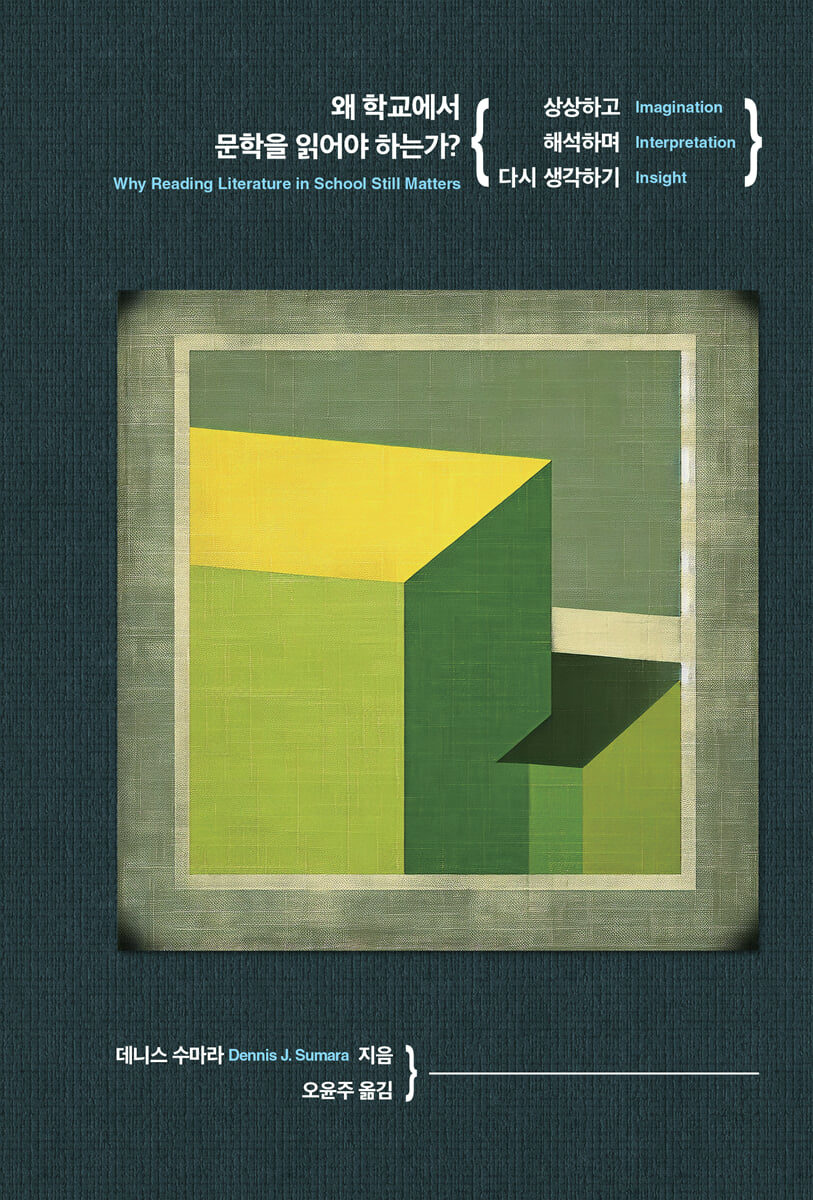
Why should we read literature in school?
 |
Description
Book Introduction
- In an age where speed has swallowed experience, why should we read, teach, and learn literature?
- Edward B., American Society for the Study of Literacy
Fry Book Award Winner
- Recommended by Jeong Jae-chan, Kim Seong-woo, and Jang Eun-soo
In October 2024, the news that author Han Kang had won the Nobel Prize in Literature resonated deeply not only in the Korean literary world but also in the educational field.
What is most noteworthy, as his acceptance speech said, is that literature has reminded us that it “imagines the first-person perspectives of life on this planet” and that it is “the language that ultimately connects us.”
But in an age where AI generates text infinitely and speed consumes experience, we cannot help but ask the following question:
Can literature still maintain its place as a platform for human sensibility, insight, and the imagination to understand one another? Why should we read, teach, and learn from literature?
Professor Dennis Sumara's book, "Why We Read Literature in School," answers this very question.
Literature should no longer be a tool for testing and memorization, but a creative practice that allows students to interpret their own lives and emotions and create new meaning in their relationships with others.
Sumara proposes a reading method called the "Commonplace Book" as a way to make this possible, and demonstrates that through this, the literature classroom can be transformed into a community of interpretation and creation.
This book serves as a catalyst for reflection on how we can answer the questions raised by author Han Kang's award in the educational field.
Moreover, at a time when anxiety about relying on AI is growing, it presents a clear reason to read literature.
- Edward B., American Society for the Study of Literacy
Fry Book Award Winner
- Recommended by Jeong Jae-chan, Kim Seong-woo, and Jang Eun-soo
In October 2024, the news that author Han Kang had won the Nobel Prize in Literature resonated deeply not only in the Korean literary world but also in the educational field.
What is most noteworthy, as his acceptance speech said, is that literature has reminded us that it “imagines the first-person perspectives of life on this planet” and that it is “the language that ultimately connects us.”
But in an age where AI generates text infinitely and speed consumes experience, we cannot help but ask the following question:
Can literature still maintain its place as a platform for human sensibility, insight, and the imagination to understand one another? Why should we read, teach, and learn from literature?
Professor Dennis Sumara's book, "Why We Read Literature in School," answers this very question.
Literature should no longer be a tool for testing and memorization, but a creative practice that allows students to interpret their own lives and emotions and create new meaning in their relationships with others.
Sumara proposes a reading method called the "Commonplace Book" as a way to make this possible, and demonstrates that through this, the literature classroom can be transformed into a community of interpretation and creation.
This book serves as a catalyst for reflection on how we can answer the questions raised by author Han Kang's award in the educational field.
Moreover, at a time when anxiety about relying on AI is growing, it presents a clear reason to read literature.
- You can preview some of the book's contents.
Preview
index
Recommendation
introduction
Chapter 1: Progressive Moments
Chapter 2: Learning to Create Insights
Chapter 3: Interpreting Identity 1: Bodies That Cause Problems
Chapter 4: Learning to Become a Subject
Chapter 5: Interpreting Identity 2: Every Moment is Two Moments
Chapter 6: Learning to Fall in Love
Chapter 7: Interpreting Identity 3: Expanding the Space of Possibility
Chapter 8: Why Reading Literature in School Still Matters
Acknowledgements
References
Translator's Note
Browse works mentioned in this book
introduction
Chapter 1: Progressive Moments
Chapter 2: Learning to Create Insights
Chapter 3: Interpreting Identity 1: Bodies That Cause Problems
Chapter 4: Learning to Become a Subject
Chapter 5: Interpreting Identity 2: Every Moment is Two Moments
Chapter 6: Learning to Fall in Love
Chapter 7: Interpreting Identity 3: Expanding the Space of Possibility
Chapter 8: Why Reading Literature in School Still Matters
Acknowledgements
References
Translator's Note
Browse works mentioned in this book
Detailed image

Into the book
The act of reading deeply, like the work of a gardener who carefully cultivates and cares for something, has the power to generate knowledge that goes beyond itself.
--- From the "Preface"
As I read the final version of the manuscript, I asked myself why, in an age where anyone can easily access a vast amount of information, we must continue to encourage close reading and deep interpretation.
You can get information on any topic by simply entering a few 'keywords' into a search engine.
But as I argue in this book, access to information does not necessarily guarantee understanding, nor does it create the conditions for deep insight.
Understanding requires interpretation, and interpretation is formed through learned activities.
Reading literature in school is still important.
Because reading literature provides students with an opportunity to learn interpretive activities.
--- From the "Preface"
Small insights like, "I could get out of this traffic jam faster if I just used the right lane" happen every day, but deeper insights don't come so easily.
Deep insight is about relationships with people,
It arises from the difficult task of interpreting human-made objects (including the stories that describe and narrate experiences) and their relationship to the world beyond humans.
Although we can create the conditions for insight to arise to some extent, deep insights usually arise at unexpected moments and in unexpected places.
One of these unexpected places is what we have come to call 'imagination.'
--- From "Chapter 1: Gradual Moments"
To imagine is to build an interpretable bridge between what is in memory, what exists now, and what is anticipated for the future.
From this perspective, imagination is not a special act limited to specific people or specific situations.
Rather, imagination is a central element in human cognition.
--- From "Chapter 1: Gradual Moments"
Gradual moments.
Over time, with persistence and the use of interpretive strategies and writing techniques, patterns become clear, themes emerge, and what we perceive as meaning is presented.
This is what happens when we engage in what I, following the work of Albert Borgmann (1992), call ‘focal practice.’
Gardening, writing poetry, novels, or memoirs, composing and singing songs, inventing new forms of mathematics—all of these can serve as sites for personal and cultural interpretive work.
--- From "Chapter 1: Gradual Moments"
Identity is not an essential quality of each human being.
Identity is created from the relationships people form through books and other language-based communication technologies.
--- From "Chapter 1: Gradual Moments"
By refining our relationship with the literary work through rereading activities and symbolizing this relationship through writing and discussion with other readers, we create an engaging "commonplace" for interpretation.
--- From "Chapter 2: Learning How to Create Insight"
What does it mean to use the Commonplace Book as a way to interact with literary texts? According to Rorty, this act is a declaration of rejection of the essentialist idea that there exists a set of truths independent of and transcendent from the world.
Instead of asking students to describe what they could find in the novel, they were asked to develop a critical awareness of the changing identities of the characters and plot.
Engaging with literary works isn't simply about identifying with characters, learning moral lessons, or broadening our horizons.
While such effects may certainly exist, literary engagement through the use of Commonplace Books can create an archive for creative and critical interpretation.
This literary archive includes the author's contributions (as revealed in the printed text), the reader's remembered and lived experiences, other published and oral materials related to the text, and the reader's interactions with the various reading contexts that surround him.
These contexts, which exist in the aforementioned groups and reading activities in schools, include the collaborative interpretive work undertaken during and after repeated reading.
--- From "Chapter 2: Learning How to Create Insight"
As Suzanne Langer (1957) put it, works of art reconstruct what has been formed, undermine certainties, and create problems.
The artists I interact with and I create spaces where, through our art, the often-obvious relationships between the biological and the phenomenological can come together.
Writing novels, painting, memoirs, essays—all of these create conditions in which “problematic bodies” can come together to engage in the work of interpretation.
--- From "Chapter 3 Interpreting Identity I"
The best teachers are those who have a deep interest in what they are teaching.
However, there is no guarantee that students will also be interested in the teacher's personal interests.
Students are often initially drawn to a teacher's passion for a particular topic, but over time they need interpretive projects that help them notice how new learning changes the way they perceive themselves.
--- From "Chapter 4: Learning to Become a Subject"
The reader-response method of literary anthropology is distinguished from all other forms of literary criticism by its concern with interpreting and further developing what has been conditioned by identification with and interpretation of literature, rather than emphasizing interpretation itself.
While reader identification with characters and plot is crucial to developing insight, it is only part of the process.
More importantly, it is a way to develop a form of mindfulness similar to meditation by continuously rereading the text.
Readers continually gather new information and interpretations from the common space created through literary engagement.
Each time the reader/researcher returns to a literary text, a generative cycle is created, as the reader/researcher must interpret the gap that exists between this reading and the last.
--- From "Chapter 5 Interpreting Identity 2"
As I developed my relationship with literature, I learned lessons about love.
As I read and reread and thought about my attachment to the characters and their situations, I engaged in an "act of focusing" that helped me better understand my situation.
I didn't learn how to fall in love by studying other people or myself.
I was able to love them because my own unhurried, close reading allowed me to notice details that surrounded my experience that were usually unnoticed.
By doing so, I learned that love is not something that can be discovered, nor is it something that can be created.
Love comes from what I do in common with others.
--- From "Chapter 6: Learning How to Fall in Love"
It's tiring to have your familiarity interrupted.
That's why learning is so difficult.
This is not simply a psychological or social phenomenon, but a biological one.
Every time you learn something new, your brain uses several times more physical energy than usual.
Thoughts need fuel.
Learning to adapt to new understandings requires much more energy.
(…) This explains why so many readers stick to romance, mystery, or crime novels, and why the most popular TV shows are melodramas, police or hospital dramas, and sitcoms.
These genres revolve around a typical and well-known plot structure, although the characters and settings may vary.
(…) This does not mean that learning does not occur, nor does it mean that these activities should not be encouraged.
However, only experiencing such activities can create fixed boundaries in perception, reducing the possibility of expanding experiences that can develop new insights.
Engaging with the structure of a formalized experience poses only a small perceptual challenge, whereas engaging with more unfamiliar structures poses a much greater perceptual challenge.
--- From "Chapter 7 Interpreting Identity 3"
As a former public school teacher and current teacher educator, I am concerned that public schools are not very interested in helping young people engage in interpretive practices.
Studying literature in school still means reading large volumes of work quickly, identifying literary devices, and writing critical essays.
Although interest in writing instruction has grown in recent years, in many cases writers do not teach writing.
This is one of the reasons why most young people answer that reading or writing literature is not important.
For literature to be considered important, it must be regarded as an essential element of human experience.
Beyond raising funds to foster interest in literature, we need to rethink what it means to teach literature in schools.
--- From the "Preface"
As I read the final version of the manuscript, I asked myself why, in an age where anyone can easily access a vast amount of information, we must continue to encourage close reading and deep interpretation.
You can get information on any topic by simply entering a few 'keywords' into a search engine.
But as I argue in this book, access to information does not necessarily guarantee understanding, nor does it create the conditions for deep insight.
Understanding requires interpretation, and interpretation is formed through learned activities.
Reading literature in school is still important.
Because reading literature provides students with an opportunity to learn interpretive activities.
--- From the "Preface"
Small insights like, "I could get out of this traffic jam faster if I just used the right lane" happen every day, but deeper insights don't come so easily.
Deep insight is about relationships with people,
It arises from the difficult task of interpreting human-made objects (including the stories that describe and narrate experiences) and their relationship to the world beyond humans.
Although we can create the conditions for insight to arise to some extent, deep insights usually arise at unexpected moments and in unexpected places.
One of these unexpected places is what we have come to call 'imagination.'
--- From "Chapter 1: Gradual Moments"
To imagine is to build an interpretable bridge between what is in memory, what exists now, and what is anticipated for the future.
From this perspective, imagination is not a special act limited to specific people or specific situations.
Rather, imagination is a central element in human cognition.
--- From "Chapter 1: Gradual Moments"
Gradual moments.
Over time, with persistence and the use of interpretive strategies and writing techniques, patterns become clear, themes emerge, and what we perceive as meaning is presented.
This is what happens when we engage in what I, following the work of Albert Borgmann (1992), call ‘focal practice.’
Gardening, writing poetry, novels, or memoirs, composing and singing songs, inventing new forms of mathematics—all of these can serve as sites for personal and cultural interpretive work.
--- From "Chapter 1: Gradual Moments"
Identity is not an essential quality of each human being.
Identity is created from the relationships people form through books and other language-based communication technologies.
--- From "Chapter 1: Gradual Moments"
By refining our relationship with the literary work through rereading activities and symbolizing this relationship through writing and discussion with other readers, we create an engaging "commonplace" for interpretation.
--- From "Chapter 2: Learning How to Create Insight"
What does it mean to use the Commonplace Book as a way to interact with literary texts? According to Rorty, this act is a declaration of rejection of the essentialist idea that there exists a set of truths independent of and transcendent from the world.
Instead of asking students to describe what they could find in the novel, they were asked to develop a critical awareness of the changing identities of the characters and plot.
Engaging with literary works isn't simply about identifying with characters, learning moral lessons, or broadening our horizons.
While such effects may certainly exist, literary engagement through the use of Commonplace Books can create an archive for creative and critical interpretation.
This literary archive includes the author's contributions (as revealed in the printed text), the reader's remembered and lived experiences, other published and oral materials related to the text, and the reader's interactions with the various reading contexts that surround him.
These contexts, which exist in the aforementioned groups and reading activities in schools, include the collaborative interpretive work undertaken during and after repeated reading.
--- From "Chapter 2: Learning How to Create Insight"
As Suzanne Langer (1957) put it, works of art reconstruct what has been formed, undermine certainties, and create problems.
The artists I interact with and I create spaces where, through our art, the often-obvious relationships between the biological and the phenomenological can come together.
Writing novels, painting, memoirs, essays—all of these create conditions in which “problematic bodies” can come together to engage in the work of interpretation.
--- From "Chapter 3 Interpreting Identity I"
The best teachers are those who have a deep interest in what they are teaching.
However, there is no guarantee that students will also be interested in the teacher's personal interests.
Students are often initially drawn to a teacher's passion for a particular topic, but over time they need interpretive projects that help them notice how new learning changes the way they perceive themselves.
--- From "Chapter 4: Learning to Become a Subject"
The reader-response method of literary anthropology is distinguished from all other forms of literary criticism by its concern with interpreting and further developing what has been conditioned by identification with and interpretation of literature, rather than emphasizing interpretation itself.
While reader identification with characters and plot is crucial to developing insight, it is only part of the process.
More importantly, it is a way to develop a form of mindfulness similar to meditation by continuously rereading the text.
Readers continually gather new information and interpretations from the common space created through literary engagement.
Each time the reader/researcher returns to a literary text, a generative cycle is created, as the reader/researcher must interpret the gap that exists between this reading and the last.
--- From "Chapter 5 Interpreting Identity 2"
As I developed my relationship with literature, I learned lessons about love.
As I read and reread and thought about my attachment to the characters and their situations, I engaged in an "act of focusing" that helped me better understand my situation.
I didn't learn how to fall in love by studying other people or myself.
I was able to love them because my own unhurried, close reading allowed me to notice details that surrounded my experience that were usually unnoticed.
By doing so, I learned that love is not something that can be discovered, nor is it something that can be created.
Love comes from what I do in common with others.
--- From "Chapter 6: Learning How to Fall in Love"
It's tiring to have your familiarity interrupted.
That's why learning is so difficult.
This is not simply a psychological or social phenomenon, but a biological one.
Every time you learn something new, your brain uses several times more physical energy than usual.
Thoughts need fuel.
Learning to adapt to new understandings requires much more energy.
(…) This explains why so many readers stick to romance, mystery, or crime novels, and why the most popular TV shows are melodramas, police or hospital dramas, and sitcoms.
These genres revolve around a typical and well-known plot structure, although the characters and settings may vary.
(…) This does not mean that learning does not occur, nor does it mean that these activities should not be encouraged.
However, only experiencing such activities can create fixed boundaries in perception, reducing the possibility of expanding experiences that can develop new insights.
Engaging with the structure of a formalized experience poses only a small perceptual challenge, whereas engaging with more unfamiliar structures poses a much greater perceptual challenge.
--- From "Chapter 7 Interpreting Identity 3"
As a former public school teacher and current teacher educator, I am concerned that public schools are not very interested in helping young people engage in interpretive practices.
Studying literature in school still means reading large volumes of work quickly, identifying literary devices, and writing critical essays.
Although interest in writing instruction has grown in recent years, in many cases writers do not teach writing.
This is one of the reasons why most young people answer that reading or writing literature is not important.
For literature to be considered important, it must be regarded as an essential element of human experience.
Beyond raising funds to foster interest in literature, we need to rethink what it means to teach literature in schools.
--- From Chapter 8, “Why Reading Literature in School Is Still Important”
Publisher's Review
In an era where speed has swallowed experience,
Why We Should Read, Teach, and Learn Literature
“Questioning our nature in the darkest night,
Imagining the first-person perspectives of the people and creatures living on this planet,
“Literature that deals with language, which ultimately connects us, is imbued with warmth.”
(From the acceptance speech of author Han Kang)
In October 2024, a Nobel Prize winner in Literature was born in Korea.
Han Kang is a writer.
The joy of being the first Korean to receive the award was immense, but it was even more meaningful in that it provided an opportunity for insight to reflect on and question the role that the "language" we use and the "literature" created through it have played and can play in human society.
But in an age where countless AIs produce endless texts and speed devours experience, why should we read, teach, and learn literature?
Professor Dennis Sumara, who has taught prospective teachers and developed curricula and methods for many years, finds the answer to this fundamental question in the art of thinking.
As the title, "Why We Read Literature in School: Imagine, Interpret, and Rethink," suggests, Professor Sumara believes that the true role of education is to cultivate, expand, and deepen the unique human skills of imagination, interpretation, and insight, and he considers literature the best textbook for such educational activities.
It reveals that the task of questioning human nature, imagining the perspectives of humans and other living beings, and realizing literature's inherent power to connect us is more urgent and crucial than ever in our children's literature classrooms, especially in public education.
Information without interpretation cannot be insight!
Literature as a power to interpret and imagine life
Think back to literature classes in middle and high school.
What scene comes to mind? While the specific context—teacher, textbook, curriculum—may vary, most likely picture students memorizing basic information about literary works, highlighting key terms and phrases in each work, and writing down the teacher's interpretations.
It has been a long time since the literature classroom, which should be rich and diverse, has been withered into a dry and uniform classroom that only pursues orthodox theories and correct answers.
Students have come to view literature as just one subject they must study for exams, and as soon as they leave school, they immediately turn away from literature.
In this book, Professor Sumara makes it clear that literature should not be a means of instilling specific knowledge, but rather a catalyst that helps readers actively explore and discover life and the world.
It emphasizes that reading literature is the process of actively intervening with the individual experiences and thoughts of students (readers) in the gaps of various interpretations of literary works and forming their own subjectivity through this, and that this is fostered through consistent learning activities.
Through learning activities that teach methods of interpretation rather than established theories, students can develop a structure that fosters deep insight into their experiences and develop the imagination to look at familiar common sense in a new way.
From author-centered to reader-centered,
'Commonplace Book' completed through literary participation
This book, consisting of eight chapters, is organized in three very unique ways (Chapters 3, 5, and 7), which directly demonstrate the 'Common Place Book' activity, a unique educational method devised by Professor Sumara.
The Common Place Book activity involves filling the margins of a book with thoughts, experiences, or free opinions about the content of a literary work that come to mind while reading it, going beyond simple notes or footnotes.
Commonplace Book, a kind of archive, functions as an intertext, collecting traces of diverse expressions of experience within and beyond the text, providing an interesting forum for interpretation.
While rereading Luiz DiSalvo's "Out of Breath," the author's experiences with her mother and study groups, her case of looking into her parents' lives through literary anthropology, focusing on Anne Michaels's "Scattered Pieces," and her experiences attending Catholic retreats and reading with undergraduate students are freely described without being restricted by format.
Although some chapters in this book, composed through the author's literary participation, may feel unfamiliar and experimental to readers, these chapters allow readers to easily understand what the Common Place Book activity, which Professor Sumara proposes as a specific literary education method, is and how it is carried out.
A new educational environment created by teachers and teachers
Towards a Literature Classroom as a Space of Creation and Connection
Schools can function as public spaces for sharing knowledge and experiences across generations and as interpretive communities where diverse perspectives are shared.
Literature classes should not be educational programs that demand a single correct answer, but rather open spaces that respect diverse interpretations and perspectives, and students should be reborn as "interpreters" and "producers of meaning."
Professor Sumara, who has been active as a teacher of teachers for many years, emphasizes that literary activities allow us to reflect anew on the common sense and truths we have taken for granted, and this is precisely why literature remains important in public education.
Literature asks us fundamental questions like, "Why do we fall in love?", "What does loss leave behind?", and "How is identity formed?"
It has the power to rewrite life and understand individual experiences within a social and historical context.
Professor Sumara's book, which awakens us to the ancient power and new possibilities of literature, persuasively demonstrates why literature remains—or rather, is even more—relevant in today's world, where speed and efficiency are paramount. As anxiety about relying on AI grows, perhaps what we need most is time to read literature.
Why We Should Read, Teach, and Learn Literature
“Questioning our nature in the darkest night,
Imagining the first-person perspectives of the people and creatures living on this planet,
“Literature that deals with language, which ultimately connects us, is imbued with warmth.”
(From the acceptance speech of author Han Kang)
In October 2024, a Nobel Prize winner in Literature was born in Korea.
Han Kang is a writer.
The joy of being the first Korean to receive the award was immense, but it was even more meaningful in that it provided an opportunity for insight to reflect on and question the role that the "language" we use and the "literature" created through it have played and can play in human society.
But in an age where countless AIs produce endless texts and speed devours experience, why should we read, teach, and learn literature?
Professor Dennis Sumara, who has taught prospective teachers and developed curricula and methods for many years, finds the answer to this fundamental question in the art of thinking.
As the title, "Why We Read Literature in School: Imagine, Interpret, and Rethink," suggests, Professor Sumara believes that the true role of education is to cultivate, expand, and deepen the unique human skills of imagination, interpretation, and insight, and he considers literature the best textbook for such educational activities.
It reveals that the task of questioning human nature, imagining the perspectives of humans and other living beings, and realizing literature's inherent power to connect us is more urgent and crucial than ever in our children's literature classrooms, especially in public education.
Information without interpretation cannot be insight!
Literature as a power to interpret and imagine life
Think back to literature classes in middle and high school.
What scene comes to mind? While the specific context—teacher, textbook, curriculum—may vary, most likely picture students memorizing basic information about literary works, highlighting key terms and phrases in each work, and writing down the teacher's interpretations.
It has been a long time since the literature classroom, which should be rich and diverse, has been withered into a dry and uniform classroom that only pursues orthodox theories and correct answers.
Students have come to view literature as just one subject they must study for exams, and as soon as they leave school, they immediately turn away from literature.
In this book, Professor Sumara makes it clear that literature should not be a means of instilling specific knowledge, but rather a catalyst that helps readers actively explore and discover life and the world.
It emphasizes that reading literature is the process of actively intervening with the individual experiences and thoughts of students (readers) in the gaps of various interpretations of literary works and forming their own subjectivity through this, and that this is fostered through consistent learning activities.
Through learning activities that teach methods of interpretation rather than established theories, students can develop a structure that fosters deep insight into their experiences and develop the imagination to look at familiar common sense in a new way.
From author-centered to reader-centered,
'Commonplace Book' completed through literary participation
This book, consisting of eight chapters, is organized in three very unique ways (Chapters 3, 5, and 7), which directly demonstrate the 'Common Place Book' activity, a unique educational method devised by Professor Sumara.
The Common Place Book activity involves filling the margins of a book with thoughts, experiences, or free opinions about the content of a literary work that come to mind while reading it, going beyond simple notes or footnotes.
Commonplace Book, a kind of archive, functions as an intertext, collecting traces of diverse expressions of experience within and beyond the text, providing an interesting forum for interpretation.
While rereading Luiz DiSalvo's "Out of Breath," the author's experiences with her mother and study groups, her case of looking into her parents' lives through literary anthropology, focusing on Anne Michaels's "Scattered Pieces," and her experiences attending Catholic retreats and reading with undergraduate students are freely described without being restricted by format.
Although some chapters in this book, composed through the author's literary participation, may feel unfamiliar and experimental to readers, these chapters allow readers to easily understand what the Common Place Book activity, which Professor Sumara proposes as a specific literary education method, is and how it is carried out.
A new educational environment created by teachers and teachers
Towards a Literature Classroom as a Space of Creation and Connection
Schools can function as public spaces for sharing knowledge and experiences across generations and as interpretive communities where diverse perspectives are shared.
Literature classes should not be educational programs that demand a single correct answer, but rather open spaces that respect diverse interpretations and perspectives, and students should be reborn as "interpreters" and "producers of meaning."
Professor Sumara, who has been active as a teacher of teachers for many years, emphasizes that literary activities allow us to reflect anew on the common sense and truths we have taken for granted, and this is precisely why literature remains important in public education.
Literature asks us fundamental questions like, "Why do we fall in love?", "What does loss leave behind?", and "How is identity formed?"
It has the power to rewrite life and understand individual experiences within a social and historical context.
Professor Sumara's book, which awakens us to the ancient power and new possibilities of literature, persuasively demonstrates why literature remains—or rather, is even more—relevant in today's world, where speed and efficiency are paramount. As anxiety about relying on AI grows, perhaps what we need most is time to read literature.
GOODS SPECIFICS
- Date of issue: August 29, 2025
- Format: Hardcover book binding method guide
- Page count, weight, size: 264 pages | 440g | 140*210*23mm
- ISBN13: 9791193865200
- ISBN10: 1193865204
You may also like
카테고리
korean


korean

![GQ KOREA Mark (Monthly): December [2025]](http://librairie.coreenne.fr/cdn/shop/files/8ef265dbbfbf186523ed75ba7319009d.jpg?v=1765340328&width=3840)


