

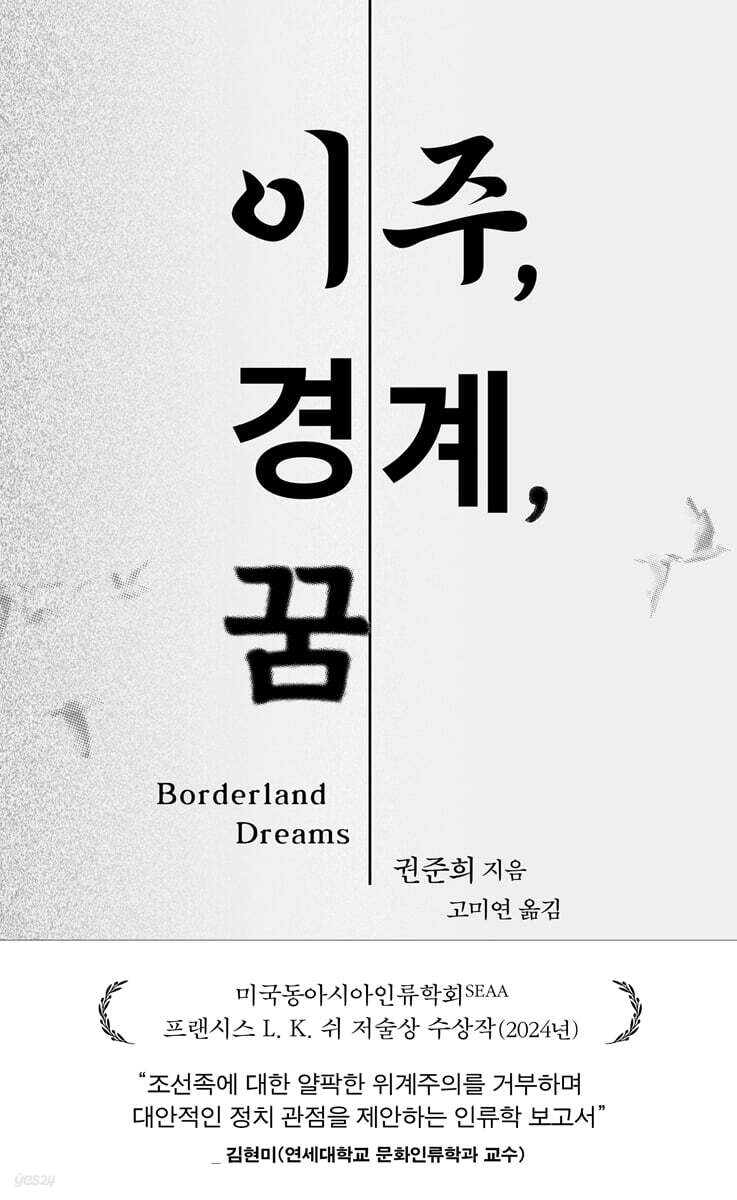
Migration, Borders, Dreams
 |
Description
Book Introduction
Between the Korean Dream and the Chinese Dream,
Following the trajectory of collective aspirations
The East Asian Anthropology Association of America (SEAA) Francis L.
K. Shih Literary Award Winner (2024)
A book exploring the complex migration paths and unique rhythms of life of the Joseonjok people has been published.
"Immigration, Borders, Dreams" follows the trajectory of the "Korean Wind" that swept through the Korean community and Yanbian in the early 1990s, and takes an in-depth look at the lives of migrant workers through the anthropological lens of body, money, and time.
This book, written by Kwon Jun-hee, a cultural anthropologist and professor at California State University, was published by Duke University Press in the United States, and was presented by Francis L.
K. Shih received the Shih Award for his academic achievements.
This book, consisting of three parts, is based on anthropological research conducted in Yanbian over a period of twelve years from 2004 to 2016.
This book, written over a period of seven years and published in the United States in 2023 and in Korea in 2025, presents the essence of 'writing through time difference.'
Through the format of “talking again here and now, across time,” the author leads readers on a journey of rereading, re-questioning, and re-thinking the story of the “close yet distant” Joseonjok from the perspective of 2025.
Furthermore, through the 'life on the border' where ethnicity, nationality, class, and gender are intertwined, it makes us reflect on the structure of boundary setting, discrimination, and exclusion in our society.
Following the trajectory of collective aspirations
The East Asian Anthropology Association of America (SEAA) Francis L.
K. Shih Literary Award Winner (2024)
A book exploring the complex migration paths and unique rhythms of life of the Joseonjok people has been published.
"Immigration, Borders, Dreams" follows the trajectory of the "Korean Wind" that swept through the Korean community and Yanbian in the early 1990s, and takes an in-depth look at the lives of migrant workers through the anthropological lens of body, money, and time.
This book, written by Kwon Jun-hee, a cultural anthropologist and professor at California State University, was published by Duke University Press in the United States, and was presented by Francis L.
K. Shih received the Shih Award for his academic achievements.
This book, consisting of three parts, is based on anthropological research conducted in Yanbian over a period of twelve years from 2004 to 2016.
This book, written over a period of seven years and published in the United States in 2023 and in Korea in 2025, presents the essence of 'writing through time difference.'
Through the format of “talking again here and now, across time,” the author leads readers on a journey of rereading, re-questioning, and re-thinking the story of the “close yet distant” Joseonjok from the perspective of 2025.
Furthermore, through the 'life on the border' where ethnicity, nationality, class, and gender are intertwined, it makes us reflect on the structure of boundary setting, discrimination, and exclusion in our society.
- You can preview some of the book's contents.
Preview
index
Preface to the Korean edition
Opening Remarks | The Wind of Migration
Part 1: The Rise of the Korean Dream
Chapter 1: Border Areas of Ethnic Minorities
Chapter 2: Cold or Welcoming Homeland
Part 2: Unstable Dreams
Chapter 3: The Rhythm of Free Movement
Chapter 4: The Labor of Waiting
Part 3: A New Dream
Chapter 5: Departure and Stay
Chapter 6 Break the Chain of Migration!
Closing Remarks | After the Korean Dream
Acknowledgements
main
References
Search
Opening Remarks | The Wind of Migration
Part 1: The Rise of the Korean Dream
Chapter 1: Border Areas of Ethnic Minorities
Chapter 2: Cold or Welcoming Homeland
Part 2: Unstable Dreams
Chapter 3: The Rhythm of Free Movement
Chapter 4: The Labor of Waiting
Part 3: A New Dream
Chapter 5: Departure and Stay
Chapter 6 Break the Chain of Migration!
Closing Remarks | After the Korean Dream
Acknowledgements
main
References
Search
Detailed image

Into the book
This book interprets the Korean Dream, which has spread and been realized widely in the Korean community and the Yanbian region over the past 30 years, and reports on the collective migration aspirations of the Korean people toward their homeland, South Korea, which has long been considered an "enemy country."
As the saying goes, “Everyone who can walk has gone to Korea” or “When two people get together, they start talking about Korea,” the Korean wind has been blowing everywhere in Yanbian for the past 30 years.
The Korean wind has been recalled and has become a standard for action in various contexts, such as financial success and failure, fake or real marriages, new apartments and new businesses, and the revival or fall of a family.
The Korean wind has been analyzed and disseminated through newspapers, academic journals, literary works, blogs, and even everyday conversations.
These discussions projected aspirations, longings, and pride.
But at the same time, concerns and criticisms about the sudden affluence brought by the Korean Wave, the spread of materialism, and the collapse of the Korean community and traditional family structure quickly spread throughout Yanbian society.
--- From "Opening Note | The Wind of Migration"
The history of Yanbian settlers is also intertwined with the way in which Han Chinese and Korean Chinese are ethnically distinguished.
During a short trip to the countryside in Yanbian, I heard stories about this from my Korean friends.
They said, "While the Joseonjok build their houses around a shabby fence of cypress trees, the Han Chinese gradually expand their house sites by building brick walls every year."
These oral stories about ethnicity show that the Joseonjok were ready to leave at any time, while the Han Chinese planned to stay in one place for a long time.
In fact, many ethnic Koreans in their 80s and older recalled constantly moving throughout the Northeast, relying on their kinship and personal connections to find better farmland.
--- From "Chapter 1: Border Areas of Ethnic Minorities"
The South Korean government's visa policy is not only complex, but also frequently changes in response to changes in the government's stance on migrant workers and overseas Koreans.
I've often been amazed at how knowledgeable Koreans are about Korean visa policies and how quickly they adjust their plans to accommodate changes.
The story told by Mr. Jiran in Chapter 1 clearly illustrates the visa-based kinship economy.
Jiran was born in 1984, the daughter of a farmer in a village in the border region of Yanbian.
Although her parents were relatively wealthy compared to other farmers, the money they earned from farming alone was not enough to cover their daughter's tuition at Yanbian University and living expenses.
My father, trying to ease his financial burden, tried to go to Korea through a broker, but his visa applications were repeatedly rejected for several years.
Jiran had a cousin who was married to a Korean man, and she could invite up to four people to Korea.
After my cousin invited her parents, there were two seats left, and a small fight broke out between my father and his brothers over these seats.
Two years ago, when Jiran was telling her story, her cousin's younger brother returned to China, and the vacancy was filled by Jiran's father.
--- From "Chapter 2: Cold or Welcoming Homeland"
I often heard from other ethnic Koreans who had returned from Korea about the inequality in income and expenditure in Yanbian.
In Yanbian, there was consumption resulting from ‘excessive free time’, or ‘excessive daily life’.
Money was earned in Korea but consumed in Yanbian, creating a distinct geographical separation between production and consumption.
Contrary to Marx's assertion that "when I am not working, I am at home, and when I am working, I am at home, as uncomfortable as if I were away from home" (Marx 1988, 74), the Koreans who returned from Korea did not feel as free in their free time in Yanbian as the Koreans who had become well-off without going to Korea.
They were not working and had difficulty spending free time in Yanbian.
The ethnic Koreans who returned from Korea longed for the cozy atmosphere of Yanbian, where they lived a lonely life of 'just working', but the cost of 'excessive daily life' in Yanbian became an economic and emotional burden.
Ok-sun's friends and relatives, believing she had made a lot of money in Korea, often invited her to meals and parties, expecting her to spend generously.
For Ok-sun, these expectations became another burden.
“Just because you’re invited once doesn’t mean it’s over.
“Once you start accepting all the invitations, there will be too much to do here and there.” This ‘excessive daily routine’ has caused fatigue among the ethnic Koreans who have returned from Korea, so they said they want to return to Korea and focus on their work.
In Korea, it was possible to live on a stable income without the burden of maintaining social networks.
Ok-sun and other ethnic Korean immigrants were accustomed to living as working individuals rather than as part of extensive and costly social networks.
Also, after I got used to the 'work-only' rhythm in Korea, it became harder to adjust to the rhythm of Yanbian.
In this way, life was divided into Yanbian as a space for consumption and Korea as a place for labor according to the '1-3-2 rhythm'.
--- From "Chapter 3: Rhythm of Free Movement"
This chapter focuses on the stories of couples living apart in Korea and Yanbian, examining how they interdepend on each other in their lives across borders and how various layers of waiting intersect in the process.
Loretta Baldassar and Laura Merla (2013) proposed the concept of ‘circles of care’ as a new perspective to understand the connectedness of people on the move.
The increasingly common practice of "crossing borders, moving and joining together" international migrant families has developed a variety of ways to exchange care in an asymmetrical yet reciprocal manner.
This functions as a kind of economic activity that waits for and takes responsibility for family members who are staying abroad and moving, and they try to remain as “one family despite the distance” even in the face of the difficulties of absence and separation (Baldassar and Merla 2013, 40).
Furthermore, we focus on the vulnerabilities experienced by international migrant families, particularly the rise in divorce and shifting gender dynamics between couples, in addition to these cycles of connectivity and care.
Unlike when a couple waits for and cares for their parents, children, or other family members, married couples aim to take on the project of joint financial and emotional care.
As the saying goes, "Where money goes, there is love," a common one in Yanbian, patience is the force that enables remittances to continue and creates the basis for returning to China.
While 'properly waiting' for remittances and the return of a spouse, close relationships are maintained while sharing this waiting time and increasing the likelihood of a financially stable life in the future.
But as the story goes, waiting can sometimes lead to betrayal and heighten anxiety.
Additionally, gendered roles and long-term separation can lead to instability in marital relationships.
--- From "Chapter 4: The Labor of Waiting"
When I first visited Yanbian in 2006, I got the impression that Yanbian was actually quite lively, contrary to its image in “I Went to All the Yanbian Popular Songs.”
The “three major industries” of Yanbian, which President Wang had previously mentioned as a joke, were bustling with customers.
Young people were criticized for eating out and spending money "like water" thanks to "emergency funds" sent from their parents in Korea, yet there was an expectation that they should treat themselves to dinner.
Complaints were also raised that young ethnic Koreans were slacking off on their work and not properly preparing for the future because of the 'Korean money', and this spending behavior was seen as a headache for employers in Yanbian.
There was also a widespread perception in China that ethnic Koreans in China were reluctant to work properly because they could not earn as much as they did in Korea.
David Fitzgerald points out a dual labor market, where people apply their experiences in one labor market to other labor markets (Fitzgerald 2009).
President Cho, whom I met in Yanbian and became friends with, was keenly aware of this dual labor market problem.
--- From "Chapter 5: Departure and Stay"
After completing 18 months of field research starting in 2008, I visited Yanbian again in 2011, 2013, and 2016 for follow-up research.
When I arrived in Yanji in the summer of 2011, the first thing I noticed was how much the city had changed in the past year and a half.
It had a more organized impression, and there were many tall buildings.
Looking out the window of a taxi heading from the airport on the outskirts of Yanji to the city center, construction sites in progress were visible everywhere.
New roads were being paved, major arterial roads were being widened, and the bridges linking the north and south of the city were undergoing renovation.
Construction vehicles and the surge in private cars caused traffic congestion.
In particular, with Yanji Station being incorporated into the high-speed rail network connecting Changchun and Beijing (the line was completed in 2019), the construction, renovation, and expansion of infrastructure have fundamentally changed the urban and rural landscapes.
Since the opening of the high-speed train, the travel time from Yanji to Changchun has been significantly shortened from seven and a half hours to two hours, and from twenty-three hours to nine hours to Beijing.
The ethnic Korean immigrants I met over a long period of time often confided that they felt confused by the rapid changes in Yanbian.
--- From "Chapter 6: Break the Chain of Migration!"
For the past 30 years, the Korean Dream has been the dominant dream of Yanbian's ethnic Koreans, but its strength has gradually weakened as it competes with the newly emerging Chinese Dream.
The dreams of crossing each other have deep roots and appear in various forms.
Since the late 19th century, Koreans have been crossing borders, dreaming of escaping poverty by reclaiming wasteland through rice farming in border regions where China, Joseon, Russia, and Japan were competing for dominance.
In the 1940s, a significant number of Korean immigrant farmers actively participated in the communist revolution in northeastern China, and as a result, the Koreans were recognized by the Chinese Communist Party as an ethnic minority group within China, enjoying autonomy in government, education, language, and media.
The communist revolution allowed Koreans to acquire farmland in China, but at the same time, their lives were confined to the border region of the autonomous prefecture of Yanbian.
However, since China's reform and opening-up policy in the 1980s, ethnic Koreans in China have been connected to the outside world, starting from major cities in China to North Korea, the Soviet Union, South Korea, Japan, and the United States, and as a result, have experienced several waves of migration.
The dreams of "leaving in search of a better life" and "development through migration" were constantly negotiated and realized within the geographical location of the border region bordering China, Russia, and North Korea, the ethnic relations between Chinese and Koreans, and the overlapping ideological conditions of the intersection of socialism and capitalism.
While these dreams have indeed brought economically better lives to countless ethnic Koreans, others have been betrayed by them, or have suffered from the constant instability of life between migration and development, love and money, family and work.
As the saying goes, “Everyone who can walk has gone to Korea” or “When two people get together, they start talking about Korea,” the Korean wind has been blowing everywhere in Yanbian for the past 30 years.
The Korean wind has been recalled and has become a standard for action in various contexts, such as financial success and failure, fake or real marriages, new apartments and new businesses, and the revival or fall of a family.
The Korean wind has been analyzed and disseminated through newspapers, academic journals, literary works, blogs, and even everyday conversations.
These discussions projected aspirations, longings, and pride.
But at the same time, concerns and criticisms about the sudden affluence brought by the Korean Wave, the spread of materialism, and the collapse of the Korean community and traditional family structure quickly spread throughout Yanbian society.
--- From "Opening Note | The Wind of Migration"
The history of Yanbian settlers is also intertwined with the way in which Han Chinese and Korean Chinese are ethnically distinguished.
During a short trip to the countryside in Yanbian, I heard stories about this from my Korean friends.
They said, "While the Joseonjok build their houses around a shabby fence of cypress trees, the Han Chinese gradually expand their house sites by building brick walls every year."
These oral stories about ethnicity show that the Joseonjok were ready to leave at any time, while the Han Chinese planned to stay in one place for a long time.
In fact, many ethnic Koreans in their 80s and older recalled constantly moving throughout the Northeast, relying on their kinship and personal connections to find better farmland.
--- From "Chapter 1: Border Areas of Ethnic Minorities"
The South Korean government's visa policy is not only complex, but also frequently changes in response to changes in the government's stance on migrant workers and overseas Koreans.
I've often been amazed at how knowledgeable Koreans are about Korean visa policies and how quickly they adjust their plans to accommodate changes.
The story told by Mr. Jiran in Chapter 1 clearly illustrates the visa-based kinship economy.
Jiran was born in 1984, the daughter of a farmer in a village in the border region of Yanbian.
Although her parents were relatively wealthy compared to other farmers, the money they earned from farming alone was not enough to cover their daughter's tuition at Yanbian University and living expenses.
My father, trying to ease his financial burden, tried to go to Korea through a broker, but his visa applications were repeatedly rejected for several years.
Jiran had a cousin who was married to a Korean man, and she could invite up to four people to Korea.
After my cousin invited her parents, there were two seats left, and a small fight broke out between my father and his brothers over these seats.
Two years ago, when Jiran was telling her story, her cousin's younger brother returned to China, and the vacancy was filled by Jiran's father.
--- From "Chapter 2: Cold or Welcoming Homeland"
I often heard from other ethnic Koreans who had returned from Korea about the inequality in income and expenditure in Yanbian.
In Yanbian, there was consumption resulting from ‘excessive free time’, or ‘excessive daily life’.
Money was earned in Korea but consumed in Yanbian, creating a distinct geographical separation between production and consumption.
Contrary to Marx's assertion that "when I am not working, I am at home, and when I am working, I am at home, as uncomfortable as if I were away from home" (Marx 1988, 74), the Koreans who returned from Korea did not feel as free in their free time in Yanbian as the Koreans who had become well-off without going to Korea.
They were not working and had difficulty spending free time in Yanbian.
The ethnic Koreans who returned from Korea longed for the cozy atmosphere of Yanbian, where they lived a lonely life of 'just working', but the cost of 'excessive daily life' in Yanbian became an economic and emotional burden.
Ok-sun's friends and relatives, believing she had made a lot of money in Korea, often invited her to meals and parties, expecting her to spend generously.
For Ok-sun, these expectations became another burden.
“Just because you’re invited once doesn’t mean it’s over.
“Once you start accepting all the invitations, there will be too much to do here and there.” This ‘excessive daily routine’ has caused fatigue among the ethnic Koreans who have returned from Korea, so they said they want to return to Korea and focus on their work.
In Korea, it was possible to live on a stable income without the burden of maintaining social networks.
Ok-sun and other ethnic Korean immigrants were accustomed to living as working individuals rather than as part of extensive and costly social networks.
Also, after I got used to the 'work-only' rhythm in Korea, it became harder to adjust to the rhythm of Yanbian.
In this way, life was divided into Yanbian as a space for consumption and Korea as a place for labor according to the '1-3-2 rhythm'.
--- From "Chapter 3: Rhythm of Free Movement"
This chapter focuses on the stories of couples living apart in Korea and Yanbian, examining how they interdepend on each other in their lives across borders and how various layers of waiting intersect in the process.
Loretta Baldassar and Laura Merla (2013) proposed the concept of ‘circles of care’ as a new perspective to understand the connectedness of people on the move.
The increasingly common practice of "crossing borders, moving and joining together" international migrant families has developed a variety of ways to exchange care in an asymmetrical yet reciprocal manner.
This functions as a kind of economic activity that waits for and takes responsibility for family members who are staying abroad and moving, and they try to remain as “one family despite the distance” even in the face of the difficulties of absence and separation (Baldassar and Merla 2013, 40).
Furthermore, we focus on the vulnerabilities experienced by international migrant families, particularly the rise in divorce and shifting gender dynamics between couples, in addition to these cycles of connectivity and care.
Unlike when a couple waits for and cares for their parents, children, or other family members, married couples aim to take on the project of joint financial and emotional care.
As the saying goes, "Where money goes, there is love," a common one in Yanbian, patience is the force that enables remittances to continue and creates the basis for returning to China.
While 'properly waiting' for remittances and the return of a spouse, close relationships are maintained while sharing this waiting time and increasing the likelihood of a financially stable life in the future.
But as the story goes, waiting can sometimes lead to betrayal and heighten anxiety.
Additionally, gendered roles and long-term separation can lead to instability in marital relationships.
--- From "Chapter 4: The Labor of Waiting"
When I first visited Yanbian in 2006, I got the impression that Yanbian was actually quite lively, contrary to its image in “I Went to All the Yanbian Popular Songs.”
The “three major industries” of Yanbian, which President Wang had previously mentioned as a joke, were bustling with customers.
Young people were criticized for eating out and spending money "like water" thanks to "emergency funds" sent from their parents in Korea, yet there was an expectation that they should treat themselves to dinner.
Complaints were also raised that young ethnic Koreans were slacking off on their work and not properly preparing for the future because of the 'Korean money', and this spending behavior was seen as a headache for employers in Yanbian.
There was also a widespread perception in China that ethnic Koreans in China were reluctant to work properly because they could not earn as much as they did in Korea.
David Fitzgerald points out a dual labor market, where people apply their experiences in one labor market to other labor markets (Fitzgerald 2009).
President Cho, whom I met in Yanbian and became friends with, was keenly aware of this dual labor market problem.
--- From "Chapter 5: Departure and Stay"
After completing 18 months of field research starting in 2008, I visited Yanbian again in 2011, 2013, and 2016 for follow-up research.
When I arrived in Yanji in the summer of 2011, the first thing I noticed was how much the city had changed in the past year and a half.
It had a more organized impression, and there were many tall buildings.
Looking out the window of a taxi heading from the airport on the outskirts of Yanji to the city center, construction sites in progress were visible everywhere.
New roads were being paved, major arterial roads were being widened, and the bridges linking the north and south of the city were undergoing renovation.
Construction vehicles and the surge in private cars caused traffic congestion.
In particular, with Yanji Station being incorporated into the high-speed rail network connecting Changchun and Beijing (the line was completed in 2019), the construction, renovation, and expansion of infrastructure have fundamentally changed the urban and rural landscapes.
Since the opening of the high-speed train, the travel time from Yanji to Changchun has been significantly shortened from seven and a half hours to two hours, and from twenty-three hours to nine hours to Beijing.
The ethnic Korean immigrants I met over a long period of time often confided that they felt confused by the rapid changes in Yanbian.
--- From "Chapter 6: Break the Chain of Migration!"
For the past 30 years, the Korean Dream has been the dominant dream of Yanbian's ethnic Koreans, but its strength has gradually weakened as it competes with the newly emerging Chinese Dream.
The dreams of crossing each other have deep roots and appear in various forms.
Since the late 19th century, Koreans have been crossing borders, dreaming of escaping poverty by reclaiming wasteland through rice farming in border regions where China, Joseon, Russia, and Japan were competing for dominance.
In the 1940s, a significant number of Korean immigrant farmers actively participated in the communist revolution in northeastern China, and as a result, the Koreans were recognized by the Chinese Communist Party as an ethnic minority group within China, enjoying autonomy in government, education, language, and media.
The communist revolution allowed Koreans to acquire farmland in China, but at the same time, their lives were confined to the border region of the autonomous prefecture of Yanbian.
However, since China's reform and opening-up policy in the 1980s, ethnic Koreans in China have been connected to the outside world, starting from major cities in China to North Korea, the Soviet Union, South Korea, Japan, and the United States, and as a result, have experienced several waves of migration.
The dreams of "leaving in search of a better life" and "development through migration" were constantly negotiated and realized within the geographical location of the border region bordering China, Russia, and North Korea, the ethnic relations between Chinese and Koreans, and the overlapping ideological conditions of the intersection of socialism and capitalism.
While these dreams have indeed brought economically better lives to countless ethnic Koreans, others have been betrayed by them, or have suffered from the constant instability of life between migration and development, love and money, family and work.
--- From "Closing Notes | After the Korean Dream"
Publisher's Review
The East Asian Anthropology Association of America (SEAA) Francis L.
K. Shih Literary Award Winner (2024)
Recommended by Kim Hyun-mi (Professor of Cultural Anthropology, Yonsei University)
Koreans of China crossing the border on the 'Korean Wind'
12 years of research by cultural anthropologists
People crossed the border.
It all started in the late 19th century when Koreans fled poverty across the Tumen River and settled in Yanbian.
They were officially recognized as an ethnic minority called the 'Joseonjok' by the Chinese government in 1949.
After receiving socialist education and Chinese-style socialization, he became a Chinese citizen.
During the Cold War, ties with Korea were severed, but in 1992, when Korea and China normalized diplomatic relations, they were recognized as "overseas Koreans" by the Korean government.
Afterwards, they entered Korean society and became a representative group of migrant workers pursuing the 'Korean dream'.
The migration route of the Joseonjok can be summarized in these few lines.
But is that all there is to it? Kwon Jun-hee, a cultural anthropologist and professor at California State University, says, "No."
Here, a book exploring the complex migration paths and unique rhythms of life of the Joseonjok has been published.
"Immigration, Borders, Dreams" follows the trajectory of the "Korean Wind" that swept through the Korean community and Yanbian in the early 1990s, and takes an in-depth look at the lives of migrant workers through the anthropological lens of body, money, and time.
This book, which explores the geopolitical significance of Yanbian as a frontier region caught between diverse desires, focusing on the intersection of South Korea's neoliberal democratization and China's rapid privatization and the new political and economic intertwining, was published by Duke University Press in the United States and won the Francis L.
He was recognized for his academic value by receiving the K. Shih Writing Award.
This book, consisting of three parts, is based on anthropological research conducted in Yanbian over a period of twelve years from 2004 to 2016.
This book, written over a period of seven years and published in the United States in 2023 and in Korea in 2025, presents the essence of 'writing through time difference.'
Through the format of “transcending time differences and speaking again here and now,” Kwon Jun-hee leads readers on a journey of rereading, re-questioning, and re-thinking the story of the “close yet distant” Joseonjok from the perspective of 2025.
Reading through ethnography
The Rise and Fall of the Korean Dream and Beyond
Ethnography is not simply field research.
It refers to an anthropological research method that involves spending a long time with research subjects in the field to deeply understand their perspectives, language, and daily rhythms.
This method of 'slowly' capturing the scene and 'lately' introducing the results to the world inevitably adopts 'time difference writing'.
Ethnography, which contains not only the time lag between the time of research and the time of publication, but also the time lag between hearing and writing, the time lag between the speaker and the recorder, and even the time lag between what was said and the emotions and context that existed at that moment but were not said, is bound to always be “incomplete” (p. 16).
But some phenomena are not left to remain in the past.
It constantly brings up past stories and persistently asks questions again.
The starting point of the research was meeting ethnic Korean workers at Uiju Church in Hongje-dong, Seoul in the summer of 2004 (p. 104).
At the time, there were about 60 ethnic Koreans living here who were at risk of being forcibly deported as 'illegal residents'.
These people, who were excluded from the category of "overseas Koreans" under the "Overseas Koreans Act" enacted by the Korean government in 1999 on the grounds that they were citizens of socialist China, were living together in churches as the protests for the revision were prolonged.
Having witnessed the suffering faced by ethnic Korean immigrants in their "homeland," the author embarked on a study of their complex lives, traveling across Korea and China "just as much as the ethnic Korean immigrants themselves."
We closely follow the lives of ethnic Koreans who immigrated to Korean society as laborers, but who now have a legal and cultural status distinct from that of other foreign workers.
“Immigration, Borders, Dreams” is the result of a process of “continuously listening and rewriting.”
Drawing on participant observation, interviews, and long-term field experience, the author reinterprets the life histories of ethnic Korean immigrants in Yanbian, their aspirations and frustrations, and the meaning of boundaries and displacement.
This book depicts the origins, growth, and decline of the "Korean Dream," a wave of mass migration to Korea, and how each individual's "dream" is reconstructed in the process, using a unique perspective called "The Life History of Dreams."
This study examines how the dreams of "leaving in search of a better life" and "development through migration" were constantly negotiated and realized within the geographical location of the border region bordering China, Russia, and North Korea, the ethnic relations between Chinese and Koreans, and the overlapping ideological conditions of socialism and capitalism.
Furthermore, it reveals that the migration of ethnic Koreans goes beyond international movement and is a complex practice that crosses multilayered boundaries such as rural and urban, periphery and center, education and labor, family and capital.
One sunny day in June 2009, I climbed a mountain with members of a Korean mountaineering group.
Hiking groups with diverse members were a great opportunity for me, a researcher, to experience the daily rhythm of the Joseonjok people.
That day we headed to Ilgwangsan Mountain.
As I climbed to the top and looked out, I saw the Tumen River, which served as a natural border between China and North Korea, forming a long belt. It was a moment when the characteristics of Yanbian as a border region came to life.
The remote, small towns in North Korea were sparsely populated, impoverished, and seemingly run-down, while the Chinese side, with its well-organized farmland and villages, presented a stark contrast.
The members of the hiking club, who were mostly middle-class, told stories of how their relatives crossed the Tumen River and came to Yanbian in the past, and how they lived with relatives in both North and South Korea.
He also emphasized the pride he felt as a Chinese citizen in China's global rise and the economic achievements of Chinese-style socialism. (p. 57)
From the beginning of crossing borders to the rise of new dreams
A Broader Understanding of the History of Korean-Chinese Migration
The book, consisting of three parts and six chapters, is filled with extensive records and analyses of the migration history of the Joseonjok.
Part 1, "The Rise of the Korean Dream," introduces Yanbian as a border region for ethnic minorities and a space where diverse desires intersect, and examines the historical process by which the Joseonjok, a migratory people, encountered Korea (p. 59).
In particular, it examines the significance of the encounter between the long-separated "homeland" and the Korean-Chinese people, describing the cultural, political, and legal processes that shaped them into a unique group of migrant workers traveling between China and Korea.
They argue that the Korean labor market has discovered and expanded their value as a special labor force by taking advantage of the special “ethnic relationship”—the diaspora status of the Joseonjok, who are ethnically “Korean” but not “Korean citizens” in South Korea (p. 47).
It focuses on how the ethnic values held by ethnic Koreans in China have established themselves as a suitable workforce for specific Korean service industries, and examines the dual nature of their acceptance as cheap and capable workers while simultaneously being treated coldly due to legal restrictions and social discrimination (p. 90).
It illuminates how the concept of "kinship," which was a reason for political persecution during the Cultural Revolution, transformed into a means of immigration to Korea (p. 92).
“We were so happy to learn that my husband’s cousin lives in Korea.
I felt like I had won the lottery, knowing that I would be invited to Korea.
But when they actually decided to invite us, they asked us to pay for the visa application.
They're asking for $5,000.
It was a lot of money in the early 1990s.
Still, I paid my cousin that amount because it seemed like a better deal than going through an illegal broker.
After I came to Korea, I had no further contact with that cousin.
Maybe it's because we've been living apart for so long, but we can't seem to get close in Korea.
“Because the relationship had already been severed before June 25.” (p. 94)
Part 2, "Unstable Dreams," analyzes the hope and frustration, prosperity and decline, mobility and immobility that exist within the volatility of the Korean dream through the anthropological lens of body, money, and time.
Centering on the stories of three female Korean workers, the argument develops by focusing on the spatial divisions created by repeated migration: Korea as a place to ‘earn’ money, and Yanbian as a place to ‘spend’ money (p. 125).
Under the H-2 visa system, which was designed as a kind of amnesty measure for undocumented Koreans of China with the revision of the Overseas Koreans Act, we examine the unique temporality formed by the life of traveling between Korea and China in a '1-3-2' rhythm (a structure in which one stays in China for one year before working in Korea on a five-year visa, returns, works in Korea for three years, and then re-enters the country to work for two years) (p. 123).
The stories of these Korean women reveal how their bodies, working at the intersection of the rhythms of migration, the power of Korean money, and gender and ethnicity, have become agents of international migration, moving between highly gendered workplaces (South Korea) and gendered homes (Yanbian).
Furthermore, it views ‘waiting’ as a form of labor and argues that immobility is also a key driving force behind migration (p. 159).
By introducing the lives of those who remain in Yanbian, waiting for the return of their loved ones, waiting for remittances from them, and waiting for the opportunity to go to Korea, the author emphasizes that the process of repeated migration itself cannot be sustained without those who do not migrate.
Mr. Ho: I started drinking because I was so lonely after my wife went to Korea 10 years ago.
I drank it almost every day.
There are too many lonely 'botori' people in Yanbian.
What else can I do? There's no one waiting for me when I get home.
Hiker 1: (Envious) But doesn't your wife send you regular remittances? How many houses do you own now? Two or three?
Hiker 2: These days, if I'm not divorced, I have one or two houses, my children are growing up well, and my remittances keep coming in, I'm happy.
Mr. Ho: Everyone is right.
But waiting for your wife for over 10 years is not easy.
I would be happy if he would just come back.
(Laughing) They just believe that if you send money from Korea to China, the love will still be there. (Page 156)
Part 3, “A New Dream,” reexamines and reassesses the Korean Dream in light of the rise of the Chinese economy.
It focuses on the aspirations and hesitations surrounding ‘staying in Yanbian’ and ‘leaving Yanbian’ that are revealed in the way Koreans and Han Chinese approach the Korean Dream (p. 190).
Through this, we capture the process of redefining interethnic relations and the desire for international migration generated by remittance-driven economic development in Yanbian.
It discusses how China's growing economic influence since the 2008 financial crisis has led many ethnic Koreans of Chinese descent to pursue the "China Dream."
It also focuses on the reevaluation of the Korean wind that is being circulated in the Yanbian region, and records the emotions of hope, frustration, anxiety, and regret that emerge in the subsequent context (p. 226).
The following 'Closing Notes' examines the process by which the Korean Dream, which has persisted for over 30 years, gradually loses its dominant position and sheds light on 'life afterward.'
Beyond the unified and simplified dreams of "nation" like the Korean Dream or the China Dream, we see the rise of a new generation seeking new paths in life.
These days, I feel embarrassed about working in Korea.
When I tell my friends that I'm going to Korea again, they respond with, "Are you still going to Korea?" and "Why?"
I feel ignored.
So these days, they just say they're going to southern China, Shenzhen or Guangdong to do business.
I don't want to say exactly what I do in Korea.
So to speak, it's a secret coming and going.
I didn't go to school much and I don't have any special skills.
One body is all there is.
So, as a Korean-Chinese, all I can do in Korea is simple physical labor.
(Omitted) But even if I return to Yanbian, there is no way.
When I run out of money, I have to go back to Korea. (Page 258)
A dream at the border
What it tells us
“Immigration, Borders, Dreams” is also a study of Yanbian.
Yanbian is a Korean Autonomous Prefecture and a border region for ethnic minorities, where the priority of the Korean people and the use of the Korean language are universally recognized. It is a dynamic space where divergent dreams intersect and compete, and a place where the rhythm of life and the flow of money have taken on a transnational aspect amid the structural changes brought about by the Korean wave over the past 30 years.
It is not just a place name, but a ‘space’ and a ‘person’ at the same time, a ‘starting point’ and ‘another possibility’.
Through this book, readers can encounter Yanbian not as a monotonous and fixed image, but as a living space that constantly changes and reconstructs itself, creating new boundaries and relationships.
Furthermore, this book goes beyond the Korean Dream of the Joseonjok, the regional identity of Yanbian, and the ethnic background of the Joseonjok, and provides crucial insights into the reality of migrant labor and international mobility that spreads throughout the world today.
Beginning with the case of the Joseonjok, we examine how the dream of migration is born and reconstructed.
“It opens new horizons in migration studies, going beyond the existing North American and European-centered studies,” said Francis L.
K. Shi's review of the award supports this.
This book is particularly special to readers in Korean society.
As the author's book, written in English, was translated back into his native Korean, he found the land of Korea, which is an important spatial background for the book.
However, this does not mean that we should “stop hating Joseonjok.”
Through anthropological research exploring the life paths of ethnic Korean immigrants, we uncover the social, political, and economic structures intertwined in their identities, movements, and experiences, and analyze the multi-layered issues facing immigrants and Korean society.
Through the 'life on the border' where ethnicity, nationality, class, and gender are intertwined, it makes us reflect on the structure of boundary setting, discrimination, and exclusion in our society.
This book, which meticulously depicts the diverse "dream competition" experienced by ethnic Korean immigrants in the interstices of post-socialist China and post-Cold War Korea, appeals not only to researchers but also to a wide range of readers.
It reveals the complex layers of temporality and social boundaries hidden behind the familiar word 'migration', and asks how 'us' and 'others' are formed.
The story of ethnic Korean immigrants who crossed the border in search of a "better life" has reached Korean society after a long time.
Behind Chunja, another group of ethnic Korean women were waiting for their turn.
The manager was busy answering the office phone, which kept ringing with job inquiries.
As she left the employment agency, Chunja spoke in a dissatisfied tone about the director's attitude.
“The director pretends to be friendly on the outside, but in reality he ignores the Joseonjok people.
Look at what that guy is saying.
You think that Joseonjok only care about money.
Saying that we are inferior to Koreans.
“Do Koreans not like money?” Chunja described herself as a “good Korean-Chinese who works hard and doesn’t waste money,” but as we saw in our conversation, she was dissatisfied with the prejudice against Korean-Chinese at employment agencies and in the workplace.
At the same time, he did not try to avoid the stigma of being only after money, but instead asked the following question:
“We came here to make money, didn’t we?” (p. 138)
K. Shih Literary Award Winner (2024)
Recommended by Kim Hyun-mi (Professor of Cultural Anthropology, Yonsei University)
Koreans of China crossing the border on the 'Korean Wind'
12 years of research by cultural anthropologists
People crossed the border.
It all started in the late 19th century when Koreans fled poverty across the Tumen River and settled in Yanbian.
They were officially recognized as an ethnic minority called the 'Joseonjok' by the Chinese government in 1949.
After receiving socialist education and Chinese-style socialization, he became a Chinese citizen.
During the Cold War, ties with Korea were severed, but in 1992, when Korea and China normalized diplomatic relations, they were recognized as "overseas Koreans" by the Korean government.
Afterwards, they entered Korean society and became a representative group of migrant workers pursuing the 'Korean dream'.
The migration route of the Joseonjok can be summarized in these few lines.
But is that all there is to it? Kwon Jun-hee, a cultural anthropologist and professor at California State University, says, "No."
Here, a book exploring the complex migration paths and unique rhythms of life of the Joseonjok has been published.
"Immigration, Borders, Dreams" follows the trajectory of the "Korean Wind" that swept through the Korean community and Yanbian in the early 1990s, and takes an in-depth look at the lives of migrant workers through the anthropological lens of body, money, and time.
This book, which explores the geopolitical significance of Yanbian as a frontier region caught between diverse desires, focusing on the intersection of South Korea's neoliberal democratization and China's rapid privatization and the new political and economic intertwining, was published by Duke University Press in the United States and won the Francis L.
He was recognized for his academic value by receiving the K. Shih Writing Award.
This book, consisting of three parts, is based on anthropological research conducted in Yanbian over a period of twelve years from 2004 to 2016.
This book, written over a period of seven years and published in the United States in 2023 and in Korea in 2025, presents the essence of 'writing through time difference.'
Through the format of “transcending time differences and speaking again here and now,” Kwon Jun-hee leads readers on a journey of rereading, re-questioning, and re-thinking the story of the “close yet distant” Joseonjok from the perspective of 2025.
Reading through ethnography
The Rise and Fall of the Korean Dream and Beyond
Ethnography is not simply field research.
It refers to an anthropological research method that involves spending a long time with research subjects in the field to deeply understand their perspectives, language, and daily rhythms.
This method of 'slowly' capturing the scene and 'lately' introducing the results to the world inevitably adopts 'time difference writing'.
Ethnography, which contains not only the time lag between the time of research and the time of publication, but also the time lag between hearing and writing, the time lag between the speaker and the recorder, and even the time lag between what was said and the emotions and context that existed at that moment but were not said, is bound to always be “incomplete” (p. 16).
But some phenomena are not left to remain in the past.
It constantly brings up past stories and persistently asks questions again.
The starting point of the research was meeting ethnic Korean workers at Uiju Church in Hongje-dong, Seoul in the summer of 2004 (p. 104).
At the time, there were about 60 ethnic Koreans living here who were at risk of being forcibly deported as 'illegal residents'.
These people, who were excluded from the category of "overseas Koreans" under the "Overseas Koreans Act" enacted by the Korean government in 1999 on the grounds that they were citizens of socialist China, were living together in churches as the protests for the revision were prolonged.
Having witnessed the suffering faced by ethnic Korean immigrants in their "homeland," the author embarked on a study of their complex lives, traveling across Korea and China "just as much as the ethnic Korean immigrants themselves."
We closely follow the lives of ethnic Koreans who immigrated to Korean society as laborers, but who now have a legal and cultural status distinct from that of other foreign workers.
“Immigration, Borders, Dreams” is the result of a process of “continuously listening and rewriting.”
Drawing on participant observation, interviews, and long-term field experience, the author reinterprets the life histories of ethnic Korean immigrants in Yanbian, their aspirations and frustrations, and the meaning of boundaries and displacement.
This book depicts the origins, growth, and decline of the "Korean Dream," a wave of mass migration to Korea, and how each individual's "dream" is reconstructed in the process, using a unique perspective called "The Life History of Dreams."
This study examines how the dreams of "leaving in search of a better life" and "development through migration" were constantly negotiated and realized within the geographical location of the border region bordering China, Russia, and North Korea, the ethnic relations between Chinese and Koreans, and the overlapping ideological conditions of socialism and capitalism.
Furthermore, it reveals that the migration of ethnic Koreans goes beyond international movement and is a complex practice that crosses multilayered boundaries such as rural and urban, periphery and center, education and labor, family and capital.
One sunny day in June 2009, I climbed a mountain with members of a Korean mountaineering group.
Hiking groups with diverse members were a great opportunity for me, a researcher, to experience the daily rhythm of the Joseonjok people.
That day we headed to Ilgwangsan Mountain.
As I climbed to the top and looked out, I saw the Tumen River, which served as a natural border between China and North Korea, forming a long belt. It was a moment when the characteristics of Yanbian as a border region came to life.
The remote, small towns in North Korea were sparsely populated, impoverished, and seemingly run-down, while the Chinese side, with its well-organized farmland and villages, presented a stark contrast.
The members of the hiking club, who were mostly middle-class, told stories of how their relatives crossed the Tumen River and came to Yanbian in the past, and how they lived with relatives in both North and South Korea.
He also emphasized the pride he felt as a Chinese citizen in China's global rise and the economic achievements of Chinese-style socialism. (p. 57)
From the beginning of crossing borders to the rise of new dreams
A Broader Understanding of the History of Korean-Chinese Migration
The book, consisting of three parts and six chapters, is filled with extensive records and analyses of the migration history of the Joseonjok.
Part 1, "The Rise of the Korean Dream," introduces Yanbian as a border region for ethnic minorities and a space where diverse desires intersect, and examines the historical process by which the Joseonjok, a migratory people, encountered Korea (p. 59).
In particular, it examines the significance of the encounter between the long-separated "homeland" and the Korean-Chinese people, describing the cultural, political, and legal processes that shaped them into a unique group of migrant workers traveling between China and Korea.
They argue that the Korean labor market has discovered and expanded their value as a special labor force by taking advantage of the special “ethnic relationship”—the diaspora status of the Joseonjok, who are ethnically “Korean” but not “Korean citizens” in South Korea (p. 47).
It focuses on how the ethnic values held by ethnic Koreans in China have established themselves as a suitable workforce for specific Korean service industries, and examines the dual nature of their acceptance as cheap and capable workers while simultaneously being treated coldly due to legal restrictions and social discrimination (p. 90).
It illuminates how the concept of "kinship," which was a reason for political persecution during the Cultural Revolution, transformed into a means of immigration to Korea (p. 92).
“We were so happy to learn that my husband’s cousin lives in Korea.
I felt like I had won the lottery, knowing that I would be invited to Korea.
But when they actually decided to invite us, they asked us to pay for the visa application.
They're asking for $5,000.
It was a lot of money in the early 1990s.
Still, I paid my cousin that amount because it seemed like a better deal than going through an illegal broker.
After I came to Korea, I had no further contact with that cousin.
Maybe it's because we've been living apart for so long, but we can't seem to get close in Korea.
“Because the relationship had already been severed before June 25.” (p. 94)
Part 2, "Unstable Dreams," analyzes the hope and frustration, prosperity and decline, mobility and immobility that exist within the volatility of the Korean dream through the anthropological lens of body, money, and time.
Centering on the stories of three female Korean workers, the argument develops by focusing on the spatial divisions created by repeated migration: Korea as a place to ‘earn’ money, and Yanbian as a place to ‘spend’ money (p. 125).
Under the H-2 visa system, which was designed as a kind of amnesty measure for undocumented Koreans of China with the revision of the Overseas Koreans Act, we examine the unique temporality formed by the life of traveling between Korea and China in a '1-3-2' rhythm (a structure in which one stays in China for one year before working in Korea on a five-year visa, returns, works in Korea for three years, and then re-enters the country to work for two years) (p. 123).
The stories of these Korean women reveal how their bodies, working at the intersection of the rhythms of migration, the power of Korean money, and gender and ethnicity, have become agents of international migration, moving between highly gendered workplaces (South Korea) and gendered homes (Yanbian).
Furthermore, it views ‘waiting’ as a form of labor and argues that immobility is also a key driving force behind migration (p. 159).
By introducing the lives of those who remain in Yanbian, waiting for the return of their loved ones, waiting for remittances from them, and waiting for the opportunity to go to Korea, the author emphasizes that the process of repeated migration itself cannot be sustained without those who do not migrate.
Mr. Ho: I started drinking because I was so lonely after my wife went to Korea 10 years ago.
I drank it almost every day.
There are too many lonely 'botori' people in Yanbian.
What else can I do? There's no one waiting for me when I get home.
Hiker 1: (Envious) But doesn't your wife send you regular remittances? How many houses do you own now? Two or three?
Hiker 2: These days, if I'm not divorced, I have one or two houses, my children are growing up well, and my remittances keep coming in, I'm happy.
Mr. Ho: Everyone is right.
But waiting for your wife for over 10 years is not easy.
I would be happy if he would just come back.
(Laughing) They just believe that if you send money from Korea to China, the love will still be there. (Page 156)
Part 3, “A New Dream,” reexamines and reassesses the Korean Dream in light of the rise of the Chinese economy.
It focuses on the aspirations and hesitations surrounding ‘staying in Yanbian’ and ‘leaving Yanbian’ that are revealed in the way Koreans and Han Chinese approach the Korean Dream (p. 190).
Through this, we capture the process of redefining interethnic relations and the desire for international migration generated by remittance-driven economic development in Yanbian.
It discusses how China's growing economic influence since the 2008 financial crisis has led many ethnic Koreans of Chinese descent to pursue the "China Dream."
It also focuses on the reevaluation of the Korean wind that is being circulated in the Yanbian region, and records the emotions of hope, frustration, anxiety, and regret that emerge in the subsequent context (p. 226).
The following 'Closing Notes' examines the process by which the Korean Dream, which has persisted for over 30 years, gradually loses its dominant position and sheds light on 'life afterward.'
Beyond the unified and simplified dreams of "nation" like the Korean Dream or the China Dream, we see the rise of a new generation seeking new paths in life.
These days, I feel embarrassed about working in Korea.
When I tell my friends that I'm going to Korea again, they respond with, "Are you still going to Korea?" and "Why?"
I feel ignored.
So these days, they just say they're going to southern China, Shenzhen or Guangdong to do business.
I don't want to say exactly what I do in Korea.
So to speak, it's a secret coming and going.
I didn't go to school much and I don't have any special skills.
One body is all there is.
So, as a Korean-Chinese, all I can do in Korea is simple physical labor.
(Omitted) But even if I return to Yanbian, there is no way.
When I run out of money, I have to go back to Korea. (Page 258)
A dream at the border
What it tells us
“Immigration, Borders, Dreams” is also a study of Yanbian.
Yanbian is a Korean Autonomous Prefecture and a border region for ethnic minorities, where the priority of the Korean people and the use of the Korean language are universally recognized. It is a dynamic space where divergent dreams intersect and compete, and a place where the rhythm of life and the flow of money have taken on a transnational aspect amid the structural changes brought about by the Korean wave over the past 30 years.
It is not just a place name, but a ‘space’ and a ‘person’ at the same time, a ‘starting point’ and ‘another possibility’.
Through this book, readers can encounter Yanbian not as a monotonous and fixed image, but as a living space that constantly changes and reconstructs itself, creating new boundaries and relationships.
Furthermore, this book goes beyond the Korean Dream of the Joseonjok, the regional identity of Yanbian, and the ethnic background of the Joseonjok, and provides crucial insights into the reality of migrant labor and international mobility that spreads throughout the world today.
Beginning with the case of the Joseonjok, we examine how the dream of migration is born and reconstructed.
“It opens new horizons in migration studies, going beyond the existing North American and European-centered studies,” said Francis L.
K. Shi's review of the award supports this.
This book is particularly special to readers in Korean society.
As the author's book, written in English, was translated back into his native Korean, he found the land of Korea, which is an important spatial background for the book.
However, this does not mean that we should “stop hating Joseonjok.”
Through anthropological research exploring the life paths of ethnic Korean immigrants, we uncover the social, political, and economic structures intertwined in their identities, movements, and experiences, and analyze the multi-layered issues facing immigrants and Korean society.
Through the 'life on the border' where ethnicity, nationality, class, and gender are intertwined, it makes us reflect on the structure of boundary setting, discrimination, and exclusion in our society.
This book, which meticulously depicts the diverse "dream competition" experienced by ethnic Korean immigrants in the interstices of post-socialist China and post-Cold War Korea, appeals not only to researchers but also to a wide range of readers.
It reveals the complex layers of temporality and social boundaries hidden behind the familiar word 'migration', and asks how 'us' and 'others' are formed.
The story of ethnic Korean immigrants who crossed the border in search of a "better life" has reached Korean society after a long time.
Behind Chunja, another group of ethnic Korean women were waiting for their turn.
The manager was busy answering the office phone, which kept ringing with job inquiries.
As she left the employment agency, Chunja spoke in a dissatisfied tone about the director's attitude.
“The director pretends to be friendly on the outside, but in reality he ignores the Joseonjok people.
Look at what that guy is saying.
You think that Joseonjok only care about money.
Saying that we are inferior to Koreans.
“Do Koreans not like money?” Chunja described herself as a “good Korean-Chinese who works hard and doesn’t waste money,” but as we saw in our conversation, she was dissatisfied with the prejudice against Korean-Chinese at employment agencies and in the workplace.
At the same time, he did not try to avoid the stigma of being only after money, but instead asked the following question:
“We came here to make money, didn’t we?” (p. 138)
GOODS SPECIFICS
- Date of issue: September 10, 2025
- Page count, weight, size: 328 pages | 126*205*30mm
- ISBN13: 9791194880141
- ISBN10: 1194880142
You may also like
카테고리
korean


korean

![GQ KOREA Mark (Monthly): December [2025]](http://librairie.coreenne.fr/cdn/shop/files/8ef265dbbfbf186523ed75ba7319009d.jpg?v=1765340328&width=3840)


