

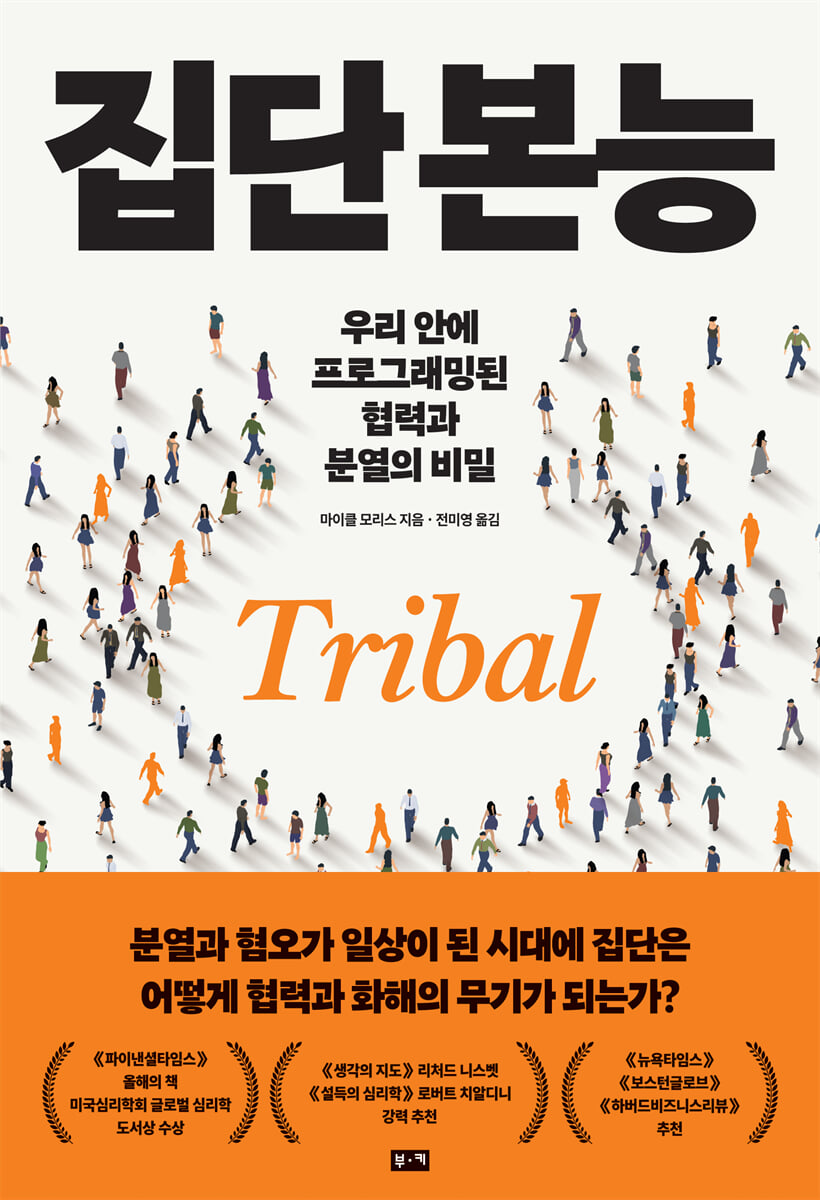
herd instinct
 |
Description
Book Introduction
“Homo sapiens survived not because of their brains being smart, but because of their brains being cooperative.”
The great ability programmed into us, the instinct of lack
Polarization and mutual distrust in today's politics are at an extreme.
Congress, having lost its ability to negotiate bipartisanly, has become chronically deadlocked, and both Democrats and Republicans routinely file lawsuits when they lose elections.
The collapse of the two-party system, including election fraud and legislative deadlock, raises concerns about the end of democracy.
Supporters of the two parties even differ in where they live, how they speak, what kind of music they like, what kind of car they own, what kind of food they enjoy, and even what brands of clothing they prefer.
Why have such extreme divisions, conflicts, hatred, and discrimination become so commonplace? Many experts point to "tribalism," a primal hostility toward other groups, as the root cause of all these problems.
But is this claim actually true? In this book, world-renowned cultural psychologist Professor Michael Morris proves, based on evolution and science, that this is not the case.
In doing so, it guides us to a whole new understanding of “tribe” and “tribalism.”
Neanderthals had straight spines like Homo sapiens, had brains the same size, and were stronger.
But a few thousand years after Homo sapiens spread to Europe, Neanderthals became extinct.
Why? Neanderthals fought and ate each other with neighboring clans.
Homo sapiens, on the other hand, traded and mated with them.
Although they were inferior in individual ability, they were superior in group ability.
It was thanks to the “tribal instinct” that Homo sapiens knew how to form groups based on trust and cooperation that they survived competition and eventually conquered the Earth.
Behind the miracles of Hiddink leading the Korean national soccer team to the World Cup semifinals, Lee Kuan Yew transforming Singapore, which was rife with corruption, into a developed country, and Satya Nadella rebuilding Microsoft and putting it at the top of the technology industry, the power of this tribal instinct was undoubtedly at work.
Contrary to popular belief, the tribal instinct is not a bug or weakness that leads us to division and hatred.
Rather, it is the characteristic of our species that has made evolutionary ascent possible, the driving force behind many of our greatest achievements even today, and the formidable ability to create our own unique culture.
When we rediscover this fact, the tribal instinct will become the solution that will save humanity from hatred and hostility.
The great ability programmed into us, the instinct of lack
Polarization and mutual distrust in today's politics are at an extreme.
Congress, having lost its ability to negotiate bipartisanly, has become chronically deadlocked, and both Democrats and Republicans routinely file lawsuits when they lose elections.
The collapse of the two-party system, including election fraud and legislative deadlock, raises concerns about the end of democracy.
Supporters of the two parties even differ in where they live, how they speak, what kind of music they like, what kind of car they own, what kind of food they enjoy, and even what brands of clothing they prefer.
Why have such extreme divisions, conflicts, hatred, and discrimination become so commonplace? Many experts point to "tribalism," a primal hostility toward other groups, as the root cause of all these problems.
But is this claim actually true? In this book, world-renowned cultural psychologist Professor Michael Morris proves, based on evolution and science, that this is not the case.
In doing so, it guides us to a whole new understanding of “tribe” and “tribalism.”
Neanderthals had straight spines like Homo sapiens, had brains the same size, and were stronger.
But a few thousand years after Homo sapiens spread to Europe, Neanderthals became extinct.
Why? Neanderthals fought and ate each other with neighboring clans.
Homo sapiens, on the other hand, traded and mated with them.
Although they were inferior in individual ability, they were superior in group ability.
It was thanks to the “tribal instinct” that Homo sapiens knew how to form groups based on trust and cooperation that they survived competition and eventually conquered the Earth.
Behind the miracles of Hiddink leading the Korean national soccer team to the World Cup semifinals, Lee Kuan Yew transforming Singapore, which was rife with corruption, into a developed country, and Satya Nadella rebuilding Microsoft and putting it at the top of the technology industry, the power of this tribal instinct was undoubtedly at work.
Contrary to popular belief, the tribal instinct is not a bug or weakness that leads us to division and hatred.
Rather, it is the characteristic of our species that has made evolutionary ascent possible, the driving force behind many of our greatest achievements even today, and the formidable ability to create our own unique culture.
When we rediscover this fact, the tribal instinct will become the solution that will save humanity from hatred and hostility.
- You can preview some of the book's contents.
Preview
index
Preface: The Mystery of Hiddink's Magic
Part 1: The Three Instincts That Lead Us to Tribalism
Chapter 1: The Companion Instinct: If Many People Do It, I Will Follow
The Secrets of the Homo Erectus Footprints from Lake Turkana | The Human Brain Grew to Control the Social, Not the Physical, Environment | The Peer Instinct Drives Early Human Evolution Through Learning, Imitation, and Conformity | How Lee Kuan Yew Rooted Out Corruption and Made Singapore a Developed Country | Why Did Malaysia Fail to Innovate? | The Cultural Chameleon Phenomenon: We Switch Cultures Automatically, Unconsciously | Language and Dress Are More Powerful Cultural Cues Than Appearance | Being Drawn to Peer Codes Is a Craving for Certainty
Chapter 2: The Hero's Instinct: Standing on the Shoulders of Giants
How Altruism and Generosity Evolved | Did Our Stone Age Ancestors Value Reputation? | How Tribal Symbols Trigger the Hero Instinct | Bank of America vs. Merrill Lynch: How Group Symbols Work | The Dynamics of Pride and Shame: We're More Prosocial When We Have Eyes on Us
Chapter 3: Ancestral Instinct: The Benefits of Learning, Carrying on, and Preserving Traditions
The Hidden Meanings of Prehistoric Cave Paintings | When and How Did Ancestral Instincts Evolve? | The Mechanisms and Effects of Traditional Learning | Tribal Rituals Are a Key Factor in Awakening Ancestral Instincts | The Power of Tradition Shines Brighter in Crisis | True Magic Occurs When Three Instincts Work Together
Part 2: How Tribal Instincts Change the World
Chapter 4: How the Dominant Signals of Our Peer Code Change Us
Why Prohibition Came to America and Why It Faded Again | Why We Smile in Photos | How the #MeToo Movement and the Protest Movement Spread | Dominant Signals Used in Voter Encouragement, Branding, Energy Conservation, and Abstinence Campaigns | Psychological Defenses: The Root Cause of Failed Change Efforts
Chapter 5: Social Changes Caused by Celebrity Fame Signals
Brazil's Birth Rate Plummets Because of Drama? | Gandhi, Ogilvy, Nadella, Nayar: How Great Leaders Use Prestige Signals | Why People Fall for Cults and Personality Cults | How to Escape Extremist Groups and Corrupt Organizations | When Prestige Signals Fail and When They Succeed
Chapter 6: Ancestral Instinct: Harnessing the Past for the Present and Future
The Secret of Thanksgiving's Birth and the Creation of New Traditions | One Characteristic of Precedent-Signaling Narratives: Antiquity, the Allure of the Old | Two Characteristics of Precedent-Signaling Narratives: Coherence, the Powerful Binding Force that Creates Group Identity | Why Was Starbucks Kicked Out of the Forbidden City? | History Is Not Fate
Part 3: When the instincts that protect us threaten us
Chapter 7: Why Some Changes Spread and Others Disappear
What Made Ecuador's Keeping Time Campaign Succeed? | Resistance, Election Campaigns, Same-Sex Marriage, Gun Control, Female Genital Mutilation: The Successes and Failures of Grassroots Movements | Driving on the Right, Anti-Smoking Campaigns, Online Posting Regulations, Dress Codes: The Successes and Failures of Top-Down Shock Therapy | Blind Obedience or Active Conformity? | Transformational Change Requires Both Bottom-Up and Top-Down Approaches
Chapter 8: How to Overcome Today's Extreme Division and Conflict
Trump's victory and Hillary's defeat reveal the reality of extreme division | Epistemological tribalism: How the good tribal instinct becomes toxic tribalism | How can we escape partisan partisanship? | Ethical tribalism: The root cause of discrimination is not out-group hatred, but in-group favoritism | How to solve ethical tribalism: Coca-Cola and Intel, the Los Angeles Philharmonic, and Kress | Ancestral instinct and traditionalism: The root cause of racial and religious genocide | How to move beyond division and conflict to reconciliation and cooperation | We can thrive when we come together in tribes.
Acknowledgements
main
Part 1: The Three Instincts That Lead Us to Tribalism
Chapter 1: The Companion Instinct: If Many People Do It, I Will Follow
The Secrets of the Homo Erectus Footprints from Lake Turkana | The Human Brain Grew to Control the Social, Not the Physical, Environment | The Peer Instinct Drives Early Human Evolution Through Learning, Imitation, and Conformity | How Lee Kuan Yew Rooted Out Corruption and Made Singapore a Developed Country | Why Did Malaysia Fail to Innovate? | The Cultural Chameleon Phenomenon: We Switch Cultures Automatically, Unconsciously | Language and Dress Are More Powerful Cultural Cues Than Appearance | Being Drawn to Peer Codes Is a Craving for Certainty
Chapter 2: The Hero's Instinct: Standing on the Shoulders of Giants
How Altruism and Generosity Evolved | Did Our Stone Age Ancestors Value Reputation? | How Tribal Symbols Trigger the Hero Instinct | Bank of America vs. Merrill Lynch: How Group Symbols Work | The Dynamics of Pride and Shame: We're More Prosocial When We Have Eyes on Us
Chapter 3: Ancestral Instinct: The Benefits of Learning, Carrying on, and Preserving Traditions
The Hidden Meanings of Prehistoric Cave Paintings | When and How Did Ancestral Instincts Evolve? | The Mechanisms and Effects of Traditional Learning | Tribal Rituals Are a Key Factor in Awakening Ancestral Instincts | The Power of Tradition Shines Brighter in Crisis | True Magic Occurs When Three Instincts Work Together
Part 2: How Tribal Instincts Change the World
Chapter 4: How the Dominant Signals of Our Peer Code Change Us
Why Prohibition Came to America and Why It Faded Again | Why We Smile in Photos | How the #MeToo Movement and the Protest Movement Spread | Dominant Signals Used in Voter Encouragement, Branding, Energy Conservation, and Abstinence Campaigns | Psychological Defenses: The Root Cause of Failed Change Efforts
Chapter 5: Social Changes Caused by Celebrity Fame Signals
Brazil's Birth Rate Plummets Because of Drama? | Gandhi, Ogilvy, Nadella, Nayar: How Great Leaders Use Prestige Signals | Why People Fall for Cults and Personality Cults | How to Escape Extremist Groups and Corrupt Organizations | When Prestige Signals Fail and When They Succeed
Chapter 6: Ancestral Instinct: Harnessing the Past for the Present and Future
The Secret of Thanksgiving's Birth and the Creation of New Traditions | One Characteristic of Precedent-Signaling Narratives: Antiquity, the Allure of the Old | Two Characteristics of Precedent-Signaling Narratives: Coherence, the Powerful Binding Force that Creates Group Identity | Why Was Starbucks Kicked Out of the Forbidden City? | History Is Not Fate
Part 3: When the instincts that protect us threaten us
Chapter 7: Why Some Changes Spread and Others Disappear
What Made Ecuador's Keeping Time Campaign Succeed? | Resistance, Election Campaigns, Same-Sex Marriage, Gun Control, Female Genital Mutilation: The Successes and Failures of Grassroots Movements | Driving on the Right, Anti-Smoking Campaigns, Online Posting Regulations, Dress Codes: The Successes and Failures of Top-Down Shock Therapy | Blind Obedience or Active Conformity? | Transformational Change Requires Both Bottom-Up and Top-Down Approaches
Chapter 8: How to Overcome Today's Extreme Division and Conflict
Trump's victory and Hillary's defeat reveal the reality of extreme division | Epistemological tribalism: How the good tribal instinct becomes toxic tribalism | How can we escape partisan partisanship? | Ethical tribalism: The root cause of discrimination is not out-group hatred, but in-group favoritism | How to solve ethical tribalism: Coca-Cola and Intel, the Los Angeles Philharmonic, and Kress | Ancestral instinct and traditionalism: The root cause of racial and religious genocide | How to move beyond division and conflict to reconciliation and cooperation | We can thrive when we come together in tribes.
Acknowledgements
main
Detailed image

Publisher's Review
· Winner of the American Psychological Association Global Psychology Book Award
· Financial Times Business Book of the Year
· Highly recommended by Robert Cialdini, Richard Nisbett, Daniel Gilbert, Adam Grant, and Scott Galloway.
· Recommended by The New York Times, The Boston Globe, and Harvard Business Review
“Is tribalism really the root cause of extreme social division and conflict?”
A self-portrait of an age concerned about the end of democracy
Today, political polarization and mutual distrust are reaching extremes.
When the Democratic and Republican parties in the United States lose an election, they invariably file lawsuits alleging election fraud and do not even hesitate to resort to violence against the other side.
Congress has lost the ability to negotiate bipartisan deals to pass legislation.
Legislative gridlock has become a chronic problem as the two parties fail to reach agreement on almost every issue, leading to increased unilateralism by the administration and further fanning partisan anger.
These electoral frauds, legislative deadlocks, and other breakdowns in the two-party system are fueling public distrust in democratic institutions, raising concerns that they could lead to the end of democracy.
This extreme division and confrontation, in which the opposing party is seen as incapable of communication or cooperation, and sometimes as an object of anger, shock, and even disgust, extends into everyday life.
Supporters of both sides avoid each other on dating sites, and even families rarely get together for Thanksgiving.
There are even differences in where they live, how they speak, what music they listen to, what vehicles they drive, what food they eat, and what clothes they wear.
Republicans tend to live in the interior and rural areas, while Democrats tend to live in coastal cities and college towns.
Republicans say they have "God-given prosperity," enjoy country music, drive pickup trucks, frequent Southern restaurants, and favor authentic American-style clothing brands.
On the other hand, Democratic supporters talk about “white privilege,” enjoy hip-hop music, drive hybrid cars, frequent organic food stores, and favor premium functional sportswear brands.
So what's causing all this? Many experts attribute it to "tribalism" or "toxic tribalism."
The primal hatred toward the outgroup surfaces and promotes division.
But is this claim actually true? Is tribalism truly the root cause of extreme social division and conflict?
“We have a great ability programmed within us to change the world through trust and cooperation!”
The ultimate secret that allowed humanity to survive competition and become the conquerors of the Earth: the tribal instinct.
Professor Michael Morris, a renowned cultural psychologist, asserts in this book that this is absolutely not the case.
“The idea that the ‘Us’ instinct inevitably leads to hostility toward ‘Them’ is an interesting one, but it doesn’t match the evolutionary or psychological evidence.” He goes on to argue that tribalism can actually be a weapon for cooperation and reconciliation.
“Clearly, tribalism is part of the problem in many conflicts today, but it can also be a solution.
…our tribal instinct is our greatest tool for group cooperation.
“We must learn to use tribalism rather than fear it.”
To provide a completely new understanding and application of tribalism, the author traverses the history of human evolution from prehistoric times millions of years ago to the present day in the 21st century.
It also encompasses a diverse and fascinating range of case studies from history, popular culture, politics, and business, as well as the latest research findings from various academic fields, including archaeology, anthropology, psychology, sociology, and behavioral science.
Through this, we are able to break away from the negative, fixed, and regressive perceptions of the past that labeled us as “uncivilized” and “barbaric,” and rediscover the original meaning of “tribe” and “tribalism” as positive, fluid, and enterprising.
When Homo sapiens migrated toward Europe 50,000 years ago, another human species, the Neanderthals, were already living there.
Neanderthals had straight spines like Homo sapiens, similar brain size, and more muscular bodies.
If our ancestors had engaged in a one-on-one strength contest with Neanderthals, they would have stood no chance.
But a few thousand years after Homo sapiens spread to Europe, Neanderthals became extinct.
What separated the fates of these two species? The key was not the resilience of the "individual," but the resilience of the "collective."
During this period, Homo sapiens culture became more complex thanks to learning and transmission within the group.
Tools became refined and standardized, and cave paintings continued to evolve and become popular over a long period of time.
Neanderthal tools, on the other hand, were crude and irregular, and their cave paintings were one-offs.
Foreign policy was also different.
Neanderthals fought and ate each other with nearby clans, while Homo sapiens traded and mated with them.
The radius of trust and cooperation has expanded from the clan level to the “tribe” level.
“Sapiens clans nested within a wider network of mutual understanding.
This extensive network connecting local clans provided access to an increasingly rich pool of shared knowledge.
Although our brains were not larger than those of Neanderthals, we developed abilities that were superior to theirs.
“Our species has become wiser thanks to the tribe.”
In this respect, Professor Michael Morris emphasizes that it is more accurate to say that humans are “tribal animals” rather than “social animals.”
Wolves and whales also live social lives.
The sociality of ants, bees, and termites dwarfs humans.
However, the social life patterns of insect colonies are simple and predictable.
Even chimpanzees, who are more free-spirited, experience breakdowns in cooperation and factional conflicts when groups exceed 50 individuals, and bloodshed erupts when groups exceed 100 individuals.
On the other hand, human social patterns are much more free, diverse, and dynamic.
Even if millions of strangers gather together, they can live together comfortably.
In addition, humans have a brain system that “shares knowledge.”
“Survival and sharing of knowledge within overlapping groups that are in solidarity with one another is tribal life.
With apologies to Aristotle, it is misleading to define humans as “social animals.”
More precisely, we are ‘tribal animals.’”
“How does tribal instinct become a weapon of cooperation and reconciliation?”
What we need now is the positive and dynamic power of the tribal instinct.
We are often taught that “rationality, creativity, and morality” are human characteristics, while “conformity, status seeking, and traditionalism” are considered wrong.
But Professor Michael Morris counters that this humanistic worldview is naive, or at least not complete.
Rather, the tribal instinct to “follow one’s peers, take heroes as examples, and carry on traditions” is a uniquely human characteristic and a powerful ability.
The author calls these three layers of tribal instinct (character, system) “comrade instinct,” “hero instinct,” and “ancestral instinct,” respectively.
The author presents a variety of fascinating examples of how the tribal instinct has succeeded or failed in changing the world in modern and contemporary society, and teaches us how to properly utilize this instinct.
For example, how Prohibition came to be and ended, why we smile in photos, how a TV drama changed the birth and divorce rates in Brazil, how leaders like Gandhi and Satya Nadella embodied extraordinary leadership, who actually invented Thanksgiving and when, and why Starbucks was kicked out of the Forbidden City.
It also presents a variety of effective solutions and examples to address the dysfunction of tribalism, including how to break free from partisan bias, build bridges between conservatives and progressives, eliminate racial discrimination in the workplace, and quell sectarian violence between Christians and Muslims.
The most interesting and important thing to note here is that tribalism and tribal instincts, which people often consider the cause of division and hatred, are actually weapons of reconciliation and cooperation.
Contrary to popular belief, tribalism is not a flaw of humanity, but rather a great ability.
“The tribal instinct is not a bug that hinders an intelligent species.
The tribal instinct is a hallmark of our species that has enabled our evolutionary ascent, and it continues to be the driving force behind many of our greatest achievements today.
“It is not a weakness that holds us back, but humanity’s formidable ability to create our own unique culture.” In that sense, this book will ultimately serve as an excellent guide to solving the crises we face today, such as democracy and climate, through collective power, and to guide us along the path to change for the better.
What we need now is not condemnation and rejection of tribalism, but rather the full revival and utilization of the positive and dynamic power of tribal instinct.
“As even our earliest ancestors knew, one thing is certain:
The challenges we face today cannot be solved by individual effort alone.
“We can only prosper when we come together in tribes.”
· Financial Times Business Book of the Year
· Highly recommended by Robert Cialdini, Richard Nisbett, Daniel Gilbert, Adam Grant, and Scott Galloway.
· Recommended by The New York Times, The Boston Globe, and Harvard Business Review
“Is tribalism really the root cause of extreme social division and conflict?”
A self-portrait of an age concerned about the end of democracy
Today, political polarization and mutual distrust are reaching extremes.
When the Democratic and Republican parties in the United States lose an election, they invariably file lawsuits alleging election fraud and do not even hesitate to resort to violence against the other side.
Congress has lost the ability to negotiate bipartisan deals to pass legislation.
Legislative gridlock has become a chronic problem as the two parties fail to reach agreement on almost every issue, leading to increased unilateralism by the administration and further fanning partisan anger.
These electoral frauds, legislative deadlocks, and other breakdowns in the two-party system are fueling public distrust in democratic institutions, raising concerns that they could lead to the end of democracy.
This extreme division and confrontation, in which the opposing party is seen as incapable of communication or cooperation, and sometimes as an object of anger, shock, and even disgust, extends into everyday life.
Supporters of both sides avoid each other on dating sites, and even families rarely get together for Thanksgiving.
There are even differences in where they live, how they speak, what music they listen to, what vehicles they drive, what food they eat, and what clothes they wear.
Republicans tend to live in the interior and rural areas, while Democrats tend to live in coastal cities and college towns.
Republicans say they have "God-given prosperity," enjoy country music, drive pickup trucks, frequent Southern restaurants, and favor authentic American-style clothing brands.
On the other hand, Democratic supporters talk about “white privilege,” enjoy hip-hop music, drive hybrid cars, frequent organic food stores, and favor premium functional sportswear brands.
So what's causing all this? Many experts attribute it to "tribalism" or "toxic tribalism."
The primal hatred toward the outgroup surfaces and promotes division.
But is this claim actually true? Is tribalism truly the root cause of extreme social division and conflict?
“We have a great ability programmed within us to change the world through trust and cooperation!”
The ultimate secret that allowed humanity to survive competition and become the conquerors of the Earth: the tribal instinct.
Professor Michael Morris, a renowned cultural psychologist, asserts in this book that this is absolutely not the case.
“The idea that the ‘Us’ instinct inevitably leads to hostility toward ‘Them’ is an interesting one, but it doesn’t match the evolutionary or psychological evidence.” He goes on to argue that tribalism can actually be a weapon for cooperation and reconciliation.
“Clearly, tribalism is part of the problem in many conflicts today, but it can also be a solution.
…our tribal instinct is our greatest tool for group cooperation.
“We must learn to use tribalism rather than fear it.”
To provide a completely new understanding and application of tribalism, the author traverses the history of human evolution from prehistoric times millions of years ago to the present day in the 21st century.
It also encompasses a diverse and fascinating range of case studies from history, popular culture, politics, and business, as well as the latest research findings from various academic fields, including archaeology, anthropology, psychology, sociology, and behavioral science.
Through this, we are able to break away from the negative, fixed, and regressive perceptions of the past that labeled us as “uncivilized” and “barbaric,” and rediscover the original meaning of “tribe” and “tribalism” as positive, fluid, and enterprising.
When Homo sapiens migrated toward Europe 50,000 years ago, another human species, the Neanderthals, were already living there.
Neanderthals had straight spines like Homo sapiens, similar brain size, and more muscular bodies.
If our ancestors had engaged in a one-on-one strength contest with Neanderthals, they would have stood no chance.
But a few thousand years after Homo sapiens spread to Europe, Neanderthals became extinct.
What separated the fates of these two species? The key was not the resilience of the "individual," but the resilience of the "collective."
During this period, Homo sapiens culture became more complex thanks to learning and transmission within the group.
Tools became refined and standardized, and cave paintings continued to evolve and become popular over a long period of time.
Neanderthal tools, on the other hand, were crude and irregular, and their cave paintings were one-offs.
Foreign policy was also different.
Neanderthals fought and ate each other with nearby clans, while Homo sapiens traded and mated with them.
The radius of trust and cooperation has expanded from the clan level to the “tribe” level.
“Sapiens clans nested within a wider network of mutual understanding.
This extensive network connecting local clans provided access to an increasingly rich pool of shared knowledge.
Although our brains were not larger than those of Neanderthals, we developed abilities that were superior to theirs.
“Our species has become wiser thanks to the tribe.”
In this respect, Professor Michael Morris emphasizes that it is more accurate to say that humans are “tribal animals” rather than “social animals.”
Wolves and whales also live social lives.
The sociality of ants, bees, and termites dwarfs humans.
However, the social life patterns of insect colonies are simple and predictable.
Even chimpanzees, who are more free-spirited, experience breakdowns in cooperation and factional conflicts when groups exceed 50 individuals, and bloodshed erupts when groups exceed 100 individuals.
On the other hand, human social patterns are much more free, diverse, and dynamic.
Even if millions of strangers gather together, they can live together comfortably.
In addition, humans have a brain system that “shares knowledge.”
“Survival and sharing of knowledge within overlapping groups that are in solidarity with one another is tribal life.
With apologies to Aristotle, it is misleading to define humans as “social animals.”
More precisely, we are ‘tribal animals.’”
“How does tribal instinct become a weapon of cooperation and reconciliation?”
What we need now is the positive and dynamic power of the tribal instinct.
We are often taught that “rationality, creativity, and morality” are human characteristics, while “conformity, status seeking, and traditionalism” are considered wrong.
But Professor Michael Morris counters that this humanistic worldview is naive, or at least not complete.
Rather, the tribal instinct to “follow one’s peers, take heroes as examples, and carry on traditions” is a uniquely human characteristic and a powerful ability.
The author calls these three layers of tribal instinct (character, system) “comrade instinct,” “hero instinct,” and “ancestral instinct,” respectively.
The author presents a variety of fascinating examples of how the tribal instinct has succeeded or failed in changing the world in modern and contemporary society, and teaches us how to properly utilize this instinct.
For example, how Prohibition came to be and ended, why we smile in photos, how a TV drama changed the birth and divorce rates in Brazil, how leaders like Gandhi and Satya Nadella embodied extraordinary leadership, who actually invented Thanksgiving and when, and why Starbucks was kicked out of the Forbidden City.
It also presents a variety of effective solutions and examples to address the dysfunction of tribalism, including how to break free from partisan bias, build bridges between conservatives and progressives, eliminate racial discrimination in the workplace, and quell sectarian violence between Christians and Muslims.
The most interesting and important thing to note here is that tribalism and tribal instincts, which people often consider the cause of division and hatred, are actually weapons of reconciliation and cooperation.
Contrary to popular belief, tribalism is not a flaw of humanity, but rather a great ability.
“The tribal instinct is not a bug that hinders an intelligent species.
The tribal instinct is a hallmark of our species that has enabled our evolutionary ascent, and it continues to be the driving force behind many of our greatest achievements today.
“It is not a weakness that holds us back, but humanity’s formidable ability to create our own unique culture.” In that sense, this book will ultimately serve as an excellent guide to solving the crises we face today, such as democracy and climate, through collective power, and to guide us along the path to change for the better.
What we need now is not condemnation and rejection of tribalism, but rather the full revival and utilization of the positive and dynamic power of tribal instinct.
“As even our earliest ancestors knew, one thing is certain:
The challenges we face today cannot be solved by individual effort alone.
“We can only prosper when we come together in tribes.”
GOODS SPECIFICS
- Date of issue: August 8, 2025
- Page count, weight, size: 452 pages | 598g | 145*212*23mm
- ISBN13: 9791193528761
You may also like
카테고리
korean


korean

![GQ KOREA Mark (Monthly): December [2025]](http://librairie.coreenne.fr/cdn/shop/files/8ef265dbbfbf186523ed75ba7319009d.jpg?v=1765340328&width=3840)


