

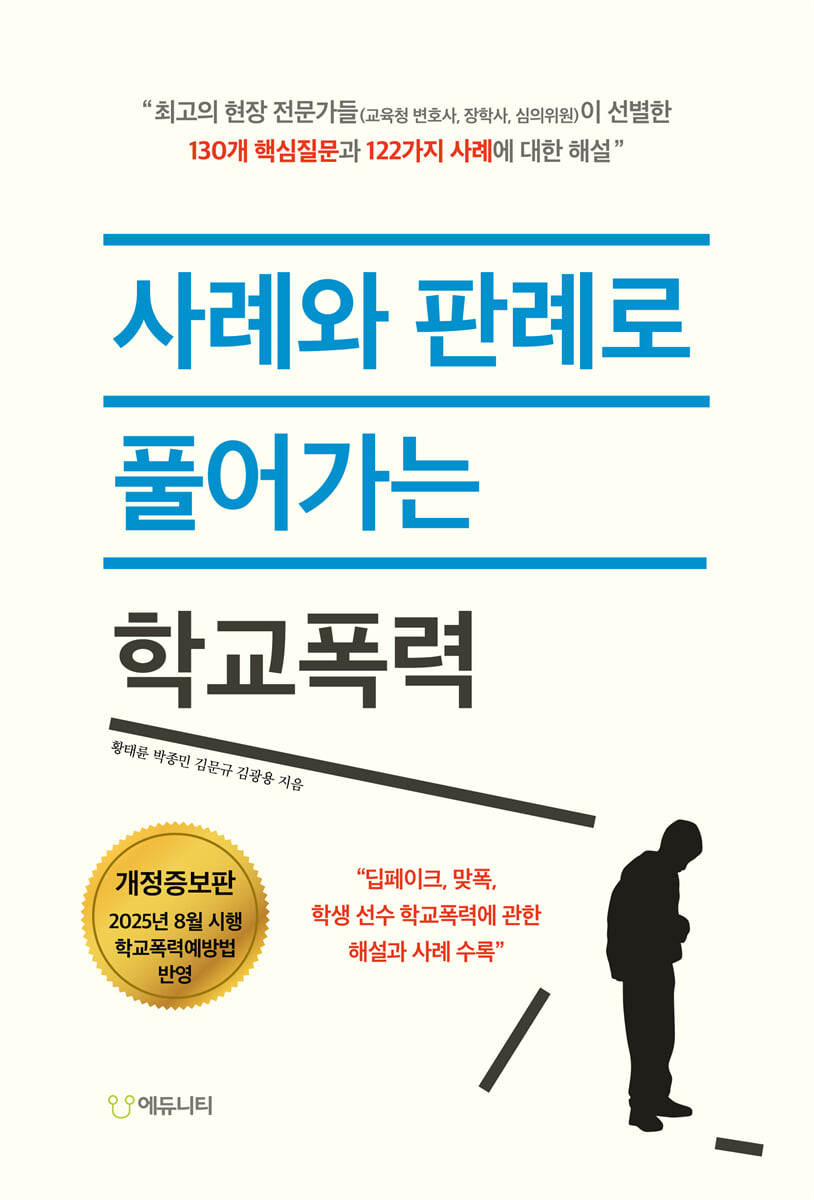
School violence explained through cases and precedents
 |
Description
Book Introduction
A revised and expanded edition reflecting the School Violence Prevention Act (deepfakes, etc.), which will be implemented in August 2025.
Selected by the best field experts (education office lawyers, scholarship officers, review committee members)
Includes 130 key questions and 122 case studies with explanations.
You can get practical help.
This revised edition includes additional content on deepfake sexual crimes, school violence by student athletes, and counter-violence incidents.
When school violence occurs, there is serious conflict among the various parties involved, including the victim and perpetrator students, their guardians, teachers, specialized organizations, members of the School Violence Countermeasures Deliberation Committee, and education office staff, both in the situation itself and in the process of handling the case, and it makes the school difficult.
Not all conflicts between students constitute school violence.
School violence is regulated by law, from its concept to the handling procedures, the handling by schools and education offices, and the compliance of students and guardians involved.
However, the content may be ambiguous or there may be differences in understanding and interpretation, and in such situations, conflicts may escalate.
This book was published with the aim of reducing conflict and promoting healthy recovery for all, taking into account the perspectives of various stakeholders.
The writing team consists of top field experts with many years of experience as members of the School Violence Countermeasures Deliberation Committee, experience handling cases as representatives of students who are victims and perpetrators, experience preparing and conducting deliberation committee meetings as the secretary of the School Violence Countermeasures Deliberation Committee, and experience managing all administrative matters related to school violence and responding to lawsuits.
Based on the expertise developed and developed in the field, the entire case handling process is explained objectively, clearly, and specifically.
We hope this book will help students distinguish between conflicts that can naturally arise among students and school violence, and reduce disputes between parents and the school during the process of handling cases.
If I may be a little more ambitious, I hope this book will be of some help in bringing school violence prevention and incident handling procedures back into school life education.
I hope the time and effort put into this book will help prevent and address school violence.
Selected by the best field experts (education office lawyers, scholarship officers, review committee members)
Includes 130 key questions and 122 case studies with explanations.
You can get practical help.
This revised edition includes additional content on deepfake sexual crimes, school violence by student athletes, and counter-violence incidents.
When school violence occurs, there is serious conflict among the various parties involved, including the victim and perpetrator students, their guardians, teachers, specialized organizations, members of the School Violence Countermeasures Deliberation Committee, and education office staff, both in the situation itself and in the process of handling the case, and it makes the school difficult.
Not all conflicts between students constitute school violence.
School violence is regulated by law, from its concept to the handling procedures, the handling by schools and education offices, and the compliance of students and guardians involved.
However, the content may be ambiguous or there may be differences in understanding and interpretation, and in such situations, conflicts may escalate.
This book was published with the aim of reducing conflict and promoting healthy recovery for all, taking into account the perspectives of various stakeholders.
The writing team consists of top field experts with many years of experience as members of the School Violence Countermeasures Deliberation Committee, experience handling cases as representatives of students who are victims and perpetrators, experience preparing and conducting deliberation committee meetings as the secretary of the School Violence Countermeasures Deliberation Committee, and experience managing all administrative matters related to school violence and responding to lawsuits.
Based on the expertise developed and developed in the field, the entire case handling process is explained objectively, clearly, and specifically.
We hope this book will help students distinguish between conflicts that can naturally arise among students and school violence, and reduce disputes between parents and the school during the process of handling cases.
If I may be a little more ambitious, I hope this book will be of some help in bringing school violence prevention and incident handling procedures back into school life education.
I hope the time and effort put into this book will help prevent and address school violence.
- You can preview some of the book's contents.
Preview
index
Prologue_ I hope this will be of practical help.
130 Key Q&As at Each Step of Case Processing
Part 1.
Definition of school violence
Part 2.
Reporting and Acceptance
go.
Reporting school violence
me.
School violence case report
all.
Obligation of reporters and whistleblowers to refrain from disclosing confidential information
la.
Separation of the perpetrator and the victim
Part 3.
Investigation of the matter
go.
General Theory of Investigation of School Violence Cases
1) Subjects and processes of school violence investigations
2) Interview process with relevant students
a) Precautions when deciding on the time and place for student interviews
b) Guidance on student interviews and student confirmation forms
D) Things to keep in mind when guiding students to write a student confirmation form
a) Response to requests for interview participation from guardians, lawyers, etc.
3) Interview with guardian
4) Collection of evidence related to school violence
5) School violence investigator
me.
School principal's emergency measures
1) Emergency measures to protect victimized students
2) Emergency measures to guide the offending student
a) General theory of emergency measures to guide the offending student
b) Things to consider when deciding on an emergency measure such as suspension or class change
D) School principal's emergency measures and approval by the deliberation committee
all.
School Violence Response Team
la.
School principal's own resolution
1) The purpose and regulations of the school principal's self-resolution
2) Requirements for self-resolution by the school principal
3) Q&A on school principal self-resolution
mind.
School violence confidentiality obligation and provision of related materials
1) Obligation to refrain from disclosing confidential information
2) Student counseling process and confidentiality obligations
3) CCTV footage containing school violence
4) Requests for provision of information from investigative agencies, etc. and courts
bar.
How to Write a School Violence Investigation Report
1) The importance of school violence investigation reports
2) How to write a case summary
3) How to write a case history
4) How to write a controversial issue
a) Key points of writing the issue at issue
b) How to write key issues
D) How to write the victim student's claim and the perpetrator student's claim
5) Method of writing the judgment factors in Article 19 of the Enforcement Decree
Part 4.
School Violence Countermeasures Deliberation Committee
go.
School Violence Countermeasures Deliberation Committee
me.
The role of the School Violence Countermeasures Deliberation Committee
all.
Composition and operation of the School Violence Countermeasures Deliberation Committee
la.
Convening a deliberation committee
1) Attendance Information
2) Progress of the deliberation committee
mind.
Questions and Answers for Students and Guardians
1) Pre-record review
2) Things to keep in mind when asking and answering questions
a) Attitudes to be avoided
b) Focus on the matters under deliberation and ask questions
bar.
decision
1) Confirmation of facts
a) Determine whether and to what extent the statements made by the students involved are consistent
b) Review of evidence
2) Determining whether it constitutes school violence
a) Are only the acts stipulated in the School Violence Prevention Act considered school violence?
A) Are school violence and criminal offenses the same?
D) If you claim it is a joke
a) Conflicts that arise during everyday school life
B) Bullying
b) Threat
Does just being present at a school violence scene make you a perpetrator of school violence?
A) Issues regarding students with disabilities
1) Sexual violence
1) Student Athlete School Violence
K) Countermeasures
3) Action decision
a) Decision on measures taken against the victim and perpetrator students
(1) Measures to protect the victimized student
(2) Guidance measures for the offending student
(a) Types of guidance measures for offending students
(I) Decision on specific leading measures
(All) Precautions when deciding on action
b) Decision to take no action
D) Reservation of decision on action
4) Approval of emergency measures
5) Notice of Action Decision
6) Minutes of the Deliberation Committee meeting
Note) Appeal procedure
Part 5.
Action taken
go.
Action taken against the victimized student
me.
Action taken against the offending student
Written apology to the first victim student
Contact, threats and accusations against the second victim student and the student who reported or reported
Prohibition of retaliatory actions (including actions using information and communications networks)
Volunteer work at school number 3
No. 4 Social Service
No. 5 Completion of special education or psychological treatment by experts within or outside the school or institutions designated by the Superintendent of Education
Suspension from attendance No. 6
Class Change No. 7
Transfer No. 8
Expulsion No. 9
all.
Additional measures against the offending student
la.
Special education for guardians of offending students
mind.
Enforcing implementation of action decisions
1) If the offending student fails to take action
2) In case of failure to provide special education to the guardian of the offending student
Part 6.
Record and delete the disciplinary action taken against the offending student from the school records.
go.
Record the measures taken against students who commit school violence in their school records.
me.
Conditional reservation of description of measures taken against students who commit school violence (Nos. 1, 2, and 3)
all.
Actions taken against students who commit school violence, deletion of school records
1) Deletion timing and method for each action
a) No. 1 (written apology), No. 2 (prohibition of contact, threats, and retaliatory acts), No. 3 (service at school)
B) No. 4 (community service), No. 5 (special education or psychological treatment), No. 6 (suspension from attendance), No. 7 (class change)
D) No. 8 (Transfer)
A) No. 9 (Expulsion)
2) Changes related to the deletion of measures taken against students who commit school violence
3) Precautions when deleting school violence measures
4) Management of documents related to entry and deletion of school life records
Epilogue_ I hope this will help you understand the School Violence Prevention Act and establish preventive measures.
130 Key Q&As at Each Step of Case Processing
Part 1.
Definition of school violence
Part 2.
Reporting and Acceptance
go.
Reporting school violence
me.
School violence case report
all.
Obligation of reporters and whistleblowers to refrain from disclosing confidential information
la.
Separation of the perpetrator and the victim
Part 3.
Investigation of the matter
go.
General Theory of Investigation of School Violence Cases
1) Subjects and processes of school violence investigations
2) Interview process with relevant students
a) Precautions when deciding on the time and place for student interviews
b) Guidance on student interviews and student confirmation forms
D) Things to keep in mind when guiding students to write a student confirmation form
a) Response to requests for interview participation from guardians, lawyers, etc.
3) Interview with guardian
4) Collection of evidence related to school violence
5) School violence investigator
me.
School principal's emergency measures
1) Emergency measures to protect victimized students
2) Emergency measures to guide the offending student
a) General theory of emergency measures to guide the offending student
b) Things to consider when deciding on an emergency measure such as suspension or class change
D) School principal's emergency measures and approval by the deliberation committee
all.
School Violence Response Team
la.
School principal's own resolution
1) The purpose and regulations of the school principal's self-resolution
2) Requirements for self-resolution by the school principal
3) Q&A on school principal self-resolution
mind.
School violence confidentiality obligation and provision of related materials
1) Obligation to refrain from disclosing confidential information
2) Student counseling process and confidentiality obligations
3) CCTV footage containing school violence
4) Requests for provision of information from investigative agencies, etc. and courts
bar.
How to Write a School Violence Investigation Report
1) The importance of school violence investigation reports
2) How to write a case summary
3) How to write a case history
4) How to write a controversial issue
a) Key points of writing the issue at issue
b) How to write key issues
D) How to write the victim student's claim and the perpetrator student's claim
5) Method of writing the judgment factors in Article 19 of the Enforcement Decree
Part 4.
School Violence Countermeasures Deliberation Committee
go.
School Violence Countermeasures Deliberation Committee
me.
The role of the School Violence Countermeasures Deliberation Committee
all.
Composition and operation of the School Violence Countermeasures Deliberation Committee
la.
Convening a deliberation committee
1) Attendance Information
2) Progress of the deliberation committee
mind.
Questions and Answers for Students and Guardians
1) Pre-record review
2) Things to keep in mind when asking and answering questions
a) Attitudes to be avoided
b) Focus on the matters under deliberation and ask questions
bar.
decision
1) Confirmation of facts
a) Determine whether and to what extent the statements made by the students involved are consistent
b) Review of evidence
2) Determining whether it constitutes school violence
a) Are only the acts stipulated in the School Violence Prevention Act considered school violence?
A) Are school violence and criminal offenses the same?
D) If you claim it is a joke
a) Conflicts that arise during everyday school life
B) Bullying
b) Threat
Does just being present at a school violence scene make you a perpetrator of school violence?
A) Issues regarding students with disabilities
1) Sexual violence
1) Student Athlete School Violence
K) Countermeasures
3) Action decision
a) Decision on measures taken against the victim and perpetrator students
(1) Measures to protect the victimized student
(2) Guidance measures for the offending student
(a) Types of guidance measures for offending students
(I) Decision on specific leading measures
(All) Precautions when deciding on action
b) Decision to take no action
D) Reservation of decision on action
4) Approval of emergency measures
5) Notice of Action Decision
6) Minutes of the Deliberation Committee meeting
Note) Appeal procedure
Part 5.
Action taken
go.
Action taken against the victimized student
me.
Action taken against the offending student
Written apology to the first victim student
Contact, threats and accusations against the second victim student and the student who reported or reported
Prohibition of retaliatory actions (including actions using information and communications networks)
Volunteer work at school number 3
No. 4 Social Service
No. 5 Completion of special education or psychological treatment by experts within or outside the school or institutions designated by the Superintendent of Education
Suspension from attendance No. 6
Class Change No. 7
Transfer No. 8
Expulsion No. 9
all.
Additional measures against the offending student
la.
Special education for guardians of offending students
mind.
Enforcing implementation of action decisions
1) If the offending student fails to take action
2) In case of failure to provide special education to the guardian of the offending student
Part 6.
Record and delete the disciplinary action taken against the offending student from the school records.
go.
Record the measures taken against students who commit school violence in their school records.
me.
Conditional reservation of description of measures taken against students who commit school violence (Nos. 1, 2, and 3)
all.
Actions taken against students who commit school violence, deletion of school records
1) Deletion timing and method for each action
a) No. 1 (written apology), No. 2 (prohibition of contact, threats, and retaliatory acts), No. 3 (service at school)
B) No. 4 (community service), No. 5 (special education or psychological treatment), No. 6 (suspension from attendance), No. 7 (class change)
D) No. 8 (Transfer)
A) No. 9 (Expulsion)
2) Changes related to the deletion of measures taken against students who commit school violence
3) Precautions when deleting school violence measures
4) Management of documents related to entry and deletion of school life records
Epilogue_ I hope this will help you understand the School Violence Prevention Act and establish preventive measures.
Into the book
We added provisions regarding the production and distribution of deepfake videos and other content to the definition of school violence, and reorganized provisions regarding support for victims of cyberbullying.
And we have established a direct basis for the system and operation of dedicated school violence investigators.
Therefore, the book presents cases related to the production and distribution of deepfake videos, etc., and explains the contents and considerations during review.
In particular, we aimed to help improve the expertise of the deliberation committee by explaining the provisions and legal principles of the Sexual Violence Punishment Act.
--- p.6
We covered the so-called 'match bombing' case, which has recently become a trend.
Because the concept of a counterattack has not yet been properly defined, there is no set method or perspective on what a counterattack is or how a counterattack incident should be handled.
However, the book assumes that reporting a victimized student is a strategic measure to cover up school violence or to reduce punishment, and explains related handling methods and precautions.
--- p.7
A student refers to a student who is enrolled in an elementary, middle, or high school, special school, or other school as defined in Article 2 of the Elementary and Secondary Education Act, or a school operated in accordance with Article 61 of the same Act.
These schools include international schools and accredited alternative schools, but do not include accredited lifelong learning facilities, foreign educational institutions, international schools or kindergartens, or universities.
Students who have dropped out or been expelled are not considered students under the Elementary and Secondary Education Act, but students on probation whose academic records are maintained are considered students.
To initiate proceedings under the School Violence Prevention Act, the perpetrator may be anyone, but the victim or the person claiming to have been victimized must be a student as defined by the law.
--- p.30
As can be seen from the name of the law, the School Violence Prevention Act places prevention as its most important goal.
Accordingly, anyone can report to the school principal or deliberation committee any preparatory or conspiracy to commit school violence, such as planning to lure students to a specific location after school and assault them, preparing bullying through group chat rooms, or plotting methods and targets of extortion.
In particular, teachers who are aware of the possibility of school violence, conspiracy, or occurrence have a duty to report it to the school principal and inform parents to prevent it (Article 20, Paragraph 4 of the School Violence Prevention Act).
--- p.38
Things to check when reporting a school violence incident.
It is best for students who are victims of school violence to report the facts in detail in accordance with the six principles of school violence, but in most cases, this is not the case.
Therefore, teachers who receive reports must proactively confirm the following facts.
1. Parties.
It is most important to identify who is responsible for school violence.
This is because we can quickly investigate and confirm the facts and proceed with the process by simply knowing the identity of the student involved and their school.
Even in cases of cyberbullying where the perpetrator is unknown, it is advisable to ask who the suspected perpetrator is based on the details of the damage.
2. Harmful acts 3.
Time and place of occurrence 4.
Witnesses, methods of securing evidence, atmosphere, etc.
--- p.41
Q.
If I become aware of a case of school violence (including sexual harassment) at school, do I need to report it to the investigative authorities?
You must immediately report this to the investigative authorities (112, 117).
Article 34, Paragraph 2 of the Act on the Protection of Children and Youth from Sexual Abuse stipulates that employees of educational institutions and other youth-related organizations and facilities are obligated to report sexual crimes against children and youth.
If you do not report or make a false report, you will be subject to a fine of up to 3 million won.
In particular, sexual harassment is sometimes not reported because it is thought to not be a sexual crime, but Article 2, Paragraph 2, Subparagraph 1 of the Act on the Protection of Children and Adolescents from Sexual Abuse stipulates that “acts of forcing a child to commit an obscene act or mediating such acts or sexual harassment or other sexual abuse that causes sexual shame to a child” in Article 17, Paragraph 2 of the Child Welfare Act are sexual crimes against children and adolescents, so they must be reported.
--- p.44
During the investigation process, the school faces various difficulties.
Since schools are not institutions that investigate crimes, they have limitations in investigating the facts of what happened.
Because of this, I am at a loss as to what to instruct students to include in their confirmation forms and what precautions to take during the process.
Furthermore, there are frequent instances where the statements of the students involved are inconsistent, and parents sometimes intervene in the investigation, raising issues and requesting the disclosure of related materials.
The conflicts that arise during this process often lead to ‘malicious complaints’ from parents.
--- p.55
In general, having the victimized student fill out a student identification form first helps identify incidents of school violence.
At this time, we instruct students to include detailed information about the time and place of the school violence, who the perpetrator was, how the violence was committed, and what damage was incurred as a result.
At this time, even if the date and location are not exact, write them down as specifically as possible, such as 'early March 2025', 'an alley near the apartment complex', and if multiple students were involved, make sure that the actions of each student involved can be individually confirmed.
--- p.58
Responding to requests for interview participation from guardians, attorneys, etc.
Recently, there have been requests for guardians to be present during the student interview and student verification process, or for a lawyer appointed by the student to be present.
First, there are no special legal provisions regarding student interviews and the writing of student verification forms during the investigation of school violence cases.
Therefore, even if the guardian or attorney does not participate in the consultation, it cannot be considered illegal. 1) There may be cases where the students involved find it difficult to tell the truth in the presence of their guardian or attorney, and the involvement of the attendees may make counseling difficult for the student, and disputes with the teacher may also arise due to differences of opinion regarding the contents of the investigation.
You may decline such participation, explaining why you deem it inappropriate.
--- p.60
Q.
A. Are at least one-third of the parents required to attend meetings of the dedicated organization?
The School Violence Prevention Act stipulates that parents must comprise at least one-third of the membership, but does not impose such restrictions on the number of attendees at individual meetings.
Therefore, a meeting without parent members is also legal as long as the number of members required for the meeting as determined by the school principal is exceeded.
For example, if confidentiality is particularly important, such as when a school violence case involves sensitive sexual matters, it is possible to conduct a meeting without parent members.
--- p.76
Q.
What should I do if the victim doesn't agree with the principal's decision to resolve the issue, even though it doesn't appear to be school violence?
For example, cases that are difficult to view as school violence in the first place, such as a student who was injured while playing basketball on the playground reporting the other student in the fight as school violence, are sometimes reported as school violence cases.
And in these cases, the injured student continues to claim school violence and demands the holding of a deliberation committee, putting the school in an awkward position.
However, since the school principal or the dedicated organization cannot decide whether an act constitutes school violence, it is impossible to simply end the issue or have the school principal resolve it on his own.
Therefore, we must ultimately request the Office of Education to convene a deliberation committee.
This is because the condition that the school principal's own resolution requires, which is 'when the victimized student and his/her guardian do not wish to convene a deliberation committee,' was not met.
--- p.80
In practice, accessing and providing CCTV footage is the most frequently questioned area at schools. Using and providing information collected through CCTV for the purpose of investigating school violence cases and informing parents about the victimization and victimization of students in accordance with the School Violence Prevention Act is legal, as it falls within the scope of the purpose for which the information was collected.
Of course, the school may refuse to release the CCTV footage on the grounds that it involves someone other than the student who filed the information disclosure request.
Providing personal information of other people besides students to a third party may violate their privacy and therefore falls under the exception to disclosure under the Information Disclosure Act (Article 9, Paragraph 1, Item 6 of the Information Disclosure Act).
--- p.92
Due to the seriousness of deepfake sexual crimes, the School Violence Prevention Act, revised on January 31, 2025, defined the production or distribution of deepfake videos as a type and content of school violence.
And this will take effect on August 1, 2025.
The revised School Violence Prevention Act defines deepfake videos as videos, images, or audio recordings that have been edited, synthesized, or processed to induce sexual desire or discomfort by targeting a student's face, body, or voice using artificial intelligence technology, and the act of producing or distributing such videos is clearly considered cyberbullying, a type of school violence.
--- p.218
Article 14-2, Paragraph 2 of the Special Act on the Punishment, etc. of Sexual Crimes stipulates the distribution of deepfake videos, etc.
Before the revision on October 16, 2024, the statutory penalty for distributing deepfake videos, etc. was “imprisonment for up to 5 years or a fine of up to 50 million won.”
Through the above revision, the statutory penalty for acts such as distribution of deepfake videos was increased to “imprisonment for not more than 7 years or a fine of not more than 50 million won,” the same as for acts of producing deepfake videos.
--- p.219
According to the current standards of the Korea Sports Council, if a student athlete receives disciplinary action under Article 17, Paragraph 1 (written apology), Paragraph 2 (prohibition of contact, retaliation, etc.), or Paragraph 3 (school service) of the School Violence Prevention Act, he or she is restricted from participating in competitions for 3 months; if he or she receives disciplinary action under Paragraph 4 (community service), Paragraph 5 (completion of special education), Paragraph 6 (suspension from attendance), or Paragraph 7 (class change), he or she is restricted from participating in competitions for 6 months; and if he or she receives disciplinary action under Paragraph 8 (transfer), he or she is restricted from participating in competitions for 12 months.
And if a student is subject to disciplinary action No. 9 (expulsion), registration as a player is prohibited depending on the reason.
If a student is expelled for rape, quasi-rape, or similar sexual violence, he or she is prohibited from registering as a player for 10 years, and if a student is expelled for sexual assault, sexual harassment, or violence, he or she is prohibited from registering as a player for 5 years.
Additionally, student athletes who have been subject to the 8th (transfer) measure are excluded from the selection of high school admissions athletic special talents.
In addition, information on student athletes who have received disciplinary action under the School Violence Prevention Act is recorded in the Disciplinary Information System under the National Sports Promotion Act.
--- p.221
Unlike simple two-way incidents, there are cases where people report school violence in order to have the incident hushed up or receive less severe measures.
This would be the case in the above case.
In the above case, V swore at P1, grabbed P1's arms and legs while he was on the floor, and used force against P1, such as pushing him with his hands and feet to get him up from the floor.
And no injury was caused to P1 as a result of V's actions.
--- p.223
Q.
In what cases can a class change be decided as a protective measure for a victimized student? A.
In cases where the victimized student actively requests a change in class for the victimized student, and when considering the severity of the case, it is objectively not necessary to change the class for the perpetrator student, but if the need to separate the perpetrator and victimized student is recognized to some extent, a decision can be made to change the class as a measure to protect the victimized student.
Because classes are the foundation for students to form friendships, changing classes can bring about a huge change in a student's life.
There is also concern that the victimized students may perceive the class change as causing new harm.
Therefore, it is important to be careful, as asking whether the victimized student has such intentions or deciding to change classes without the victim requesting it may provoke considerable backlash.
--- p.229
Q.
If the perpetrator is acquitted of charges for school violence, must a decision be made to take no action?
no.
Even if the offending student is not prosecuted, guidance measures can be taken against the offending student in accordance with the School Violence Prevention Act.
The School Violence Prevention Act has a different purpose from the criminal law system, and decisions to take action under the School Violence Prevention Act are made for educational purposes for youth who are parties to school violence, so they do not necessarily have to be consistent with judgments made through judicial procedures.
In addition, under the School Violence Prevention Act, the recognition of facts that lead to action against a student who committed school violence does not require proof beyond reasonable doubt, as is the case in criminal proceedings. Therefore, if there is a high degree of probability that a student who committed school violence committed school violence, a student who committed school violence can be subject to guidance measures.
--- p.253
Q.
What should the victimized student do if he or she files a complaint with the school, claiming that the offending student has not issued a written apology? A.
Unlike other measures taken against the offending student, the offending student's failure to issue a written apology cannot be used as a reason for requesting additional measures.
Because forcing an apology is seen as an infringement on freedom of conscience.
The School Violence Prevention Act also stipulates that additional measures may be taken only in cases where the offending student refuses or avoids measures from No. 2 to No. 9, excluding measure No. 1 (Article 17, Paragraph 15 of the School Violence Prevention Act).
Therefore, even if the offending student does not issue a written apology to the victim, schools should not force a written apology or take separate disciplinary action for non-compliance.
However, it seems quite possible to encourage compliance, such as by reminding the recipient of the written apology or confirming the future implementation plan.
--- p.288
2024.
3. The enforcement regulations of the Elementary and Secondary Education Act and the guidelines for the preparation and management of school records, which will be implemented from 1.01, have extended the retention period for school records for some measures from 2 years to 4 years after graduation in order to strengthen punishment for students who commit crimes.
Just 2024.
3. The contents to be implemented from 1.2023, depending on the time of reporting school violence.
2. 28.
Previously, 2023.
3. From 1. 2024.
2. 29.
Sai, 2024.
3. 1.
Since it is applied separately from here on, there may be some confusion about the deletion period, so let's compare them and find out.
--- p.321
If we devise countermeasures based on the issues that are mentioned from time to time, it may seem like we will see immediate results, but it will not solve the fundamental problem.
Finding the cause of a problem and devising a solution is not an easy task and takes a long time.
I hope this book will help students distinguish between conflicts that may arise between students and school violence, and help them understand the current school violence prevention laws, thereby contributing to the development of countermeasures against school violence.
And we have established a direct basis for the system and operation of dedicated school violence investigators.
Therefore, the book presents cases related to the production and distribution of deepfake videos, etc., and explains the contents and considerations during review.
In particular, we aimed to help improve the expertise of the deliberation committee by explaining the provisions and legal principles of the Sexual Violence Punishment Act.
--- p.6
We covered the so-called 'match bombing' case, which has recently become a trend.
Because the concept of a counterattack has not yet been properly defined, there is no set method or perspective on what a counterattack is or how a counterattack incident should be handled.
However, the book assumes that reporting a victimized student is a strategic measure to cover up school violence or to reduce punishment, and explains related handling methods and precautions.
--- p.7
A student refers to a student who is enrolled in an elementary, middle, or high school, special school, or other school as defined in Article 2 of the Elementary and Secondary Education Act, or a school operated in accordance with Article 61 of the same Act.
These schools include international schools and accredited alternative schools, but do not include accredited lifelong learning facilities, foreign educational institutions, international schools or kindergartens, or universities.
Students who have dropped out or been expelled are not considered students under the Elementary and Secondary Education Act, but students on probation whose academic records are maintained are considered students.
To initiate proceedings under the School Violence Prevention Act, the perpetrator may be anyone, but the victim or the person claiming to have been victimized must be a student as defined by the law.
--- p.30
As can be seen from the name of the law, the School Violence Prevention Act places prevention as its most important goal.
Accordingly, anyone can report to the school principal or deliberation committee any preparatory or conspiracy to commit school violence, such as planning to lure students to a specific location after school and assault them, preparing bullying through group chat rooms, or plotting methods and targets of extortion.
In particular, teachers who are aware of the possibility of school violence, conspiracy, or occurrence have a duty to report it to the school principal and inform parents to prevent it (Article 20, Paragraph 4 of the School Violence Prevention Act).
--- p.38
Things to check when reporting a school violence incident.
It is best for students who are victims of school violence to report the facts in detail in accordance with the six principles of school violence, but in most cases, this is not the case.
Therefore, teachers who receive reports must proactively confirm the following facts.
1. Parties.
It is most important to identify who is responsible for school violence.
This is because we can quickly investigate and confirm the facts and proceed with the process by simply knowing the identity of the student involved and their school.
Even in cases of cyberbullying where the perpetrator is unknown, it is advisable to ask who the suspected perpetrator is based on the details of the damage.
2. Harmful acts 3.
Time and place of occurrence 4.
Witnesses, methods of securing evidence, atmosphere, etc.
--- p.41
Q.
If I become aware of a case of school violence (including sexual harassment) at school, do I need to report it to the investigative authorities?
You must immediately report this to the investigative authorities (112, 117).
Article 34, Paragraph 2 of the Act on the Protection of Children and Youth from Sexual Abuse stipulates that employees of educational institutions and other youth-related organizations and facilities are obligated to report sexual crimes against children and youth.
If you do not report or make a false report, you will be subject to a fine of up to 3 million won.
In particular, sexual harassment is sometimes not reported because it is thought to not be a sexual crime, but Article 2, Paragraph 2, Subparagraph 1 of the Act on the Protection of Children and Adolescents from Sexual Abuse stipulates that “acts of forcing a child to commit an obscene act or mediating such acts or sexual harassment or other sexual abuse that causes sexual shame to a child” in Article 17, Paragraph 2 of the Child Welfare Act are sexual crimes against children and adolescents, so they must be reported.
--- p.44
During the investigation process, the school faces various difficulties.
Since schools are not institutions that investigate crimes, they have limitations in investigating the facts of what happened.
Because of this, I am at a loss as to what to instruct students to include in their confirmation forms and what precautions to take during the process.
Furthermore, there are frequent instances where the statements of the students involved are inconsistent, and parents sometimes intervene in the investigation, raising issues and requesting the disclosure of related materials.
The conflicts that arise during this process often lead to ‘malicious complaints’ from parents.
--- p.55
In general, having the victimized student fill out a student identification form first helps identify incidents of school violence.
At this time, we instruct students to include detailed information about the time and place of the school violence, who the perpetrator was, how the violence was committed, and what damage was incurred as a result.
At this time, even if the date and location are not exact, write them down as specifically as possible, such as 'early March 2025', 'an alley near the apartment complex', and if multiple students were involved, make sure that the actions of each student involved can be individually confirmed.
--- p.58
Responding to requests for interview participation from guardians, attorneys, etc.
Recently, there have been requests for guardians to be present during the student interview and student verification process, or for a lawyer appointed by the student to be present.
First, there are no special legal provisions regarding student interviews and the writing of student verification forms during the investigation of school violence cases.
Therefore, even if the guardian or attorney does not participate in the consultation, it cannot be considered illegal. 1) There may be cases where the students involved find it difficult to tell the truth in the presence of their guardian or attorney, and the involvement of the attendees may make counseling difficult for the student, and disputes with the teacher may also arise due to differences of opinion regarding the contents of the investigation.
You may decline such participation, explaining why you deem it inappropriate.
--- p.60
Q.
A. Are at least one-third of the parents required to attend meetings of the dedicated organization?
The School Violence Prevention Act stipulates that parents must comprise at least one-third of the membership, but does not impose such restrictions on the number of attendees at individual meetings.
Therefore, a meeting without parent members is also legal as long as the number of members required for the meeting as determined by the school principal is exceeded.
For example, if confidentiality is particularly important, such as when a school violence case involves sensitive sexual matters, it is possible to conduct a meeting without parent members.
--- p.76
Q.
What should I do if the victim doesn't agree with the principal's decision to resolve the issue, even though it doesn't appear to be school violence?
For example, cases that are difficult to view as school violence in the first place, such as a student who was injured while playing basketball on the playground reporting the other student in the fight as school violence, are sometimes reported as school violence cases.
And in these cases, the injured student continues to claim school violence and demands the holding of a deliberation committee, putting the school in an awkward position.
However, since the school principal or the dedicated organization cannot decide whether an act constitutes school violence, it is impossible to simply end the issue or have the school principal resolve it on his own.
Therefore, we must ultimately request the Office of Education to convene a deliberation committee.
This is because the condition that the school principal's own resolution requires, which is 'when the victimized student and his/her guardian do not wish to convene a deliberation committee,' was not met.
--- p.80
In practice, accessing and providing CCTV footage is the most frequently questioned area at schools. Using and providing information collected through CCTV for the purpose of investigating school violence cases and informing parents about the victimization and victimization of students in accordance with the School Violence Prevention Act is legal, as it falls within the scope of the purpose for which the information was collected.
Of course, the school may refuse to release the CCTV footage on the grounds that it involves someone other than the student who filed the information disclosure request.
Providing personal information of other people besides students to a third party may violate their privacy and therefore falls under the exception to disclosure under the Information Disclosure Act (Article 9, Paragraph 1, Item 6 of the Information Disclosure Act).
--- p.92
Due to the seriousness of deepfake sexual crimes, the School Violence Prevention Act, revised on January 31, 2025, defined the production or distribution of deepfake videos as a type and content of school violence.
And this will take effect on August 1, 2025.
The revised School Violence Prevention Act defines deepfake videos as videos, images, or audio recordings that have been edited, synthesized, or processed to induce sexual desire or discomfort by targeting a student's face, body, or voice using artificial intelligence technology, and the act of producing or distributing such videos is clearly considered cyberbullying, a type of school violence.
--- p.218
Article 14-2, Paragraph 2 of the Special Act on the Punishment, etc. of Sexual Crimes stipulates the distribution of deepfake videos, etc.
Before the revision on October 16, 2024, the statutory penalty for distributing deepfake videos, etc. was “imprisonment for up to 5 years or a fine of up to 50 million won.”
Through the above revision, the statutory penalty for acts such as distribution of deepfake videos was increased to “imprisonment for not more than 7 years or a fine of not more than 50 million won,” the same as for acts of producing deepfake videos.
--- p.219
According to the current standards of the Korea Sports Council, if a student athlete receives disciplinary action under Article 17, Paragraph 1 (written apology), Paragraph 2 (prohibition of contact, retaliation, etc.), or Paragraph 3 (school service) of the School Violence Prevention Act, he or she is restricted from participating in competitions for 3 months; if he or she receives disciplinary action under Paragraph 4 (community service), Paragraph 5 (completion of special education), Paragraph 6 (suspension from attendance), or Paragraph 7 (class change), he or she is restricted from participating in competitions for 6 months; and if he or she receives disciplinary action under Paragraph 8 (transfer), he or she is restricted from participating in competitions for 12 months.
And if a student is subject to disciplinary action No. 9 (expulsion), registration as a player is prohibited depending on the reason.
If a student is expelled for rape, quasi-rape, or similar sexual violence, he or she is prohibited from registering as a player for 10 years, and if a student is expelled for sexual assault, sexual harassment, or violence, he or she is prohibited from registering as a player for 5 years.
Additionally, student athletes who have been subject to the 8th (transfer) measure are excluded from the selection of high school admissions athletic special talents.
In addition, information on student athletes who have received disciplinary action under the School Violence Prevention Act is recorded in the Disciplinary Information System under the National Sports Promotion Act.
--- p.221
Unlike simple two-way incidents, there are cases where people report school violence in order to have the incident hushed up or receive less severe measures.
This would be the case in the above case.
In the above case, V swore at P1, grabbed P1's arms and legs while he was on the floor, and used force against P1, such as pushing him with his hands and feet to get him up from the floor.
And no injury was caused to P1 as a result of V's actions.
--- p.223
Q.
In what cases can a class change be decided as a protective measure for a victimized student? A.
In cases where the victimized student actively requests a change in class for the victimized student, and when considering the severity of the case, it is objectively not necessary to change the class for the perpetrator student, but if the need to separate the perpetrator and victimized student is recognized to some extent, a decision can be made to change the class as a measure to protect the victimized student.
Because classes are the foundation for students to form friendships, changing classes can bring about a huge change in a student's life.
There is also concern that the victimized students may perceive the class change as causing new harm.
Therefore, it is important to be careful, as asking whether the victimized student has such intentions or deciding to change classes without the victim requesting it may provoke considerable backlash.
--- p.229
Q.
If the perpetrator is acquitted of charges for school violence, must a decision be made to take no action?
no.
Even if the offending student is not prosecuted, guidance measures can be taken against the offending student in accordance with the School Violence Prevention Act.
The School Violence Prevention Act has a different purpose from the criminal law system, and decisions to take action under the School Violence Prevention Act are made for educational purposes for youth who are parties to school violence, so they do not necessarily have to be consistent with judgments made through judicial procedures.
In addition, under the School Violence Prevention Act, the recognition of facts that lead to action against a student who committed school violence does not require proof beyond reasonable doubt, as is the case in criminal proceedings. Therefore, if there is a high degree of probability that a student who committed school violence committed school violence, a student who committed school violence can be subject to guidance measures.
--- p.253
Q.
What should the victimized student do if he or she files a complaint with the school, claiming that the offending student has not issued a written apology? A.
Unlike other measures taken against the offending student, the offending student's failure to issue a written apology cannot be used as a reason for requesting additional measures.
Because forcing an apology is seen as an infringement on freedom of conscience.
The School Violence Prevention Act also stipulates that additional measures may be taken only in cases where the offending student refuses or avoids measures from No. 2 to No. 9, excluding measure No. 1 (Article 17, Paragraph 15 of the School Violence Prevention Act).
Therefore, even if the offending student does not issue a written apology to the victim, schools should not force a written apology or take separate disciplinary action for non-compliance.
However, it seems quite possible to encourage compliance, such as by reminding the recipient of the written apology or confirming the future implementation plan.
--- p.288
2024.
3. The enforcement regulations of the Elementary and Secondary Education Act and the guidelines for the preparation and management of school records, which will be implemented from 1.01, have extended the retention period for school records for some measures from 2 years to 4 years after graduation in order to strengthen punishment for students who commit crimes.
Just 2024.
3. The contents to be implemented from 1.2023, depending on the time of reporting school violence.
2. 28.
Previously, 2023.
3. From 1. 2024.
2. 29.
Sai, 2024.
3. 1.
Since it is applied separately from here on, there may be some confusion about the deletion period, so let's compare them and find out.
--- p.321
If we devise countermeasures based on the issues that are mentioned from time to time, it may seem like we will see immediate results, but it will not solve the fundamental problem.
Finding the cause of a problem and devising a solution is not an easy task and takes a long time.
I hope this book will help students distinguish between conflicts that may arise between students and school violence, and help them understand the current school violence prevention laws, thereby contributing to the development of countermeasures against school violence.
--- p.331
Publisher's Review
This book actually explains the contents according to the order of handling school violence cases.
130 questions to help you understand the process,
We have compiled explanations for 122 cases.
As a result of handling school violence cases, protective measures are taken for the victimized student, and guidance and educational measures are taken for the perpetrator.
Therefore, in order to protect the victimized students, the current situation of the victimized students and the necessary measures should be actively discussed.
Meanwhile, measures taken against the offending student are measures that impose obligations or restrict the rights of the parties involved, so strictness and caution must be applied in the judgment and handling of such measures.
By writing the book's content according to the order in which school violence cases are handled, we explain what staff members must handle and what to be careful of, and provide specific examples to help them easily find answers.
Additionally, we are providing practical assistance in your work by providing guidance on regulations for protecting victimized students, changes in the roles and measures of each person in charge, and even tips for filling out and deleting school records, reflecting the revised School Violence Prevention Act, which will be implemented starting in August 2025.
This book takes all of this into account and organizes the contents according to the actual order in which school violence cases are handled.
We have explained the entire process of handling school violence cases, from reporting and acceptance, investigation, the principal's own resolution, operation of the School Violence Countermeasures Deliberation Committee, implementation of measures, and record management, including the handling of school violence cases and subsequent actions.
In particular, we hope that this will be helpful to those who actually deal with school violence cases, such as school principals, school violence countermeasures committee members, school violence investigators, and education office staff.
130 questions to help you understand the process,
We have compiled explanations for 122 cases.
As a result of handling school violence cases, protective measures are taken for the victimized student, and guidance and educational measures are taken for the perpetrator.
Therefore, in order to protect the victimized students, the current situation of the victimized students and the necessary measures should be actively discussed.
Meanwhile, measures taken against the offending student are measures that impose obligations or restrict the rights of the parties involved, so strictness and caution must be applied in the judgment and handling of such measures.
By writing the book's content according to the order in which school violence cases are handled, we explain what staff members must handle and what to be careful of, and provide specific examples to help them easily find answers.
Additionally, we are providing practical assistance in your work by providing guidance on regulations for protecting victimized students, changes in the roles and measures of each person in charge, and even tips for filling out and deleting school records, reflecting the revised School Violence Prevention Act, which will be implemented starting in August 2025.
This book takes all of this into account and organizes the contents according to the actual order in which school violence cases are handled.
We have explained the entire process of handling school violence cases, from reporting and acceptance, investigation, the principal's own resolution, operation of the School Violence Countermeasures Deliberation Committee, implementation of measures, and record management, including the handling of school violence cases and subsequent actions.
In particular, we hope that this will be helpful to those who actually deal with school violence cases, such as school principals, school violence countermeasures committee members, school violence investigators, and education office staff.
GOODS SPECIFICS
- Date of issue: March 20, 2025
- Page count, weight, size: 332 pages | 152*224*19mm
- ISBN13: 9791164251773
You may also like
카테고리
korean


korean

![GQ KOREA Mark (Monthly): December [2025]](http://librairie.coreenne.fr/cdn/shop/files/8ef265dbbfbf186523ed75ba7319009d.jpg?v=1765340328&width=3840)


