

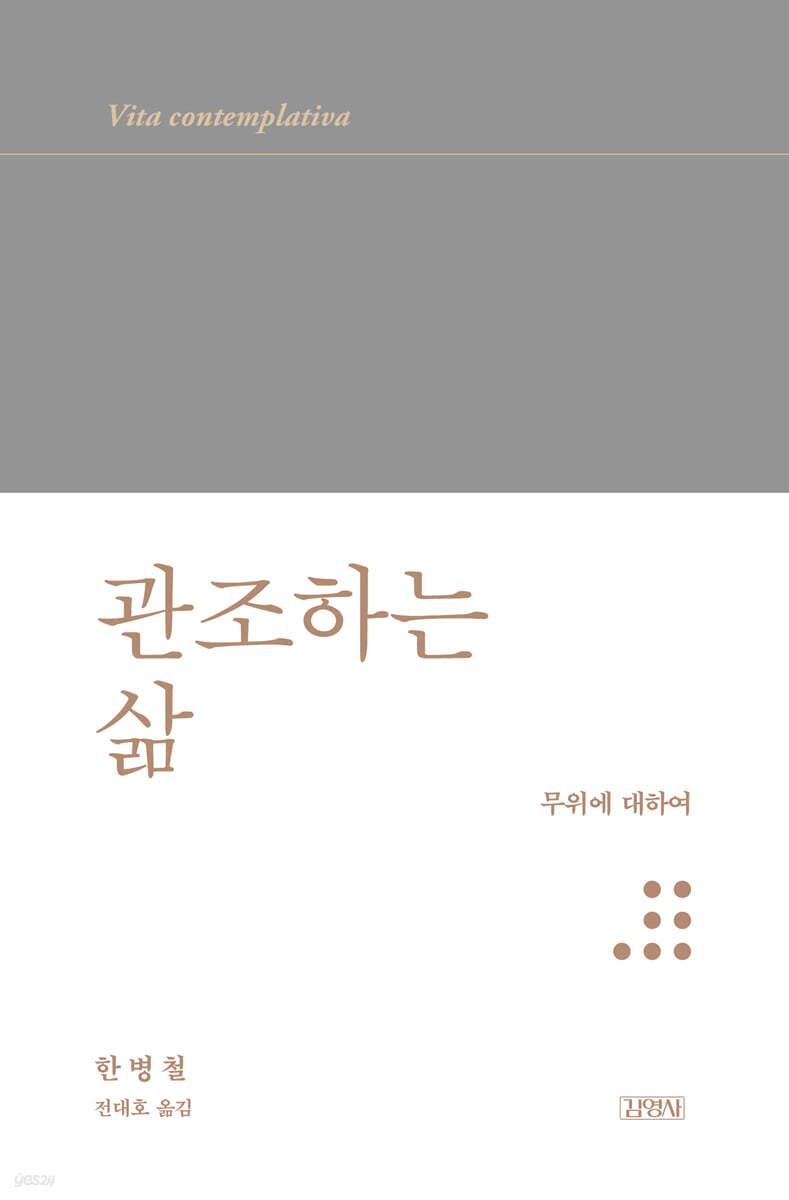
The Contemplative Life: On Inaction
 |
Description
Book Introduction
The era of dopamine flood
that can restore our lives
The most intense form of life is 'inaction'!
German philosopher Han Byung-chul sheds new light on the forgotten virtue of modern society, the "contemplative life," and praises the "life of inaction."
The title of the new book is ‘A Life of Observation.’
This is a critical book that asks modern people, obsessed with the desire for achievement and instant gratification, to adopt a special attitude toward life.
This book urges us to break free from the compulsion to do something more, to stop activities with 'intention and purpose' (inaction), and to look at the true nature of the world (contemplation) that 'magically' reveals itself at that moment.
According to Han Byung-chul, people forced into the brutal competition of today's performance-based society are experiencing "absolute existential deprivation" in isolation and loneliness.
To fill their 'lack of existence,' people work busier, consume more, and even fill their leisure time with mindless play and packed schedules.
For them, 'intense life' means more work, achievement, consumption, and stimulation.
However, the author diagnoses that true happiness and peace are impossible if one remains on the 'hamster wheel of action' (a life of action).
Rather, it is “idleness that produces nothing” that is praised as “an intense form of life.”
This book draws attention to the hidden role, value, and creative power of 'inaction' by quoting or refuting the writings and key concepts of major thinkers (Plato, Novalis, Hannah Arendt, Nietzsche, Walter Benjamin, etc.) from ancient Greek philosophers to the early Romantics and modern philosophers.
Readers will encounter Han Byung-chul's unique aesthetic and sharp insight through the delicate critiques contained in this book.
that can restore our lives
The most intense form of life is 'inaction'!
German philosopher Han Byung-chul sheds new light on the forgotten virtue of modern society, the "contemplative life," and praises the "life of inaction."
The title of the new book is ‘A Life of Observation.’
This is a critical book that asks modern people, obsessed with the desire for achievement and instant gratification, to adopt a special attitude toward life.
This book urges us to break free from the compulsion to do something more, to stop activities with 'intention and purpose' (inaction), and to look at the true nature of the world (contemplation) that 'magically' reveals itself at that moment.
According to Han Byung-chul, people forced into the brutal competition of today's performance-based society are experiencing "absolute existential deprivation" in isolation and loneliness.
To fill their 'lack of existence,' people work busier, consume more, and even fill their leisure time with mindless play and packed schedules.
For them, 'intense life' means more work, achievement, consumption, and stimulation.
However, the author diagnoses that true happiness and peace are impossible if one remains on the 'hamster wheel of action' (a life of action).
Rather, it is “idleness that produces nothing” that is praised as “an intense form of life.”
This book draws attention to the hidden role, value, and creative power of 'inaction' by quoting or refuting the writings and key concepts of major thinkers (Plato, Novalis, Hannah Arendt, Nietzsche, Walter Benjamin, etc.) from ancient Greek philosophers to the early Romantics and modern philosophers.
Readers will encounter Han Byung-chul's unique aesthetic and sharp insight through the delicate critiques contained in this book.
- You can preview some of the book's contents.
Preview
index
Landscapes of Idleness
A footnote attached to the eldest son
From action to being
Absolute lack of existence
Passion for action
The Coming Society
A footnote attached to the eldest son
From action to being
Absolute lack of existence
Passion for action
The Coming Society
Detailed image

Into the book
Silence deepens speech.
Without silence there is no music, only noise and noise.
Play is the essence of beauty.
When only patterns of stimulus and response, of desire and satisfaction, of problems and answers, of goals and actions dominate, life is reduced to survival, to a bare animal existence.
--- p.13
In this age of haste, where everything is short-term, short-sighted, and short-sighted, inaction is rare.
What prevails everywhere today is the consumerist lifestyle.
In that life, we have all our desires met instantly.
We don't have the patience to wait.
In that persistence, something may slowly ripen.
--- p.24
The dialectic of inaction transforms inaction into a threshold, a zone of uncertainty.
Thanks to that area, we can create something that has never been done before.
Without that threshold, the same thing repeats itself.
--- p.33
When the compulsion to produce takes over language, language is converted into a mode of labor.
Then language is reduced to a carrier of information.
In other words, it becomes merely a means of communication.
Information is a form of language behavior.
--- p.36
We who act now hardly read poetry.
The loss of our ability to contemplate affects our attitude toward language.
Intoxicated with information and communication, we shy away from writing poetry as a means of contemplating language.
Even we begin to hate writing poetry.
--- p.36
We live in a world created by humans, among objects of use, in homes, on the streets, and in cities.
And almost all the time we see all these things only from the perspective of human actions that can be done with them as means or objects.
Cézanne's idle landscapes break away from humanized nature and reestablish the order of non-humanized objects.
Within that order, things return to themselves.
Therefore, Cezanne's apples are not fit for eating.
Cézanne's jars and plates are not "tools" subordinated to human purposes.
Rather, they have their own dignity, their own splendor.
--- p.43
If the absolutization of human behavior, which recklessly conquers and exploits nature, is the cause of the impending disaster, then human behavior itself must be revised.
Therefore, it is absolutely necessary to increase the contemplative component of action, or in other words, to add reflection to action.
--- p.70
Existence has a temporal dimension.
Existence grows in slowness and aura.
Today's short-termism destroys existence.
Existence becomes concentrated only when you stay with it for a long time.
But it is impossible to stay with information for long.
Information corresponds to the absolute extinction stage of existence.
--- p.85
We try to compensate for the lack of existence by extending our naked lives.
And then you completely lose the sense of an intensive life.
We confuse intensive living with more production, performance, and consumption.
But these are just survival forms.
--- p.88
According to Thomas Aquinas, the ultimate goal of the active life is to engage in the happiness of the contemplative life.
"The active life tends toward the contemplative life." The contemplative life is "the goal of all human life."
.--- p.91
When man's primary way of relating to the world was by looking, he was still related to a divine being without lack.
--- p.95
Only a life of contemplation promises divine self-sufficiency and complete happiness.
History is completed at the moment when action is completely pushed aside and watching takes its place, that is, on the Sabbath of inaction.
--- p.98
Rest is the essential core of creation.
Only the Sabbath gives divine majesty to creation.
Rest is divine, inaction is divine.
Without rest, humans lose the divine. --- p.102
Contemplation as a path toward knowledge, a path toward truth, precedes action.
A life of action without a life of contemplation is a blind life.
--- p.134
Romanticism gives nature a divine splendor.
The moment we regard nature as a resource, a means to human ends, we are already committing violence against nature.
Our attitude of treating nature as a tool inevitably leads to catastrophe, but Romanticism's understanding of nature has the potential to correct that attitude.
--- p.142~143
In the coming land of peace, humans and nature will be reconciled.
Man is merely a citizen of the republic of living things.
Plants, animals, stones, clouds, and stars are also fellow citizens of that republic. --- p.156
Without silence there is no music, only noise and noise.
Play is the essence of beauty.
When only patterns of stimulus and response, of desire and satisfaction, of problems and answers, of goals and actions dominate, life is reduced to survival, to a bare animal existence.
--- p.13
In this age of haste, where everything is short-term, short-sighted, and short-sighted, inaction is rare.
What prevails everywhere today is the consumerist lifestyle.
In that life, we have all our desires met instantly.
We don't have the patience to wait.
In that persistence, something may slowly ripen.
--- p.24
The dialectic of inaction transforms inaction into a threshold, a zone of uncertainty.
Thanks to that area, we can create something that has never been done before.
Without that threshold, the same thing repeats itself.
--- p.33
When the compulsion to produce takes over language, language is converted into a mode of labor.
Then language is reduced to a carrier of information.
In other words, it becomes merely a means of communication.
Information is a form of language behavior.
--- p.36
We who act now hardly read poetry.
The loss of our ability to contemplate affects our attitude toward language.
Intoxicated with information and communication, we shy away from writing poetry as a means of contemplating language.
Even we begin to hate writing poetry.
--- p.36
We live in a world created by humans, among objects of use, in homes, on the streets, and in cities.
And almost all the time we see all these things only from the perspective of human actions that can be done with them as means or objects.
Cézanne's idle landscapes break away from humanized nature and reestablish the order of non-humanized objects.
Within that order, things return to themselves.
Therefore, Cezanne's apples are not fit for eating.
Cézanne's jars and plates are not "tools" subordinated to human purposes.
Rather, they have their own dignity, their own splendor.
--- p.43
If the absolutization of human behavior, which recklessly conquers and exploits nature, is the cause of the impending disaster, then human behavior itself must be revised.
Therefore, it is absolutely necessary to increase the contemplative component of action, or in other words, to add reflection to action.
--- p.70
Existence has a temporal dimension.
Existence grows in slowness and aura.
Today's short-termism destroys existence.
Existence becomes concentrated only when you stay with it for a long time.
But it is impossible to stay with information for long.
Information corresponds to the absolute extinction stage of existence.
--- p.85
We try to compensate for the lack of existence by extending our naked lives.
And then you completely lose the sense of an intensive life.
We confuse intensive living with more production, performance, and consumption.
But these are just survival forms.
--- p.88
According to Thomas Aquinas, the ultimate goal of the active life is to engage in the happiness of the contemplative life.
"The active life tends toward the contemplative life." The contemplative life is "the goal of all human life."
.--- p.91
When man's primary way of relating to the world was by looking, he was still related to a divine being without lack.
--- p.95
Only a life of contemplation promises divine self-sufficiency and complete happiness.
History is completed at the moment when action is completely pushed aside and watching takes its place, that is, on the Sabbath of inaction.
--- p.98
Rest is the essential core of creation.
Only the Sabbath gives divine majesty to creation.
Rest is divine, inaction is divine.
Without rest, humans lose the divine. --- p.102
Contemplation as a path toward knowledge, a path toward truth, precedes action.
A life of action without a life of contemplation is a blind life.
--- p.134
Romanticism gives nature a divine splendor.
The moment we regard nature as a resource, a means to human ends, we are already committing violence against nature.
Our attitude of treating nature as a tool inevitably leads to catastrophe, but Romanticism's understanding of nature has the potential to correct that attitude.
--- p.142~143
In the coming land of peace, humans and nature will be reconciled.
Man is merely a citizen of the republic of living things.
Plants, animals, stones, clouds, and stars are also fellow citizens of that republic. --- p.156
--- p.156
Publisher's Review
The era of dopamine flood
that can restore our lives
The most intense form of life is 'inaction'!
Re-examining the "contemplative life," a forgotten virtue in modern society.
Examining the power of "inaction" in the face of labor and performance coercion.
An original rebuttal to Hannah Arendt's "Vita Activa"
On the life of contemplation and inaction
“If there is a goal toward which all human endeavor and all history are directed, that goal is to reach perfection through contemplation.”
German philosopher Han Byung-chul sheds new light on the forgotten virtue of modern society, the "contemplative life," and praises the "life of inaction."
The title of the new book is ‘A Life of Observation.’
This is a critical book that asks modern people, caught up in the desire for achievement and instant gratification in an era of dopamine flood, to adopt a special attitude toward life.
This book urges us to break free from the compulsion to do something more, to stop activities with 'intention and purpose' (inaction), and to look at the true nature of the world (contemplation) that 'magically' reveals itself at that moment.
According to Han Byung-chul, people forced into the brutal competition of today's performance-based society are experiencing "absolute existential deprivation" in isolation and loneliness.
To fill their 'lack of existence,' people work busier, consume more, and even fill their leisure time with mindless play and packed schedules.
For them, 'intense life' means more work, achievement, consumption, and stimulation.
However, the author diagnoses that true happiness and peace are impossible if one remains on the 'hamster wheel of action' (a life of action).
Rather, it is “idleness that produces nothing” that is praised as “an intense form of life.”
This book contains six essays, including “Landscapes of Inaction,” “An Attachment to Zhuangzi,” and “From Action to Being.”
This book delves deeper into the important themes of our time, such as ‘acceleration of life’ and ‘lack of existence,’ which were presented in the author’s previous works (e.g., ‘The Scent of Time,’ ‘The Fatigued Society,’ and ‘Why Revolution is Impossible Today.’)
From ancient Greek philosophers to the early Romantics and modern philosophers, the book extensively quotes or refutes the writings and key concepts of major thinkers (Plato, Novalis, Hannah Arendt, Nietzsche, Walter Benjamin, etc.), focusing on the hidden role, value, and creative power of 'inaction'.
Readers will encounter Han Byung-chul's unique aesthetic and sharp insight through the delicate critiques contained in this book.
Praise of inaction
“In this age of haste, where everything is short-term, short-sighted, and short-sighted, inaction is rare.
We don't have the patience to wait.
“Within that persistence, something can slowly ripen.”
The book's message of living a 'life of inaction' and having 'contemplative rest' sounds quite sweet.
Especially, those who are tired of the daily grind will find this book captivating, and those who want to enjoy laziness to the fullest may find a strong ally in several passages of this book that will ease their guilt.
But as avid readers of Han Byung-chul would have already guessed, this book is not a praise for laziness or a book that presents practical methods for contemplative meditation.
Rather, it is a book that calls for and advocates 'creative inaction' that resists the constantly growing and commercializing capitalist system.
According to Han Byung-chul, inaction is not mere laziness, denial, a listless attitude toward life, or a “vacuum of activity.”
It is a “brilliant form of human existence” that has “its own logic, its own language, its own temporality, its own structure, its own splendor, its own magic.”
Capitalism absolutizes survival and values efficiency and functionality, but he thinks that “true happiness lies in the aimless and useless, in the deliberately prolix, in the unproductive, in the circumlocution, in the deviation, in the superfluity, in the beautiful forms and gestures that are useful for nothing and serve nothing” (rituality of inaction).
Meanwhile, ‘inaction’ is a kind of “threshold” that leads to a creative world.
'Action' (a life of action) only repeats and reproduces the same things according to a given purpose and goal, and does not create anything new.
Inventive humans need “time (of idleness) to engage in purposeless and ruleless actions.
So, in that time of inaction, “the emergence of something completely different, something that has never existed before, becomes possible.” (Dialectics of Inaction) In this way, ‘inaction’ becomes an antidote for our lives in a world dominated by purpose and utility, and a source of creativity.
The ultimate goal of human action is 'inaction'.
“Activity is truly human to the extent that inaction occupies a share of it.”
Han Byeong-cheol emphasizes that ‘inaction’ is an important element that constitutes humanity.
“Without rest, new barbarism arises.
Silence deepens speech.
Without silence there is no music, only noise and noise.
“Play is the essence of beauty,” he warns, “if we do not have “moments of hesitation and pause,” our actions degenerate into blind activity and reaction.
When the patterns of stimulus-response, desire-gratification, and goal-action dominate, our lives are reduced to survival, to “naked animal life.”
The loss of the ability to ‘do nothing’ soon turns us into “merely functional machines.”
Human existence is completely absorbed by activity, and even leisure time away from productive activity is reduced to a time for recovering from the fatigue of labor (i.e., a “derivative of labor”), “time we kill to prevent boredom from rearing its head.”
Han Byeong-cheol asserts that “the ultimate goal pursued by humans is inaction.”
He notes a scene in Kleist's short story "On Puppetry" where a human dancer loses his grace the moment he becomes conscious of his own gestures.
“A master shakes off his will through practice.
The skill of a master is inaction.
“Action is completed when it reaches inaction.” Similarly, ‘history’ is made through action, but Han Byung-chul believes that ‘history’ is completed only on “the Sabbath of inaction, when action is completely pushed aside and observation (contemplation) takes its place.”
“The Sabbath is the first to give divine majesty to creation.
“Without rest, man loses the divine,” he writes, guessing at Nietzsche’s thoughts on ‘inaction.’
“Life is impossible without inaction.
“Inaction is the condition for the living to survive and prosper.”
Vita Activa and the Crisis of Humanity
“A life of action without a life of contemplation is a life of blindness.”
The part where Han Byung-chul criticizes Hannah Arendt for defining the 20th century as the 'age of action' is quite interesting.
Arendt, author of Vita Activa, idealizes the ancient Greek polis as a shining example of freedom, and calls the pursuit of immortal fame “the source and center of the active life” (“Humanity attains immortality on the stage of the political”).
On the other hand, ‘a life of observation’ is interpreted as something like “an escape from the world.”
In Han Byung-chul's view, Arendt's argument is obsessed with the "passion for action" and is steeped in the "modern spirit" that has brought about today's global crisis.
Today's crisis is the result of "considering nature as a resource, a means to human ends," and completely subordinating it to human action.
Since the modern era, nature has completely lost its “authenticity and dignity” and has been “relegated to an appendix, a component of human history.”
Han Byung-chul defines the "Anthropocene," which is often cited in today's discourse on the crisis of civilization, as "a historical period in which human actions completely absorb and exploit nature."
Han Byung-chul emphasizes that in this situation, we must recover the 'ethics of inaction' (to use the metaphor of land, respecting the naturally formed potential of the land and leaving it alone without artificial changes).
“If the absolutization of human behavior, which recklessly conquers and exploits nature, is the cause of the impending disaster, then human behavior itself must be revised.
Therefore, it is absolutely necessary to increase the contemplative component in action and to add reflection to action.” He repeatedly emphasizes that the future of humanity depends not on “the power of those who act” but on “reviving the ability to contemplate.”
And he warns that if we neglect the contemplative life, the future of humanity will end in spiritual depravity and the exhaustion of the entire planet.
that can restore our lives
The most intense form of life is 'inaction'!
Re-examining the "contemplative life," a forgotten virtue in modern society.
Examining the power of "inaction" in the face of labor and performance coercion.
An original rebuttal to Hannah Arendt's "Vita Activa"
On the life of contemplation and inaction
“If there is a goal toward which all human endeavor and all history are directed, that goal is to reach perfection through contemplation.”
German philosopher Han Byung-chul sheds new light on the forgotten virtue of modern society, the "contemplative life," and praises the "life of inaction."
The title of the new book is ‘A Life of Observation.’
This is a critical book that asks modern people, caught up in the desire for achievement and instant gratification in an era of dopamine flood, to adopt a special attitude toward life.
This book urges us to break free from the compulsion to do something more, to stop activities with 'intention and purpose' (inaction), and to look at the true nature of the world (contemplation) that 'magically' reveals itself at that moment.
According to Han Byung-chul, people forced into the brutal competition of today's performance-based society are experiencing "absolute existential deprivation" in isolation and loneliness.
To fill their 'lack of existence,' people work busier, consume more, and even fill their leisure time with mindless play and packed schedules.
For them, 'intense life' means more work, achievement, consumption, and stimulation.
However, the author diagnoses that true happiness and peace are impossible if one remains on the 'hamster wheel of action' (a life of action).
Rather, it is “idleness that produces nothing” that is praised as “an intense form of life.”
This book contains six essays, including “Landscapes of Inaction,” “An Attachment to Zhuangzi,” and “From Action to Being.”
This book delves deeper into the important themes of our time, such as ‘acceleration of life’ and ‘lack of existence,’ which were presented in the author’s previous works (e.g., ‘The Scent of Time,’ ‘The Fatigued Society,’ and ‘Why Revolution is Impossible Today.’)
From ancient Greek philosophers to the early Romantics and modern philosophers, the book extensively quotes or refutes the writings and key concepts of major thinkers (Plato, Novalis, Hannah Arendt, Nietzsche, Walter Benjamin, etc.), focusing on the hidden role, value, and creative power of 'inaction'.
Readers will encounter Han Byung-chul's unique aesthetic and sharp insight through the delicate critiques contained in this book.
Praise of inaction
“In this age of haste, where everything is short-term, short-sighted, and short-sighted, inaction is rare.
We don't have the patience to wait.
“Within that persistence, something can slowly ripen.”
The book's message of living a 'life of inaction' and having 'contemplative rest' sounds quite sweet.
Especially, those who are tired of the daily grind will find this book captivating, and those who want to enjoy laziness to the fullest may find a strong ally in several passages of this book that will ease their guilt.
But as avid readers of Han Byung-chul would have already guessed, this book is not a praise for laziness or a book that presents practical methods for contemplative meditation.
Rather, it is a book that calls for and advocates 'creative inaction' that resists the constantly growing and commercializing capitalist system.
According to Han Byung-chul, inaction is not mere laziness, denial, a listless attitude toward life, or a “vacuum of activity.”
It is a “brilliant form of human existence” that has “its own logic, its own language, its own temporality, its own structure, its own splendor, its own magic.”
Capitalism absolutizes survival and values efficiency and functionality, but he thinks that “true happiness lies in the aimless and useless, in the deliberately prolix, in the unproductive, in the circumlocution, in the deviation, in the superfluity, in the beautiful forms and gestures that are useful for nothing and serve nothing” (rituality of inaction).
Meanwhile, ‘inaction’ is a kind of “threshold” that leads to a creative world.
'Action' (a life of action) only repeats and reproduces the same things according to a given purpose and goal, and does not create anything new.
Inventive humans need “time (of idleness) to engage in purposeless and ruleless actions.
So, in that time of inaction, “the emergence of something completely different, something that has never existed before, becomes possible.” (Dialectics of Inaction) In this way, ‘inaction’ becomes an antidote for our lives in a world dominated by purpose and utility, and a source of creativity.
The ultimate goal of human action is 'inaction'.
“Activity is truly human to the extent that inaction occupies a share of it.”
Han Byeong-cheol emphasizes that ‘inaction’ is an important element that constitutes humanity.
“Without rest, new barbarism arises.
Silence deepens speech.
Without silence there is no music, only noise and noise.
“Play is the essence of beauty,” he warns, “if we do not have “moments of hesitation and pause,” our actions degenerate into blind activity and reaction.
When the patterns of stimulus-response, desire-gratification, and goal-action dominate, our lives are reduced to survival, to “naked animal life.”
The loss of the ability to ‘do nothing’ soon turns us into “merely functional machines.”
Human existence is completely absorbed by activity, and even leisure time away from productive activity is reduced to a time for recovering from the fatigue of labor (i.e., a “derivative of labor”), “time we kill to prevent boredom from rearing its head.”
Han Byeong-cheol asserts that “the ultimate goal pursued by humans is inaction.”
He notes a scene in Kleist's short story "On Puppetry" where a human dancer loses his grace the moment he becomes conscious of his own gestures.
“A master shakes off his will through practice.
The skill of a master is inaction.
“Action is completed when it reaches inaction.” Similarly, ‘history’ is made through action, but Han Byung-chul believes that ‘history’ is completed only on “the Sabbath of inaction, when action is completely pushed aside and observation (contemplation) takes its place.”
“The Sabbath is the first to give divine majesty to creation.
“Without rest, man loses the divine,” he writes, guessing at Nietzsche’s thoughts on ‘inaction.’
“Life is impossible without inaction.
“Inaction is the condition for the living to survive and prosper.”
Vita Activa and the Crisis of Humanity
“A life of action without a life of contemplation is a life of blindness.”
The part where Han Byung-chul criticizes Hannah Arendt for defining the 20th century as the 'age of action' is quite interesting.
Arendt, author of Vita Activa, idealizes the ancient Greek polis as a shining example of freedom, and calls the pursuit of immortal fame “the source and center of the active life” (“Humanity attains immortality on the stage of the political”).
On the other hand, ‘a life of observation’ is interpreted as something like “an escape from the world.”
In Han Byung-chul's view, Arendt's argument is obsessed with the "passion for action" and is steeped in the "modern spirit" that has brought about today's global crisis.
Today's crisis is the result of "considering nature as a resource, a means to human ends," and completely subordinating it to human action.
Since the modern era, nature has completely lost its “authenticity and dignity” and has been “relegated to an appendix, a component of human history.”
Han Byung-chul defines the "Anthropocene," which is often cited in today's discourse on the crisis of civilization, as "a historical period in which human actions completely absorb and exploit nature."
Han Byung-chul emphasizes that in this situation, we must recover the 'ethics of inaction' (to use the metaphor of land, respecting the naturally formed potential of the land and leaving it alone without artificial changes).
“If the absolutization of human behavior, which recklessly conquers and exploits nature, is the cause of the impending disaster, then human behavior itself must be revised.
Therefore, it is absolutely necessary to increase the contemplative component in action and to add reflection to action.” He repeatedly emphasizes that the future of humanity depends not on “the power of those who act” but on “reviving the ability to contemplate.”
And he warns that if we neglect the contemplative life, the future of humanity will end in spiritual depravity and the exhaustion of the entire planet.
GOODS SPECIFICS
- Date of issue: October 18, 2024
- Format: Hardcover book binding method guide
- Page count, weight, size: 168 pages | 308g | 124*190*18mm
- ISBN13: 9788934918639
- ISBN10: 8934918632
You may also like
카테고리
korean


korean

![GQ KOREA Mark (Monthly): December [2025]](http://librairie.coreenne.fr/cdn/shop/files/8ef265dbbfbf186523ed75ba7319009d.jpg?v=1765340328&width=3840)


