

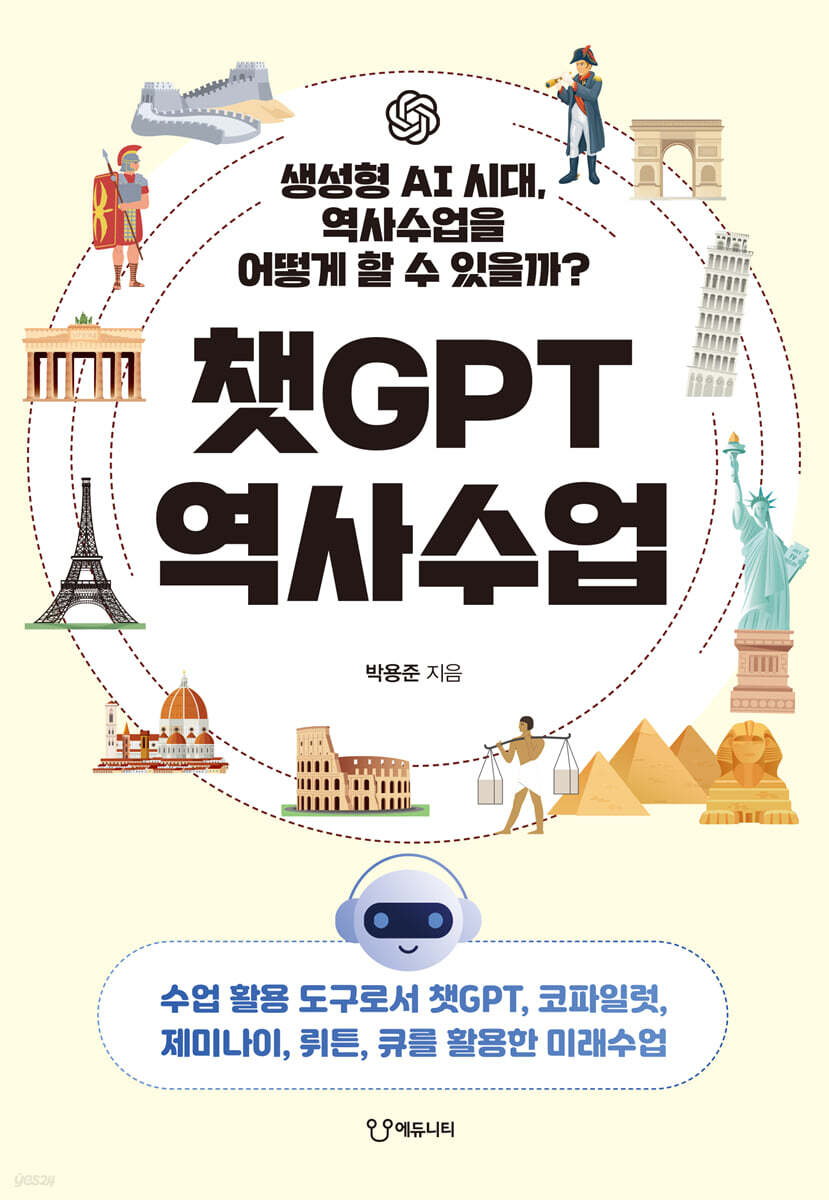
ChatGPT History Class
 |
Description
Book Introduction
In an era where people who are good at asking questions are important,
What can we do with ChatGPT?
ChatGPT has arrived.
When a human asks a question, ChatGPT automatically searches for the necessary knowledge or information, organizes it, and answers.
It not only responds with words or text, but also creates drawings, photos, music, videos, and even computer programs.
A world has opened up where you can achieve a lot just by asking good questions.
Rather than just worrying, we need to first talk about what we can do with ChatGPT.
Teachers are always burdened with guidance and administrative tasks, but they often lack time to prepare for class.
There are quite a few teachers who prepare for class even after they get home from work.
The author, confident that ChatGPT would be a great help in class preparation, planned "ChatGPT History Class" while considering how it could be helpful to teachers.
We present specific case studies in a scenario format, starting with what ChatGPT is and how to use it, how to use ChatGPT to search for knowledge, read foreign language materials, conduct 1:1 customized learning, develop imagination, and conduct virtual character interviews.
This book contains specific examples from class preparation to evaluation.
In particular, parts 3 and 4 contain lesson plans and assessment plans that can be used immediately in the classroom.
Please review ChatGPT as a teaching tool and revise it as needed.
What can we do with ChatGPT?
ChatGPT has arrived.
When a human asks a question, ChatGPT automatically searches for the necessary knowledge or information, organizes it, and answers.
It not only responds with words or text, but also creates drawings, photos, music, videos, and even computer programs.
A world has opened up where you can achieve a lot just by asking good questions.
Rather than just worrying, we need to first talk about what we can do with ChatGPT.
Teachers are always burdened with guidance and administrative tasks, but they often lack time to prepare for class.
There are quite a few teachers who prepare for class even after they get home from work.
The author, confident that ChatGPT would be a great help in class preparation, planned "ChatGPT History Class" while considering how it could be helpful to teachers.
We present specific case studies in a scenario format, starting with what ChatGPT is and how to use it, how to use ChatGPT to search for knowledge, read foreign language materials, conduct 1:1 customized learning, develop imagination, and conduct virtual character interviews.
This book contains specific examples from class preparation to evaluation.
In particular, parts 3 and 4 contain lesson plans and assessment plans that can be used immediately in the classroom.
Please review ChatGPT as a teaching tool and revise it as needed.
- You can preview some of the book's contents.
Preview
index
Introduction_ If artificial intelligence could help with history classes
Chapter 1.
Preparing for ChatGPT History Class
● Artificial Intelligence (AI) and Chat GPT
● Getting started with ChatGPT
How to Ask Good Questions to Get Good Answers from ChatGPT
Chapter 2.
Understanding Historical Knowledge with ChatGPT
● Search for historical knowledge
Ask for basic explanation
Ask about the background/cause/development/result/impact of the incident
Ask about people involved in historical events
Ask about events that occurred in other areas around the same time.
Ask if there are any similar cases
Ask for interpretation from a different perspective
● Reading historical materials
Translating historical materials in foreign languages
Identifying historically relevant images
● 1:1 customized learning
Ask for a description of the topic you want to learn about
Ask for comparison on similar topics
Take a quiz to test what you've learned
Creating an error notebook
Chapter 3.
Cultivating Historical Imagination with ChatGPT
Become a Time Traveler “Travel back in time and meet people and times.”
World History 2nd Period Lesson Plan
1st period.
Selecting a Time Travel Topic and Pre-Studying
2nd period.
Time travel and group activities
Examples of evaluation criteria for time travel using generative AI
● Virtual Interviews with Historical Figures “Chat in Real Time with Historical Figures”
Historical Figure Virtual Interview Lesson Plan
1st period.
Selecting and Pre-Studying Virtual Interviewees
2nd period.
Conducting virtual interviews and group activities
Example Evaluation Criteria for Virtual Interviews with Historical Figures
● Drawing historical images “From now on, I am a historical image designer.”
Drawing portraits of historical figures
Drawing historical buildings
Drawing historical events
Chapter 4.
Developing Historical Research Skills with ChatGPT
● Historical Simulation: "Develop your decision-making skills in the midst of history."
History Simulation Lesson Plan for the 2nd Period
1st period.
Selection of historical simulation subjects and pre-learning
2nd period.
History simulation classes and group activities
Example of Evaluation Criteria for History Simulation Classes
● Does ChatGPT Lie? "How to Avoid Being Fooled by AI's Lies"
Going Out_ The Future of History Classes Through Chat GPT
supplement.
Career and College Advancement Guidance for Aspiring History Teachers and History Students - Mock Interviews
Chapter 1.
Preparing for ChatGPT History Class
● Artificial Intelligence (AI) and Chat GPT
● Getting started with ChatGPT
How to Ask Good Questions to Get Good Answers from ChatGPT
Chapter 2.
Understanding Historical Knowledge with ChatGPT
● Search for historical knowledge
Ask for basic explanation
Ask about the background/cause/development/result/impact of the incident
Ask about people involved in historical events
Ask about events that occurred in other areas around the same time.
Ask if there are any similar cases
Ask for interpretation from a different perspective
● Reading historical materials
Translating historical materials in foreign languages
Identifying historically relevant images
● 1:1 customized learning
Ask for a description of the topic you want to learn about
Ask for comparison on similar topics
Take a quiz to test what you've learned
Creating an error notebook
Chapter 3.
Cultivating Historical Imagination with ChatGPT
Become a Time Traveler “Travel back in time and meet people and times.”
World History 2nd Period Lesson Plan
1st period.
Selecting a Time Travel Topic and Pre-Studying
2nd period.
Time travel and group activities
Examples of evaluation criteria for time travel using generative AI
● Virtual Interviews with Historical Figures “Chat in Real Time with Historical Figures”
Historical Figure Virtual Interview Lesson Plan
1st period.
Selecting and Pre-Studying Virtual Interviewees
2nd period.
Conducting virtual interviews and group activities
Example Evaluation Criteria for Virtual Interviews with Historical Figures
● Drawing historical images “From now on, I am a historical image designer.”
Drawing portraits of historical figures
Drawing historical buildings
Drawing historical events
Chapter 4.
Developing Historical Research Skills with ChatGPT
● Historical Simulation: "Develop your decision-making skills in the midst of history."
History Simulation Lesson Plan for the 2nd Period
1st period.
Selection of historical simulation subjects and pre-learning
2nd period.
History simulation classes and group activities
Example of Evaluation Criteria for History Simulation Classes
● Does ChatGPT Lie? "How to Avoid Being Fooled by AI's Lies"
Going Out_ The Future of History Classes Through Chat GPT
supplement.
Career and College Advancement Guidance for Aspiring History Teachers and History Students - Mock Interviews
Into the book
Rather than just worrying about it, I'd like to first talk about what we can do with ChatGPT.
One thing is for sure, it will be a great help in preparing for class.
When I first tried ChatGPT, I thought, 'This will be really convenient for teaching.'
Many teachers have to teach while struggling with student guidance and administrative work.
I have to prepare for class, but I always run out of time.
There are quite a few teachers who prepare for classes even after they get home from work.
I was thinking about how I could help such teachers, and that's how I came to write this book, "Chat GPT History Class."
--- p.5
Chat means that it operates by conversing with humans, G(Generative) means that it generates text, pictures, photos, music, videos, etc., and P(Pre-Trained) means that it has learned a vast amount of knowledge and information in advance.
The T at the end (Transformer) means that this artificial intelligence was created based on a model called Transformer.
--- p.16
The answers of generative AI, including ChatGPT, vary depending on the situation.
First, generative AI's answers vary depending on what explanation it has received from the person asking the question.
Second, the generative AI's answers will vary depending on how much it has grown over time answering similar questions.
Third, the answer will vary depending on what materials the generative AI has learned and references.
Fourth, the answer will vary depending on the type of generative AI.
Finally, the answer will vary depending on how detailed and accurate your question is.
--- p.49
For example, you could read a generative AI's answer and then ask it to correct or supplement it by saying things like, "Please give me another example," or "I need more explanation."
Meanwhile, you can also improve the content of your questions by asking generative AI questions like, “Is there anything you don’t understand about my question?” or “How should I ask the question?”
We hope that you will continue to exchange feedback with generative AI and utilize it more effectively.
--- p.53
Gemini answered in detail about how the Manjeok Rebellion was discovered in advance.
First, I summarized the circumstances that led to the rebellion being discovered in advance.
Next, we explain the process of how the rebellion plan was discovered in chronological order and speculate on what caused the discovery of the rebellion plan.
Although there are no clear records of the reasons for the discovery of the rebellion plan, he is analyzing the causes at the personal and social level.
Finally, we have described the impact of the discovery of the rebellion plan from several perspectives.
When asked about knowledge and information about a specific aspect of an event, such as its background, cause, development, outcome, and impact, generative AI only extracts information related to that aspect and provides an answer.
--- p.61
Many people are already using various translation tools such as Google Translate and Naver Papago.
But compared to these, generative AI can do more than simply translate sentences.
When translating content related to a certain historical event, if you use a general translator, the sentences are often translated verbatim without much consideration of the fact that the content is related to a certain historical event.
However, if you ask generative AI to translate, it will translate appropriately by considering the historical event the sentence is about and even provide detailed explanations of the relevant historical facts.
--- p.75
This chapter covers how to use generative AI to provide 1:1 personalized learning.
When teaching, there are often students who have trouble keeping up with the progress.
I want to teach those students calmly, but I have to move on to the next step, and there are many times when I worry.
In such cases, using conversational AI, we can guide students to learn on their own at a level appropriate to their understanding of the content they do not fully understand.
You can use generative AI to listen to supplementary explanations, take quizzes to check your understanding, and even organize your mistakes.
--- p.92
'Time Travel Performance' is a field that evaluates the ability of generative AI to actually perform time travel.
Since the topic of time travel is covered in history class, we made sure to cover it in a way that fits the curriculum.
And not only the subject matter, but also the time travel performance allowed us to experience the historical situation at that time.
We took care to ensure that the time travel wasn't unrelated to the class or too exciting.
--- p.132
Using generative AI to conduct 'virtual interviews with historical figures' would significantly reduce the time required.
And it's no longer an activity I do alone.
It's essentially talking to another person.
Generative AI can adequately recreate countless figures from history.
As a result, students can conduct virtual interviews as if they were talking to a real historical figure.
Even through real-time chat.
By conducting virtual interviews with various historical figures, you will learn about them and gain a different perspective on history.
Below is a world history lesson plan for 'Virtual Interviews with Historical Figures.'
--- p.134
You can use generative AI to create 'historical simulations' or even design your own.
Students make choices based on historical circumstances and conditions presented by generative AI, and understand the consequences of their choices.
You can also explore the consequences of other alternatives you might not have chosen.
In the process, students will come to recognize that decision-making is an important issue throughout history.
Not only that, you will develop the ability to think and reflect on what better decisions can be made.
--- p.180
We can expect that self-directed learning will become more important in future history classes.
Even if AI digital textbooks are fully implemented, if students only study the content contained within them, it will be worse than learning from traditional textbooks. AI textbooks will likely contain more historical knowledge and information than the actual texts in AI digital textbooks.
The knowledge and information contained therein will be available to students through continuous questioning and answering with AI.
I think the gap between students who do not have this ability will only widen further.
One thing is for sure, it will be a great help in preparing for class.
When I first tried ChatGPT, I thought, 'This will be really convenient for teaching.'
Many teachers have to teach while struggling with student guidance and administrative work.
I have to prepare for class, but I always run out of time.
There are quite a few teachers who prepare for classes even after they get home from work.
I was thinking about how I could help such teachers, and that's how I came to write this book, "Chat GPT History Class."
--- p.5
Chat means that it operates by conversing with humans, G(Generative) means that it generates text, pictures, photos, music, videos, etc., and P(Pre-Trained) means that it has learned a vast amount of knowledge and information in advance.
The T at the end (Transformer) means that this artificial intelligence was created based on a model called Transformer.
--- p.16
The answers of generative AI, including ChatGPT, vary depending on the situation.
First, generative AI's answers vary depending on what explanation it has received from the person asking the question.
Second, the generative AI's answers will vary depending on how much it has grown over time answering similar questions.
Third, the answer will vary depending on what materials the generative AI has learned and references.
Fourth, the answer will vary depending on the type of generative AI.
Finally, the answer will vary depending on how detailed and accurate your question is.
--- p.49
For example, you could read a generative AI's answer and then ask it to correct or supplement it by saying things like, "Please give me another example," or "I need more explanation."
Meanwhile, you can also improve the content of your questions by asking generative AI questions like, “Is there anything you don’t understand about my question?” or “How should I ask the question?”
We hope that you will continue to exchange feedback with generative AI and utilize it more effectively.
--- p.53
Gemini answered in detail about how the Manjeok Rebellion was discovered in advance.
First, I summarized the circumstances that led to the rebellion being discovered in advance.
Next, we explain the process of how the rebellion plan was discovered in chronological order and speculate on what caused the discovery of the rebellion plan.
Although there are no clear records of the reasons for the discovery of the rebellion plan, he is analyzing the causes at the personal and social level.
Finally, we have described the impact of the discovery of the rebellion plan from several perspectives.
When asked about knowledge and information about a specific aspect of an event, such as its background, cause, development, outcome, and impact, generative AI only extracts information related to that aspect and provides an answer.
--- p.61
Many people are already using various translation tools such as Google Translate and Naver Papago.
But compared to these, generative AI can do more than simply translate sentences.
When translating content related to a certain historical event, if you use a general translator, the sentences are often translated verbatim without much consideration of the fact that the content is related to a certain historical event.
However, if you ask generative AI to translate, it will translate appropriately by considering the historical event the sentence is about and even provide detailed explanations of the relevant historical facts.
--- p.75
This chapter covers how to use generative AI to provide 1:1 personalized learning.
When teaching, there are often students who have trouble keeping up with the progress.
I want to teach those students calmly, but I have to move on to the next step, and there are many times when I worry.
In such cases, using conversational AI, we can guide students to learn on their own at a level appropriate to their understanding of the content they do not fully understand.
You can use generative AI to listen to supplementary explanations, take quizzes to check your understanding, and even organize your mistakes.
--- p.92
'Time Travel Performance' is a field that evaluates the ability of generative AI to actually perform time travel.
Since the topic of time travel is covered in history class, we made sure to cover it in a way that fits the curriculum.
And not only the subject matter, but also the time travel performance allowed us to experience the historical situation at that time.
We took care to ensure that the time travel wasn't unrelated to the class or too exciting.
--- p.132
Using generative AI to conduct 'virtual interviews with historical figures' would significantly reduce the time required.
And it's no longer an activity I do alone.
It's essentially talking to another person.
Generative AI can adequately recreate countless figures from history.
As a result, students can conduct virtual interviews as if they were talking to a real historical figure.
Even through real-time chat.
By conducting virtual interviews with various historical figures, you will learn about them and gain a different perspective on history.
Below is a world history lesson plan for 'Virtual Interviews with Historical Figures.'
--- p.134
You can use generative AI to create 'historical simulations' or even design your own.
Students make choices based on historical circumstances and conditions presented by generative AI, and understand the consequences of their choices.
You can also explore the consequences of other alternatives you might not have chosen.
In the process, students will come to recognize that decision-making is an important issue throughout history.
Not only that, you will develop the ability to think and reflect on what better decisions can be made.
--- p.180
We can expect that self-directed learning will become more important in future history classes.
Even if AI digital textbooks are fully implemented, if students only study the content contained within them, it will be worse than learning from traditional textbooks. AI textbooks will likely contain more historical knowledge and information than the actual texts in AI digital textbooks.
The knowledge and information contained therein will be available to students through continuous questioning and answering with AI.
I think the gap between students who do not have this ability will only widen further.
--- p.223
Publisher's Review
ChatGPT as a class tool.
Future Classes Using Co-Pilot, Gemini, Luton, and Q
This is a step-by-step explanation of what ChatGPT is and how to use it, in a way that even teachers who didn't know what ChatGPT was can easily understand.
ChatGPT as a teaching tool, simple yet offers endless possibilities.
Chapter 1 briefly explains the basic concepts and operating principles of ChatGPT to help you understand them.
We also explain the most widely used generative AIs, such as ChatGPT, Copilot, Gemini, Luton, and Naver's Q, and introduce 'how to ask good questions' to get good answers.
Chapter 2 presents specific methods and examples for researching various knowledge and reading materials to prepare for history classes, as well as for one-on-one personalized learning.
You can ask questions about the background of a historical event, the people involved, whether there were similar events in other regions during that time, and even the perspectives.
We can even translate materials into foreign languages.
You can also ask about topics you want to learn for 1:1 personalized learning, take quizzes on what you've learned, and even create and download error notes.
These contents can be applied not only to history classes but to all classes.
Chapter 3 contains methods to develop historical imagination by using ‘Becoming a Time Traveler,’ ‘Virtual Interviews with Historical Figures,’ and ‘Drawing Historical Images.’
This chapter presents specific lesson plans and assessment plans as examples so that teachers can immediately apply and utilize them as needed.
Chapter 4 includes examples of lesson plans and assessment plans that can help students develop critical thinking skills through 'history simulation activities.'
Additionally, for students aspiring to become history teachers or history students, we have included a 'ChatGPT-based mock interview scenario' as an appendix for career and academic guidance.
I hope this book will be of some help to teachers in the field and students who dream of becoming history teachers.
Future Classes Using Co-Pilot, Gemini, Luton, and Q
This is a step-by-step explanation of what ChatGPT is and how to use it, in a way that even teachers who didn't know what ChatGPT was can easily understand.
ChatGPT as a teaching tool, simple yet offers endless possibilities.
Chapter 1 briefly explains the basic concepts and operating principles of ChatGPT to help you understand them.
We also explain the most widely used generative AIs, such as ChatGPT, Copilot, Gemini, Luton, and Naver's Q, and introduce 'how to ask good questions' to get good answers.
Chapter 2 presents specific methods and examples for researching various knowledge and reading materials to prepare for history classes, as well as for one-on-one personalized learning.
You can ask questions about the background of a historical event, the people involved, whether there were similar events in other regions during that time, and even the perspectives.
We can even translate materials into foreign languages.
You can also ask about topics you want to learn for 1:1 personalized learning, take quizzes on what you've learned, and even create and download error notes.
These contents can be applied not only to history classes but to all classes.
Chapter 3 contains methods to develop historical imagination by using ‘Becoming a Time Traveler,’ ‘Virtual Interviews with Historical Figures,’ and ‘Drawing Historical Images.’
This chapter presents specific lesson plans and assessment plans as examples so that teachers can immediately apply and utilize them as needed.
Chapter 4 includes examples of lesson plans and assessment plans that can help students develop critical thinking skills through 'history simulation activities.'
Additionally, for students aspiring to become history teachers or history students, we have included a 'ChatGPT-based mock interview scenario' as an appendix for career and academic guidance.
I hope this book will be of some help to teachers in the field and students who dream of becoming history teachers.
GOODS SPECIFICS
- Date of issue: July 18, 2024
- Page count, weight, size: 248 pages | 398g | 145*210*16mm
- ISBN13: 9791164251650
- ISBN10: 1164251651
You may also like
카테고리
korean


korean

![GQ KOREA Mark (Monthly): December [2025]](http://librairie.coreenne.fr/cdn/shop/files/8ef265dbbfbf186523ed75ba7319009d.jpg?v=1765340328&width=3840)


