

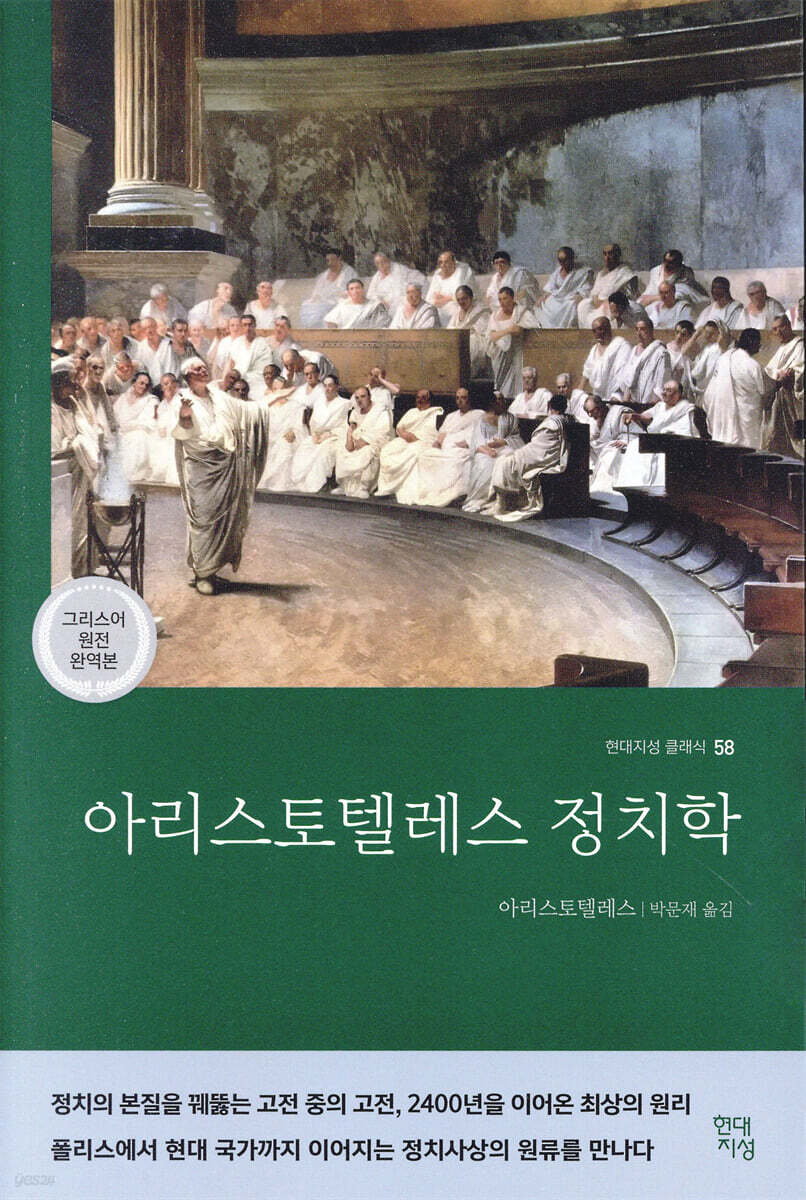
Aristotle's Politics (Complete Translation of the Greek Original)
 |
Description
Book Introduction
From the police to the modern state
Encounter the origins of political thought
Complete translation of the Greek original
Aristotle's Politics is considered a masterpiece of ancient Greek political thought.
Aristotle systematically analyzed the political structures of 158 city-states of his time and explored the nature of the state and political system based on extensive data.
Aristotle, who lived through turbulent times and witnessed firsthand the ideals and limitations of democracy, intensely explored the ideal state, the conditions for a desirable political system, the qualifications and virtues of citizens, and the causes and solutions to political instability.
His political thought is based on the view of humanity and ethics established in the Nicomachean Ethics.
He defines the nation as the “best community” for realizing individual happiness and emphasizes that the ultimate goal of politics is to cultivate the virtues of just citizens.
It organically examines all elements of national governance, including education, legislation, national defense, and the economy, and provides in-depth insight.
It is considered a classic among classics in that it develops and inherits the idealistic utopian theory of its teacher Plato, but presents a blueprint for an ideal state in a more realistic context.
After closely examining various forms of government, including democracy, oligarchy, and aristocracy, he emphasized that a mixed government that seeks harmony and balance among them is the most stable and desirable form of government.
He proposed gradual reform rather than radical revolution, and a politics of moderation that does not lean to either side as his ideal.
In particular, it emphasizes that politics based on 'publicness', which aims for the good of the entire community rather than the private interests of individuals, classes, or political parties, is the most important virtue.
The translator, who has demonstrated his ability to satisfy both the depth of the classics and readability for modern readers through his translation of Aristotle's Nicomachean Ethics, Rhetoric, and Poetics from the original Greek, has faithfully preserved the depth and context of Aristotle's thought in this book with 404 meticulous footnotes and high-quality commentary that provides a glimpse into his overall thoughts.
It will serve as an invaluable guide for intellectuals of this era who seek to fundamentally explore the raison d'être of the nation and political community and to seek a desirable direction for politics and society.
Encounter the origins of political thought
Complete translation of the Greek original
Aristotle's Politics is considered a masterpiece of ancient Greek political thought.
Aristotle systematically analyzed the political structures of 158 city-states of his time and explored the nature of the state and political system based on extensive data.
Aristotle, who lived through turbulent times and witnessed firsthand the ideals and limitations of democracy, intensely explored the ideal state, the conditions for a desirable political system, the qualifications and virtues of citizens, and the causes and solutions to political instability.
His political thought is based on the view of humanity and ethics established in the Nicomachean Ethics.
He defines the nation as the “best community” for realizing individual happiness and emphasizes that the ultimate goal of politics is to cultivate the virtues of just citizens.
It organically examines all elements of national governance, including education, legislation, national defense, and the economy, and provides in-depth insight.
It is considered a classic among classics in that it develops and inherits the idealistic utopian theory of its teacher Plato, but presents a blueprint for an ideal state in a more realistic context.
After closely examining various forms of government, including democracy, oligarchy, and aristocracy, he emphasized that a mixed government that seeks harmony and balance among them is the most stable and desirable form of government.
He proposed gradual reform rather than radical revolution, and a politics of moderation that does not lean to either side as his ideal.
In particular, it emphasizes that politics based on 'publicness', which aims for the good of the entire community rather than the private interests of individuals, classes, or political parties, is the most important virtue.
The translator, who has demonstrated his ability to satisfy both the depth of the classics and readability for modern readers through his translation of Aristotle's Nicomachean Ethics, Rhetoric, and Poetics from the original Greek, has faithfully preserved the depth and context of Aristotle's thought in this book with 404 meticulous footnotes and high-quality commentary that provides a glimpse into his overall thoughts.
It will serve as an invaluable guide for intellectuals of this era who seek to fundamentally explore the raison d'être of the nation and political community and to seek a desirable direction for politics and society.
- You can preview some of the book's contents.
Preview
index
Volume 1.
Family and Country
Chapter 1: The State as the Best Community
Chapter 2: The Process of Formation of the Nation
Chapter 3: Components of a Family
Chapter 4: The Nature and Role of Slaves
Chapter 5: Slavery by Nature
Chapter 6: On the practice of enslaving prisoners of war
Chapter 7 Master and Slave
Chapter 8: The Natural and Essential Skills of Acquiring Wealth
Chapter 9: Commerce, the Non-Natural and Non-Essential Art of Acquiring Wealth
Chapter 10: Conclusions on the Relationship Between Household Management Skills and Property Acquisition Skills
Chapter 11: The Need for Practical Application of Property Acquisition Techniques
Chapter 12: The Art of Governing Children and Wife
Chapter 13: Are the Virtues of the Ruler and the Ruled the Same?
Volume 2.
General Overview of Political Systems
Chapter 1 Introduction
Chapter 2: Should the State Become a Monolith?
Chapter 3: The Sharing of Women and Children Does Not Make the Nation a Single Entity
Chapter 4: The Abuses of Sharing a Woman and a Child
Chapter 5: Criticizing Socrates' Ideal Republic
Chapter 6: Critique of the political system presented by Plato in the Laws
Chapter 7: Criticism of the Equalization of Property Proposed by Phaleas
Chapter 8: Criticism of the State System Envisioned by Hippodamus
Chapter 9: Sparta's Political System
Chapter 10: The Political System of Crete
Chapter 11: The Political System of Carthage
Chapter 12 General Commentary on Various Legislators
Volume 3.
Types of political systems
Chapter 1 Definition of Citizen
Chapter 2: Do Parents Need to Be Citizens to Become a Citizen?
Chapter 3: The Problem of National Identity
Chapter 4: Human Virtue and Civic Virtue
Chapter 5: Conclusion on Civil Issues
Chapter 6: The Good Life as the Purpose of Individuals and Communities
Chapter 7 Types of Political Systems
Chapter 8: Redefining Oligarchy and Democracy
Chapter 9: The Definition of Democracy and Oligarchy
Chapter 10: The question of the attribution of the highest power of the state
Chapter 11: The Supreme Power of the State Should Be Held by the Majority
Chapter 12: The State and Justice
Chapter 13: Who Rules Justly?
Chapter 14 Types of Monarchy
Chapter 15: Does Monarchy Serve the National Interest?
Chapter 16: The Logic of Those Who Oppose Absolute Monarchy
Chapter 17: Monarchy, Aristocracy, or Mixed Government?
Chapter 18 Conclusion
Volume 4.
Various political systems in reality
Chapter 1: Why We Should Study Feasible Political Systems and Laws
Chapter 2: Which Political Systems Should We Consider?
Chapter 3: The Relationship Between Mixed Government, Oligarchy, and Democracy
Chapter 4 Types of Democracy
Chapter 5 Types of Oligarchy
Chapter 6: Types of Democracy and Oligarchy as Seen Through the Process of Change
Chapter 7 Types of Aristocracy
Chapter 8: What is a Mixed Judgment?
Chapter 9 Composition of Mixed Definitions
Chapter 10 Types of Tyranny
Chapter 11: What is the best political system?
Chapter 12: How is a nation's political system determined?
Chapter 13: Methods for Maintaining Mixtures
Chapter 14 Deliberation Section
Chapter 15 Public Service Sector
Chapter 16 Trial Section
Volume 5.
Transformation of the political system
Chapter 1: Inequality as a Common Cause of Conflict and Change
Chapter 2: Specific Origins and Causes of the Dispute
Chapter 3: Specific Cases for Each Cause (1)
Chapter 4: Specific Cases for Each Cause (2)
Chapter 5: Democracy and the Transformation of the Political System
Chapter 6: Oligarchy and the Transformation of the Political System
Chapter 7: Aristocracy and the Transformation of the Political System
Chapter 8: Causes of the Destruction of Democracy and Oligarchy
Chapter 9: Causes of Preserving Democracy and Oligarchy
Chapter 10: Causes of the Destruction of Tyranny and Monarchy
Chapter 11: Causes for Preserving Monarchy
Chapter 12 Conclusion
Volume 6.
Organization of various types of democracy and oligarchy
Chapter 1 Introduction
Chapter 2: Common Features and Organization of All Types of Democracy
Chapter 3: How Can Equality Be Secured?
Chapter 4 Types of Democracy According to the Composition of the People
Chapter 5: The Proper Organization of Democracy
Chapter 6. Various types of oligarchy according to property qualifications
Chapter 7. Different Types of Oligarchy According to the Military
Chapter 8 Organization of Public Service
Volume 7.
The best political system
Chapter 1: The Best Life for Individuals and Nations
Chapter 2: Individual Happiness and National Happiness
Chapter 3: Political Life and Philosophical Life
Chapter 4 Population
Chapter 5 Territory
Chapter 6 Ports and the Navy
Chapter 7: Citizen Character
Chapter 8: What is essential to the state
Chapter 9: What Citizens Should Do
Chapter 10 Distribution of Land
Chapter 11: City Location and Facilities
Chapter 12 Location of Urban Facilities
Chapter 13: A Good Citizen
Chapter 14: How to Educate Citizens
Chapter 15: Goals of Civic Education
Chapter 16: Childbirth
Chapter 17 Parenting
Volume 8.
Youth education in the best political system
Chapter 1: The Importance of Youth Education
Chapter 2: What to Learn
Chapter 3 Four Subjects
Chapter 4 Physical Education
Chapter 5: The Power and Uses of Music
Chapter 6: How to Conduct Music Education
Chapter 7: Mode and Rhythm
Release | Park Moon-jae
Aristotle's Chronology
Family and Country
Chapter 1: The State as the Best Community
Chapter 2: The Process of Formation of the Nation
Chapter 3: Components of a Family
Chapter 4: The Nature and Role of Slaves
Chapter 5: Slavery by Nature
Chapter 6: On the practice of enslaving prisoners of war
Chapter 7 Master and Slave
Chapter 8: The Natural and Essential Skills of Acquiring Wealth
Chapter 9: Commerce, the Non-Natural and Non-Essential Art of Acquiring Wealth
Chapter 10: Conclusions on the Relationship Between Household Management Skills and Property Acquisition Skills
Chapter 11: The Need for Practical Application of Property Acquisition Techniques
Chapter 12: The Art of Governing Children and Wife
Chapter 13: Are the Virtues of the Ruler and the Ruled the Same?
Volume 2.
General Overview of Political Systems
Chapter 1 Introduction
Chapter 2: Should the State Become a Monolith?
Chapter 3: The Sharing of Women and Children Does Not Make the Nation a Single Entity
Chapter 4: The Abuses of Sharing a Woman and a Child
Chapter 5: Criticizing Socrates' Ideal Republic
Chapter 6: Critique of the political system presented by Plato in the Laws
Chapter 7: Criticism of the Equalization of Property Proposed by Phaleas
Chapter 8: Criticism of the State System Envisioned by Hippodamus
Chapter 9: Sparta's Political System
Chapter 10: The Political System of Crete
Chapter 11: The Political System of Carthage
Chapter 12 General Commentary on Various Legislators
Volume 3.
Types of political systems
Chapter 1 Definition of Citizen
Chapter 2: Do Parents Need to Be Citizens to Become a Citizen?
Chapter 3: The Problem of National Identity
Chapter 4: Human Virtue and Civic Virtue
Chapter 5: Conclusion on Civil Issues
Chapter 6: The Good Life as the Purpose of Individuals and Communities
Chapter 7 Types of Political Systems
Chapter 8: Redefining Oligarchy and Democracy
Chapter 9: The Definition of Democracy and Oligarchy
Chapter 10: The question of the attribution of the highest power of the state
Chapter 11: The Supreme Power of the State Should Be Held by the Majority
Chapter 12: The State and Justice
Chapter 13: Who Rules Justly?
Chapter 14 Types of Monarchy
Chapter 15: Does Monarchy Serve the National Interest?
Chapter 16: The Logic of Those Who Oppose Absolute Monarchy
Chapter 17: Monarchy, Aristocracy, or Mixed Government?
Chapter 18 Conclusion
Volume 4.
Various political systems in reality
Chapter 1: Why We Should Study Feasible Political Systems and Laws
Chapter 2: Which Political Systems Should We Consider?
Chapter 3: The Relationship Between Mixed Government, Oligarchy, and Democracy
Chapter 4 Types of Democracy
Chapter 5 Types of Oligarchy
Chapter 6: Types of Democracy and Oligarchy as Seen Through the Process of Change
Chapter 7 Types of Aristocracy
Chapter 8: What is a Mixed Judgment?
Chapter 9 Composition of Mixed Definitions
Chapter 10 Types of Tyranny
Chapter 11: What is the best political system?
Chapter 12: How is a nation's political system determined?
Chapter 13: Methods for Maintaining Mixtures
Chapter 14 Deliberation Section
Chapter 15 Public Service Sector
Chapter 16 Trial Section
Volume 5.
Transformation of the political system
Chapter 1: Inequality as a Common Cause of Conflict and Change
Chapter 2: Specific Origins and Causes of the Dispute
Chapter 3: Specific Cases for Each Cause (1)
Chapter 4: Specific Cases for Each Cause (2)
Chapter 5: Democracy and the Transformation of the Political System
Chapter 6: Oligarchy and the Transformation of the Political System
Chapter 7: Aristocracy and the Transformation of the Political System
Chapter 8: Causes of the Destruction of Democracy and Oligarchy
Chapter 9: Causes of Preserving Democracy and Oligarchy
Chapter 10: Causes of the Destruction of Tyranny and Monarchy
Chapter 11: Causes for Preserving Monarchy
Chapter 12 Conclusion
Volume 6.
Organization of various types of democracy and oligarchy
Chapter 1 Introduction
Chapter 2: Common Features and Organization of All Types of Democracy
Chapter 3: How Can Equality Be Secured?
Chapter 4 Types of Democracy According to the Composition of the People
Chapter 5: The Proper Organization of Democracy
Chapter 6. Various types of oligarchy according to property qualifications
Chapter 7. Different Types of Oligarchy According to the Military
Chapter 8 Organization of Public Service
Volume 7.
The best political system
Chapter 1: The Best Life for Individuals and Nations
Chapter 2: Individual Happiness and National Happiness
Chapter 3: Political Life and Philosophical Life
Chapter 4 Population
Chapter 5 Territory
Chapter 6 Ports and the Navy
Chapter 7: Citizen Character
Chapter 8: What is essential to the state
Chapter 9: What Citizens Should Do
Chapter 10 Distribution of Land
Chapter 11: City Location and Facilities
Chapter 12 Location of Urban Facilities
Chapter 13: A Good Citizen
Chapter 14: How to Educate Citizens
Chapter 15: Goals of Civic Education
Chapter 16: Childbirth
Chapter 17 Parenting
Volume 8.
Youth education in the best political system
Chapter 1: The Importance of Youth Education
Chapter 2: What to Learn
Chapter 3 Four Subjects
Chapter 4 Physical Education
Chapter 5: The Power and Uses of Music
Chapter 6: How to Conduct Music Education
Chapter 7: Mode and Rhythm
Release | Park Moon-jae
Aristotle's Chronology
Detailed image

Into the book
It is important to understand that nature provides all living things with the resources they need from the moment they are born until they grow.
Among animals, there are some that provide their young with all the necessary food from the moment they are born until they are able to fend for themselves.
Examples include animals that lay larvae or eggs.
Viviparous animals give birth to their young after they have grown to a certain extent, and at this time they store food in their bodies that can be provided to the young for a certain period of time. We call this milk.
This applies equally to grown living things, and we must understand that plants exist for animals, and other animals exist for humans.
Domesticated animals, or livestock, exist for various purposes and as food, and most wild animals help humans by providing food as well as various tools, including clothing.
If we recognize that nature does not create anything without purpose or uselessness, we can conclude that everything nature creates is for human beings.
Accordingly, hunting skills are part of the skills of war, and are essentially skills for acquiring property.
--- From "Natural and Essential Wealth Acquisition Skills"
The most important characteristic of a full citizen is participation in trials and public office.
Some public offices have limited terms, meaning a person cannot hold them twice or must wait a certain period of time before being able to hold them again.
However, public offices such as jurors and members of the public have no term limits.
Some may argue that serving on a jury or as a member of the public service committee is not a public service, but it is not appropriate to exclude the highest office of the state.
Even if there is no name that encompasses both jurors and members of the public, there is no need to raise an issue about that.
You can just call it a public office without a term of office.
Therefore, we define people who hold public office as citizens.
This is the definition that best describes all people who are called citizens.
--- From "Citizen's Justice"
We must first determine for what purpose the state was organized, and what kinds of systems of government there are for governing people and their communal life.
At the beginning of this book, when we considered the management of the home and the management of slaves by masters, we said that man is by nature a political animal.
So even if people have no need for help from each other, their desire to live together never diminishes.
But common interests are also an important factor in bringing people together as a community.
Within a community, all members strive for a good life, which becomes the goal of both the community and the individual.
But the fundamental reason why people form national communities is survival.
Even though life is difficult and arduous, it has value in itself, so most people show the will to overcome adversity and live on.
This is because life inherently contains happiness and joy.
It is not difficult to distinguish between ways of governing people.
Because I have frequently addressed this issue in my published writings.
One of them is the master ruling the slave.
This rule is essentially beneficial to both slave and master, but it is primarily for the benefit of the master, with the slave's interests often considered only incidentally.
When a slave dies, the master cannot rule over the slave, so the slave is also given certain benefits.
--- From "A Good Life as the Purpose of Individuals and Communities"
Some people today think of democracy as simply a political system in which the majority holds the highest power in the country.
But this is a misunderstanding.
In all political systems, including oligarchy, the supreme power of the state usually belongs to the majority.
Also, it is a mistake to think of oligarchy as a political system in which only a few people have ultimate power.
For example, suppose that in a country of 1,300 people, 1,000 are rich and the remaining 300 are poor, but free citizens equal to the rich in all other respects.
In this case, no one would call a country a democracy if 300 poor people cannot get public office and the majority of the wealthy have the highest power.
Conversely, if the poor, though a minority, were to wield more influence than the wealthy, who are the majority, and thus exclude the rich from public office, no one would call such a system an oligarchy.
Therefore, if the highest power of the country is held by the free people, it can be seen as a democracy, and if it is held by the rich, it can be seen as an oligarchy.
The supreme power of the state is vested in the majority in the former case, and in the minority in the latter, simply because there are many free people and few rich people.
Otherwise, if you were to allocate public offices to tall people or, as some say, good-looking people in Ethiopia, you'd end up with an oligarchy.
Because there are only a few good-looking or tall people.
--- From "Types of Democracy"
What is the most ideal political system for the majority of nations and people, and what is the best life they should pursue? To find the answer to this question, we need to consider not education or an ideal political system that can be achieved solely through innate talent or wealth, but rather a life in which the majority of people can participate and a political system in which the majority of nations can participate.
At this time, most of the aristocratic governments mentioned previously are not suitable for the country, and some are very similar to mixed governments, so there is no need to discuss them separately.
However, all these problems can be solved by following the same principles.
As I mentioned in Ethics, a happy life is one lived according to virtue without any hindrance, and if it is correct to say that virtue is moderation, then the life of moderation that anyone can live is the best life.
However, since the political system is the very life of a country, the same standards apply when evaluating the good and bad of a country and its political system.
Every country is basically made up of three parts.
The first is the rich, the second is the poor, and the third is the middle class between the two.
If you think that moderation and the middle are best, then the middle will also be best when it comes to possessing all the gifts of fortune.
Such people are prone to obey reason, whereas those who are too great, too strong, too well-born, too rich, or, conversely, too poor, too weak, or too lowly, find it difficult to follow reason.
The former becomes reckless and commits major crimes, while the latter becomes a gangster and commits minor crimes.
The former commits sin because of arrogance, and the latter commits sin because of wickedness.
Both avoiding public office and coveting it are detrimental to the nation, but the middle class is the least prone to both.
--- From "What is the best political system?"
In democracies, change often occurs because the rabble rouses.
Demagogues falsely accuse the wealthy individually and bring them down, while also inciting the masses to attack the wealthy class as a whole.
Then, no matter how badly people get along, they tend to unite when faced with a common threat, and so the rich end up sticking together.
We see this happen often.
For example, in the course, democracy was transformed as the nobles united due to the appearance of evil rabble-rousers.
The democracy in Rhodes was also transformed because the agitators paid the citizens but not the triremes, and when the triremes were brought to trial, the people had no choice but to unite and overthrow the democracy.
In Heracleia, too, democracy collapsed shortly after the colonization because of popular agitators.
This is because the nobles who fled the city due to persecution by the agitators gathered their forces and returned to the country to overthrow democracy.
Likewise, democracy collapsed in Megara in the same way.
The agitators of the people expelled many nobles in order to confiscate their property and return it to the national treasury. As the number of expelled nobles increased, they gathered their forces, returned to the country, fought against the people, and defeated them, establishing an oligarchy.
The same thing happened in Cyme, where the democracy was overthrown by Thrasymachus.
--- From "Democracy and the Transformation of the Political System"
The common principle of all political systems, from democracy to oligarchy to monarchy, is that no one should acquire too much power over another.
To this end, the terms of office for minor public offices should be long, and those for major public offices should be short.
This is because people are easily corrupted and not everyone can shoulder the responsibilities of power.
Therefore, power should not be granted all at once, but should be given in stages, and likewise, it should not be taken away all at once, but should be gradually recovered.
In particular, there should be legal measures in place to prevent anyone from using their connections or financial resources to gain excessive power.
If that doesn't work, those people should be expelled from the country.
--- From "Causes that destroy democracy and oligarchy"
This can be easily understood even if we consider it theoretically.
External goodness, like all tools, has its limits.
Because every tool is only useful for something specific.
So, if there is too much external goodness beyond what is necessary, it can be harmful or of no benefit to the person who has it.
On the other hand, the more good things related to the soul, the more useful they are.
I'm not sure if it's appropriate to use the word useful rather than excellent for something good related to the soul.
In general, the superiority of something over its best state is determined by what object it is related to.
Therefore, since the soul is more important than property or the body, either in itself or in relation to us, when comparing the state of the soul at its best with the state of property or the body at its best, the soul should naturally take precedence.
Moreover, the choices we make for our wealth or good physical condition are ultimately for the sake of our soul.
It is clear that all sensible people would not sacrifice their souls for property and body.
Therefore, we must agree that happiness is given to each person in proportion to the virtue and wisdom he possesses and the actions he takes in accordance with them.
God can be cited as a witness to prove this.
God's happiness and blessings are not due to any external goodness that God possesses, but to God himself and something that God possesses by nature.
Therefore, luck cannot be the same as happiness.
For external good things outside the soul may be obtained by chance and luck, but justice or moderation can never be obtained by chance or exist by chance.
If we follow this logic, we can conclude that a happy nation, a nation that is well-governed, is the best nation.
But a well-run nation cannot exist without people who do well.
And there is no good action, whether of an individual or a nation, without virtue and wisdom.
The courage, justice, wisdom, and moderation of a nation are deeply connected in their meaning and form with the courageous, just, wise, and moderating actions of all its citizens.
--- From "The Best Life of an Individual and a Nation"
It is clear that the best political system is one that allows everyone to behave well and live happily.
But even among those who agree that a life of virtue is the most desirable, there is disagreement as to whether a practical life involving participation in state affairs is preferable, or a life free from all externals, a contemplative life fit only for philosophers.
For those who, past or present, make every effort to live according to virtue, choose both these lives: the political life and the philosophical life.
The truth about which of these two lives is more desirable is by no means a trivial matter.
Because it is only right that any conscious person, whether an individual or an entire nation, should aim for a better goal.
Among animals, there are some that provide their young with all the necessary food from the moment they are born until they are able to fend for themselves.
Examples include animals that lay larvae or eggs.
Viviparous animals give birth to their young after they have grown to a certain extent, and at this time they store food in their bodies that can be provided to the young for a certain period of time. We call this milk.
This applies equally to grown living things, and we must understand that plants exist for animals, and other animals exist for humans.
Domesticated animals, or livestock, exist for various purposes and as food, and most wild animals help humans by providing food as well as various tools, including clothing.
If we recognize that nature does not create anything without purpose or uselessness, we can conclude that everything nature creates is for human beings.
Accordingly, hunting skills are part of the skills of war, and are essentially skills for acquiring property.
--- From "Natural and Essential Wealth Acquisition Skills"
The most important characteristic of a full citizen is participation in trials and public office.
Some public offices have limited terms, meaning a person cannot hold them twice or must wait a certain period of time before being able to hold them again.
However, public offices such as jurors and members of the public have no term limits.
Some may argue that serving on a jury or as a member of the public service committee is not a public service, but it is not appropriate to exclude the highest office of the state.
Even if there is no name that encompasses both jurors and members of the public, there is no need to raise an issue about that.
You can just call it a public office without a term of office.
Therefore, we define people who hold public office as citizens.
This is the definition that best describes all people who are called citizens.
--- From "Citizen's Justice"
We must first determine for what purpose the state was organized, and what kinds of systems of government there are for governing people and their communal life.
At the beginning of this book, when we considered the management of the home and the management of slaves by masters, we said that man is by nature a political animal.
So even if people have no need for help from each other, their desire to live together never diminishes.
But common interests are also an important factor in bringing people together as a community.
Within a community, all members strive for a good life, which becomes the goal of both the community and the individual.
But the fundamental reason why people form national communities is survival.
Even though life is difficult and arduous, it has value in itself, so most people show the will to overcome adversity and live on.
This is because life inherently contains happiness and joy.
It is not difficult to distinguish between ways of governing people.
Because I have frequently addressed this issue in my published writings.
One of them is the master ruling the slave.
This rule is essentially beneficial to both slave and master, but it is primarily for the benefit of the master, with the slave's interests often considered only incidentally.
When a slave dies, the master cannot rule over the slave, so the slave is also given certain benefits.
--- From "A Good Life as the Purpose of Individuals and Communities"
Some people today think of democracy as simply a political system in which the majority holds the highest power in the country.
But this is a misunderstanding.
In all political systems, including oligarchy, the supreme power of the state usually belongs to the majority.
Also, it is a mistake to think of oligarchy as a political system in which only a few people have ultimate power.
For example, suppose that in a country of 1,300 people, 1,000 are rich and the remaining 300 are poor, but free citizens equal to the rich in all other respects.
In this case, no one would call a country a democracy if 300 poor people cannot get public office and the majority of the wealthy have the highest power.
Conversely, if the poor, though a minority, were to wield more influence than the wealthy, who are the majority, and thus exclude the rich from public office, no one would call such a system an oligarchy.
Therefore, if the highest power of the country is held by the free people, it can be seen as a democracy, and if it is held by the rich, it can be seen as an oligarchy.
The supreme power of the state is vested in the majority in the former case, and in the minority in the latter, simply because there are many free people and few rich people.
Otherwise, if you were to allocate public offices to tall people or, as some say, good-looking people in Ethiopia, you'd end up with an oligarchy.
Because there are only a few good-looking or tall people.
--- From "Types of Democracy"
What is the most ideal political system for the majority of nations and people, and what is the best life they should pursue? To find the answer to this question, we need to consider not education or an ideal political system that can be achieved solely through innate talent or wealth, but rather a life in which the majority of people can participate and a political system in which the majority of nations can participate.
At this time, most of the aristocratic governments mentioned previously are not suitable for the country, and some are very similar to mixed governments, so there is no need to discuss them separately.
However, all these problems can be solved by following the same principles.
As I mentioned in Ethics, a happy life is one lived according to virtue without any hindrance, and if it is correct to say that virtue is moderation, then the life of moderation that anyone can live is the best life.
However, since the political system is the very life of a country, the same standards apply when evaluating the good and bad of a country and its political system.
Every country is basically made up of three parts.
The first is the rich, the second is the poor, and the third is the middle class between the two.
If you think that moderation and the middle are best, then the middle will also be best when it comes to possessing all the gifts of fortune.
Such people are prone to obey reason, whereas those who are too great, too strong, too well-born, too rich, or, conversely, too poor, too weak, or too lowly, find it difficult to follow reason.
The former becomes reckless and commits major crimes, while the latter becomes a gangster and commits minor crimes.
The former commits sin because of arrogance, and the latter commits sin because of wickedness.
Both avoiding public office and coveting it are detrimental to the nation, but the middle class is the least prone to both.
--- From "What is the best political system?"
In democracies, change often occurs because the rabble rouses.
Demagogues falsely accuse the wealthy individually and bring them down, while also inciting the masses to attack the wealthy class as a whole.
Then, no matter how badly people get along, they tend to unite when faced with a common threat, and so the rich end up sticking together.
We see this happen often.
For example, in the course, democracy was transformed as the nobles united due to the appearance of evil rabble-rousers.
The democracy in Rhodes was also transformed because the agitators paid the citizens but not the triremes, and when the triremes were brought to trial, the people had no choice but to unite and overthrow the democracy.
In Heracleia, too, democracy collapsed shortly after the colonization because of popular agitators.
This is because the nobles who fled the city due to persecution by the agitators gathered their forces and returned to the country to overthrow democracy.
Likewise, democracy collapsed in Megara in the same way.
The agitators of the people expelled many nobles in order to confiscate their property and return it to the national treasury. As the number of expelled nobles increased, they gathered their forces, returned to the country, fought against the people, and defeated them, establishing an oligarchy.
The same thing happened in Cyme, where the democracy was overthrown by Thrasymachus.
--- From "Democracy and the Transformation of the Political System"
The common principle of all political systems, from democracy to oligarchy to monarchy, is that no one should acquire too much power over another.
To this end, the terms of office for minor public offices should be long, and those for major public offices should be short.
This is because people are easily corrupted and not everyone can shoulder the responsibilities of power.
Therefore, power should not be granted all at once, but should be given in stages, and likewise, it should not be taken away all at once, but should be gradually recovered.
In particular, there should be legal measures in place to prevent anyone from using their connections or financial resources to gain excessive power.
If that doesn't work, those people should be expelled from the country.
--- From "Causes that destroy democracy and oligarchy"
This can be easily understood even if we consider it theoretically.
External goodness, like all tools, has its limits.
Because every tool is only useful for something specific.
So, if there is too much external goodness beyond what is necessary, it can be harmful or of no benefit to the person who has it.
On the other hand, the more good things related to the soul, the more useful they are.
I'm not sure if it's appropriate to use the word useful rather than excellent for something good related to the soul.
In general, the superiority of something over its best state is determined by what object it is related to.
Therefore, since the soul is more important than property or the body, either in itself or in relation to us, when comparing the state of the soul at its best with the state of property or the body at its best, the soul should naturally take precedence.
Moreover, the choices we make for our wealth or good physical condition are ultimately for the sake of our soul.
It is clear that all sensible people would not sacrifice their souls for property and body.
Therefore, we must agree that happiness is given to each person in proportion to the virtue and wisdom he possesses and the actions he takes in accordance with them.
God can be cited as a witness to prove this.
God's happiness and blessings are not due to any external goodness that God possesses, but to God himself and something that God possesses by nature.
Therefore, luck cannot be the same as happiness.
For external good things outside the soul may be obtained by chance and luck, but justice or moderation can never be obtained by chance or exist by chance.
If we follow this logic, we can conclude that a happy nation, a nation that is well-governed, is the best nation.
But a well-run nation cannot exist without people who do well.
And there is no good action, whether of an individual or a nation, without virtue and wisdom.
The courage, justice, wisdom, and moderation of a nation are deeply connected in their meaning and form with the courageous, just, wise, and moderating actions of all its citizens.
--- From "The Best Life of an Individual and a Nation"
It is clear that the best political system is one that allows everyone to behave well and live happily.
But even among those who agree that a life of virtue is the most desirable, there is disagreement as to whether a practical life involving participation in state affairs is preferable, or a life free from all externals, a contemplative life fit only for philosophers.
For those who, past or present, make every effort to live according to virtue, choose both these lives: the political life and the philosophical life.
The truth about which of these two lives is more desirable is by no means a trivial matter.
Because it is only right that any conscious person, whether an individual or an entire nation, should aim for a better goal.
--- From "Individual Happiness and National Happiness"
Publisher's Review
In the rise and fall of 158 city-states,
Discovering universal human political principles that still hold true
The political landscape of ancient Greece, where Aristotle lived, was extremely complex.
There were over 100 city-states on the Greek mainland alone, and over 1,000 including colonies, and each city-state had its own unique political system.
Aristotle closely studied the political systems of these 158 city-states in an attempt to find universal political principles.
He did not simply draw an ideal image of the nation, but coolly analyzed the dynamics and limitations of real politics.
After analyzing the pros and cons of various political systems, such as Sparta's military oligarchy, Athens' radical democracy, and Carthage's mixed government, Aristotle discovered the wisdom of moderation.
Excessive oligarchy can lead to despotism by a minority, and extreme democracy can lead to tyranny by the majority.
His insight concluded that a stable and prosperous politics was possible only through the cultivation of citizens' virtue and the rule of law.
Aristotle also believed that civic qualities and a sense of responsibility were essential for democracy to function properly.
The principles of checks and balances, the importance of democratic discussion and consensus, etc., are universal political wisdoms of humanity that he emphasized, and they are still valid today, transcending 2,400 years.
In the postmodern era and the combination and connection of artificial intelligence,
The organizational principles of human society that are still worth exploring
Aristotle's Politics consists of eight volumes.
Volume 1 deals with the relationship between the state and humans.
The state is defined as the best community formed by human nature, and it is said that through it one can live a human life.
In Volume 2, we critically examine the ideal state image presented by various political thinkers of the time.
In particular, it discusses Plato's Republic in detail.
In Volume 3, he defines citizens and distinguishes between good and bad governments, and in Volume 4, he analyzes the types and characteristics of various governments, such as democracy, oligarchy, and aristocracy.
Volume 5 explains the causes of changes in the political system, and Volume 6 explains in detail the organizational methods of democracy and oligarchy.
In Volume 7, the book explores what constitutes the best state, presents the conditions for achieving it, and finally, in Volume 8, it emphasizes the importance of education and concludes with a discussion of the ideal educational method.
In a vast narrative spanning eight volumes, he poses profound questions about humanity and the state.
Why is a state necessary? What makes a good state? How can political power be justified? What virtues should citizens possess? What role should education play? These are eternal questions that have confronted political communities of all times, transcending ancient Greece.
In this way, Aristotle's Politics systematically and in-depthly covers a wide range of topics, including the state, individuals, political systems, citizens, and education.
He defines humans as “political animals” and sees the state as a necessary condition for the individual’s happy life.
This is a very different perspective from modern thought, which emphasizes only the freedom and rights of the ‘individual.’
It is also highly practical in that it goes beyond mere conceptual discussion and thoroughly analyzes actual cases.
His approach, which criticized Plato's Republic and analyzed real-world cases in detail, elevated political science to the ranks of empirical science.
One of the principles he discovered was the cycle of political systems.
Aristocracy, oligarchy, democracy, and tyranny appear and disappear like a kind of circular cycle.
The driving force of this cycle is the constant tension and struggle between the ruling and ruled classes.
This is also a dynamic that has been repeatedly confirmed in the history of modern and contemporary revolutions.
Aristotle also suggests a mixed government with a strong 'middle class' as the most stable form of government.
A community that embodies the rule of law and a politics of moderation that does not favor either the nobility or the commoners was the ideal, and it is also the norm for a democratic nation today.
In today's postmodern era, skepticism about the state and community is growing, and individualism is rampant.
In the midst of the disintegration of grand narratives and the confusion of values, we can easily fall into relativism and cynicism.
Here, the development of artificial intelligence is threatening even the unique domain of humans.
Today, political turmoil is growing not only in our country but also around the world due to the spread of neoliberalism and the rise of populism.
What is needed in times like these is fundamental questions about humanity and the nation.
A practical approach that confronts reality while exploring the possibilities of communication and consensus, and a comprehensive perspective that considers both individual ethics and the community's vision, offer us significant insights.
In this respect, Aristotle's insight, which he pondered fiercely in the bloody political arena some 2,400 years ago, still resonates.
Vivid and realistic insights from one of humanity's greatest thinkers.
Why We Should Read Aristotle's Politics Now
Aristotle's narrative, grounded in thorough realism and rich in vivid historical examples, consistently stimulates the reader's intellectual curiosity.
The greatest appeal of 『Political Science』 lies in the perfect harmony between theory and practice.
Aristotle developed profound insights into the political community in general based on the specific examples of 158 polis.
In publishing 『Aristotle's Politics』 for the 58th time, Hyundai Jisung Classics has done its best to present a vivid and readable translation, “as if Aristotle himself were speaking in Korean.”
It is presented to readers with a meticulous translation by Park Moon-jae, a classical language translation expert who translated Aristotle's Nicomachean Ethics, Rhetoric, and Poetics, and edited for easy readability.
The emphasis was placed on making it flow smoothly, so that you don't have to go back and reread it several times to understand the meaning as you read.
The meticulous efforts to enhance readability, including 404 detailed footnotes including explanations of key concepts, 30 pages of in-depth commentary on the overall content, and easy-to-read editing, will always exceed readers' expectations.
Aristotle's realistic perspective, in contrast to Plato's idealism, will be an invaluable asset for those seeking practical wisdom in today's political arena, where demands are sharp and opinions must be coordinated among complex and multifaceted interest groups.
This meticulous empiricism is the greatest charm of Political Science and the reason why it is read as a timeless classic.
Discovering universal human political principles that still hold true
The political landscape of ancient Greece, where Aristotle lived, was extremely complex.
There were over 100 city-states on the Greek mainland alone, and over 1,000 including colonies, and each city-state had its own unique political system.
Aristotle closely studied the political systems of these 158 city-states in an attempt to find universal political principles.
He did not simply draw an ideal image of the nation, but coolly analyzed the dynamics and limitations of real politics.
After analyzing the pros and cons of various political systems, such as Sparta's military oligarchy, Athens' radical democracy, and Carthage's mixed government, Aristotle discovered the wisdom of moderation.
Excessive oligarchy can lead to despotism by a minority, and extreme democracy can lead to tyranny by the majority.
His insight concluded that a stable and prosperous politics was possible only through the cultivation of citizens' virtue and the rule of law.
Aristotle also believed that civic qualities and a sense of responsibility were essential for democracy to function properly.
The principles of checks and balances, the importance of democratic discussion and consensus, etc., are universal political wisdoms of humanity that he emphasized, and they are still valid today, transcending 2,400 years.
In the postmodern era and the combination and connection of artificial intelligence,
The organizational principles of human society that are still worth exploring
Aristotle's Politics consists of eight volumes.
Volume 1 deals with the relationship between the state and humans.
The state is defined as the best community formed by human nature, and it is said that through it one can live a human life.
In Volume 2, we critically examine the ideal state image presented by various political thinkers of the time.
In particular, it discusses Plato's Republic in detail.
In Volume 3, he defines citizens and distinguishes between good and bad governments, and in Volume 4, he analyzes the types and characteristics of various governments, such as democracy, oligarchy, and aristocracy.
Volume 5 explains the causes of changes in the political system, and Volume 6 explains in detail the organizational methods of democracy and oligarchy.
In Volume 7, the book explores what constitutes the best state, presents the conditions for achieving it, and finally, in Volume 8, it emphasizes the importance of education and concludes with a discussion of the ideal educational method.
In a vast narrative spanning eight volumes, he poses profound questions about humanity and the state.
Why is a state necessary? What makes a good state? How can political power be justified? What virtues should citizens possess? What role should education play? These are eternal questions that have confronted political communities of all times, transcending ancient Greece.
In this way, Aristotle's Politics systematically and in-depthly covers a wide range of topics, including the state, individuals, political systems, citizens, and education.
He defines humans as “political animals” and sees the state as a necessary condition for the individual’s happy life.
This is a very different perspective from modern thought, which emphasizes only the freedom and rights of the ‘individual.’
It is also highly practical in that it goes beyond mere conceptual discussion and thoroughly analyzes actual cases.
His approach, which criticized Plato's Republic and analyzed real-world cases in detail, elevated political science to the ranks of empirical science.
One of the principles he discovered was the cycle of political systems.
Aristocracy, oligarchy, democracy, and tyranny appear and disappear like a kind of circular cycle.
The driving force of this cycle is the constant tension and struggle between the ruling and ruled classes.
This is also a dynamic that has been repeatedly confirmed in the history of modern and contemporary revolutions.
Aristotle also suggests a mixed government with a strong 'middle class' as the most stable form of government.
A community that embodies the rule of law and a politics of moderation that does not favor either the nobility or the commoners was the ideal, and it is also the norm for a democratic nation today.
In today's postmodern era, skepticism about the state and community is growing, and individualism is rampant.
In the midst of the disintegration of grand narratives and the confusion of values, we can easily fall into relativism and cynicism.
Here, the development of artificial intelligence is threatening even the unique domain of humans.
Today, political turmoil is growing not only in our country but also around the world due to the spread of neoliberalism and the rise of populism.
What is needed in times like these is fundamental questions about humanity and the nation.
A practical approach that confronts reality while exploring the possibilities of communication and consensus, and a comprehensive perspective that considers both individual ethics and the community's vision, offer us significant insights.
In this respect, Aristotle's insight, which he pondered fiercely in the bloody political arena some 2,400 years ago, still resonates.
Vivid and realistic insights from one of humanity's greatest thinkers.
Why We Should Read Aristotle's Politics Now
Aristotle's narrative, grounded in thorough realism and rich in vivid historical examples, consistently stimulates the reader's intellectual curiosity.
The greatest appeal of 『Political Science』 lies in the perfect harmony between theory and practice.
Aristotle developed profound insights into the political community in general based on the specific examples of 158 polis.
In publishing 『Aristotle's Politics』 for the 58th time, Hyundai Jisung Classics has done its best to present a vivid and readable translation, “as if Aristotle himself were speaking in Korean.”
It is presented to readers with a meticulous translation by Park Moon-jae, a classical language translation expert who translated Aristotle's Nicomachean Ethics, Rhetoric, and Poetics, and edited for easy readability.
The emphasis was placed on making it flow smoothly, so that you don't have to go back and reread it several times to understand the meaning as you read.
The meticulous efforts to enhance readability, including 404 detailed footnotes including explanations of key concepts, 30 pages of in-depth commentary on the overall content, and easy-to-read editing, will always exceed readers' expectations.
Aristotle's realistic perspective, in contrast to Plato's idealism, will be an invaluable asset for those seeking practical wisdom in today's political arena, where demands are sharp and opinions must be coordinated among complex and multifaceted interest groups.
This meticulous empiricism is the greatest charm of Political Science and the reason why it is read as a timeless classic.
GOODS SPECIFICS
- Date of issue: June 26, 2024
- Page count, weight, size: 528 pages | 150*225*35mm
- ISBN13: 9791139716962
- ISBN10: 1139716964
You may also like
카테고리
korean


korean

![GQ KOREA Mark (Monthly): December [2025]](http://librairie.coreenne.fr/cdn/shop/files/8ef265dbbfbf186523ed75ba7319009d.jpg?v=1765340328&width=3840)


