

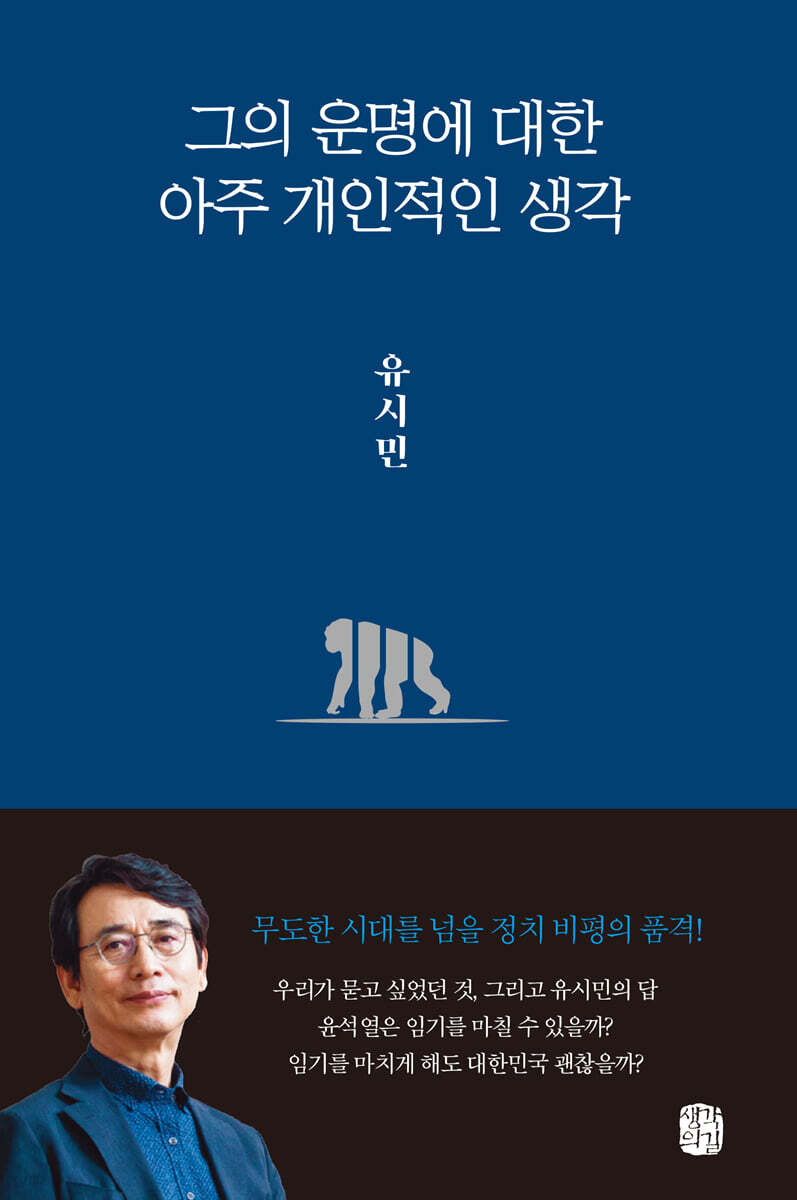
A very personal thought about his fate
 |
Description
Book Introduction
What we wanted to ask, and Yoo Si-min's answer
Will Yoon Seok-yeol be able to complete his term?
Would it be okay for the Republic of Korea to finish its term?
“Citizens ask each other:
Even though the ruling party suffered a historic defeat in the general election, the president acts as if nothing happened.
"Will Yoon Seok-yeol be able to complete his term? Will South Korea be okay if he does? I wrote this book to try to answer that question."
Whenever things get murky, we wait for Yoo Si-min to step forward.
Provides information for judgment without pushing, doesn't blur the issue to avoid attack, doesn't try to balance it out by pretending to be cool without being exploited, and discerns what needs to be understood even if it's uncomfortable and what needs to be fought for even if it's scary.
It provides a deep and broad perspective on the context beyond the phenomenon, making us think about what is important and essential here and now, and what choices will change the flow.
So his comments are not obvious or meaningless, but they are memorable.
This book is a testament to Yu Si-min's clear and unique approach to answering the questions we want to ask at this time, as he has done so far.
Will Yoon Seok-yeol be able to complete his term?
Would it be okay for the Republic of Korea to finish its term?
“Citizens ask each other:
Even though the ruling party suffered a historic defeat in the general election, the president acts as if nothing happened.
"Will Yoon Seok-yeol be able to complete his term? Will South Korea be okay if he does? I wrote this book to try to answer that question."
Whenever things get murky, we wait for Yoo Si-min to step forward.
Provides information for judgment without pushing, doesn't blur the issue to avoid attack, doesn't try to balance it out by pretending to be cool without being exploited, and discerns what needs to be understood even if it's uncomfortable and what needs to be fought for even if it's scary.
It provides a deep and broad perspective on the context beyond the phenomenon, making us think about what is important and essential here and now, and what choices will change the flow.
So his comments are not obvious or meaningless, but they are memorable.
This book is a testament to Yu Si-min's clear and unique approach to answering the questions we want to ask at this time, as he has done so far.
- You can preview some of the book's contents.
Preview
index
preface
Elephant 5 at the Ceramic Museum
Chapter 1 What I Learned from Watching Him 17
· Subjective Iron King
Limits and Decentralization of Power 19
Democracy and Government Levels 23
· The vulgarity of evil
Evil and Vulgarity 29
The Power of Thought 32
· Imperfect lines
No right to sue 36
Let's be friends even though we are lacking 40
Chapter 2: Why the Ruling Party Failed 45
· Distrust and anger toward him
Ruling Party Seat Calculation Formula 47
Voter Mobility 53
· Conservative division
Victory of the Union 59
65 blindly following the ruling party
· The People Power Party's helplessness
Whose party is it? 70
Yoon Seok-yeol's monarchy 73
The Future of Yoon Seok-yeol's Division 77
Park Geun-hye's Broken Legacy 81
Chapter 3: The Decline of the Press 87
· Journalism as we know it
The News Decision Process 89
Symptoms of the Decline of the Media 96
The Mystery of the February Poll
Incompetent Media Elite 103
Statistical Noise Created by the People Power Party 107
Self-Fulfilling Prophecy 110
· New journalism
Press Releases and Mike Power 114
The Liberation of Journalism 117
Journalist Kim Eo-jun 120
Chapter 4: Why He's Unpopular 127
Extreme incompetence
Dismal economic report card 129
Fanatical Marketism 134
Yoon Seok-yeol's Julpu-se 139
· Dictator behavior
59 minutes President 145
Chun Doo-hwan's Parallel Theory 149
· Lack of learning ability
How to Write a Crazy Speech 156
President Ignorance 163
· Cowardly servility
Diplomacy that Insults the People 171
The Roots of the Army and the Military Academy 178
Inter-Korean Relations: 40 Years of Regression 183
Privatization of power
Leader Instinct 186
Political Privatization of State Power 189
Chapter 5 His Enemies 195
· Lee Jae-myung, the one who hasn't been killed yet
The Power to Endure Humiliation 197
Legitimate Privilege 204
Struggle for Survival 209
· The fatherland, the one who killed but survived
The Changing Homeland 216
Revenge and Retribution 220
The Future of the Fatherland Innovation Party 222
· The Democratic Party, the only progressive party in power
Ready-made clothing party 227
Party Member Democracy 231
Zeitgeist and Youth Politics 239
Chapter 6 His Fate 249
· Voluntary resignation
Wrong Encounter 251
Ability to resign voluntarily 254
· Cooperation
Democratic Party-led grand coalition 258
The Beginning of the Crisis 262
· Showdown
Problem 267: Yoon Seok-yeol
Goblin's Last Stand 273
Special pardon without indictment 276
In closing, to my young friends 281
Elephant 5 at the Ceramic Museum
Chapter 1 What I Learned from Watching Him 17
· Subjective Iron King
Limits and Decentralization of Power 19
Democracy and Government Levels 23
· The vulgarity of evil
Evil and Vulgarity 29
The Power of Thought 32
· Imperfect lines
No right to sue 36
Let's be friends even though we are lacking 40
Chapter 2: Why the Ruling Party Failed 45
· Distrust and anger toward him
Ruling Party Seat Calculation Formula 47
Voter Mobility 53
· Conservative division
Victory of the Union 59
65 blindly following the ruling party
· The People Power Party's helplessness
Whose party is it? 70
Yoon Seok-yeol's monarchy 73
The Future of Yoon Seok-yeol's Division 77
Park Geun-hye's Broken Legacy 81
Chapter 3: The Decline of the Press 87
· Journalism as we know it
The News Decision Process 89
Symptoms of the Decline of the Media 96
The Mystery of the February Poll
Incompetent Media Elite 103
Statistical Noise Created by the People Power Party 107
Self-Fulfilling Prophecy 110
· New journalism
Press Releases and Mike Power 114
The Liberation of Journalism 117
Journalist Kim Eo-jun 120
Chapter 4: Why He's Unpopular 127
Extreme incompetence
Dismal economic report card 129
Fanatical Marketism 134
Yoon Seok-yeol's Julpu-se 139
· Dictator behavior
59 minutes President 145
Chun Doo-hwan's Parallel Theory 149
· Lack of learning ability
How to Write a Crazy Speech 156
President Ignorance 163
· Cowardly servility
Diplomacy that Insults the People 171
The Roots of the Army and the Military Academy 178
Inter-Korean Relations: 40 Years of Regression 183
Privatization of power
Leader Instinct 186
Political Privatization of State Power 189
Chapter 5 His Enemies 195
· Lee Jae-myung, the one who hasn't been killed yet
The Power to Endure Humiliation 197
Legitimate Privilege 204
Struggle for Survival 209
· The fatherland, the one who killed but survived
The Changing Homeland 216
Revenge and Retribution 220
The Future of the Fatherland Innovation Party 222
· The Democratic Party, the only progressive party in power
Ready-made clothing party 227
Party Member Democracy 231
Zeitgeist and Youth Politics 239
Chapter 6 His Fate 249
· Voluntary resignation
Wrong Encounter 251
Ability to resign voluntarily 254
· Cooperation
Democratic Party-led grand coalition 258
The Beginning of the Crisis 262
· Showdown
Problem 267: Yoon Seok-yeol
Goblin's Last Stand 273
Special pardon without indictment 276
In closing, to my young friends 281
Detailed image

Into the book
* Yoon Seok-yeol's election as president was a 'political accident.'
Even the voters who voted for him had no idea that he was such an ignorant, incompetent, and cruel person.
Yoon Seok-yeol is like an elephant entering a porcelain museum.
Problems arise not because of 'intention' but because of 'nature'.
The breaking of the pottery is merely 'collateral damage', unrelated to his intention.
…it wasn't the elephant's fault for entering the ceramics museum.
The people who let you in there were wrong.
Politicians and party members of the People Power Party, media professionals who praised Yoon Seok-yeol as the embodiment of fairness and common sense, and voters who were deceived by false reports should feel a greater sense of responsibility than others.
However, the People Power Party politicians and party members do not admit their mistakes.
The majority still support Yoon Seok-yeol.
Newspaper and broadcasting workers, who disguised their identities with business cards labeled as journalists, did their best to support the People Power Party in the general election.
But voters didn't.
Some voters who voted for Yoon Seok-yeol on March 9, 2022, voted for the opposition candidate on April 10, 2024.
He acknowledged that he was also responsible for his 'political thinking' and tried to rectify the situation.
Because of that, his fate was in jeopardy.
* Let's not say 'that guy, that guy'.
The saying, 'It's the same no matter who does it' is wrong.
The state of society and the lives of its people change greatly depending on who holds power.
Who should rule? Plato's question is significant and important.
* It was not human ethics and morality that determined Amos and the Goblin's loss of power and their subsequent lives, but the biological instinct of a chimpanzee pack that expects sheriff behavior from an alpha male.
The ethical morality that humans have developed in relation to power is based on instincts shared by Homo sapiens and chimpanzees.
The genes for that instinct already existed in nature 6 million years ago, when the ancestors of the two species diverged.
In that sense, the origins of politics are clearly older than human history.
Humans did not create ethics and morality out of nothing.
Because of the abilities given by nature, we were able to establish the norms of civilization.
Instinct is persistent and powerful.
It does not disappear in the course of history.
I, a so-called humanities student, am using biology to predict the future of those in power.
But it's not my fault.
No humanist warned of the possibility of this type of alpha male emerging in 21st-century South Korea.
* In democracy, institutions are more important than anything else.
But people are just as important.
Yoon Seok-yeol taught us to be wary of institutionalism.
A nation is an abstract entity.
The government is the same.
What physically exists are the people who make up the government.
The level of a nation is determined by the level of its government, and the level of its government is determined by the level of its people.
The level of government in our country, a presidential system, depends on the level of the president himself, the highest authority, and the level of people he appoints to the government.
Yoon Seok-yeol has brought the government down to his level.
The nation of the Republic of Korea is also sinking to the level of human being Yoon Seok-yeol.
The international community's reputation for South Korea is also declining.
* The media tried to nail down the Democratic Party's defeat as a foregone conclusion based on the February opinion poll trends.
They attacked Lee Jae-myung and incited division within the Democratic Party by pointing out that the nomination was a case of 'pro-Myeong windfall and pro-Myeong death'.
Even neutral critics and journalists joined in, spreading the theory of a Democratic Party crisis and calling for Lee Jae-myung to resign or step down from his second term.
Citizens who wanted to judge Yoon Seok-yeol's incompetence and tyranny felt distrust and disillusionment with humanity.
With so many people supporting this president and this ruling party, I began to wonder if it might be better to just give up on politics.
I was a little disappointed when I voted.
Even the voters who voted for him had no idea that he was such an ignorant, incompetent, and cruel person.
Yoon Seok-yeol is like an elephant entering a porcelain museum.
Problems arise not because of 'intention' but because of 'nature'.
The breaking of the pottery is merely 'collateral damage', unrelated to his intention.
…it wasn't the elephant's fault for entering the ceramics museum.
The people who let you in there were wrong.
Politicians and party members of the People Power Party, media professionals who praised Yoon Seok-yeol as the embodiment of fairness and common sense, and voters who were deceived by false reports should feel a greater sense of responsibility than others.
However, the People Power Party politicians and party members do not admit their mistakes.
The majority still support Yoon Seok-yeol.
Newspaper and broadcasting workers, who disguised their identities with business cards labeled as journalists, did their best to support the People Power Party in the general election.
But voters didn't.
Some voters who voted for Yoon Seok-yeol on March 9, 2022, voted for the opposition candidate on April 10, 2024.
He acknowledged that he was also responsible for his 'political thinking' and tried to rectify the situation.
Because of that, his fate was in jeopardy.
* Let's not say 'that guy, that guy'.
The saying, 'It's the same no matter who does it' is wrong.
The state of society and the lives of its people change greatly depending on who holds power.
Who should rule? Plato's question is significant and important.
* It was not human ethics and morality that determined Amos and the Goblin's loss of power and their subsequent lives, but the biological instinct of a chimpanzee pack that expects sheriff behavior from an alpha male.
The ethical morality that humans have developed in relation to power is based on instincts shared by Homo sapiens and chimpanzees.
The genes for that instinct already existed in nature 6 million years ago, when the ancestors of the two species diverged.
In that sense, the origins of politics are clearly older than human history.
Humans did not create ethics and morality out of nothing.
Because of the abilities given by nature, we were able to establish the norms of civilization.
Instinct is persistent and powerful.
It does not disappear in the course of history.
I, a so-called humanities student, am using biology to predict the future of those in power.
But it's not my fault.
No humanist warned of the possibility of this type of alpha male emerging in 21st-century South Korea.
* In democracy, institutions are more important than anything else.
But people are just as important.
Yoon Seok-yeol taught us to be wary of institutionalism.
A nation is an abstract entity.
The government is the same.
What physically exists are the people who make up the government.
The level of a nation is determined by the level of its government, and the level of its government is determined by the level of its people.
The level of government in our country, a presidential system, depends on the level of the president himself, the highest authority, and the level of people he appoints to the government.
Yoon Seok-yeol has brought the government down to his level.
The nation of the Republic of Korea is also sinking to the level of human being Yoon Seok-yeol.
The international community's reputation for South Korea is also declining.
* The media tried to nail down the Democratic Party's defeat as a foregone conclusion based on the February opinion poll trends.
They attacked Lee Jae-myung and incited division within the Democratic Party by pointing out that the nomination was a case of 'pro-Myeong windfall and pro-Myeong death'.
Even neutral critics and journalists joined in, spreading the theory of a Democratic Party crisis and calling for Lee Jae-myung to resign or step down from his second term.
Citizens who wanted to judge Yoon Seok-yeol's incompetence and tyranny felt distrust and disillusionment with humanity.
With so many people supporting this president and this ruling party, I began to wonder if it might be better to just give up on politics.
I was a little disappointed when I voted.
--- From the text
Publisher's Review
Analysis and outlook that reveals the essence
What the past two years have brought to light
“I sympathize with Sima Qian’s feelings.
There is no such thing as the way of heaven.
There is no such thing as divine punishment.
But the days when force determined the course of power are over.
The power of the Republic of Korea comes not from physical force, but from the support of the people.
It is a world where public sentiment overturns power just as the sea overturns ships.
The Tao is not in the sky.
It is in the human heart, in human relationships, and in human nature.
Yoon Seok-yeol's power was given to him by the people.
“The people can take that power back.”
“In a situation where the entire media has joined the conservative party, big capital, and vested interest groups, destroying all journalistic norms… the ‘journalists’ media,’ including the Hankyoreh, is focusing on maintaining its own balance.
They do not strive to bring balance to the world, risking accusations of bias.
…what contributed to the Democratic Party’s landslide victory in the general election was… ‘new journalism.’
They ignored some of the journalistic norms we know.
He fought to bring balance to the world, risking accusations of bias.
We created news by communicating and interacting with the public.
The public approved of the news they produced.
That's why it's called new journalism."
“One thing is clear.
The fates of Cho Kuk and Yoon Seok-yeol are completely intertwined.
There is no way for either of them to end their fight honorably.
To Yoon Seok-yeol, Cho Kuk is a different person from Lee Jae-myung.
From Yoon Seok-yeol's perspective, Lee Jae-myung is someone he has yet to kill.
There is room to stop fighting and try to coexist.
But the motherland is 'already dead'.
You cannot coexist with someone who has already killed you.
The same goes for the motherland.
The 'resurrected one' can confirm that he is alive only by killing the one who killed him.
“Yoon Seok-yeol’s most dangerous enemy is not Lee Jae-myung, but Cho Kuk.”
This book organizes and then dismantles the past two years we've lived through, dispassionately analyzing cause and effect and clearly showing the changes individuals and society have had to endure.
From the birth of the Yoon administration and the results of the general election, to analysis of public opinion poll data, this book explains what different political landscapes—politicians, political parties, the media, and power organizations—pursue, why they act, and how they operate to achieve their goals and exert influence on society—with a solid historical and humanistic background, allowing readers to read it within the larger flow of the times.
It clearly reveals the opaque nature of our society, entangled in the vested interests of the privileged class' powerful cartel, the media that is one with them, and interest groups, while also showing what sparks of hope lead to change in our society and how they spread to move society forward.
It sharply analyzes how the phenomena of the past two years are intertwined with our ideas and behavior patterns, what we have felt and realized, and what power that awakening will have on President Yoon's fate.
Lee Jae-myung, Cho Kuk, and the Zeitgeist
“I think Lee Jae-myung is a person with a clear sense of purpose.
Not only do they strive to succeed, they strive to be recognized as successful.
It is difficult to explain Lee Jae-myung's life without that desire.
Standing at the pinnacle of power is not his goal in itself.
The goal is to use the power of the president to achieve what the public wants.
Lee Jae-myung feels pride and satisfaction when he does that.
It was like that when I was the mayor of Seongnam and the governor of Gyeonggi Province.
It will be the same even if he becomes president.
People with high self-esteem do not hold grudges.
Do not seek revenge on past abusers.
Lee Jae-myung doesn't feel the need to do that.
…the evils committed by the President through his power are not subject to personal revenge.
It is subject to public punishment.
Lee Jae-myung will think so.”
“Long before he became president, politician Kim Dae-jung presented the spirit of the times we should pursue.
I have yet to find a higher and more precious value than that.
…the highest goals that the Republic of Korea should pursue were set as ‘a society where everyone prospers,’ ‘high-level democracy,’ and ‘a peaceful Korean Peninsula.’
That was the zeitgeist he sought. The People's Government, the Participatory Government, and the Moon Jae-in government all pursued that zeitgeist, but Lee Myung-bak and Park Geun-hye turned away from it, and Yoon Seok-yeol trampled on it.
… This zeitgeist does not belong to Kim Dae-jung personally, but to the Democratic Party and to everyone living in the same era.”
“By driving Roh Moo-hyun to death, they plunged Korean politics into a whirlpool of hostile confrontation that no one could control.
…the energy created by Roh Moo-hyun’s death did not dissipate even after Park Geun-hye was impeached and Lee Myung-bak was arrested.
It gave Park Geun-hye supporters a desire for revenge and gave the progressive camp the task of prosecutorial reform.
“Every incident, from the Cho Kuk incident, the Seocho-dong and Gwanghwamun rallies, to the Democratic Party’s ‘complete prosecution and investigation’ legislation and Yoon Seok-yeol’s election as president, occurred along those lines.”
This book closely examines the spirit of the times, the Democratic Party's mission, Lee Jae-myung's aspirations, the nation's goals, and the party members and public sentiment that created and led them, awakening us to what our times must confront and address head-on.
This paper explores the origins of the hostile confrontation that has driven our society into a maelstrom of confrontation, and suggests what agenda we must consider together to ensure that the next version of the Yoon administration, beyond its current state of control and punishment, does not repeat the same hostile maelstrom.
When that happens, we talk about what will come when the Yoon administration ends, what hopes we can have, and what that means for us.
The dignity of political criticism that transcends the era of ruthlessness
“Democracy does not reject ‘extreme ideologies.’
Why are extreme ideologies called extreme? They're called extreme because only a tiny minority understands and supports them.
Such ideologies do not threaten society.
It's not necessarily wrong.
When something gains the understanding and support of the majority, it becomes a social norm.
Emancipation of slaves, popular sovereignty, and feminism were also initially considered 'extreme ideologies' by only a very small minority.
What democracy rejects is not extreme ideologies, but the self-righteousness and intolerance that seek to attack and destroy other ideologies with violence.
It doesn't matter whether it's majority or minority.
“We must not tolerate the act of forcing one’s own ideology, which one believes to be right, onto others through violence.”
“I know I can be criticized for not being perfect.
But it doesn't make you shrink from it.
Imperfect as they are, struggling to suppress their fears, sometimes lost and wandering, they strive to move towards social virtue and goodness according to their nature.
Likewise, by joining hands with imperfect people, comforting and encouraging them, we strive to make tomorrow's world better than today's.
I keep this in mind when I see Yoon Seok-yeol.
That mutual distrust and intolerance prolong the reign of evil.
“We can overcome evil only by being friends with each other, with our imperfections and differences, and by being generous to our imperfect friends.”
Only those who seek to understand most can offer the clearest commentary.
His commentary is imbued with a deep struggle to understand people and life.
The more complex the issue, the more likely it is that you will follow your heart's lead and act accordingly, making choices that you will not be ashamed of.
So his commentary is human, realistic, and has the power to change the course of events.
It makes us think about what makes us act the way we do and what is right and how to live a desirable life.
It has the power to connect us to the essence of a good life and a good society, to make us think about it, and to make us masters of ourselves.
After reading his writing, anyone will gain the strength to think for themselves and take a step forward in their own way.
The untamed power of Yoo Si-min's unique perspective and insight, which does not harbor illusions about humanity and politics but never abandons their potential, is always proven through time.
Although he was sometimes misunderstood, ridiculed, and attacked, the ridicule he received and the failures he could not overcome returned to us as scars through time, clearly revealing what he tried to protect and what he tried to overcome.
Just seeing his courage to speak clearly when he needs to speak, no matter the storm or fear, makes me not lose hope for humanity and society.
This is why he, who was developing his identity as a writer, is doing political criticism and publishing a book of political criticism at this time, and why we are waiting for his book.
The wit and cool satire seen throughout the book are Yoo Si-min's characteristic consideration for readers who are quietly going through difficult times in their own ways.
What the past two years have brought to light
“I sympathize with Sima Qian’s feelings.
There is no such thing as the way of heaven.
There is no such thing as divine punishment.
But the days when force determined the course of power are over.
The power of the Republic of Korea comes not from physical force, but from the support of the people.
It is a world where public sentiment overturns power just as the sea overturns ships.
The Tao is not in the sky.
It is in the human heart, in human relationships, and in human nature.
Yoon Seok-yeol's power was given to him by the people.
“The people can take that power back.”
“In a situation where the entire media has joined the conservative party, big capital, and vested interest groups, destroying all journalistic norms… the ‘journalists’ media,’ including the Hankyoreh, is focusing on maintaining its own balance.
They do not strive to bring balance to the world, risking accusations of bias.
…what contributed to the Democratic Party’s landslide victory in the general election was… ‘new journalism.’
They ignored some of the journalistic norms we know.
He fought to bring balance to the world, risking accusations of bias.
We created news by communicating and interacting with the public.
The public approved of the news they produced.
That's why it's called new journalism."
“One thing is clear.
The fates of Cho Kuk and Yoon Seok-yeol are completely intertwined.
There is no way for either of them to end their fight honorably.
To Yoon Seok-yeol, Cho Kuk is a different person from Lee Jae-myung.
From Yoon Seok-yeol's perspective, Lee Jae-myung is someone he has yet to kill.
There is room to stop fighting and try to coexist.
But the motherland is 'already dead'.
You cannot coexist with someone who has already killed you.
The same goes for the motherland.
The 'resurrected one' can confirm that he is alive only by killing the one who killed him.
“Yoon Seok-yeol’s most dangerous enemy is not Lee Jae-myung, but Cho Kuk.”
This book organizes and then dismantles the past two years we've lived through, dispassionately analyzing cause and effect and clearly showing the changes individuals and society have had to endure.
From the birth of the Yoon administration and the results of the general election, to analysis of public opinion poll data, this book explains what different political landscapes—politicians, political parties, the media, and power organizations—pursue, why they act, and how they operate to achieve their goals and exert influence on society—with a solid historical and humanistic background, allowing readers to read it within the larger flow of the times.
It clearly reveals the opaque nature of our society, entangled in the vested interests of the privileged class' powerful cartel, the media that is one with them, and interest groups, while also showing what sparks of hope lead to change in our society and how they spread to move society forward.
It sharply analyzes how the phenomena of the past two years are intertwined with our ideas and behavior patterns, what we have felt and realized, and what power that awakening will have on President Yoon's fate.
Lee Jae-myung, Cho Kuk, and the Zeitgeist
“I think Lee Jae-myung is a person with a clear sense of purpose.
Not only do they strive to succeed, they strive to be recognized as successful.
It is difficult to explain Lee Jae-myung's life without that desire.
Standing at the pinnacle of power is not his goal in itself.
The goal is to use the power of the president to achieve what the public wants.
Lee Jae-myung feels pride and satisfaction when he does that.
It was like that when I was the mayor of Seongnam and the governor of Gyeonggi Province.
It will be the same even if he becomes president.
People with high self-esteem do not hold grudges.
Do not seek revenge on past abusers.
Lee Jae-myung doesn't feel the need to do that.
…the evils committed by the President through his power are not subject to personal revenge.
It is subject to public punishment.
Lee Jae-myung will think so.”
“Long before he became president, politician Kim Dae-jung presented the spirit of the times we should pursue.
I have yet to find a higher and more precious value than that.
…the highest goals that the Republic of Korea should pursue were set as ‘a society where everyone prospers,’ ‘high-level democracy,’ and ‘a peaceful Korean Peninsula.’
That was the zeitgeist he sought. The People's Government, the Participatory Government, and the Moon Jae-in government all pursued that zeitgeist, but Lee Myung-bak and Park Geun-hye turned away from it, and Yoon Seok-yeol trampled on it.
… This zeitgeist does not belong to Kim Dae-jung personally, but to the Democratic Party and to everyone living in the same era.”
“By driving Roh Moo-hyun to death, they plunged Korean politics into a whirlpool of hostile confrontation that no one could control.
…the energy created by Roh Moo-hyun’s death did not dissipate even after Park Geun-hye was impeached and Lee Myung-bak was arrested.
It gave Park Geun-hye supporters a desire for revenge and gave the progressive camp the task of prosecutorial reform.
“Every incident, from the Cho Kuk incident, the Seocho-dong and Gwanghwamun rallies, to the Democratic Party’s ‘complete prosecution and investigation’ legislation and Yoon Seok-yeol’s election as president, occurred along those lines.”
This book closely examines the spirit of the times, the Democratic Party's mission, Lee Jae-myung's aspirations, the nation's goals, and the party members and public sentiment that created and led them, awakening us to what our times must confront and address head-on.
This paper explores the origins of the hostile confrontation that has driven our society into a maelstrom of confrontation, and suggests what agenda we must consider together to ensure that the next version of the Yoon administration, beyond its current state of control and punishment, does not repeat the same hostile maelstrom.
When that happens, we talk about what will come when the Yoon administration ends, what hopes we can have, and what that means for us.
The dignity of political criticism that transcends the era of ruthlessness
“Democracy does not reject ‘extreme ideologies.’
Why are extreme ideologies called extreme? They're called extreme because only a tiny minority understands and supports them.
Such ideologies do not threaten society.
It's not necessarily wrong.
When something gains the understanding and support of the majority, it becomes a social norm.
Emancipation of slaves, popular sovereignty, and feminism were also initially considered 'extreme ideologies' by only a very small minority.
What democracy rejects is not extreme ideologies, but the self-righteousness and intolerance that seek to attack and destroy other ideologies with violence.
It doesn't matter whether it's majority or minority.
“We must not tolerate the act of forcing one’s own ideology, which one believes to be right, onto others through violence.”
“I know I can be criticized for not being perfect.
But it doesn't make you shrink from it.
Imperfect as they are, struggling to suppress their fears, sometimes lost and wandering, they strive to move towards social virtue and goodness according to their nature.
Likewise, by joining hands with imperfect people, comforting and encouraging them, we strive to make tomorrow's world better than today's.
I keep this in mind when I see Yoon Seok-yeol.
That mutual distrust and intolerance prolong the reign of evil.
“We can overcome evil only by being friends with each other, with our imperfections and differences, and by being generous to our imperfect friends.”
Only those who seek to understand most can offer the clearest commentary.
His commentary is imbued with a deep struggle to understand people and life.
The more complex the issue, the more likely it is that you will follow your heart's lead and act accordingly, making choices that you will not be ashamed of.
So his commentary is human, realistic, and has the power to change the course of events.
It makes us think about what makes us act the way we do and what is right and how to live a desirable life.
It has the power to connect us to the essence of a good life and a good society, to make us think about it, and to make us masters of ourselves.
After reading his writing, anyone will gain the strength to think for themselves and take a step forward in their own way.
The untamed power of Yoo Si-min's unique perspective and insight, which does not harbor illusions about humanity and politics but never abandons their potential, is always proven through time.
Although he was sometimes misunderstood, ridiculed, and attacked, the ridicule he received and the failures he could not overcome returned to us as scars through time, clearly revealing what he tried to protect and what he tried to overcome.
Just seeing his courage to speak clearly when he needs to speak, no matter the storm or fear, makes me not lose hope for humanity and society.
This is why he, who was developing his identity as a writer, is doing political criticism and publishing a book of political criticism at this time, and why we are waiting for his book.
The wit and cool satire seen throughout the book are Yoo Si-min's characteristic consideration for readers who are quietly going through difficult times in their own ways.
GOODS SPECIFICS
- Date of issue: June 19, 2024
- Page count, weight, size: 288 pages | 374g | 138*210*20mm
- ISBN13: 9788965138068
- ISBN10: 896513806X
You may also like
카테고리
korean


korean

![GQ KOREA Mark (Monthly): December [2025]](http://librairie.coreenne.fr/cdn/shop/files/8ef265dbbfbf186523ed75ba7319009d.jpg?v=1765340328&width=3840)


