

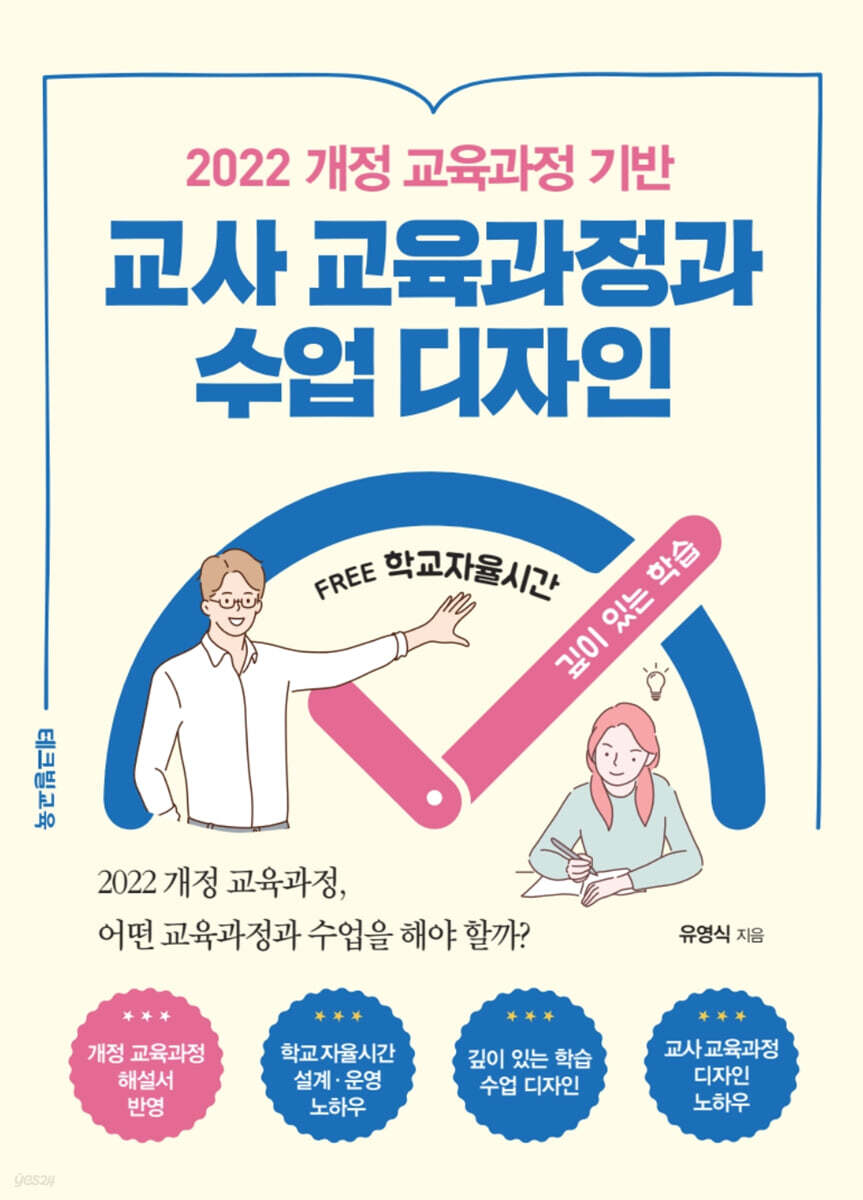
Teacher Education Curriculum and Instructional Design Based on the 2022 Revised Curriculum
 |
Description
Book Introduction
Bestselling curriculum book, “Good teachers have routines”
Another masterpiece following 『Curriculum Literacy』 and 『Curriculum-Centered Assessment』!
"2022 Revised Curriculum-Based Teacher Education Curriculum and Class Design" by Professor Yoo Young-sik, who is achieving "results" and "sharing" based on "policy participation" and "practice" in the curriculum.
This book is another masterpiece by Yoo Young-sik, following his curriculum bestsellers, "Teachers Who Are Good at Teaching Have a Routine," "Curriculum Literacy," and "Curriculum-Centered Evaluation." It is the latest edition, a fresh take on the core of the "2022 Revised Curriculum" that is presented in an easy-to-understand manner.
This book specifically presents the essence of "school autonomy time" and "deep learning," which are emphasized to foster student initiative and the ability to "actively respond to the uncertainties of the future society," which are the core of the 2022 revised curriculum, and the teacher training curriculum and lesson design process to implement these in actual education.
Furthermore, it contains various methods for interpretation and implementation from the perspective of field teachers.
Another masterpiece following 『Curriculum Literacy』 and 『Curriculum-Centered Assessment』!
"2022 Revised Curriculum-Based Teacher Education Curriculum and Class Design" by Professor Yoo Young-sik, who is achieving "results" and "sharing" based on "policy participation" and "practice" in the curriculum.
This book is another masterpiece by Yoo Young-sik, following his curriculum bestsellers, "Teachers Who Are Good at Teaching Have a Routine," "Curriculum Literacy," and "Curriculum-Centered Evaluation." It is the latest edition, a fresh take on the core of the "2022 Revised Curriculum" that is presented in an easy-to-understand manner.
This book specifically presents the essence of "school autonomy time" and "deep learning," which are emphasized to foster student initiative and the ability to "actively respond to the uncertainties of the future society," which are the core of the 2022 revised curriculum, and the teacher training curriculum and lesson design process to implement these in actual education.
Furthermore, it contains various methods for interpretation and implementation from the perspective of field teachers.
- You can preview some of the book's contents.
Preview
index
prolog
Part 1.
The curriculum desired by future education
Future education, spoken through the curriculum
Curriculum for Student Agencies
Curriculum created by Teacher Agency
Curriculum created together through co-agency
Part 2.
Teacher training curriculum created through school autonomous time
Allow space for schools and teachers
What is teacher education curriculum?
The Relationship Between School Autonomy Time and Teacher Curriculum
Current status of curriculum utilizing school free time
Is this different from a restructuring of the subject-centered, project-based curriculum?
The Double-Edged Sword of School Autonomy Time
Half-autonomy
The power of independent study time at school
Part 3.
2022 Revised Curriculum: Building Literacy
What's New in the 2022 Revised Curriculum?
How to Read the 2022 Revised Curriculum Overview
Principles for Creating the 2022 Revised Curriculum (Specific Theory)
How to View the 2022 Revised Curriculum (Specific Theory) Document
Characteristics of the 2022 Revised Curriculum Achievement Standards
Part 4.
Teacher Curriculum Design Know-How Using School Free Time
How do we create autonomous time at school?
How many hours of free time at school would be enough?
School Autonomy Time Type 1: Subject-Based
School Autonomy Time Type 2: Pure Autonomy Time-Based Type
School Autonomy Time Type 3: School Autonomy Time Max Type
What should be included in school self-study time?
School Autonomy Time, Design Process from Start to Finish
School Free Time: Paper vs. Real Time
How to easily access and practice school self-study time
Creating autonomous school time together with cloud-based curriculum
How to Restructure Achievement Standards to Create Autonomous Time in Schools
How to develop achievement standards and content structure for school autonomous time
How are school self-study time evaluated and recorded?
Additional options to create school-based free time
Citizenship education and school autonomy time
Ecological Transition Education and School Autonomy Time
Digital and AI literacy education and autonomous school hours
Career-linked education and school autonomous time
Tips for Beginners
School Autonomy Time Q&A
Part 5.
Lesson Design for Deep Learning
What is deep learning?
What is a core idea and how to write it?
Concept-based curriculum and instruction
How to achieve deep learning?
What are realistic alternatives for creating deep learning?
Class routines that create deep learning
Exploratory questions, how to do it?
Process-centered assessment in the 2022 revised curriculum
Assessment for Deep Learning
Epilogue
References
Part 1.
The curriculum desired by future education
Future education, spoken through the curriculum
Curriculum for Student Agencies
Curriculum created by Teacher Agency
Curriculum created together through co-agency
Part 2.
Teacher training curriculum created through school autonomous time
Allow space for schools and teachers
What is teacher education curriculum?
The Relationship Between School Autonomy Time and Teacher Curriculum
Current status of curriculum utilizing school free time
Is this different from a restructuring of the subject-centered, project-based curriculum?
The Double-Edged Sword of School Autonomy Time
Half-autonomy
The power of independent study time at school
Part 3.
2022 Revised Curriculum: Building Literacy
What's New in the 2022 Revised Curriculum?
How to Read the 2022 Revised Curriculum Overview
Principles for Creating the 2022 Revised Curriculum (Specific Theory)
How to View the 2022 Revised Curriculum (Specific Theory) Document
Characteristics of the 2022 Revised Curriculum Achievement Standards
Part 4.
Teacher Curriculum Design Know-How Using School Free Time
How do we create autonomous time at school?
How many hours of free time at school would be enough?
School Autonomy Time Type 1: Subject-Based
School Autonomy Time Type 2: Pure Autonomy Time-Based Type
School Autonomy Time Type 3: School Autonomy Time Max Type
What should be included in school self-study time?
School Autonomy Time, Design Process from Start to Finish
School Free Time: Paper vs. Real Time
How to easily access and practice school self-study time
Creating autonomous school time together with cloud-based curriculum
How to Restructure Achievement Standards to Create Autonomous Time in Schools
How to develop achievement standards and content structure for school autonomous time
How are school self-study time evaluated and recorded?
Additional options to create school-based free time
Citizenship education and school autonomy time
Ecological Transition Education and School Autonomy Time
Digital and AI literacy education and autonomous school hours
Career-linked education and school autonomous time
Tips for Beginners
School Autonomy Time Q&A
Part 5.
Lesson Design for Deep Learning
What is deep learning?
What is a core idea and how to write it?
Concept-based curriculum and instruction
How to achieve deep learning?
What are realistic alternatives for creating deep learning?
Class routines that create deep learning
Exploratory questions, how to do it?
Process-centered assessment in the 2022 revised curriculum
Assessment for Deep Learning
Epilogue
References
Into the book
The characteristics of learners that are to be fostered not only in Korea's 2022 revised curriculum but also through the 'OECD Future of Education and Skills 2030' are presented as 'student agency' or student agency.
Agency is a concept that includes a sense of responsibility to positively influence others and the surrounding environment while actively and proactively participating in the world. A person with agency means having the ability to set goals and design actions to meet them (Ministry of Education, 2021).
--- p.12
Teacher autonomy means that teachers should have the authority to use their professional knowledge, skills, and opinions to effectively implement the curriculum.
This concept emphasizes that teachers are 'agents of change' rather than objects of change, and that teachers should not limit their role to conveying and implementing centrally decided decisions, but should proactively lead changes in the school environment (OECD, 2018).
--- p.16
In order to derive autonomous school hours, the number of subject hours is reorganized based on the curriculum organization and operation standards.
In order to operate the autonomous school time secured in this way, the school's own achievement standards and curriculum content system are developed.
Afterwards, a process is carried out to integrate similar achievement standards or to restructure and supplement the achievement standards, and to reorganize the textbook period based on the achievement standards.
In other words, operating school autonomous time is a comprehensive combination of all processes related to curriculum restructuring.
--- pp.31~32
For in-depth learning, contextual understanding of learning content and inquiry questions are provided, and active participation in class means not only external activity-centered classes but also active participation in the thinking process.
--- p.77
Inquiry questions can serve as a bridge to deeper learning.
Students with strong cognitive abilities have the ability to generate student-directed thinking and big ideas on their own, which is necessary for deep learning, but students who are slow learners need teacher help to develop generalized ideas through inductive thinking.
Agency is a concept that includes a sense of responsibility to positively influence others and the surrounding environment while actively and proactively participating in the world. A person with agency means having the ability to set goals and design actions to meet them (Ministry of Education, 2021).
--- p.12
Teacher autonomy means that teachers should have the authority to use their professional knowledge, skills, and opinions to effectively implement the curriculum.
This concept emphasizes that teachers are 'agents of change' rather than objects of change, and that teachers should not limit their role to conveying and implementing centrally decided decisions, but should proactively lead changes in the school environment (OECD, 2018).
--- p.16
In order to derive autonomous school hours, the number of subject hours is reorganized based on the curriculum organization and operation standards.
In order to operate the autonomous school time secured in this way, the school's own achievement standards and curriculum content system are developed.
Afterwards, a process is carried out to integrate similar achievement standards or to restructure and supplement the achievement standards, and to reorganize the textbook period based on the achievement standards.
In other words, operating school autonomous time is a comprehensive combination of all processes related to curriculum restructuring.
--- pp.31~32
For in-depth learning, contextual understanding of learning content and inquiry questions are provided, and active participation in class means not only external activity-centered classes but also active participation in the thinking process.
--- p.77
Inquiry questions can serve as a bridge to deeper learning.
Students with strong cognitive abilities have the ability to generate student-directed thinking and big ideas on their own, which is necessary for deep learning, but students who are slow learners need teacher help to develop generalized ideas through inductive thinking.
--- p.215
Publisher's Review
Differences in the 2022 revised curriculum,
School self-study time & in-depth learning
In an era of great educational transformation, education is also rapidly changing to keep pace with a rapidly changing society.
Technologies such as digital and AI are rapidly entering the educational field.
However, technology can be a means of future education, but it cannot be the goal.
The goal of future education is to educate students so that they can develop their individual characteristics and abilities to the fullest extent possible in accordance with the changing social system.
This is impossible when the state designs all educational content and teaches all students at the same level in one classroom using one textbook.
Accordingly, the 2022 revised curriculum presented the teaching directions of 'school autonomy time' and 'in-depth learning' to provide personalized education for each student.
By utilizing school free time, schools and teachers can create individualized and specialized curricula that reflect the individual characteristics of each student.
And deep learning allows learners to internalize the material and delve deeply into a small number of core concepts so they can apply what they've learned to new situations.
This ultimately leads to ‘student agency’ and requires ‘teacher agency’.
Based on the 2022 revised curriculum
Teacher Education Curriculum and Instructional Design
"Teacher Education Curriculum and Class Design Based on the 2022 Revised Curriculum" was created based on Professor Yoo Young-sik's extensive experience in curriculum policy and practice.
In this book, Professor Yoo Young-sik interprets the core concepts of the revised curriculum for future education that can actively cope with the future society, namely 'school autonomy time' and 'in-depth learning,' from the perspective of a field teacher and presents specific plans for implementing them, along with classroom examples.
The book consists of five parts, and Part 1 presents ‘the direction of future education and the curriculum for it.’
In Part 2, we analyzed the ‘meaning of school autonomous time and its relationship with teacher education curriculum.’
Part 3 includes content that can foster literacy in the national curriculum in order to 'design autonomous school time and in-depth learning.'
Part 4 includes ‘ways to practice autonomous school time’ based on actual experience.
In Part 5, ‘class design and evaluation methods for deep learning’ were presented.
I hope that the contents of this book will serve as a small beacon for the curriculum and teaching direction of teachers needed for future education.
School self-study time & in-depth learning
In an era of great educational transformation, education is also rapidly changing to keep pace with a rapidly changing society.
Technologies such as digital and AI are rapidly entering the educational field.
However, technology can be a means of future education, but it cannot be the goal.
The goal of future education is to educate students so that they can develop their individual characteristics and abilities to the fullest extent possible in accordance with the changing social system.
This is impossible when the state designs all educational content and teaches all students at the same level in one classroom using one textbook.
Accordingly, the 2022 revised curriculum presented the teaching directions of 'school autonomy time' and 'in-depth learning' to provide personalized education for each student.
By utilizing school free time, schools and teachers can create individualized and specialized curricula that reflect the individual characteristics of each student.
And deep learning allows learners to internalize the material and delve deeply into a small number of core concepts so they can apply what they've learned to new situations.
This ultimately leads to ‘student agency’ and requires ‘teacher agency’.
Based on the 2022 revised curriculum
Teacher Education Curriculum and Instructional Design
"Teacher Education Curriculum and Class Design Based on the 2022 Revised Curriculum" was created based on Professor Yoo Young-sik's extensive experience in curriculum policy and practice.
In this book, Professor Yoo Young-sik interprets the core concepts of the revised curriculum for future education that can actively cope with the future society, namely 'school autonomy time' and 'in-depth learning,' from the perspective of a field teacher and presents specific plans for implementing them, along with classroom examples.
The book consists of five parts, and Part 1 presents ‘the direction of future education and the curriculum for it.’
In Part 2, we analyzed the ‘meaning of school autonomous time and its relationship with teacher education curriculum.’
Part 3 includes content that can foster literacy in the national curriculum in order to 'design autonomous school time and in-depth learning.'
Part 4 includes ‘ways to practice autonomous school time’ based on actual experience.
In Part 5, ‘class design and evaluation methods for deep learning’ were presented.
I hope that the contents of this book will serve as a small beacon for the curriculum and teaching direction of teachers needed for future education.
GOODS SPECIFICS
- Date of issue: June 1, 2023
- Page count, weight, size: 252 pages | 152*210*20mm
- ISBN13: 9791163461739
- ISBN10: 1163461733
You may also like
카테고리
korean


korean

![GQ KOREA Mark (Monthly): December [2025]](http://librairie.coreenne.fr/cdn/shop/files/8ef265dbbfbf186523ed75ba7319009d.jpg?v=1765340328&width=3840)


