

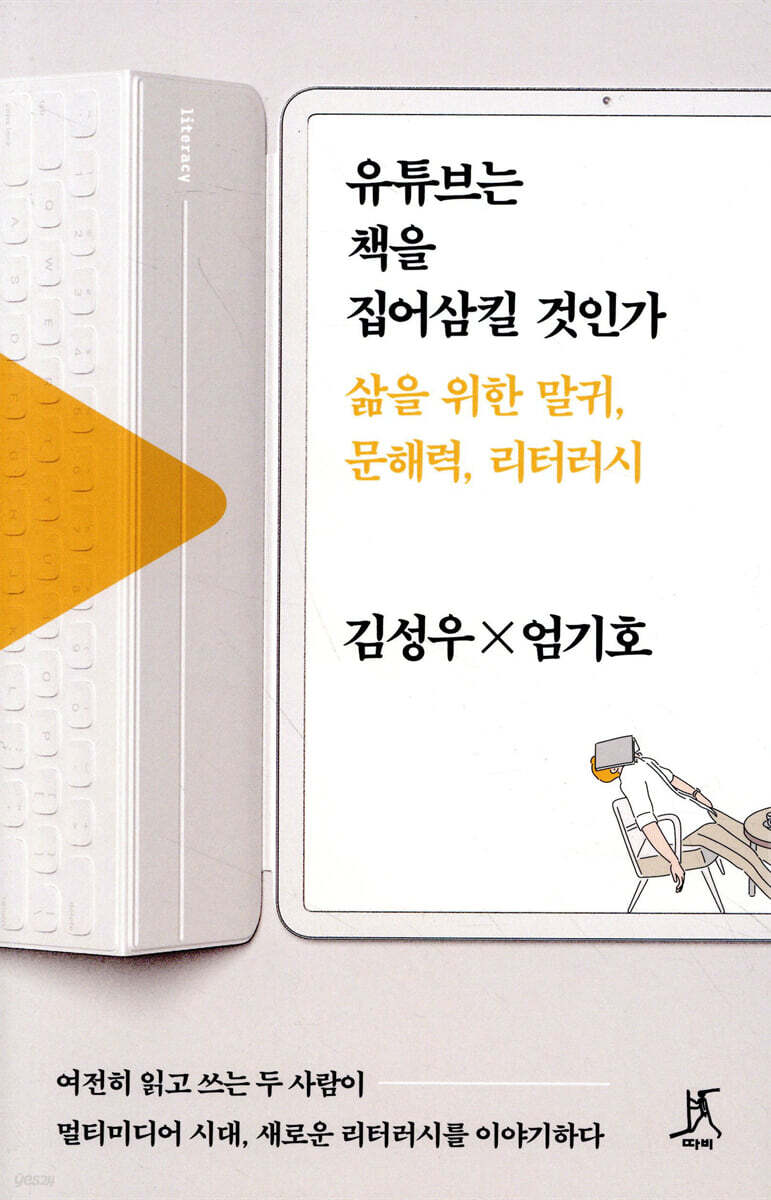
Will YouTube Eat Books?
 |
Description
Book Introduction
Not a show of force, but a bridge for understanding.
Not as a tool of competition, but as a capacity of community.
Not only reading and writing, but also the possibility of listening and seeing
Cultural researcher Eom Ki-ho and applied linguist Kim Seong-woo shared
Literacy for a Good Life
When I have a question, I don't read a book or search for information on the Internet.
Browse YouTube videos and communicate using the YouTube chat feature.
In a rapidly changing media landscape, how should the definition of literacy evolve? Depending on political stance, generation, and gender, people leave sarcastic comments, asking each other if they have dyslexia.
Even if there is a hint of trying to impart knowledge and information, the 'old farts' are wary and think 'you are trying to teach'.
Couldn't literacy be a tool for reflection, rather than a weapon that justifies hatred?
There are growing concerns that the reading skills of the younger generation are declining.
In recent years, the rankings of Korean students in the reading section of the Program for International Student Assessment (PISA) have continued to fall, and the percentage of Korean students with “very weak literacy” (38%) is among the lowest among OECD countries (2018 survey).
Parents and teachers' experiences also support this, saying, "My child doesn't read books and only looks at his smartphone." and "Students don't properly understand the content of textbooks."
Has the literacy level of the younger generation truly declined? Could this be considered a literacy crisis?
Cultural researcher Eom Ki-ho, who has focused on the way life is permeated by words, and applied linguist Kim Seong-woo, who has explored how words shape life, discussed literacy.
A wide-ranging discussion on whether it is justifiable to call the current state of literacy a 'crisis', how changes in the media environment are changing the human body and thinking, and how literacy can be made into a public infrastructure rather than a tool for competition is recorded in the new book, "Will YouTube Devour Books: Words for Life, Literacy, and Literacy," published by Tabi Publishing.
Not as a tool of competition, but as a capacity of community.
Not only reading and writing, but also the possibility of listening and seeing
Cultural researcher Eom Ki-ho and applied linguist Kim Seong-woo shared
Literacy for a Good Life
When I have a question, I don't read a book or search for information on the Internet.
Browse YouTube videos and communicate using the YouTube chat feature.
In a rapidly changing media landscape, how should the definition of literacy evolve? Depending on political stance, generation, and gender, people leave sarcastic comments, asking each other if they have dyslexia.
Even if there is a hint of trying to impart knowledge and information, the 'old farts' are wary and think 'you are trying to teach'.
Couldn't literacy be a tool for reflection, rather than a weapon that justifies hatred?
There are growing concerns that the reading skills of the younger generation are declining.
In recent years, the rankings of Korean students in the reading section of the Program for International Student Assessment (PISA) have continued to fall, and the percentage of Korean students with “very weak literacy” (38%) is among the lowest among OECD countries (2018 survey).
Parents and teachers' experiences also support this, saying, "My child doesn't read books and only looks at his smartphone." and "Students don't properly understand the content of textbooks."
Has the literacy level of the younger generation truly declined? Could this be considered a literacy crisis?
Cultural researcher Eom Ki-ho, who has focused on the way life is permeated by words, and applied linguist Kim Seong-woo, who has explored how words shape life, discussed literacy.
A wide-ranging discussion on whether it is justifiable to call the current state of literacy a 'crisis', how changes in the media environment are changing the human body and thinking, and how literacy can be made into a public infrastructure rather than a tool for competition is recorded in the new book, "Will YouTube Devour Books: Words for Life, Literacy, and Literacy," published by Tabi Publishing.
- You can preview some of the book's contents.
Preview
index
To begin with
Why We Need to Talk About "Literature for Life" Now / Kim Seong-woo 8
Literacy 1
Literacy: Crisis or Change? 14
Literacy? Literacy? / Crisis or change? / Studying for exams with text, seeing the world through video / The power that defines literacy / Emoticons and exclamation marks are more important than content / Another lens for viewing literacy / Taking issue with others' dyslexia / Literacy is a spectrum / For literacy to be a bridge, not a tower of Babel
Literacy 2
Is Reading Still Valid? 74
Reading was a revolution / How did letters change history / The birth of the individual and reading / Why writing is freer than images / What is possible only through reading and writing and the price / We have never properly taught reading and writing / From 'reading for the test' to 'tests that help reading' / Inequality of literacy, crisis of democracy / Is the ability to think a privilege of reading? / The aura of text and barriers to entry / Literacy is a capacity of society
Literacy 3
From Reading to Seeing, Media and the Body 140
Different media build different bodies / Three-line summary and the breath of reading / The body created by seeing / Everything comes up in a search? / How can literacy become the ability to deal with things / The paradox that knowledge interferes with life / How can literacy establish an ethical subject / Even if it is not refreshing, store it and let it mature
Literacy 4
Literacy: How to Build a Bridge 190
School, Assessment, and Literacy / Assessment Stuck in Fairness, Classes That Only Learn Examination Techniques / From Fairness of Assessment to Public Learning / Reasons for Transforming Media / Scientific Knowledge and Narrative: The Transition Between Two Types of Knowledge / Literacy that Reads Life Deeply
Literacy 5
Towards Literacy Education for Life 224
If the breath of class becomes longer / School comes alive with reading discussions / How does writing change when it touches one's life / Slowing down the speed of communication and setting the direction of literacy / Discussion free from performance / How is structuring that fosters autonomy possible / The crisis of literacy is a crisis of joy / Perspective, daily life, repetition, relationship, ethics, intersection, breathing / Literacy for a good life
In conclusion
From Speaking to Responding: Dialogue as a Research Methodology for Life / Eom Ki-ho 284
Reference 294
Why We Need to Talk About "Literature for Life" Now / Kim Seong-woo 8
Literacy 1
Literacy: Crisis or Change? 14
Literacy? Literacy? / Crisis or change? / Studying for exams with text, seeing the world through video / The power that defines literacy / Emoticons and exclamation marks are more important than content / Another lens for viewing literacy / Taking issue with others' dyslexia / Literacy is a spectrum / For literacy to be a bridge, not a tower of Babel
Literacy 2
Is Reading Still Valid? 74
Reading was a revolution / How did letters change history / The birth of the individual and reading / Why writing is freer than images / What is possible only through reading and writing and the price / We have never properly taught reading and writing / From 'reading for the test' to 'tests that help reading' / Inequality of literacy, crisis of democracy / Is the ability to think a privilege of reading? / The aura of text and barriers to entry / Literacy is a capacity of society
Literacy 3
From Reading to Seeing, Media and the Body 140
Different media build different bodies / Three-line summary and the breath of reading / The body created by seeing / Everything comes up in a search? / How can literacy become the ability to deal with things / The paradox that knowledge interferes with life / How can literacy establish an ethical subject / Even if it is not refreshing, store it and let it mature
Literacy 4
Literacy: How to Build a Bridge 190
School, Assessment, and Literacy / Assessment Stuck in Fairness, Classes That Only Learn Examination Techniques / From Fairness of Assessment to Public Learning / Reasons for Transforming Media / Scientific Knowledge and Narrative: The Transition Between Two Types of Knowledge / Literacy that Reads Life Deeply
Literacy 5
Towards Literacy Education for Life 224
If the breath of class becomes longer / School comes alive with reading discussions / How does writing change when it touches one's life / Slowing down the speed of communication and setting the direction of literacy / Discussion free from performance / How is structuring that fosters autonomy possible / The crisis of literacy is a crisis of joy / Perspective, daily life, repetition, relationship, ethics, intersection, breathing / Literacy for a good life
In conclusion
From Speaking to Responding: Dialogue as a Research Methodology for Life / Eom Ki-ho 284
Reference 294
Into the book
If this is an external change, I think there is an urgent need for some kind of self-reflection within that situation.
The situation in which those who can define literacy at the institutional level, select tools to evaluate literacy, and operate specific indicators, and those who embody dominant forms of literacy and turn them into sociocultural capital, do not reflect on themselves—this could be called internal literacy fluctuations.
--- p.54
It seems like something is being actively taught and learned, but in reality, the intensity only increases and no leap forward occurs.
I think the fact that this leap isn't happening should be seen as illiteracy.
If we define literacy as a movement rather than a state, then anything that continues to be strengthened in one state is illiterate.
From this perspective, it can be clearly seen that a literacy crisis exists.
--- p.73
Through language, I can load anything I can imagine into my head.
That's possible in an instant, because you can imagine it.
And you can do various simulations within it.
The ability to load and simulate gives humans great freedom.
But if you put this into words, the scale of loading and simulation will increase enormously.
In the oral era, it was possible to simulate things like bringing a few pieces of furniture into a room, but now it is possible to simulate the history of philosophy, a novel, or even a ten-season drama.
Because there is writing.
--- p.99
On the other hand, with YouTube, you start watching at first thinking you only need to watch this, but as you watch, you start thinking that this is also interesting and that looks fun too, and you keep watching.
The act of watching a video may not be the same as reading.
But the flow it creates is what we initially imagined when we read, and it's how good readers do it.
--- p.121
Even when reading the same text, the eye movements, finger flicks, and gestures for turning the pages are bound to be different when reading a world literature collection on paper and when reading a web novel on a mobile device.
Ultimately, the use of different media gradually builds different bodies.
Just like clothes getting wet in a drizzle, the movements of the brain, eyes, and fingers change.
--- p.142
In a situation where one's validity and legitimacy are easily attacked and easily destroyed, it seems that studying itself has become a means of self-defense.
So, they only prefer words and writings that justify themselves.
It seems that through him, rather than learning how to think and communicate with others, he only confirms and reinforces his own righteousness.
There is no joy of growth, no joy of learning here.
--- p.219~220
I often wonder if the public's sense of time has become too short.
When I see a news headline, I feel like I have to say something right away, and when I see an article with a political stance I don't like, I feel like I have to 'get involved' right away.
This is a question of speed of communication.
The speed at which news and social media posts are updated and consumed seems to make many people feel they have to react quickly.
--- p.245
To this end, I emphasize once again that we must learn to read our own bodies and the patterns engraved on them.
If writing and books were the body of a certain era and generation, the patterns engraved on that body, the means of transformation of that body, and the words of those people, then perhaps we are now in an era where images and YouTube are the body, the patterns engraved on that body, the words, and the means of transformation.
The situation in which those who can define literacy at the institutional level, select tools to evaluate literacy, and operate specific indicators, and those who embody dominant forms of literacy and turn them into sociocultural capital, do not reflect on themselves—this could be called internal literacy fluctuations.
--- p.54
It seems like something is being actively taught and learned, but in reality, the intensity only increases and no leap forward occurs.
I think the fact that this leap isn't happening should be seen as illiteracy.
If we define literacy as a movement rather than a state, then anything that continues to be strengthened in one state is illiterate.
From this perspective, it can be clearly seen that a literacy crisis exists.
--- p.73
Through language, I can load anything I can imagine into my head.
That's possible in an instant, because you can imagine it.
And you can do various simulations within it.
The ability to load and simulate gives humans great freedom.
But if you put this into words, the scale of loading and simulation will increase enormously.
In the oral era, it was possible to simulate things like bringing a few pieces of furniture into a room, but now it is possible to simulate the history of philosophy, a novel, or even a ten-season drama.
Because there is writing.
--- p.99
On the other hand, with YouTube, you start watching at first thinking you only need to watch this, but as you watch, you start thinking that this is also interesting and that looks fun too, and you keep watching.
The act of watching a video may not be the same as reading.
But the flow it creates is what we initially imagined when we read, and it's how good readers do it.
--- p.121
Even when reading the same text, the eye movements, finger flicks, and gestures for turning the pages are bound to be different when reading a world literature collection on paper and when reading a web novel on a mobile device.
Ultimately, the use of different media gradually builds different bodies.
Just like clothes getting wet in a drizzle, the movements of the brain, eyes, and fingers change.
--- p.142
In a situation where one's validity and legitimacy are easily attacked and easily destroyed, it seems that studying itself has become a means of self-defense.
So, they only prefer words and writings that justify themselves.
It seems that through him, rather than learning how to think and communicate with others, he only confirms and reinforces his own righteousness.
There is no joy of growth, no joy of learning here.
--- p.219~220
I often wonder if the public's sense of time has become too short.
When I see a news headline, I feel like I have to say something right away, and when I see an article with a political stance I don't like, I feel like I have to 'get involved' right away.
This is a question of speed of communication.
The speed at which news and social media posts are updated and consumed seems to make many people feel they have to react quickly.
--- p.245
To this end, I emphasize once again that we must learn to read our own bodies and the patterns engraved on them.
If writing and books were the body of a certain era and generation, the patterns engraved on that body, the means of transformation of that body, and the words of those people, then perhaps we are now in an era where images and YouTube are the body, the patterns engraved on that body, the words, and the means of transformation.
--- p.277
Publisher's Review
Literacy: Crisis or Shift?
Although the translated terms literacy or literacy are widely used, the frequency of using the foreign word literacy as it is, such as news literacy, media literacy, and environmental literacy, is gradually increasing.
This word, which is very familiar to some, is new to others, and even those who use it naturally use it with different meanings.
Let's first look at the definition of this problematic word, literacy.
The most widely used definition worldwide is UNESCO's: "the ability to locate, understand, interpret, create, communicate and compute information using printed and written materials in a variety of contexts."
However, the definition of literacy has been given different emphasis over time.
In ancient times, a literate person was defined as 'a learned person with a knowledge of literature', in the Middle Ages as 'a person who can read Latin', and after the Reformation as 'a person who has the ability to read and write his or her native language'.
So, what is the current literacy landscape? It's said that when elementary school students do their homework, they search YouTube instead of books, encyclopedias, or even search engines.
There is a growing number of digital natives who have used smartphones or tablets before ever touching a book.
We have entered an information environment that is completely different from that of the older generation, who received basic education centered on textbooks and 'preliminary studies.'
This is why the authors argue that it is a ‘change’ rather than a crisis in literacy.
However, assessments of literacy are still based on text media familiar to older generations, not on images and videos familiar to digital natives, and are conducted through textbooks and multiple-choice tests.
This assessment is unfair to younger generations (and older generations who have not had the opportunity to develop their literacy skills properly).
This is because it is like 'giving them only half the time to study, evaluating them, and then criticizing them for not being able to do it all.'
Being able to define and evaluate literacy is power.
This power is monopolized by a certain generation and a certain class.
From text to image, from reading to viewing
Since the modern era, literacy has been based on the ability to read and write.
The medium of writing and the act of reading have dramatically expanded the length, scale, and systematicity of thought, and through this, the concept of 'the individual as a citizen, the citizen as an individual' was born.
The authors point out that we need to examine the barrier to entry called 'abstraction', which is the core of the advantages of reading/writing activities.
To read books or newspapers earnestly and extract meaningful knowledge from them requires the acquisition of a symbol system, attitude, will, and concentration.
This is a resource that is likely to be distributed class-wise.
Children from families rich in economic and cultural capital have access to a variety of media, selecting and utilizing quality content for information acquisition, learning, and entertainment. However, "neglected" children often spend endless hours surfing the web.
On the other hand, we often see literacy being wielded like a weapon.
A word that frequently appears in recent online debates and comments on social media is literacy.
They mock each other by saying things like, “You illiterate bastards” and “You can’t even read.”
Literacy has become a political rhetoric used to ridicule and criticize others.
Hatred also grows with the presence or absence of literacy.
As is evident in statements like “Old people, stop watching YouTube and read some books or newspapers,” it becomes a weapon to justify hatred by belittling the intellectual abilities of a certain group.
The authors diagnose that if there is a crisis in literacy, it is a crisis of this kind of reflexivity.
It is a crisis of communication, a crisis of community, and a crisis of democracy.
From Reading to Seeing? Literacy in the Multimedia Age
On the other side of the lamenting gaze about the lack of literacy among the younger generation, who are addicted to "short videos" like YouTube, there is also the question of whether reading and writing skills are still valuable, and the anxiety about whether we should now teach video shooting and editing.
The authors say that we must first consider how the media affects the body and brain.
The brain is activated differently when reading Shakespeare's "Romeo and Juliet" in book form than when watching the film version.
There is a difference between seeing "Slam Dunk" as a comic book and seeing it produced as an animation.
In this way, our brain experiences not only ‘the same content’ but also ‘different media.’
Other media properties are linked to the problem of 'breathing'.
Although we live in the age of video, the amount of text we read may be much greater than in previous times.
However, the medium and platform on which the text is loaded is not a book, but a mobile phone.
The older generation criticizes those in their teens and twenties for only watching YouTube videos and not reading books, but those in their 40s and 50s also make judgments based solely on headlines or think they know the content after reading a "three-line summary."
Literacy centered on letters offers the benefit of imaginative power and abstraction, but it also imposes limitations that weaken the power to deal with reality.
The authors say that this is why multi-literacies, or the ability to learn and use a variety of media while maintaining balance, are necessary.
And he emphasizes that this multiliteracy must include not only the literacy of 'seeing' and 'virtual things' coming from the future, but also the literacy of 'speaking and listening', which is still coming from the past and will inevitably continue to come, that is, the literacy of speech.
Only then can we think of literacy as a matter of dealing with things rather than a matter of knowledge, and through dealing with things, we can reach an understanding of others.
Now is the time to talk about literacy.
The story the authors shared can be summarized as 'literacy for life.'
It explores the effects and value of speech, writing, and video within the context of life, and emphasizes the need for literacy that builds bridges between people and serves as the foundation for communication, rather than literacy that is piled up like a tower and attributed to individual competitiveness and power.
The authors argue that for this to be possible, literacy must become a 'social capacity' rather than an individual capacity.
This means that not only must we establish institutional and environmental infrastructure to enable everyone in our society to develop literacy, but we must also provide literacy experiences that allow each person to experience joy in their lives.
The two authors conclude their discussion by sharing specific methods for how this kind of "literacy education for life" is possible, including examples from their own teaching experiences and from the field of education.
The goal is to increase the pace of classes so that reading and writing activities do not become mere test preparation, and to introduce a non-competitive principle into reading and discussion so that students are not obsessed with performance.
Only then can we freely travel through the world of text and images and accept others' words and thoughts as our own opinions without necessarily refuting them.
The authors emphasize that now is the right time to reflect on the shift in literacy and its implications.
This book will examine the achievements and failures of text-centered education and serve as an invitation to discuss literacy that serves the "good life" rather than the ability of each individual to survive on their own.
Although the translated terms literacy or literacy are widely used, the frequency of using the foreign word literacy as it is, such as news literacy, media literacy, and environmental literacy, is gradually increasing.
This word, which is very familiar to some, is new to others, and even those who use it naturally use it with different meanings.
Let's first look at the definition of this problematic word, literacy.
The most widely used definition worldwide is UNESCO's: "the ability to locate, understand, interpret, create, communicate and compute information using printed and written materials in a variety of contexts."
However, the definition of literacy has been given different emphasis over time.
In ancient times, a literate person was defined as 'a learned person with a knowledge of literature', in the Middle Ages as 'a person who can read Latin', and after the Reformation as 'a person who has the ability to read and write his or her native language'.
So, what is the current literacy landscape? It's said that when elementary school students do their homework, they search YouTube instead of books, encyclopedias, or even search engines.
There is a growing number of digital natives who have used smartphones or tablets before ever touching a book.
We have entered an information environment that is completely different from that of the older generation, who received basic education centered on textbooks and 'preliminary studies.'
This is why the authors argue that it is a ‘change’ rather than a crisis in literacy.
However, assessments of literacy are still based on text media familiar to older generations, not on images and videos familiar to digital natives, and are conducted through textbooks and multiple-choice tests.
This assessment is unfair to younger generations (and older generations who have not had the opportunity to develop their literacy skills properly).
This is because it is like 'giving them only half the time to study, evaluating them, and then criticizing them for not being able to do it all.'
Being able to define and evaluate literacy is power.
This power is monopolized by a certain generation and a certain class.
From text to image, from reading to viewing
Since the modern era, literacy has been based on the ability to read and write.
The medium of writing and the act of reading have dramatically expanded the length, scale, and systematicity of thought, and through this, the concept of 'the individual as a citizen, the citizen as an individual' was born.
The authors point out that we need to examine the barrier to entry called 'abstraction', which is the core of the advantages of reading/writing activities.
To read books or newspapers earnestly and extract meaningful knowledge from them requires the acquisition of a symbol system, attitude, will, and concentration.
This is a resource that is likely to be distributed class-wise.
Children from families rich in economic and cultural capital have access to a variety of media, selecting and utilizing quality content for information acquisition, learning, and entertainment. However, "neglected" children often spend endless hours surfing the web.
On the other hand, we often see literacy being wielded like a weapon.
A word that frequently appears in recent online debates and comments on social media is literacy.
They mock each other by saying things like, “You illiterate bastards” and “You can’t even read.”
Literacy has become a political rhetoric used to ridicule and criticize others.
Hatred also grows with the presence or absence of literacy.
As is evident in statements like “Old people, stop watching YouTube and read some books or newspapers,” it becomes a weapon to justify hatred by belittling the intellectual abilities of a certain group.
The authors diagnose that if there is a crisis in literacy, it is a crisis of this kind of reflexivity.
It is a crisis of communication, a crisis of community, and a crisis of democracy.
From Reading to Seeing? Literacy in the Multimedia Age
On the other side of the lamenting gaze about the lack of literacy among the younger generation, who are addicted to "short videos" like YouTube, there is also the question of whether reading and writing skills are still valuable, and the anxiety about whether we should now teach video shooting and editing.
The authors say that we must first consider how the media affects the body and brain.
The brain is activated differently when reading Shakespeare's "Romeo and Juliet" in book form than when watching the film version.
There is a difference between seeing "Slam Dunk" as a comic book and seeing it produced as an animation.
In this way, our brain experiences not only ‘the same content’ but also ‘different media.’
Other media properties are linked to the problem of 'breathing'.
Although we live in the age of video, the amount of text we read may be much greater than in previous times.
However, the medium and platform on which the text is loaded is not a book, but a mobile phone.
The older generation criticizes those in their teens and twenties for only watching YouTube videos and not reading books, but those in their 40s and 50s also make judgments based solely on headlines or think they know the content after reading a "three-line summary."
Literacy centered on letters offers the benefit of imaginative power and abstraction, but it also imposes limitations that weaken the power to deal with reality.
The authors say that this is why multi-literacies, or the ability to learn and use a variety of media while maintaining balance, are necessary.
And he emphasizes that this multiliteracy must include not only the literacy of 'seeing' and 'virtual things' coming from the future, but also the literacy of 'speaking and listening', which is still coming from the past and will inevitably continue to come, that is, the literacy of speech.
Only then can we think of literacy as a matter of dealing with things rather than a matter of knowledge, and through dealing with things, we can reach an understanding of others.
Now is the time to talk about literacy.
The story the authors shared can be summarized as 'literacy for life.'
It explores the effects and value of speech, writing, and video within the context of life, and emphasizes the need for literacy that builds bridges between people and serves as the foundation for communication, rather than literacy that is piled up like a tower and attributed to individual competitiveness and power.
The authors argue that for this to be possible, literacy must become a 'social capacity' rather than an individual capacity.
This means that not only must we establish institutional and environmental infrastructure to enable everyone in our society to develop literacy, but we must also provide literacy experiences that allow each person to experience joy in their lives.
The two authors conclude their discussion by sharing specific methods for how this kind of "literacy education for life" is possible, including examples from their own teaching experiences and from the field of education.
The goal is to increase the pace of classes so that reading and writing activities do not become mere test preparation, and to introduce a non-competitive principle into reading and discussion so that students are not obsessed with performance.
Only then can we freely travel through the world of text and images and accept others' words and thoughts as our own opinions without necessarily refuting them.
The authors emphasize that now is the right time to reflect on the shift in literacy and its implications.
This book will examine the achievements and failures of text-centered education and serve as an invitation to discuss literacy that serves the "good life" rather than the ability of each individual to survive on their own.
GOODS SPECIFICS
- Publication date: April 20, 2020
- Page count, weight, size: 296 pages | 380g | 138*215*20mm
- ISBN13: 9788998439798
- ISBN10: 8998439794
You may also like
카테고리
korean


korean

![GQ KOREA Mark (Monthly): December [2025]](http://librairie.coreenne.fr/cdn/shop/files/8ef265dbbfbf186523ed75ba7319009d.jpg?v=1765340328&width=3840)


